Hematuria
                       The presence of blood/RBCs in the
                                     urine


                                                         Dr. Prajwal Ghimire
Origin:[hemato- [G. haima (haimat-)]+ G. ouron, urine]
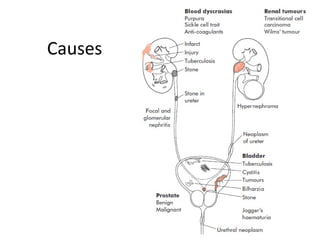
Causes
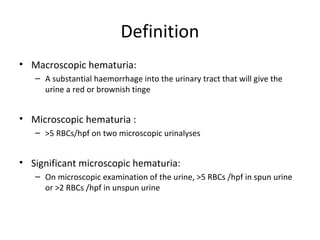
Definition
• Macroscopic hematuria:
   – A substantial haemorrhage into the urinary tract that will give the
     urine a red or brownish tinge


• Microscopic hematuria :
   – >5 RBCs/hpf on two microscopic urinalyses


• Significant microscopic hematuria:
   – On microscopic examination of the urine, >5 RBCs /hpf in spun urine
     or >2 RBCs /hpf in unspun urine
Haematuria
•   Painful or painless
•   Gross (visible to the naked eye) or microscopic
•   Initial (only at the start of the stream)
•   Terminal (only at the end of the stream)
•   Total
•   intermittent or persistent
•   Glomerular or non- glomerular (essential)
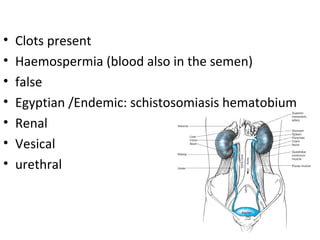
•   Clots present
•   Haemospermia (blood also in the semen)
•   false
•   Egyptian /Endemic: schistosomiasis hematobium
•   Renal
•   Vesical
•   urethral
• Blood appearing at the beginning of the urinary stream
  indicates a lower urinary tract cause, whereas uniform
  staining throughout the stream points to a cause higher up.

• Terminal haematuria is typical of severe bladder irritation
  caused stone or infection.

• If the patient experiences pain with haematuria, the
  characteristics of the pain may help to identify the source of
  the bleeding.

• If there is a malignant cause for the haematuria there is usually
  no pain.
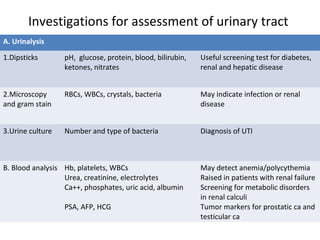
Investigations for assessment of urinary tract
A. Urinalysis

1.Dipsticks       pH, glucose, protein, blood, bilirubin,   Useful screening test for diabetes,
                  ketones, nitrates                         renal and hepatic disease


2.Microscopy      RBCs, WBCs, crystals, bacteria            May indicate infection or renal
and gram stain                                              disease


3.Urine culture   Number and type of bacteria               Diagnosis of UTI


B. Blood analysis Hb, platelets, WBCs                       May detect anemia/polycythemia
                  Urea, creatinine, electrolytes            Raised in patients with renal failure
                  Ca++, phosphates, uric acid, albumin      Screening for metabolic disorders
                                                            in renal calculi
                  PSA, AFP, HCG                             Tumor markers for prostatic ca and
                                                            testicular ca
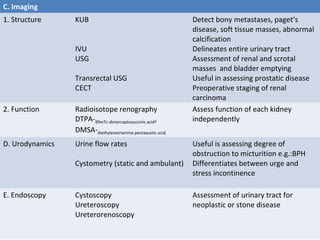
C. Imaging
1. Structure     KUB                                         Detect bony metastases, paget’s
                                                             disease, soft tissue masses, abnormal
                                                             calcification
                 IVU                                         Delineates entire urinary tract
                 USG                                         Assessment of renal and scrotal
                                                             masses and bladder emptying
                 Transrectal USG                             Useful in assessing prostatic disease
                 CECT                                        Preoperative staging of renal
                                                             carcinoma
2. Function      Radioisotope renography                     Assess function of each kidney
                 DTPA-99mTc-dimercaptosuccinic acid,         independently
                 DMSA-diethylenetriamine pentaacetic acid.
D. Urodynamics   Urine flow rates                            Useful is assessing degree of
                                                             obstruction to micturition e.g.:BPH
                 Cystometry (static and ambulant)            Differentiates between urge and
                                                             stress incontinence

E. Endoscopy     Cystoscopy                                  Assessment of urinary tract for
                 Ureteroscopy                                neoplastic or stone disease
                 Ureterorenoscopy
Differential Diagnosis of red urine
•   Hematuria
•   Hemoglobinuria/myoglobinuria
•   Anthrocyanin in beets and blackberries
•   Chronic lead and mercury poisoning
•   Phenolphthalein (in bowel evacuants)
•   Phenothiazines (e.g., Compazine)
•   Rifampin
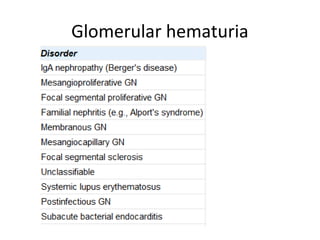
Glomerular hematuria
• The urinalysis in nonglomerular medical and
  surgical hematuria is similar in that both are
  characterized by
  – circular erythrocytes and
  – the absence of erythrocyte casts
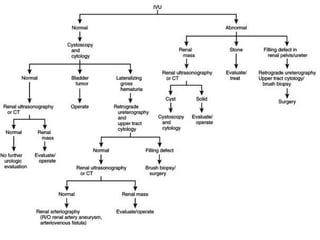
An algorithm for the evaluation of
       essential hematuria
• Is always abnormal whether microscopic or
  macroscopic
  ■ May be caused by a lesion anywhere in the urinary
  tract
  ■ Is investigated by:
• examination of midstream specimen for infection
• cytological examination of a urine specimen
• intravenous urogram and/or urinary tract ultrasound
  scan
• flexible or rigid cystoscopy

• Is commonly caused by urinary infection, especially in
  young women

Hematuria

  • 1.
    Hematuria The presence of blood/RBCs in the urine Dr. Prajwal Ghimire Origin:[hemato- [G. haima (haimat-)]+ G. ouron, urine]
  • 2.
  • 3.
    Definition • Macroscopic hematuria: – A substantial haemorrhage into the urinary tract that will give the urine a red or brownish tinge • Microscopic hematuria : – >5 RBCs/hpf on two microscopic urinalyses • Significant microscopic hematuria: – On microscopic examination of the urine, >5 RBCs /hpf in spun urine or >2 RBCs /hpf in unspun urine
  • 4.
    Haematuria • Painful or painless • Gross (visible to the naked eye) or microscopic • Initial (only at the start of the stream) • Terminal (only at the end of the stream) • Total • intermittent or persistent • Glomerular or non- glomerular (essential)
  • 5.
    Clots present • Haemospermia (blood also in the semen) • false • Egyptian /Endemic: schistosomiasis hematobium • Renal • Vesical • urethral
  • 6.
    • Blood appearingat the beginning of the urinary stream indicates a lower urinary tract cause, whereas uniform staining throughout the stream points to a cause higher up. • Terminal haematuria is typical of severe bladder irritation caused stone or infection. • If the patient experiences pain with haematuria, the characteristics of the pain may help to identify the source of the bleeding. • If there is a malignant cause for the haematuria there is usually no pain.
  • 7.
    Investigations for assessmentof urinary tract A. Urinalysis 1.Dipsticks pH, glucose, protein, blood, bilirubin, Useful screening test for diabetes, ketones, nitrates renal and hepatic disease 2.Microscopy RBCs, WBCs, crystals, bacteria May indicate infection or renal and gram stain disease 3.Urine culture Number and type of bacteria Diagnosis of UTI B. Blood analysis Hb, platelets, WBCs May detect anemia/polycythemia Urea, creatinine, electrolytes Raised in patients with renal failure Ca++, phosphates, uric acid, albumin Screening for metabolic disorders in renal calculi PSA, AFP, HCG Tumor markers for prostatic ca and testicular ca
  • 8.
    C. Imaging 1. Structure KUB Detect bony metastases, paget’s disease, soft tissue masses, abnormal calcification IVU Delineates entire urinary tract USG Assessment of renal and scrotal masses and bladder emptying Transrectal USG Useful in assessing prostatic disease CECT Preoperative staging of renal carcinoma 2. Function Radioisotope renography Assess function of each kidney DTPA-99mTc-dimercaptosuccinic acid, independently DMSA-diethylenetriamine pentaacetic acid. D. Urodynamics Urine flow rates Useful is assessing degree of obstruction to micturition e.g.:BPH Cystometry (static and ambulant) Differentiates between urge and stress incontinence E. Endoscopy Cystoscopy Assessment of urinary tract for Ureteroscopy neoplastic or stone disease Ureterorenoscopy
  • 9.
    Differential Diagnosis ofred urine • Hematuria • Hemoglobinuria/myoglobinuria • Anthrocyanin in beets and blackberries • Chronic lead and mercury poisoning • Phenolphthalein (in bowel evacuants) • Phenothiazines (e.g., Compazine) • Rifampin
  • 10.
  • 11.
    • The urinalysisin nonglomerular medical and surgical hematuria is similar in that both are characterized by – circular erythrocytes and – the absence of erythrocyte casts
  • 12.
    An algorithm forthe evaluation of essential hematuria
  • 14.
    • Is alwaysabnormal whether microscopic or macroscopic ■ May be caused by a lesion anywhere in the urinary tract ■ Is investigated by: • examination of midstream specimen for infection • cytological examination of a urine specimen • intravenous urogram and/or urinary tract ultrasound scan • flexible or rigid cystoscopy • Is commonly caused by urinary infection, especially in young women