HAEMATURIA
Dr. P. KUMAR
MS ( Surg.), FLCS, FAIS, FICS,ACME
CAME, PGDHHM ( Gold Medalist )
Associate Professor
Department of General Surgery
Dr KNS Memorial Institute of Medical Sciences, Barabanki,
U.P., Bharat
Learning Objectives
• Introduction
• Discolouration of urine
• Definition of Haematuria.
• How to approach to a case of Haematuria.
• Clinical presentation
• Investigations in the haematuria work-up.
• Effective use of lab. and Imaging
• Management of Haematuria
Urinary system
INTRODUCTION
• Haematuria occurs when there is blood in the urine.
• Now classified as - Visible Haematuria (VH) or non-visible H. (NVH).
• Haematuria is a frequent reason for physician consultation in clinical
practice upto 08-20% of Urology consultations (Messing et al., 2006).
• Patient with haematuria should be investigated regardless of
anticoagulant therapy.
• Main focus in haematuria: is tumour detection, because haematuria,
especially if it is painless, may be due to an underlying neoplasm,
usually a Bladder or Renal tumour - Urothelial cell Carcinoma or
Renal cell carcinoma (RCC).
Is it Haematuria ?
Red Coloured Urine
• Haemoglobinuria / myoglobinuria
• Anthrocyanine – Beat roots & Blackberry
• Chronic Lead & Mercury Poison
• Phenolphthalein (Laxative)
• Phenothiazine &
• Rifampicin etc.
Discoloration of the urine
• Many drugs & foodstuffs have been reported to produce abnormal
discoloration of urine. Most frequently encountered clinically are red,
orange and brown.
• Disordered Haem in urine, produces red discoloration and gives
positive dipstick test. It is seen in porphyria, may change to  brown
or purple (with exposure to sunlight).
• Red colour of urine due to haemoglobinuria – seen in haemolytic
disorders e.g. ‘March haematuria’, classically seen in dehydrated
soldiers after prolonged marching.
• Myoglobinuria caused by Rhabdomyolysis after crush injury or
Compartment syndrome, also produces red discolouration.
Discoloration of the urine (Contd.)
• Several medications cause red / orange discoloration e.g. Rifampicin,
Isoniazid or Phenazopyridine. Others include - Chlorpromazine,
Thioridazine, Senna & Phenolphthalein laxatives.
• Consumption of large quantities of Beet root results in red
discoloration of urine, due to excretion of Betacyanin pigments.
• Commonly used antibiotics e.g. Nitrofurantoin & Metronidazole lead
to brown urine.
• Brown urine, due to Hyper-Bilirubinaemia is a feature of Obstructive
jaundice.
Definition
• Haematuria occurs – “when there is blood in
the urine”.
• Now classified as - Visible Haematuria (VH) or
non-visible H. (NVH).
• Gross Haematuria: (VH) visible to the human
eye (Red Urine)
• Microscopic Haematuria (NVH): >
3 RBC / HPF from 2 of 3 urinary sediments
without UTI / Menstruation on microscopy
(Grossfeld, 2001) - Rule out Urethral bleed.
• Photo: arrows point to WBCs surrounded by
monomorphic RBCs. 
Definition of positivity
• Urine dipstick Test: is sensitive to detect haematuria (if done in fresh
voided urine sample, without preservative).
• Urine R/M - for confirmation of dipstick haematuria is not necessary.
• Significant haematuria > or = 1+ (Trace haematuria considered – ve)
What is significant haematuria?
• a) Any single episode of VH.
• b) Persistent NVH (in absence of UTI or other transient causes).
*Persistence is defined as 2 out of 3 dipsticks positive for NVH.
Transient causes to be excluded
• UTI - A negative dipstick result for both leucocytes and nitrites.
• MSU negative for pyuria and culture.
• Exercise induced haematuria
• Menstruation.
• Rarely Myoglobinuria
Classification
l . CLINICAL
• Gross Haematuria
• Frankly bloody H.
• Macroscopic H.
• Red urine
• Microscopic H.
Il PATHO-PHYSIOLOGICAL
• Glomerular Haematuria
• Non-Glomerular H.
How to confirm Diagnosis ?
1. Gross Inspection 
2. Haematuria grading scale
How to confirm Diagnosis ?
3. Urine Dipstick test : 
• High false positive, so needs
confirmation by M/E
4. Urine microscopic
examination: Gold standard
• Crenated R.B.C.s can be seen
on Urine sediment
microscopy 
AETIOLOGY
Causes of haematuria include –
• Trauma (T) – Blunt injury abdomen, Run over accident
• Infection (I) – Pyelonephritis, Cystitis, urethritis
• Neoplasm (N) - anywhere in the urinary tract: chiefly Urothelial.
• Stones (S) – Mainly Oxalate
Other causes:
• Vascular
• Glomerular
• Interstitial disorders etc.
AETIOLOGY
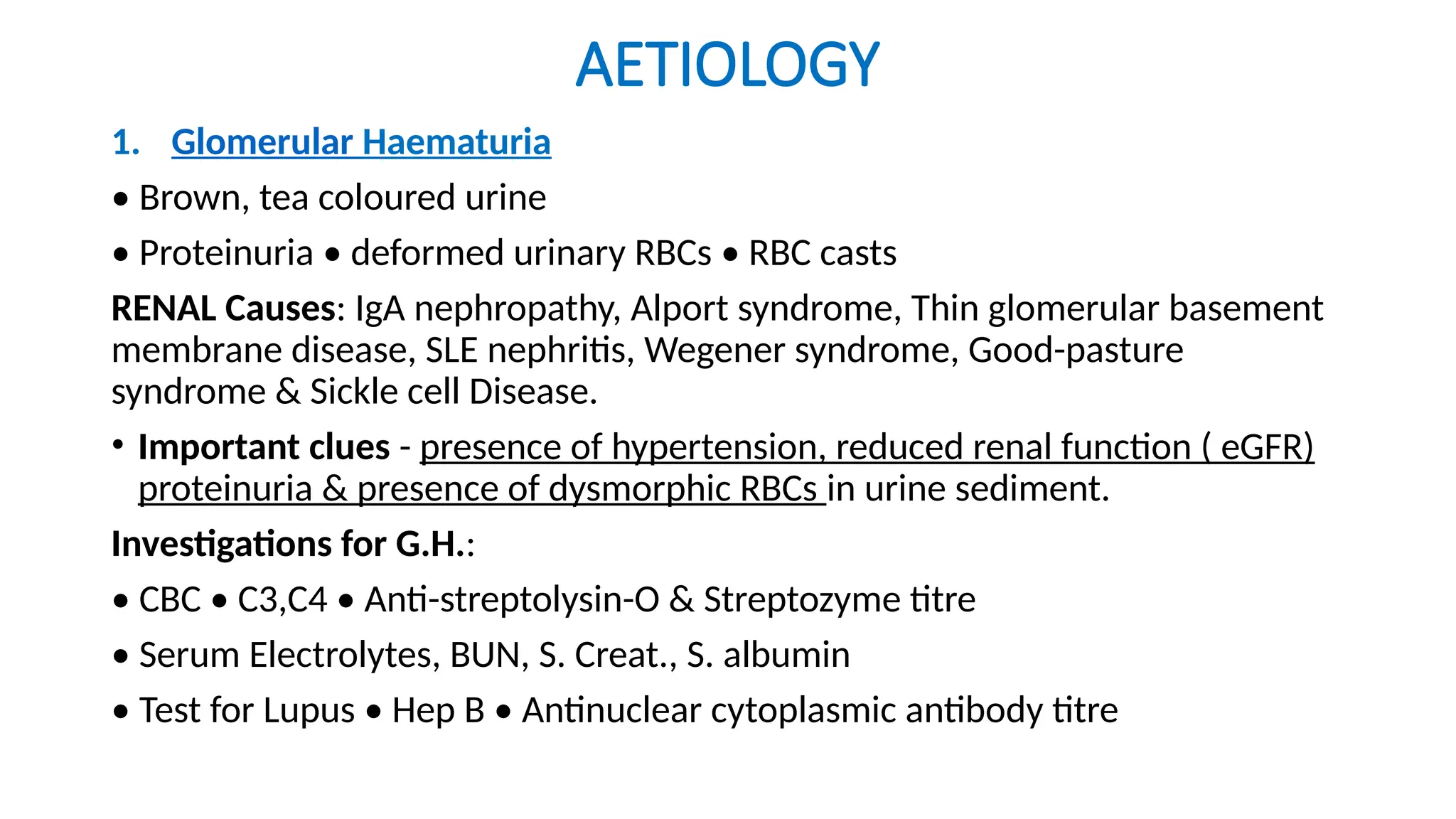
1. Glomerular Haematuria
• Brown, tea coloured urine
• Proteinuria • deformed urinary RBCs • RBC casts
RENAL Causes: IgA nephropathy, Alport syndrome, Thin glomerular basement
membrane disease, SLE nephritis, Wegener syndrome, Good-pasture
syndrome & Sickle cell Disease.
• Important clues - presence of hypertension, reduced renal function ( eGFR)
proteinuria & presence of dysmorphic RBCs in urine sediment.
Investigations for G.H.:
• CBC • C3,C4 • Anti-streptolysin-O & Streptozyme titre
• Serum Electrolytes, BUN, S. Creat., S. albumin
• Test for Lupus • Hep B • Antinuclear cytoplasmic antibody titre
2. Extra-glomerular Haematuria
• Haematuria from Upper urinary tract - Pyelonephritis, Papillary necrosis,
Nephro-calcinosis, Renal calculi esp. Oxalate stones, PUJ obstruction,
Uretero-cele & Munchausen disease
• Haematuria from Lower urinary tract – Cystitis, urethritis, Urolithiasis,
trauma, coagulopathy & heavy exercise.
• Terminal haematuria – Prostatitis, B.P.H. & Bladder neck diseases.
Nephrological referral
• Declining GFR (by > 10ml /min at any stage in last 5 years or by >
5ml /min within the last 1 year)
• Stage 4 or 5 CKD (e GFR < 30 ml/min) • Significant proteinuria
• Isolated haematuria with hypertension in those aged <40.
• Visible haematuria coinciding with inter-current URTI
Clinical presentation
History
• Severity –Mild, Moderate, Severe Haematuria - Brisk
• Associated with Symptoms (Pain- Dysuria) / Painless* (Could be malignant)
• Initial, Total or Terminal Haematuria
• Classic triad of Renal tumour - haematuria associated with loin pain and
palpable loin mass. Seen in < 10% patients.
• Genitourinary TB - haema­
turia associated with dysuria & frequency due to
bladder infection.
• Filariasis of retro-peritoneal lymphatics - haematuria is intermittent, often
lasting months or years and is associated with ‘milky’ or cloudy urine, the
condition is called Chyluria.
How to approach to a case of Haematuria
• Enquire about:
1. Timing of blood in relation to urinary stream -
• initial  Urethral pathology
• throughout the stream  Bladder or Upper Urinary tract
• terminal  Bladder neck or Prostatic pathology
2. Degree of haematuria and
3. Its frequency.
RED FLAGS: Risk factors for malignancy
• Smoking history
• Occupational exposure to chemicals or dyes
• Exposure to - Benzenes or Aromatic amines – Industrial worker
• History of gross haematuria
• Age – 50 years or Older
• History of urologic disorder or disease (not simple UTIs)
• History of persistent irritative voiding symptoms
• History of recurrent or chronic UTI
• Analgesic abuse
• History of Pelvic irradiation
*Source: Urology 2001;57(4)
Physical Examination
Vitals
Symptoms & signs
• Fever ? Infection (Pyelonephritis); HTN? (Glomerulonephritis)
• Heart: New murmur? (Endocarditis)
• Lungs: Crackles, Rhonchi ? (Good-pasture’s syndrome)
• Abdomen: Masses? (Cancer, Obstruction), Bruits? (Renal Ischemia)
• Extremities: Oedema? (Glomerulonephritis), Rashes? (HSP, CTD, SLE)
• Rectal: BPH? Nodules, Hard ? (CA Prostate),
• Tenderness present - (Prostatitis, Endometriosis)
INVESTIGATIONS
• Haematuria requires detailed investigation in almost all cases.
• Except young women with a proven UTI.
• Investigations include –
1. Laboratory studies
2. Imaging studies
3. Ultrasound scan (USS) of KUB (kidneys–ureters– bladder) and
4. Additional contrast imaging, if needed.
INVESTIGATIONS
5. Cystoscopy: Mandatory
(If no aetiology found on lab. / imaging studies).
• BPH can cause haematuria in older men, this diagnosis to be made
after exclusion of all other causes.
• Cancer detection rate depends on degree of haematuria,
• Approx. 20% in patients with VH but
• Much lower in those with NVH (<5%).
Laboratory Diagnosis of Haematuria
Urinalysis : Most urine samples are early morning urine, for analysis of
corpuscular elements, the “second morning urine” is more suitable and
recommended.
• Analysis should follow rapidly, preferably within 1 hour for sediment
analysis and 2 hours for dipstick testing.
Urine Cytology • Sensitivity of urine cytology for diagnosis of
urothelial CA is low and
• Negative result does not stop further testing (Rodgers et al., 2006].
• Urine cytology in hematuria does not contribute to diagnosis [Hovius
et al., 2008], which is usually made by cystoscopy or imaging.
Laboratory Diagnosis of Haematuria
Urine Culture - may be indicated if the sediment shows leukocytes.
Clinical Chemistry - Important to support a nephrologic diagnosis
• KFT • Coagulation profile
Cystoscopy - Flexible cystoscopy remains Gold standard for diagnosis
• Bladder Imaging to precede cystoscopy  improves diagnostic yield.
Uretero-Renoscopy
• Upper tract gross haematuria
• Unilateral haematuria
• Urothelial tumours of upper tract if imaging inconclusive & cytology
is negative.
IMAGING: Radiologic Diagnosis
Abdominal Radiographs • Overall sensitivity for renal and ureteral
stones is only 45–60% in multiple studies (Ege et al., 2004)
Ultrasound - suitable as first-line diagnostic test
• USG showed higher sensitivity for bladder tumours & upper urinary
tract tumours, in comparison with Excretory Urography.
• Ultrasound alone is not sensitive (19–32%) for stone detection,
Left Renal calculus Right Renal tumour
IMAGING (Contd.)
Excretory Urography ( IVU) 
• Low sensitivity (< 60%) for
renal tumours < 3 cm
• Hence, CT urography is
superior to Excretory
Urography.
Retrograde Uretero-
pyelography - with increasing
use of MDCT urography and
uretero-renoscopy, its role has
diminished significantly.
Computerized Tomography Scan
Non-contrast CT - Now reference standard for stone detection
• Even very-low-dose NCCT with radiation dose comparable to that of
abdominal radiographs have shown better results (Kluner et al. 2006).
CT Urography - For haematuria, overall sensitivity is 92–100% &
specificity is 89–97% (Albani et al.,2007 & Sudakoff et al., 2008)
Radiation Exposure:
• KUB = 0.2–0.7 mSv, CTKUB = 2–3 mSv, CTU = 9-16 mSv ;
• Therefore, use of CT urography should be justified by weighing
benefits versus risks and CT urography protocols should be optimized
to radiation dose.
Non-contrast computed tomography scan
demonstrating (a) bilateral renal calculi (b) Left ureteric calculus
IMAGING (Contd.)
MR Urography (MRU) -
• Advantages: it does not require ionizing radiation, has a high
contrast resolution, has good sensitivity for contrast media and
better tissue characterization than other imaging techniques.
• It is good for paediatric diseases and for evaluation of obstructive
disease (Silverman et al., 2009)
• Disadvantage: costly, technically demanding & not widely practiced.
MRU expertise is available only in specific dedicated centers.
Urology stack 
from top to down: (a) Monitor, (b) Laparoscopy Insufflator for CO2,
(c) Camera connector, (d) Light source (e) Video recording device.
Flexible cystoscope
CYSTOSCOPY
Management
Principles:
• ABC….
• Assessment & Initial Tt
Resuscitation & Bleeding control
• Be aware of Causes
Establishment of Diagnosis
• Cure - Definitive Treatment
Management
Assessment : Initial Treatment
• Severe - Haemorrhagic Shock  Resuscitation
• Restoration of Blood Volume - I.V. Fluid - (Crystalloids/Colloids)
• Blood Component Transfusion
Base line lab. Tests :
• Hb%, Hematocrit, Renal function – S. Creatinine
• Bleeding Diathesis : BT / CT, PT /PC, INR
• Activated Thromboplastin Time , Platelet Count, etc.
• Blood Cross match
Conservative Treatment
Bleeding Control -
Haemostyptics:
• Ethamsylate : Capillary Hge., 250 - 500 mg TDS, IV /Oral
• Tranexamic : Acid activation of Plasminogen, 500 – 1000 mg TDS
• Adrenochrome : Oxidised product of Adrenaline, 10 - 20 mg / day
• Botropase : Venom based, 1ml SOS, upto 2 to 3 times / day
• Various Combinations
Antibiotics
Assurance & Anxiolytics
I. V. Fluid
Catheterization (If Retention present) +- Bladder Irrigation
Be aware of Causes:
Establishment of Diagnosis
CAUSES:
1. Medical 2. Surgical / Urological
Medical:
1. Drugs 2. Bleeding Diathesis
3. Nephrolgical
• Glomerular - Cast, Proteinurea,
Dysmorphic RBCs.
• Tubulo-interstitial - Uniform round RBCs
Photo: Glomerular - Casts and
Dysmorphic RBCs (arrow) 
Surgical / Urological
• Tumour – Renal, Ureter ,Bladder,
Prostate
• Trauma- Iatrogenic, External
• Stone - KUB
• Infection - Tuberculosis, Filariasis,
Non-specific infections
• Vascular- Renal artery embolism,
Thrombosis, A. V. fistula
• Congenital- Adult Polycystic Kidney,
P.U.J. Obstuction
Investigation of Choice for Select conditions
• USG - Stone, Mass
• CECT - RCC, Polycystic Kidney, Trauma
• IVU ? - TB, TCC Upper tract
• RGU / Cystoscopy - Bladder Lesion
• Ureteroscopy - Ureter and calyx
• Renal Angiography - Vascular Causes
Cure –Definitive Treatment of Disease
1. Trauma – Conservative management first
• - Surgical Mgt. – Nephrectomy – Partial / Total
2. Infection – Plenty of fluids orally, Antibiotics: Initially Empirical
• - According to Urine C/S
3. Stone – If < 5 mm - Plenty of fluids orally
• - If > 5 – 10 mm - Analgesics, Tamsulosin, Syp. Stone 1 B6
• - If > 10 mm – Surgical Mgt. – ESWL, PCNL, URL, Lithotomy
4. Tumour –
• Renal: Partial or Total Nephrectomy
• Urinary Bladder: Trans – Urethral Resection of Prostate (TURBT)
TURBT
Take home message
Confirm Haematuria
• Positive Dipsticks for blood should get microscopic confirmation
• Review Urethral Bleeding
Assessment and Initial Management:
• Resuscitation & Control Bleeding
Beware of Causes : Establish diagnosis
• Top 3 Suspects are: Infection, Stones and Tumor.
• Proper evaluation, to establish cause & site of Bleeding is mandatory
Cure –Definitive Treatment of Disease
References
• Schwartz principles of Surgery (9th edition).
• Bailey & Love ; Short practice of Surgery (28th edition).
• Beers MH, et al., Merck Manual of Diagnosis and Therapy (18th print)
• Cohen RA and Brown RS, “Microscopic Hematuria,” New England
Journal of Medicine, 348:23, 5 June 2003.
• Grossfeld GD, et al., “Evaluation of asymptomatic microscopic
hematuria in adults: the American Urological Association best practice
policy recommendations. Part II: patient evaluation, cytology,
• Schrute D, “Beets and Urine” Pennsylvania Beet Farms, vol. 3, no. 6.
Presence of Blood in Urine or HAEMATURIA.pptx

Presence of Blood in Urine or HAEMATURIA.pptx

  • 1.
    HAEMATURIA Dr. P. KUMAR MS( Surg.), FLCS, FAIS, FICS,ACME CAME, PGDHHM ( Gold Medalist ) Associate Professor Department of General Surgery Dr KNS Memorial Institute of Medical Sciences, Barabanki, U.P., Bharat
  • 2.
    Learning Objectives • Introduction •Discolouration of urine • Definition of Haematuria. • How to approach to a case of Haematuria. • Clinical presentation • Investigations in the haematuria work-up. • Effective use of lab. and Imaging • Management of Haematuria
  • 3.
  • 4.
    INTRODUCTION • Haematuria occurswhen there is blood in the urine. • Now classified as - Visible Haematuria (VH) or non-visible H. (NVH). • Haematuria is a frequent reason for physician consultation in clinical practice upto 08-20% of Urology consultations (Messing et al., 2006). • Patient with haematuria should be investigated regardless of anticoagulant therapy. • Main focus in haematuria: is tumour detection, because haematuria, especially if it is painless, may be due to an underlying neoplasm, usually a Bladder or Renal tumour - Urothelial cell Carcinoma or Renal cell carcinoma (RCC).
  • 5.
    Is it Haematuria? Red Coloured Urine • Haemoglobinuria / myoglobinuria • Anthrocyanine – Beat roots & Blackberry • Chronic Lead & Mercury Poison • Phenolphthalein (Laxative) • Phenothiazine & • Rifampicin etc.
  • 6.
    Discoloration of theurine • Many drugs & foodstuffs have been reported to produce abnormal discoloration of urine. Most frequently encountered clinically are red, orange and brown. • Disordered Haem in urine, produces red discoloration and gives positive dipstick test. It is seen in porphyria, may change to  brown or purple (with exposure to sunlight). • Red colour of urine due to haemoglobinuria – seen in haemolytic disorders e.g. ‘March haematuria’, classically seen in dehydrated soldiers after prolonged marching. • Myoglobinuria caused by Rhabdomyolysis after crush injury or Compartment syndrome, also produces red discolouration.
  • 7.
    Discoloration of theurine (Contd.) • Several medications cause red / orange discoloration e.g. Rifampicin, Isoniazid or Phenazopyridine. Others include - Chlorpromazine, Thioridazine, Senna & Phenolphthalein laxatives. • Consumption of large quantities of Beet root results in red discoloration of urine, due to excretion of Betacyanin pigments. • Commonly used antibiotics e.g. Nitrofurantoin & Metronidazole lead to brown urine. • Brown urine, due to Hyper-Bilirubinaemia is a feature of Obstructive jaundice.
  • 8.
    Definition • Haematuria occurs– “when there is blood in the urine”. • Now classified as - Visible Haematuria (VH) or non-visible H. (NVH). • Gross Haematuria: (VH) visible to the human eye (Red Urine) • Microscopic Haematuria (NVH): > 3 RBC / HPF from 2 of 3 urinary sediments without UTI / Menstruation on microscopy (Grossfeld, 2001) - Rule out Urethral bleed. • Photo: arrows point to WBCs surrounded by monomorphic RBCs. 
  • 9.
    Definition of positivity •Urine dipstick Test: is sensitive to detect haematuria (if done in fresh voided urine sample, without preservative). • Urine R/M - for confirmation of dipstick haematuria is not necessary. • Significant haematuria > or = 1+ (Trace haematuria considered – ve) What is significant haematuria? • a) Any single episode of VH. • b) Persistent NVH (in absence of UTI or other transient causes). *Persistence is defined as 2 out of 3 dipsticks positive for NVH.
  • 10.
    Transient causes tobe excluded • UTI - A negative dipstick result for both leucocytes and nitrites. • MSU negative for pyuria and culture. • Exercise induced haematuria • Menstruation. • Rarely Myoglobinuria
  • 11.
    Classification l . CLINICAL •Gross Haematuria • Frankly bloody H. • Macroscopic H. • Red urine • Microscopic H. Il PATHO-PHYSIOLOGICAL • Glomerular Haematuria • Non-Glomerular H.
  • 12.
    How to confirmDiagnosis ? 1. Gross Inspection  2. Haematuria grading scale
  • 13.
    How to confirmDiagnosis ? 3. Urine Dipstick test :  • High false positive, so needs confirmation by M/E 4. Urine microscopic examination: Gold standard • Crenated R.B.C.s can be seen on Urine sediment microscopy 
  • 14.
    AETIOLOGY Causes of haematuriainclude – • Trauma (T) – Blunt injury abdomen, Run over accident • Infection (I) – Pyelonephritis, Cystitis, urethritis • Neoplasm (N) - anywhere in the urinary tract: chiefly Urothelial. • Stones (S) – Mainly Oxalate Other causes: • Vascular • Glomerular • Interstitial disorders etc.
  • 15.
    AETIOLOGY 1. Glomerular Haematuria •Brown, tea coloured urine • Proteinuria • deformed urinary RBCs • RBC casts RENAL Causes: IgA nephropathy, Alport syndrome, Thin glomerular basement membrane disease, SLE nephritis, Wegener syndrome, Good-pasture syndrome & Sickle cell Disease. • Important clues - presence of hypertension, reduced renal function ( eGFR) proteinuria & presence of dysmorphic RBCs in urine sediment. Investigations for G.H.: • CBC • C3,C4 • Anti-streptolysin-O & Streptozyme titre • Serum Electrolytes, BUN, S. Creat., S. albumin • Test for Lupus • Hep B • Antinuclear cytoplasmic antibody titre
  • 16.
    2. Extra-glomerular Haematuria •Haematuria from Upper urinary tract - Pyelonephritis, Papillary necrosis, Nephro-calcinosis, Renal calculi esp. Oxalate stones, PUJ obstruction, Uretero-cele & Munchausen disease • Haematuria from Lower urinary tract – Cystitis, urethritis, Urolithiasis, trauma, coagulopathy & heavy exercise. • Terminal haematuria – Prostatitis, B.P.H. & Bladder neck diseases. Nephrological referral • Declining GFR (by > 10ml /min at any stage in last 5 years or by > 5ml /min within the last 1 year) • Stage 4 or 5 CKD (e GFR < 30 ml/min) • Significant proteinuria • Isolated haematuria with hypertension in those aged <40. • Visible haematuria coinciding with inter-current URTI
  • 17.
    Clinical presentation History • Severity–Mild, Moderate, Severe Haematuria - Brisk • Associated with Symptoms (Pain- Dysuria) / Painless* (Could be malignant) • Initial, Total or Terminal Haematuria • Classic triad of Renal tumour - haematuria associated with loin pain and palpable loin mass. Seen in < 10% patients. • Genitourinary TB - haema­ turia associated with dysuria & frequency due to bladder infection. • Filariasis of retro-peritoneal lymphatics - haematuria is intermittent, often lasting months or years and is associated with ‘milky’ or cloudy urine, the condition is called Chyluria.
  • 18.
    How to approachto a case of Haematuria • Enquire about: 1. Timing of blood in relation to urinary stream - • initial  Urethral pathology • throughout the stream  Bladder or Upper Urinary tract • terminal  Bladder neck or Prostatic pathology 2. Degree of haematuria and 3. Its frequency.
  • 19.
    RED FLAGS: Riskfactors for malignancy • Smoking history • Occupational exposure to chemicals or dyes • Exposure to - Benzenes or Aromatic amines – Industrial worker • History of gross haematuria • Age – 50 years or Older • History of urologic disorder or disease (not simple UTIs) • History of persistent irritative voiding symptoms • History of recurrent or chronic UTI • Analgesic abuse • History of Pelvic irradiation *Source: Urology 2001;57(4)
  • 20.
    Physical Examination Vitals Symptoms &signs • Fever ? Infection (Pyelonephritis); HTN? (Glomerulonephritis) • Heart: New murmur? (Endocarditis) • Lungs: Crackles, Rhonchi ? (Good-pasture’s syndrome) • Abdomen: Masses? (Cancer, Obstruction), Bruits? (Renal Ischemia) • Extremities: Oedema? (Glomerulonephritis), Rashes? (HSP, CTD, SLE) • Rectal: BPH? Nodules, Hard ? (CA Prostate), • Tenderness present - (Prostatitis, Endometriosis)
  • 21.
    INVESTIGATIONS • Haematuria requiresdetailed investigation in almost all cases. • Except young women with a proven UTI. • Investigations include – 1. Laboratory studies 2. Imaging studies 3. Ultrasound scan (USS) of KUB (kidneys–ureters– bladder) and 4. Additional contrast imaging, if needed.
  • 22.
    INVESTIGATIONS 5. Cystoscopy: Mandatory (Ifno aetiology found on lab. / imaging studies). • BPH can cause haematuria in older men, this diagnosis to be made after exclusion of all other causes. • Cancer detection rate depends on degree of haematuria, • Approx. 20% in patients with VH but • Much lower in those with NVH (<5%).
  • 23.
    Laboratory Diagnosis ofHaematuria Urinalysis : Most urine samples are early morning urine, for analysis of corpuscular elements, the “second morning urine” is more suitable and recommended. • Analysis should follow rapidly, preferably within 1 hour for sediment analysis and 2 hours for dipstick testing. Urine Cytology • Sensitivity of urine cytology for diagnosis of urothelial CA is low and • Negative result does not stop further testing (Rodgers et al., 2006]. • Urine cytology in hematuria does not contribute to diagnosis [Hovius et al., 2008], which is usually made by cystoscopy or imaging.
  • 24.
    Laboratory Diagnosis ofHaematuria Urine Culture - may be indicated if the sediment shows leukocytes. Clinical Chemistry - Important to support a nephrologic diagnosis • KFT • Coagulation profile Cystoscopy - Flexible cystoscopy remains Gold standard for diagnosis • Bladder Imaging to precede cystoscopy  improves diagnostic yield. Uretero-Renoscopy • Upper tract gross haematuria • Unilateral haematuria • Urothelial tumours of upper tract if imaging inconclusive & cytology is negative.
  • 25.
    IMAGING: Radiologic Diagnosis AbdominalRadiographs • Overall sensitivity for renal and ureteral stones is only 45–60% in multiple studies (Ege et al., 2004) Ultrasound - suitable as first-line diagnostic test • USG showed higher sensitivity for bladder tumours & upper urinary tract tumours, in comparison with Excretory Urography. • Ultrasound alone is not sensitive (19–32%) for stone detection,
  • 26.
    Left Renal calculusRight Renal tumour
  • 27.
    IMAGING (Contd.) Excretory Urography( IVU)  • Low sensitivity (< 60%) for renal tumours < 3 cm • Hence, CT urography is superior to Excretory Urography. Retrograde Uretero- pyelography - with increasing use of MDCT urography and uretero-renoscopy, its role has diminished significantly.
  • 28.
    Computerized Tomography Scan Non-contrastCT - Now reference standard for stone detection • Even very-low-dose NCCT with radiation dose comparable to that of abdominal radiographs have shown better results (Kluner et al. 2006). CT Urography - For haematuria, overall sensitivity is 92–100% & specificity is 89–97% (Albani et al.,2007 & Sudakoff et al., 2008) Radiation Exposure: • KUB = 0.2–0.7 mSv, CTKUB = 2–3 mSv, CTU = 9-16 mSv ; • Therefore, use of CT urography should be justified by weighing benefits versus risks and CT urography protocols should be optimized to radiation dose.
  • 29.
    Non-contrast computed tomographyscan demonstrating (a) bilateral renal calculi (b) Left ureteric calculus
  • 30.
    IMAGING (Contd.) MR Urography(MRU) - • Advantages: it does not require ionizing radiation, has a high contrast resolution, has good sensitivity for contrast media and better tissue characterization than other imaging techniques. • It is good for paediatric diseases and for evaluation of obstructive disease (Silverman et al., 2009) • Disadvantage: costly, technically demanding & not widely practiced. MRU expertise is available only in specific dedicated centers.
  • 32.
    Urology stack  fromtop to down: (a) Monitor, (b) Laparoscopy Insufflator for CO2, (c) Camera connector, (d) Light source (e) Video recording device. Flexible cystoscope
  • 33.
  • 34.
    Management Principles: • ABC…. • Assessment& Initial Tt Resuscitation & Bleeding control • Be aware of Causes Establishment of Diagnosis • Cure - Definitive Treatment
  • 35.
    Management Assessment : InitialTreatment • Severe - Haemorrhagic Shock  Resuscitation • Restoration of Blood Volume - I.V. Fluid - (Crystalloids/Colloids) • Blood Component Transfusion Base line lab. Tests : • Hb%, Hematocrit, Renal function – S. Creatinine • Bleeding Diathesis : BT / CT, PT /PC, INR • Activated Thromboplastin Time , Platelet Count, etc. • Blood Cross match
  • 36.
    Conservative Treatment Bleeding Control- Haemostyptics: • Ethamsylate : Capillary Hge., 250 - 500 mg TDS, IV /Oral • Tranexamic : Acid activation of Plasminogen, 500 – 1000 mg TDS • Adrenochrome : Oxidised product of Adrenaline, 10 - 20 mg / day • Botropase : Venom based, 1ml SOS, upto 2 to 3 times / day • Various Combinations Antibiotics Assurance & Anxiolytics I. V. Fluid Catheterization (If Retention present) +- Bladder Irrigation
  • 37.
    Be aware ofCauses: Establishment of Diagnosis CAUSES: 1. Medical 2. Surgical / Urological Medical: 1. Drugs 2. Bleeding Diathesis 3. Nephrolgical • Glomerular - Cast, Proteinurea, Dysmorphic RBCs. • Tubulo-interstitial - Uniform round RBCs Photo: Glomerular - Casts and Dysmorphic RBCs (arrow) 
  • 38.
    Surgical / Urological •Tumour – Renal, Ureter ,Bladder, Prostate • Trauma- Iatrogenic, External • Stone - KUB • Infection - Tuberculosis, Filariasis, Non-specific infections • Vascular- Renal artery embolism, Thrombosis, A. V. fistula • Congenital- Adult Polycystic Kidney, P.U.J. Obstuction
  • 39.
    Investigation of Choicefor Select conditions • USG - Stone, Mass • CECT - RCC, Polycystic Kidney, Trauma • IVU ? - TB, TCC Upper tract • RGU / Cystoscopy - Bladder Lesion • Ureteroscopy - Ureter and calyx • Renal Angiography - Vascular Causes
  • 42.
    Cure –Definitive Treatmentof Disease 1. Trauma – Conservative management first • - Surgical Mgt. – Nephrectomy – Partial / Total 2. Infection – Plenty of fluids orally, Antibiotics: Initially Empirical • - According to Urine C/S 3. Stone – If < 5 mm - Plenty of fluids orally • - If > 5 – 10 mm - Analgesics, Tamsulosin, Syp. Stone 1 B6 • - If > 10 mm – Surgical Mgt. – ESWL, PCNL, URL, Lithotomy 4. Tumour – • Renal: Partial or Total Nephrectomy • Urinary Bladder: Trans – Urethral Resection of Prostate (TURBT)
  • 43.
  • 44.
    Take home message ConfirmHaematuria • Positive Dipsticks for blood should get microscopic confirmation • Review Urethral Bleeding Assessment and Initial Management: • Resuscitation & Control Bleeding Beware of Causes : Establish diagnosis • Top 3 Suspects are: Infection, Stones and Tumor. • Proper evaluation, to establish cause & site of Bleeding is mandatory Cure –Definitive Treatment of Disease
  • 45.
    References • Schwartz principlesof Surgery (9th edition). • Bailey & Love ; Short practice of Surgery (28th edition). • Beers MH, et al., Merck Manual of Diagnosis and Therapy (18th print) • Cohen RA and Brown RS, “Microscopic Hematuria,” New England Journal of Medicine, 348:23, 5 June 2003. • Grossfeld GD, et al., “Evaluation of asymptomatic microscopic hematuria in adults: the American Urological Association best practice policy recommendations. Part II: patient evaluation, cytology, • Schrute D, “Beets and Urine” Pennsylvania Beet Farms, vol. 3, no. 6.