Non Specific UTINon Specific UTI
05/02/1605/02/16 Urology DepartmentUrology Department 22
 U.T.I:U.T.I: AAn inflammation of then inflammation of the
urothelium due to invadingurothelium due to invading
organism.organism.
 Bacteruria: presence of bacterialBacteruria: presence of bacterial
colonization in urinecolonization in urine
 Pyuria: presence of > 3 WBC / H.P.F.Pyuria: presence of > 3 WBC / H.P.F.
 Sterile pyuria: presence of pyuriaSterile pyuria: presence of pyuria
without bacteruria.without bacteruria.
05/02/1605/02/16 Urology DepartmentUrology Department 44
1.1. First documented UTIFirst documented UTI
1.1. Unresolved UTI: failure to eradicateUnresolved UTI: failure to eradicate
bacteria due to:bacteria due to:
1- Bacterial resistance.1- Bacterial resistance.
2- Mixed infection.2- Mixed infection.
3- Persistent source of inf.3- Persistent source of inf.
Classification of U.T.IClassification of U.T.I
Recurrent UTIRecurrent UTI
1-Reinfections1-Reinfections
2-Persistent organism2-Persistent organism
 Reinfection:Reinfection: recurrent U.T.I. afterrecurrent U.T.I. after
sterilization of urine due to infectionsterilization of urine due to infection
with different organism from outsidewith different organism from outside
urinary tract.urinary tract.
 Bacterial persistence:Bacterial persistence: recurrent U.T.Irecurrent U.T.I
after sterilization of urine by theafter sterilization of urine by the
same organism from focus insidesame organism from focus inside
urinary tract. e.g. infection stone.urinary tract. e.g. infection stone.
05/02/1605/02/16 Urology DepartmentUrology Department 77
 High renal vascularity.High renal vascularity.
 Competent ureterovesical junction.Competent ureterovesical junction.
 U.B. evacuation without residual urine.U.B. evacuation without residual urine.
Protective FactorsProtective Factors
 Antimicrobial properties of urine:Antimicrobial properties of urine:
1- Urinary antibodies1- Urinary antibodies
2- Acidic urine2- Acidic urine
3- High osmolarity surface mucin.3- High osmolarity surface mucin.
05/02/1605/02/16 Urology DepartmentUrology Department 99
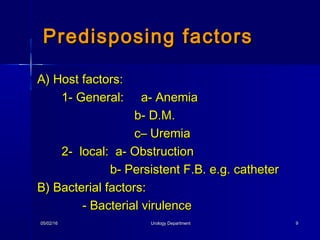
A) Host factors:A) Host factors:
1- General: a- Anemia1- General: a- Anemia
b- D.M.b- D.M.
c– Uremiac– Uremia
2- local: a- Obstruction2- local: a- Obstruction
b- Persistent F.B. e.g. catheterb- Persistent F.B. e.g. catheter
B) Bacterial factors:B) Bacterial factors:
- Bacterial virulence- Bacterial virulence
Predisposing factorsPredisposing factors
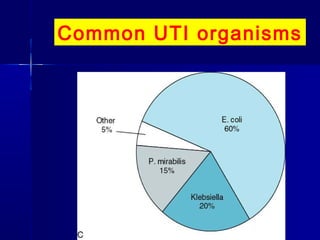
Common UTI organisms
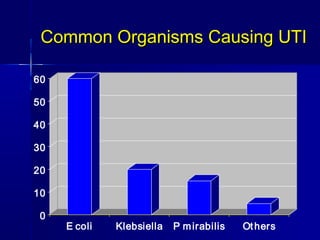
Common Organisms Causing UTICommon Organisms Causing UTI
0
10
20
30
40
50
60
E coli Klebsiella P mirabilis Others
05/02/1605/02/16 Urology DepartmentUrology Department 1212
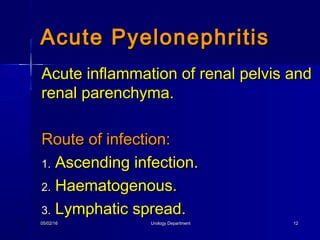
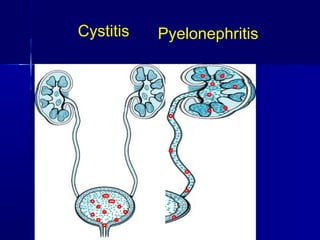
Acute inflammation of renal pelvis andAcute inflammation of renal pelvis and
renal parenchyma.renal parenchyma.
Route of infection:Route of infection:
1.1. Ascending infection.Ascending infection.
2.2. Haematogenous.Haematogenous.
3.3. Lymphatic spread.Lymphatic spread.
Acute PyelonephritisAcute Pyelonephritis
PyelonephritisCystitis
05/02/1605/02/16 Urology DepartmentUrology Department 1414
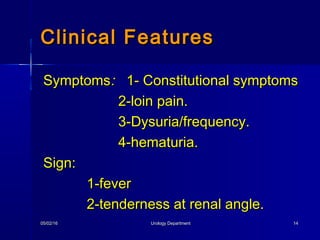
SymptomsSymptoms:: 1- Constitutional symptoms1- Constitutional symptoms
2-loin pain.2-loin pain.
3-Dysuria/frequency.3-Dysuria/frequency.
4-hematuria.4-hematuria.
Sign:Sign:
1-fever1-fever
2-tenderness at renal angle.2-tenderness at renal angle.
Clinical FeaturesClinical Features
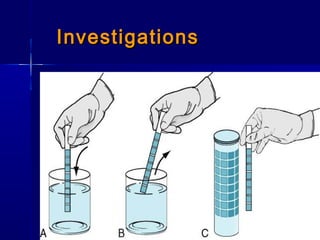
InvestigationsInvestigations
05/02/1605/02/16 Urology DepartmentUrology Department 1616
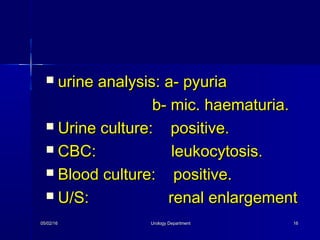
 urine analysis: a- pyuriaurine analysis: a- pyuria
b- mic. haematuria.b- mic. haematuria.
 Urine culture: positive.Urine culture: positive.
 CBC: leukocytosis.CBC: leukocytosis.
 Blood culture: positive.Blood culture: positive.
 U/S: renal enlargementU/S: renal enlargement
05/02/1605/02/16 Urology DepartmentUrology Department 1717
Approximately 25% require hospitalizationApproximately 25% require hospitalization
1.1. Bed rest- I.V. fluidsBed rest- I.V. fluids
2.2. Analgesic-Antipyretic.Analgesic-Antipyretic.
3.3. Empiric therapy with intravenousEmpiric therapy with intravenous
ampicillin and aminoglycosides or aampicillin and aminoglycosides or a
third generation cephalosporinthird generation cephalosporin
TreatmentTreatment
Perinephric AbscessPerinephric Abscess
Accumulation of pus in the perinephricAccumulation of pus in the perinephric
space within Gerota’s fascia.space within Gerota’s fascia.
Route of infectionRoute of infection::
1- Haematogenous spread1- Haematogenous spread
2- Direct spread from renal infection2- Direct spread from renal infection
-Acute flank pain.Acute flank pain.
-- Fever.- Fever.
- Anorexia, nausea and vomiting.- Anorexia, nausea and vomiting.
- Skin oedema,- Skin oedema,
- Loin swelling,- Loin swelling,
- Scoliosis- Scoliosis
- Symptoms of cystitis (in 50%).- Symptoms of cystitis (in 50%).
Clinical PictureClinical Picture
Laboratory:Laboratory:
- Urine analysis: positive in 50%.- Urine analysis: positive in 50%.
- CBC: leukocytosis.- CBC: leukocytosis.
- Blood culture: positive in 50%- Blood culture: positive in 50%
Radiology:Radiology:
a- KUB: enlargement of soft tissue shadow of thea- KUB: enlargement of soft tissue shadow of the
kidney and obliteration of psoas shadow.kidney and obliteration of psoas shadow.
b- U/S: hypoechoic mass with internal echoesb- U/S: hypoechoic mass with internal echoes
InvestigationsInvestigations
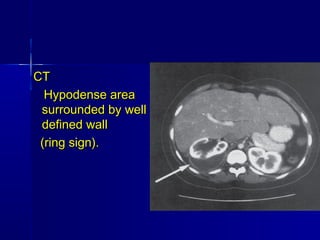
CTCT
Hypodense areaHypodense area
surrounded by wellsurrounded by well
defined walldefined wall
(ring sign).(ring sign).
A)A) Small abscess: percutaneous drainageSmall abscess: percutaneous drainage
under U/S or C.T. guidedunder U/S or C.T. guided
B)B) Large abscess: open drainageLarge abscess: open drainage
TreatmentTreatment
Acute CystitisAcute Cystitis
 Urine stagnation inUrine stagnation in::
1.1. Urethral strictureUrethral stricture
2.2. Prostatic enlargementProstatic enlargement
3.3. Bladder diverticulumBladder diverticulum
 Devitalision of mucosaDevitalision of mucosa byby
bilharzial ova, stone, tumorbilharzial ova, stone, tumor
Predisposing factorsPredisposing factors
Clinical pictureClinical picture
Symptoms:Symptoms:
– Dysuria/ FrequencyDysuria/ Frequency
– Suprapubic pain.Suprapubic pain.
– HaematuriaHaematuria
Sign:Sign:
Tenderness in suprapubic region.Tenderness in suprapubic region.
TreatmentTreatment
–A short course of oral antibiotics.A short course of oral antibiotics.
TMP-SMX, nitrofurantoin, or quinolonesTMP-SMX, nitrofurantoin, or quinolones
–Fluids.Fluids.
–AnalgesicAnalgesic
–Antispasmodics to decrease bladderAntispasmodics to decrease bladder
spasm and frequency.spasm and frequency.
Chronic PyelonephritisChronic Pyelonephritis
A process of renal scarring and atrophy withA process of renal scarring and atrophy with
subsequent renal insufficiency.subsequent renal insufficiency.
Etiology:Etiology:
 In adult: repeated attack of acuteIn adult: repeated attack of acute
pyelonephritis in presence of risk factorspyelonephritis in presence of risk factors
e.g. D.M., analgesic nephropathy,e.g. D.M., analgesic nephropathy,
obstructive uropathy and renal calculi.obstructive uropathy and renal calculi.
 In children: association betweenIn children: association between
vesicoureteric reflux ant U.T.I.vesicoureteric reflux ant U.T.I.
Clinical pictureClinical picture
Pathology:Pathology: Small scarred kidney.Small scarred kidney.
usually discovered accidentally by:usually discovered accidentally by:
 HypertensionHypertension
 Renal impairmentRenal impairment
 Easy fatigability.Easy fatigability.
InvestigationInvestigation
1-labaratory:1-labaratory:
 Urine analysis: pyuria, proteinuria and casts.Urine analysis: pyuria, proteinuria and casts.
 Urine CultureUrine Culture
 Serum creatinineSerum creatinine
2-Radiology2-Radiology::
 U/S: small irregular kidney.U/S: small irregular kidney.
 I.V.P.:I.V.P.:
1.1. Decrease renal cortex.Decrease renal cortex.
2.2. Irregular kidney and scaringIrregular kidney and scaring
3.3. Dilated calyces with narrow neckDilated calyces with narrow neck
4.4. Delayed poor excretion of Contrast.Delayed poor excretion of Contrast.
TreatmentTreatment
1-Long course antimicrobial therapy1-Long course antimicrobial therapy
2-Treatment of hypertension.2-Treatment of hypertension.
3-Nephrectomy in unilateral atrophic non3-Nephrectomy in unilateral atrophic non
functioning kidneyfunctioning kidney
4-Dialysis in case of ESRD4-Dialysis in case of ESRD
5-Renal transplantation5-Renal transplantation
ProstatitisProstatitis
Classification:Classification:
 Acute Bacterial ProstatitisAcute Bacterial Prostatitis
 Chronic Bacterial ProstatitisChronic Bacterial Prostatitis
 Chronic Pelvic Pain Syndrome CPPS:Chronic Pelvic Pain Syndrome CPPS:
(Inflammatory CPPS or non(Inflammatory CPPS or non
inflammatory CPPS)inflammatory CPPS)
Acute BacterialAcute Bacterial
ProstatitisProstatitis
Organism:Organism:
- E. coli, most common 80 %E. coli, most common 80 %
- Proteus, Klebsiella, Pseudomonas,or otherProteus, Klebsiella, Pseudomonas,or other
Route of infection:Route of infection:
 Ascending from urethra.Ascending from urethra.
 Lymphatic.Lymphatic.
 Haematogenous.Haematogenous.
Clinical picture:Clinical picture:
 Dysuria / Frequency, urgency.Dysuria / Frequency, urgency.
 Variable degree of BNO.Variable degree of BNO.
 Pain: low back pain, perineal pain.Pain: low back pain, perineal pain.
 Fever, chills and malaiseFever, chills and malaise
 PR : extremely tender prostatePR : extremely tender prostate
 N.B. Vigorous prostatic examination orN.B. Vigorous prostatic examination or
prostatic massage should be avoided.prostatic massage should be avoided.
ManagementManagement
::
 Hospitalization in severe cases withHospitalization in severe cases with
sepsis or acute urine retention.sepsis or acute urine retention.
 Immediate antibiotic therapyImmediate antibiotic therapy
 Hydration, AnalgesicHydration, Analgesic
Chronic BacterialChronic Bacterial
ProstatitisProstatitis
Represents 5-25 % of cases of prostatitis, it is theRepresents 5-25 % of cases of prostatitis, it is the
most common cause of recurrent U.T.I.most common cause of recurrent U.T.I.
Clinical picture:Clinical picture:
 History of recurrent U.T.I. by the same organism.History of recurrent U.T.I. by the same organism.
 Patient may be asymptomatic between attacks.Patient may be asymptomatic between attacks.
 Long history of chronic pelvic pain syndrome.Long history of chronic pelvic pain syndrome.
Investigation:Investigation:
Expressed Prostatic Secretion (EPS) forExpressed Prostatic Secretion (EPS) for
microscopic examination and culture &microscopic examination and culture &
sensitivity tests.sensitivity tests.
InvestigationInvestigation
 Mid stream urine for urine analysisMid stream urine for urine analysis
and culture & sensitivity test.and culture & sensitivity test.
 Leucocytic countLeucocytic count
 Blood culture.Blood culture.
TreatmentTreatment
 Antimicrobial therapy according toAntimicrobial therapy according to
culture and sensitivity eg Quinolone forculture and sensitivity eg Quinolone for
>4weeks.>4weeks.
 Alpha blocker to reduce symptomAlpha blocker to reduce symptom
 Despite maximal therapy, cure is notDespite maximal therapy, cure is not
often achieved due to poor penetration ofoften achieved due to poor penetration of
antibiotic into prostatic tissueantibiotic into prostatic tissue
Gonococcal UrethritisGonococcal Urethritis
Infection with Niesseria gonorrhea (gram –Infection with Niesseria gonorrhea (gram –
ve diplococci)ve diplococci)
Incubation period 3-10 days.Incubation period 3-10 days.
Mode of transmission:Mode of transmission:
Sexual intercourse.Sexual intercourse.
Homosexual.Homosexual.
Clinical picture:Clinical picture:
 Urethral discharge profuse, purulent.Urethral discharge profuse, purulent.
 Complicated casesComplicated cases
-chronic urethritis-chronic urethritis
-urethral stricture-urethral stricture
-prostatitis and epididymitis-prostatitis and epididymitis
DiagnosisDiagnosis
Detection of the organisms in urethralDetection of the organisms in urethral
smear ( intracellularly Gram–negativesmear ( intracellularly Gram–negative
diplococci).diplococci).
TreatmentTreatment
 1st line1st line: -Ceftriaxone or cefixime: -Ceftriaxone or cefixime
 2nd line2nd line: - Ofloxacin, ciprofloxacin, or: - Ofloxacin, ciprofloxacin, or
levofloxacinelevofloxacine
 As gonorrhea is often associated withAs gonorrhea is often associated with
chlamydial infection, antichlamydialchlamydial infection, antichlamydial
therapy should be addedtherapy should be added
Non GonococcalNon Gonococcal
UrethritisUrethritis
Higher incidence than gonococal urethritis.Higher incidence than gonococal urethritis.
Etiology:Etiology:
 Chlamydia trochmatus 30%-50%Chlamydia trochmatus 30%-50%
 Ureaplasma urelyticum 30%-50%Ureaplasma urelyticum 30%-50%
 Candidiasis.Candidiasis.
 Mycoplasma.Mycoplasma.
 Viral e.g. herps.Viral e.g. herps.
 Chemical irritation.Chemical irritation.
Clinical pictureClinical picture
 Incubation period 1-5 weeks.Incubation period 1-5 weeks.
 Discharge: scanty and clear.Discharge: scanty and clear.
 DysuriaDysuria
 ItchingItching
 Complication:Complication: epididymitis, prostatitis.epididymitis, prostatitis.
Investigation:Investigation:
 Culture and sensitivity of urethralCulture and sensitivity of urethral
discharge to exclude gonococcaldischarge to exclude gonococcal
urethritis.urethritis.
 P.C.R. is now available.P.C.R. is now available.
Treatment:Treatment:
 1st line1st line: Azithromycin or Doxycycline: Azithromycin or Doxycycline
 2nd line2nd line: Erythromycine or levofloxacine: Erythromycine or levofloxacine
 If treatment fail, Trichomonas vaginalis orIf treatment fail, Trichomonas vaginalis or
mycoplasma should be suspected andmycoplasma should be suspected and
treated with metronidazoletreated with metronidazole
Thank
you

Non Specific Urinary Tract Infection

  • 1.
    Non Specific UTINonSpecific UTI
  • 2.
    05/02/1605/02/16 Urology DepartmentUrologyDepartment 22  U.T.I:U.T.I: AAn inflammation of then inflammation of the urothelium due to invadingurothelium due to invading organism.organism.  Bacteruria: presence of bacterialBacteruria: presence of bacterial colonization in urinecolonization in urine
  • 3.
     Pyuria: presenceof > 3 WBC / H.P.F.Pyuria: presence of > 3 WBC / H.P.F.  Sterile pyuria: presence of pyuriaSterile pyuria: presence of pyuria without bacteruria.without bacteruria.
  • 4.
    05/02/1605/02/16 Urology DepartmentUrologyDepartment 44 1.1. First documented UTIFirst documented UTI 1.1. Unresolved UTI: failure to eradicateUnresolved UTI: failure to eradicate bacteria due to:bacteria due to: 1- Bacterial resistance.1- Bacterial resistance. 2- Mixed infection.2- Mixed infection. 3- Persistent source of inf.3- Persistent source of inf. Classification of U.T.IClassification of U.T.I
  • 5.
  • 6.
     Reinfection:Reinfection: recurrentU.T.I. afterrecurrent U.T.I. after sterilization of urine due to infectionsterilization of urine due to infection with different organism from outsidewith different organism from outside urinary tract.urinary tract.  Bacterial persistence:Bacterial persistence: recurrent U.T.Irecurrent U.T.I after sterilization of urine by theafter sterilization of urine by the same organism from focus insidesame organism from focus inside urinary tract. e.g. infection stone.urinary tract. e.g. infection stone.
  • 7.
    05/02/1605/02/16 Urology DepartmentUrologyDepartment 77  High renal vascularity.High renal vascularity.  Competent ureterovesical junction.Competent ureterovesical junction.  U.B. evacuation without residual urine.U.B. evacuation without residual urine. Protective FactorsProtective Factors
  • 8.
     Antimicrobial propertiesof urine:Antimicrobial properties of urine: 1- Urinary antibodies1- Urinary antibodies 2- Acidic urine2- Acidic urine 3- High osmolarity surface mucin.3- High osmolarity surface mucin.
  • 9.
    05/02/1605/02/16 Urology DepartmentUrologyDepartment 99 A) Host factors:A) Host factors: 1- General: a- Anemia1- General: a- Anemia b- D.M.b- D.M. c– Uremiac– Uremia 2- local: a- Obstruction2- local: a- Obstruction b- Persistent F.B. e.g. catheterb- Persistent F.B. e.g. catheter B) Bacterial factors:B) Bacterial factors: - Bacterial virulence- Bacterial virulence Predisposing factorsPredisposing factors
  • 10.
  • 11.
    Common Organisms CausingUTICommon Organisms Causing UTI 0 10 20 30 40 50 60 E coli Klebsiella P mirabilis Others
  • 12.
    05/02/1605/02/16 Urology DepartmentUrologyDepartment 1212 Acute inflammation of renal pelvis andAcute inflammation of renal pelvis and renal parenchyma.renal parenchyma. Route of infection:Route of infection: 1.1. Ascending infection.Ascending infection. 2.2. Haematogenous.Haematogenous. 3.3. Lymphatic spread.Lymphatic spread. Acute PyelonephritisAcute Pyelonephritis
  • 13.
  • 14.
    05/02/1605/02/16 Urology DepartmentUrologyDepartment 1414 SymptomsSymptoms:: 1- Constitutional symptoms1- Constitutional symptoms 2-loin pain.2-loin pain. 3-Dysuria/frequency.3-Dysuria/frequency. 4-hematuria.4-hematuria. Sign:Sign: 1-fever1-fever 2-tenderness at renal angle.2-tenderness at renal angle. Clinical FeaturesClinical Features
  • 15.
  • 16.
    05/02/1605/02/16 Urology DepartmentUrologyDepartment 1616  urine analysis: a- pyuriaurine analysis: a- pyuria b- mic. haematuria.b- mic. haematuria.  Urine culture: positive.Urine culture: positive.  CBC: leukocytosis.CBC: leukocytosis.  Blood culture: positive.Blood culture: positive.  U/S: renal enlargementU/S: renal enlargement
  • 17.
    05/02/1605/02/16 Urology DepartmentUrologyDepartment 1717 Approximately 25% require hospitalizationApproximately 25% require hospitalization 1.1. Bed rest- I.V. fluidsBed rest- I.V. fluids 2.2. Analgesic-Antipyretic.Analgesic-Antipyretic. 3.3. Empiric therapy with intravenousEmpiric therapy with intravenous ampicillin and aminoglycosides or aampicillin and aminoglycosides or a third generation cephalosporinthird generation cephalosporin TreatmentTreatment
  • 18.
    Perinephric AbscessPerinephric Abscess Accumulationof pus in the perinephricAccumulation of pus in the perinephric space within Gerota’s fascia.space within Gerota’s fascia. Route of infectionRoute of infection:: 1- Haematogenous spread1- Haematogenous spread 2- Direct spread from renal infection2- Direct spread from renal infection
  • 19.
    -Acute flank pain.Acuteflank pain. -- Fever.- Fever. - Anorexia, nausea and vomiting.- Anorexia, nausea and vomiting. - Skin oedema,- Skin oedema, - Loin swelling,- Loin swelling, - Scoliosis- Scoliosis - Symptoms of cystitis (in 50%).- Symptoms of cystitis (in 50%). Clinical PictureClinical Picture
  • 20.
    Laboratory:Laboratory: - Urine analysis:positive in 50%.- Urine analysis: positive in 50%. - CBC: leukocytosis.- CBC: leukocytosis. - Blood culture: positive in 50%- Blood culture: positive in 50% Radiology:Radiology: a- KUB: enlargement of soft tissue shadow of thea- KUB: enlargement of soft tissue shadow of the kidney and obliteration of psoas shadow.kidney and obliteration of psoas shadow. b- U/S: hypoechoic mass with internal echoesb- U/S: hypoechoic mass with internal echoes InvestigationsInvestigations
  • 21.
    CTCT Hypodense areaHypodense area surroundedby wellsurrounded by well defined walldefined wall (ring sign).(ring sign).
  • 22.
    A)A) Small abscess:percutaneous drainageSmall abscess: percutaneous drainage under U/S or C.T. guidedunder U/S or C.T. guided B)B) Large abscess: open drainageLarge abscess: open drainage TreatmentTreatment
  • 23.
  • 24.
     Urine stagnationinUrine stagnation in:: 1.1. Urethral strictureUrethral stricture 2.2. Prostatic enlargementProstatic enlargement 3.3. Bladder diverticulumBladder diverticulum  Devitalision of mucosaDevitalision of mucosa byby bilharzial ova, stone, tumorbilharzial ova, stone, tumor Predisposing factorsPredisposing factors
  • 25.
    Clinical pictureClinical picture Symptoms:Symptoms: –Dysuria/ FrequencyDysuria/ Frequency – Suprapubic pain.Suprapubic pain. – HaematuriaHaematuria Sign:Sign: Tenderness in suprapubic region.Tenderness in suprapubic region.
  • 26.
    TreatmentTreatment –A short courseof oral antibiotics.A short course of oral antibiotics. TMP-SMX, nitrofurantoin, or quinolonesTMP-SMX, nitrofurantoin, or quinolones –Fluids.Fluids. –AnalgesicAnalgesic –Antispasmodics to decrease bladderAntispasmodics to decrease bladder spasm and frequency.spasm and frequency.
  • 27.
    Chronic PyelonephritisChronic Pyelonephritis Aprocess of renal scarring and atrophy withA process of renal scarring and atrophy with subsequent renal insufficiency.subsequent renal insufficiency. Etiology:Etiology:  In adult: repeated attack of acuteIn adult: repeated attack of acute pyelonephritis in presence of risk factorspyelonephritis in presence of risk factors e.g. D.M., analgesic nephropathy,e.g. D.M., analgesic nephropathy, obstructive uropathy and renal calculi.obstructive uropathy and renal calculi.  In children: association betweenIn children: association between vesicoureteric reflux ant U.T.I.vesicoureteric reflux ant U.T.I.
  • 28.
    Clinical pictureClinical picture Pathology:Pathology:Small scarred kidney.Small scarred kidney. usually discovered accidentally by:usually discovered accidentally by:  HypertensionHypertension  Renal impairmentRenal impairment  Easy fatigability.Easy fatigability.
  • 29.
    InvestigationInvestigation 1-labaratory:1-labaratory:  Urine analysis:pyuria, proteinuria and casts.Urine analysis: pyuria, proteinuria and casts.  Urine CultureUrine Culture  Serum creatinineSerum creatinine 2-Radiology2-Radiology::  U/S: small irregular kidney.U/S: small irregular kidney.  I.V.P.:I.V.P.: 1.1. Decrease renal cortex.Decrease renal cortex. 2.2. Irregular kidney and scaringIrregular kidney and scaring 3.3. Dilated calyces with narrow neckDilated calyces with narrow neck 4.4. Delayed poor excretion of Contrast.Delayed poor excretion of Contrast.
  • 30.
    TreatmentTreatment 1-Long course antimicrobialtherapy1-Long course antimicrobial therapy 2-Treatment of hypertension.2-Treatment of hypertension. 3-Nephrectomy in unilateral atrophic non3-Nephrectomy in unilateral atrophic non functioning kidneyfunctioning kidney 4-Dialysis in case of ESRD4-Dialysis in case of ESRD 5-Renal transplantation5-Renal transplantation
  • 31.
    ProstatitisProstatitis Classification:Classification:  Acute BacterialProstatitisAcute Bacterial Prostatitis  Chronic Bacterial ProstatitisChronic Bacterial Prostatitis  Chronic Pelvic Pain Syndrome CPPS:Chronic Pelvic Pain Syndrome CPPS: (Inflammatory CPPS or non(Inflammatory CPPS or non inflammatory CPPS)inflammatory CPPS)
  • 32.
    Acute BacterialAcute Bacterial ProstatitisProstatitis Organism:Organism: -E. coli, most common 80 %E. coli, most common 80 % - Proteus, Klebsiella, Pseudomonas,or otherProteus, Klebsiella, Pseudomonas,or other Route of infection:Route of infection:  Ascending from urethra.Ascending from urethra.  Lymphatic.Lymphatic.  Haematogenous.Haematogenous.
  • 33.
    Clinical picture:Clinical picture: Dysuria / Frequency, urgency.Dysuria / Frequency, urgency.  Variable degree of BNO.Variable degree of BNO.  Pain: low back pain, perineal pain.Pain: low back pain, perineal pain.  Fever, chills and malaiseFever, chills and malaise  PR : extremely tender prostatePR : extremely tender prostate  N.B. Vigorous prostatic examination orN.B. Vigorous prostatic examination or prostatic massage should be avoided.prostatic massage should be avoided.
  • 34.
    ManagementManagement ::  Hospitalization insevere cases withHospitalization in severe cases with sepsis or acute urine retention.sepsis or acute urine retention.  Immediate antibiotic therapyImmediate antibiotic therapy  Hydration, AnalgesicHydration, Analgesic
  • 35.
    Chronic BacterialChronic Bacterial ProstatitisProstatitis Represents5-25 % of cases of prostatitis, it is theRepresents 5-25 % of cases of prostatitis, it is the most common cause of recurrent U.T.I.most common cause of recurrent U.T.I. Clinical picture:Clinical picture:  History of recurrent U.T.I. by the same organism.History of recurrent U.T.I. by the same organism.  Patient may be asymptomatic between attacks.Patient may be asymptomatic between attacks.  Long history of chronic pelvic pain syndrome.Long history of chronic pelvic pain syndrome.
  • 36.
    Investigation:Investigation: Expressed Prostatic Secretion(EPS) forExpressed Prostatic Secretion (EPS) for microscopic examination and culture &microscopic examination and culture & sensitivity tests.sensitivity tests.
  • 37.
    InvestigationInvestigation  Mid streamurine for urine analysisMid stream urine for urine analysis and culture & sensitivity test.and culture & sensitivity test.  Leucocytic countLeucocytic count  Blood culture.Blood culture.
  • 38.
    TreatmentTreatment  Antimicrobial therapyaccording toAntimicrobial therapy according to culture and sensitivity eg Quinolone forculture and sensitivity eg Quinolone for >4weeks.>4weeks.  Alpha blocker to reduce symptomAlpha blocker to reduce symptom  Despite maximal therapy, cure is notDespite maximal therapy, cure is not often achieved due to poor penetration ofoften achieved due to poor penetration of antibiotic into prostatic tissueantibiotic into prostatic tissue
  • 39.
    Gonococcal UrethritisGonococcal Urethritis Infectionwith Niesseria gonorrhea (gram –Infection with Niesseria gonorrhea (gram – ve diplococci)ve diplococci) Incubation period 3-10 days.Incubation period 3-10 days. Mode of transmission:Mode of transmission: Sexual intercourse.Sexual intercourse. Homosexual.Homosexual.
  • 40.
    Clinical picture:Clinical picture: Urethral discharge profuse, purulent.Urethral discharge profuse, purulent.  Complicated casesComplicated cases -chronic urethritis-chronic urethritis -urethral stricture-urethral stricture -prostatitis and epididymitis-prostatitis and epididymitis
  • 41.
    DiagnosisDiagnosis Detection of theorganisms in urethralDetection of the organisms in urethral smear ( intracellularly Gram–negativesmear ( intracellularly Gram–negative diplococci).diplococci).
  • 42.
    TreatmentTreatment  1st line1stline: -Ceftriaxone or cefixime: -Ceftriaxone or cefixime  2nd line2nd line: - Ofloxacin, ciprofloxacin, or: - Ofloxacin, ciprofloxacin, or levofloxacinelevofloxacine  As gonorrhea is often associated withAs gonorrhea is often associated with chlamydial infection, antichlamydialchlamydial infection, antichlamydial therapy should be addedtherapy should be added
  • 43.
    Non GonococcalNon Gonococcal UrethritisUrethritis Higherincidence than gonococal urethritis.Higher incidence than gonococal urethritis. Etiology:Etiology:  Chlamydia trochmatus 30%-50%Chlamydia trochmatus 30%-50%  Ureaplasma urelyticum 30%-50%Ureaplasma urelyticum 30%-50%  Candidiasis.Candidiasis.  Mycoplasma.Mycoplasma.  Viral e.g. herps.Viral e.g. herps.  Chemical irritation.Chemical irritation.
  • 44.
    Clinical pictureClinical picture Incubation period 1-5 weeks.Incubation period 1-5 weeks.  Discharge: scanty and clear.Discharge: scanty and clear.  DysuriaDysuria  ItchingItching  Complication:Complication: epididymitis, prostatitis.epididymitis, prostatitis.
  • 45.
    Investigation:Investigation:  Culture andsensitivity of urethralCulture and sensitivity of urethral discharge to exclude gonococcaldischarge to exclude gonococcal urethritis.urethritis.  P.C.R. is now available.P.C.R. is now available.
  • 46.
    Treatment:Treatment:  1st line1stline: Azithromycin or Doxycycline: Azithromycin or Doxycycline  2nd line2nd line: Erythromycine or levofloxacine: Erythromycine or levofloxacine  If treatment fail, Trichomonas vaginalis orIf treatment fail, Trichomonas vaginalis or mycoplasma should be suspected andmycoplasma should be suspected and treated with metronidazoletreated with metronidazole
  • 47.