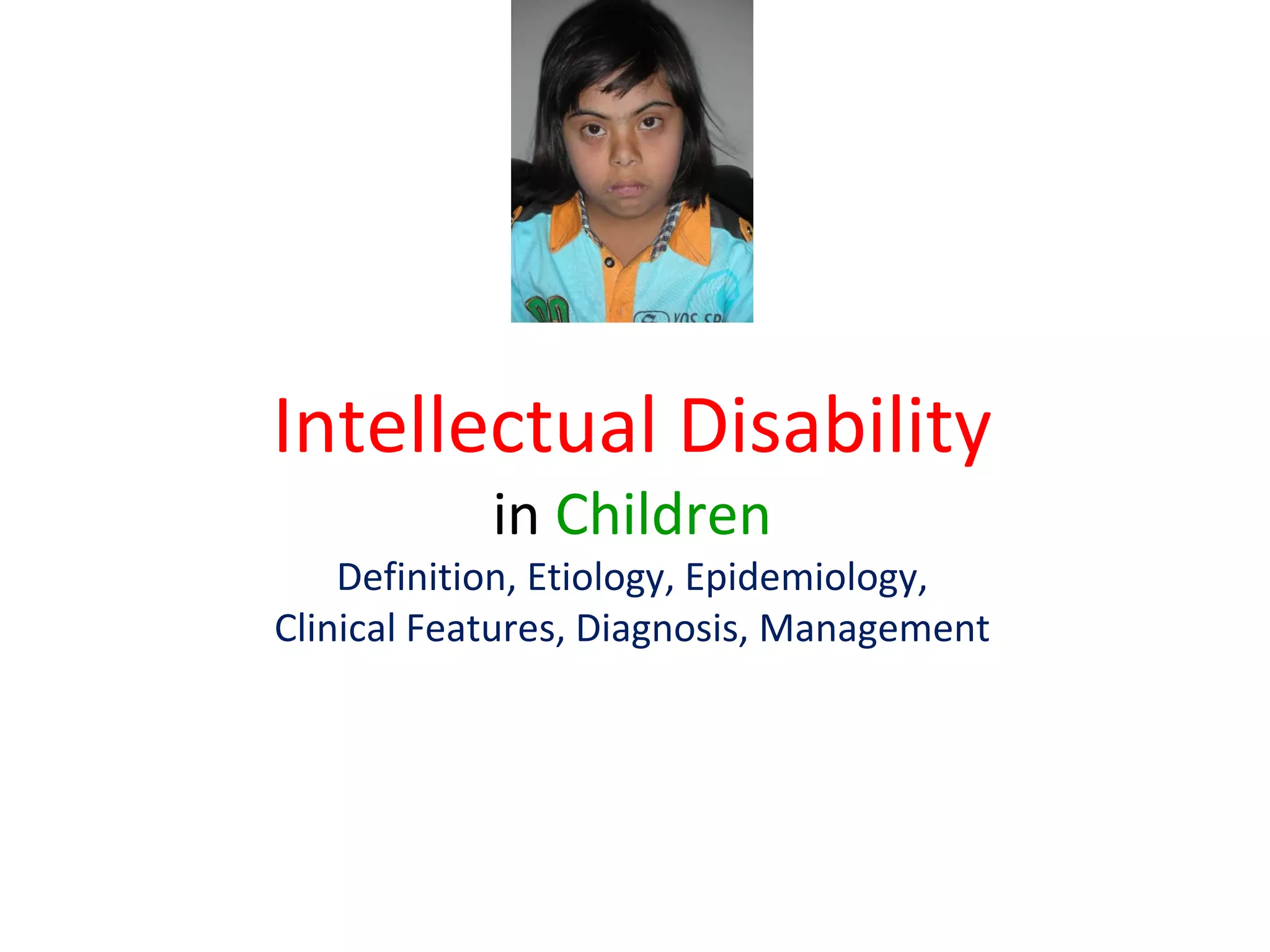
Intellectual Disability
in Children
Definition, Epidemiology, Etiology, Clinical Features,
Diagnosis, Assessment, Management, Prognosis and Prevention
Prof. Imran Iqbal
Fellowship in Pediatric Neurology (Australia)
Prof of Paediatrics (2003-2018)
Prof of Pediatrics Emeritus, CHICH
Prof of Pediatrics, CIMS
Multan, Pakistan
(God Almighty speaking to Prophet Muhammad (PBUH)
Say, “It is He who created and nurtured you;
and given you the hearing, the vision, and the thinking.
But rarely do you pay gratitude.”
The Holy Quran; surah Al-Mulk 67:23
In the name of Our Creator Allah, the most Gracious, the most Merciful
CNS
Brain
Our perceptions and Movements
Evaluation
of the Child with
Neurological Symptoms
CNS – Abnormal Symptoms
• Convulsions
• Altered Consciousness
• Delayed development
• Intellectual handicap
• Speech problem
• Motor weakness / Walking problem
• Sensory changes
• Headache
• Unable to see / listen
History – Ask about Symptoms
• Neurological Symptoms –
• Onset
• Frequency
• Severity
• Progression
• Birth history
• Development history
• Family history
CNS – Abnormal Signs
• Developmental milestones (in relation to age)
• Impaired Conscious level (GCS)
• Convulsions
• Intellectual impairment (retardation / handicap)
• Motor weakness / Paralysis / Paresis
• Abnormal gait
• Abnormal movements
• Visual impairment
• Auditory impairment
CNS Examination
in Children
Examination of CNS in Children
• OBSERVE – observe the child
• General Physical Examination
• Developmental Examination
• NEUROLOGICAL EXAMINATION –
• Higher Mental Functions
• Cranial Nerves
• Motor System
• Sensory system
• Skull and Spine
• SOMI
Developmental Examination
Child Development
Areas of Development
 Posture and locomotion
 Vision and manipulation
 Hearing and speech
 Personal and social
Areas of Development
 Posture and locomotion
 Vision and manipulation
 Hearing and speech
 Personal and social
Milestones of Development
Posture and locomotion
 3 months – Head control
 6 months – Roll over
 9 months -– sit without support
 12 months – stand / walk held
Milestones of Development
Vision and manipulation (eye – hand coordination)
 3 mo – Eyes fix and follow
 6 mo – Hand approach to hold
 9 mo -– Finger grasp
 12 mo – Release object in examiner’s hand
Milestones of Development
Hearing and Speech
 3 mo – Response to voice
 6 mo – Turn to sound
 9 mo -– Babbles
 12 mo – One word
Milestones of Development
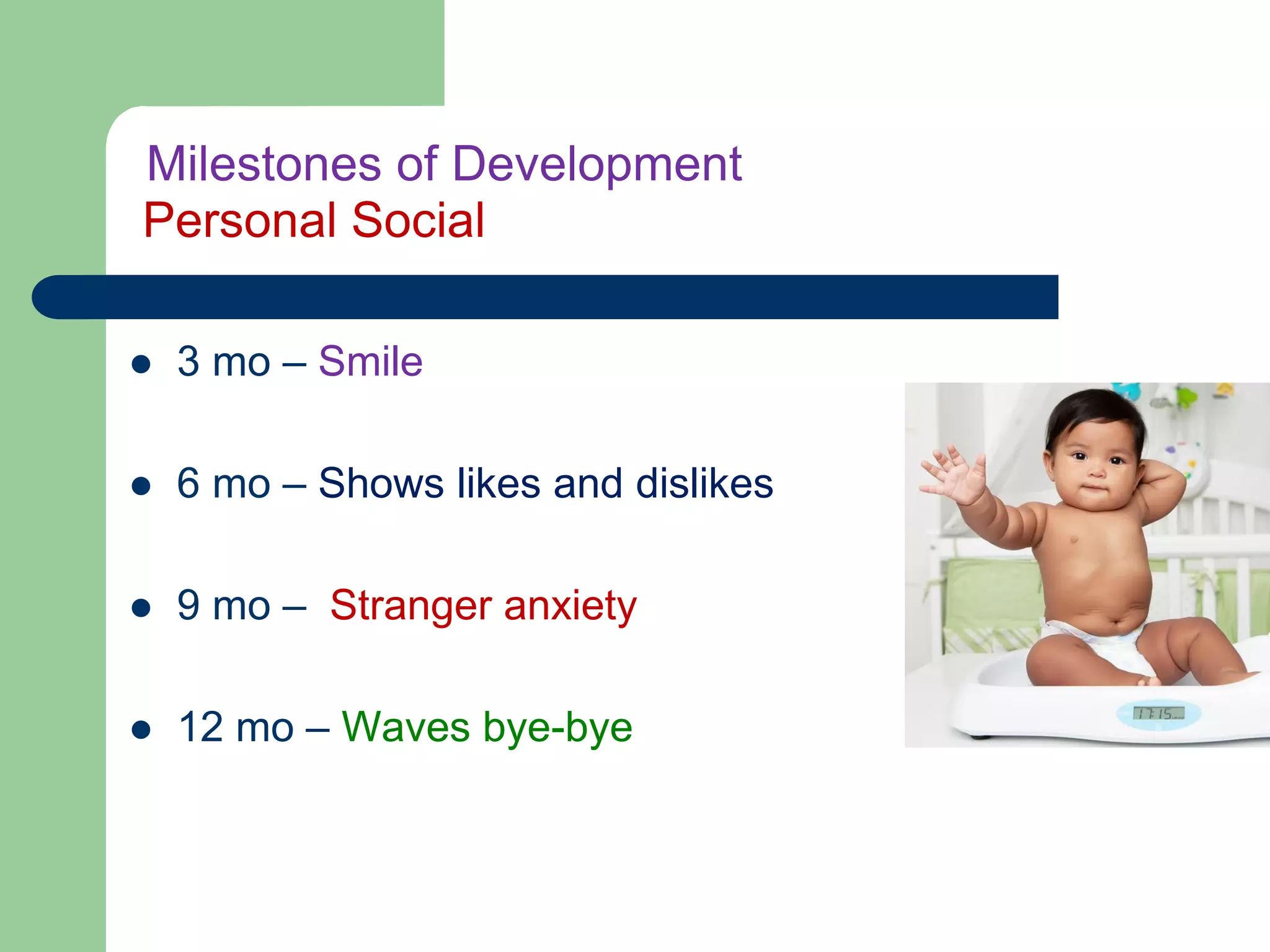
Personal Social
 3 mo – Smile
 6 mo – Shows likes and dislikes
 9 mo – Stranger anxiety
 12 mo – Waves bye-bye
Neurological Examination
NEUROLOGICAL EXAMINATION
• Higher Mental Functions
• Cranial Nerves
• Motor System
• Sensory system
• Skull and Spine
• SOMI
Higher Mental Functions
• Conscious Level (Glasgow Coma Scale)
• Recognition and Response
• Behavior and activity
• Speech
• Memory
Cranial Nerves
• Visual focusing and following
• Light reflex
• Facial Movements
• Response to sound
• Sucking and Swallowing
• Palate movement and Gag reflex
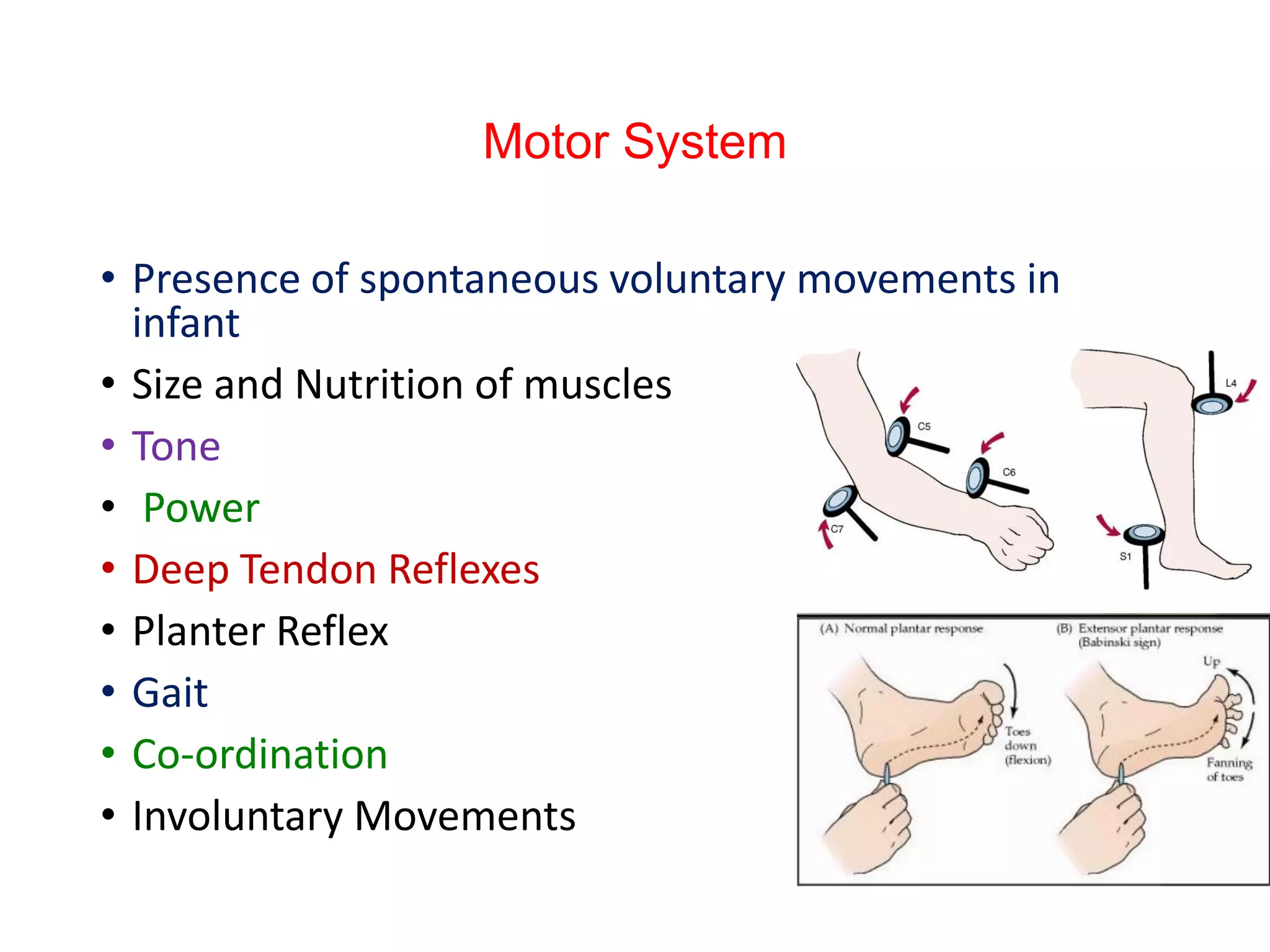
Motor System
• Presence of spontaneous voluntary movements in
infant
• Size and Nutrition of muscles
• Tone
• Power
• Deep Tendon Reflexes
• Planter Reflex
• Gait
• Co-ordination
• Involuntary Movements
Sensory System
• Touch
• Pain
• Temperature
• Position
• Vibration
Skull & Spine
• Shape of skull
• Anterior fontanel
• Occipito-frontal Circumference (OFC)
• Spine – Curvature, local swelling
SOMI – Signs of Meningeal Irritation
• Bulging Anterior fontanel
• Neck rigidity
• Kernig's sign
• Brudzinski's sign
Clinical Presentation
of
CNS diseases
CNS disease – Clinical Presentation
• Seizures / Convulsions / Fits
• Impaired Conscious level
• Developmental delay
• Intellectual handicap
• Neurological Paralysis / Paresis (motor weakness )
• Neuromuscular disorders / Hypotonia
• Movement disorders
• Headache
• Regression of acquired milestones
• Behaviour problems
Developmental delay
and
Intellectual handicap
Developmental delay / Intellectual handicap
Etiology
• Perinatal Brain Damage (HIE) (Hypoxic Ischemic
Encephalopathy)
• Postnatal Brain damage (e.g. Meningitis)
• Cerebral Malformations (e.g. agenesis of corpus callosum)
• Chromosomal disorders (e.g. Down syndrome)
• Genetic syndromes (single gene defects)
• Degenerative brain diseases (Leukodystrophy)
• Hypothyroidism (Cretinism)
• Severe Systemic Diseases (cardiac, renal, malnutrition)
Developmental delay / Intellectual handicap
Clinical Presentation
• Cerebral Palsy
• Delayed development
• Intellectual disability
Intellectual Disability
in Children
Definition, Etiology, Epidemiology,
Clinical Features, Diagnosis, Management
Intellectual Disability
Definition
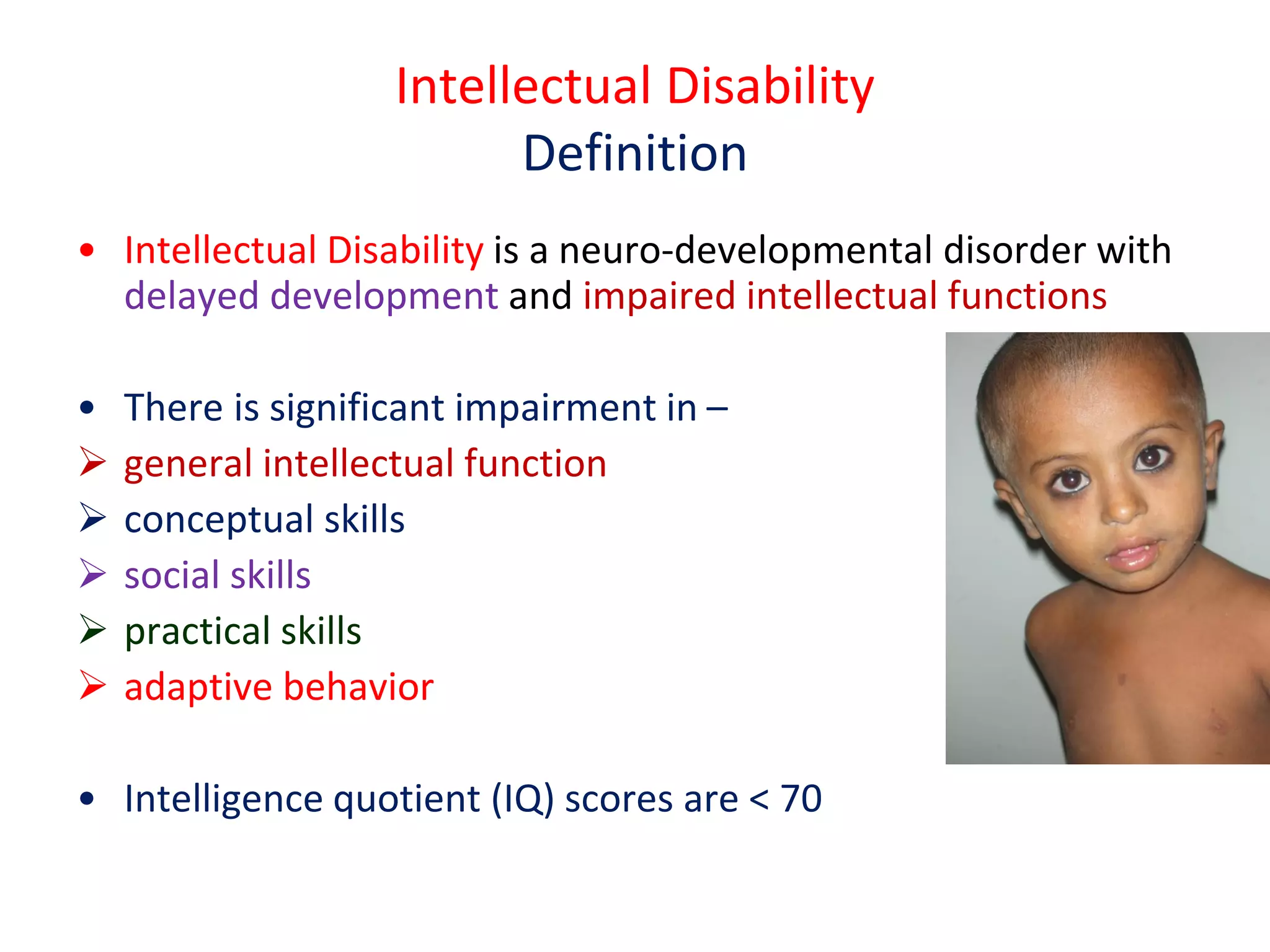
• Intellectual Disability is a neuro-developmental disorder with
delayed development and impaired intellectual functions
• There is significant impairment in –
 general intellectual function
 conceptual skills
 social skills
 practical skills
 adaptive behavior
• Intelligence quotient (IQ) scores are < 70
Intellectual Disability
Impairment of Intellectual Functions
• General intellectual function – reasoning, learning, problem
solving
• Conceptual skills – language, reading, writing, time, number
concepts, and self-direction
• Social skills – interpersonal skills, social responsibility, obeying
laws
• Practical skills – activities of daily living (dressing, feeding,
toileting/bathing, mobility)
• Adaptive behavior – functions of living (e.g., housework,
managing money, taking medication, shopping, using phone)
Intellectual Disability
Etiology
• Cerebral Malformations (e.g. agenesis of corpus callosum)
• Chromosomal disorders (e.g. Down syndrome)
• Genetic syndromes (single gene defects)
• Perinatal Brain Damage (HIE) (Hypoxic Ischemic
Encephalopathy)
• Postnatal Brain damage (e.g. Meningitis)
• Hypothyroidism (Cretinism)
• Nutritional disorders – severe malnutrition
• Child abuse and neglect
Intellectual Disability
Epidemiology
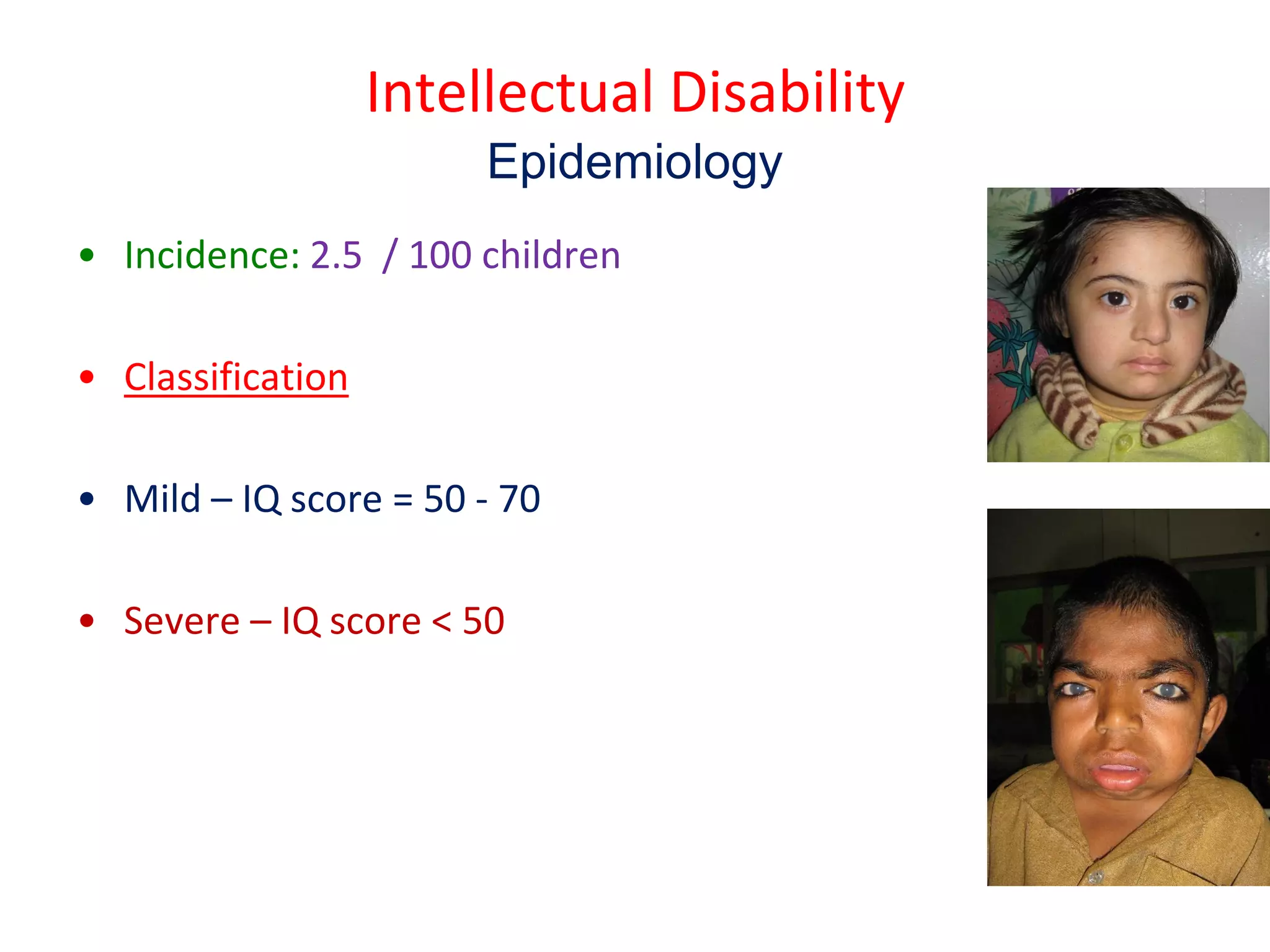
• Incidence: 2.5 / 100 children
• Classification
• Mild – IQ score = 50 - 70
• Severe – IQ score < 50
Intellectual Disability
Investigations
Competencies
• Developmental evaluation – IQ
• Eyes / Vision evaluation
• Hearing evaluation
• Psychologist evaluation
• Teacher evaluation
Etiology
• CT / MRI Brain
• EEG – seizures
• Karyotype
• Metabolic studies
• Genetic studies – Whole Exome Sequencing (WES)
– Whole Genome Sequencing (WGS)
Intellectual Disability
Management
• Family support
• Special education
• Behavior management
• Medications
UN Convention on the Rights of the Child
1989
“A disabled child has the right to enjoy
a full and decent life,
in conditions which
ensure dignity,
promote self-reliance
and
facilitate the child’s active participation
in the community.”
Prof Imran Iqbal
Fellowship Pediatric Neurology-1991
Royal Children Hospital, Melbourne, Australia

Intellectual disability in children 2021

  • 1.
    Intellectual Disability in Children Definition,Epidemiology, Etiology, Clinical Features, Diagnosis, Assessment, Management, Prognosis and Prevention Prof. Imran Iqbal Fellowship in Pediatric Neurology (Australia) Prof of Paediatrics (2003-2018) Prof of Pediatrics Emeritus, CHICH Prof of Pediatrics, CIMS Multan, Pakistan
  • 2.
    (God Almighty speakingto Prophet Muhammad (PBUH) Say, “It is He who created and nurtured you; and given you the hearing, the vision, and the thinking. But rarely do you pay gratitude.” The Holy Quran; surah Al-Mulk 67:23 In the name of Our Creator Allah, the most Gracious, the most Merciful
  • 3.
  • 4.
  • 5.
  • 6.
    Evaluation of the Childwith Neurological Symptoms
  • 7.
    CNS – AbnormalSymptoms • Convulsions • Altered Consciousness • Delayed development • Intellectual handicap • Speech problem • Motor weakness / Walking problem • Sensory changes • Headache • Unable to see / listen
  • 8.
    History – Askabout Symptoms • Neurological Symptoms – • Onset • Frequency • Severity • Progression • Birth history • Development history • Family history
  • 9.
    CNS – AbnormalSigns • Developmental milestones (in relation to age) • Impaired Conscious level (GCS) • Convulsions • Intellectual impairment (retardation / handicap) • Motor weakness / Paralysis / Paresis • Abnormal gait • Abnormal movements • Visual impairment • Auditory impairment
  • 10.
  • 11.
    Examination of CNSin Children • OBSERVE – observe the child • General Physical Examination • Developmental Examination • NEUROLOGICAL EXAMINATION – • Higher Mental Functions • Cranial Nerves • Motor System • Sensory system • Skull and Spine • SOMI
  • 12.
  • 13.
  • 14.
    Areas of Development Posture and locomotion  Vision and manipulation  Hearing and speech  Personal and social
  • 15.
    Areas of Development Posture and locomotion  Vision and manipulation  Hearing and speech  Personal and social
  • 16.
    Milestones of Development Postureand locomotion  3 months – Head control  6 months – Roll over  9 months -– sit without support  12 months – stand / walk held
  • 17.
    Milestones of Development Visionand manipulation (eye – hand coordination)  3 mo – Eyes fix and follow  6 mo – Hand approach to hold  9 mo -– Finger grasp  12 mo – Release object in examiner’s hand
  • 18.
    Milestones of Development Hearingand Speech  3 mo – Response to voice  6 mo – Turn to sound  9 mo -– Babbles  12 mo – One word
  • 19.
    Milestones of Development PersonalSocial  3 mo – Smile  6 mo – Shows likes and dislikes  9 mo – Stranger anxiety  12 mo – Waves bye-bye
  • 20.
  • 21.
    NEUROLOGICAL EXAMINATION • HigherMental Functions • Cranial Nerves • Motor System • Sensory system • Skull and Spine • SOMI
  • 22.
    Higher Mental Functions •Conscious Level (Glasgow Coma Scale) • Recognition and Response • Behavior and activity • Speech • Memory
  • 23.
    Cranial Nerves • Visualfocusing and following • Light reflex • Facial Movements • Response to sound • Sucking and Swallowing • Palate movement and Gag reflex
  • 24.
    Motor System • Presenceof spontaneous voluntary movements in infant • Size and Nutrition of muscles • Tone • Power • Deep Tendon Reflexes • Planter Reflex • Gait • Co-ordination • Involuntary Movements
  • 25.
    Sensory System • Touch •Pain • Temperature • Position • Vibration
  • 26.
    Skull & Spine •Shape of skull • Anterior fontanel • Occipito-frontal Circumference (OFC) • Spine – Curvature, local swelling
  • 27.
    SOMI – Signsof Meningeal Irritation • Bulging Anterior fontanel • Neck rigidity • Kernig's sign • Brudzinski's sign
  • 28.
  • 29.
    CNS disease –Clinical Presentation • Seizures / Convulsions / Fits • Impaired Conscious level • Developmental delay • Intellectual handicap • Neurological Paralysis / Paresis (motor weakness ) • Neuromuscular disorders / Hypotonia • Movement disorders • Headache • Regression of acquired milestones • Behaviour problems
  • 30.
  • 31.
    Developmental delay /Intellectual handicap Etiology • Perinatal Brain Damage (HIE) (Hypoxic Ischemic Encephalopathy) • Postnatal Brain damage (e.g. Meningitis) • Cerebral Malformations (e.g. agenesis of corpus callosum) • Chromosomal disorders (e.g. Down syndrome) • Genetic syndromes (single gene defects) • Degenerative brain diseases (Leukodystrophy) • Hypothyroidism (Cretinism) • Severe Systemic Diseases (cardiac, renal, malnutrition)
  • 32.
    Developmental delay /Intellectual handicap Clinical Presentation • Cerebral Palsy • Delayed development • Intellectual disability
  • 33.
    Intellectual Disability in Children Definition,Etiology, Epidemiology, Clinical Features, Diagnosis, Management
  • 34.
    Intellectual Disability Definition • IntellectualDisability is a neuro-developmental disorder with delayed development and impaired intellectual functions • There is significant impairment in –  general intellectual function  conceptual skills  social skills  practical skills  adaptive behavior • Intelligence quotient (IQ) scores are < 70
  • 35.
    Intellectual Disability Impairment ofIntellectual Functions • General intellectual function – reasoning, learning, problem solving • Conceptual skills – language, reading, writing, time, number concepts, and self-direction • Social skills – interpersonal skills, social responsibility, obeying laws • Practical skills – activities of daily living (dressing, feeding, toileting/bathing, mobility) • Adaptive behavior – functions of living (e.g., housework, managing money, taking medication, shopping, using phone)
  • 36.
    Intellectual Disability Etiology • CerebralMalformations (e.g. agenesis of corpus callosum) • Chromosomal disorders (e.g. Down syndrome) • Genetic syndromes (single gene defects) • Perinatal Brain Damage (HIE) (Hypoxic Ischemic Encephalopathy) • Postnatal Brain damage (e.g. Meningitis) • Hypothyroidism (Cretinism) • Nutritional disorders – severe malnutrition • Child abuse and neglect
  • 37.
    Intellectual Disability Epidemiology • Incidence:2.5 / 100 children • Classification • Mild – IQ score = 50 - 70 • Severe – IQ score < 50
  • 38.
    Intellectual Disability Investigations Competencies • Developmentalevaluation – IQ • Eyes / Vision evaluation • Hearing evaluation • Psychologist evaluation • Teacher evaluation Etiology • CT / MRI Brain • EEG – seizures • Karyotype • Metabolic studies • Genetic studies – Whole Exome Sequencing (WES) – Whole Genome Sequencing (WGS)
  • 39.
    Intellectual Disability Management • Familysupport • Special education • Behavior management • Medications
  • 40.
    UN Convention onthe Rights of the Child 1989 “A disabled child has the right to enjoy a full and decent life, in conditions which ensure dignity, promote self-reliance and facilitate the child’s active participation in the community.”
  • 41.
    Prof Imran Iqbal FellowshipPediatric Neurology-1991 Royal Children Hospital, Melbourne, Australia