The  1 st  24 hours   of Life The  first 24 hours  of life is a very significant and a highly vulnerable time due to critical transition from intrauterine  to extrauterine life
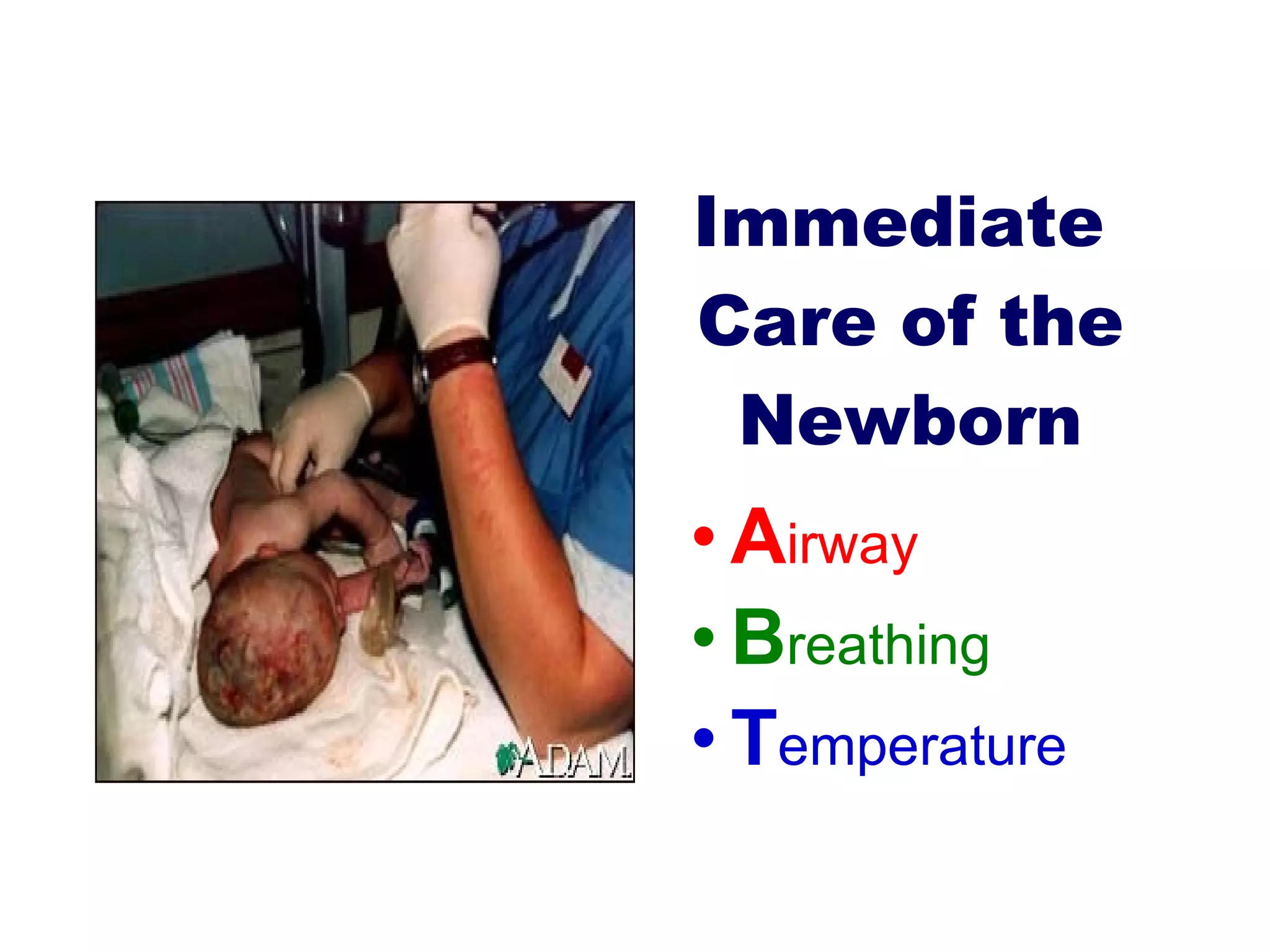
Immediate  Care of the Newborn A irway B reathing T emperature
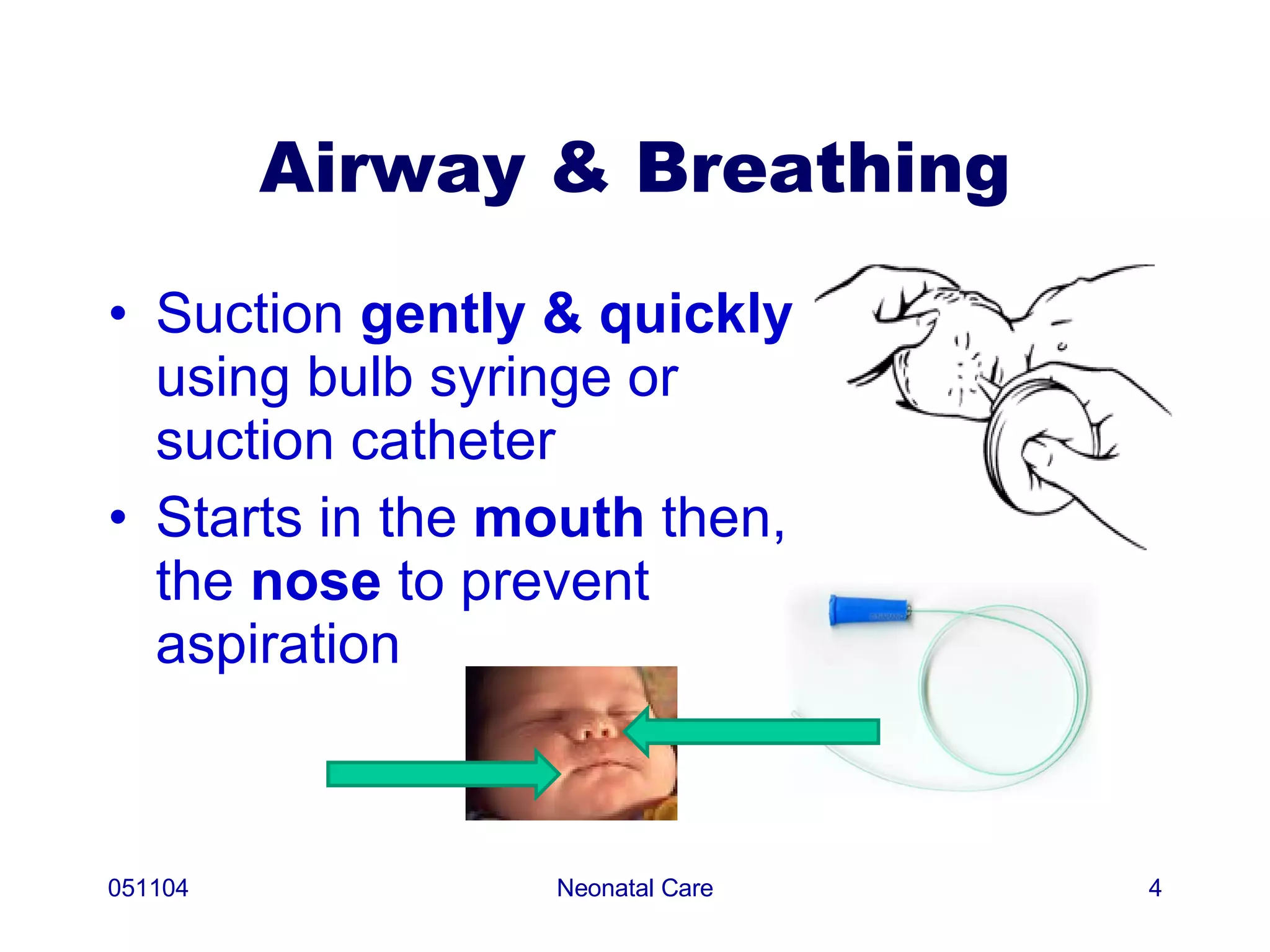
Airway & Breathing Suction  gently & quickly  using bulb syringe or suction catheter Starts in the  mouth  then, the  nose  to prevent aspiration  051104 Neonatal Care
051104 Neonatal Care
Airway & Breathing Stimulate  crying  by rubbing Position properly-  side lying / modified t-berg Provide  oxygen  when necessary 051104 Neonatal Care
Temperature Dry immediately Place in infant warmer or use droplight Wrap warmly 051104 Neonatal Care
APGAR Scoring Standardized evaluation of the newborn Perform 1 minute and 5 minutes after birth Involves (5) indicators: Activity Pulse Grimace Appearance Respirations 051104 Neonatal Care
Care of the Newborn in the Nursery
Components A nthropometric Measurements B athing – Oil bath/ warm water bath C ord Care D ressing/ Wrapping - mummified E ye prophylaxis – Crede’s F oot printing / Identification G et APGAR score – 1 & 5 mins H R, RR, Temp, BP I njection of Vitamin K 051104 Neonatal Care
Components Proper identification –tag/bracelet Oil bath/ Warm water bath Cord Care/ Dressing Measurements Weight Anthropometric measurements 051104 Neonatal Care
Crede’s Prophylaxis Vitamin K Administration Foot printing/ marking Vital signs Dressing/ wrapping 051104 Neonatal Care
Proper Identification After delivery, gender should be determined  Pertinent records should be completed including the ID bracelet Before transferring to nursery, ID tag should be applied. 051104 Neonatal Care
Bathing Oil bath or complete warm water bath From cleanest to dirties part DO NOT remove vernix caseosa vigorously 051104 Neonatal Care
Cord Care 051104 Neonatal Care
Weight/ Anthropometric Measurements 051104 Neonatal Care
051104 Neonatal Care
Crede’s Prophylaxis 051104 Neonatal Care
Vitamin K Administration 051104 Neonatal Care
Foot Printing 051104 Neonatal Care
Vital Signs 051104 Neonatal Care
Dressing/ Wrapping “ Mummy” Wrap in warm blanket Cover head with stockinette cap 051104 Neonatal Care
Daily Care Nutrition/ Feeding Elimination Weight Bathing & Hygiene/ Grooming Obtain vital signs Rooming-in Note for any abnormalities 051104 Neonatal Care
NEWBORN ASSESSMENT Assessment of the newborn is essential to ensure a successful transition
Major Time Frames Immediately after birth Within the 1 st  4 hours after birth Prior to discharge 051104 Neonatal Care
APGAR Scoring System A   ctivity/ Muscle Tone P   ulse/ Heart Rate G   rimace/ Reflex Irritability/ Responsiveness A   ppearance/ Skin Color R  espiration/ Breathing 051104 Neonatal Care 1  2  3  4  5
051104 Neonatal Care APGAR Scoring System INDICATORS 2 1 0 Activity Active, spontaneous  Some flexion of extremities No movement (flaccid, limp) Pulse >100 bpm < 100 bpm Absent Grimace Pulls away, sneezes, coughs Facial grimace only No response with stimulation Appearance Completely pink Acrocyanosis Bluish-gray or pale all over Respiration Good vigorous cry Slow, irregular Weak cry Absent
051104 Neonatal Care Score Interpretation Score Interpretation Nursing Interventions 7 to 10 Well baby Rarely needs resuscitation 4 to 6 At risk INFANT NEEDS INTENSIVE CARE  Requires resuscitation Suction Dry immediately Ventilate until stable Careful observation 0 to 3 Sick baby PROGNOSIS FOR NB IS GRAVE Intensive resuscitation ET/ Ambu bag Ventilate with 100% O 2 CPR Maintain body temperature Parental support
General Guidelines Keep warm during examination From general to specific Least disturbing first Document ALL abnormal findings & provide nursing care 051104 Neonatal Care
GENERAL APPEARANCE
Posture Full term: Symmetric Face turned to side Flexed extremities Hands tightly fisted with thumb covered by the fingers 051104 Neonatal Care
Special Concerns  Asymmetric  Fractured clavicle or humerus Nerve injuries (Erb-Duchenne’s Paralysis) Breech Presentation Knees and legs straightened or in FROG position 051104 Neonatal Care
VITAL SIGNS
TEMPERATURE Site: Axillary NOT Rectal Duration: 3 mins Normal Range: 36.5 – 37.6 C Stabilizes within 8-12 hrs Monitor q 30 mins until stable for 2 hrs then q 8 hrs 051104 Neonatal Care
Heat Loss Mechanisms Convection  – the flow of heat from the body surface to cooler surrounding air Eliminating drafts such as windows or air con, reduces convection Conduction  – the transfer of body heat to a cooler solid object in contact with the baby Covering surfaces with a warmed blanket or towel helps minimize conduction heat loss 051104 Neonatal Care
Radiation  – the transfer of heat to a cooler object not in contact with the baby Cold window surface or air con; moving as far from the cold surface, reduces heat loss Evaporation  – loss of heat through conversion of a liquid to a vapor From amniotic fluid; NB should be dried immediately 051104 Neonatal Care
Nursing Considerations Keep dry and well-wrapped Keep away from cold objects or outside walls Perform procedures in warm, padded surface Keep room temperature warm 051104 Neonatal Care
Pulse Awake: 120 – 160 bpm—120 – 140 bpm Asleep: 90-110 bpm Crying: 180 bpm Rhythm: irregular,  immaturity of cardiac regulatory center in the medulla Duration: 1 full minute, not crying Site: Apical 051104 Neonatal Care
Nursing Considerations Keep warm Take HR for 1 full minute Listen for murmurs Palpate peripheral pulses Assess for cyanosis Observe for CP distress 051104 Neonatal Care
Special Concerns (+) Prominent radial pulse = CHD (-) Femoral pulse = Coarctation of aorta 051104 Neonatal Care
Respiration Characteristics:  Nasal breathers, gentle, quiet, rapid BUT shallow; may have short periods of apnea (<15 secs) and irregular without cyanosis—periodic respirations Rate: 30-60 cpm Duration: 1 full minute 051104 Neonatal Care
Nursing Considerations Position on side Suction PRN Observe for respiratory distress Administer oxygen via hood PRN and as prescribed 051104 Neonatal Care
Silverman-Anderson Index Perform to observe for signs of respiratory distress Chest lag Retractions Nasal flaring Expiratory grunting  051104 Neonatal Care
Silverman Scoring System 051104 Neonatal Care 0 1 2
Example  051104 Neonatal Care 0 1 2 Score:  5
Score Interpretation 051104 Neonatal Care Score Interpretation 0-3 No RDS 4-6 Moderate RDS 7-10 Severe RDS
Blood Pressure NOT routinely measured UNLESS  in distress or CHD is suspected At birth:  80/46 mmHg* After birth: 65/41 mmHg* Using Doppler UTZ 051104 Neonatal Care
ANTHROPOMETRIC MESUREMENTS
Body Measurements Weight :   5.5 to 9.5 lbs (2500-4300 gms) Caucasian:  7 lbs Filipinos: 6.5 lbs  70-75% TBW is water LBW = below 2500 gms; regardless of AOG  051104 Neonatal Care
Length :   45 to 55 cm (18-22 inches) Average: 50 cm Techniques: using tape measure Supine with legs extended Crown to rump Head to heel 051104 Neonatal Care
Head Circumference (HC) :   33 to 35.5 cm (13-14 inches) Technique: using tape measure From the most prominent part of the OCCIPUT to just above the EYEBROWS 051104 Neonatal Care
1/3 the size of an adult’s head Disproportionately LARGE for its body HC should be  =  or 2cm  >  CC 051104 Neonatal Care
Chest Circumference (CC) :   30 to 33 cm (12-13 inches) Technique: using tape measure From the lower edge of the SCAPULAS to directly over the NIPPLE LINE anteriorly CC should be  =  or  <  2 cm than HC 051104 Neonatal Care
SKIN
Nursing Considerations Under natural light Assess for: Color Hair distribution Turgor/ Texture Pigmentation/ Birthmarks Other skin marks 051104 Neonatal Care
Skin Color Velvety  smooth  and  puffy  esp. at the legs, dorsal aspects of hands & feet and in the scrotum or labia Pinkish   red  (light skinned) to  pinkish  brown  to  yellow  (dark skinned) “ Ruddy”  or  reddish  due to increased RBC concentration and decreased subQ tissues 051104 Neonatal Care
051104 Neonatal Care
Skin Color Cyanosis/ Acro cyanosis Pallor Jaundice Meconium Staining 051104 Neonatal Care
Acro cyanosis Bluish   discoloration of   palms   of hands &   soles   of feet Due to immature peripheral circulation Exacerbated by cold temperatures Normal within  1 st  24 hrs 051104 Neonatal Care
Pallor/ Cyanosis May indicate hypothermia, infection, anemia, hypoglycemia, cardiac, respiratory or neurological problems 051104 Neonatal Care
Jaundice Under natural light Blanch skin over the chest or tip of the nose 051104 Neonatal Care
Physiologic FT:  after the 1 st  24 hrs  (2-7 days)  PT:after the 1 st  48 hrs Peaks at  5-7  days & disappears by the  2 nd  week Due to immaturity of liver Usually found over the face, upper body and conjunctiva of eyes 051104 Neonatal Care
Pathologic Within 1 st  24 hrs May indicate early  hemolysis  of RBC or underlying disease process Duration: FT: 1 wk PT: 2 wks 051104 Neonatal Care
Management of Jaundice Monitoring serum bilirubin levels  Physiologic: not more than 5 mg/dl per day Pathologic: more than 15-20 mg/dl (critical levels) Maintain hydration Place in bilirubin lights as needed Provide emotional support to parents 051104 Neonatal Care
Phototherapy units 051104 Neonatal Care
051104 Neonatal Care Nursing Responsibilities: -cover eyes and sex organ
Meconium Staining Over the skin, fingernails & umbilical cord Due to passage of meconium in utero r/t fetal hypoxia 051104 Neonatal Care
Lanugo Found after  20 weeks  of gestation on the entire body except the palms & soles Fine downy hair that covers the shoulders, back & upper arms 051104 Neonatal Care
Nursing Considerations: More mature, less lanugo May disappear within 2 weeks Preterm: woolly patches of lanugo on skin and head Post term: parchment-like skin w/o lanugo 051104 Neonatal Care
Vernix Caseosa Protective cheesy-like, gray-white fatty substance FT: skin folds under the arms and in the groin under the scrotum or in the labia Nursing Considerations: Use baby oil DO NOT attempt to remove vigorously  051104 Neonatal Care Vernix Caseosa
Desquamation Dryness/ peeling of the skin Usually occurs after 24-36 hours  Marked scaliness & desquamation = signs of postmaturity 051104 Neonatal Care
Milia Multiple, yellow or pearly white papules approx. 1 mm wide Due to enlarged or clogged sebaceous gland Usually found on the nose, chin, cheeks, eyebrows and forehead 051104 Neonatal Care
051104 Neonatal Care                                                               
Birthmarks
Mongolian Spots Blue - green  or  gray  pigmentation Lower back, sacrum & buttocks Disappears by  4 years  of age 051104 Neonatal Care
051104 Neonatal Care
Salmon Patches Seen commonly in NB More on Caucasian AKA: Naevus simplex, &quot;angel kisses&quot; (when on the forehead or eyelids), and &quot;stork bites&quot; (over the nape of the neck) midline malformations consisting of ectatic capillaries in the upper dermis with normal overlying skin. 051104 Neonatal Care
Stork bites Telangiectatic Nevi Flat  red  or  purple  lesions Back of neck, lower occiput, upper eyelid and bridge of the nose After  2 years  of age 051104 Neonatal Care
Strawberry marks Nevus Vasculosus or Capillary Hemangioma Dark red , raised lobulated tumor Head, neck trunk & extremities After  7 to 9 years  of age 051104 Neonatal Care                                          
051104 Neonatal Care
051104 Neonatal Care Large capillary hemangioma
051104 Neonatal Care Cavernous Hemangioma
Port-wine stain Nevus Flammeus or Capillary Angioma capillary malformation Flat  Red  to  purple , sharply demarcated dense areas beneath the capillaries Face Does not fade with time Associated with Sturge-Weber syndrome 051104 Neonatal Care                                           
Sturge-Weber syndrome PWS involving the forehead (V1 area of the trigeminal nerve), eye abnormalities (choroidal vascular abnormalities, glaucoma), and leptomeningeal and brain abnormalities (vascular malformations, calcification, or cerebral atrophy) 051104 Neonatal Care
Other Skin Marks
Mottling Cutis marmorata reticulated pattern of constricted capillaries and venules due to vasomotor instability in immature infants Bluish  mottling or marbling of skin in response to chilling, stress or overstimulation 051104 Neonatal Care
051104 Neonatal Care
Erythema toxicum Newborn rash Small, white, yellow, or pink to red papular rash Trunk, face & extremities Within 48 hrs 051104 Neonatal Care
051104 Neonatal Care                                                             
Petechiae Pinpoint hemorrhages on skin Due to increased vascular pressure, infection or thrombocytopenia Within 48 hrs 051104 Neonatal Care
Ecchymosis Bruises As a result of rupture of blood vessels May appear over the presenting part as a result of trauma during delivery May also indicate infection or bleeding problems 051104 Neonatal Care                                        
Harlequin Sign When on side, dependent side turns red and upper side/ half turns pale Due to gravity and vasomotor instability or immature circulation Skin resembles a  CLOWN’S SUIT 051104 Neonatal Care CLOWN’S SUIT
Café-au-lait spots Tan or light brown macules or patches NO pathologic significance, if <3cm in length and <6 in number If > 3 or 6 = Cutaneous neurofibromatosis 051104 Neonatal Care
Neurofibromatosis  051104 Neonatal Care
HEAD
What to assess For symmetry, shape, swelling, movement Soft, pliable, moves easily With some molding (if VSD); round & well-shaped (if CS) Measure HC; HC = or > CC 051104 Neonatal Care
Fontanelles “soft spot” BAD (12-18 mos) LPT (2-3 mos or 8-12 wks) Bulging or sunken Sutures Overriding or separated 051104 Neonatal Care
Head lag Common when pulling newborn to a sitting position When prone, NB should be able to lift the head slightly and turn head from side to side 051104 Neonatal Care
Caput Succeedaneum Swelling of soft tissues of the scalp Due to pressure Crosses the suture lines Presenting part 3 days after birth 051104 Neonatal Care
Cephalhematoma Subperiosteal hemorrhage with collection blood Due to rupture of capillaries as a result of trauma Does not crossed suture lines Several weeks 051104 Neonatal Care
Molding Overlapping of skull bones Due to compression during labor and delivery Disappears in few days 051104 Neonatal Care
051104 Neonatal Care
Forcep Marks U –shaped bruising usually on the cheeks after forcep delivery 051104 Neonatal Care
Craniotabes Localized softening of the cranial bones Can be indented by pressure of fingers MOST common among 1 st  born babies, pathological in older child—metabolic disorder Caused by pressure of the fetal skull against the mother’s pelvic bone in utero 051104 Neonatal Care
Craniosynostosis Premature closure of the fontanelles 051104 Neonatal Care
Face/Eyes/Ears/ Nose /Mouth
What to Assess Facial movement & symmetry Symmetry, size, shape and spacing of eyes, nose and ears 051104 Neonatal Care                    
Eyes Color:  white sclera Slate gray, brown or dark blue Final eye color: after 6-12 months Symmetrical Pupils equal, round, reactive to light (+) Blink reflex 051104 Neonatal Care
(+) transient strabismus due to weak EOM Able to move and fixate momentarily (+) Red reflex – if (-), cataract (+) Edema on eyelids r/t pressure during delivery or effects of medication (-) Tear formation (begins @ 2-3 mos) 051104 Neonatal Care
051104 Neonatal Care                                                                                                                            
Nursing Considerations Administer eye medication within 1 hr after birth to prevent Ophthalmia neonatorum DOC:  Erythromycin 0.5% Tetracycline 1% Silver Nitrate 1% From inner to outer canthus of the eye (conjunctival sac) 051104 Neonatal Care
Nose Small & narrow Flattened, midline  Nasal breathers (+) Periodic sneezing Reactive to strong odors (+) Flaring = respiratory distress (+) Low nasal bridge = Down’s syndrome 051104 Neonatal Care
Ears Soft and pliable; with firm cartilage Pinna should be at the level of outer canthus of the eye (+) Low set ears = renal or chromosomal abnormalities May be congested and hear well after few days 051104 Neonatal Care
051104 Neonatal Care Low set ears
051104 Neonatal Care Accessory tragus:  remnant of 1 st  branchial arch Congenital preauricular sinus: ends blindly risk for infection                                                  
Mouth Pink, moist gums Intact soft & hard palates (+) Epstein’s pearls Uvula midline Tongue moves freely, symmetrical with short frenulum (+) Extrusion & Gag reflexes  051104 Neonatal Care
Small mouth or large tongue = chromosomal problems (+) white patches on tongue or side of the cheek = Oral thrush 051104 Neonatal Care
Neck Short, thick, in midline Able to flex and extend but cannot support the full weight of head Creased with skin folds Trachea midline Thyroid gland not palpable Intact clavicle 051104 Neonatal Care
Chest CC = or < 2cm than HC Cylindrical; equal AP:T diameters Symmetrical Abdominal breathers 051104 Neonatal Care
(+) Bronchial sounds (+) Breast engorgement ; subsides after 2 wks  (+)Prominent/ edematous nipple (+) Accessory nipples (+) “Witch Milk” 051104 Neonatal Care
Abdomen Umbilical Cord 2 arteries; 1 vein White & gelatinous immediately after birth Begins to DRY between 1-2 hrs following birth Blackened or shriveled between 2-3 days Dried  & gradually falls off  by 7 days 051104 Neonatal Care
Daily Cord Care Keep cord dry and clean & clamp secured Apply 70% isopropyl alcohol to the cord with each diaper change and at least 2-3x a day. DO NOT cover with diaper Note for any signs of bleeding or drainage from the cord and other abnormalities Sponge bath until cord falls off. 051104 Neonatal Care
GIT: Capacity: 90 ml, with rapid intestinal peristalsis ( 2 ½ to 3 hrs) Bowels sounds; (+) within 1-2 hrs after birth Presence of mass, distention  depression or protrusion (+) Scaphoid = diaphragmatic hernia (+) Distended = LGIT obstruction/ mass 051104 Neonatal Care
Anus Check patency First stool (Meconium) – within 1 st  24 hrs Sticky, tarlike, blackish-green, odorless material 051104 Neonatal Care
051104 Neonatal Care
Transitional Stool Within 2- 10 days after birth Breastfed:  golden yellow, mushy, more frequent 3-4x and sweet smelling Bottlefed: Pale yello, firm, less frequent 2-3x, with more noticeable odor 051104 Neonatal Care
Nursing Considerations Breastfeeding can usually begin immediately after birth Bottlefeeding may be started with sterile water to 4 hrs after birth prior to formula feeding Burp during and after feeding Position properly during and after feeding 051104 Neonatal Care
Genitals Female: Labia: edematous Clitoris: enlarged (+) Smegma Pseudomenstruation possible Visible “hymen tag” First voiding within 24 hrs 051104 Neonatal Care
Male: Prepuce covers glans penis (+) adherent foreskin = Phimosis Scrotum: edematous (+) enlarged = Hernia Meatus: central (+) ventral/ dorsal = Hypo/epispadias Testes: descended (+) undescended = Cryptorchidism 051104 Neonatal Care
051104 Neonatal Care                                
Back Spine Straight, posture flexed Supports head momentarily Arms & legs flexed Chin flexed on upper chest Check for protrusion, excessive or poor muscle contractions = CNS damage 051104 Neonatal Care
Extremities Flexed, full ROM, symmetrical Clenched fists; flat soles With 10 fingers and toes in each hand Legs bowed Even gluteal folds 051104 Neonatal Care
(+) Creases on soles of feet (-) Creases = prematurity Check for hip fractures or dysplasia (+) Ortolani’s click & uneven gluteal folds = Hip dysplasia 051104 Neonatal Care click !
051104 Neonatal Care                                                                                                      
051104 Neonatal Care                                                              
(+) inward turning of the foot = club foot or talipes equinovarus 051104 Neonatal Care
(+) extra digits = Polydactyly (+) web fingers = Syndactyly 051104 Neonatal Care                                               
Neurologic System
Reflexes
Sucking/ Rooting Touch the lip, cheek or corner of the mouth Turns head toward the nipple, opens mouth, takes hold of the nipple and sucks Disappears after 3-4 mos up to 1 year 051104 Neonatal Care
Extrusion Anything place on the anterior portion of the tongue will be “spit out’ To prevent swallowing of inedible substances Disappears after 4 months Disappearance indicates readiness for semi-solid to solid foods 051104 Neonatal Care
Swallowing Occurs spontaneously after sucking and obtaining fluids NEVER disappear Newborn swallows in coordination with sucking without gagging, coughing or vomiting 051104 Neonatal Care
Tonic Neck/ Fencing While the baby is falling asleep or sleeping, gently and quickly turn the head to one side As the baby faces the left side, the left arm and leg extend outward while the right arm or leg flex and vice-versa Disappears within 3-4 mos 051104 Neonatal Care
Palmar(Grasping)/ Plantar Place a finger in the palm of the baby’s hand, then place a finger at the base of the toes Fingers will curl or grasp the examiner’s finger and the toes will curl downward Palmar: fades within 3-4 mos Plantar: fades within 8 mos 051104 Neonatal Care
Moro Hold baby in a semi sitting position then allow the head and trunk to fall backward to at least a 30-degree angle Symmetrically abducts and extends the arms; fans the fingers out and forms a C with the thumb and the forefinger; and adducts the arms to an embracing position & returns to a relaxed state 051104 Neonatal Care
Present  at birth; complete response at 8 weeks MOST significant singular reflex  indicative of CNS problem (>6 mos) Disappears after 4-5 mos. 051104 Neonatal Care
Startle Best elicited if baby is 24 hrs old Make a loud noise or claps hands Baby ‘s arms adduct while elbows flex with fists clenched Disappears within 4 mos 051104 Neonatal Care
Babinski Gently stroke upward along the lateral aspect of the sole, starting at the heel of the foot to the ball of the foot Dorsiflexion of big toe and fanning of little toes Disappears starts a 3 mos to 1 year Disappearance indicates maturity of CNS 051104 Neonatal Care
Stepping/ Walking/ Dancing Hold baby in a standing position allowing one foot to touch a surface Simulates walking by alternately flexing and extending feet Disappears after 3-4 mos 051104 Neonatal Care
Assessment of Gestational Age Dubowitz Maturity Scale Gestational rating scale NB are observed and tested according to the criteria Help determine whether the NB needs immediate high-risk nursery intervention 051104 Neonatal Care
Usher’s Criteria 051104 Neonatal Care FINDINGS 0-36 WKS 37-38 WKS 39 WKS AND OVER Sole creases Anterior transverse crease only Occl creases in ant 2/3 Sole covered with creases Breast nodule diameter (mm) 2 4 7 Scalp hair Fine and fuzzy Fine and fuzzy Coarse and silky Ear lobe Pliable; no cartilage Some cartilage Stiffened by thick cartilage Testes and scrotum Testes in lower canal; scrotum small; few rugae Intermediate Testes pendulous, scrotum full; extensive rugae
Ballard’s Scoring Completed in 3-4 min 2 portions: physical maturity and neuromuscular maturity 051104 Neonatal Care
051104 Neonatal Care Physical maturity
051104 Neonatal Care Neuromuscular Maturity
051104 Neonatal Care Scoring
051104 Neonatal Care Physical maturity 19
051104 Neonatal Care Neuromuscular Maturity 17
051104 Neonatal Care Scoring 19+17=36 36 39
Other Nursing Responsibilities Identification band Birth Registration Birth record and   documentation 051104 Neonatal Care
Newborn Screening The Newborn Screening Reference Center (NSRC) is an office under the National Institutes of Health (NIH), University of the Philippines Manila created under RA 9288– The Newborn Screening Act of 2004 Performed after 24 hours of life up to 3 days except for patient in intensive care, must be tested by 7 days 051104 Neonatal Care
Congenital Hypothyroidism (CH) Congenital Adrenal Hyperplasia (CAH) Galactosemia (GAL) Phenylketonuria (PKU) Glucose-6-Phosphate-Dehydrogenase Deficiency (G6PD Def) 051104 Neonatal Care
051104 Neonatal Care Disorder Screened If not screened If screened Congenital Hypothyroidism Severe mental retardation Normal Congenital Adrenal Hyperplasia Death Alive and Normal Galactosemia Death or Cataracts Alive and normal PKU Severe mental retardation Normal G6PD Deficiency Severe Anemia, Kernicterus Normal
Infant Care Skills Holding the baby Football Hold Cradle Hold Shoulder Hold 051104 Neonatal Care
Football Hold Purpose: to carry on one hand free A holding technique in bathing a baby Use for small babies Procedure: 1. slide forearm under his back 2. support neck and head with your hand 3. press his arm firmly against your side 4. his head faces you 5. infant’s feet tucked under your elbow 051104 Neonatal Care
Cradle Hold Purpose: use for feeding and cuddling a baby   Procedure: support head in the crook of your arm encircle the body with your arm press baby firmly against your side use other hand to support bottom and thigh 051104 Neonatal Care
Shoulder Hold Purpose: use for burping   Procedure: draw baby towards your chest with one forearm bracing his back and your hand cradling his head support your baby’s bottom and thighs with your other arm gently press his head against shoulder 051104 Neonatal Care
The end 081007 Neonatal Care

Care Of The Newborn

  • 1.
  • 2.
    The 1st 24 hours of Life The first 24 hours of life is a very significant and a highly vulnerable time due to critical transition from intrauterine to extrauterine life
  • 3.
    Immediate Careof the Newborn A irway B reathing T emperature
  • 4.
    Airway & BreathingSuction gently & quickly using bulb syringe or suction catheter Starts in the mouth then, the nose to prevent aspiration 051104 Neonatal Care
  • 5.
  • 6.
    Airway & BreathingStimulate crying by rubbing Position properly- side lying / modified t-berg Provide oxygen when necessary 051104 Neonatal Care
  • 7.
    Temperature Dry immediatelyPlace in infant warmer or use droplight Wrap warmly 051104 Neonatal Care
  • 8.
    APGAR Scoring Standardizedevaluation of the newborn Perform 1 minute and 5 minutes after birth Involves (5) indicators: Activity Pulse Grimace Appearance Respirations 051104 Neonatal Care
  • 9.
    Care of theNewborn in the Nursery
  • 10.
    Components A nthropometricMeasurements B athing – Oil bath/ warm water bath C ord Care D ressing/ Wrapping - mummified E ye prophylaxis – Crede’s F oot printing / Identification G et APGAR score – 1 & 5 mins H R, RR, Temp, BP I njection of Vitamin K 051104 Neonatal Care
  • 11.
    Components Proper identification–tag/bracelet Oil bath/ Warm water bath Cord Care/ Dressing Measurements Weight Anthropometric measurements 051104 Neonatal Care
  • 12.
    Crede’s Prophylaxis VitaminK Administration Foot printing/ marking Vital signs Dressing/ wrapping 051104 Neonatal Care
  • 13.
    Proper Identification Afterdelivery, gender should be determined Pertinent records should be completed including the ID bracelet Before transferring to nursery, ID tag should be applied. 051104 Neonatal Care
  • 14.
    Bathing Oil bathor complete warm water bath From cleanest to dirties part DO NOT remove vernix caseosa vigorously 051104 Neonatal Care
  • 15.
    Cord Care 051104Neonatal Care
  • 16.
  • 17.
  • 18.
  • 19.
    Vitamin K Administration051104 Neonatal Care
  • 20.
    Foot Printing 051104Neonatal Care
  • 21.
    Vital Signs 051104Neonatal Care
  • 22.
    Dressing/ Wrapping “Mummy” Wrap in warm blanket Cover head with stockinette cap 051104 Neonatal Care
  • 23.
    Daily Care Nutrition/Feeding Elimination Weight Bathing & Hygiene/ Grooming Obtain vital signs Rooming-in Note for any abnormalities 051104 Neonatal Care
  • 24.
    NEWBORN ASSESSMENT Assessmentof the newborn is essential to ensure a successful transition
  • 25.
    Major Time FramesImmediately after birth Within the 1 st 4 hours after birth Prior to discharge 051104 Neonatal Care
  • 26.
    APGAR Scoring SystemA ctivity/ Muscle Tone P ulse/ Heart Rate G rimace/ Reflex Irritability/ Responsiveness A ppearance/ Skin Color R espiration/ Breathing 051104 Neonatal Care 1 2 3 4 5
  • 27.
    051104 Neonatal CareAPGAR Scoring System INDICATORS 2 1 0 Activity Active, spontaneous Some flexion of extremities No movement (flaccid, limp) Pulse >100 bpm < 100 bpm Absent Grimace Pulls away, sneezes, coughs Facial grimace only No response with stimulation Appearance Completely pink Acrocyanosis Bluish-gray or pale all over Respiration Good vigorous cry Slow, irregular Weak cry Absent
  • 28.
    051104 Neonatal CareScore Interpretation Score Interpretation Nursing Interventions 7 to 10 Well baby Rarely needs resuscitation 4 to 6 At risk INFANT NEEDS INTENSIVE CARE Requires resuscitation Suction Dry immediately Ventilate until stable Careful observation 0 to 3 Sick baby PROGNOSIS FOR NB IS GRAVE Intensive resuscitation ET/ Ambu bag Ventilate with 100% O 2 CPR Maintain body temperature Parental support
  • 29.
    General Guidelines Keepwarm during examination From general to specific Least disturbing first Document ALL abnormal findings & provide nursing care 051104 Neonatal Care
  • 30.
  • 31.
    Posture Full term:Symmetric Face turned to side Flexed extremities Hands tightly fisted with thumb covered by the fingers 051104 Neonatal Care
  • 32.
    Special Concerns Asymmetric Fractured clavicle or humerus Nerve injuries (Erb-Duchenne’s Paralysis) Breech Presentation Knees and legs straightened or in FROG position 051104 Neonatal Care
  • 33.
  • 34.
    TEMPERATURE Site: AxillaryNOT Rectal Duration: 3 mins Normal Range: 36.5 – 37.6 C Stabilizes within 8-12 hrs Monitor q 30 mins until stable for 2 hrs then q 8 hrs 051104 Neonatal Care
  • 35.
    Heat Loss MechanismsConvection – the flow of heat from the body surface to cooler surrounding air Eliminating drafts such as windows or air con, reduces convection Conduction – the transfer of body heat to a cooler solid object in contact with the baby Covering surfaces with a warmed blanket or towel helps minimize conduction heat loss 051104 Neonatal Care
  • 36.
    Radiation –the transfer of heat to a cooler object not in contact with the baby Cold window surface or air con; moving as far from the cold surface, reduces heat loss Evaporation – loss of heat through conversion of a liquid to a vapor From amniotic fluid; NB should be dried immediately 051104 Neonatal Care
  • 37.
    Nursing Considerations Keepdry and well-wrapped Keep away from cold objects or outside walls Perform procedures in warm, padded surface Keep room temperature warm 051104 Neonatal Care
  • 38.
    Pulse Awake: 120– 160 bpm—120 – 140 bpm Asleep: 90-110 bpm Crying: 180 bpm Rhythm: irregular, immaturity of cardiac regulatory center in the medulla Duration: 1 full minute, not crying Site: Apical 051104 Neonatal Care
  • 39.
    Nursing Considerations Keepwarm Take HR for 1 full minute Listen for murmurs Palpate peripheral pulses Assess for cyanosis Observe for CP distress 051104 Neonatal Care
  • 40.
    Special Concerns (+)Prominent radial pulse = CHD (-) Femoral pulse = Coarctation of aorta 051104 Neonatal Care
  • 41.
    Respiration Characteristics: Nasal breathers, gentle, quiet, rapid BUT shallow; may have short periods of apnea (<15 secs) and irregular without cyanosis—periodic respirations Rate: 30-60 cpm Duration: 1 full minute 051104 Neonatal Care
  • 42.
    Nursing Considerations Positionon side Suction PRN Observe for respiratory distress Administer oxygen via hood PRN and as prescribed 051104 Neonatal Care
  • 43.
    Silverman-Anderson Index Performto observe for signs of respiratory distress Chest lag Retractions Nasal flaring Expiratory grunting 051104 Neonatal Care
  • 44.
    Silverman Scoring System051104 Neonatal Care 0 1 2
  • 45.
    Example 051104Neonatal Care 0 1 2 Score: 5
  • 46.
    Score Interpretation 051104Neonatal Care Score Interpretation 0-3 No RDS 4-6 Moderate RDS 7-10 Severe RDS
  • 47.
    Blood Pressure NOTroutinely measured UNLESS in distress or CHD is suspected At birth: 80/46 mmHg* After birth: 65/41 mmHg* Using Doppler UTZ 051104 Neonatal Care
  • 48.
  • 49.
    Body Measurements Weight: 5.5 to 9.5 lbs (2500-4300 gms) Caucasian: 7 lbs Filipinos: 6.5 lbs 70-75% TBW is water LBW = below 2500 gms; regardless of AOG 051104 Neonatal Care
  • 50.
    Length : 45 to 55 cm (18-22 inches) Average: 50 cm Techniques: using tape measure Supine with legs extended Crown to rump Head to heel 051104 Neonatal Care
  • 51.
    Head Circumference (HC): 33 to 35.5 cm (13-14 inches) Technique: using tape measure From the most prominent part of the OCCIPUT to just above the EYEBROWS 051104 Neonatal Care
  • 52.
    1/3 the sizeof an adult’s head Disproportionately LARGE for its body HC should be = or 2cm > CC 051104 Neonatal Care
  • 53.
    Chest Circumference (CC): 30 to 33 cm (12-13 inches) Technique: using tape measure From the lower edge of the SCAPULAS to directly over the NIPPLE LINE anteriorly CC should be = or < 2 cm than HC 051104 Neonatal Care
  • 54.
  • 55.
    Nursing Considerations Undernatural light Assess for: Color Hair distribution Turgor/ Texture Pigmentation/ Birthmarks Other skin marks 051104 Neonatal Care
  • 56.
    Skin Color Velvety smooth and puffy esp. at the legs, dorsal aspects of hands & feet and in the scrotum or labia Pinkish red (light skinned) to pinkish brown to yellow (dark skinned) “ Ruddy” or reddish due to increased RBC concentration and decreased subQ tissues 051104 Neonatal Care
  • 57.
  • 58.
    Skin Color Cyanosis/Acro cyanosis Pallor Jaundice Meconium Staining 051104 Neonatal Care
  • 59.
    Acro cyanosis Bluish discoloration of palms of hands & soles of feet Due to immature peripheral circulation Exacerbated by cold temperatures Normal within 1 st 24 hrs 051104 Neonatal Care
  • 60.
    Pallor/ Cyanosis Mayindicate hypothermia, infection, anemia, hypoglycemia, cardiac, respiratory or neurological problems 051104 Neonatal Care
  • 61.
    Jaundice Under naturallight Blanch skin over the chest or tip of the nose 051104 Neonatal Care
  • 62.
    Physiologic FT: after the 1 st 24 hrs (2-7 days) PT:after the 1 st 48 hrs Peaks at 5-7 days & disappears by the 2 nd week Due to immaturity of liver Usually found over the face, upper body and conjunctiva of eyes 051104 Neonatal Care
  • 63.
    Pathologic Within 1st 24 hrs May indicate early hemolysis of RBC or underlying disease process Duration: FT: 1 wk PT: 2 wks 051104 Neonatal Care
  • 64.
    Management of JaundiceMonitoring serum bilirubin levels Physiologic: not more than 5 mg/dl per day Pathologic: more than 15-20 mg/dl (critical levels) Maintain hydration Place in bilirubin lights as needed Provide emotional support to parents 051104 Neonatal Care
  • 65.
  • 66.
    051104 Neonatal CareNursing Responsibilities: -cover eyes and sex organ
  • 67.
    Meconium Staining Overthe skin, fingernails & umbilical cord Due to passage of meconium in utero r/t fetal hypoxia 051104 Neonatal Care
  • 68.
    Lanugo Found after 20 weeks of gestation on the entire body except the palms & soles Fine downy hair that covers the shoulders, back & upper arms 051104 Neonatal Care
  • 69.
    Nursing Considerations: Moremature, less lanugo May disappear within 2 weeks Preterm: woolly patches of lanugo on skin and head Post term: parchment-like skin w/o lanugo 051104 Neonatal Care
  • 70.
    Vernix Caseosa Protectivecheesy-like, gray-white fatty substance FT: skin folds under the arms and in the groin under the scrotum or in the labia Nursing Considerations: Use baby oil DO NOT attempt to remove vigorously 051104 Neonatal Care Vernix Caseosa
  • 71.
    Desquamation Dryness/ peelingof the skin Usually occurs after 24-36 hours Marked scaliness & desquamation = signs of postmaturity 051104 Neonatal Care
  • 72.
    Milia Multiple, yellowor pearly white papules approx. 1 mm wide Due to enlarged or clogged sebaceous gland Usually found on the nose, chin, cheeks, eyebrows and forehead 051104 Neonatal Care
  • 73.
    051104 Neonatal Care                                                              
  • 74.
  • 75.
    Mongolian Spots Blue- green or gray pigmentation Lower back, sacrum & buttocks Disappears by 4 years of age 051104 Neonatal Care
  • 76.
  • 77.
    Salmon Patches Seencommonly in NB More on Caucasian AKA: Naevus simplex, &quot;angel kisses&quot; (when on the forehead or eyelids), and &quot;stork bites&quot; (over the nape of the neck) midline malformations consisting of ectatic capillaries in the upper dermis with normal overlying skin. 051104 Neonatal Care
  • 78.
    Stork bites TelangiectaticNevi Flat red or purple lesions Back of neck, lower occiput, upper eyelid and bridge of the nose After 2 years of age 051104 Neonatal Care
  • 79.
    Strawberry marks NevusVasculosus or Capillary Hemangioma Dark red , raised lobulated tumor Head, neck trunk & extremities After 7 to 9 years of age 051104 Neonatal Care                                          
  • 80.
  • 81.
    051104 Neonatal CareLarge capillary hemangioma
  • 82.
    051104 Neonatal CareCavernous Hemangioma
  • 83.
    Port-wine stain NevusFlammeus or Capillary Angioma capillary malformation Flat Red to purple , sharply demarcated dense areas beneath the capillaries Face Does not fade with time Associated with Sturge-Weber syndrome 051104 Neonatal Care                                        
  • 84.
    Sturge-Weber syndrome PWSinvolving the forehead (V1 area of the trigeminal nerve), eye abnormalities (choroidal vascular abnormalities, glaucoma), and leptomeningeal and brain abnormalities (vascular malformations, calcification, or cerebral atrophy) 051104 Neonatal Care
  • 85.
  • 86.
    Mottling Cutis marmoratareticulated pattern of constricted capillaries and venules due to vasomotor instability in immature infants Bluish mottling or marbling of skin in response to chilling, stress or overstimulation 051104 Neonatal Care
  • 87.
  • 88.
    Erythema toxicum Newbornrash Small, white, yellow, or pink to red papular rash Trunk, face & extremities Within 48 hrs 051104 Neonatal Care
  • 89.
    051104 Neonatal Care                                                            
  • 90.
    Petechiae Pinpoint hemorrhageson skin Due to increased vascular pressure, infection or thrombocytopenia Within 48 hrs 051104 Neonatal Care
  • 91.
    Ecchymosis Bruises Asa result of rupture of blood vessels May appear over the presenting part as a result of trauma during delivery May also indicate infection or bleeding problems 051104 Neonatal Care                                        
  • 92.
    Harlequin Sign Whenon side, dependent side turns red and upper side/ half turns pale Due to gravity and vasomotor instability or immature circulation Skin resembles a CLOWN’S SUIT 051104 Neonatal Care CLOWN’S SUIT
  • 93.
    Café-au-lait spots Tanor light brown macules or patches NO pathologic significance, if <3cm in length and <6 in number If > 3 or 6 = Cutaneous neurofibromatosis 051104 Neonatal Care
  • 94.
  • 95.
  • 96.
    What to assessFor symmetry, shape, swelling, movement Soft, pliable, moves easily With some molding (if VSD); round & well-shaped (if CS) Measure HC; HC = or > CC 051104 Neonatal Care
  • 97.
    Fontanelles “soft spot”BAD (12-18 mos) LPT (2-3 mos or 8-12 wks) Bulging or sunken Sutures Overriding or separated 051104 Neonatal Care
  • 98.
    Head lag Commonwhen pulling newborn to a sitting position When prone, NB should be able to lift the head slightly and turn head from side to side 051104 Neonatal Care
  • 99.
    Caput Succeedaneum Swellingof soft tissues of the scalp Due to pressure Crosses the suture lines Presenting part 3 days after birth 051104 Neonatal Care
  • 100.
    Cephalhematoma Subperiosteal hemorrhagewith collection blood Due to rupture of capillaries as a result of trauma Does not crossed suture lines Several weeks 051104 Neonatal Care
  • 101.
    Molding Overlapping ofskull bones Due to compression during labor and delivery Disappears in few days 051104 Neonatal Care
  • 102.
  • 103.
    Forcep Marks U–shaped bruising usually on the cheeks after forcep delivery 051104 Neonatal Care
  • 104.
    Craniotabes Localized softeningof the cranial bones Can be indented by pressure of fingers MOST common among 1 st born babies, pathological in older child—metabolic disorder Caused by pressure of the fetal skull against the mother’s pelvic bone in utero 051104 Neonatal Care
  • 105.
    Craniosynostosis Premature closureof the fontanelles 051104 Neonatal Care
  • 106.
  • 107.
    What to AssessFacial movement & symmetry Symmetry, size, shape and spacing of eyes, nose and ears 051104 Neonatal Care                    
  • 108.
    Eyes Color: white sclera Slate gray, brown or dark blue Final eye color: after 6-12 months Symmetrical Pupils equal, round, reactive to light (+) Blink reflex 051104 Neonatal Care
  • 109.
    (+) transient strabismusdue to weak EOM Able to move and fixate momentarily (+) Red reflex – if (-), cataract (+) Edema on eyelids r/t pressure during delivery or effects of medication (-) Tear formation (begins @ 2-3 mos) 051104 Neonatal Care
  • 110.
    051104 Neonatal Care                                                                                                                           
  • 111.
    Nursing Considerations Administereye medication within 1 hr after birth to prevent Ophthalmia neonatorum DOC: Erythromycin 0.5% Tetracycline 1% Silver Nitrate 1% From inner to outer canthus of the eye (conjunctival sac) 051104 Neonatal Care
  • 112.
    Nose Small &narrow Flattened, midline Nasal breathers (+) Periodic sneezing Reactive to strong odors (+) Flaring = respiratory distress (+) Low nasal bridge = Down’s syndrome 051104 Neonatal Care
  • 113.
    Ears Soft andpliable; with firm cartilage Pinna should be at the level of outer canthus of the eye (+) Low set ears = renal or chromosomal abnormalities May be congested and hear well after few days 051104 Neonatal Care
  • 114.
  • 115.
    051104 Neonatal CareAccessory tragus: remnant of 1 st branchial arch Congenital preauricular sinus: ends blindly risk for infection                                                  
  • 116.
    Mouth Pink, moistgums Intact soft & hard palates (+) Epstein’s pearls Uvula midline Tongue moves freely, symmetrical with short frenulum (+) Extrusion & Gag reflexes 051104 Neonatal Care
  • 117.
    Small mouth orlarge tongue = chromosomal problems (+) white patches on tongue or side of the cheek = Oral thrush 051104 Neonatal Care
  • 118.
    Neck Short, thick,in midline Able to flex and extend but cannot support the full weight of head Creased with skin folds Trachea midline Thyroid gland not palpable Intact clavicle 051104 Neonatal Care
  • 119.
    Chest CC =or < 2cm than HC Cylindrical; equal AP:T diameters Symmetrical Abdominal breathers 051104 Neonatal Care
  • 120.
    (+) Bronchial sounds(+) Breast engorgement ; subsides after 2 wks (+)Prominent/ edematous nipple (+) Accessory nipples (+) “Witch Milk” 051104 Neonatal Care
  • 121.
    Abdomen Umbilical Cord2 arteries; 1 vein White & gelatinous immediately after birth Begins to DRY between 1-2 hrs following birth Blackened or shriveled between 2-3 days Dried & gradually falls off by 7 days 051104 Neonatal Care
  • 122.
    Daily Cord CareKeep cord dry and clean & clamp secured Apply 70% isopropyl alcohol to the cord with each diaper change and at least 2-3x a day. DO NOT cover with diaper Note for any signs of bleeding or drainage from the cord and other abnormalities Sponge bath until cord falls off. 051104 Neonatal Care
  • 123.
    GIT: Capacity: 90ml, with rapid intestinal peristalsis ( 2 ½ to 3 hrs) Bowels sounds; (+) within 1-2 hrs after birth Presence of mass, distention depression or protrusion (+) Scaphoid = diaphragmatic hernia (+) Distended = LGIT obstruction/ mass 051104 Neonatal Care
  • 124.
    Anus Check patencyFirst stool (Meconium) – within 1 st 24 hrs Sticky, tarlike, blackish-green, odorless material 051104 Neonatal Care
  • 125.
  • 126.
    Transitional Stool Within2- 10 days after birth Breastfed: golden yellow, mushy, more frequent 3-4x and sweet smelling Bottlefed: Pale yello, firm, less frequent 2-3x, with more noticeable odor 051104 Neonatal Care
  • 127.
    Nursing Considerations Breastfeedingcan usually begin immediately after birth Bottlefeeding may be started with sterile water to 4 hrs after birth prior to formula feeding Burp during and after feeding Position properly during and after feeding 051104 Neonatal Care
  • 128.
    Genitals Female: Labia:edematous Clitoris: enlarged (+) Smegma Pseudomenstruation possible Visible “hymen tag” First voiding within 24 hrs 051104 Neonatal Care
  • 129.
    Male: Prepuce coversglans penis (+) adherent foreskin = Phimosis Scrotum: edematous (+) enlarged = Hernia Meatus: central (+) ventral/ dorsal = Hypo/epispadias Testes: descended (+) undescended = Cryptorchidism 051104 Neonatal Care
  • 130.
    051104 Neonatal Care                               
  • 131.
    Back Spine Straight,posture flexed Supports head momentarily Arms & legs flexed Chin flexed on upper chest Check for protrusion, excessive or poor muscle contractions = CNS damage 051104 Neonatal Care
  • 132.
    Extremities Flexed, fullROM, symmetrical Clenched fists; flat soles With 10 fingers and toes in each hand Legs bowed Even gluteal folds 051104 Neonatal Care
  • 133.
    (+) Creases onsoles of feet (-) Creases = prematurity Check for hip fractures or dysplasia (+) Ortolani’s click & uneven gluteal folds = Hip dysplasia 051104 Neonatal Care click !
  • 134.
    051104 Neonatal Care                                                                                                    
  • 135.
    051104 Neonatal Care                                                             
  • 136.
    (+) inward turningof the foot = club foot or talipes equinovarus 051104 Neonatal Care
  • 137.
    (+) extra digits= Polydactyly (+) web fingers = Syndactyly 051104 Neonatal Care                                               
  • 138.
  • 139.
  • 140.
    Sucking/ Rooting Touchthe lip, cheek or corner of the mouth Turns head toward the nipple, opens mouth, takes hold of the nipple and sucks Disappears after 3-4 mos up to 1 year 051104 Neonatal Care
  • 141.
    Extrusion Anything placeon the anterior portion of the tongue will be “spit out’ To prevent swallowing of inedible substances Disappears after 4 months Disappearance indicates readiness for semi-solid to solid foods 051104 Neonatal Care
  • 142.
    Swallowing Occurs spontaneouslyafter sucking and obtaining fluids NEVER disappear Newborn swallows in coordination with sucking without gagging, coughing or vomiting 051104 Neonatal Care
  • 143.
    Tonic Neck/ FencingWhile the baby is falling asleep or sleeping, gently and quickly turn the head to one side As the baby faces the left side, the left arm and leg extend outward while the right arm or leg flex and vice-versa Disappears within 3-4 mos 051104 Neonatal Care
  • 144.
    Palmar(Grasping)/ Plantar Placea finger in the palm of the baby’s hand, then place a finger at the base of the toes Fingers will curl or grasp the examiner’s finger and the toes will curl downward Palmar: fades within 3-4 mos Plantar: fades within 8 mos 051104 Neonatal Care
  • 145.
    Moro Hold babyin a semi sitting position then allow the head and trunk to fall backward to at least a 30-degree angle Symmetrically abducts and extends the arms; fans the fingers out and forms a C with the thumb and the forefinger; and adducts the arms to an embracing position & returns to a relaxed state 051104 Neonatal Care
  • 146.
    Present atbirth; complete response at 8 weeks MOST significant singular reflex indicative of CNS problem (>6 mos) Disappears after 4-5 mos. 051104 Neonatal Care
  • 147.
    Startle Best elicitedif baby is 24 hrs old Make a loud noise or claps hands Baby ‘s arms adduct while elbows flex with fists clenched Disappears within 4 mos 051104 Neonatal Care
  • 148.
    Babinski Gently strokeupward along the lateral aspect of the sole, starting at the heel of the foot to the ball of the foot Dorsiflexion of big toe and fanning of little toes Disappears starts a 3 mos to 1 year Disappearance indicates maturity of CNS 051104 Neonatal Care
  • 149.
    Stepping/ Walking/ DancingHold baby in a standing position allowing one foot to touch a surface Simulates walking by alternately flexing and extending feet Disappears after 3-4 mos 051104 Neonatal Care
  • 150.
    Assessment of GestationalAge Dubowitz Maturity Scale Gestational rating scale NB are observed and tested according to the criteria Help determine whether the NB needs immediate high-risk nursery intervention 051104 Neonatal Care
  • 151.
    Usher’s Criteria 051104Neonatal Care FINDINGS 0-36 WKS 37-38 WKS 39 WKS AND OVER Sole creases Anterior transverse crease only Occl creases in ant 2/3 Sole covered with creases Breast nodule diameter (mm) 2 4 7 Scalp hair Fine and fuzzy Fine and fuzzy Coarse and silky Ear lobe Pliable; no cartilage Some cartilage Stiffened by thick cartilage Testes and scrotum Testes in lower canal; scrotum small; few rugae Intermediate Testes pendulous, scrotum full; extensive rugae
  • 152.
    Ballard’s Scoring Completedin 3-4 min 2 portions: physical maturity and neuromuscular maturity 051104 Neonatal Care
  • 153.
    051104 Neonatal CarePhysical maturity
  • 154.
    051104 Neonatal CareNeuromuscular Maturity
  • 155.
  • 156.
    051104 Neonatal CarePhysical maturity 19
  • 157.
    051104 Neonatal CareNeuromuscular Maturity 17
  • 158.
    051104 Neonatal CareScoring 19+17=36 36 39
  • 159.
    Other Nursing ResponsibilitiesIdentification band Birth Registration Birth record and documentation 051104 Neonatal Care
  • 160.
    Newborn Screening TheNewborn Screening Reference Center (NSRC) is an office under the National Institutes of Health (NIH), University of the Philippines Manila created under RA 9288– The Newborn Screening Act of 2004 Performed after 24 hours of life up to 3 days except for patient in intensive care, must be tested by 7 days 051104 Neonatal Care
  • 161.
    Congenital Hypothyroidism (CH)Congenital Adrenal Hyperplasia (CAH) Galactosemia (GAL) Phenylketonuria (PKU) Glucose-6-Phosphate-Dehydrogenase Deficiency (G6PD Def) 051104 Neonatal Care
  • 162.
    051104 Neonatal CareDisorder Screened If not screened If screened Congenital Hypothyroidism Severe mental retardation Normal Congenital Adrenal Hyperplasia Death Alive and Normal Galactosemia Death or Cataracts Alive and normal PKU Severe mental retardation Normal G6PD Deficiency Severe Anemia, Kernicterus Normal
  • 163.
    Infant Care SkillsHolding the baby Football Hold Cradle Hold Shoulder Hold 051104 Neonatal Care
  • 164.
    Football Hold Purpose:to carry on one hand free A holding technique in bathing a baby Use for small babies Procedure: 1. slide forearm under his back 2. support neck and head with your hand 3. press his arm firmly against your side 4. his head faces you 5. infant’s feet tucked under your elbow 051104 Neonatal Care
  • 165.
    Cradle Hold Purpose:use for feeding and cuddling a baby   Procedure: support head in the crook of your arm encircle the body with your arm press baby firmly against your side use other hand to support bottom and thigh 051104 Neonatal Care
  • 166.
    Shoulder Hold Purpose:use for burping   Procedure: draw baby towards your chest with one forearm bracing his back and your hand cradling his head support your baby’s bottom and thighs with your other arm gently press his head against shoulder 051104 Neonatal Care
  • 167.
    The end 081007Neonatal Care