APPROACH TO ABLEEDING CHILD
JISHNU.K.R
FINAL MBBS
• Bleeding may occur due to:
1)Defects in platelet
a)Thrombocytopenia
b)Qualitative disorders of function
2)Coagulation disorders
3)Dysfunctional fibrinolysis
CAUSES OF THROMBOCYTOPENIA
• ITP
• Infections: DIC, malaria, kala-azar, DHF, hepatitis B & C
• Medications : valproate, penicillin, heparin
• Thrombotic microangiopathy: TTP, HUS
• Malignancies: leukemia, lymphoma
• Autoimmune or related disorders: SLE, APL syndrome
• Immunodeficiency
• Bone marrow failure and marrow replacement
• Others: hypersplenism
QUALITATIVE DISORDERS OF
PLATELET FUNCTION
• INHERITED DISORDERS
Glanzmann thrombasthenia
Bernard Soulier syndrome
Gray platelet syndrome
Dense body deficiency
• ACQUIRED DISORDERS
Medications
c/c renal failure
Cardioulmonary bypass
COMMON COAGULATION
DISORDERS
• INHERITED DISORDERS
Hemophilia A and B
von Willebrand disease
Specific factor deficiencies
Factor VII, X, XIII deficiency
Afibrinogenemia
• ACQUIRED DISORDERS
Liver disease
Vit K deficiency
Warfarin overdose
DIC
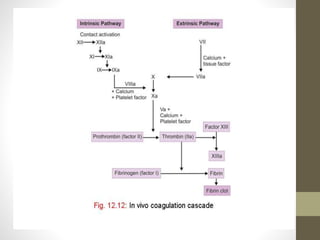
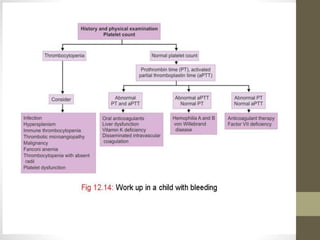
• The process of hemostasis involves platelets, vessel wall and plasma
proteins in a fine balance b/w blood flow and local response to
vascular injury
• Extrinsic pathway is the primary initiating pathway for coagulation
& is measured by PT
• Intrinsic system works as a regulatory amplification loop, measured
by APTT
CLINICAL EVALUATION
• Age of onset of bleeding
• Type of bleeding
• Precipitating factors
• Recent onset bleeding – h/o antecedent infection, rash
(Henoch-Schonlein purpura, varicella), icterus (liver failure),
prodromal diarrhoea & associated renal failure(HUS)
• Medications
• Family history – X linked (hemophilia) –only boys are affected,
girls may have bleeding in autosomal dominant (von
willibrand)
• Poor wound healing & prolonged bleeding from umbilical
stump – factor XIII deficiency
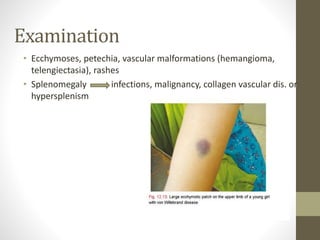
Examination
• Ecchymoses, petechia, vascular malformations (hemangioma,
telengiectasia), rashes
• Splenomegaly infections, malignancy, collagen vascular dis. or
hypersplenism
ITP / IMMUNE THROMBOCYTOPENIA
CLINICAL EVALUATION
• Antecedent h/o febrile illness
• Sudden appearance of bruises & mucosal bleeding, epistaxis, oral
oozing & prolonged bleeds with superficial trauma
• Presence of petechie & ecchymoses
LABORATORY EVALUATION
• CBC – low platelet count
• Peripheral smear – for abnormal cells or malarial parasites
• LFT, RFT & LDH to rule out hepatitis, occult malignancy, hemolysis &
HUS
• Appropriate evaluation of infections
• Screening tests for DIC if sepsis is suspected
• Bone marrow – increased megakaryocytes
MANAGEMENT
• Minimising the risk of h’ge & decreasing the long term side effects
of treatment
• Active bleeding – IV Ig (1g/kg/day) for 1-2days or Anti- D Ig (50-
75mg/kg) in Rh +ve children
• Corticosteroids – Prednisolone (1-4mg/kg/day) for 2-4 weeks and
tapered.
• Severe h’ge – platelet transfusions under cover of steroids
• Chronic ITP – prednisone at low dose on alternate days ,
combination of danazol , vincristine , cyclosporine, azathioprine ,
rituximab , splenectomy , thrombopoetin receptor binding agents.
NEONATAL ALLOIMMUNE
THROMBOCYTOPENIA
• Fetal platelets are destroyed by maternal Abs against paternally
inherited Ags on fetal platelets
• H’gic complications including intracranial h’ge may occur within hrs
after birth
• Specific tests are limited – diagnosed by excluding sepsis,
meconium aspiration, IU infections, effect of maternal medications,
maternal SLE
• Postnatal Mx – transfusion of washed maternal platelets & close
monitoring until the platelet counts normalize
• Fetus requires serial USG for intracranial h’ge
• IV Ig during pregnancy & at birth along with dexamethasone
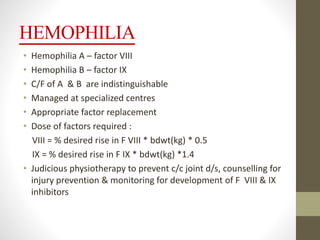
HEMOPHILIA
• Hemophilia A – factor VIII
• Hemophilia B – factor IX
• C/F of A & B are indistinguishable
• Managed at specialized centres
• Appropriate factor replacement
• Dose of factors required :
VIII = % desired rise in F VIII * bdwt(kg) * 0.5
IX = % desired rise in F IX * bdwt(kg) *1.4
• Judicious physiotherapy to prevent c/c joint d/s, counselling for
injury prevention & monitoring for development of F VIII & IX
inhibitors
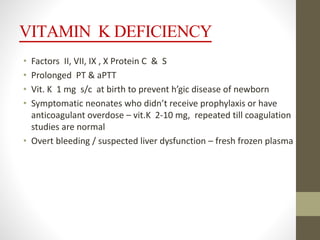
VITAMIN K DEFICIENCY
• Factors II, VII, IX , X Protein C & S
• Prolonged PT & aPTT
• Vit. K 1 mg s/c at birth to prevent h’gic disease of newborn
• Symptomatic neonates who didn’t receive prophylaxis or have
anticoagulant overdose – vit.K 2-10 mg, repeated till coagulation
studies are normal
• Overt bleeding / suspected liver dysfunction – fresh frozen plasma
DIC
SCREENING TESTS
• Peripheral blood film & hemogram – schistocytes &
thrombocytopenia
• PT, aPTT, thrombin time – prolonged
SUPPORTIVE TESTS
• D – dimer – increased
• DIC scoring system based on recommendations of Scientific
Standardization Committee of the International Society on
Thrombosis & Hemostasis
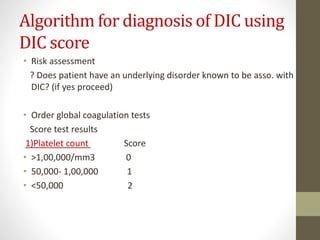
Algorithm for diagnosis of DIC using
DIC score
• Risk assessment
? Does patient have an underlying disorder known to be asso. with
DIC? (if yes proceed)
• Order global coagulation tests
Score test results
1)Platelet count Score
• >1,00,000/mm3 0
• 50,000- 1,00,000 1
• <50,000 2
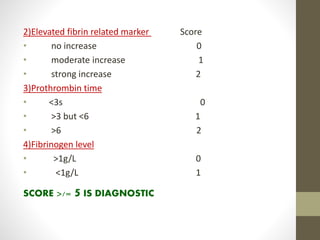
2)Elevated fibrin related marker Score
• no increase 0
• moderate increase 1
• strong increase 2
3)Prothrombin time
• <3s 0
• >3 but <6 1
• >6 2
4)Fibrinogen level
• >1g/L 0
• <1g/L 1
SCORE >/= 5 IS DIAGNOSTIC
TREATMENT
1)Hemostatic support(replacement therapy)
• Blood components used in DIC are : fresh frozen plasma,
cryoprecipitate, platelet concentrate, packed red cells
2)Heparin therapy
• Indication – arterial or large vessel venous thrombosis
THROMBOTIC DISORDERS
CLINICAL EVALUATION
• Predisposing factors : CHD, recent cardiac catheterization, recent sx,
trauma, use of central venous catheter, nephrotic syndrome,
dehydration, sepsis, collagen vascular diseases
• Limb edema, erythema & tenderness on dorsiflexion of foot (+VE
HOMAN SIGN) –DVT
• Diminished / absent arterial pulses & cool extremities – arterial
thrombosis
• Pulmonary embolism – anxiety, breathlessness, pleuritic chest pain,
fever, tachypnoea & cough
• CNS thrombosis – vomiting, lethargy, seizures, weakness
• In-utero stroke – seizures & lethargy
• Renal vein thrombosis – flank pain & hematuria
LABORATORY EVALUATION
• Rule out DIC
• Colour doppler – thrombosed vessels
• Echocardiography – for venacaval & proximal subclavian vein
thrombosis
• MRI in conjunction with magnetic resonance venography – cerebral
venous thrombosis
• CXR & ventilation- perfusion scanning– pulmonary embolism
MANAGEMENT
• Unfractionated / LMW Heparin followed by oral warfarin
THANK YOU

Approach to a bleeding child

  • 1.
    APPROACH TO ABLEEDINGCHILD JISHNU.K.R FINAL MBBS
  • 2.
    • Bleeding mayoccur due to: 1)Defects in platelet a)Thrombocytopenia b)Qualitative disorders of function 2)Coagulation disorders 3)Dysfunctional fibrinolysis
  • 3.
    CAUSES OF THROMBOCYTOPENIA •ITP • Infections: DIC, malaria, kala-azar, DHF, hepatitis B & C • Medications : valproate, penicillin, heparin • Thrombotic microangiopathy: TTP, HUS • Malignancies: leukemia, lymphoma • Autoimmune or related disorders: SLE, APL syndrome • Immunodeficiency • Bone marrow failure and marrow replacement • Others: hypersplenism
  • 4.
    QUALITATIVE DISORDERS OF PLATELETFUNCTION • INHERITED DISORDERS Glanzmann thrombasthenia Bernard Soulier syndrome Gray platelet syndrome Dense body deficiency • ACQUIRED DISORDERS Medications c/c renal failure Cardioulmonary bypass
  • 5.
    COMMON COAGULATION DISORDERS • INHERITEDDISORDERS Hemophilia A and B von Willebrand disease Specific factor deficiencies Factor VII, X, XIII deficiency Afibrinogenemia • ACQUIRED DISORDERS Liver disease Vit K deficiency Warfarin overdose DIC
  • 6.
    • The processof hemostasis involves platelets, vessel wall and plasma proteins in a fine balance b/w blood flow and local response to vascular injury • Extrinsic pathway is the primary initiating pathway for coagulation & is measured by PT • Intrinsic system works as a regulatory amplification loop, measured by APTT
  • 8.
    CLINICAL EVALUATION • Ageof onset of bleeding • Type of bleeding • Precipitating factors • Recent onset bleeding – h/o antecedent infection, rash (Henoch-Schonlein purpura, varicella), icterus (liver failure), prodromal diarrhoea & associated renal failure(HUS) • Medications • Family history – X linked (hemophilia) –only boys are affected, girls may have bleeding in autosomal dominant (von willibrand) • Poor wound healing & prolonged bleeding from umbilical stump – factor XIII deficiency
  • 9.
    Examination • Ecchymoses, petechia,vascular malformations (hemangioma, telengiectasia), rashes • Splenomegaly infections, malignancy, collagen vascular dis. or hypersplenism
  • 11.
    ITP / IMMUNETHROMBOCYTOPENIA CLINICAL EVALUATION • Antecedent h/o febrile illness • Sudden appearance of bruises & mucosal bleeding, epistaxis, oral oozing & prolonged bleeds with superficial trauma • Presence of petechie & ecchymoses
  • 12.
    LABORATORY EVALUATION • CBC– low platelet count • Peripheral smear – for abnormal cells or malarial parasites • LFT, RFT & LDH to rule out hepatitis, occult malignancy, hemolysis & HUS • Appropriate evaluation of infections • Screening tests for DIC if sepsis is suspected • Bone marrow – increased megakaryocytes
  • 13.
    MANAGEMENT • Minimising therisk of h’ge & decreasing the long term side effects of treatment • Active bleeding – IV Ig (1g/kg/day) for 1-2days or Anti- D Ig (50- 75mg/kg) in Rh +ve children • Corticosteroids – Prednisolone (1-4mg/kg/day) for 2-4 weeks and tapered. • Severe h’ge – platelet transfusions under cover of steroids • Chronic ITP – prednisone at low dose on alternate days , combination of danazol , vincristine , cyclosporine, azathioprine , rituximab , splenectomy , thrombopoetin receptor binding agents.
  • 14.
    NEONATAL ALLOIMMUNE THROMBOCYTOPENIA • Fetalplatelets are destroyed by maternal Abs against paternally inherited Ags on fetal platelets • H’gic complications including intracranial h’ge may occur within hrs after birth • Specific tests are limited – diagnosed by excluding sepsis, meconium aspiration, IU infections, effect of maternal medications, maternal SLE
  • 15.
    • Postnatal Mx– transfusion of washed maternal platelets & close monitoring until the platelet counts normalize • Fetus requires serial USG for intracranial h’ge • IV Ig during pregnancy & at birth along with dexamethasone
  • 16.
    HEMOPHILIA • Hemophilia A– factor VIII • Hemophilia B – factor IX • C/F of A & B are indistinguishable • Managed at specialized centres • Appropriate factor replacement • Dose of factors required : VIII = % desired rise in F VIII * bdwt(kg) * 0.5 IX = % desired rise in F IX * bdwt(kg) *1.4 • Judicious physiotherapy to prevent c/c joint d/s, counselling for injury prevention & monitoring for development of F VIII & IX inhibitors
  • 17.
    VITAMIN K DEFICIENCY •Factors II, VII, IX , X Protein C & S • Prolonged PT & aPTT • Vit. K 1 mg s/c at birth to prevent h’gic disease of newborn • Symptomatic neonates who didn’t receive prophylaxis or have anticoagulant overdose – vit.K 2-10 mg, repeated till coagulation studies are normal • Overt bleeding / suspected liver dysfunction – fresh frozen plasma
  • 18.
    DIC SCREENING TESTS • Peripheralblood film & hemogram – schistocytes & thrombocytopenia • PT, aPTT, thrombin time – prolonged SUPPORTIVE TESTS • D – dimer – increased • DIC scoring system based on recommendations of Scientific Standardization Committee of the International Society on Thrombosis & Hemostasis
  • 19.
    Algorithm for diagnosisof DIC using DIC score • Risk assessment ? Does patient have an underlying disorder known to be asso. with DIC? (if yes proceed) • Order global coagulation tests Score test results 1)Platelet count Score • >1,00,000/mm3 0 • 50,000- 1,00,000 1 • <50,000 2
  • 20.
    2)Elevated fibrin relatedmarker Score • no increase 0 • moderate increase 1 • strong increase 2 3)Prothrombin time • <3s 0 • >3 but <6 1 • >6 2 4)Fibrinogen level • >1g/L 0 • <1g/L 1 SCORE >/= 5 IS DIAGNOSTIC
  • 21.
    TREATMENT 1)Hemostatic support(replacement therapy) •Blood components used in DIC are : fresh frozen plasma, cryoprecipitate, platelet concentrate, packed red cells 2)Heparin therapy • Indication – arterial or large vessel venous thrombosis
  • 22.
    THROMBOTIC DISORDERS CLINICAL EVALUATION •Predisposing factors : CHD, recent cardiac catheterization, recent sx, trauma, use of central venous catheter, nephrotic syndrome, dehydration, sepsis, collagen vascular diseases • Limb edema, erythema & tenderness on dorsiflexion of foot (+VE HOMAN SIGN) –DVT • Diminished / absent arterial pulses & cool extremities – arterial thrombosis
  • 23.
    • Pulmonary embolism– anxiety, breathlessness, pleuritic chest pain, fever, tachypnoea & cough • CNS thrombosis – vomiting, lethargy, seizures, weakness • In-utero stroke – seizures & lethargy • Renal vein thrombosis – flank pain & hematuria LABORATORY EVALUATION • Rule out DIC • Colour doppler – thrombosed vessels • Echocardiography – for venacaval & proximal subclavian vein thrombosis
  • 24.
    • MRI inconjunction with magnetic resonance venography – cerebral venous thrombosis • CXR & ventilation- perfusion scanning– pulmonary embolism MANAGEMENT • Unfractionated / LMW Heparin followed by oral warfarin
  • 25.