BLEEDING
DISORDERS
Dr VIJAY SHANKAR . S.
Learning Objectives
 Introduction
 Thromocytopenia – Classification
 Idiopathic thrombocytopenic Purpura
 Thrombotic thrombocytopenic purpura
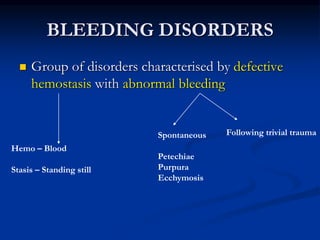
BLEEDING DISORDERS
 Group of disorders characterised by defective
hemostasis with abnormal bleeding
Hemo – Blood
Stasis – Standing still
Spontaneous
Petechiae
Purpura
Ecchymosis
Following trivial trauma
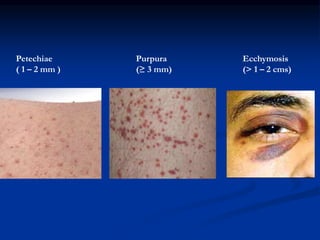
Petechiae
( 1 – 2 mm )
Purpura
(≥ 3 mm)
Ecchymosis
(> 1 – 2 cms)
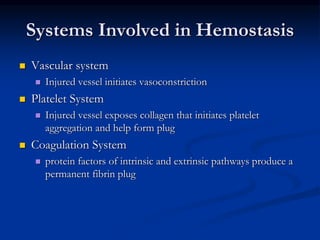
Systems Involved in Hemostasis
 Vascular system
 Injured vessel initiates vasoconstriction
 Platelet System
 Injured vessel exposes collagen that initiates platelet
aggregation and help form plug
 Coagulation System
 protein factors of intrinsic and extrinsic pathways produce a
permanent fibrin plug
Disorders of Hemostasis
 Vascular disorders:
 Scurvy, easy bruising, Henoch-Schonlein purpura.
 Platelet disorders:
 Quantitative - Thrombocytopenia
 Qualitative - Platelet function disorders – Glanzmans
 Coagulation disorders:
 Congenital - Haemophilia (A, B), Von-Willebrands
 Acquired - Vitamin-K deficiency, Liver disease
 Mixed/Consumption: DIC
PLATELET( Thrombocyte)
 Small discoid( 1 – 4 µm) nonnucleate structures
containing granules
 Normal count – 1.5 – 4 lakhs
 Life span – 7 – 8 days
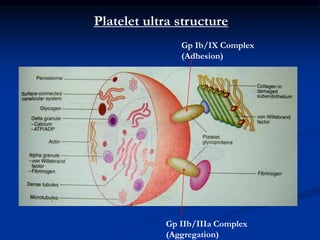
Gp IIb/IIIa Complex
(Aggregation)
Gp Ib/IX Complex
(Adhesion)
Platelet ultra structure
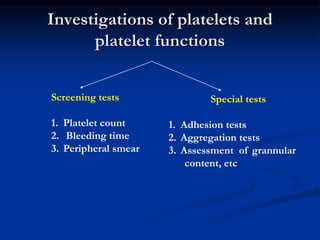
Investigations of platelets and
platelet functions
Screening tests
1. Platelet count
2. Bleeding time
3. Peripheral smear
Special tests
1. Adhesion tests
2. Aggregation tests
3. Assessment of grannular
content, etc
Hemorrhagic diathesis due to
platelet disorders
QUANTITATIVE
↓ in platelet number
( Thrombocytopenia)
QUALITATIVE
Defective platelet function
Congenital Acquired
1. Aspirin therapy
2. Uremia
3. Multiple myeloma, etc
Adhesion defect
Bernard Soulier Synd
VWD
Aggregation defect
Glanzmanns
thrombasthenia
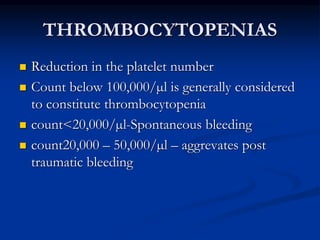
THROMBOCYTOPENIAS
 Reduction in the platelet number
 Count below 100,000/µl is generally considered
to constitute thrombocytopenia
 count<20,000/µl-Spontaneous bleeding
 count20,000 – 50,000/µl – aggrevates post
traumatic bleeding
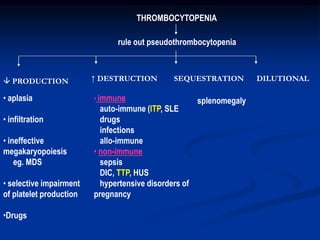
• aplasia
• infiltration
• ineffective
megakaryopoiesis
eg. MDS
• selective impairment
of platelet production
•Drugs
• immune
auto-immune (ITP, SLE
drugs
infections
allo-immune
• non-immune
sepsis
DIC, TTP, HUS
hypertensive disorders of
pregnancy
splenomegaly
THROMBOCYTOPENIA
rule out pseudothrombocytopenia
 PRODUCTION SEQUESTRATION↑ DESTRUCTION DILUTIONAL
Idiopathic
Thrombocytopenic
Purpura (ITP)
Definition
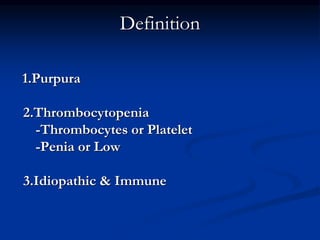
1.Purpura
2.Thrombocytopenia
-Thrombocytes or Platelet
-Penia or Low
3.Idiopathic & Immune
Incidence
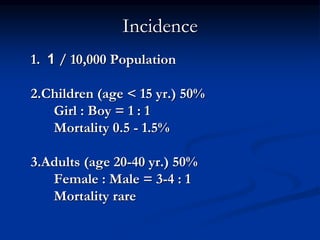
1. 1 / 10,000 Population
2.Children (age < 15 yr.) 50%
Girl : Boy = 1 : 1
Mortality 0.5 - 1.5%
3.Adults (age 20-40 yr.) 50%
Female : Male = 3-4 : 1
Mortality rare
Etiology
.ITP is a disease of increased peripheral
platelet destruction.
.Most patients produce auto-antibodies
to specific platelet membrane
glycoproteins.
.Most patients have either normal or
increased platelet production in BM.
Clinical Manifestations
1.Purpura
-Petechiae
-Ecchymoses
2.Hemorrhage
Clinical Appearance
1.Acute ITP (children)
2.Chronic ITP (adults)
Classification
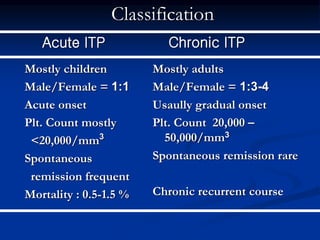
Mostly children
Male/Female = 1:1
Acute onset
Plt. Count mostly
<20,000/mm3
Spontaneous
remission frequent
Mortality : 0.5-1.5 %
Mostly adults
Male/Female = 1:3-4
Usaully gradual onset
Plt. Count 20,000 –
50,000/mm3
Spontaneous remission rare
Chronic recurrent course
Acute ITP Chronic ITP
Common Signs and Symptoms
1.Purpura
2.Menorrhagia
3.Epitaxis
4.Gingival bleeding
5.Recent virus immunization (acute ITP)
6.Recent viral illness (acute ITP)
7.Bruising tendency
Role of Spleen
1.Auto-antibody production
2.Platelet destruction
3.Platelet storage
Common Physical Findings
Nonpalpable petechiae
Hemorrhage
Purpura
Gingival bleeding
Signs of GI bleeding
Spontaneous bleeding
( plt. < 10,000 /mm3)
Menorrhagia
Retinal hemorrhage
Evidence of intracranial
hemorrhage
Nonpalpable spleen
Mortality/Morbidity
1.Hemorrhage represents the most serious
complication
2.Mortality rate from hemorrhage is
approximately 1% in children and 5% in adult
3.Increase risk of severe bleeding in adult ITP
4.Spontaneous remission
: occure in more than 80 % in children
: uncommon in adults
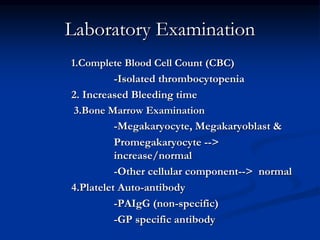
Laboratory Examination
1.Complete Blood Cell Count (CBC)
-Isolated thrombocytopenia
2. Increased Bleeding time
3.Bone Marrow Examination
-Megakaryocyte, Megakaryoblast &
Promegakaryocyte -->
increase/normal
-Other cellular component--> normal
4.Platelet Auto-antibody
-PAIgG (non-specific)
-GP specific antibody
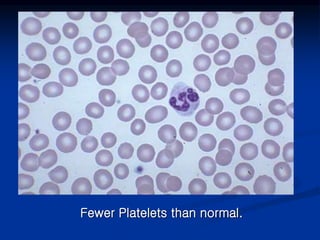
Fewer Platelets than normal.
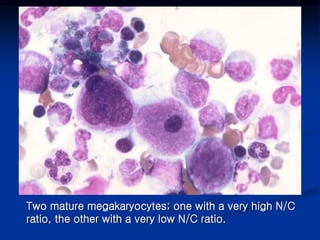
Two mature megakaryocytes; one with a very high N/C
ratio, the other with a very low N/C ratio.
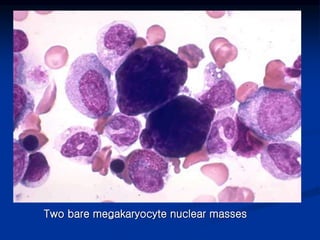
Two bare megakaryocyte nuclear masses
Laboratory Findings
1.Isolated thrombocytopenia
2.No splenomegaly
3.Increase megakaryocytes in BM
4.No other cause of thrombocytopenia
5.Platelet auto-antibody found
Treatment & Prognosis
Acute ITP
1.Self remission 80 %
2.Platelet transfusion in severe bleeding
3.Corticosteroid therapy within 3-4 weeks
4.No response to corticosteroid > 6 months (15 %)
consider Splenectomy
Chronic ITP
1.Complete remission (10-20 %)
2.Corticosteroid therapy to reduce phagocytic activity of
RE system & suppress antibody production
3.Consider Splenectomy :
-No response to high dose steroid
-Cerebral hemorrhage
THROMBOTIC THROMBOCYTOPENIC
PURPURA( TTP)
 Fulminant and lethal disorder
 Characterised by the formation of hyaline
microthrombi within the microvasculature
throughout the body
 The thrombi is composed of platelets and fibrin.
Thrombotic Thrombocytopenic
Purpura
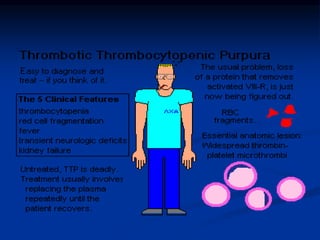
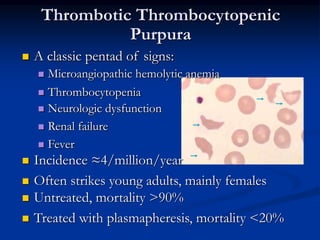
 A classic pentad of signs:
 Microangiopathic hemolytic anemia
 Thrombocytopenia
 Neurologic dysfunction
 Renal failure
 Fever
 Untreated, mortality >90%
 Treated with plasmapheresis, mortality <20%
 Incidence ≈4/million/year
 Often strikes young adults, mainly females
 A classic pentad of signs:
 Microangiopathic hemolytic anemia
 Thrombocytopenia
 Neurologic dysfunction
 Renal failure
 Fever
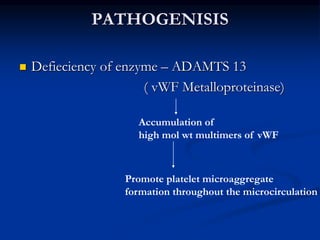
PATHOGENISIS
 Defieciency of enzyme – ADAMTS 13
( vWF Metalloproteinase)
Accumulation of
high mol wt multimers of vWF
Promote platelet microaggregate
formation throughout the microcirculation
 Untreated, mortality >90%
 Treated with plasmapheresis, mortality <20%
Summary
 Thromocytopenia – Classification
 Idiopathic thrombocytopenic Purpura
 Thrombotic thrombocytopenic purpura
Bleeding disorders

Bleeding disorders

  • 1.
  • 2.
    Learning Objectives  Introduction Thromocytopenia – Classification  Idiopathic thrombocytopenic Purpura  Thrombotic thrombocytopenic purpura
  • 3.
    BLEEDING DISORDERS  Groupof disorders characterised by defective hemostasis with abnormal bleeding Hemo – Blood Stasis – Standing still Spontaneous Petechiae Purpura Ecchymosis Following trivial trauma
  • 4.
    Petechiae ( 1 –2 mm ) Purpura (≥ 3 mm) Ecchymosis (> 1 – 2 cms)
  • 5.
    Systems Involved inHemostasis  Vascular system  Injured vessel initiates vasoconstriction  Platelet System  Injured vessel exposes collagen that initiates platelet aggregation and help form plug  Coagulation System  protein factors of intrinsic and extrinsic pathways produce a permanent fibrin plug
  • 6.
    Disorders of Hemostasis Vascular disorders:  Scurvy, easy bruising, Henoch-Schonlein purpura.  Platelet disorders:  Quantitative - Thrombocytopenia  Qualitative - Platelet function disorders – Glanzmans  Coagulation disorders:  Congenital - Haemophilia (A, B), Von-Willebrands  Acquired - Vitamin-K deficiency, Liver disease  Mixed/Consumption: DIC
  • 7.
    PLATELET( Thrombocyte)  Smalldiscoid( 1 – 4 µm) nonnucleate structures containing granules  Normal count – 1.5 – 4 lakhs  Life span – 7 – 8 days
  • 8.
    Gp IIb/IIIa Complex (Aggregation) GpIb/IX Complex (Adhesion) Platelet ultra structure
  • 9.
    Investigations of plateletsand platelet functions Screening tests 1. Platelet count 2. Bleeding time 3. Peripheral smear Special tests 1. Adhesion tests 2. Aggregation tests 3. Assessment of grannular content, etc
  • 10.
    Hemorrhagic diathesis dueto platelet disorders QUANTITATIVE ↓ in platelet number ( Thrombocytopenia) QUALITATIVE Defective platelet function Congenital Acquired 1. Aspirin therapy 2. Uremia 3. Multiple myeloma, etc Adhesion defect Bernard Soulier Synd VWD Aggregation defect Glanzmanns thrombasthenia
  • 11.
    THROMBOCYTOPENIAS  Reduction inthe platelet number  Count below 100,000/µl is generally considered to constitute thrombocytopenia  count<20,000/µl-Spontaneous bleeding  count20,000 – 50,000/µl – aggrevates post traumatic bleeding
  • 12.
    • aplasia • infiltration •ineffective megakaryopoiesis eg. MDS • selective impairment of platelet production •Drugs • immune auto-immune (ITP, SLE drugs infections allo-immune • non-immune sepsis DIC, TTP, HUS hypertensive disorders of pregnancy splenomegaly THROMBOCYTOPENIA rule out pseudothrombocytopenia  PRODUCTION SEQUESTRATION↑ DESTRUCTION DILUTIONAL
  • 13.
  • 14.
  • 15.
    Incidence 1. 1 /10,000 Population 2.Children (age < 15 yr.) 50% Girl : Boy = 1 : 1 Mortality 0.5 - 1.5% 3.Adults (age 20-40 yr.) 50% Female : Male = 3-4 : 1 Mortality rare
  • 16.
    Etiology .ITP is adisease of increased peripheral platelet destruction. .Most patients produce auto-antibodies to specific platelet membrane glycoproteins. .Most patients have either normal or increased platelet production in BM.
  • 17.
  • 18.
    Clinical Appearance 1.Acute ITP(children) 2.Chronic ITP (adults)
  • 19.
    Classification Mostly children Male/Female =1:1 Acute onset Plt. Count mostly <20,000/mm3 Spontaneous remission frequent Mortality : 0.5-1.5 % Mostly adults Male/Female = 1:3-4 Usaully gradual onset Plt. Count 20,000 – 50,000/mm3 Spontaneous remission rare Chronic recurrent course Acute ITP Chronic ITP
  • 20.
    Common Signs andSymptoms 1.Purpura 2.Menorrhagia 3.Epitaxis 4.Gingival bleeding 5.Recent virus immunization (acute ITP) 6.Recent viral illness (acute ITP) 7.Bruising tendency
  • 21.
    Role of Spleen 1.Auto-antibodyproduction 2.Platelet destruction 3.Platelet storage
  • 22.
    Common Physical Findings Nonpalpablepetechiae Hemorrhage Purpura Gingival bleeding Signs of GI bleeding Spontaneous bleeding ( plt. < 10,000 /mm3) Menorrhagia Retinal hemorrhage Evidence of intracranial hemorrhage Nonpalpable spleen
  • 23.
    Mortality/Morbidity 1.Hemorrhage represents themost serious complication 2.Mortality rate from hemorrhage is approximately 1% in children and 5% in adult 3.Increase risk of severe bleeding in adult ITP 4.Spontaneous remission : occure in more than 80 % in children : uncommon in adults
  • 24.
    Laboratory Examination 1.Complete BloodCell Count (CBC) -Isolated thrombocytopenia 2. Increased Bleeding time 3.Bone Marrow Examination -Megakaryocyte, Megakaryoblast & Promegakaryocyte --> increase/normal -Other cellular component--> normal 4.Platelet Auto-antibody -PAIgG (non-specific) -GP specific antibody
  • 25.
  • 26.
    Two mature megakaryocytes;one with a very high N/C ratio, the other with a very low N/C ratio.
  • 27.
    Two bare megakaryocytenuclear masses
  • 28.
    Laboratory Findings 1.Isolated thrombocytopenia 2.Nosplenomegaly 3.Increase megakaryocytes in BM 4.No other cause of thrombocytopenia 5.Platelet auto-antibody found
  • 29.
    Treatment & Prognosis AcuteITP 1.Self remission 80 % 2.Platelet transfusion in severe bleeding 3.Corticosteroid therapy within 3-4 weeks 4.No response to corticosteroid > 6 months (15 %) consider Splenectomy Chronic ITP 1.Complete remission (10-20 %) 2.Corticosteroid therapy to reduce phagocytic activity of RE system & suppress antibody production 3.Consider Splenectomy : -No response to high dose steroid -Cerebral hemorrhage
  • 30.
    THROMBOTIC THROMBOCYTOPENIC PURPURA( TTP) Fulminant and lethal disorder  Characterised by the formation of hyaline microthrombi within the microvasculature throughout the body  The thrombi is composed of platelets and fibrin.
  • 32.
    Thrombotic Thrombocytopenic Purpura  Aclassic pentad of signs:  Microangiopathic hemolytic anemia  Thrombocytopenia  Neurologic dysfunction  Renal failure  Fever  Untreated, mortality >90%  Treated with plasmapheresis, mortality <20%  Incidence ≈4/million/year  Often strikes young adults, mainly females  A classic pentad of signs:  Microangiopathic hemolytic anemia  Thrombocytopenia  Neurologic dysfunction  Renal failure  Fever
  • 33.
    PATHOGENISIS  Defieciency ofenzyme – ADAMTS 13 ( vWF Metalloproteinase) Accumulation of high mol wt multimers of vWF Promote platelet microaggregate formation throughout the microcirculation
  • 34.
     Untreated, mortality>90%  Treated with plasmapheresis, mortality <20%
  • 35.
    Summary  Thromocytopenia –Classification  Idiopathic thrombocytopenic Purpura  Thrombotic thrombocytopenic purpura