Bleeding neonate

        Dr. Abhijeet
Etiology
A.Deficiency of clotting factors:
1.Transitory deficiencies-
Deficiency of vitamin K dependent
  C.F- II, VII, IX, X.
 Deficiency of anticoagulant proteins
  C & S.
Causes:
a. Total parenteral nutrition or antibiotics
b. Lack of administration of vitamin K .
c. Drug intake in pregnancy
     eg.i. Phenytoin, Phenobarbital, Salicylates .
            (Interferes with the synthesis of vit. K
   dependent c.f. )
        ii. Calmodulin compounds : interfare
   with synthesis of vit K
   dependeat C.F.
• The incidence among babies born to mothers
  on these drugs have varied between 6-12%*.
   In a recent series on children born to mothers
  on anticonvulsants, abnormal PT was
  documented in 14 out of 105 babies (13%)
  , no overt bleeding was observed*.
2. Disturbances of clotting
- Related to DIC due to infection, shock,
  anoxia, NEC, renal vein thrombosis, use
  of IV canula.

3. Inherited abnormalities of C.F.
 a. X-Linked recessive diseases-
    i. Hemophilia-A : Factor VIII deficiency.
   ii. Hemophilia-B : Factor IX deficiency.
b. Autosomal dominant diseases:
    i. Von Willebrand disease – Deficiency of
  VWF which is a carrier of factor VIII & as a
  platelet aggregation agent.
c. Autosomal recessive diseases:
    i. Severe factor VII & factor XIII deficiency –
  intracranial hemorrhage in neonates
   ii. Factor XI deficiency –
       unpredictable bleeding during
  surgery/trauma.
iii. VWD Type III


B. Platelet problems:
1. Qualitative disorders:
- Glanzman’s thrombasthenia.
- Bernard-Soulier syndrome
- Platelet type VWD
2. Quantitive disorders:
- Immune thrombocytipenia
- Matrnal Preeclampsia, HELLP syndrome
  or severe uteroplacental insuffuciency.
- DIC due to infection or asphyxia.
- Inherited marrow failure syndromes :
  Fanconi anemia & congenital
  amegakaryocytic thrombocytopenia
- Congenital leukemia
- Inherited thrombocytopenia syndromes
  : gray platelet syndrome
- Macrothrombocytopenias : May-
  Hegglin syndr.
- Platelet consumption in clots/ vascular
  disorders eg. Vascular malformations,
  NEC.
C. Vascular origin:
- Pulmonary haemorrhage
- A-V malformations
- CNS haemorrhage
- Hemangiomas.
Diagnostic workup

A.History
-   Family h/o bleeding disorders
-   Maternal medications
-   Pregnancy & birth history
-   Maternal h/o infant with bleeding disorder
-   Any medications, procedures, anomalies in
    infant
B. Examination:
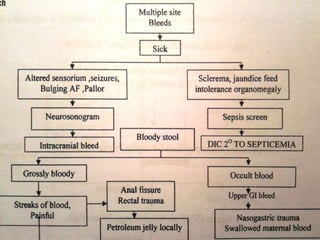
First diagnose whether the infant is Sick or Well
1. Sick infant:
- DIC
- Bacterial/ viral infections.
2. Well infant:
- Vit K deficiency
- Isolated C.F. deficiencies
- Immune thrombocytopenia
- Maternal blood in infant’s GIT.
3. Patchiae, ecchymosis, mucosal
  bleeding: Platelet problem
4. Large bruises: DIC, C.F deficiencies,
  liver diseases
5. Enlarged spleen : Possible congenital
  infections or erythroblastosis.
6. Jaundice : Sepsis, liver diseases,
  resorption of large hematoma.
C. Laboratory tests:
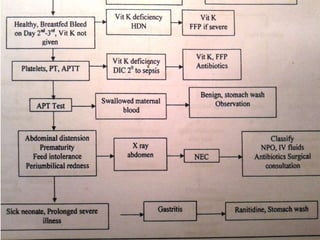
1. Apt test :
 - To rule out maternal blood in infant’s
   GIT
 - Done in otherwise well infant with
   only GI bleeding.
2. PBS :
- DIC- fragmented RBCs
- Congenital macrothrombocytopenias –
   large platelets.
3. PT
4. APTT
5. D-Dimer assays: Measure fibrin
  degradation products in DIC & Liver
  diseases causing defective clearing of
  fibrin split products.
6. Specific factor assays & Von
  Willebrand assay: For patients with +
  ve family h/o.
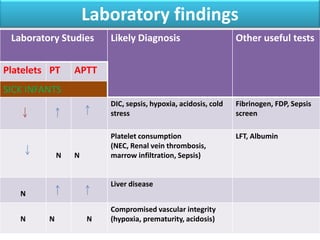
Laboratory findings
 Laboratory Studies      Likely Diagnosis                       Other useful tests


Platelets PT     APTT
SICK INFANTS
                         DIC, sepsis, hypoxia, acidosis, cold   Fibrinogen, FDP, Sepsis
                         stress                                 screen

                         Platelet consumption                   LFT, Albumin
                         (NEC, Renal vein thrombosis,
             N   N       marrow infiltration, Sepsis)


                         Liver disease
   N
                         Compromised vascular integrity
   N     N           N   (hypoxia, prematurity, acidosis)
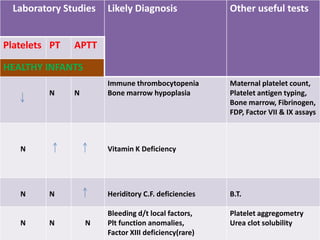
Laboratory Studies    Likely Diagnosis               Other useful tests


Platelets PT   APTT

HEALTHY INFANTS
                       Immune thrombocytopenia        Maternal platelet count,
         N     N       Bone marrow hypoplasia         Platelet antigen typing,
                                                      Bone marrow, Fibrinogen,
                                                      FDP, Factor VII & IX assays


   N                   Vitamin K Deficiency


   N     N             Heriditory C.F. deficiencies   B.T.

                       Bleeding d/t local factors,    Platelet aggregometry
   N     N         N   Plt function anomalies,        Urea clot solubility
                       Factor XIII deficiency(rare)
Treatment Of Bleeding
A. Inj Vitamin K1 (Aquaminophyton)
- 1 mg IV or IM if not given at birth.
- Infants on TPN
- Infants on Antibiotics > 2 weeks: at
   least 0.5mg Vit K weekly.
- Preferred rather than FFP for prolonged
   PT & PTT, FFP should be reserved for
   emergencies.
B. FFP:
- 10ml/kg IV for active bleeding
- Repeated 8-12 hrly as needed.
- Replaces C.F. immediately.
C. Platelets:
- 1 Unit of platelet raises count by
  50,000-10,000/mm3.
- Platelet count slowly decreases if stores
  3-5 days.
D. Fresh whole blood:
- 10ml/kg
- Can be repeated after 6-8 hrs as needed.
E. Clotting factor concetrates
- Severe VWD :
- VWF containing plasma derived factor VIII
  concetrate.
- Known deficiency of factor VIII or IX :
  Recombinent DNA derived factor VIII and
  IX concetrate
F. Disorders due to problems other than hemostatic
   proteins :
- Rule out the underlying possibilities
- eg. Infection, Liver rupture, catheter, NEC.

G. T/t of specific disorders :
1. DIC :
- Treat the underlying cause i.e. sepsis, NEC
- Make sure that Vit K1 has been given.
- Platelets/ FFP to keep platelet counts > 50,000/ml
  and to stop bleeding.


- If bleeding persists,
   i. Exchange transfusion with fresh whole blood
    /Packed RBC/Platelets/FFP
  ii. Continuous transfusion with platelets, packed
    RBCs or FFP as needed.
 iii. For hypofibrinogenemia : Cryoprecipitate
    (10ml/kg)
2. Haemorrhagic disease of newborn
- Incidance is 1:200 neonates (Not given Vit-K).
- For active bleeding : 10ml/kg FFP & Inj
  Vitamin K 1mg IV .
- If mother is on t/t with Phenytoin, primidone,
   Methoximide or Phenobarbital, the infant
  may be deficient in vit K
   .Inj Vit K 10mg IM 24 hours before delivery
   . Newborn is monitored for signs of bleeding,
  PT, APTT.
3. Delayed Hemorrhagic disease of
  newborn:
- Occurs at 4-12 weeks of age
- Not very common in infants who received Vit
  K at birth.
- Exclusively breast feeding infant
- Infant on t/t with broad spectrum antibiotics
- Infant with malabsorption
   T/t: Vitamin K1- 1mg/week orally for first 3
  months of life.
Referances
*. Sutor AH, von Kries R, Marlies Conelissen EA,
  Mcninch, Andrew M. VitaminK Deficiency
  Bleeding (VKDB) in infancy.Thrombosis and
  Haemostasis 1999;81: 456-461.
* Narang A. Hemorrhagic Disease of Newborn.
  Indian Pediatr 1989, 26:523-524. 4. von Kries
  R, Hanawa Y. Neonatal vitamin K
  prophylaxis.Thrombosis and Haemostasis
  1993, 69:293-295.
Thank You…

Bleeding neonate

  • 1.
    Bleeding neonate Dr. Abhijeet
  • 2.
    Etiology A.Deficiency of clottingfactors: 1.Transitory deficiencies- Deficiency of vitamin K dependent C.F- II, VII, IX, X.  Deficiency of anticoagulant proteins C & S.
  • 3.
    Causes: a. Total parenteralnutrition or antibiotics b. Lack of administration of vitamin K . c. Drug intake in pregnancy eg.i. Phenytoin, Phenobarbital, Salicylates . (Interferes with the synthesis of vit. K dependent c.f. ) ii. Calmodulin compounds : interfare with synthesis of vit K dependeat C.F.
  • 4.
    • The incidenceamong babies born to mothers on these drugs have varied between 6-12%*. In a recent series on children born to mothers on anticonvulsants, abnormal PT was documented in 14 out of 105 babies (13%) , no overt bleeding was observed*.
  • 5.
    2. Disturbances ofclotting - Related to DIC due to infection, shock, anoxia, NEC, renal vein thrombosis, use of IV canula. 3. Inherited abnormalities of C.F. a. X-Linked recessive diseases- i. Hemophilia-A : Factor VIII deficiency. ii. Hemophilia-B : Factor IX deficiency.
  • 6.
    b. Autosomal dominantdiseases: i. Von Willebrand disease – Deficiency of VWF which is a carrier of factor VIII & as a platelet aggregation agent. c. Autosomal recessive diseases: i. Severe factor VII & factor XIII deficiency – intracranial hemorrhage in neonates ii. Factor XI deficiency – unpredictable bleeding during surgery/trauma.
  • 7.
    iii. VWD TypeIII B. Platelet problems: 1. Qualitative disorders: - Glanzman’s thrombasthenia. - Bernard-Soulier syndrome - Platelet type VWD
  • 8.
    2. Quantitive disorders: -Immune thrombocytipenia - Matrnal Preeclampsia, HELLP syndrome or severe uteroplacental insuffuciency. - DIC due to infection or asphyxia. - Inherited marrow failure syndromes : Fanconi anemia & congenital amegakaryocytic thrombocytopenia
  • 9.
    - Congenital leukemia -Inherited thrombocytopenia syndromes : gray platelet syndrome - Macrothrombocytopenias : May- Hegglin syndr. - Platelet consumption in clots/ vascular disorders eg. Vascular malformations, NEC.
  • 10.
    C. Vascular origin: -Pulmonary haemorrhage - A-V malformations - CNS haemorrhage - Hemangiomas.
  • 11.
    Diagnostic workup A.History - Family h/o bleeding disorders - Maternal medications - Pregnancy & birth history - Maternal h/o infant with bleeding disorder - Any medications, procedures, anomalies in infant
  • 12.
    B. Examination: First diagnosewhether the infant is Sick or Well 1. Sick infant: - DIC - Bacterial/ viral infections. 2. Well infant: - Vit K deficiency - Isolated C.F. deficiencies - Immune thrombocytopenia - Maternal blood in infant’s GIT.
  • 13.
    3. Patchiae, ecchymosis,mucosal bleeding: Platelet problem 4. Large bruises: DIC, C.F deficiencies, liver diseases 5. Enlarged spleen : Possible congenital infections or erythroblastosis. 6. Jaundice : Sepsis, liver diseases, resorption of large hematoma.
  • 14.
    C. Laboratory tests: 1.Apt test : - To rule out maternal blood in infant’s GIT - Done in otherwise well infant with only GI bleeding. 2. PBS : - DIC- fragmented RBCs - Congenital macrothrombocytopenias – large platelets.
  • 15.
    3. PT 4. APTT 5.D-Dimer assays: Measure fibrin degradation products in DIC & Liver diseases causing defective clearing of fibrin split products. 6. Specific factor assays & Von Willebrand assay: For patients with + ve family h/o.
  • 18.
    Laboratory findings LaboratoryStudies Likely Diagnosis Other useful tests Platelets PT APTT SICK INFANTS DIC, sepsis, hypoxia, acidosis, cold Fibrinogen, FDP, Sepsis stress screen Platelet consumption LFT, Albumin (NEC, Renal vein thrombosis, N N marrow infiltration, Sepsis) Liver disease N Compromised vascular integrity N N N (hypoxia, prematurity, acidosis)
  • 19.
    Laboratory Studies Likely Diagnosis Other useful tests Platelets PT APTT HEALTHY INFANTS Immune thrombocytopenia Maternal platelet count, N N Bone marrow hypoplasia Platelet antigen typing, Bone marrow, Fibrinogen, FDP, Factor VII & IX assays N Vitamin K Deficiency N N Heriditory C.F. deficiencies B.T. Bleeding d/t local factors, Platelet aggregometry N N N Plt function anomalies, Urea clot solubility Factor XIII deficiency(rare)
  • 20.
    Treatment Of Bleeding A.Inj Vitamin K1 (Aquaminophyton) - 1 mg IV or IM if not given at birth. - Infants on TPN - Infants on Antibiotics > 2 weeks: at least 0.5mg Vit K weekly. - Preferred rather than FFP for prolonged PT & PTT, FFP should be reserved for emergencies.
  • 21.
    B. FFP: - 10ml/kgIV for active bleeding - Repeated 8-12 hrly as needed. - Replaces C.F. immediately. C. Platelets: - 1 Unit of platelet raises count by 50,000-10,000/mm3. - Platelet count slowly decreases if stores 3-5 days.
  • 22.
    D. Fresh wholeblood: - 10ml/kg - Can be repeated after 6-8 hrs as needed. E. Clotting factor concetrates - Severe VWD : - VWF containing plasma derived factor VIII concetrate. - Known deficiency of factor VIII or IX : Recombinent DNA derived factor VIII and IX concetrate
  • 23.
    F. Disorders dueto problems other than hemostatic proteins : - Rule out the underlying possibilities - eg. Infection, Liver rupture, catheter, NEC. G. T/t of specific disorders : 1. DIC : - Treat the underlying cause i.e. sepsis, NEC - Make sure that Vit K1 has been given.
  • 24.
    - Platelets/ FFPto keep platelet counts > 50,000/ml and to stop bleeding. - If bleeding persists, i. Exchange transfusion with fresh whole blood /Packed RBC/Platelets/FFP ii. Continuous transfusion with platelets, packed RBCs or FFP as needed. iii. For hypofibrinogenemia : Cryoprecipitate (10ml/kg)
  • 25.
    2. Haemorrhagic diseaseof newborn - Incidance is 1:200 neonates (Not given Vit-K). - For active bleeding : 10ml/kg FFP & Inj Vitamin K 1mg IV . - If mother is on t/t with Phenytoin, primidone, Methoximide or Phenobarbital, the infant may be deficient in vit K .Inj Vit K 10mg IM 24 hours before delivery . Newborn is monitored for signs of bleeding, PT, APTT.
  • 26.
    3. Delayed Hemorrhagicdisease of newborn: - Occurs at 4-12 weeks of age - Not very common in infants who received Vit K at birth. - Exclusively breast feeding infant - Infant on t/t with broad spectrum antibiotics - Infant with malabsorption T/t: Vitamin K1- 1mg/week orally for first 3 months of life.
  • 27.
    Referances *. Sutor AH,von Kries R, Marlies Conelissen EA, Mcninch, Andrew M. VitaminK Deficiency Bleeding (VKDB) in infancy.Thrombosis and Haemostasis 1999;81: 456-461. * Narang A. Hemorrhagic Disease of Newborn. Indian Pediatr 1989, 26:523-524. 4. von Kries R, Hanawa Y. Neonatal vitamin K prophylaxis.Thrombosis and Haemostasis 1993, 69:293-295.
  • 28.