The document discusses different types of real numbers including rational and irrational numbers. It provides examples and definitions of natural numbers, whole numbers, integers, rational numbers, and irrational numbers. It also includes information on Euclid's division algorithm and its application in finding the highest common factor of two numbers. Examples are provided to illustrate the algorithm.
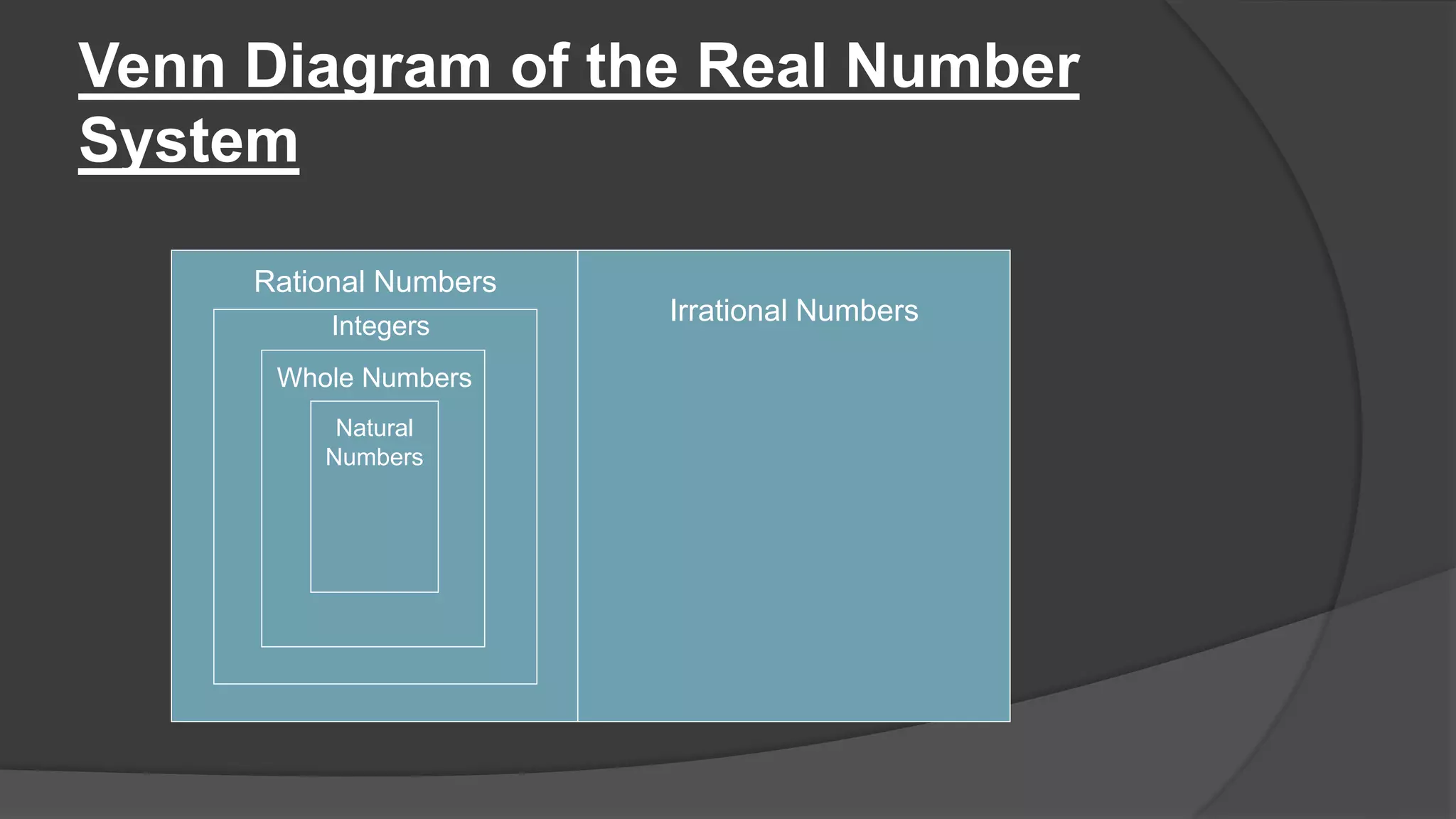
Explains real numbers, including natural, whole, integers, rational, and irrational numbers. Discusses representations using Venn diagrams.
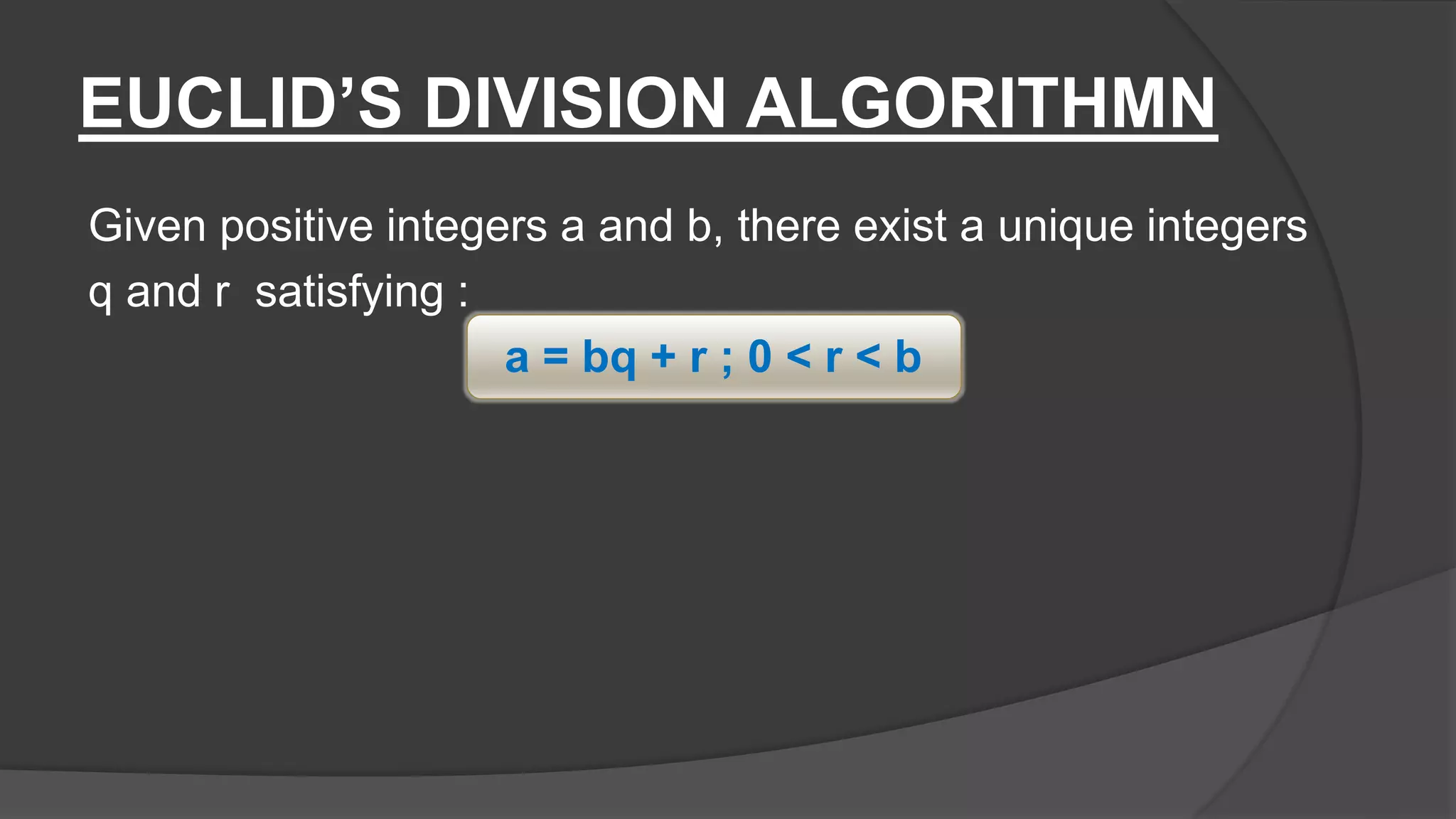
Introduces Euclid’s Division Algorithm for finding the HCF of numbers with detailed step-by-step examples.
Discusses contributions by Cantor, Dedekind, and Archimedes in understanding real numbers and their decimal expansions.
Covers multiple examples of finding the HCF and LCM using Euclid’s theorem and factorization for sets of integers.Proves various mathematical expressions as irrational. Discusses properties of rational numbers and their decimal forms.
Provides decimal expansions for specific rational numbers confirming their types of decimal expansions.
Real Numbers
Realnumbers consist of all the rational and irrational numbers.
The real number system has many subsets:
Natural Numbers
Whole Numbers
Integers
Rational Number
Irrational Numbers
4.
Venn Diagram ofthe Real Number
System
Irrational Numbers
Rational Numbers
Integers
Whole Numbers
Natural
Numbers
5.
DESCIPTION OF PARTSOF REAL
NUMBERS
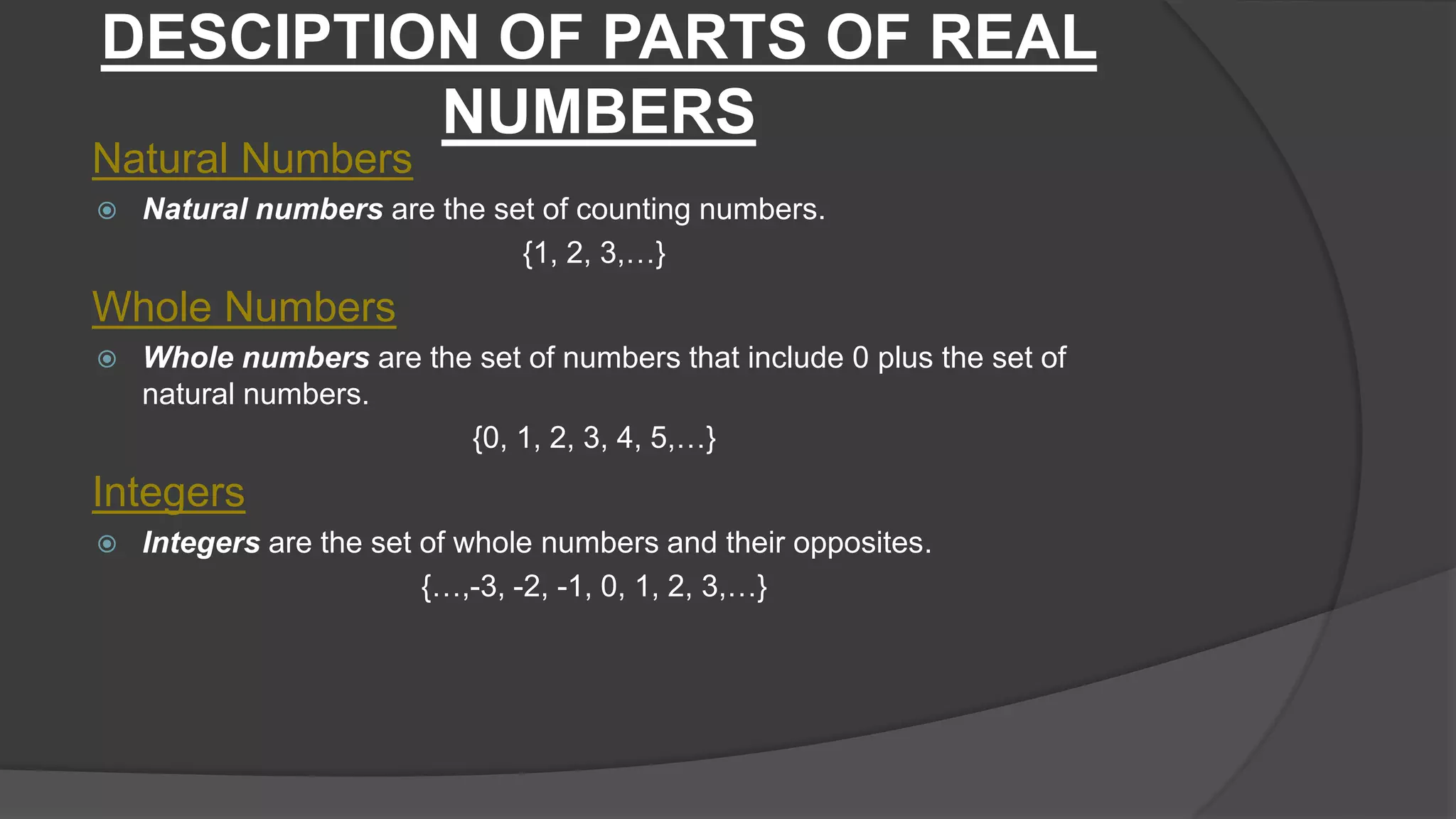
Natural Numbers
Natural numbers are the set of counting numbers.
{1, 2, 3,…}
Whole Numbers
Whole numbers are the set of numbers that include 0 plus the set of
natural numbers.
{0, 1, 2, 3, 4, 5,…}
Integers
Integers are the set of whole numbers and their opposites.
{…,-3, -2, -1, 0, 1, 2, 3,…}
6.
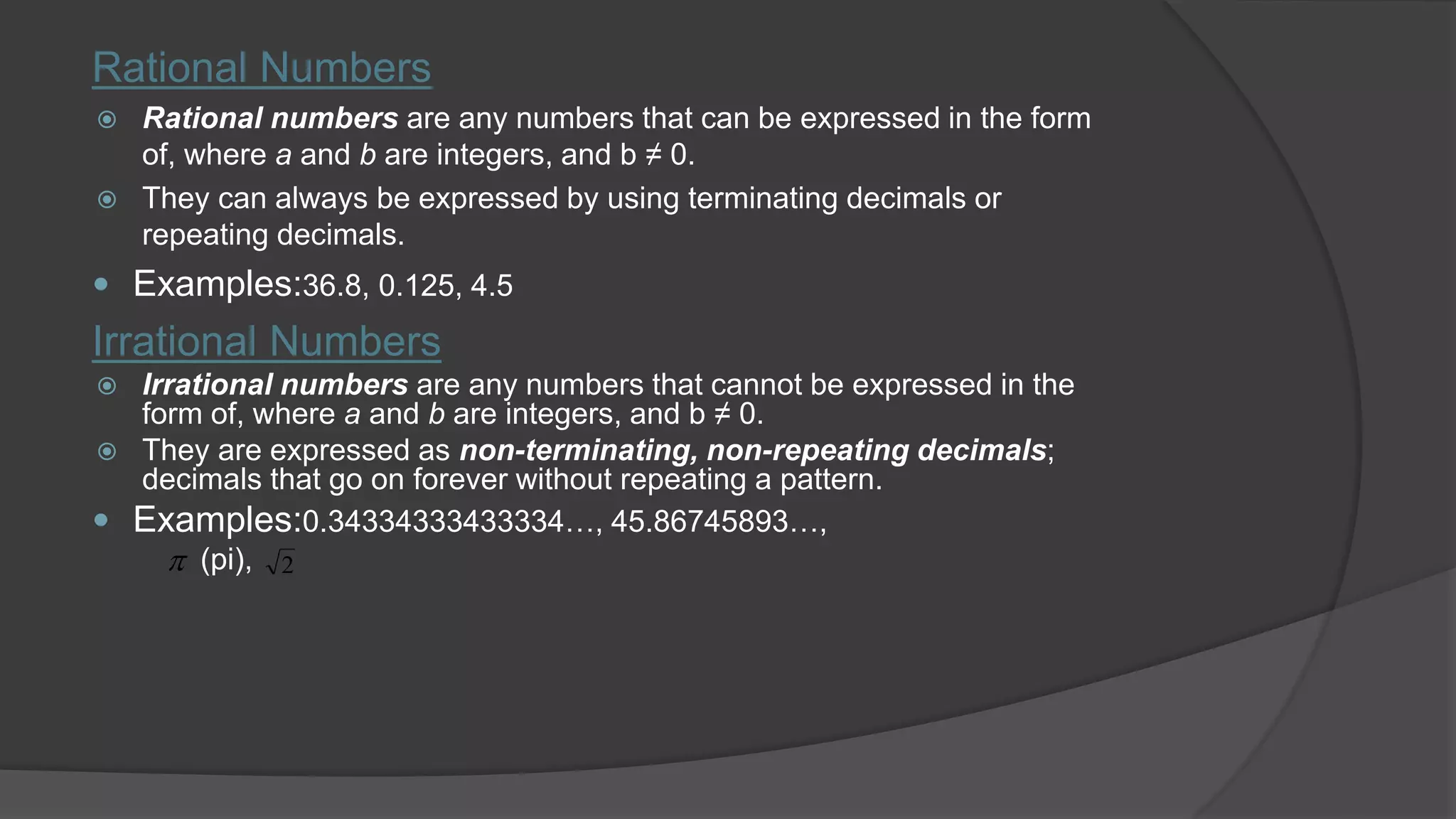
Rational Numbers
Rationalnumbers are any numbers that can be expressed in the form
of, where a and b are integers, and b ≠ 0.
They can always be expressed by using terminating decimals or
repeating decimals.
Examples:36.8, 0.125, 4.5
Irrational Numbers
Irrational numbers are any numbers that cannot be expressed in the
form of, where a and b are integers, and b ≠ 0.
They are expressed as non-terminating, non-repeating decimals;
decimals that go on forever without repeating a pattern.
Examples:0.34334333433334…, 45.86745893…,
(pi), 2
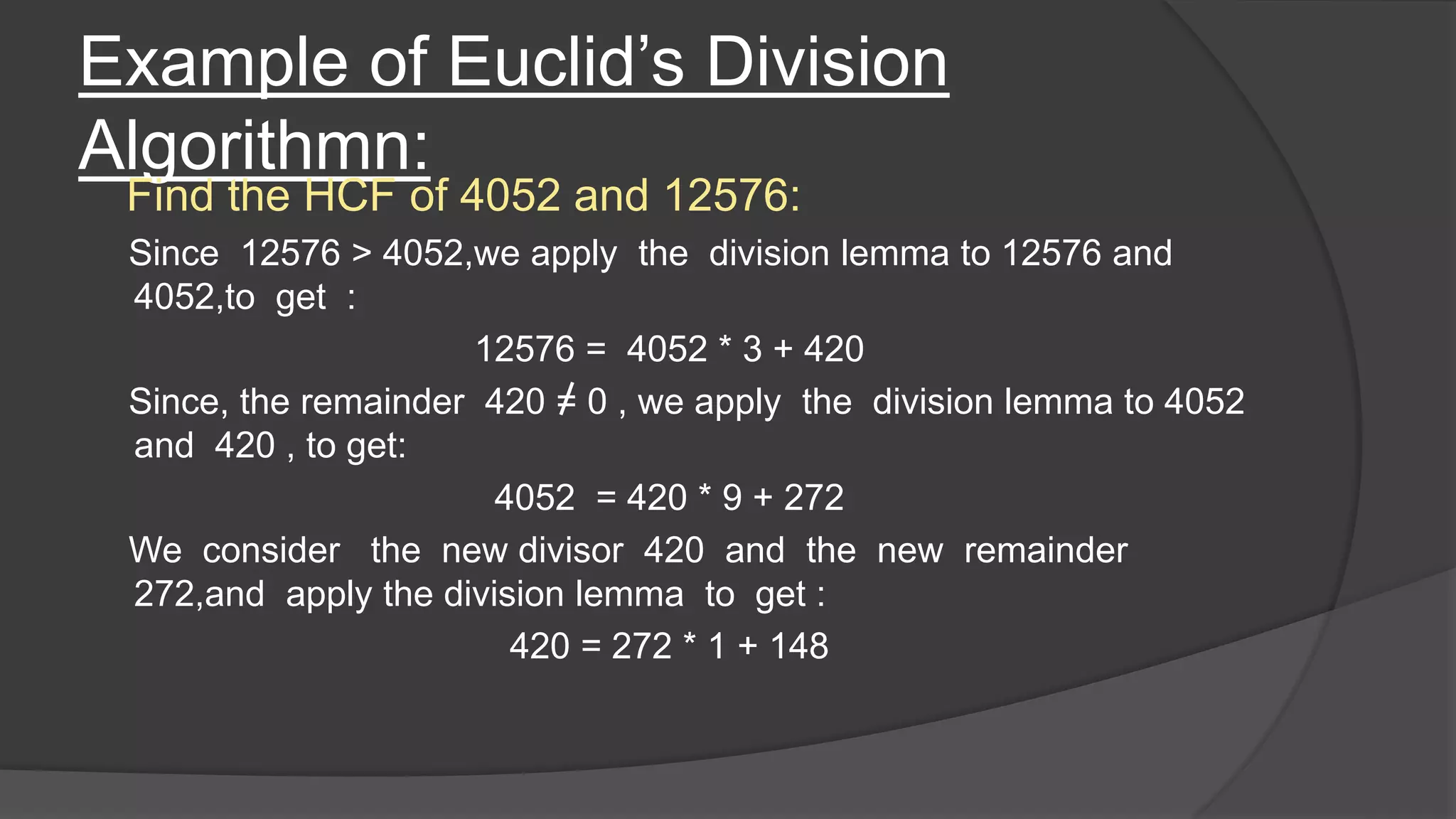
Example of Euclid’sDivision
Algorithmn:
Find the HCF of 4052 and 12576:
Since 12576 > 4052,we apply the division lemma to 12576 and
4052,to get :
12576 = 4052 * 3 + 420
Since, the remainder 420 = 0 , we apply the division lemma to 4052
and 420 , to get:
4052 = 420 * 9 + 272
We consider the new divisor 420 and the new remainder
272,and apply the division lemma to get :
420 = 272 * 1 + 148
9.
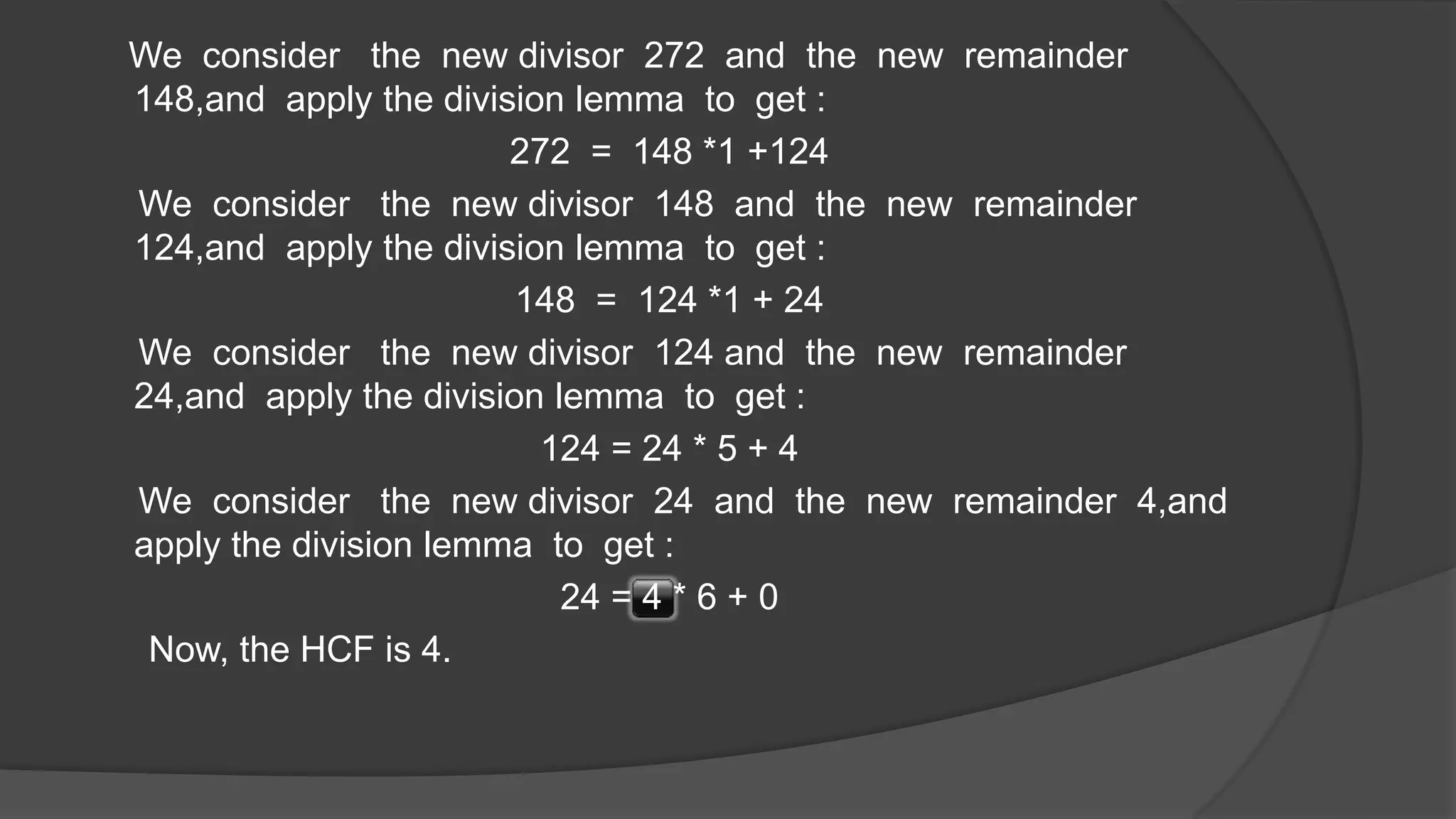
We consider thenew divisor 272 and the new remainder
148,and apply the division lemma to get :
272 = 148 *1 +124
We consider the new divisor 148 and the new remainder
124,and apply the division lemma to get :
148 = 124 *1 + 24
We consider the new divisor 124 and the new remainder
24,and apply the division lemma to get :
124 = 24 * 5 + 4
We consider the new divisor 24 and the new remainder 4,and
apply the division lemma to get :
24 = 4 * 6 + 0
Now, the HCF is 4.
11.
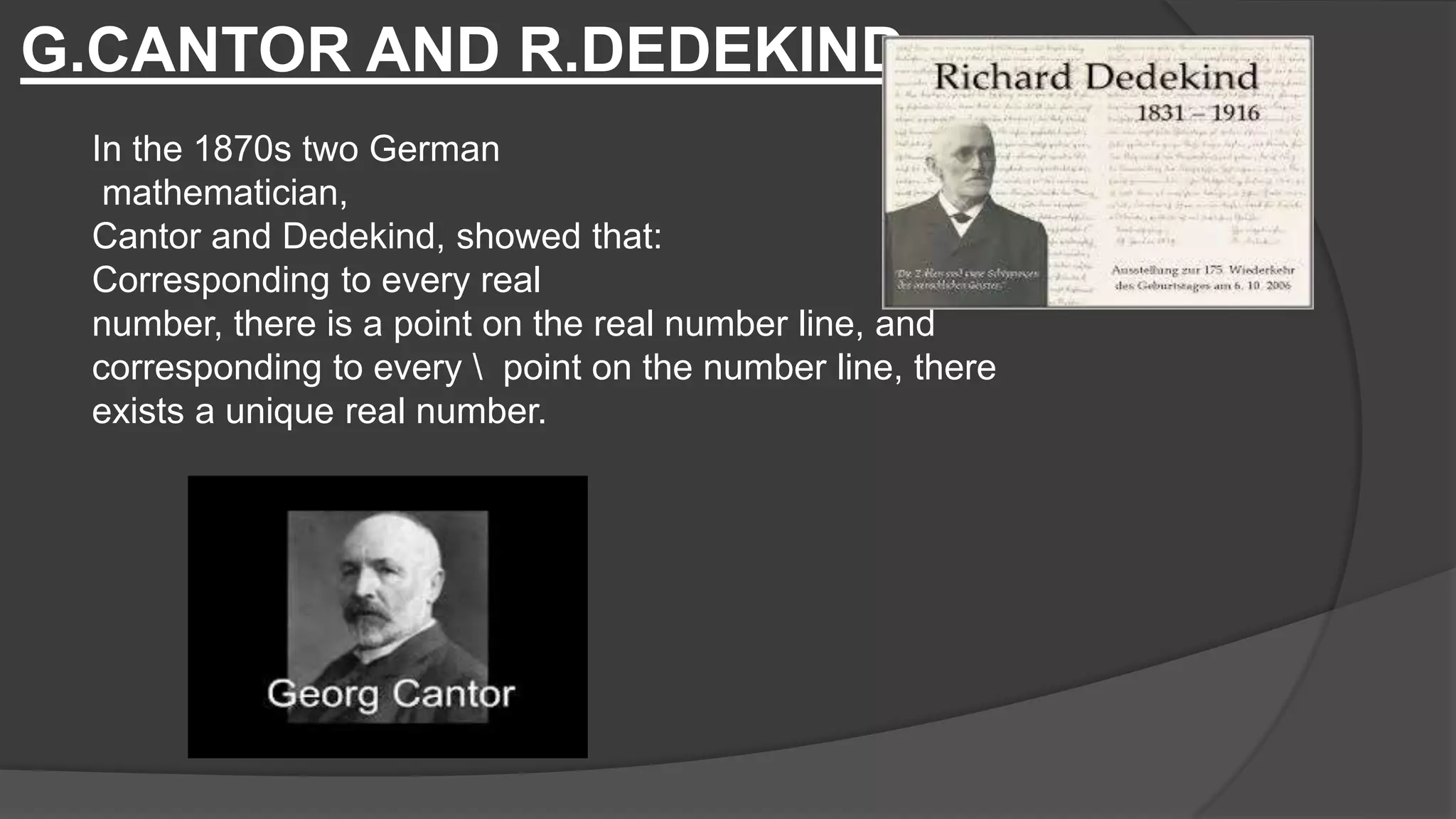
G.CANTOR AND R.DEDEKIND
Inthe 1870s two German
mathematician,
Cantor and Dedekind, showed that:
Corresponding to every real
number, there is a point on the real number line, and
corresponding to every point on the number line, there
exists a unique real number.
12.
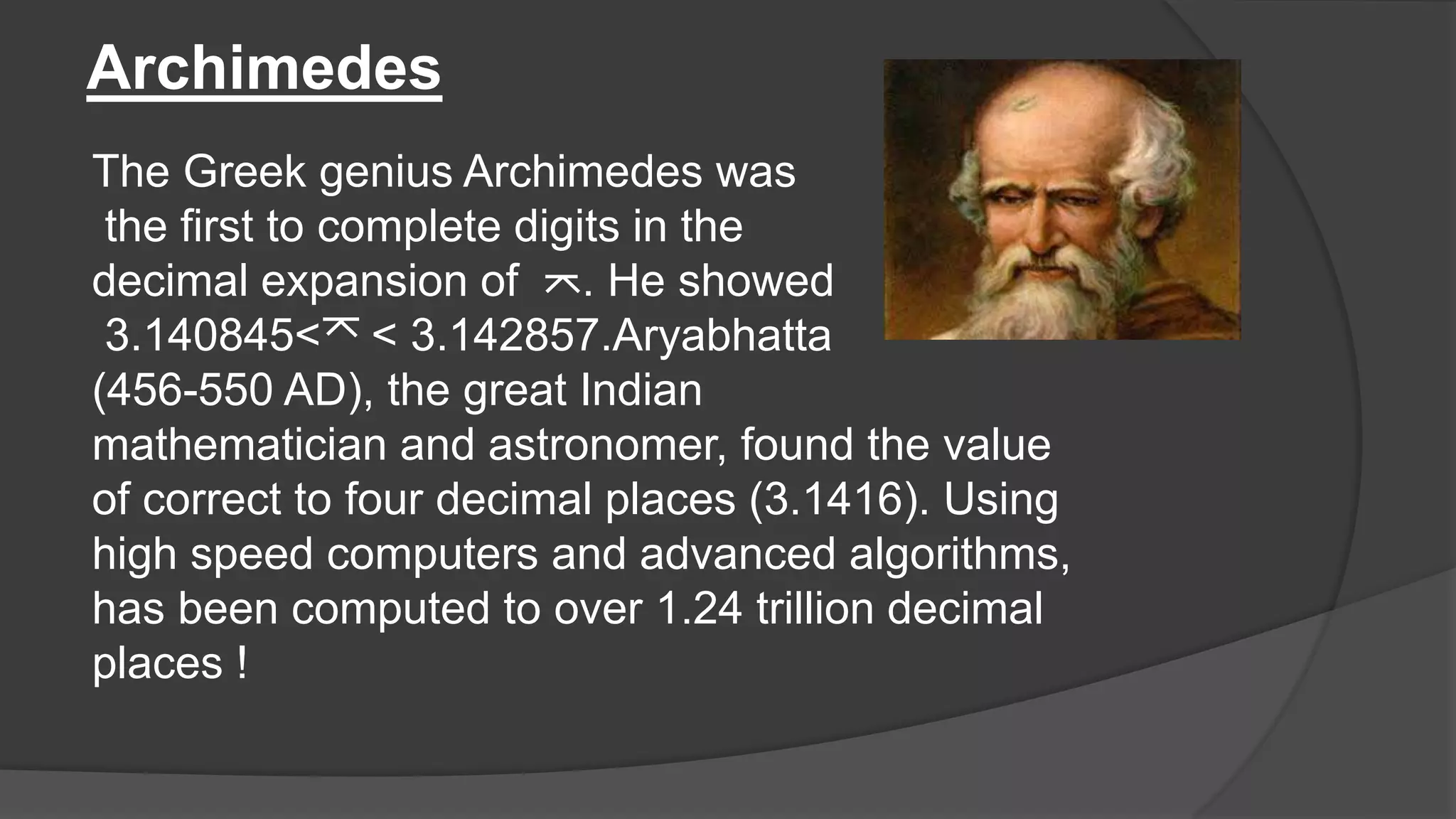
Archimedes
The Greek geniusArchimedes was
the first to complete digits in the
decimal expansion of . He showed
3.140845< < 3.142857.Aryabhatta
(456-550 AD), the great Indian
mathematician and astronomer, found the value
of correct to four decimal places (3.1416). Using
high speed computers and advanced algorithms,
has been computed to over 1.24 trillion decimal
places !
13.
QUESTIONS
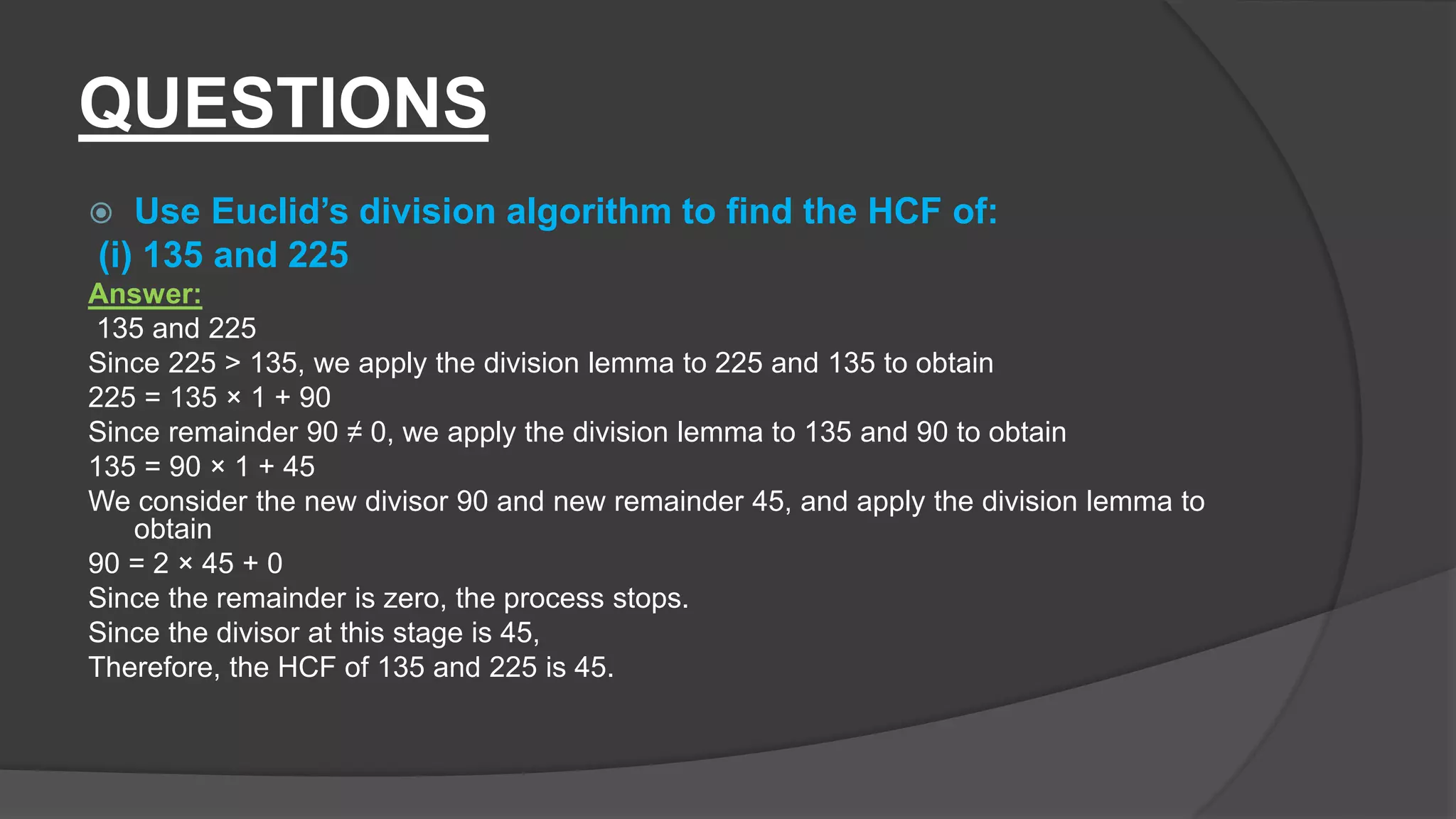
Use Euclid’sdivision algorithm to find the HCF of:
(i) 135 and 225
Answer:
135 and 225
Since 225 > 135, we apply the division lemma to 225 and 135 to obtain
225 = 135 × 1 + 90
Since remainder 90 ≠ 0, we apply the division lemma to 135 and 90 to obtain
135 = 90 × 1 + 45
We consider the new divisor 90 and new remainder 45, and apply the division lemma to
obtain
90 = 2 × 45 + 0
Since the remainder is zero, the process stops.
Since the divisor at this stage is 45,
Therefore, the HCF of 135 and 225 is 45.
14.
(ii) 196 and38220
Answer
196 and 38220
Since 38220 > 196, we apply the division lemma to
38220 and 196 to obtain
38220 = 196 × 195 + 0
Since the remainder is zero, the process stops.
Since the divisor at this stage is 196,
Therefore, HCF of 196 and 38220 is 196.
15.
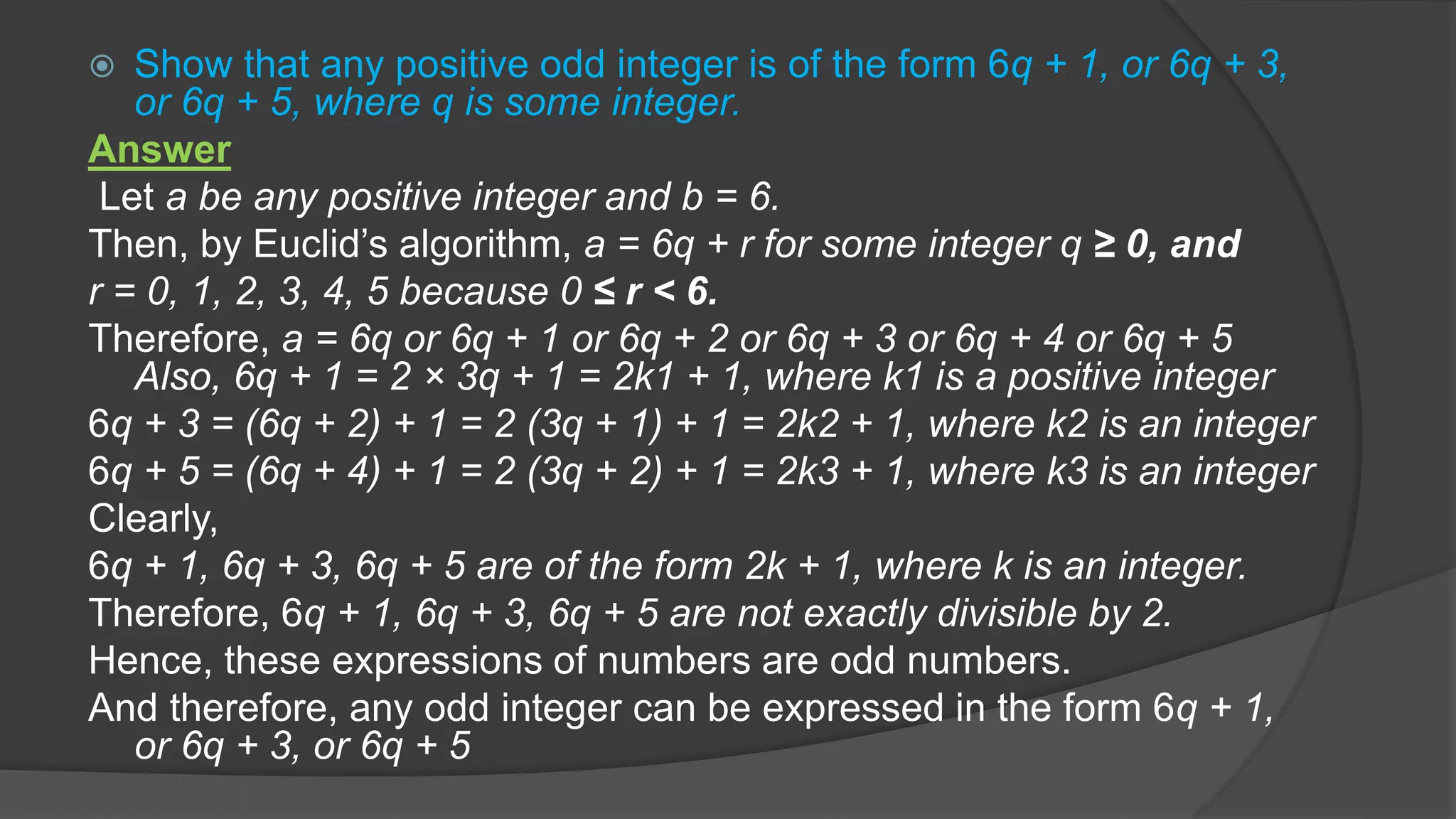
Show thatany positive odd integer is of the form 6q + 1, or 6q + 3,
or 6q + 5, where q is some integer.
Answer
Let a be any positive integer and b = 6.
Then, by Euclid’s algorithm, a = 6q + r for some integer q ≥ 0, and
r = 0, 1, 2, 3, 4, 5 because 0 ≤ r < 6.
Therefore, a = 6q or 6q + 1 or 6q + 2 or 6q + 3 or 6q + 4 or 6q + 5
Also, 6q + 1 = 2 × 3q + 1 = 2k1 + 1, where k1 is a positive integer
6q + 3 = (6q + 2) + 1 = 2 (3q + 1) + 1 = 2k2 + 1, where k2 is an integer
6q + 5 = (6q + 4) + 1 = 2 (3q + 2) + 1 = 2k3 + 1, where k3 is an integer
Clearly,
6q + 1, 6q + 3, 6q + 5 are of the form 2k + 1, where k is an integer.
Therefore, 6q + 1, 6q + 3, 6q + 5 are not exactly divisible by 2.
Hence, these expressions of numbers are odd numbers.
And therefore, any odd integer can be expressed in the form 6q + 1,
or 6q + 3, or 6q + 5
16.
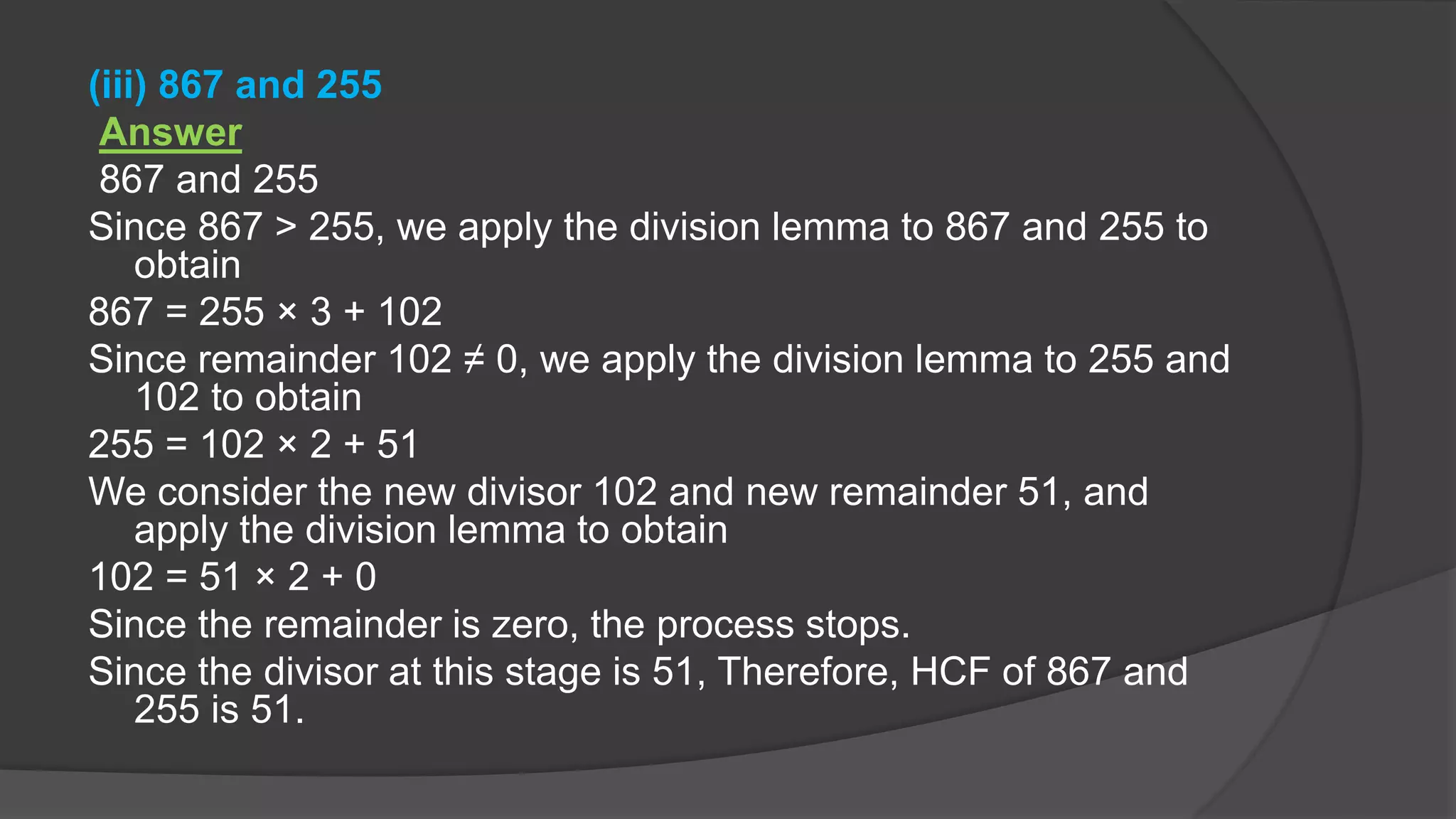
(iii) 867 and255
Answer
867 and 255
Since 867 > 255, we apply the division lemma to 867 and 255 to
obtain
867 = 255 × 3 + 102
Since remainder 102 ≠ 0, we apply the division lemma to 255 and
102 to obtain
255 = 102 × 2 + 51
We consider the new divisor 102 and new remainder 51, and
apply the division lemma to obtain
102 = 51 × 2 + 0
Since the remainder is zero, the process stops.
Since the divisor at this stage is 51, Therefore, HCF of 867 and
255 is 51.
17.
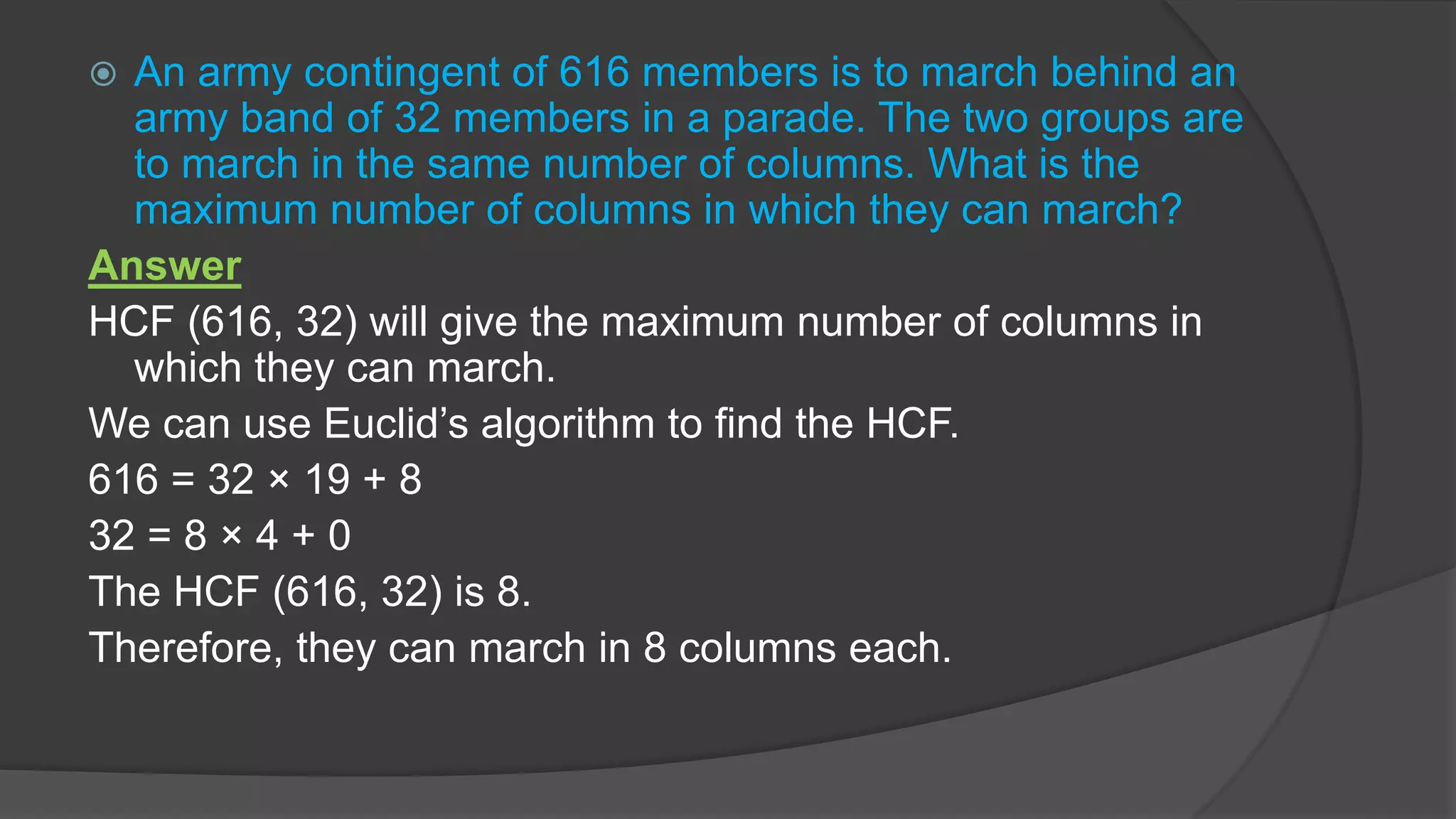
An armycontingent of 616 members is to march behind an
army band of 32 members in a parade. The two groups are
to march in the same number of columns. What is the
maximum number of columns in which they can march?
Answer
HCF (616, 32) will give the maximum number of columns in
which they can march.
We can use Euclid’s algorithm to find the HCF.
616 = 32 × 19 + 8
32 = 8 × 4 + 0
The HCF (616, 32) is 8.
Therefore, they can march in 8 columns each.
18.
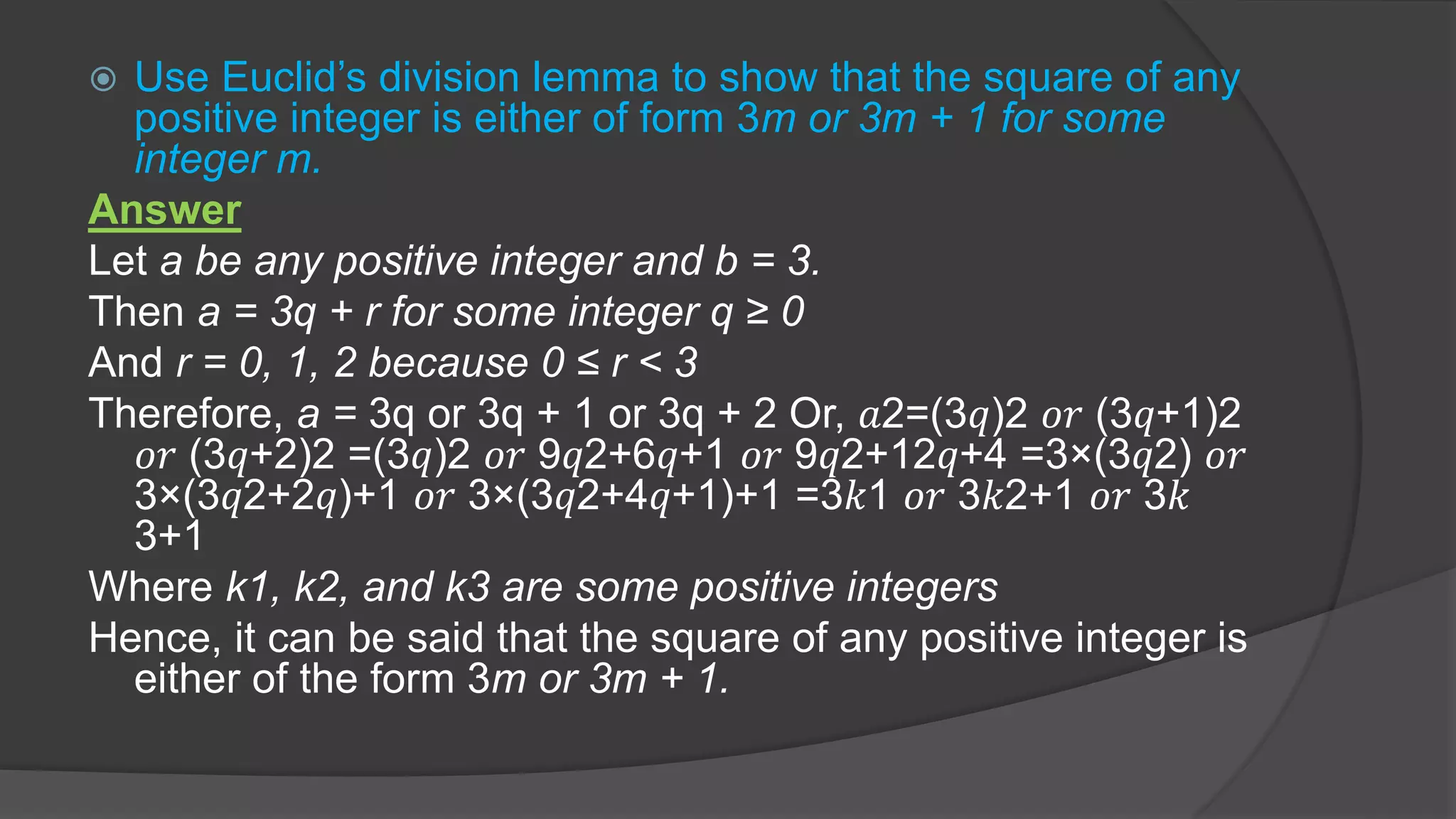
Use Euclid’sdivision lemma to show that the square of any
positive integer is either of form 3m or 3m + 1 for some
integer m.
Answer
Let a be any positive integer and b = 3.
Then a = 3q + r for some integer q ≥ 0
And r = 0, 1, 2 because 0 ≤ r < 3
Therefore, a = 3q or 3q + 1 or 3q + 2 Or, 𝑎2=(3𝑞)2 𝑜𝑟 (3𝑞+1)2
𝑜𝑟 (3𝑞+2)2 =(3𝑞)2 𝑜𝑟 9𝑞2+6𝑞+1 𝑜𝑟 9𝑞2+12𝑞+4 =3×(3𝑞2) 𝑜𝑟
3×(3𝑞2+2𝑞)+1 𝑜𝑟 3×(3𝑞2+4𝑞+1)+1 =3𝑘1 𝑜𝑟 3𝑘2+1 𝑜𝑟 3𝑘
3+1
Where k1, k2, and k3 are some positive integers
Hence, it can be said that the square of any positive integer is
either of the form 3m or 3m + 1.
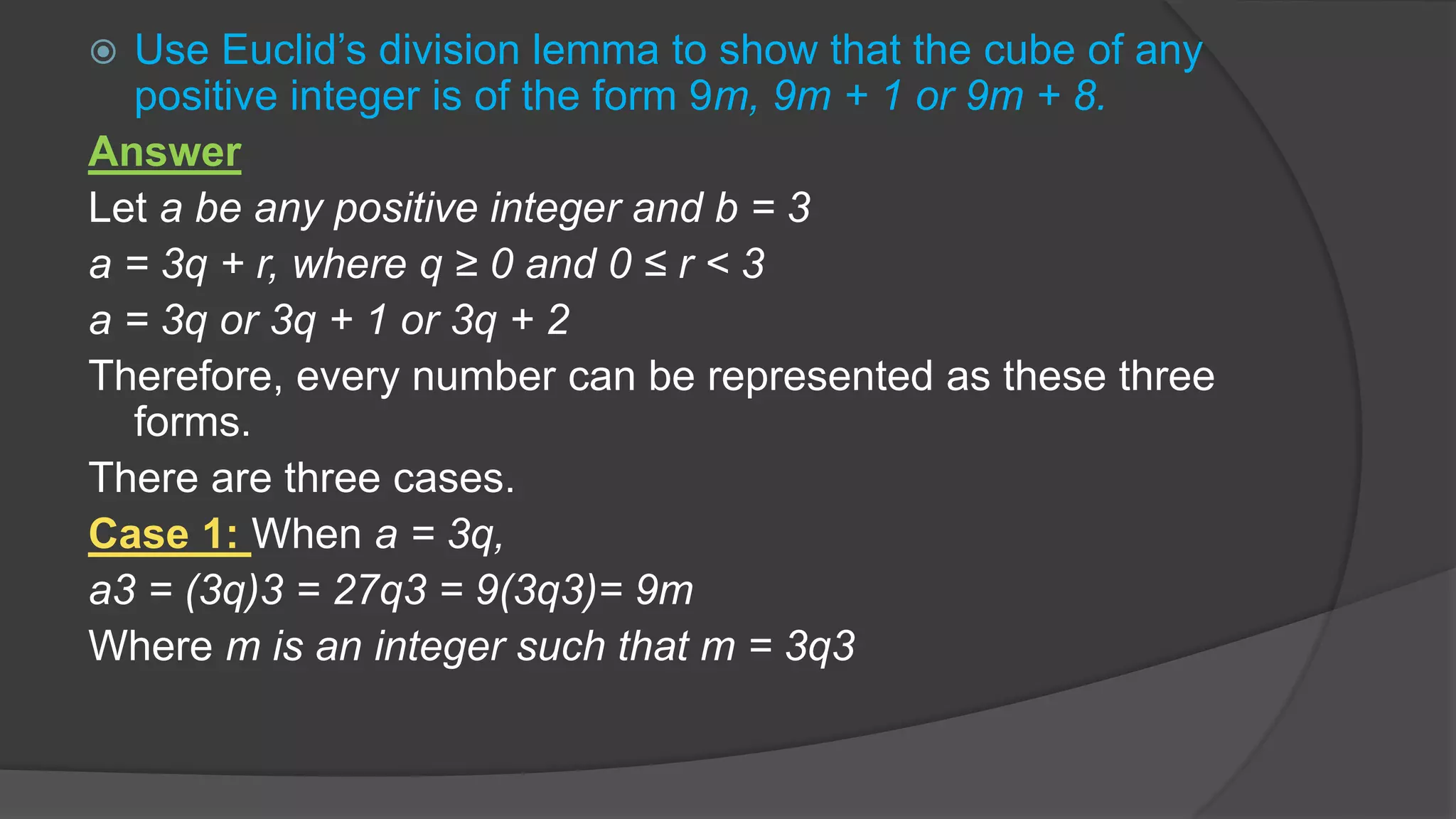
Use Euclid’sdivision lemma to show that the cube of any
positive integer is of the form 9m, 9m + 1 or 9m + 8.
Answer
Let a be any positive integer and b = 3
a = 3q + r, where q ≥ 0 and 0 ≤ r < 3
a = 3q or 3q + 1 or 3q + 2
Therefore, every number can be represented as these three
forms.
There are three cases.
Case 1: When a = 3q,
a3 = (3q)3 = 27q3 = 9(3q3)= 9m
Where m is an integer such that m = 3q3
21.
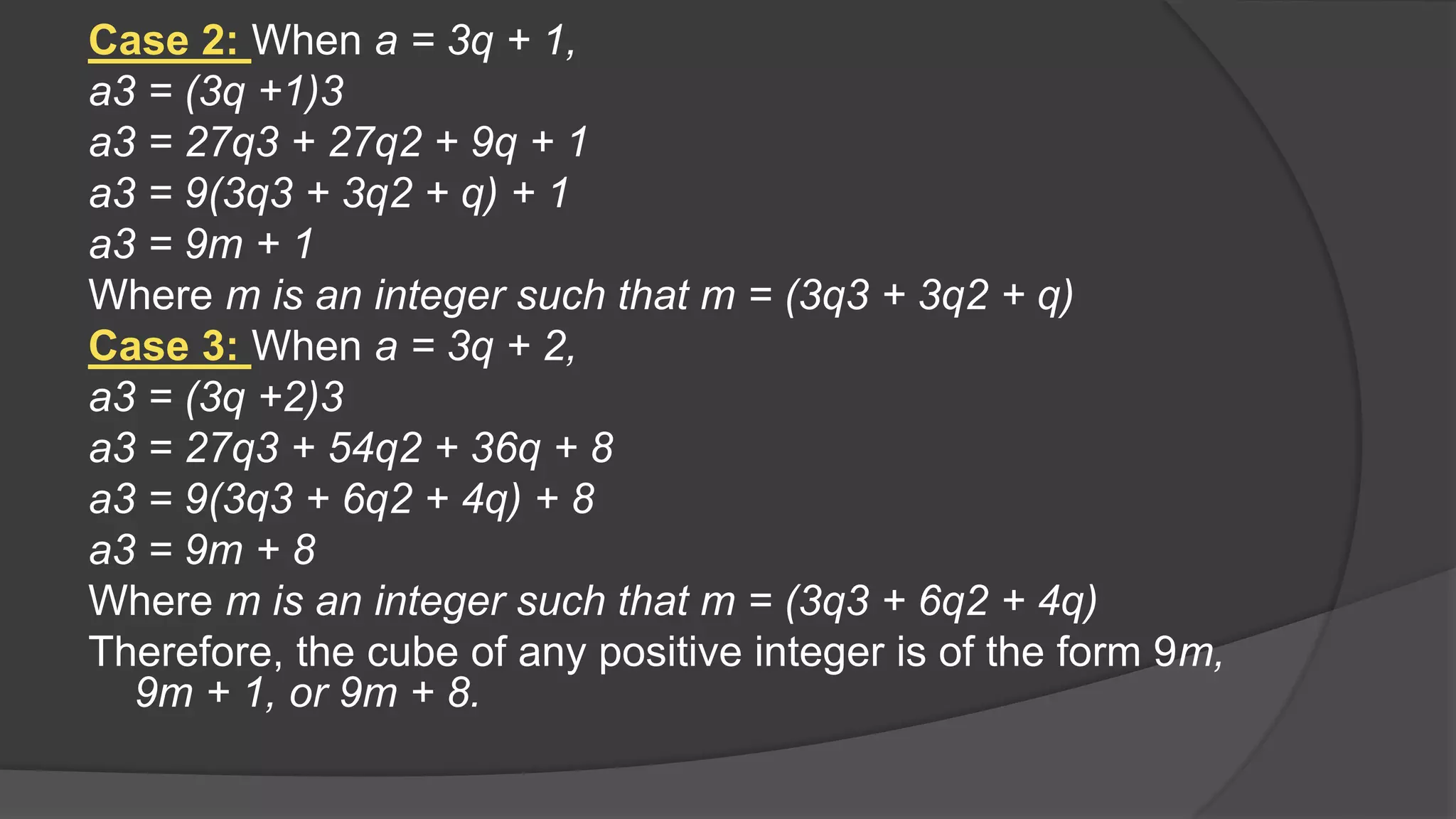
Case 2: Whena = 3q + 1,
a3 = (3q +1)3
a3 = 27q3 + 27q2 + 9q + 1
a3 = 9(3q3 + 3q2 + q) + 1
a3 = 9m + 1
Where m is an integer such that m = (3q3 + 3q2 + q)
Case 3: When a = 3q + 2,
a3 = (3q +2)3
a3 = 27q3 + 54q2 + 36q + 8
a3 = 9(3q3 + 6q2 + 4q) + 8
a3 = 9m + 8
Where m is an integer such that m = (3q3 + 6q2 + 4q)
Therefore, the cube of any positive integer is of the form 9m,
9m + 1, or 9m + 8.
22.
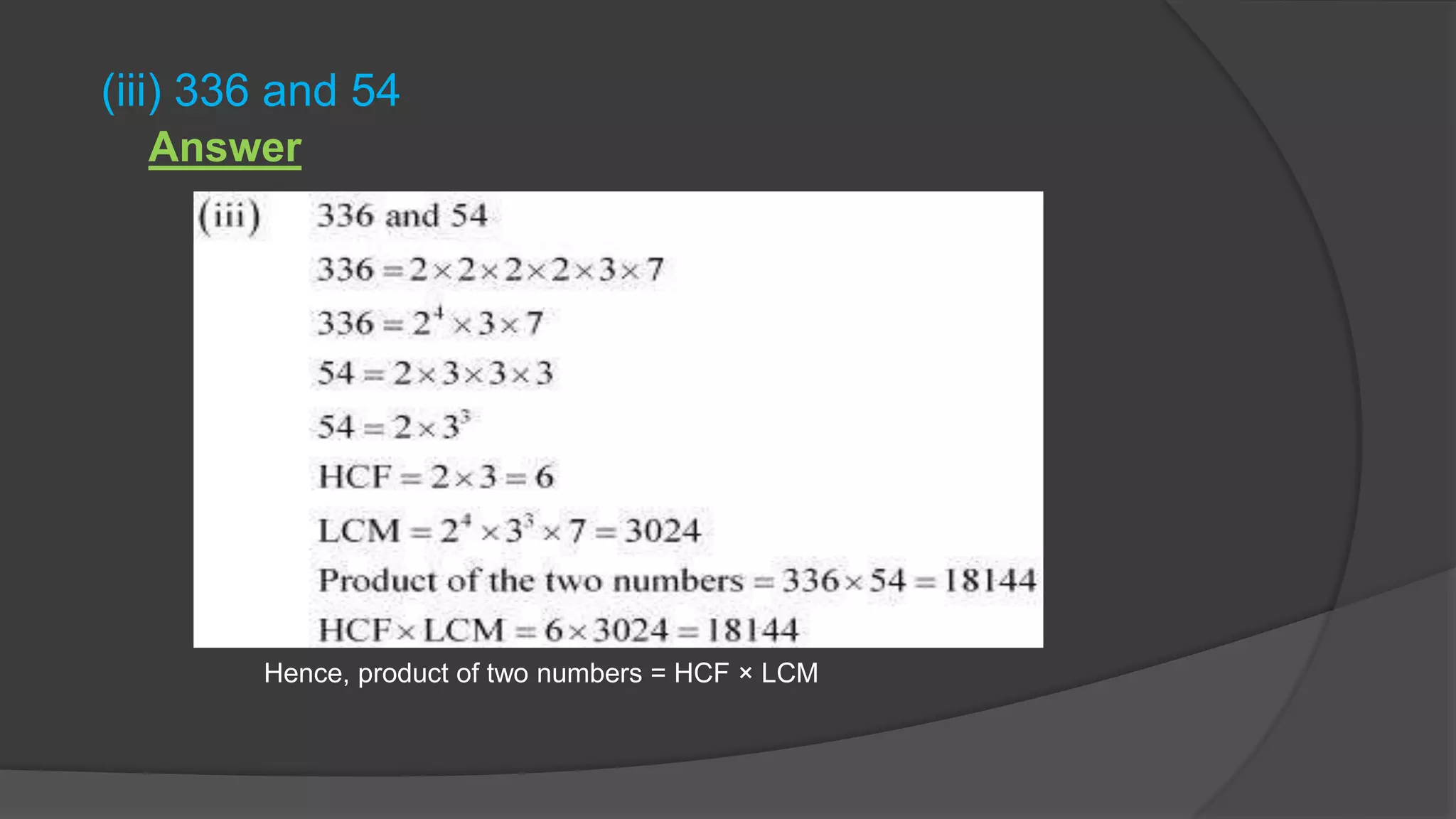
(iii) 336 and54
Hence, product of two numbers = HCF × LCM
Answer
23.
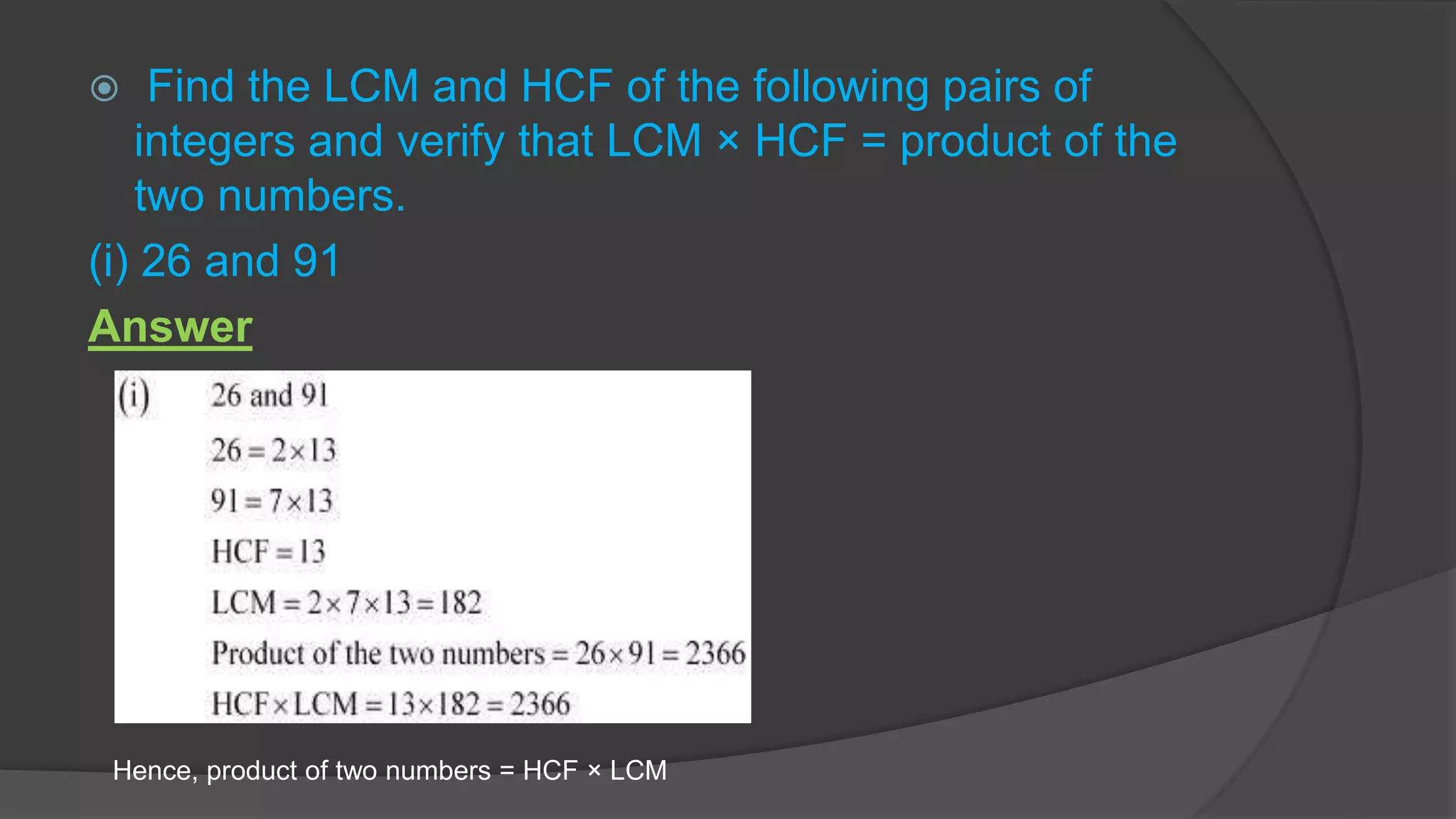
Find theLCM and HCF of the following pairs of
integers and verify that LCM × HCF = product of the
two numbers.
(i) 26 and 91
Answer
Hence, product of two numbers = HCF × LCM
24.
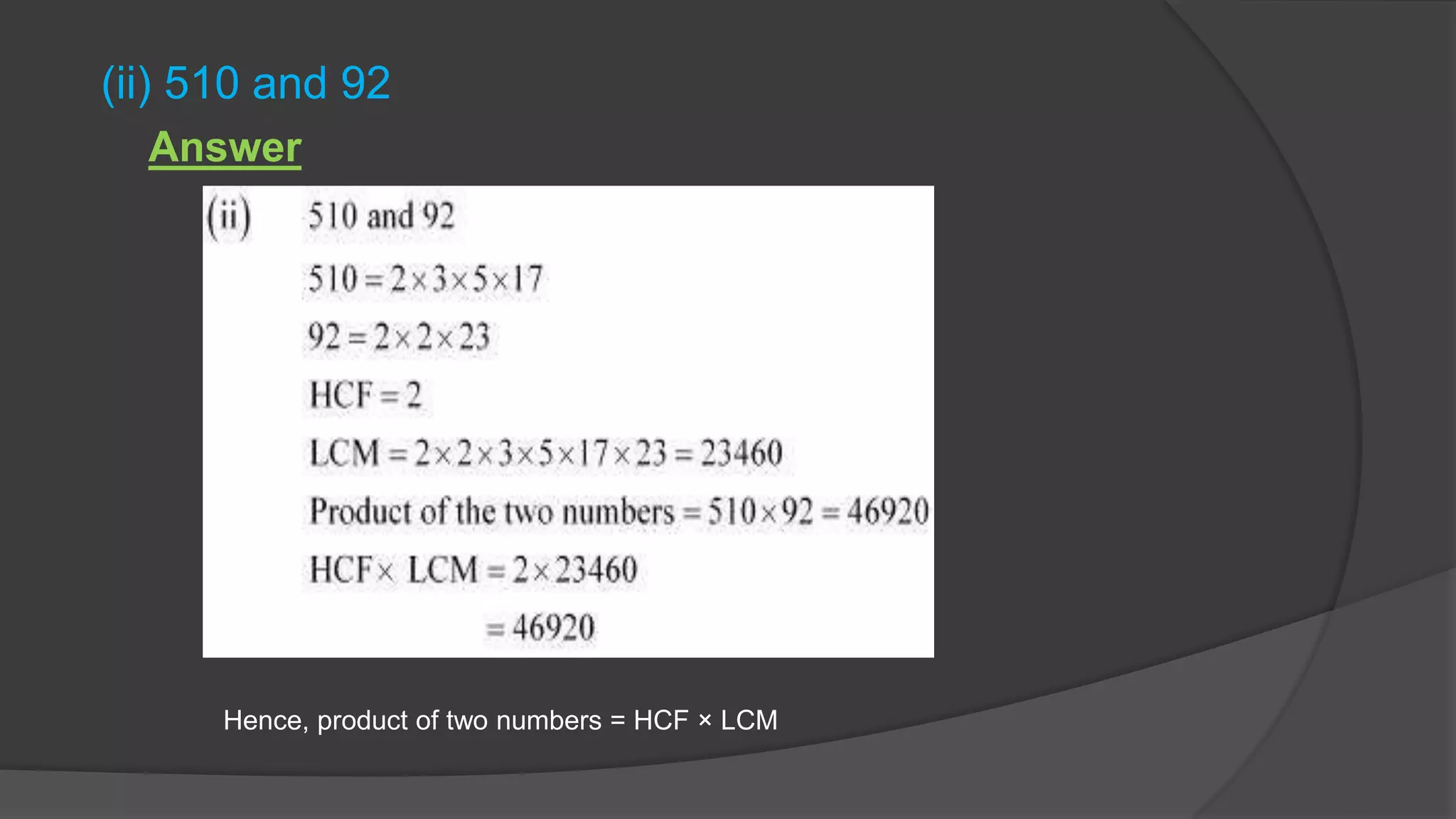
(ii) 510 and92
Hence, product of two numbers = HCF × LCM
Answer
25.
Find theLCM and HCF of the following integers by
applying the prime factorisation method.
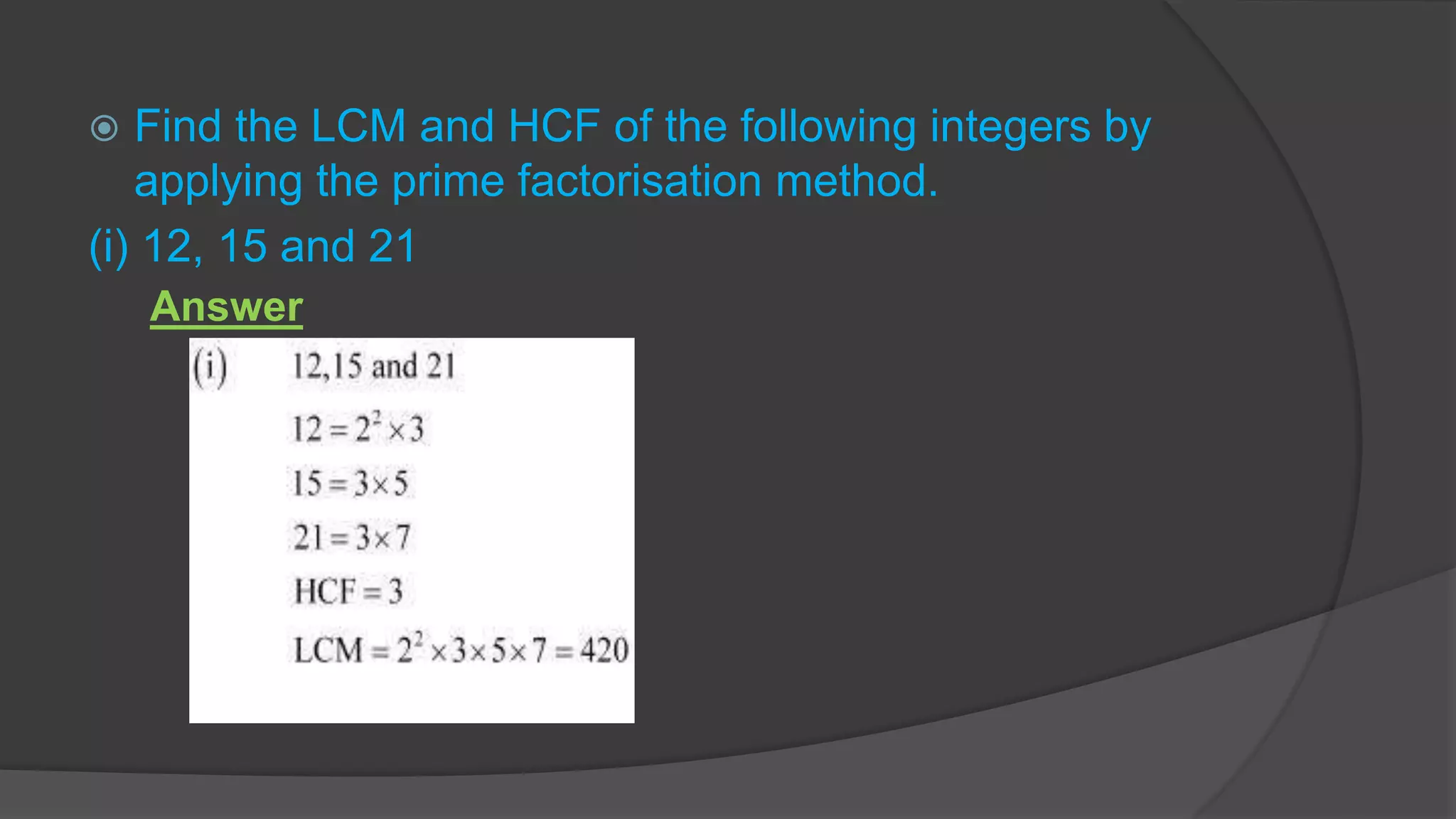
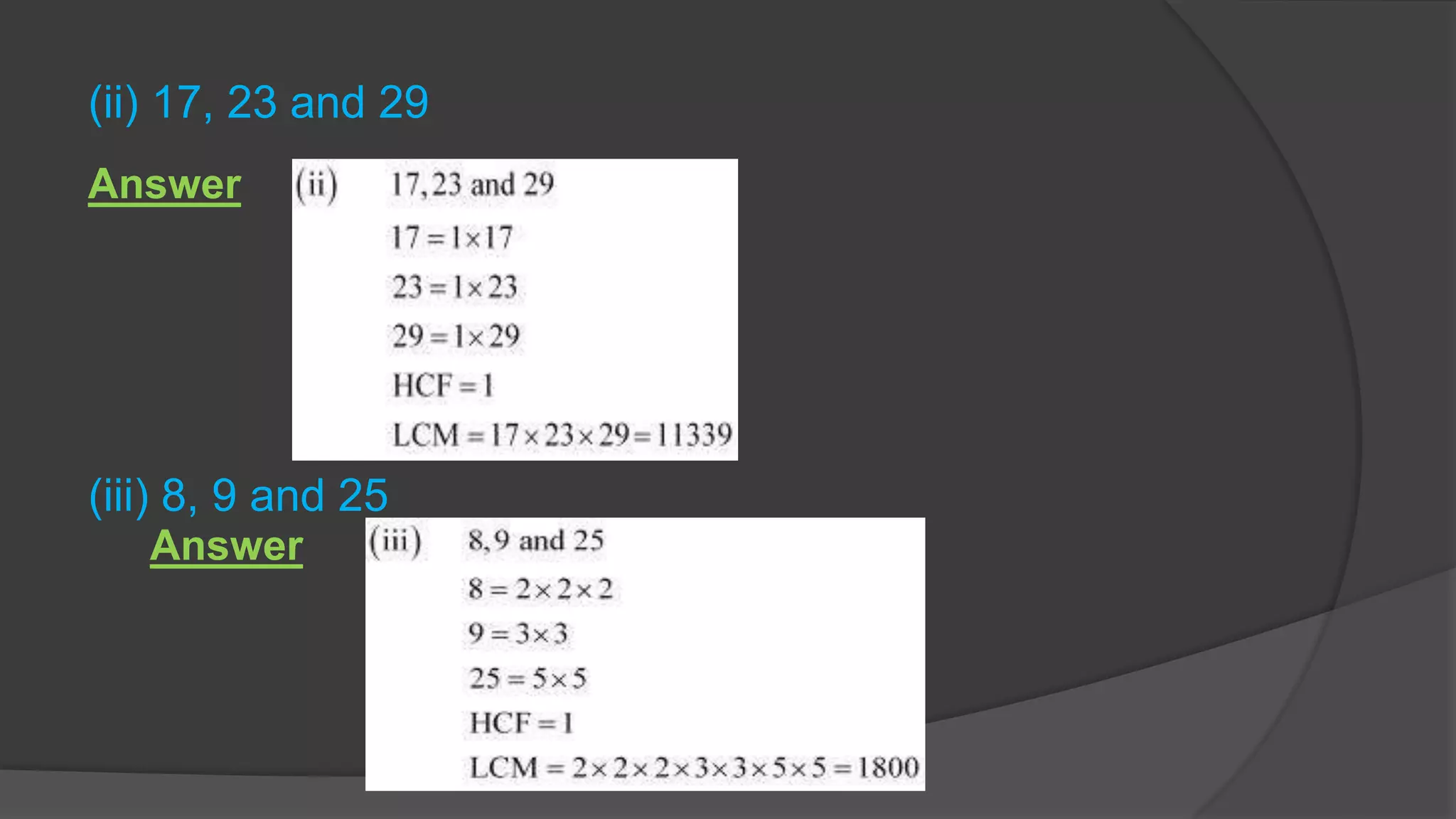
(i) 12, 15 and 21
Answer
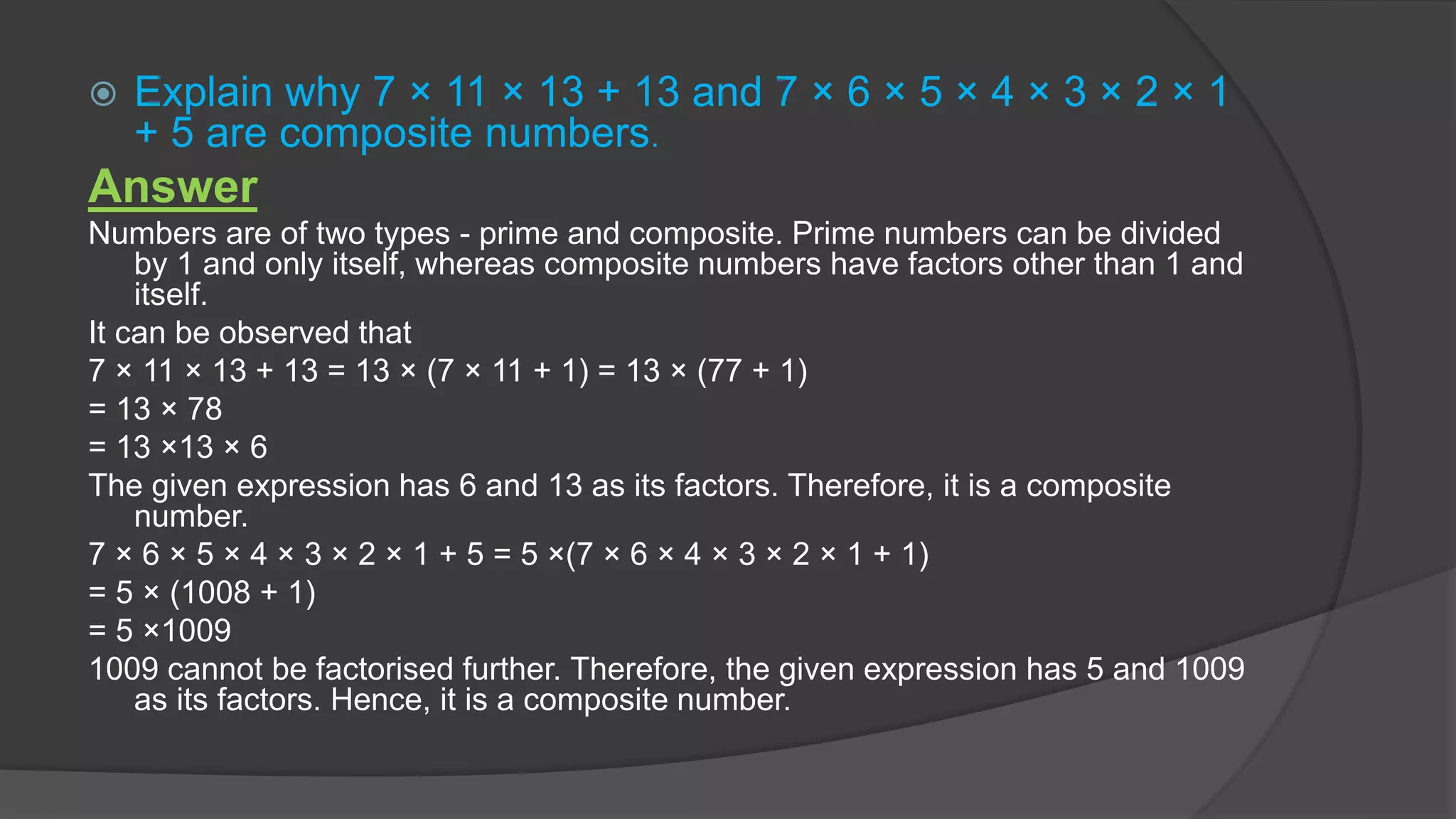
Explain why7 × 11 × 13 + 13 and 7 × 6 × 5 × 4 × 3 × 2 × 1
+ 5 are composite numbers.
Answer
Numbers are of two types - prime and composite. Prime numbers can be divided
by 1 and only itself, whereas composite numbers have factors other than 1 and
itself.
It can be observed that
7 × 11 × 13 + 13 = 13 × (7 × 11 + 1) = 13 × (77 + 1)
= 13 × 78
= 13 ×13 × 6
The given expression has 6 and 13 as its factors. Therefore, it is a composite
number.
7 × 6 × 5 × 4 × 3 × 2 × 1 + 5 = 5 ×(7 × 6 × 4 × 3 × 2 × 1 + 1)
= 5 × (1008 + 1)
= 5 ×1009
1009 cannot be factorised further. Therefore, the given expression has 5 and 1009
as its factors. Hence, it is a composite number.
29.
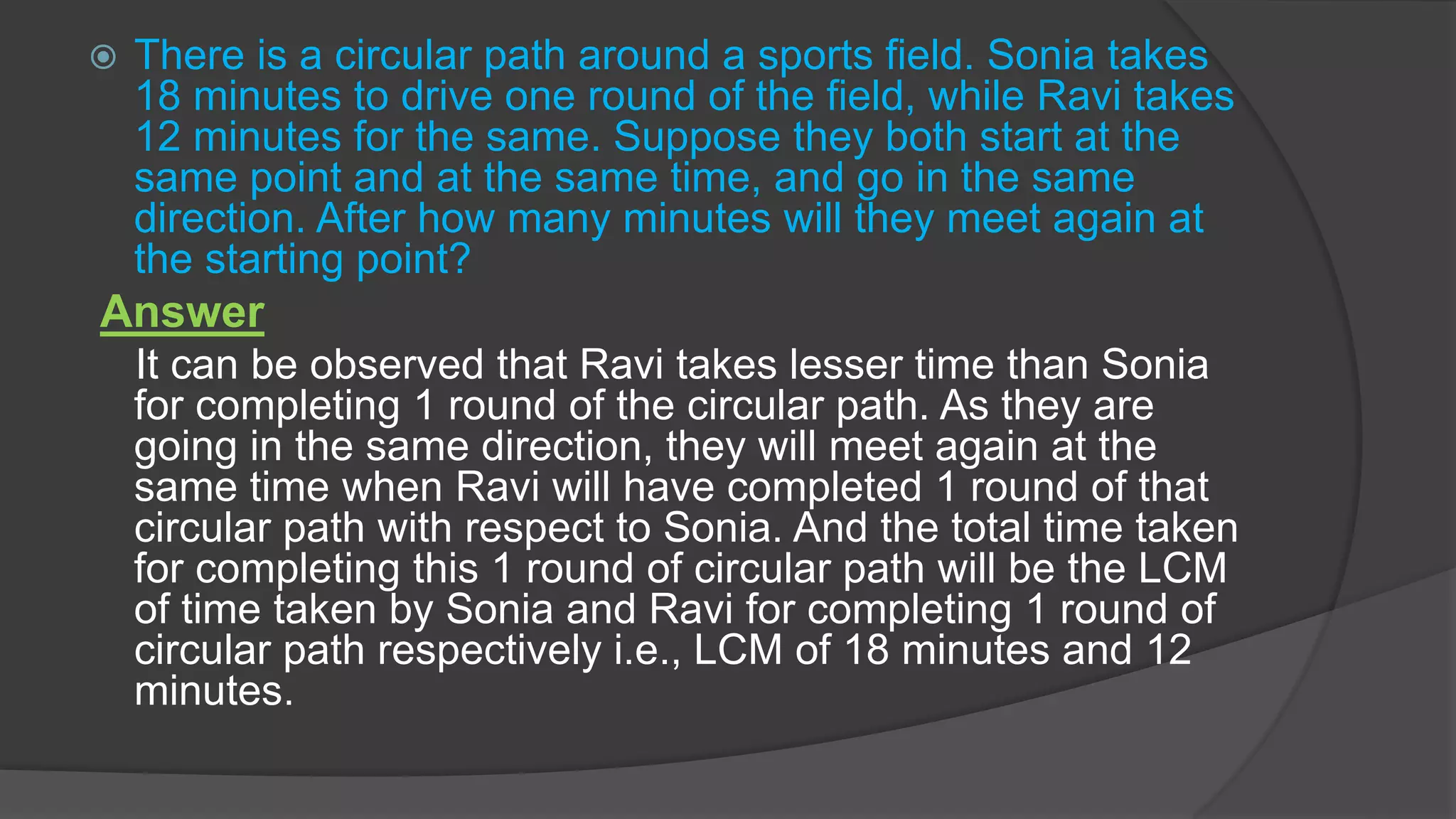
There isa circular path around a sports field. Sonia takes
18 minutes to drive one round of the field, while Ravi takes
12 minutes for the same. Suppose they both start at the
same point and at the same time, and go in the same
direction. After how many minutes will they meet again at
the starting point?
Answer
It can be observed that Ravi takes lesser time than Sonia
for completing 1 round of the circular path. As they are
going in the same direction, they will meet again at the
same time when Ravi will have completed 1 round of that
circular path with respect to Sonia. And the total time taken
for completing this 1 round of circular path will be the LCM
of time taken by Sonia and Ravi for completing 1 round of
circular path respectively i.e., LCM of 18 minutes and 12
minutes.
30.
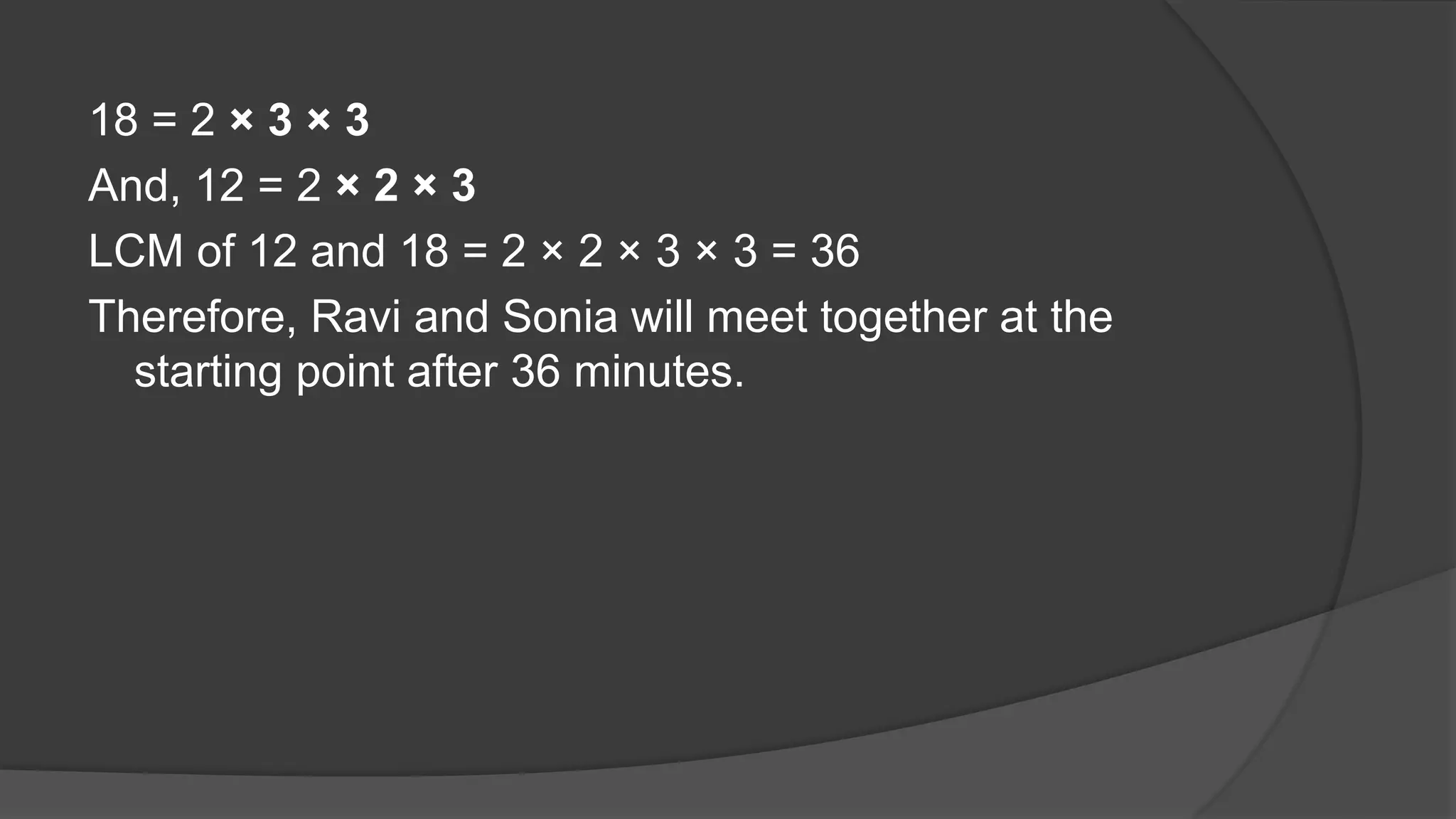
18 = 2× 3 × 3
And, 12 = 2 × 2 × 3
LCM of 12 and 18 = 2 × 2 × 3 × 3 = 36
Therefore, Ravi and Sonia will meet together at the
starting point after 36 minutes.
31.
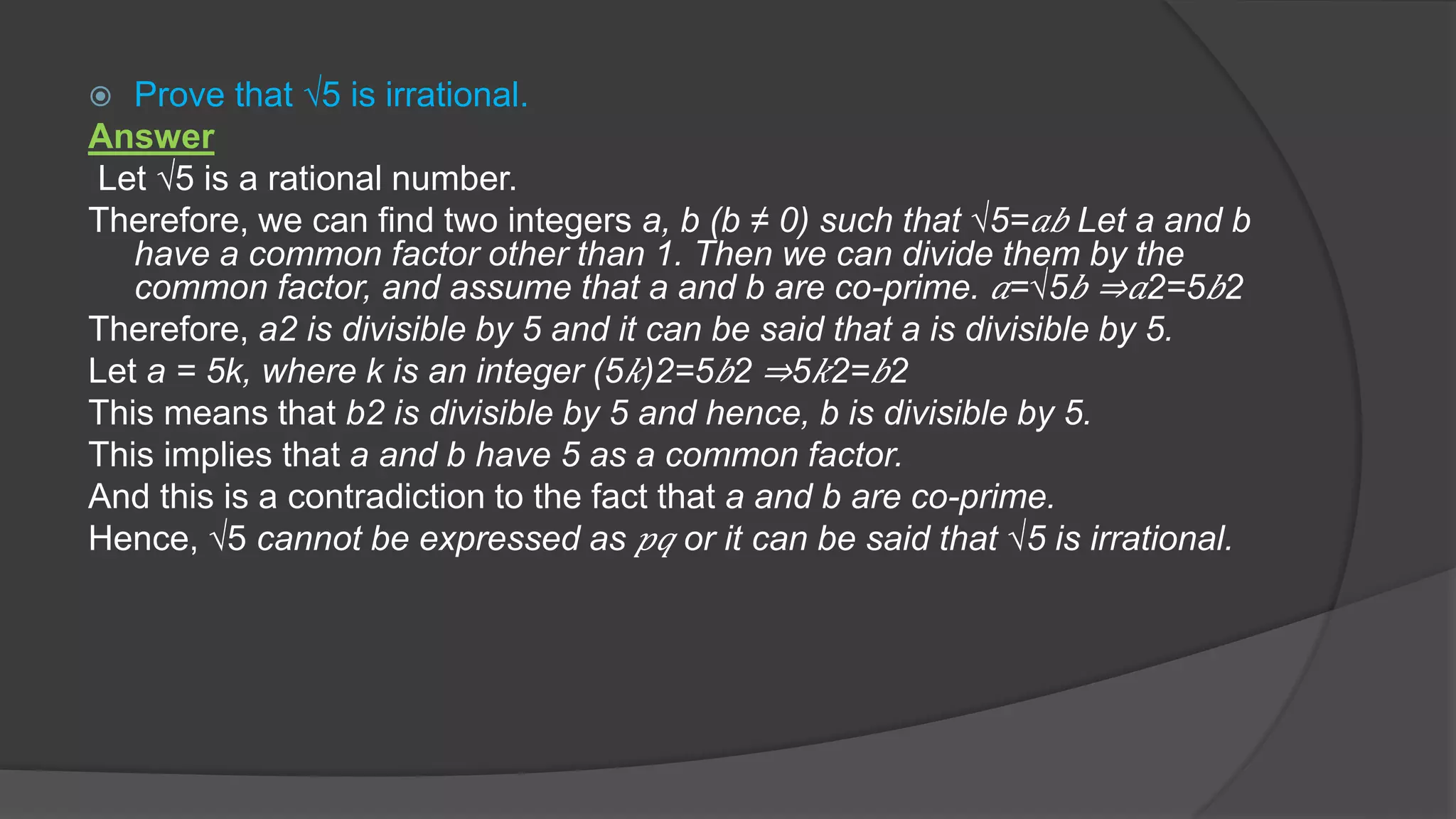
Prove that√5 is irrational.
Answer
Let √5 is a rational number.
Therefore, we can find two integers a, b (b ≠ 0) such that √5= 𝑎𝑏 Let a and b
have a common factor other than 1. Then we can divide them by the
common factor, and assume that a and b are co-prime. 𝑎=√5 𝑏 ⇒𝑎2=5 𝑏2
Therefore, a2 is divisible by 5 and it can be said that a is divisible by 5.
Let a = 5k, where k is an integer (5 𝑘)2=5 𝑏2 ⇒5 𝑘2= 𝑏2
This means that b2 is divisible by 5 and hence, b is divisible by 5.
This implies that a and b have 5 as a common factor.
And this is a contradiction to the fact that a and b are co-prime.
Hence, √5 cannot be expressed as 𝑝𝑞 or it can be said that √5 is irrational.
32.
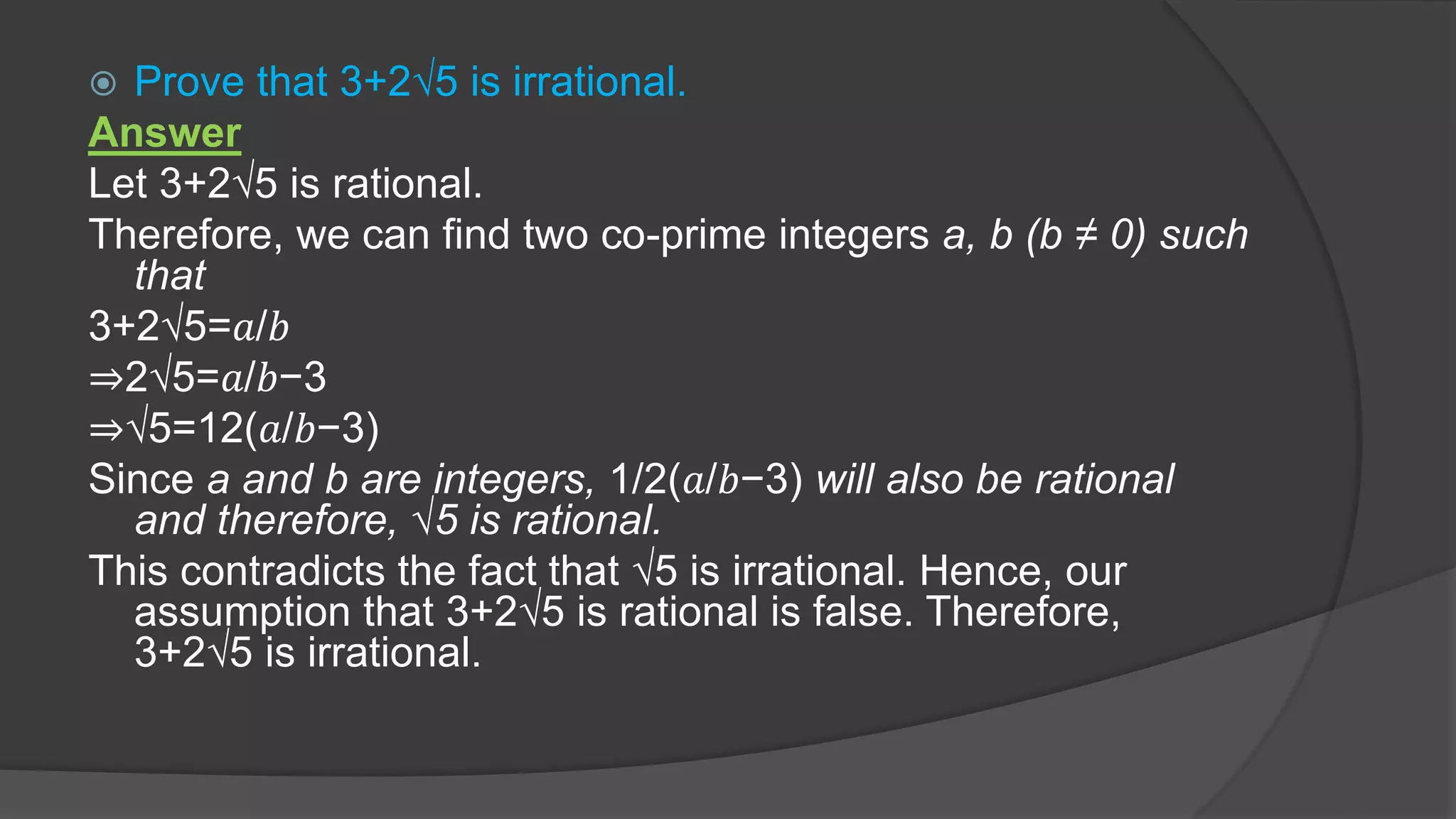
Prove that3+2√5 is irrational.
Answer
Let 3+2√5 is rational.
Therefore, we can find two co-prime integers a, b (b ≠ 0) such
that
3+2√5=𝑎/𝑏
⇒2√5=𝑎/𝑏−3
⇒√5=12(𝑎/𝑏−3)
Since a and b are integers, 1/2(𝑎/𝑏−3) will also be rational
and therefore, √5 is rational.
This contradicts the fact that √5 is irrational. Hence, our
assumption that 3+2√5 is rational is false. Therefore,
3+2√5 is irrational.
33.
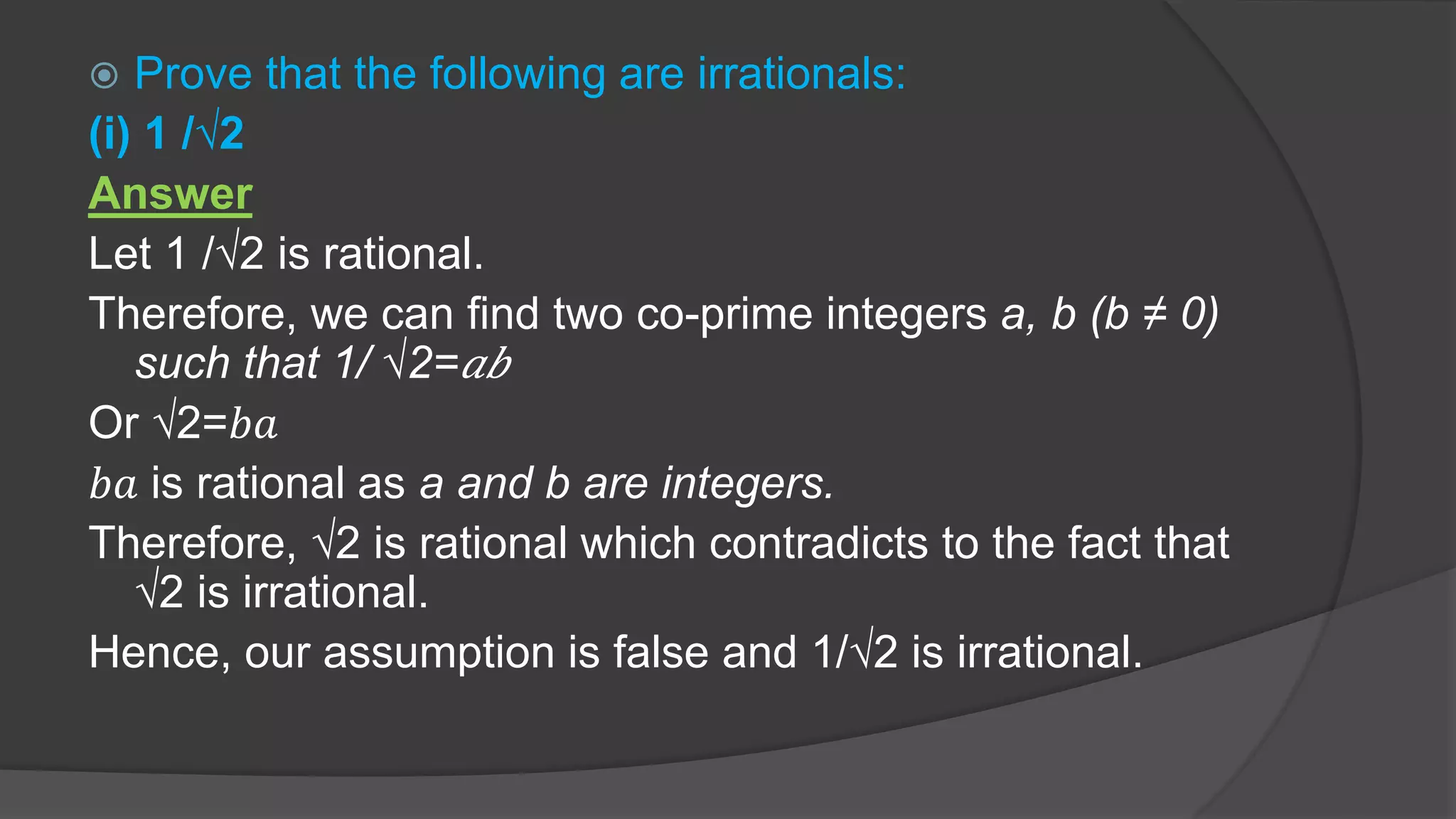
Prove thatthe following are irrationals:
(i) 1 /√2
Answer
Let 1 /√2 is rational.
Therefore, we can find two co-prime integers a, b (b ≠ 0)
such that 1/ √2= 𝑎𝑏
Or √2=𝑏𝑎
𝑏𝑎 is rational as a and b are integers.
Therefore, √2 is rational which contradicts to the fact that
√2 is irrational.
Hence, our assumption is false and 1/√2 is irrational.
34.
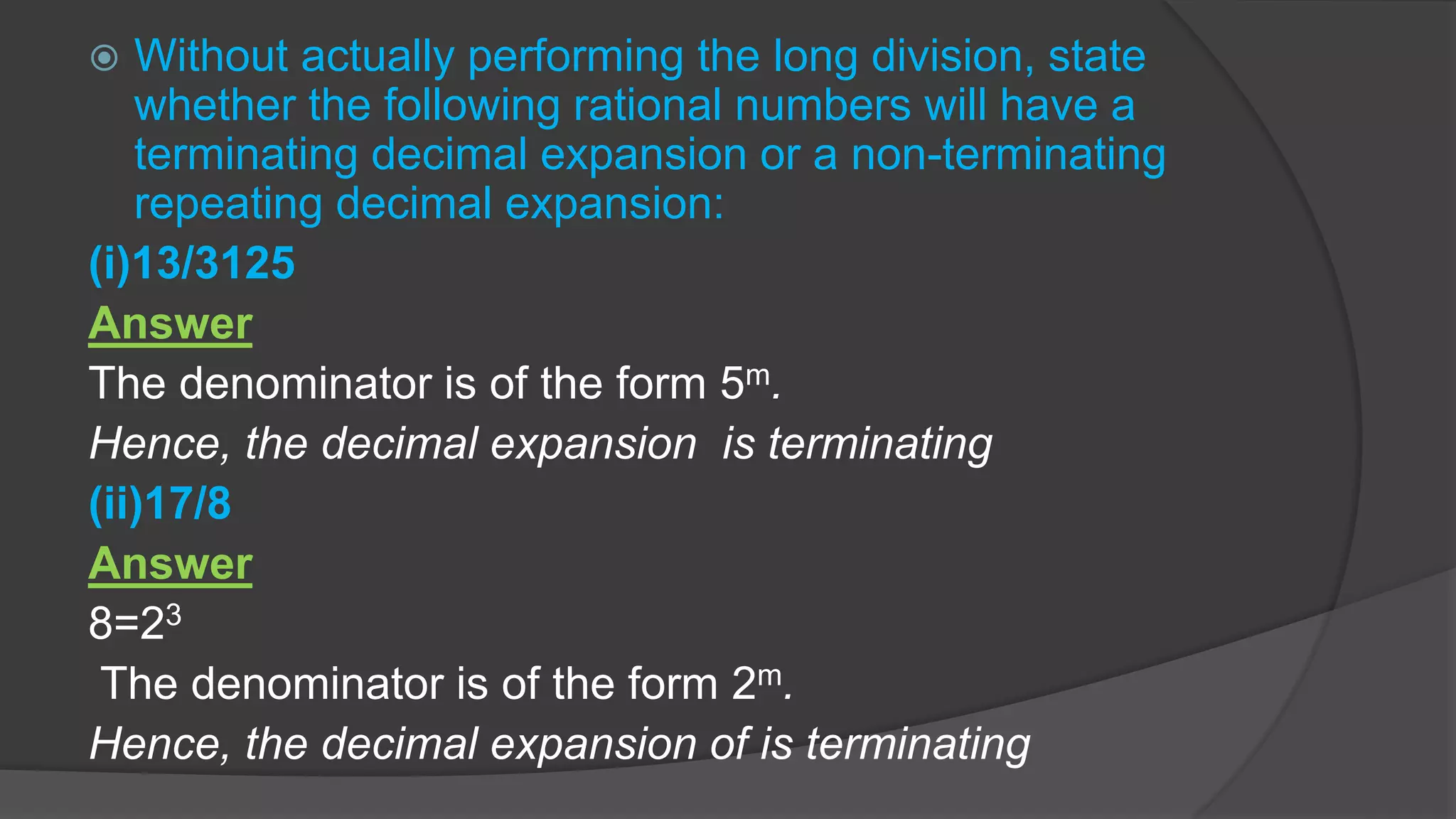
Without actuallyperforming the long division, state
whether the following rational numbers will have a
terminating decimal expansion or a non-terminating
repeating decimal expansion:
(i)13/3125
Answer
The denominator is of the form 5m.
Hence, the decimal expansion is terminating
(ii)17/8
Answer
8=23
The denominator is of the form 2m.
Hence, the decimal expansion of is terminating
35.
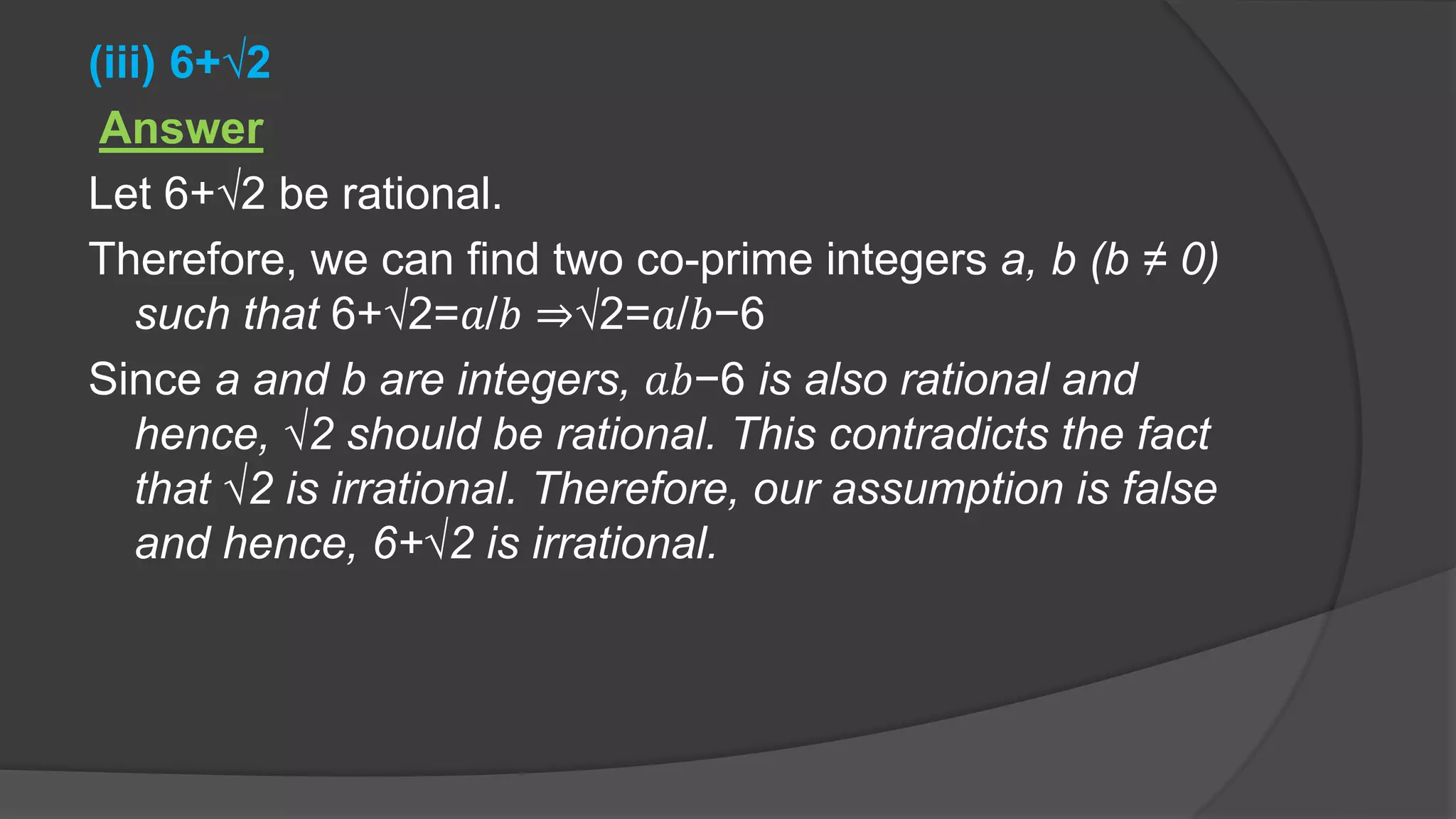
(iii) 6+√2
Answer
Let 6+√2be rational.
Therefore, we can find two co-prime integers a, b (b ≠ 0)
such that 6+√2=𝑎/𝑏 ⇒√2=𝑎/𝑏−6
Since a and b are integers, 𝑎𝑏−6 is also rational and
hence, √2 should be rational. This contradicts the fact
that √2 is irrational. Therefore, our assumption is false
and hence, 6+√2 is irrational.
36.
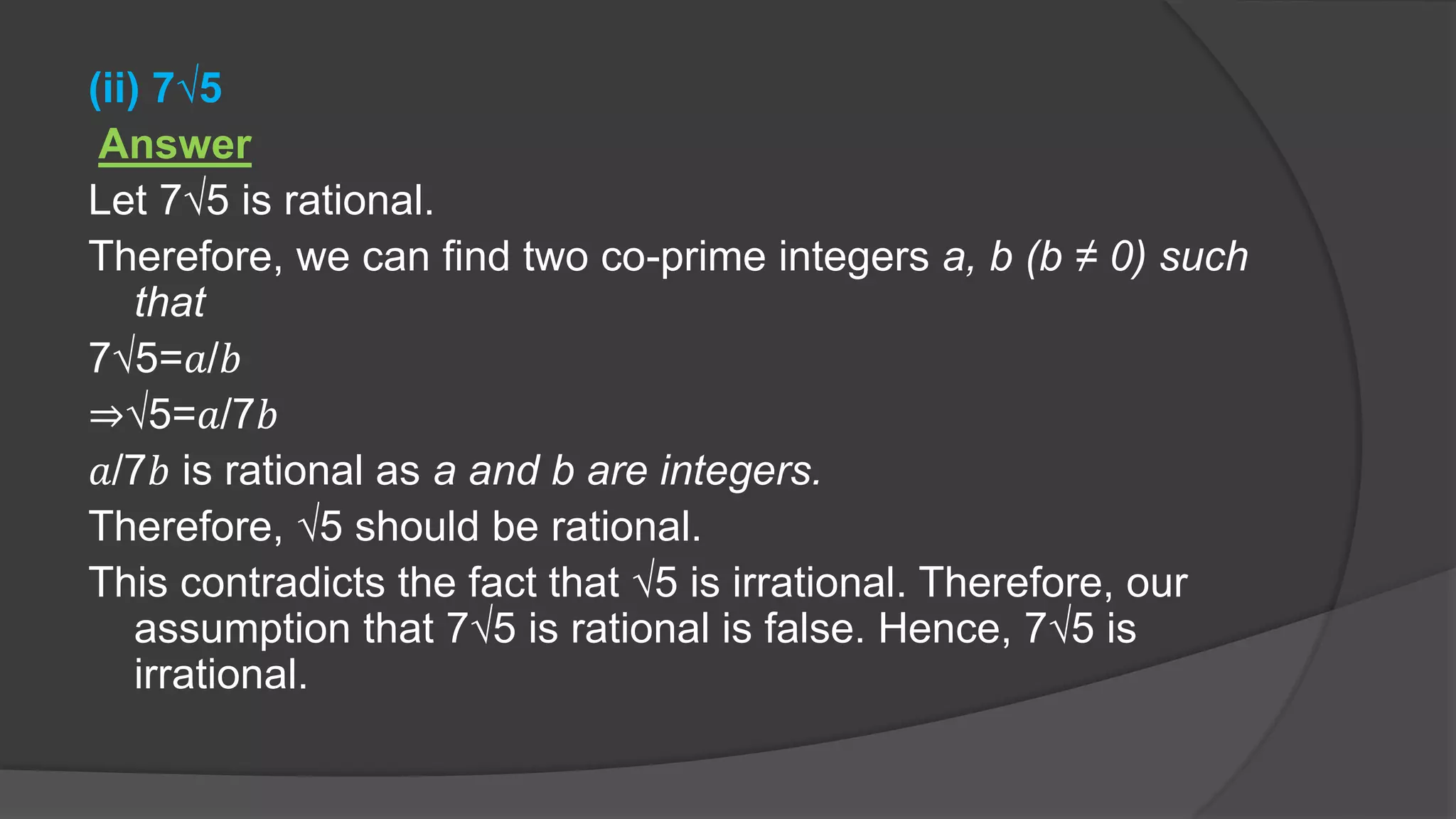
(ii) 7√5
Answer
Let 7√5is rational.
Therefore, we can find two co-prime integers a, b (b ≠ 0) such
that
7√5=𝑎/𝑏
⇒√5=𝑎/7𝑏
𝑎/7𝑏 is rational as a and b are integers.
Therefore, √5 should be rational.
This contradicts the fact that √5 is irrational. Therefore, our
assumption that 7√5 is rational is false. Hence, 7√5 is
irrational.
37.
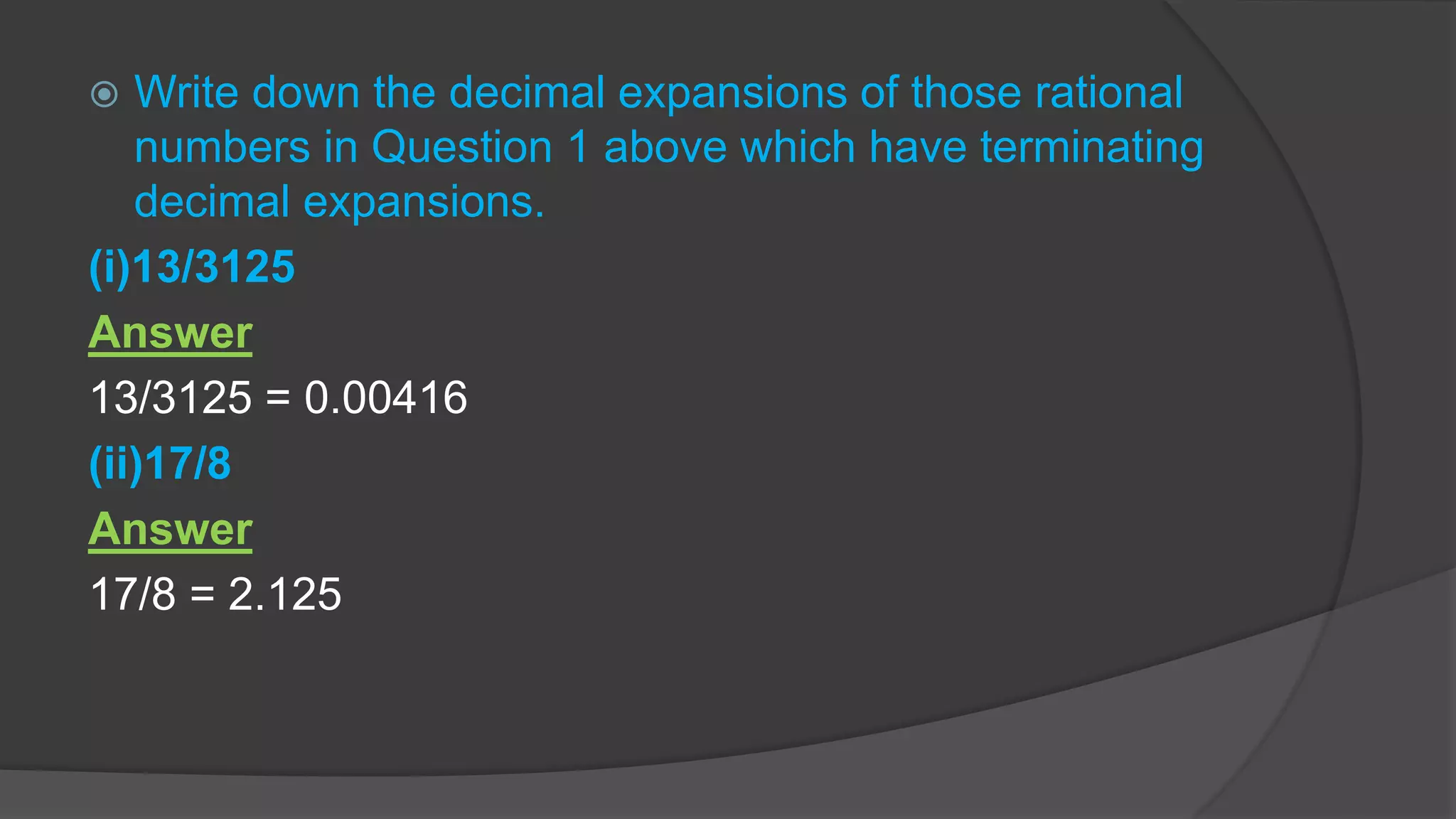
Write downthe decimal expansions of those rational
numbers in Question 1 above which have terminating
decimal expansions.
(i)13/3125
Answer
13/3125 = 0.00416
(ii)17/8
Answer
17/8 = 2.125







![Interpersonal attraction [autosaved] save](https://cdn.slidesharecdn.com/ss_thumbnails/interpersonalattractionautosavedsave-170326141720-thumbnail.jpg?width=640&height=640&fit=bounds)


