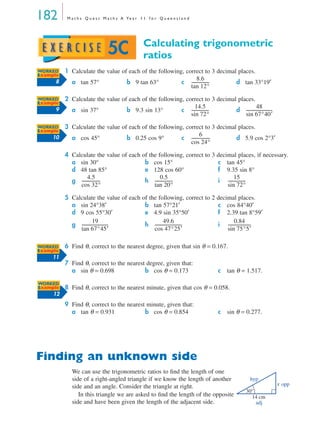
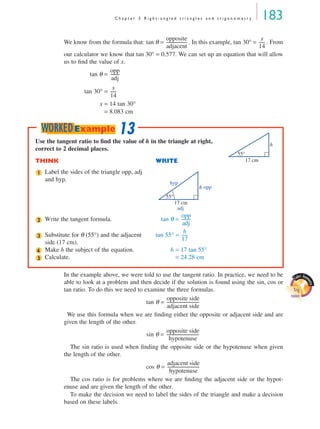
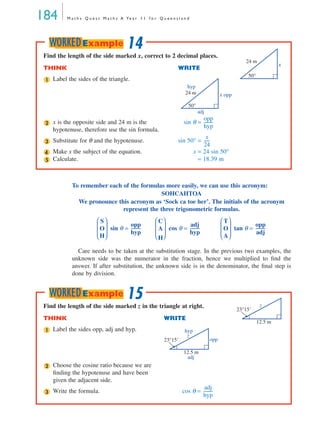
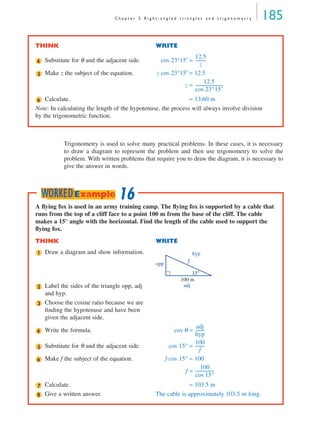
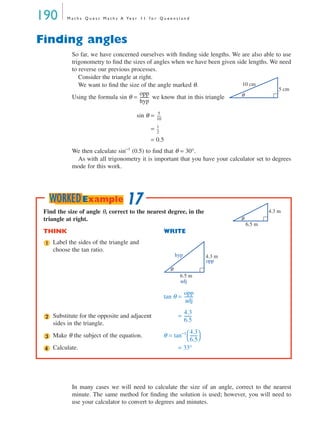
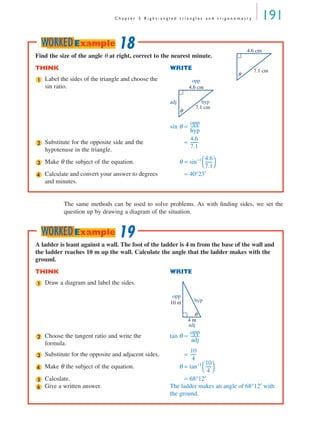
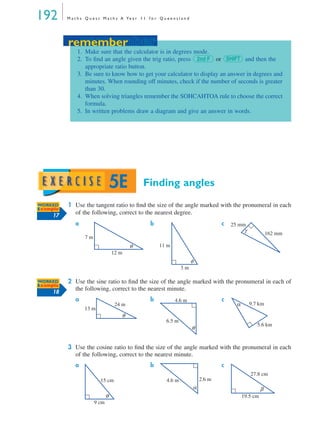
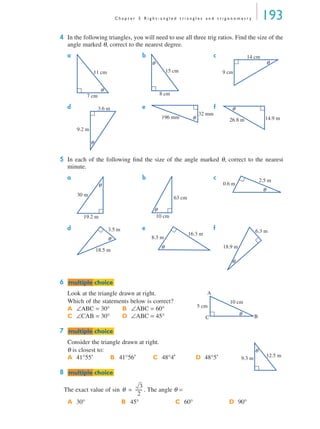
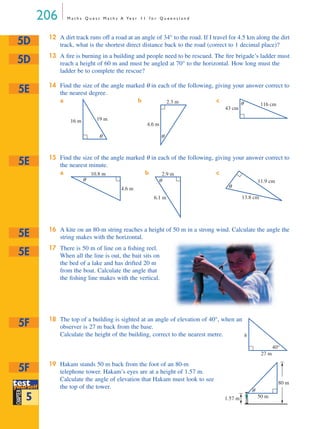
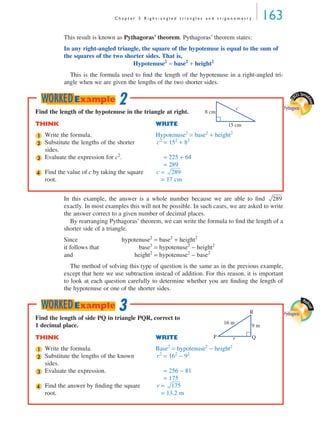
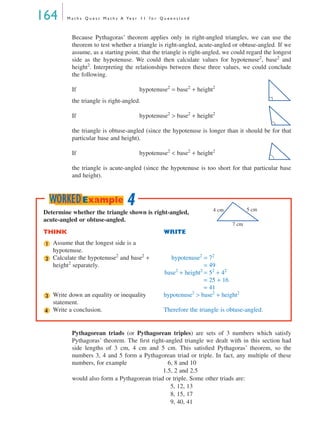
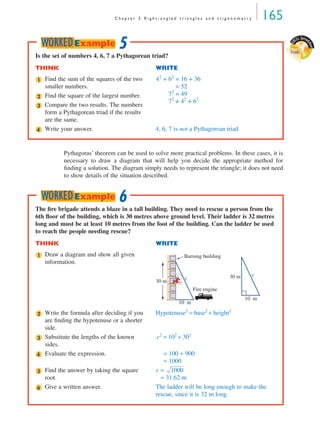
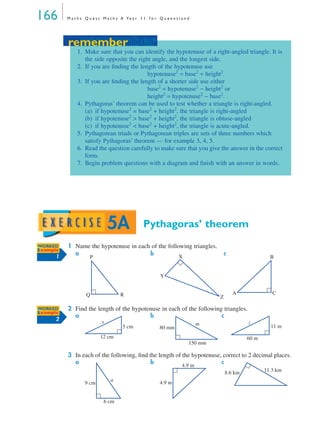
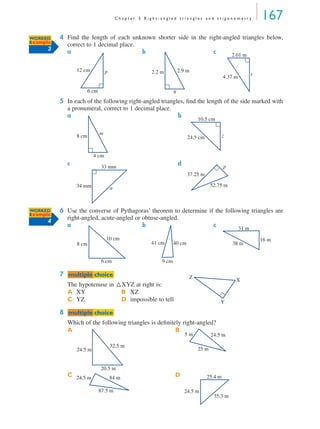
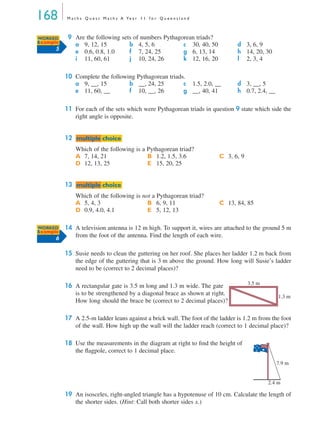
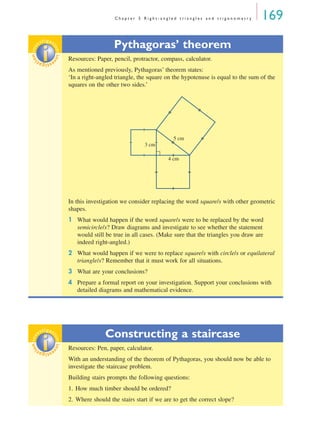
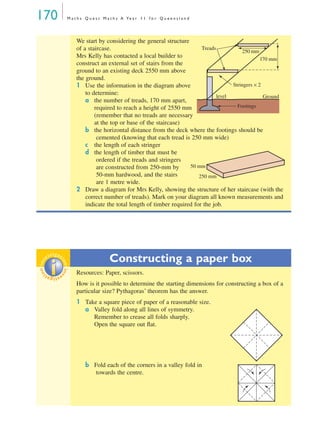
This document provides information about Pythagoras' theorem and how it can be used to solve problems involving right triangles. It begins with a brief history of Pythagoras and the times he lived in. It then explains Pythagoras' theorem, which states that in a right triangle, the square of the hypotenuse is equal to the sum of the squares of the other two sides. Examples are provided to demonstrate how to use the theorem to calculate unknown sides of right triangles. The document also notes that rearranging the theorem allows calculating the lengths of the shorter sides given the hypotenuse.
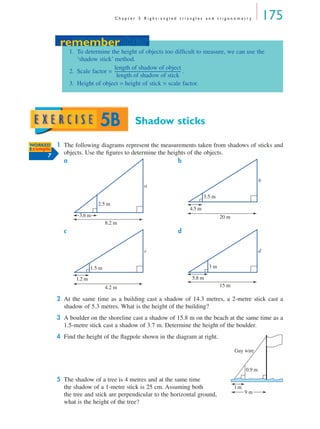
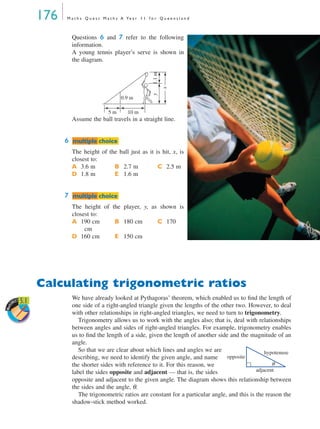
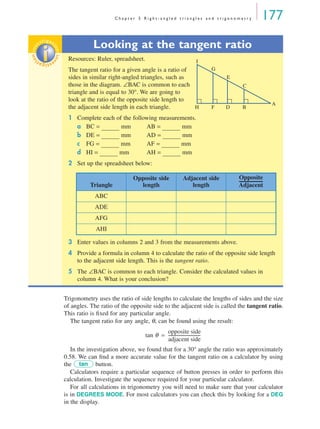
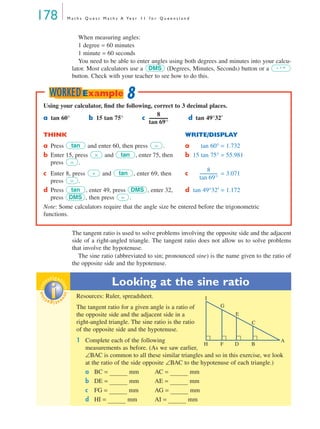
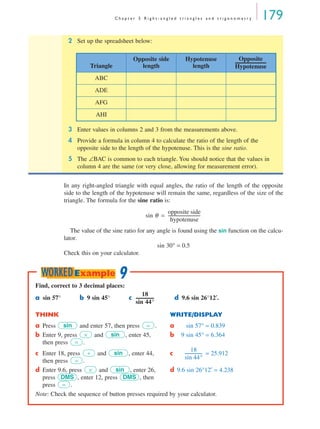
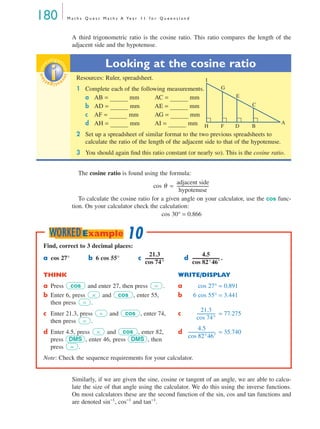
![C h a p t e r 5 R i g h t - a n g l e d t r i a n g l e s a n d t r i g o n o m e t r y 181
Problems sometimes supply angles in degrees, minutes and seconds, or require
answers to be written in the form of degrees, minutes and seconds. On most calcu-
lators, you will use the DMS (Degrees, Minutes, Seconds) function or the
function.
If you are using a graphics calculator, the ‘angle’ function provides this facility. Check
with your teacher for the requirements of your particular calculator.
Find θ, correct to the nearest degree, given that sin θ = 0.738.
THINK WRITE/DISPLAY
Press [sin–1
] and enter .738,
then press .
Round your answer to the nearest
degree.
θ = 48°
Note: Check the sequence requirements for your calculator.
1 2nd F
=
2
11WORKEDExample
° ’ ”
Given that tan θ = 1.647, calculate θ to the nearest minute.
THINK WRITE/DISPLAY
Press [tan–1
] and enter 1.647,
then press .
Convert your answer to degrees and
minutes by pressing .
θ = 58°44′
1 2nd F
=
2
DMS
12WORKEDExample
remember
1. The tangent ratio is the ratio of the opposite side and the adjacent side.
tan θ =
2. The sine ratio is the ratio of the opposite side and the hypotenuse.
sin θ =
3. The cosine ratio is the ratio of the adjacent side and the hypotenuse.
cos θ =
4. The value of the trigonometric ratios can be found using the sin, cos and tan
functions on your calculator.
5. The angle can be found when given the trigonometric ratio using the sin−1
,
cos−1
and tan−1
functions on your calculator.
opposite side
adjacent side
-------------------------------
opposite side
hypotenuse
-------------------------------
adjacent side
hypotenuse
-------------------------------
remember
MQ Maths A Yr 11 - 05 Page 181 Wednesday, July 4, 2001 4:39 PM](https://image.slidesharecdn.com/mqach05-130825182428-phpapp01/85/Maths-A-Chapter-5-25-320.jpg)