


“Atoms are said to be the very tiny particles of any
  matter that cannot be divided any more after a
             certain stage “ for example :
 Take a chair and keep on doing its pieces , a stage
  will come when there will small particle left that
          particle can be said to be an atom.
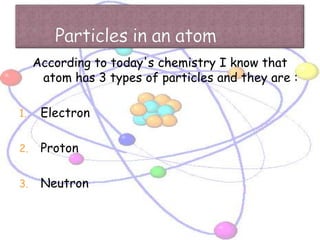
According to today's chemistry I know that
      atom has 3 types of particles and they are :

1.    Electron

2.    Proton

3.    Neutron
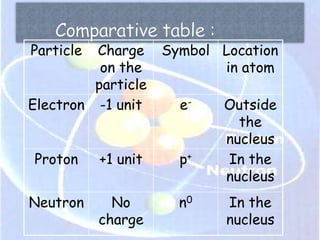
Particle Charge      Symbol Location
          on the            in atom
         particle
Electron -1 unit       e-    Outside
                               the
                             nucleus
Proton     +1 unit     p+    In the
                             nucleus
Neutron      No        n0    In the
           charge            nucleus
As we make it from the name that I must be talking
    about the mass of the atom taken. The mass is
      nothing but the sum of electrons Protons &
     neutrons . But actually mass no. can be finded
  through just doubling the atomic no. of the given
            atom if the atomic no. is even .
If the atomic no. is odd then just double the atomic
             no. and add 1 to the answer .
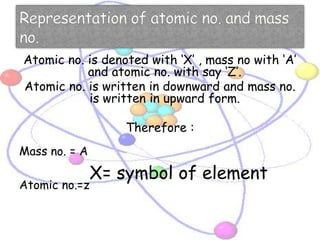
Atomic no. is denoted with ‘X’ , mass no with ‘A’
           and atomic no. with say ‘Z’.
Atomic no. is written in downward and mass no.
           is written in upward form.

                   Therefore :
Mass no. = A
               X= symbol of element
Atomic no.=z
Now if we know the atomic no. then we can find
          both of the proton & electron.
  Because the no. of protons and electrons are
    directly proportional to the atomic no. for
                     example :
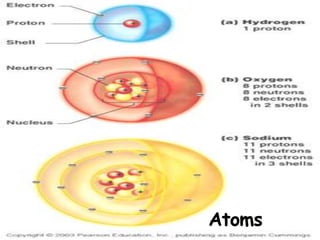
We take sodium . The atomic no. of Sodium (Na) is
                11 therefore the :-
Atomic no. = no. of Protons = no. of Electrons
There is very easy and simple way to find neutrons
    as we had earlier taken sodium (Na) so the
         formulae for finding neutrons is :-

    Mass no. – Atomic no. = no. of neutrons
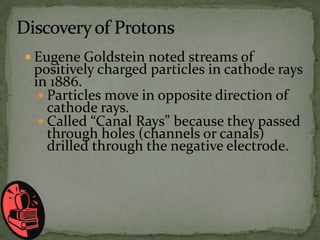
 Eugene Goldstein noted streams of
 positively charged particles in cathode rays
 in 1886.
   Particles move in opposite direction of
    cathode rays.
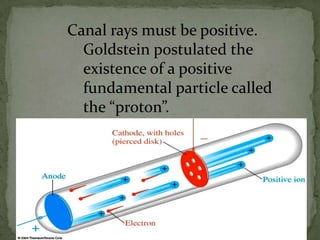
   Called “Canal Rays” because they passed
    through holes (channels or canals)
    drilled through the negative electrode.
Canal rays must be positive.
  Goldstein postulated the
  existence of a positive
  fundamental particle called
  the “proton”.
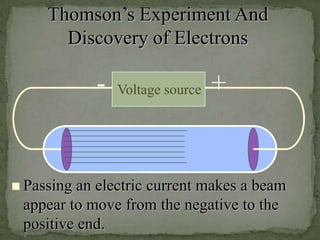
Thomson’s Experiment And
       Discovery of Electrons

            -   Voltage source   +


 Passing an electric current makes a beam
 appear to move from the negative to the
 positive end.
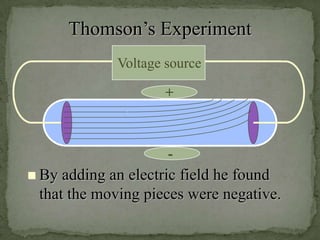
Thomson’s Experiment
            Voltage source

                    +


                    -
 By adding an electric field he found
 that the moving pieces were negative.
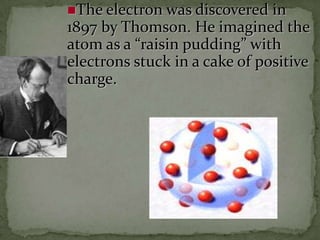
The electron was discovered   in
1897 by Thomson. He imagined the
atom as a “raisin pudding” with
electrons stuck in a cake of positive
charge.
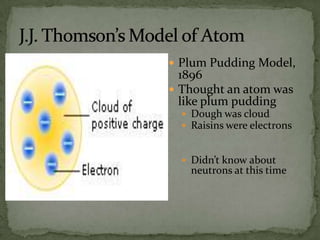
 Plum Pudding Model,
  1896
 Thought an atom was
  like plum pudding
   Dough was cloud
   Raisins were electrons


   Didn’t know about
    neutrons at this time
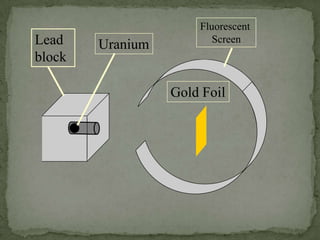
 English physicist Ernest Rutherford (1911)
 Shot alpha particles at fluorescent screen.
 When an alpha particle hits a fluorescent screen, it
  glows.
Fluorescent
Lead    Uranium          Screen
block

                  Gold Foil
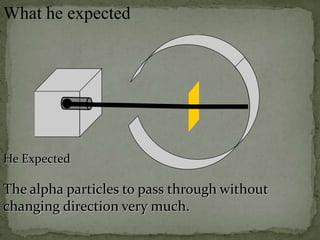
What he expected


He Expected

The alpha particles to pass through without
changing direction very much.
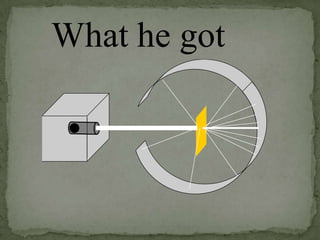
What he got
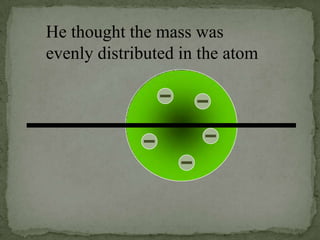
He thought the mass was
evenly distributed in the atom
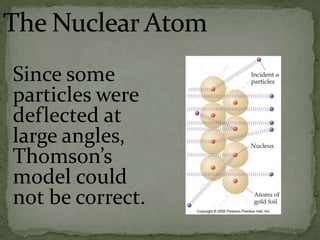
Since some
particles were
deflected at
large angles,
Thomson’s
model could
not be correct.
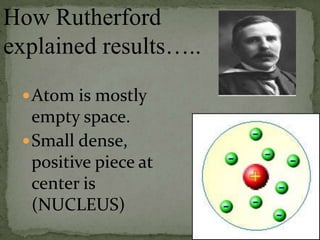
How Rutherford
explained results…..
  Atom is mostly
   empty space.
  Small dense,
   positive piece at
   center is
   (NUCLEUS)
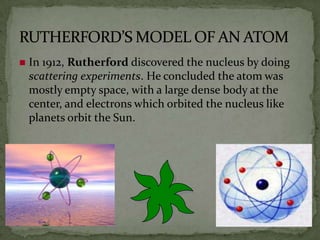
   In 1912, Rutherford discovered the nucleus by doing
    scattering experiments. He concluded the atom was
    mostly empty space, with a large dense body at the
    center, and electrons which orbited the nucleus like
    planets orbit the Sun.
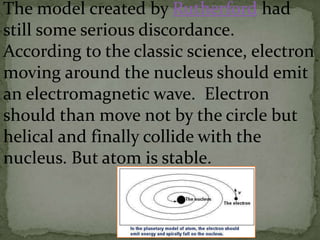
The model created by Rutherford had
still some serious discordance.
According to the classic science, electron
moving around the nucleus should emit
an electromagnetic wave. Electron
should than move not by the circle but
helical and finally collide with the
nucleus. But atom is stable.
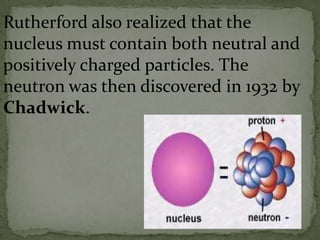
Rutherford also realized that the
nucleus must contain both neutral and
positively charged particles. The
neutron was then discovered in 1932 by
Chadwick.
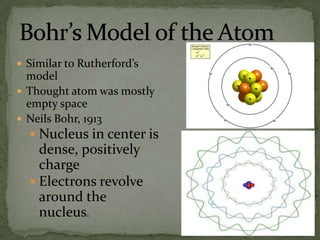
 Similar to Rutherford’s
  model
 Thought atom was mostly
  empty space
 Neils Bohr, 1913
    Nucleus in center is
    dense, positively
    charge
   Electrons revolve
    around the
    nucleus.
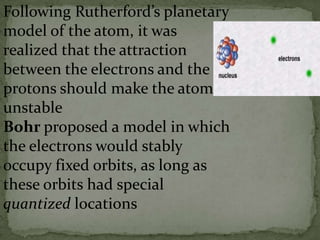
Following Rutherford’s planetary
model of the atom, it was
realized that the attraction
between the electrons and the
protons should make the atom
unstable
Bohr proposed a model in which
the electrons would stably
occupy fixed orbits, as long as
these orbits had special
quantized locations
Parts of an Atom
Each element has a different number of protons
in its nucleus
    Protons have positive charge                  p
    Change the number of protons  change
    elements
    This is called nuclear physics
The element also has the same number of
electrons
    Electrons have negative charge
                                                  e
    Change the number of electrons  ionize the
    element
    This is called chemistry
Some elements also have neutrons
    Neutrons have no charge                       n
    They are in the nuclei of atoms
Structure of atom

Structure of atom

  • 2.
    “Atoms are saidto be the very tiny particles of any matter that cannot be divided any more after a certain stage “ for example : Take a chair and keep on doing its pieces , a stage will come when there will small particle left that particle can be said to be an atom.
  • 4.
    According to today'schemistry I know that atom has 3 types of particles and they are : 1. Electron 2. Proton 3. Neutron
  • 5.
    Particle Charge Symbol Location on the in atom particle Electron -1 unit e- Outside the nucleus Proton +1 unit p+ In the nucleus Neutron No n0 In the charge nucleus
  • 6.
    As we makeit from the name that I must be talking about the mass of the atom taken. The mass is nothing but the sum of electrons Protons & neutrons . But actually mass no. can be finded through just doubling the atomic no. of the given atom if the atomic no. is even . If the atomic no. is odd then just double the atomic no. and add 1 to the answer .
  • 7.
    Atomic no. isdenoted with ‘X’ , mass no with ‘A’ and atomic no. with say ‘Z’. Atomic no. is written in downward and mass no. is written in upward form. Therefore : Mass no. = A X= symbol of element Atomic no.=z
  • 8.
    Now if weknow the atomic no. then we can find both of the proton & electron. Because the no. of protons and electrons are directly proportional to the atomic no. for example : We take sodium . The atomic no. of Sodium (Na) is 11 therefore the :- Atomic no. = no. of Protons = no. of Electrons
  • 9.
    There is veryeasy and simple way to find neutrons as we had earlier taken sodium (Na) so the formulae for finding neutrons is :- Mass no. – Atomic no. = no. of neutrons
  • 11.
     Eugene Goldsteinnoted streams of positively charged particles in cathode rays in 1886.  Particles move in opposite direction of cathode rays.  Called “Canal Rays” because they passed through holes (channels or canals) drilled through the negative electrode.
  • 12.
    Canal rays mustbe positive. Goldstein postulated the existence of a positive fundamental particle called the “proton”.
  • 13.
    Thomson’s Experiment And Discovery of Electrons - Voltage source +  Passing an electric current makes a beam appear to move from the negative to the positive end.
  • 14.
    Thomson’s Experiment Voltage source + -  By adding an electric field he found that the moving pieces were negative.
  • 15.
    The electron wasdiscovered in 1897 by Thomson. He imagined the atom as a “raisin pudding” with electrons stuck in a cake of positive charge.
  • 16.
     Plum PuddingModel, 1896  Thought an atom was like plum pudding  Dough was cloud  Raisins were electrons  Didn’t know about neutrons at this time
  • 17.
     English physicistErnest Rutherford (1911)  Shot alpha particles at fluorescent screen.  When an alpha particle hits a fluorescent screen, it glows.
  • 18.
    Fluorescent Lead Uranium Screen block Gold Foil
  • 19.
    What he expected HeExpected The alpha particles to pass through without changing direction very much.
  • 20.
  • 21.
    He thought themass was evenly distributed in the atom
  • 22.
    Since some particles were deflectedat large angles, Thomson’s model could not be correct.
  • 23.
    How Rutherford explained results…..  Atom is mostly empty space.  Small dense, positive piece at center is (NUCLEUS)
  • 24.
    In 1912, Rutherford discovered the nucleus by doing scattering experiments. He concluded the atom was mostly empty space, with a large dense body at the center, and electrons which orbited the nucleus like planets orbit the Sun.
  • 25.
    The model createdby Rutherford had still some serious discordance. According to the classic science, electron moving around the nucleus should emit an electromagnetic wave. Electron should than move not by the circle but helical and finally collide with the nucleus. But atom is stable.
  • 26.
    Rutherford also realizedthat the nucleus must contain both neutral and positively charged particles. The neutron was then discovered in 1932 by Chadwick.
  • 27.
     Similar toRutherford’s model  Thought atom was mostly empty space  Neils Bohr, 1913  Nucleus in center is dense, positively charge  Electrons revolve around the nucleus.
  • 28.
    Following Rutherford’s planetary modelof the atom, it was realized that the attraction between the electrons and the protons should make the atom unstable Bohr proposed a model in which the electrons would stably occupy fixed orbits, as long as these orbits had special quantized locations
  • 29.
    Parts of anAtom Each element has a different number of protons in its nucleus Protons have positive charge p Change the number of protons  change elements This is called nuclear physics The element also has the same number of electrons Electrons have negative charge e Change the number of electrons  ionize the element This is called chemistry Some elements also have neutrons Neutrons have no charge n They are in the nuclei of atoms