MeasuringLength and DistanceBy Moira Whitehouse PhD
It is said that long, long ago, people used the length of the king’s foot to settle arguments about how long  or wide something was. So that everyone would know how long his foot was, the king passed out sticks the same length as his foot. The sticks were called the ruler’s foot or “rulers.”
•Then, about 200 years ago, someone decided that measurement systems would be better based on Mother Earth than on some king’s foot.  •So, using mathematics, they figured the distance from the equator to the north pole.Here10 										  MillionHere•And divided that distance by:
And the answer to that division problem was named:The MeterThe system is called the System International or         the Metric System.•A whole system of measurement was developed with the meter as its basis.
•The Metric System is based on dividing the meter by the number 10 or multiplying it by some multiple of 10.•Considering the various numbers we used in the English system (12 inches to a foot, 3 feet to a yard, 1760 yards to a mile , etc. etc.) multiplying or dividing by 10 makes the Metric System seem easy.
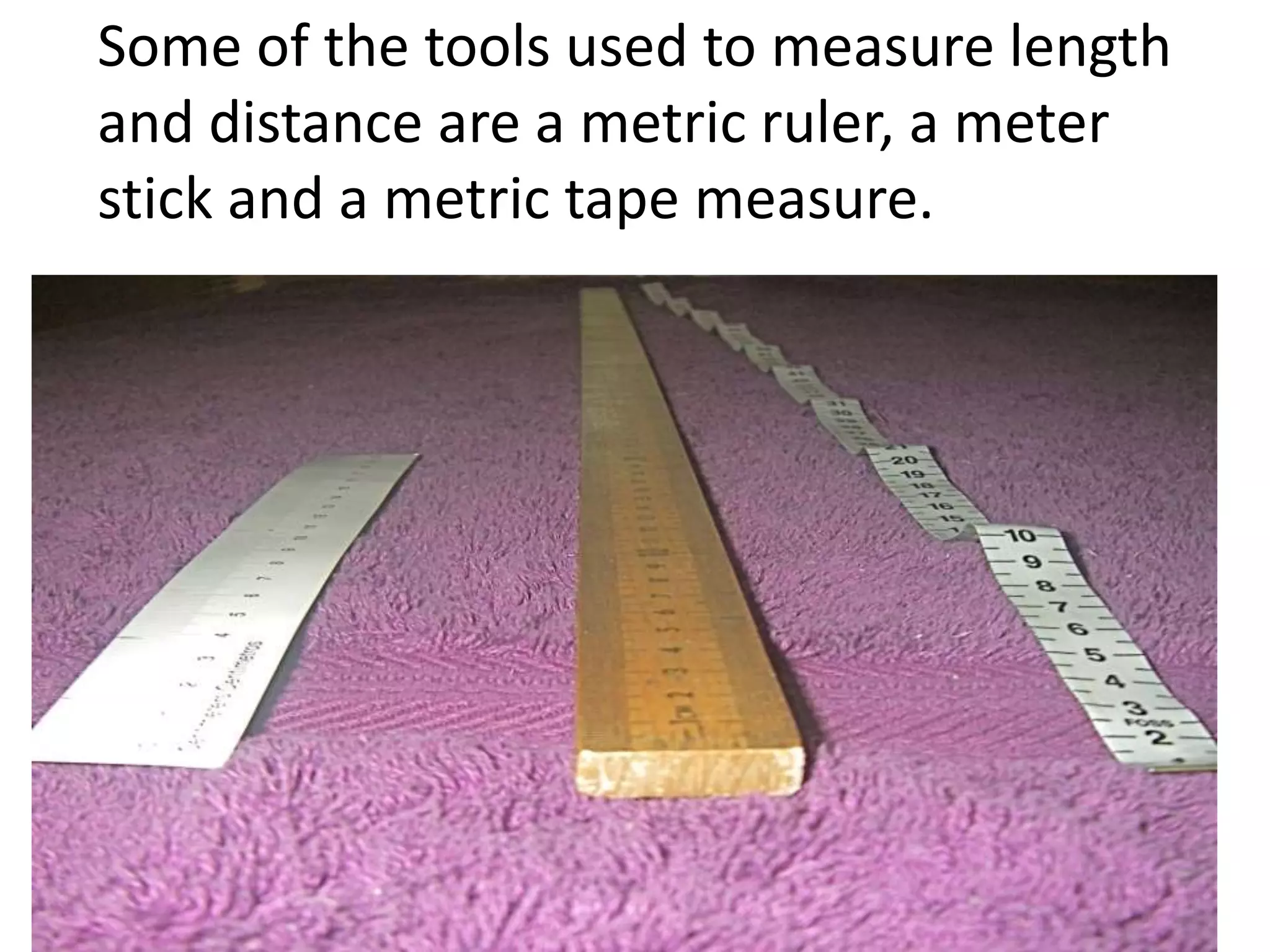
Some of the tools used to measure length and distance are a metric ruler, a meter stick and a metric tape measure.
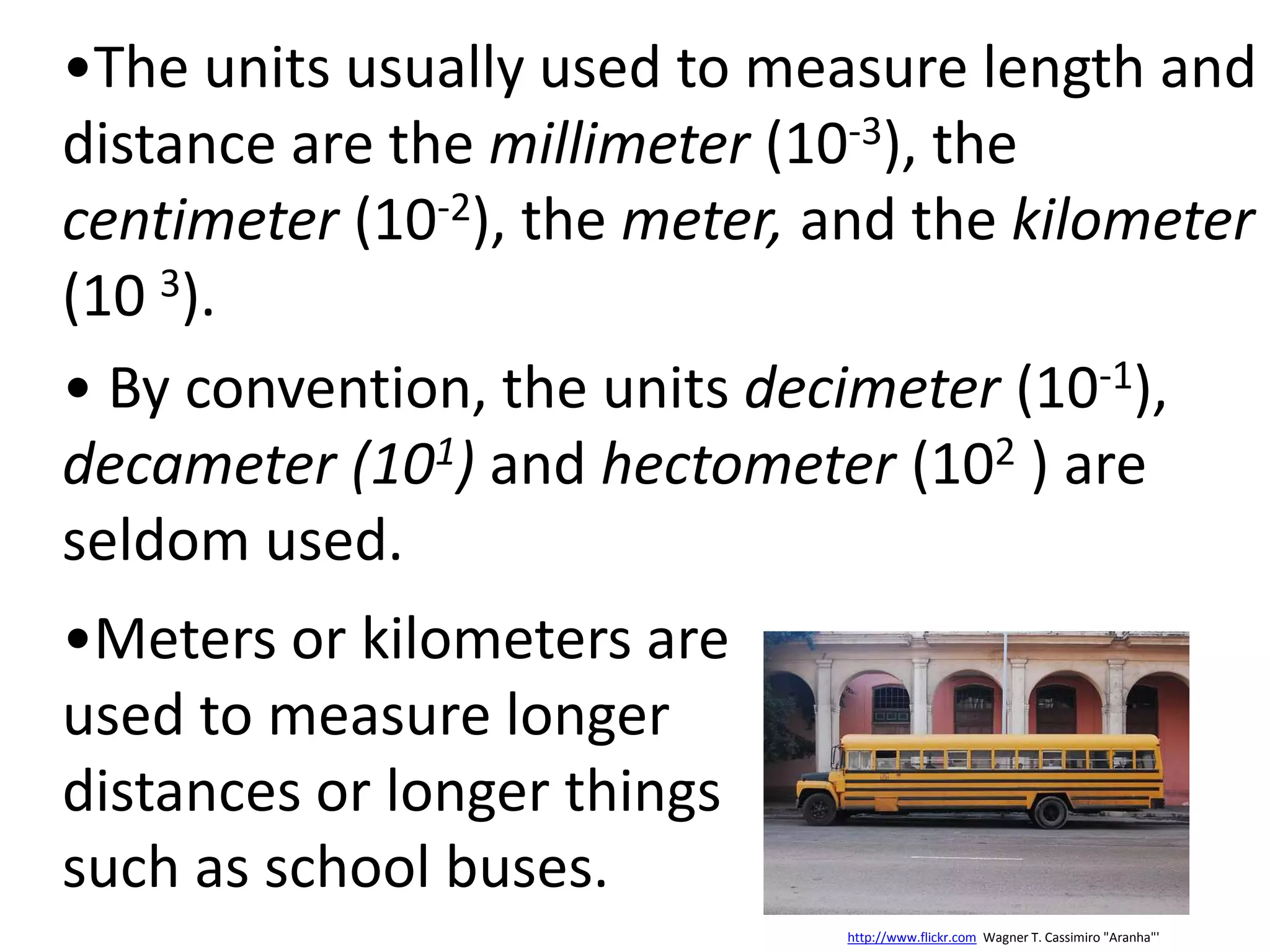
•The units usually used to measure length and distance are the millimeter (10-3), the centimeter (10-2), the meter, and the kilometer (10 3). • By convention, the units decimeter (10-1), decameter (101) and hectometer (102 ) are seldom used. •Meters or kilometers are used to measure longer distances or longer things such as school buses. http://www.flickr.com  Wagner T. Cassimiro "Aranha"'
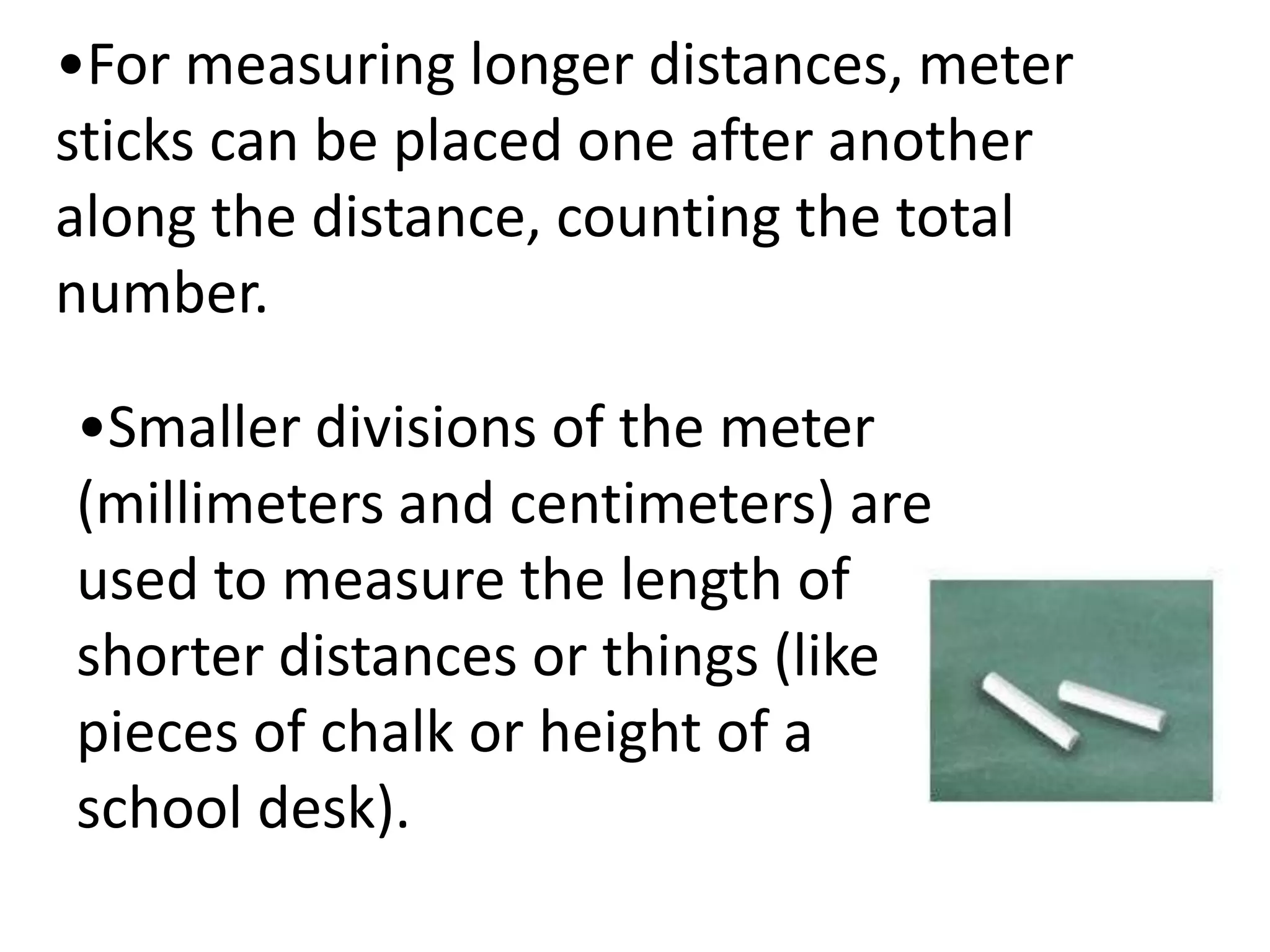
•For measuring longer distances, meter sticks can be placed one after another along the distance, counting the total number.  •Smaller divisions of the meter (millimeters and centimeters) are used to measure the length of shorter distances or things (like pieces of chalk or height of a school desk).
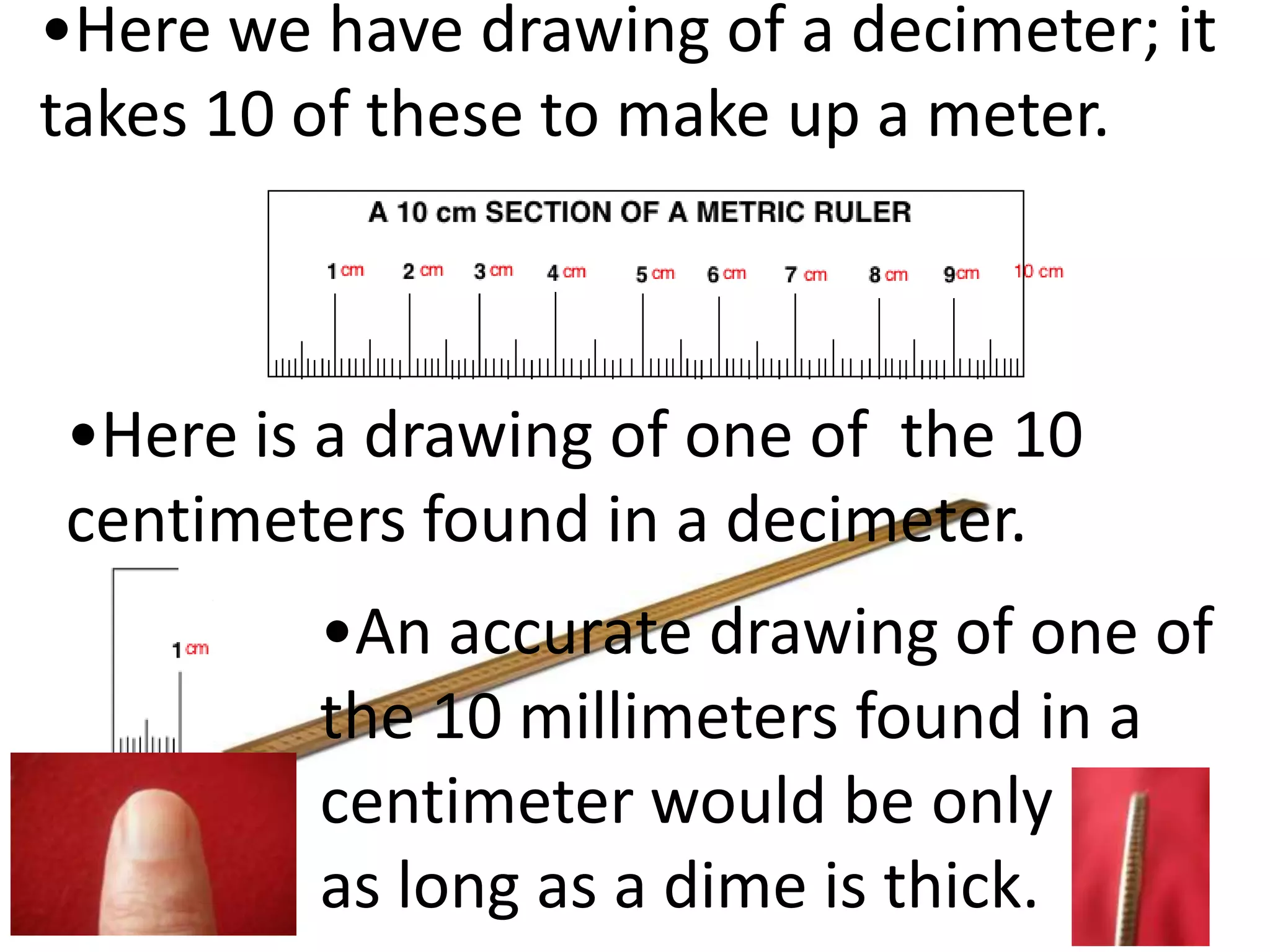
•Here we have drawing of a decimeter; it takes 10 of these to make up a meter.•Here is a drawing of one of  the 10 centimeters found in a decimeter.•An accurate drawing of one ofthe 10 millimeters found in a centimeter would be onlyas long as a dime is thick.
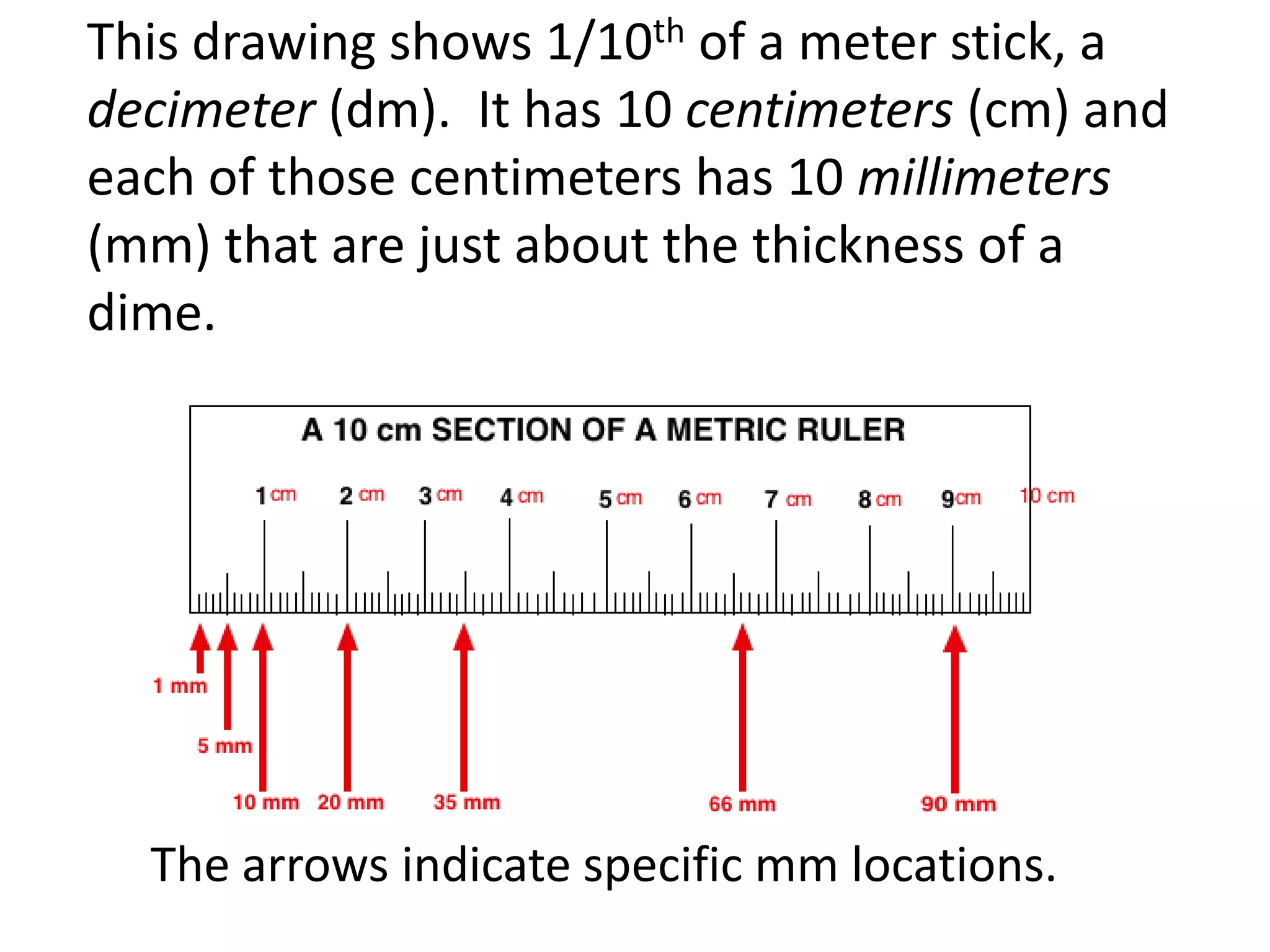
This drawing shows 1/10th of a meter stick, a decimeter (dm).  It has 10 centimeters (cm) and each of those centimeters has 10 millimeters (mm) that are just about the thickness of a dime.The arrows indicate specific mm locations.
Before getting some practice in measuring length, it is important to understand that scientists use the meter as the basis for measuring mass and volume as well as length.
• Length/Distance:  how far from here to there in		•Kilometers  (thousands of meters....Fort Worth to Dallas, 50 Km)		•Meters  (a school bus, about 10 meters)		•Centimeters (top of your desk, about 70 Cm) 		•Millimeters (width of a dime, 1 mm)
Volume:  Scientist also use the meter (cubic meters) to measure volume (how much space something takes up.)
Mass: And in a round about way, scientists even use the meter to measure mass.	•That is because the amount of water that fits into 1 centimeter cubed has a mass of 1 gram and the gram is the unit we use to measure mass.
We will start by measuring distance, first by finding the correct millimeter and then stating the answer in centimeters for “A” through “G”.  Stated as centimeters
We will start by measuring distance, first by finding the correct millimeter and stating the answer in centimeters for “A” through “G”.  First, “A”.Stated as centimeters
We will start by measuring distance, first by finding the correct millimeter and then stating the answer in centimeters for “A” through “G”.  First, “A”.18  mm1.8 cmStated as centimeters
We will start by measuring distance, first by finding the correct millimeter and then stating the answer in centimeters for “A” through “G”.  Then, “B”.18  mm1.8 cmStated as centimeters
We will start by measuring distance, first by finding the correct millimeter and then stating the answer in centimeters for “A” through “G”.  Then, “B”.18  mm1.8 cm32  mm3.2  cm Stated as centimeters
We will start by measuring distance, first by finding the correct millimeter and then stating the answer in centimeters for “A” through “G”.  Then, “C”.18  mm1.8 cm32  mm3.2  cmStated as centimeters
We will start by measuring distance, first by finding the correct millimeter and then stating the answer in centimeters for “A” through “G”.  Then, “C”.18  mm1.8 cm32  mm3.2  cm44  mm4.4  cmStated as centimeters
We will start by measuring distance, first by finding the correct millimeter and then stating the answer in centimeters for “A” through “G”.  Then, “D”.18  mm1.8 cm32  mm3.2  cm44  mm4.4  cmStated as centimeters
We will start by measuring distance, first by finding the correct millimeter and then stating the answer in centimeters for “A” through “G”.  Then, “D”.18  mm1.8 cm32  mm3.2  cm44  mm4.4  cmStated as centimeters59  mm5.9  cm
We will start by measuring distance, first by finding the correct millimeter and then stating the answer in centimeters for “A” through “G”.  Then, “E”.18  mm1.8 cm32  mm3.2  cm44  mm4.4  cmStated as centimeters59  mm5.9  cm
We will start by measuring distance, first by finding the correct millimeter and then stating the answer in centimeters for “A” through “G”.  Then, “E”.18  mm1.8 cm32  mm3.2  cm44  mm4.4  cmStated as centimeters59  mm5.9  cm7.5 cm75  mm
We will start by measuring distance, first by finding the correct millimeter and then stating the answer in centimeters for “A” through “G”.  Then, “F”.18  mm1.8 cm32  mm3.2  cm44  mm4.4  cmStated as centimeters59  mm5.9  cm7.5  cm75  mm
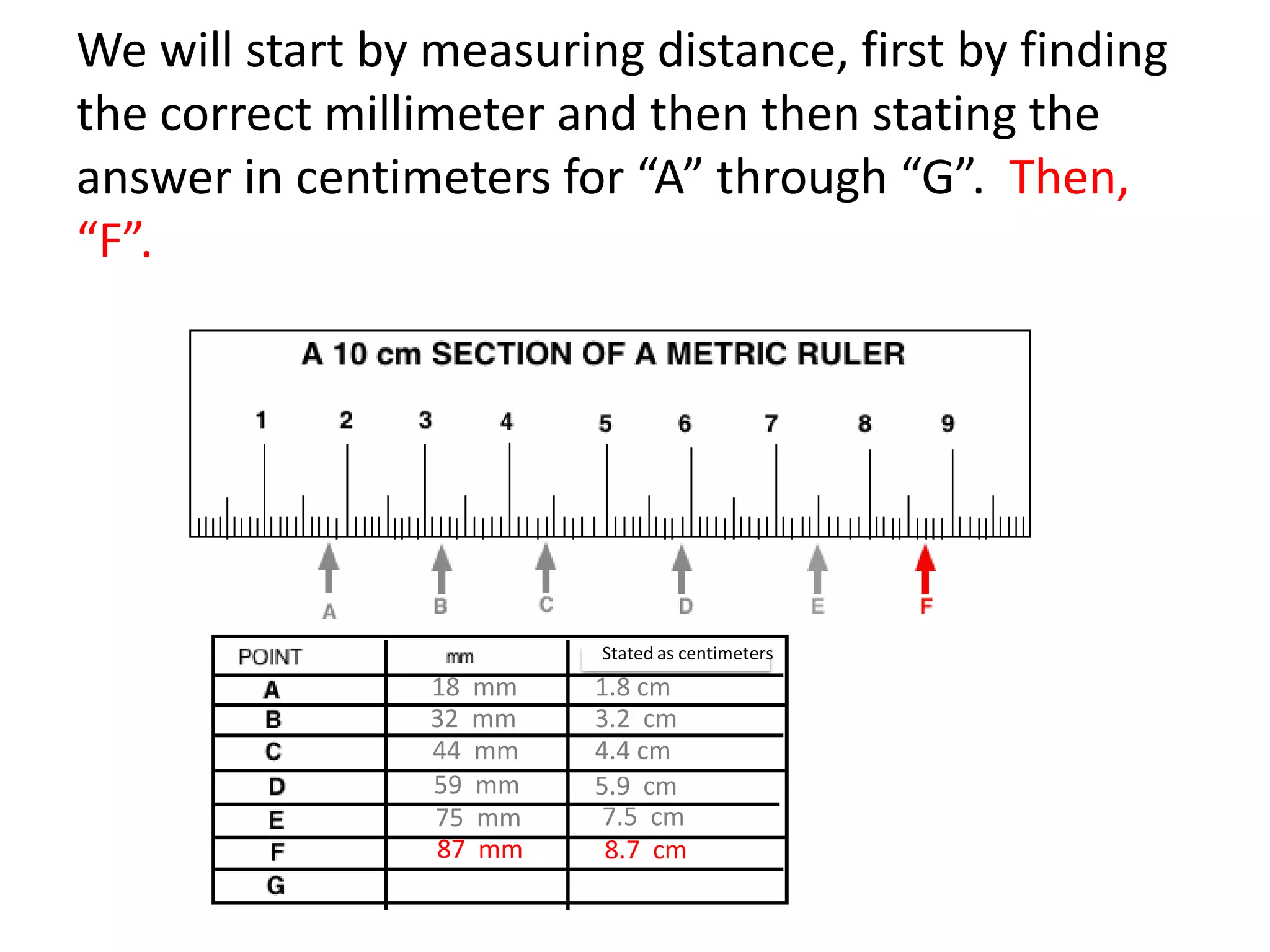
We will start by measuring distance, first by finding the correct millimeter and then then stating the answer in centimeters for “A” through “G”.  Then, “F”.18  mm1.8 cm32  mm3.2  cm44  mm4.4 cm Stated as centimeters59  mm5.9  cm7.5  cm75  mm87  mm8.7  cm
We will start by measuring distance, first by finding the correct millimeter and then stating the answer in centimeters for “A” through “G”.  Then, “G”.18  mm1.8 cm32  mm3.2  cm44  mm4.4  cmStated as centimeters59  mm5.9  cm7.5  cm75  mm87  mm8.7  cm
We will start by measuring distance, first by finding the correct millimeter and then stating the answer in centimeters for “A” through “G”.  Then, “G”.18  mm1.8 cm32  mm3.2  cm44  mm4.4  cmStated as centimeters59  mm5.9  cm7.5  cm75  mm87  mm8.7  cm96  mm9.6  cm
How long is Mr. Toad?
How long is this fish in millimeters?How many centimeters is that?The butterflies wing span is _________mm or stated in centimeters is ____________.The caterpillar’s length in millimeters is _________ or stated in centimeters is ____________.
Some rulers start at the very end of the stick and others have a small space before the actual ruler starts.
Placement of one of these screwdrivers will get you the wrong answer for the screwdriver’s length.	• Is this screwdriver 900 millimeters long (that is the same as 9 centimeters)?	•Or is it 940 millimeters long (that is the same as 9 centimeters plus 4 millimeters?
What is the length of this tooth pick?In millimeters?   Stated in centimeters?
What is the length of this paper clip in millimeters?  Stated in centimeters?
•Here is a little “pop” quiz as we finish discussing the measurement of length. •In pairs, measure your height with a meter stick or metric measuring tape.•How tall are you are in these metric length units?•  meters		• millimeters•  centimeters

MEASURING LENGTH (teach)

  • 1.
    MeasuringLength and DistanceByMoira Whitehouse PhD
  • 2.
    It is saidthat long, long ago, people used the length of the king’s foot to settle arguments about how long or wide something was. So that everyone would know how long his foot was, the king passed out sticks the same length as his foot. The sticks were called the ruler’s foot or “rulers.”
  • 3.
    •Then, about 200years ago, someone decided that measurement systems would be better based on Mother Earth than on some king’s foot. •So, using mathematics, they figured the distance from the equator to the north pole.Here10 MillionHere•And divided that distance by:
  • 4.
    And the answerto that division problem was named:The MeterThe system is called the System International or the Metric System.•A whole system of measurement was developed with the meter as its basis.
  • 5.
    •The Metric Systemis based on dividing the meter by the number 10 or multiplying it by some multiple of 10.•Considering the various numbers we used in the English system (12 inches to a foot, 3 feet to a yard, 1760 yards to a mile , etc. etc.) multiplying or dividing by 10 makes the Metric System seem easy.
  • 6.
    Some of thetools used to measure length and distance are a metric ruler, a meter stick and a metric tape measure.
  • 7.
    •The units usuallyused to measure length and distance are the millimeter (10-3), the centimeter (10-2), the meter, and the kilometer (10 3). • By convention, the units decimeter (10-1), decameter (101) and hectometer (102 ) are seldom used. •Meters or kilometers are used to measure longer distances or longer things such as school buses. http://www.flickr.com Wagner T. Cassimiro "Aranha"'
  • 8.
    •For measuring longerdistances, meter sticks can be placed one after another along the distance, counting the total number. •Smaller divisions of the meter (millimeters and centimeters) are used to measure the length of shorter distances or things (like pieces of chalk or height of a school desk).
  • 9.
    •Here we havedrawing of a decimeter; it takes 10 of these to make up a meter.•Here is a drawing of one of the 10 centimeters found in a decimeter.•An accurate drawing of one ofthe 10 millimeters found in a centimeter would be onlyas long as a dime is thick.
  • 10.
    This drawing shows1/10th of a meter stick, a decimeter (dm). It has 10 centimeters (cm) and each of those centimeters has 10 millimeters (mm) that are just about the thickness of a dime.The arrows indicate specific mm locations.
  • 11.
    Before getting somepractice in measuring length, it is important to understand that scientists use the meter as the basis for measuring mass and volume as well as length.
  • 12.
    • Length/Distance: how far from here to there in •Kilometers (thousands of meters....Fort Worth to Dallas, 50 Km) •Meters (a school bus, about 10 meters) •Centimeters (top of your desk, about 70 Cm) •Millimeters (width of a dime, 1 mm)
  • 13.
    Volume: Scientistalso use the meter (cubic meters) to measure volume (how much space something takes up.)
  • 14.
    Mass: And ina round about way, scientists even use the meter to measure mass. •That is because the amount of water that fits into 1 centimeter cubed has a mass of 1 gram and the gram is the unit we use to measure mass.
  • 15.
    We will startby measuring distance, first by finding the correct millimeter and then stating the answer in centimeters for “A” through “G”. Stated as centimeters
  • 16.
    We will startby measuring distance, first by finding the correct millimeter and stating the answer in centimeters for “A” through “G”. First, “A”.Stated as centimeters
  • 17.
    We will startby measuring distance, first by finding the correct millimeter and then stating the answer in centimeters for “A” through “G”. First, “A”.18 mm1.8 cmStated as centimeters
  • 18.
    We will startby measuring distance, first by finding the correct millimeter and then stating the answer in centimeters for “A” through “G”. Then, “B”.18 mm1.8 cmStated as centimeters
  • 19.
    We will startby measuring distance, first by finding the correct millimeter and then stating the answer in centimeters for “A” through “G”. Then, “B”.18 mm1.8 cm32 mm3.2 cm Stated as centimeters
  • 20.
    We will startby measuring distance, first by finding the correct millimeter and then stating the answer in centimeters for “A” through “G”. Then, “C”.18 mm1.8 cm32 mm3.2 cmStated as centimeters
  • 21.
    We will startby measuring distance, first by finding the correct millimeter and then stating the answer in centimeters for “A” through “G”. Then, “C”.18 mm1.8 cm32 mm3.2 cm44 mm4.4 cmStated as centimeters
  • 22.
    We will startby measuring distance, first by finding the correct millimeter and then stating the answer in centimeters for “A” through “G”. Then, “D”.18 mm1.8 cm32 mm3.2 cm44 mm4.4 cmStated as centimeters
  • 23.
    We will startby measuring distance, first by finding the correct millimeter and then stating the answer in centimeters for “A” through “G”. Then, “D”.18 mm1.8 cm32 mm3.2 cm44 mm4.4 cmStated as centimeters59 mm5.9 cm
  • 24.
    We will startby measuring distance, first by finding the correct millimeter and then stating the answer in centimeters for “A” through “G”. Then, “E”.18 mm1.8 cm32 mm3.2 cm44 mm4.4 cmStated as centimeters59 mm5.9 cm
  • 25.
    We will startby measuring distance, first by finding the correct millimeter and then stating the answer in centimeters for “A” through “G”. Then, “E”.18 mm1.8 cm32 mm3.2 cm44 mm4.4 cmStated as centimeters59 mm5.9 cm7.5 cm75 mm
  • 26.
    We will startby measuring distance, first by finding the correct millimeter and then stating the answer in centimeters for “A” through “G”. Then, “F”.18 mm1.8 cm32 mm3.2 cm44 mm4.4 cmStated as centimeters59 mm5.9 cm7.5 cm75 mm
  • 27.
    We will startby measuring distance, first by finding the correct millimeter and then then stating the answer in centimeters for “A” through “G”. Then, “F”.18 mm1.8 cm32 mm3.2 cm44 mm4.4 cm Stated as centimeters59 mm5.9 cm7.5 cm75 mm87 mm8.7 cm
  • 28.
    We will startby measuring distance, first by finding the correct millimeter and then stating the answer in centimeters for “A” through “G”. Then, “G”.18 mm1.8 cm32 mm3.2 cm44 mm4.4 cmStated as centimeters59 mm5.9 cm7.5 cm75 mm87 mm8.7 cm
  • 29.
    We will startby measuring distance, first by finding the correct millimeter and then stating the answer in centimeters for “A” through “G”. Then, “G”.18 mm1.8 cm32 mm3.2 cm44 mm4.4 cmStated as centimeters59 mm5.9 cm7.5 cm75 mm87 mm8.7 cm96 mm9.6 cm
  • 30.
    How long isMr. Toad?
  • 31.
    How long isthis fish in millimeters?How many centimeters is that?The butterflies wing span is _________mm or stated in centimeters is ____________.The caterpillar’s length in millimeters is _________ or stated in centimeters is ____________.
  • 32.
    Some rulers startat the very end of the stick and others have a small space before the actual ruler starts.
  • 33.
    Placement of oneof these screwdrivers will get you the wrong answer for the screwdriver’s length. • Is this screwdriver 900 millimeters long (that is the same as 9 centimeters)? •Or is it 940 millimeters long (that is the same as 9 centimeters plus 4 millimeters?
  • 34.
    What is thelength of this tooth pick?In millimeters? Stated in centimeters?
  • 35.
    What is thelength of this paper clip in millimeters? Stated in centimeters?
  • 36.
    •Here is alittle “pop” quiz as we finish discussing the measurement of length. •In pairs, measure your height with a meter stick or metric measuring tape.•How tall are you are in these metric length units?• meters • millimeters• centimeters