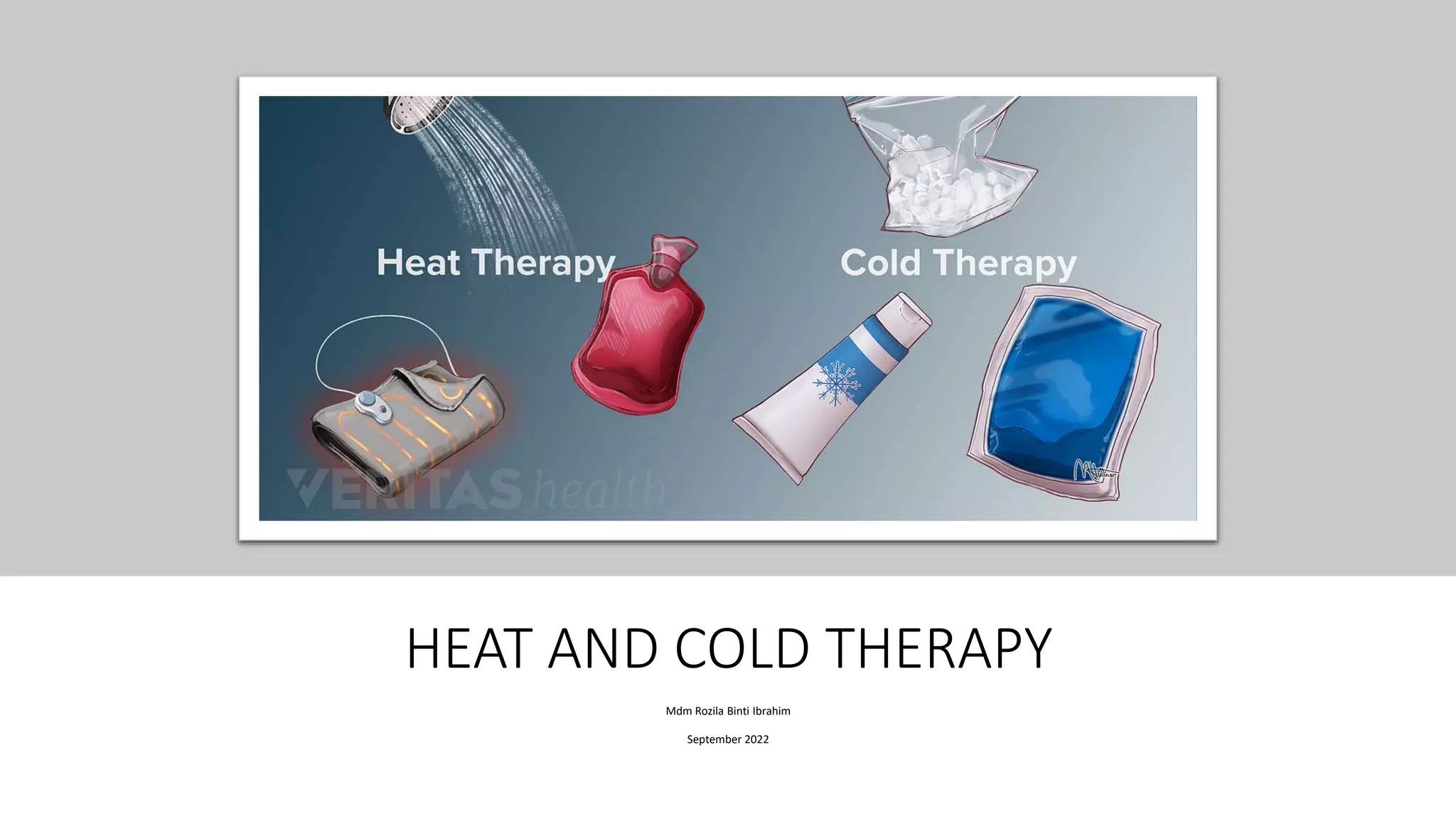
HEAT AND COLD THERAPY
Mdm Rozila Binti Ibrahim
September 2022
Learning Outcome
At the end of the session, student would be able to;
• Identify the definition and physiologic effect of heat and cold
compress
• Describe the type and principle of the heat and cold application
• Understand the side effect and complication heat and cold
application
• Elaborate nurses’ responsibility in application heat and cold to the
patient
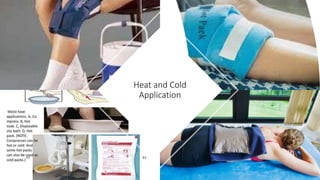
Heat and Cold
Application
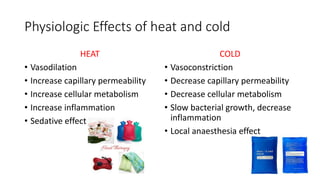
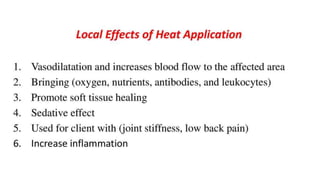
Physiologic Effects of heat and cold
HEAT
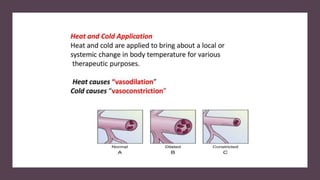
• Vasodilation
• Increase capillary permeability
• Increase cellular metabolism
• Increase inflammation
• Sedative effect
COLD
• Vasoconstriction
• Decrease capillary permeability
• Decrease cellular metabolism
• Slow bacterial growth, decrease
inflammation
• Local anaesthesia effect
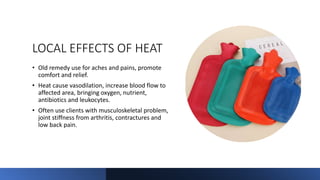
LOCAL EFFECTS OF HEAT
• Old remedy use for aches and pains, promote
comfort and relief.
• Heat cause vasodilation, increase blood flow to
affected area, bringing oxygen, nutrient,
antibiotics and leukocytes.
• Often use clients with musculoskeletal problem,
joint stiffness from arthritis, contractures and
low back pain.
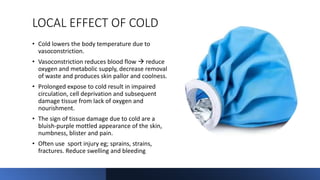
LOCAL EFFECT OF COLD
• Cold lowers the body temperature due to
vasoconstriction.
• Vasoconstriction reduces blood flow  reduce
oxygen and metabolic supply, decrease removal
of waste and produces skin pallor and coolness.
• Prolonged expose to cold result in impaired
circulation, cell deprivation and subsequent
damage tissue from lack of oxygen and
nourishment.
• The sign of tissue damage due to cold are a
bluish-purple mottled appearance of the skin,
numbness, blister and pain.
• Often use sport injury eg; sprains, strains,
fractures. Reduce swelling and bleeding
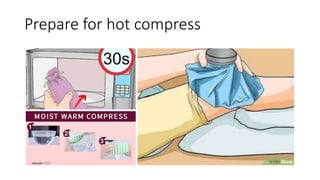
Prepare for hot compress
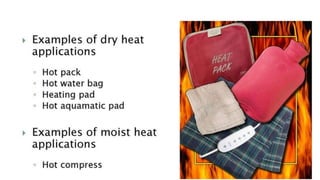
Hot water bag
• The water temperature not more than100°F (37.8°C) for babies and
children.
• 120°F - 100°F / (49°C - 37.8°C) for adults
• Hot water bags is also called hot water bottles, are rubber bags filled
with hot water and used for heat therapy. It is used to manage pain,
such as headache or arthritis, or keep yourself warm on a cold night.
• Hot water bottle are safer than electrical heating pads, which can
start fires or cause electric shocks.
• Hot water bags may cause injury if we don’t use carefully.
SYSTEMIC EFFECT OF HEAT AND COLD
Heat applied to localized area. Application to large body area may
cause excessive peripheral vasodilation  drop in BP  painting.

Extensive cold application and vasoconstriction, clients BP increase.
Shivering is general effect of prolong cold, respond to warm itself.
Thermal tolerance
• Various part of body differ in tolerance to heat and cold.
• The physiologic tolerance individual also varies:
Body part: back, hand and foot not very temperature sensitive.
Inner aspect of wrist, forearm, neck, perineal area - > sensitive
Size exposed: The large area expose, the lower tolerance.
Individual tolerance: very young and very old have lower tolerance.
Length of exposure: People feel hot and cold application most
while temperature is changing, after period of time, tolerance
increase.
Intactness of skin: Injured skin area more sensitive to temperature.
Client
condition need
to consider
before
application of
heat and cold.
Neurosensory impairment
Impaired mental status
Impaired circulation
Immediate after injury or surgery
Open wounds
Adaption of
thermal
receptors
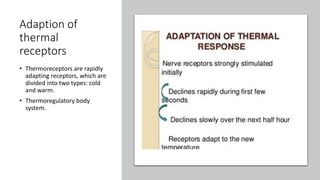
• Thermoreceptors are rapidly
adapting receptors, which are
divided into two types: cold
and warm.
• Thermoregulatory body
system.
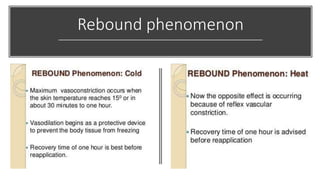
Rebound phenomenon
Aquathermia Pad
• Aquathermia pad is a plastic or
rubber pad
• contains small channels, it contains
water.
• This water flows through the small
channels of pad. T
• may either used as heating or
cooling pad.
• If the patient needs to take heating
pad on any site of body, then hot
water is added in the aquathermia
pad, and then it is placed on the site.
• Likewise in case of cool pad, cold
water is added to aquathermia pad,
and place it on the site. An electrical
control unit is also attached along
with a motor.
Indication of Aquathermia pad
• swelling,
• redness,
• muscle pull,
• muscle sprain and inflammation.
• relief edema.
• relax stiff muscles and contracted muscles of body.
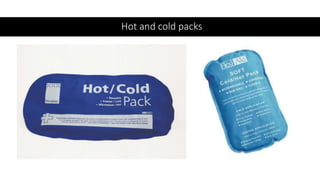
Hot and cold packs
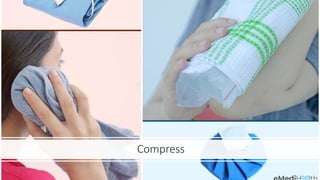
Compress
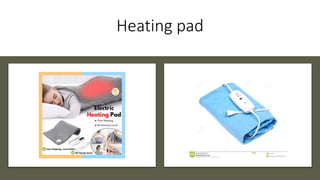
Heating pad
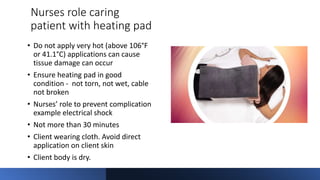
Nurses role caring
patient with heating pad
• Do not apply very hot (above 106°F
or 41.1°C) applications can cause
tissue damage can occur
• Ensure heating pad in good
condition - not torn, not wet, cable
not broken
• Nurses’ role to prevent complication
example electrical shock
• Not more than 30 minutes
• Client wearing cloth. Avoid direct
application on client skin
• Client body is dry.
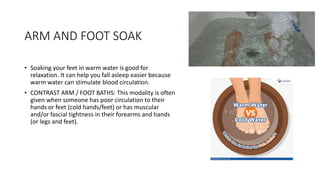
ARM AND FOOT SOAK
• Soaking your feet in warm water is good for
relaxation. It can help you fall asleep easier because
warm water can stimulate blood circulation.
• CONTRAST ARM / FOOT BATHS: This modality is often
given when someone has poor circulation to their
hands or feet (cold hands/feet) or has muscular
and/or fascial tightness in their forearms and hands
(or legs and feet).
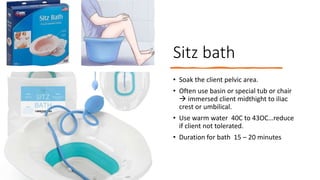
Sitz bath
• Soak the client pelvic area.
• Often use basin or special tub or chair
 immersed client midthight to iliac
crest or umbilical.
• Use warm water 40C to 43OC…reduce
if client not tolerated.
• Duration for bath 15 – 20 minutes
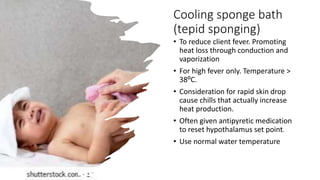
Cooling sponge bath
(tepid sponging)
• To reduce client fever. Promoting
heat loss through conduction and
vaporization
• For high fever only. Temperature >
38⁰C.
• Consideration for rapid skin drop
cause chills that actually increase
heat production.
• Often given antipyretic medication
to reset hypothalamus set point.
• Use normal water temperature
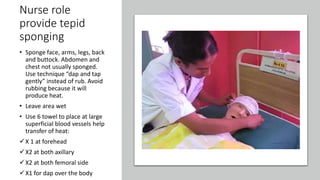
Nurse role
provide tepid
sponging
• Sponge face, arms, legs, back
and buttock. Abdomen and
chest not usually sponged.
Use technique “dap and tap
gently” instead of rub. Avoid
rubbing because it will
produce heat.
• Leave area wet
• Use 6 towel to place at large
superficial blood vessels help
transfer of heat:
X 1 at forehead
X2 at both axillary
X2 at both femoral side
X1 for dap over the body
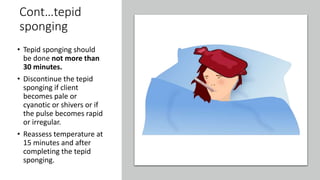
Cont…tepid
sponging
• Tepid sponging should
be done not more than
30 minutes.
• Discontinue the tepid
sponging if client
becomes pale or
cyanotic or shivers or if
the pulse becomes rapid
or irregular.
• Reassess temperature at
15 minutes and after
completing the tepid
sponging.

HEAT AND COLD THERAPY.pptx

HEAT AND COLD THERAPY.pptx

  • 1.
    HEAT AND COLDTHERAPY Mdm Rozila Binti Ibrahim September 2022
  • 2.
    Learning Outcome At theend of the session, student would be able to; • Identify the definition and physiologic effect of heat and cold compress • Describe the type and principle of the heat and cold application • Understand the side effect and complication heat and cold application • Elaborate nurses’ responsibility in application heat and cold to the patient
  • 5.
  • 8.
    Physiologic Effects ofheat and cold HEAT • Vasodilation • Increase capillary permeability • Increase cellular metabolism • Increase inflammation • Sedative effect COLD • Vasoconstriction • Decrease capillary permeability • Decrease cellular metabolism • Slow bacterial growth, decrease inflammation • Local anaesthesia effect
  • 10.
    LOCAL EFFECTS OFHEAT • Old remedy use for aches and pains, promote comfort and relief. • Heat cause vasodilation, increase blood flow to affected area, bringing oxygen, nutrient, antibiotics and leukocytes. • Often use clients with musculoskeletal problem, joint stiffness from arthritis, contractures and low back pain.
  • 12.
    LOCAL EFFECT OFCOLD • Cold lowers the body temperature due to vasoconstriction. • Vasoconstriction reduces blood flow  reduce oxygen and metabolic supply, decrease removal of waste and produces skin pallor and coolness. • Prolonged expose to cold result in impaired circulation, cell deprivation and subsequent damage tissue from lack of oxygen and nourishment. • The sign of tissue damage due to cold are a bluish-purple mottled appearance of the skin, numbness, blister and pain. • Often use sport injury eg; sprains, strains, fractures. Reduce swelling and bleeding
  • 15.
  • 16.
    Hot water bag •The water temperature not more than100°F (37.8°C) for babies and children. • 120°F - 100°F / (49°C - 37.8°C) for adults • Hot water bags is also called hot water bottles, are rubber bags filled with hot water and used for heat therapy. It is used to manage pain, such as headache or arthritis, or keep yourself warm on a cold night. • Hot water bottle are safer than electrical heating pads, which can start fires or cause electric shocks. • Hot water bags may cause injury if we don’t use carefully.
  • 17.
    SYSTEMIC EFFECT OFHEAT AND COLD Heat applied to localized area. Application to large body area may cause excessive peripheral vasodilation  drop in BP  painting. Extensive cold application and vasoconstriction, clients BP increase. Shivering is general effect of prolong cold, respond to warm itself.
  • 18.
    Thermal tolerance • Variouspart of body differ in tolerance to heat and cold. • The physiologic tolerance individual also varies: Body part: back, hand and foot not very temperature sensitive. Inner aspect of wrist, forearm, neck, perineal area - > sensitive Size exposed: The large area expose, the lower tolerance. Individual tolerance: very young and very old have lower tolerance. Length of exposure: People feel hot and cold application most while temperature is changing, after period of time, tolerance increase. Intactness of skin: Injured skin area more sensitive to temperature.
  • 19.
    Client condition need to consider before applicationof heat and cold. Neurosensory impairment Impaired mental status Impaired circulation Immediate after injury or surgery Open wounds
  • 20.
    Adaption of thermal receptors • Thermoreceptorsare rapidly adapting receptors, which are divided into two types: cold and warm. • Thermoregulatory body system.
  • 21.
  • 22.
    Aquathermia Pad • Aquathermiapad is a plastic or rubber pad • contains small channels, it contains water. • This water flows through the small channels of pad. T • may either used as heating or cooling pad. • If the patient needs to take heating pad on any site of body, then hot water is added in the aquathermia pad, and then it is placed on the site. • Likewise in case of cool pad, cold water is added to aquathermia pad, and place it on the site. An electrical control unit is also attached along with a motor.
  • 23.
    Indication of Aquathermiapad • swelling, • redness, • muscle pull, • muscle sprain and inflammation. • relief edema. • relax stiff muscles and contracted muscles of body.
  • 24.
  • 25.
  • 28.
  • 29.
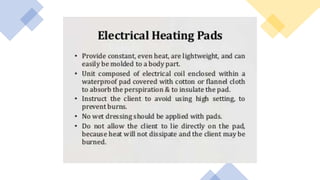
    Nurses role caring patientwith heating pad • Do not apply very hot (above 106°F or 41.1°C) applications can cause tissue damage can occur • Ensure heating pad in good condition - not torn, not wet, cable not broken • Nurses’ role to prevent complication example electrical shock • Not more than 30 minutes • Client wearing cloth. Avoid direct application on client skin • Client body is dry.
  • 30.
    ARM AND FOOTSOAK • Soaking your feet in warm water is good for relaxation. It can help you fall asleep easier because warm water can stimulate blood circulation. • CONTRAST ARM / FOOT BATHS: This modality is often given when someone has poor circulation to their hands or feet (cold hands/feet) or has muscular and/or fascial tightness in their forearms and hands (or legs and feet).
  • 31.
    Sitz bath • Soakthe client pelvic area. • Often use basin or special tub or chair  immersed client midthight to iliac crest or umbilical. • Use warm water 40C to 43OC…reduce if client not tolerated. • Duration for bath 15 – 20 minutes
  • 32.
    Cooling sponge bath (tepidsponging) • To reduce client fever. Promoting heat loss through conduction and vaporization • For high fever only. Temperature > 38⁰C. • Consideration for rapid skin drop cause chills that actually increase heat production. • Often given antipyretic medication to reset hypothalamus set point. • Use normal water temperature
  • 33.
    Nurse role provide tepid sponging •Sponge face, arms, legs, back and buttock. Abdomen and chest not usually sponged. Use technique “dap and tap gently” instead of rub. Avoid rubbing because it will produce heat. • Leave area wet • Use 6 towel to place at large superficial blood vessels help transfer of heat: X 1 at forehead X2 at both axillary X2 at both femoral side X1 for dap over the body
  • 34.
    Cont…tepid sponging • Tepid spongingshould be done not more than 30 minutes. • Discontinue the tepid sponging if client becomes pale or cyanotic or shivers or if the pulse becomes rapid or irregular. • Reassess temperature at 15 minutes and after completing the tepid sponging.