MICROWAVE DIATHERMY
Dr. Paras Bhura PT
MPT (Musculoskeletal-Ortho.),MIAP, CMT, DNHE, YTTC.
INTRODUCTION
 Microwave Diathermy(MWD) is irradiation of tissue
with radiation in shorter wireless part of
electromagnetic spectrum.
 Its wavelength between infra-red rays and short
wave diathermic waves (hertzian rays).
 hertzian rays: An electromagnetic wave with a
frequency : 3 × 10¹⁰ hertz to1.5 ×105 hertz
 Also k/a Decimeter waves, as their wavelength lies
between 1-100cm.
PARAMETERS
 Frequency ranges from 300 MHz to 300 GHz.
 Wavelength ranges from 1 mm to 1 m.
 The commonly used for treatment
 Frequency : 2450 MHz, Wave length – 12.25 cm
 Frequency : 915 MHz, Wave length –32.8 cm
 Frequency : 434 MHz, Wave length – 69.1 cm
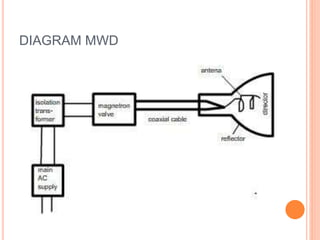
DIAGRAM MWD
PRODUCTION OF WAVES
 Its is not possible to produce microwaves by
mechanical means.
 Hence microwaves are obtained from a unique
special type of thermionic valve called the
Magnetron,
 which is perforated with tiny holes, through which
the electrons flow into the treatment heads.
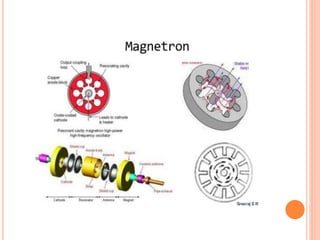
 Magnetron is thermionic valve characterized by
centrally placed cathode and a surrounding circular
metal anode.
PRODUCTION CONT…
 Coaxial cable carries these high frequency currents
from magnetron and passes it to the antenna of
emitter.
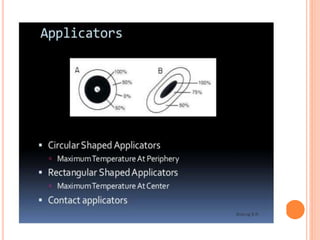
 The applicators consist of an antenna element
backed by a reflector and endorsed within a plastic
case, one face of which is transparent to microwave
energy.
 The special design of the treatment heads shapes
and focuses the field directly at the target area.
 In this kind of treatment, the patient does not form a
part of the circuit, so no tuning is necessary as in
short wave application.
LAWS OF MICROWAVE RADIATIONS
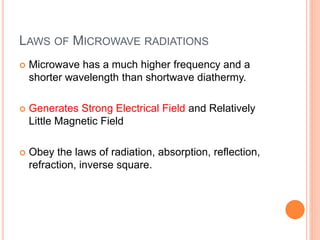
 Microwave has a much higher frequency and a
shorter wavelength than shortwave diathermy.
 Generates Strong Electrical Field and Relatively
Little Magnetic Field
 Obey the laws of radiation, absorption, reflection,
refraction, inverse square.
PHYSIOLOGICAL EFFECT (P/E)
 Ionic movements
 Rotation of dipoles
 Distortion of molecules
 The amount of heating will be proportional to the
amount of absorbed radiation and the water content
of the tissue.
 Heating is More in muscle tissues and tissue with
more water and iron content and less in fat and
bone.
P/E CONT…
 Produces more superficial heating compared to
SWD and deeper compared to IRR.
 Heat production decreases as the depth increases.
 This could be because of microwaves are reflected
at various interfaces s/a
 skin-air,
 skin-fat,
 fat-muscle,
 muscle-bone interfaces.
P/E CONT… DEPTH OF PENETRATION
 Higher DOP with lower frequency
 DOP: 4.3 cm. with half value depth (HVD) 3 cm.
 For Muscle :HVD is 0.7 cm at frequency 2450
MHz.
 For fat, bone HWD is 3.5 cm at frequency of 2450
MHz.
 So, heating of the subcutaneous fat can be avoided
by MWD.
P/E CONT… DEPTH OF PENETRATION
 Higher Depth of penetration with lower frequency.
 So, frequency 915 MHz is more suitable for
therapeutic heating than 2450 MHz.
 As the wavelength increases penetration and
absorption increases in the deeper tissues.
 So, the wavelength of 32.8 cm (915 MHz) produces
more deeper heating than the wavelength 12.2
cm.(2450 MHz)
THERAPEUTIC USES:
 Inflammatory conditions:
 Increases blood supply and relieve muscle spasm
 Pulse mode can be used 72 hrs following trauma.
 Jumpers knee, tennis elbow, sprain, strain, etc.
 Traumatic conditions:
 For the remediation of early trauma.
 Resolve inflammation and pain.
 Enhance the extensibility of collagen fibers.
 Sports injuries, surgical lengthening of tight muscle.
 Arthritic conditions:
 Reduces pain, swelling, inflammation, increases
extensibility of collagen fibers.
 Pain relief :
INDICATIONS
 Pain and muscle spasm
 Tennis elbow, jumpers knee
 Sprain and strain
 Sports injuries
 Rheumatoid arthritis, O.A, A.S.
 Bacterial infection.
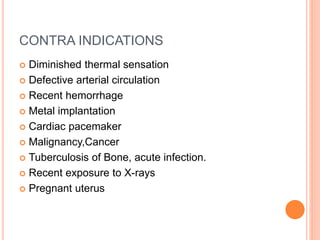
CONTRA INDICATIONS
 Diminished thermal sensation
 Defective arterial circulation
 Recent hemorrhage
 Metal implantation
 Cardiac pacemaker
 Malignancy,Cancer
 Tuberculosis of Bone, acute infection.
 Recent exposure to X-rays
 Pregnant uterus
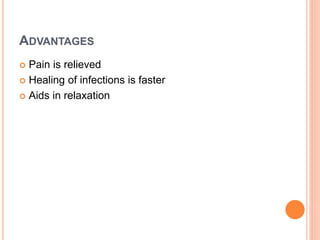
ADVANTAGES
 Pain is relieved
 Healing of infections is faster
 Aids in relaxation
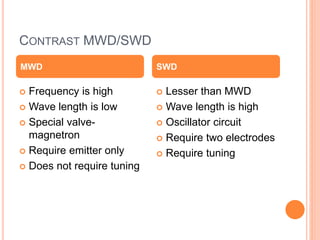
CONTRAST MWD/SWD
 Frequency is high
 Wave length is low
 Special valve-
magnetron
 Require emitter only
 Does not require tuning
 Lesser than MWD
 Wave length is high
 Oscillator circuit
 Require two electrodes
 Require tuning
MWD SWD

MWD

  • 1.
    MICROWAVE DIATHERMY Dr. ParasBhura PT MPT (Musculoskeletal-Ortho.),MIAP, CMT, DNHE, YTTC.
  • 2.
    INTRODUCTION  Microwave Diathermy(MWD)is irradiation of tissue with radiation in shorter wireless part of electromagnetic spectrum.  Its wavelength between infra-red rays and short wave diathermic waves (hertzian rays).  hertzian rays: An electromagnetic wave with a frequency : 3 × 10¹⁰ hertz to1.5 ×105 hertz  Also k/a Decimeter waves, as their wavelength lies between 1-100cm.
  • 3.
    PARAMETERS  Frequency rangesfrom 300 MHz to 300 GHz.  Wavelength ranges from 1 mm to 1 m.  The commonly used for treatment  Frequency : 2450 MHz, Wave length – 12.25 cm  Frequency : 915 MHz, Wave length –32.8 cm  Frequency : 434 MHz, Wave length – 69.1 cm
  • 4.
  • 5.
    PRODUCTION OF WAVES Its is not possible to produce microwaves by mechanical means.  Hence microwaves are obtained from a unique special type of thermionic valve called the Magnetron,  which is perforated with tiny holes, through which the electrons flow into the treatment heads.  Magnetron is thermionic valve characterized by centrally placed cathode and a surrounding circular metal anode.
  • 7.
    PRODUCTION CONT…  Coaxialcable carries these high frequency currents from magnetron and passes it to the antenna of emitter.  The applicators consist of an antenna element backed by a reflector and endorsed within a plastic case, one face of which is transparent to microwave energy.  The special design of the treatment heads shapes and focuses the field directly at the target area.  In this kind of treatment, the patient does not form a part of the circuit, so no tuning is necessary as in short wave application.
  • 9.
    LAWS OF MICROWAVERADIATIONS  Microwave has a much higher frequency and a shorter wavelength than shortwave diathermy.  Generates Strong Electrical Field and Relatively Little Magnetic Field  Obey the laws of radiation, absorption, reflection, refraction, inverse square.
  • 10.
    PHYSIOLOGICAL EFFECT (P/E) Ionic movements  Rotation of dipoles  Distortion of molecules  The amount of heating will be proportional to the amount of absorbed radiation and the water content of the tissue.  Heating is More in muscle tissues and tissue with more water and iron content and less in fat and bone.
  • 11.
    P/E CONT…  Producesmore superficial heating compared to SWD and deeper compared to IRR.  Heat production decreases as the depth increases.  This could be because of microwaves are reflected at various interfaces s/a  skin-air,  skin-fat,  fat-muscle,  muscle-bone interfaces.
  • 12.
    P/E CONT… DEPTHOF PENETRATION  Higher DOP with lower frequency  DOP: 4.3 cm. with half value depth (HVD) 3 cm.  For Muscle :HVD is 0.7 cm at frequency 2450 MHz.  For fat, bone HWD is 3.5 cm at frequency of 2450 MHz.  So, heating of the subcutaneous fat can be avoided by MWD.
  • 13.
    P/E CONT… DEPTHOF PENETRATION  Higher Depth of penetration with lower frequency.  So, frequency 915 MHz is more suitable for therapeutic heating than 2450 MHz.  As the wavelength increases penetration and absorption increases in the deeper tissues.  So, the wavelength of 32.8 cm (915 MHz) produces more deeper heating than the wavelength 12.2 cm.(2450 MHz)
  • 14.
    THERAPEUTIC USES:  Inflammatoryconditions:  Increases blood supply and relieve muscle spasm  Pulse mode can be used 72 hrs following trauma.  Jumpers knee, tennis elbow, sprain, strain, etc.  Traumatic conditions:  For the remediation of early trauma.  Resolve inflammation and pain.  Enhance the extensibility of collagen fibers.  Sports injuries, surgical lengthening of tight muscle.  Arthritic conditions:  Reduces pain, swelling, inflammation, increases extensibility of collagen fibers.  Pain relief :
  • 15.
    INDICATIONS  Pain andmuscle spasm  Tennis elbow, jumpers knee  Sprain and strain  Sports injuries  Rheumatoid arthritis, O.A, A.S.  Bacterial infection.
  • 16.
    CONTRA INDICATIONS  Diminishedthermal sensation  Defective arterial circulation  Recent hemorrhage  Metal implantation  Cardiac pacemaker  Malignancy,Cancer  Tuberculosis of Bone, acute infection.  Recent exposure to X-rays  Pregnant uterus
  • 17.
    ADVANTAGES  Pain isrelieved  Healing of infections is faster  Aids in relaxation
  • 18.
    CONTRAST MWD/SWD  Frequencyis high  Wave length is low  Special valve- magnetron  Require emitter only  Does not require tuning  Lesser than MWD  Wave length is high  Oscillator circuit  Require two electrodes  Require tuning MWD SWD