Rahul A.P
Asso: Professor, LIAHS KANNUR
BPT,MPT(CRD&ICU), C-HSET MIAP
COLDTHERAPY
 The application of ice to the tissue after injury
is known as cryotherapy or therapeutic use of
cold
 It reduce the local temperature of the skin
Ice therapy is used to
 Reduce pain
 Reduce spasticity
 Reduce muscle pain
 Reduce swelling
 Promote repair
PHYSICAL PRINCIPLES
When ice is applied to the skin the heat is conducted
from the skin to the ice in order to melt it, to change
its state the ice requires some energy (latent heat )
 To raise the temp: of 1gm of ice at 0˚c to 1gm of water
at 37˚c requires 491 j where as to raise 1gm of water
at 0˚c to 1 gm of water at 37˚c requires only 155 j
 So it is important to use ice to cool tissues rather than
cold water
PHYSIOLOGICAL EFFECTS
 If cold is applied to the skin it causes an immediate
constriction of the cutaneous vessels (cold application
less than 15-20 mnts) and thereby reducing the blood
flow
 When cold is applied for longer period of time (beyond
20 mnts) or tissue temp reaches less than 10°c
vasodilatation may occur, that phenomenon is (CIVD)
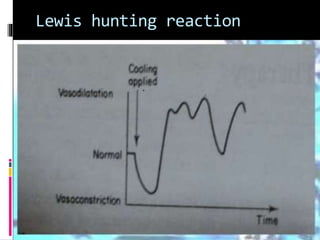
 The initial decreased temp will cyclically increase and
decrease after 15 mints and is called as hunting
response found by Lewis 1930
Lewis hunting reaction
Physiotherapeutic uses
Circulatory response
 The initial vasoconstriction help to limit the
extravasations of blood in to the tissue following
injury e.g in sports injuries.
 The vasoconstriction help to remove the swelling and
excess tissue fluid and vasodilatation helps to allow
more nutrients and repair substances to the damaged
area thus plays role in removing swelling and aiding
repair
 The reduced metabolic rate of cooled tissue ( van’t
hoff’s law) allow muscle to contract many more times
before fatigue sets in
 Increased circulation could carry away chemical
substances which are stimulating nociceptors and
producing pain
 Inflammation control-it reduce the rate of chemical
reaction that occurs during the acute inflammatory
response and also reduces the heat, redness,
edema, pain and loss of function associated with
this phase
 Edema control- vasoconstriction
 Reduce DOMS-reduce inflammatory changes
 Cryotherapy reduces the blood flow by
vasoconstriction and increase the blood
viscosity and decreases the capillary
permeability and there by controlling bleeding
and fluid loss after acute trauma
Neural response
Cold has verity of effects on neuromuscular
functions including
 Reduction of pain- applying cryotherapy can
decrease the sensation of pain.The mechanism
of this effect is by counter irritations via the gate
control mechanism
 The probable mechanism is that by the
stimulation of cold receptors, impulses will be
send which will pass into the posterior root of
the spinal cord.These impulses, arriving through
large diameter nerves, effectively block out any
other (pain) impulses attempting to access the
spinal cord
Reduction of spasticity
 Spasticity is the pathological state of increased
muscle tone,increased tendon reflex activity,
tightnes and stiffness resulting from damage to
the upper motor neurons
 Spasm is a normal response to injury or pain and
is manifested as an increase in muscle tone in a
specific area with the apparent aim of limiting
movement and further damage.
The reduction of Spasticity is temporary. It is by 2
mechanism
 Decrease in gamma motor neuron activity and
decrease in afferent spindle and GTO as a result
of decreased muscle temp:
 Spasticity will reduce after prolonged cooling
lasting for 10 -30 mnts and the effect persist for
1 to 1½ hours
Excitatory cold
 When cryotherapy is applied in an appropriate
way(stroke ice 3 times quickly over myotome
and dermatome) the skin stimulus of ice can be
used to increase excitation of muscles combined
with patients volition
 This can be used where muscles are inhibited
postoperatively and later stage of regeneration
of mixed peripheral nerve
Decreased nerve conduction velocity
 When nerve temperature is decreased nerve
conduction velocity decreases when ice is
applied on skin for 5 mnts or longer, which will
recover within 15 mnts
 When it is applied for 20mnts the nerve
conduction takes 30mnts or longer to recover
Contraindication
 Cold hypersensitivity (cold induced urticaria)
 Cold intolerance
 Cardiac condition
 Cryoglobulinemia
 Raynaud’s disease
 Paroxysmal cold hemoglobinuria
 Over regenerating peripheral nerve
 Areas with circulatory compromise
Contraindications to Ice
Treatment
 Cold hypersensitivity-some patients have familial
or acquired hypersensitivity to cold that cause
vascular skin reaction like elevated red patches
often attended with sever itching
 Cold intolerance- it is in the form of sever pain
numbness and colour changes in response to cold.
It can be seen in some pat: with some type of
rheumatic disease
 Cardiac condition-6 months after MI ice Rx should be
avoided the initial ice application cause an increased
HR and weak heart may not meet the demand
Left shoulder and heart have same sympathetic supply
so ice application to left shoulder can cause an
excitatory impulse to heart and therefore it should be
avoided
 Cryoglobulinemia- it’s a rare disorder characterized by
aggregation of serum proteins in the distal circulation
when distal extremities are cooled and they form a
precipitate or gel which block circulation causing
ischemia and gangrene associated with RA
 Raynaud’s disease and Raynaud’s phenomenon - a
condition characterized by sudden pallor, cyanosis
pain and numbness of the digits by cold and
relieved by warmth
 Paroxysmal cold hemoglobinuria- a condition in
which hemoglobin from lysed blood cells is released
in to the urine in response to local or general
exposure to cold
Over regenerating peripheral nerve
 cryotherapy should not be applied directly
over a regenerating peripheral nerve because
vasoconstriction and altered nerve
conduction may delay nerve regeneration
 Areas with circulatory compromise- cryotherapy
should not be applied directly over an areas with
circulatory compromise because it may
aggravate the condition by causing
vasoconstriction and increasing blood viscosity
and it may give rise a chance to gangrene
because of low metabolic rate eg-PVD
Techniques of Application of
Cryotherapy
 The way which ice is applied will vary according
to the required effects.
 It may be applied in the following ways:
 Ice towels
 Ice packs
 Immersion
 Ice cube massage
 Excitatory cold ( quick ice)
 Ice spray
 Cold gel
Thank you ….

Cryotherapy in Physiotherapy

  • 1.
    Rahul A.P Asso: Professor,LIAHS KANNUR BPT,MPT(CRD&ICU), C-HSET MIAP COLDTHERAPY
  • 2.
     The applicationof ice to the tissue after injury is known as cryotherapy or therapeutic use of cold  It reduce the local temperature of the skin Ice therapy is used to  Reduce pain  Reduce spasticity  Reduce muscle pain  Reduce swelling  Promote repair
  • 3.
    PHYSICAL PRINCIPLES When iceis applied to the skin the heat is conducted from the skin to the ice in order to melt it, to change its state the ice requires some energy (latent heat )  To raise the temp: of 1gm of ice at 0˚c to 1gm of water at 37˚c requires 491 j where as to raise 1gm of water at 0˚c to 1 gm of water at 37˚c requires only 155 j  So it is important to use ice to cool tissues rather than cold water
  • 4.
    PHYSIOLOGICAL EFFECTS  Ifcold is applied to the skin it causes an immediate constriction of the cutaneous vessels (cold application less than 15-20 mnts) and thereby reducing the blood flow  When cold is applied for longer period of time (beyond 20 mnts) or tissue temp reaches less than 10°c vasodilatation may occur, that phenomenon is (CIVD)  The initial decreased temp will cyclically increase and decrease after 15 mints and is called as hunting response found by Lewis 1930
  • 5.
  • 6.
    Physiotherapeutic uses Circulatory response The initial vasoconstriction help to limit the extravasations of blood in to the tissue following injury e.g in sports injuries.  The vasoconstriction help to remove the swelling and excess tissue fluid and vasodilatation helps to allow more nutrients and repair substances to the damaged area thus plays role in removing swelling and aiding repair  The reduced metabolic rate of cooled tissue ( van’t hoff’s law) allow muscle to contract many more times before fatigue sets in
  • 7.
     Increased circulationcould carry away chemical substances which are stimulating nociceptors and producing pain  Inflammation control-it reduce the rate of chemical reaction that occurs during the acute inflammatory response and also reduces the heat, redness, edema, pain and loss of function associated with this phase
  • 8.
     Edema control-vasoconstriction  Reduce DOMS-reduce inflammatory changes  Cryotherapy reduces the blood flow by vasoconstriction and increase the blood viscosity and decreases the capillary permeability and there by controlling bleeding and fluid loss after acute trauma
  • 9.
    Neural response Cold hasverity of effects on neuromuscular functions including  Reduction of pain- applying cryotherapy can decrease the sensation of pain.The mechanism of this effect is by counter irritations via the gate control mechanism
  • 10.
     The probablemechanism is that by the stimulation of cold receptors, impulses will be send which will pass into the posterior root of the spinal cord.These impulses, arriving through large diameter nerves, effectively block out any other (pain) impulses attempting to access the spinal cord
  • 11.
    Reduction of spasticity Spasticity is the pathological state of increased muscle tone,increased tendon reflex activity, tightnes and stiffness resulting from damage to the upper motor neurons  Spasm is a normal response to injury or pain and is manifested as an increase in muscle tone in a specific area with the apparent aim of limiting movement and further damage.
  • 12.
    The reduction ofSpasticity is temporary. It is by 2 mechanism  Decrease in gamma motor neuron activity and decrease in afferent spindle and GTO as a result of decreased muscle temp:
  • 13.
     Spasticity willreduce after prolonged cooling lasting for 10 -30 mnts and the effect persist for 1 to 1½ hours Excitatory cold  When cryotherapy is applied in an appropriate way(stroke ice 3 times quickly over myotome and dermatome) the skin stimulus of ice can be used to increase excitation of muscles combined with patients volition  This can be used where muscles are inhibited postoperatively and later stage of regeneration of mixed peripheral nerve
  • 14.
    Decreased nerve conductionvelocity  When nerve temperature is decreased nerve conduction velocity decreases when ice is applied on skin for 5 mnts or longer, which will recover within 15 mnts  When it is applied for 20mnts the nerve conduction takes 30mnts or longer to recover
  • 15.
    Contraindication  Cold hypersensitivity(cold induced urticaria)  Cold intolerance  Cardiac condition  Cryoglobulinemia  Raynaud’s disease  Paroxysmal cold hemoglobinuria  Over regenerating peripheral nerve  Areas with circulatory compromise
  • 16.
    Contraindications to Ice Treatment Cold hypersensitivity-some patients have familial or acquired hypersensitivity to cold that cause vascular skin reaction like elevated red patches often attended with sever itching  Cold intolerance- it is in the form of sever pain numbness and colour changes in response to cold. It can be seen in some pat: with some type of rheumatic disease
  • 17.
     Cardiac condition-6months after MI ice Rx should be avoided the initial ice application cause an increased HR and weak heart may not meet the demand Left shoulder and heart have same sympathetic supply so ice application to left shoulder can cause an excitatory impulse to heart and therefore it should be avoided  Cryoglobulinemia- it’s a rare disorder characterized by aggregation of serum proteins in the distal circulation when distal extremities are cooled and they form a precipitate or gel which block circulation causing ischemia and gangrene associated with RA
  • 19.
     Raynaud’s diseaseand Raynaud’s phenomenon - a condition characterized by sudden pallor, cyanosis pain and numbness of the digits by cold and relieved by warmth  Paroxysmal cold hemoglobinuria- a condition in which hemoglobin from lysed blood cells is released in to the urine in response to local or general exposure to cold
  • 21.
    Over regenerating peripheralnerve  cryotherapy should not be applied directly over a regenerating peripheral nerve because vasoconstriction and altered nerve conduction may delay nerve regeneration
  • 22.
     Areas withcirculatory compromise- cryotherapy should not be applied directly over an areas with circulatory compromise because it may aggravate the condition by causing vasoconstriction and increasing blood viscosity and it may give rise a chance to gangrene because of low metabolic rate eg-PVD
  • 23.
    Techniques of Applicationof Cryotherapy  The way which ice is applied will vary according to the required effects.  It may be applied in the following ways:  Ice towels  Ice packs  Immersion  Ice cube massage  Excitatory cold ( quick ice)  Ice spray  Cold gel
  • 24.