Unit: 14
Hot & Cold Application
Mr Yogendra Mehta
Assist. Professor
TU,IOM,BNC, Biratnagar
Definition
Hot application
• Application of hot agent, warmer than skin either in a moist or dry form on
the surface of the body to relieve pain and congestion, to provide warmth.
• To promote suppuration & healing.
• To decrease muscle tone and softens the exudates.
Cold application
• Application of cold agent, cooler than skin either in a moist or dry form on
the surface of the body to relieve pain and body temperature.
• To anaesthetize an area.
• To check hemorrhage.
• To control growth of bacteria and prevent gangrene.
• To prevent oedema and reduce inflammation.
Effects of Hot Application
• Peripheral Vasodilatation
• Increased capillary permeability,
• Increased local metabolism
• Increased oxygen requirement.
• Decreased blood viscosity
• Increased blood flow
• Increased lymph flow
• Increased the action of phagocytosis & removal of the waste products of
infection
• Reduce muscle tension by muscles relaxation, make connective tissue
flexible and pain relief.
• Decrease the abdominal peristalsis.
Effects of Cold Application
• Pheripheral Vasoconstriction
• Decreased capillary permeability
• Decreased local metabolism
• Decreased oxygen requirement.
• Increased blood viscosity
• Decreased blood flow &lymph flow
• Decreased muscle tension
• Slows bacterial Growth
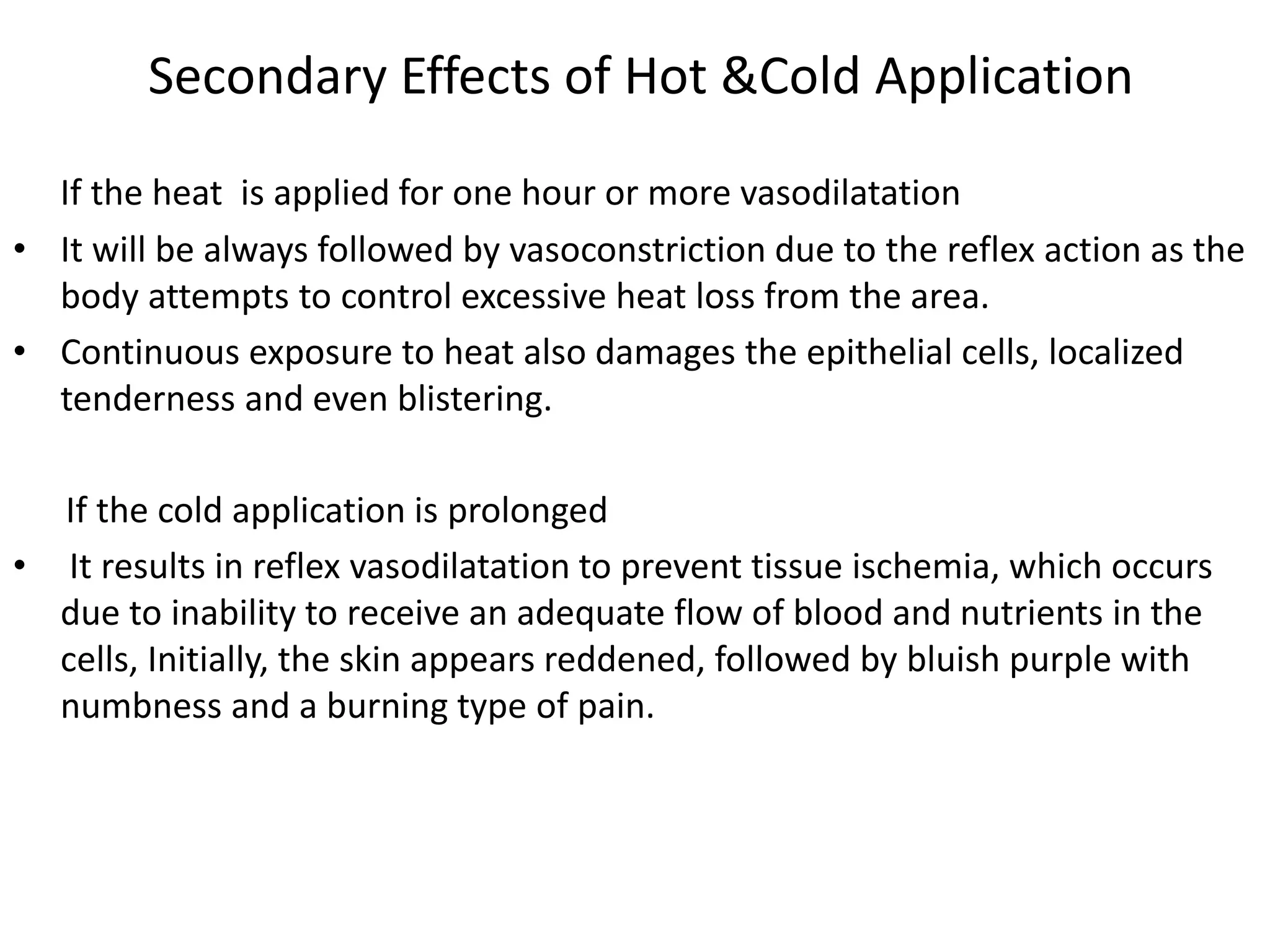
Secondary Effects of Hot &Cold Application
If the heat is applied for one hour or more vasodilatation
• It will be always followed by vasoconstriction due to the reflex action as the
body attempts to control excessive heat loss from the area.
• Continuous exposure to heat also damages the epithelial cells, localized
tenderness and even blistering.
If the cold application is prolonged
• It results in reflex vasodilatation to prevent tissue ischemia, which occurs
due to inability to receive an adequate flow of blood and nutrients in the
cells, Initially, the skin appears reddened, followed by bluish purple with
numbness and a burning type of pain.
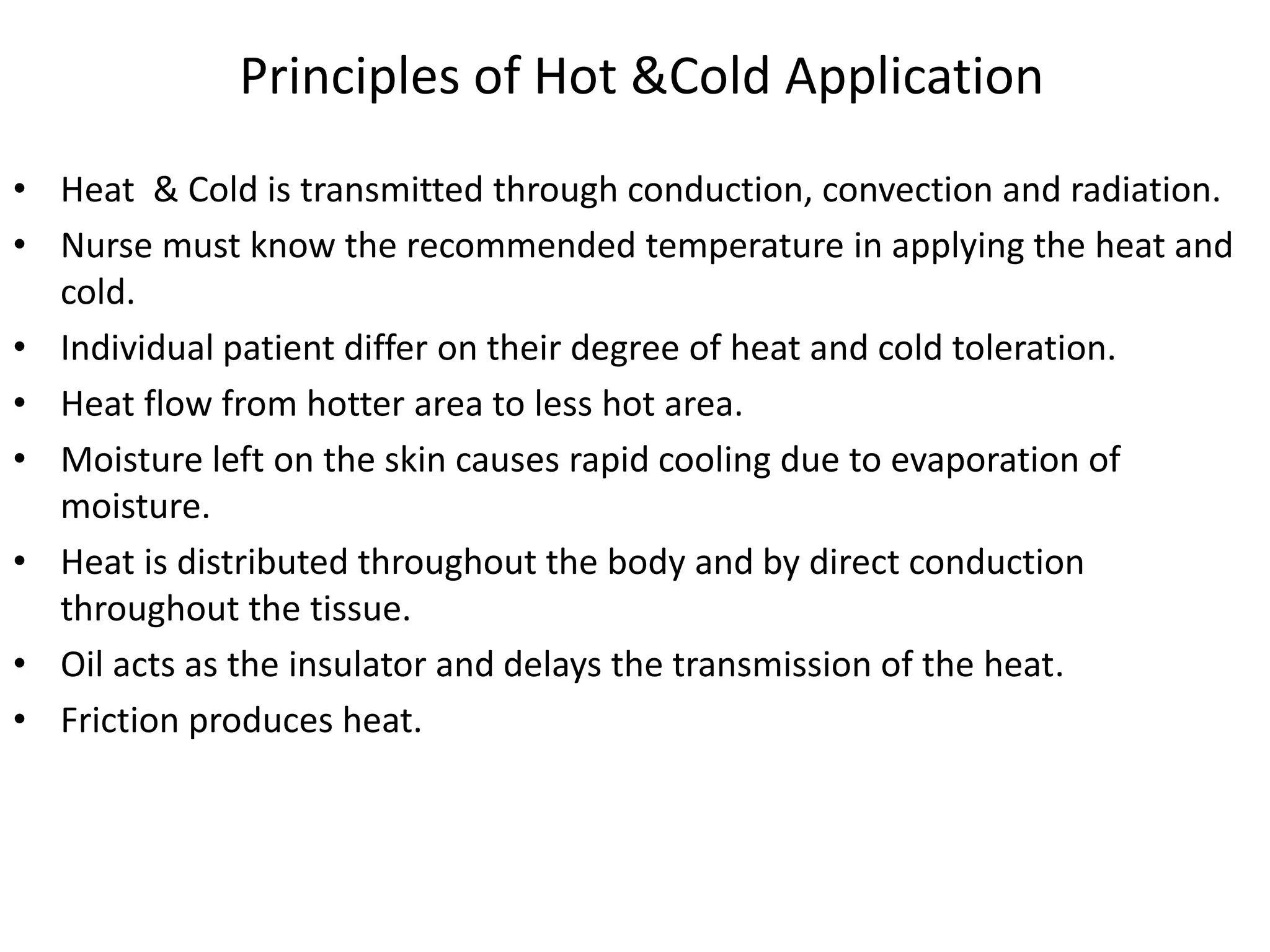
Principles of Hot &Cold Application
• Heat & Cold is transmitted through conduction, convection and radiation.
• Nurse must know the recommended temperature in applying the heat and
cold.
• Individual patient differ on their degree of heat and cold toleration.
• Heat flow from hotter area to less hot area.
• Moisture left on the skin causes rapid cooling due to evaporation of
moisture.
• Heat is distributed throughout the body and by direct conduction
throughout the tissue.
• Oil acts as the insulator and delays the transmission of the heat.
• Friction produces heat.
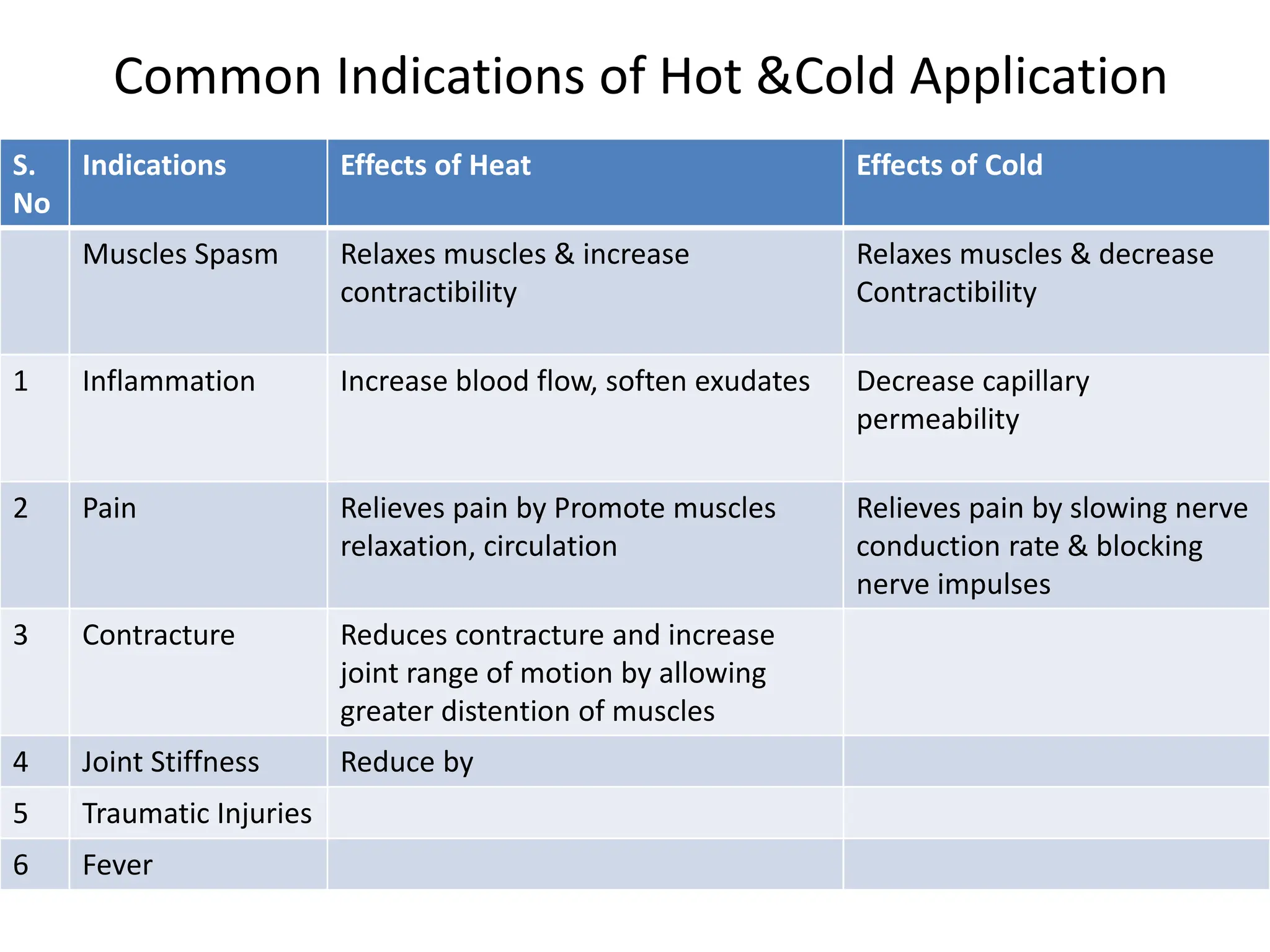
Common Indications of Hot &Cold Application
S.
No
Indications Effects of Heat Effects of Cold
Muscles Spasm Relaxes muscles & increase
contractibility
Relaxes muscles & decrease
Contractibility
1 Inflammation Increase blood flow, soften exudates Decrease capillary
permeability
2 Pain Relieves pain by Promote muscles
relaxation, circulation
Relieves pain by slowing nerve
conduction rate & blocking
nerve impulses
3 Contracture Reduces contracture and increase
joint range of motion by allowing
greater distention of muscles
4 Joint Stiffness Reduce by
5 Traumatic Injuries
6 Fever
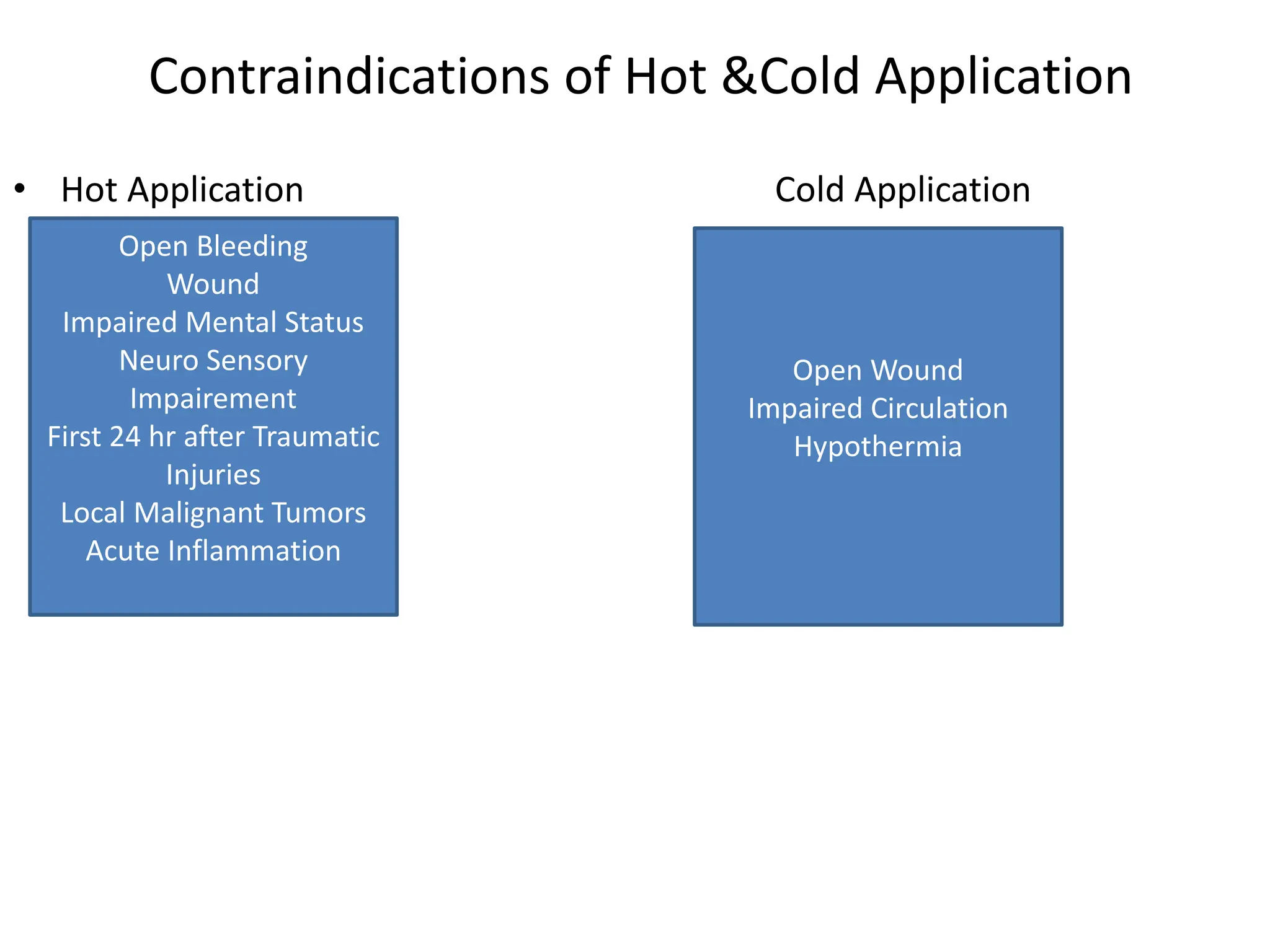
Contraindications of Hot &Cold Application
• Hot Application Cold Application
Open Bleeding
Wound
Impaired Mental Status
Neuro Sensory
Impairement
First 24 hr after Traumatic
Injuries
Local Malignant Tumors
Acute Inflammation
Open Wound
Impaired Circulation
Hypothermia
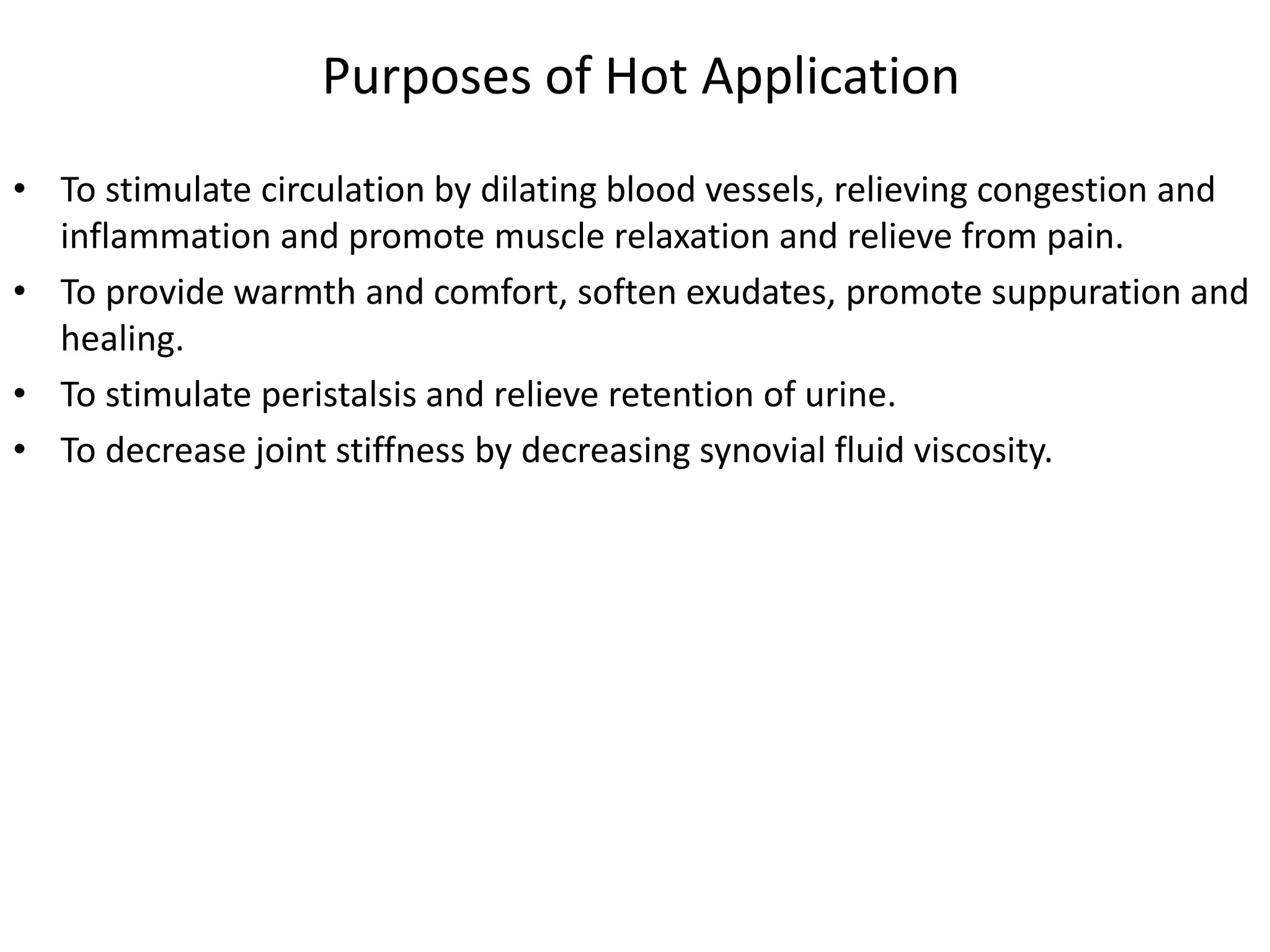
Purposes of Hot Application
• To stimulate circulation by dilating blood vessels, relieving congestion and
inflammation and promote muscle relaxation and relieve from pain.
• To provide warmth and comfort, soften exudates, promote suppuration and
healing.
• To stimulate peristalsis and relieve retention of urine.
• To decrease joint stiffness by decreasing synovial fluid viscosity.
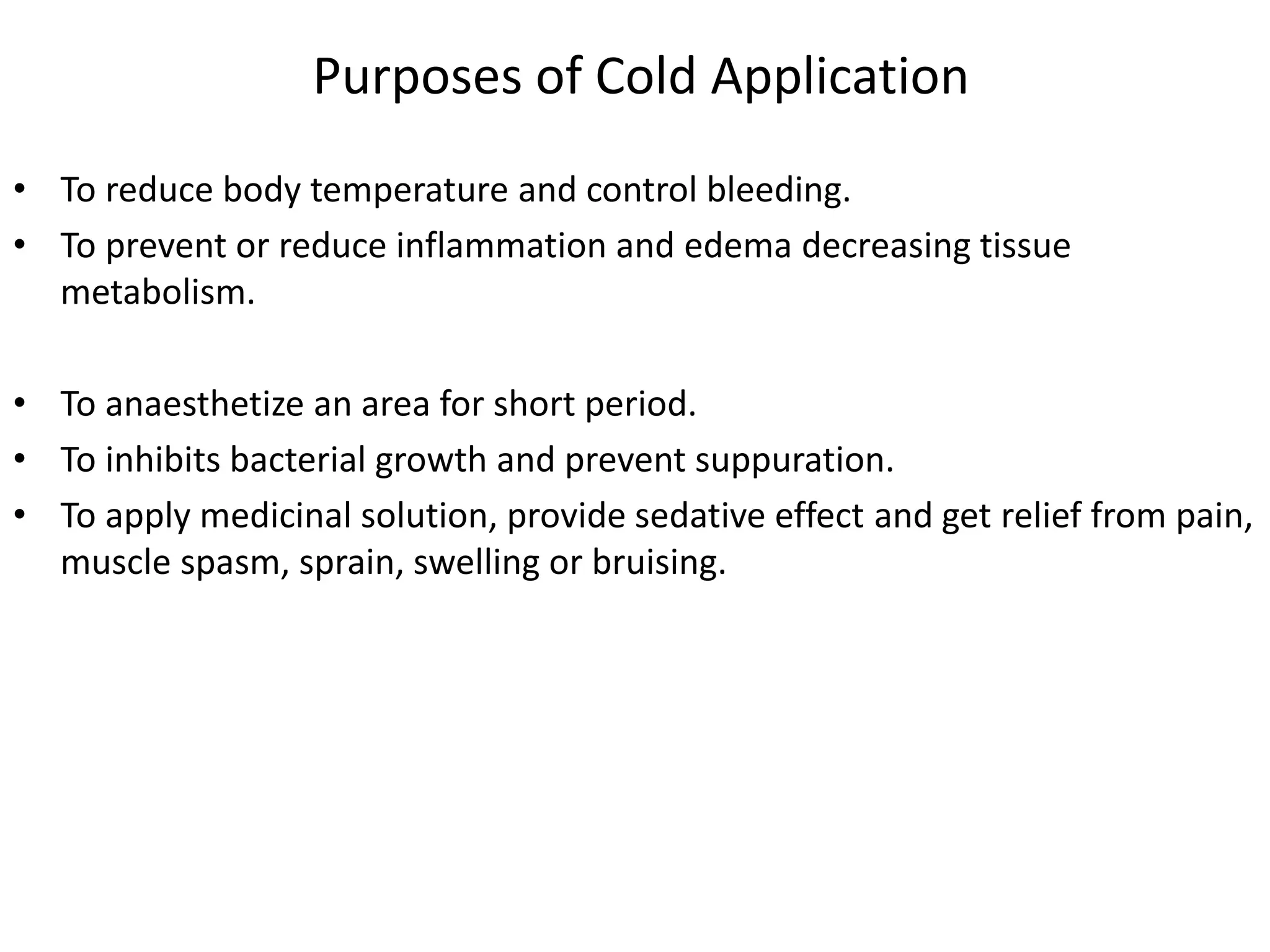
Purposes of Cold Application
• To reduce body temperature and control bleeding.
• To prevent or reduce inflammation and edema decreasing tissue
metabolism.
• To anaesthetize an area for short period.
• To inhibits bacterial growth and prevent suppuration.
• To apply medicinal solution, provide sedative effect and get relief from pain,
muscle spasm, sprain, swelling or bruising.
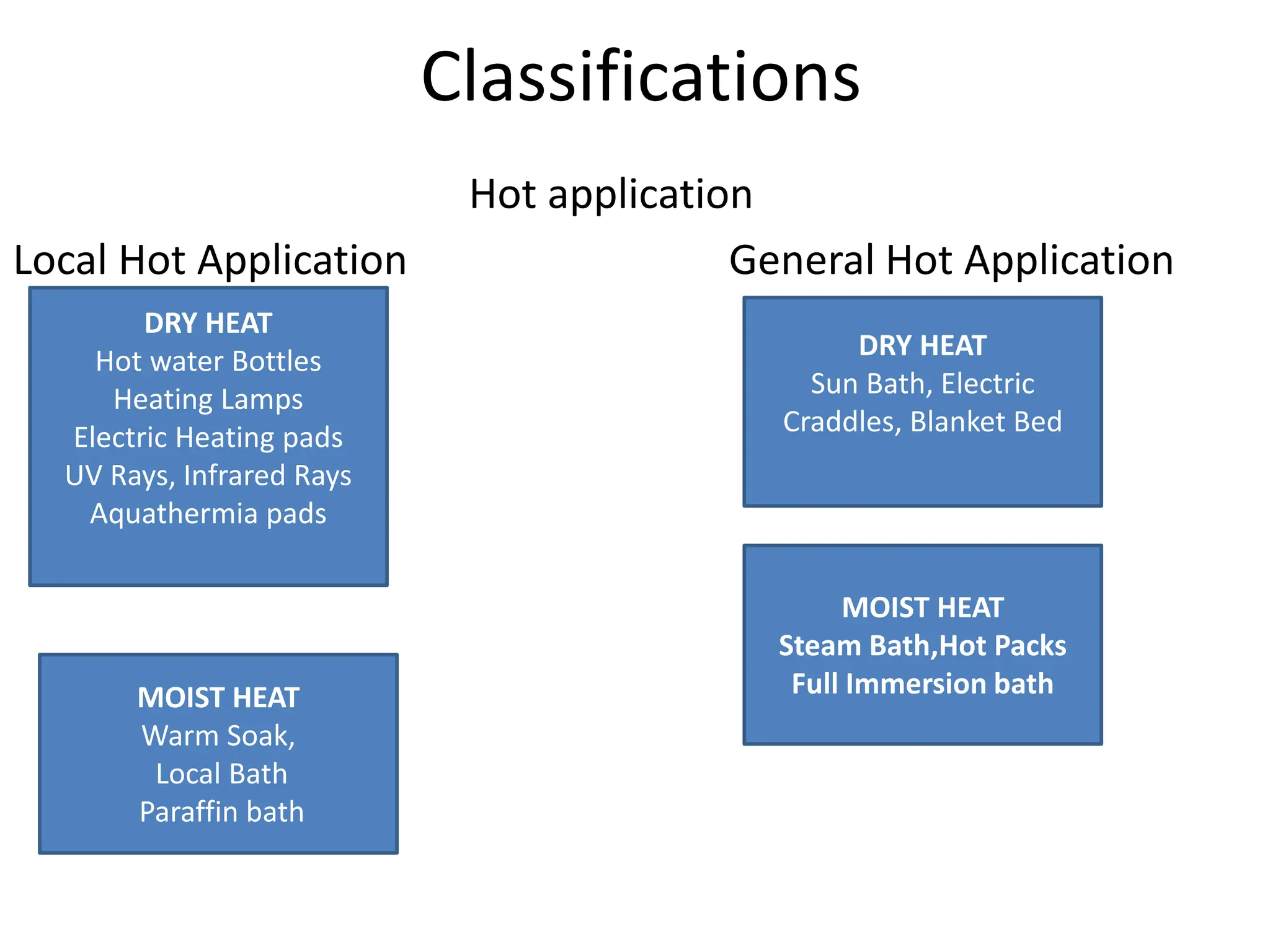
Classifications
Hot application
Local Hot Application General Hot Application
DRY HEAT
Hot water Bottles
Heating Lamps
Electric Heating pads
UV Rays, Infrared Rays
Aquathermia pads
MOIST HEAT
Warm Soak,
Local Bath
Paraffin bath
DRY HEAT
Sun Bath, Electric
Craddles, Blanket Bed
MOIST HEAT
Steam Bath,Hot Packs
Full Immersion bath
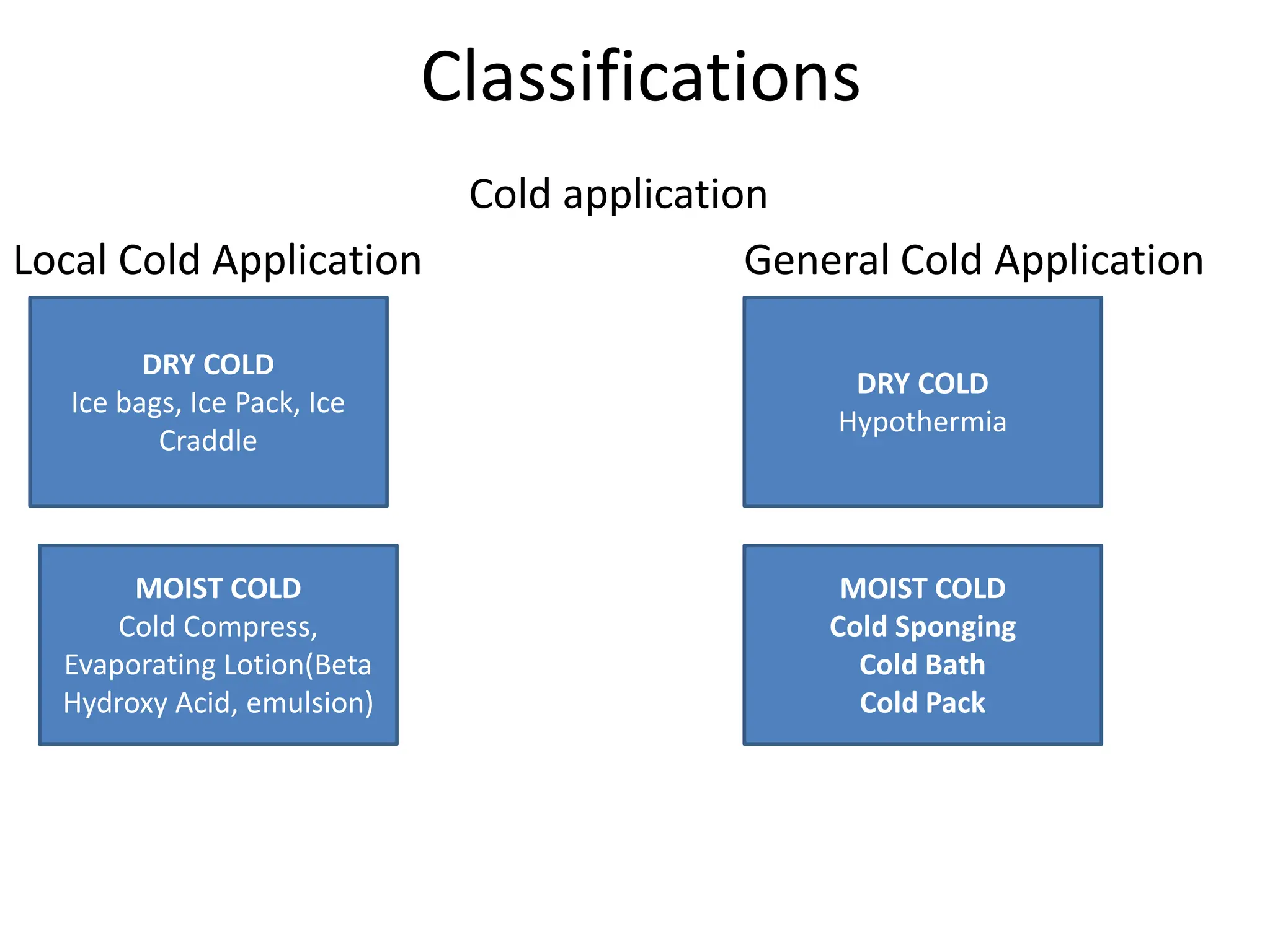
Classifications
Cold application
Local Cold Application General Cold Application
DRY COLD
Ice bags, Ice Pack, Ice
Craddle
MOIST COLD
Cold Compress,
Evaporating Lotion(Beta
Hydroxy Acid, emulsion)
DRY COLD
Hypothermia
MOIST COLD
Cold Sponging
Cold Bath
Cold Pack
Procedure of Cold Application
(Ice Collar or Ice Bag)
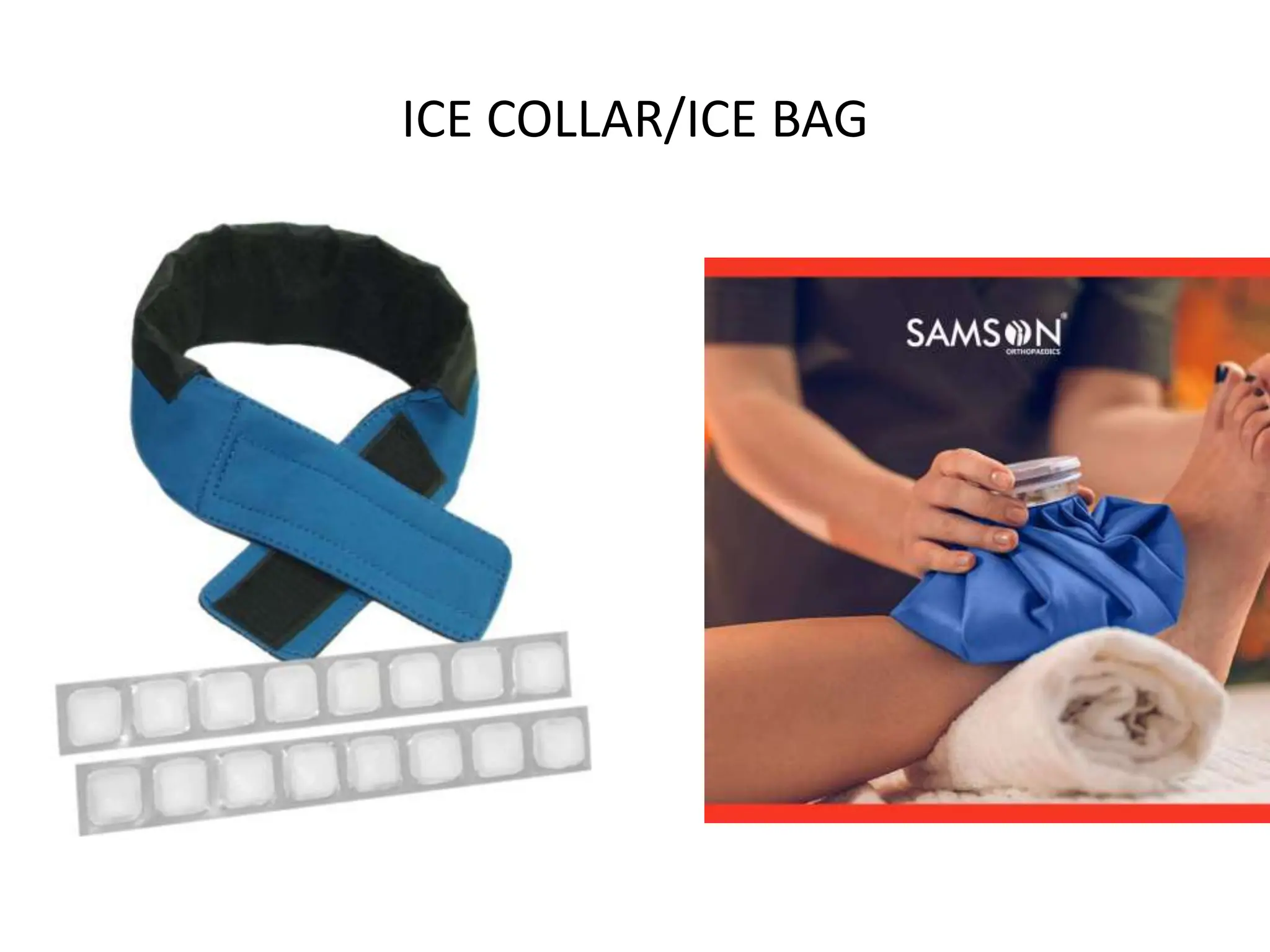
• It is small rubber bags filled with small pieces of ice and salt, shaped as
collar and serve as device for cold application.
• Articles required
a. Ice cap with cover
b. Ice in a bowl
c. towel
d. Kidney tray
e. Mackintosh
f. Salt
g. Duster to wipe ice cap after filling
Procedure of Cold Application
(Ice Collar or Ice Bag)
• Procedure
a. Assess patient’s condition and explain the procedure to the patient.
b. position patient in such a way that the injured body part is above the
heart.
c. Prepare compress. Fill the 2/3rd ice cap with ice cubes and expels air before
closing the cap.
d. Gently place the cold compress on the injured area.
e. Remove the cold compress after 20 minutes to prevent skin from frost
bitten.
f. Reapply cold compress after 2 hours and check the tolerance of patient in
between.
g. Position the patient in a comfortable position.
h. Replace the articles after cleaning and drying.
i. Wash hands.
j. Record the procedure including time , purposes and patient’s response.
k. Report to the seniors.
ICE COLLAR/ICE BAG
Procedure of Cold Application
(Cold Compress)
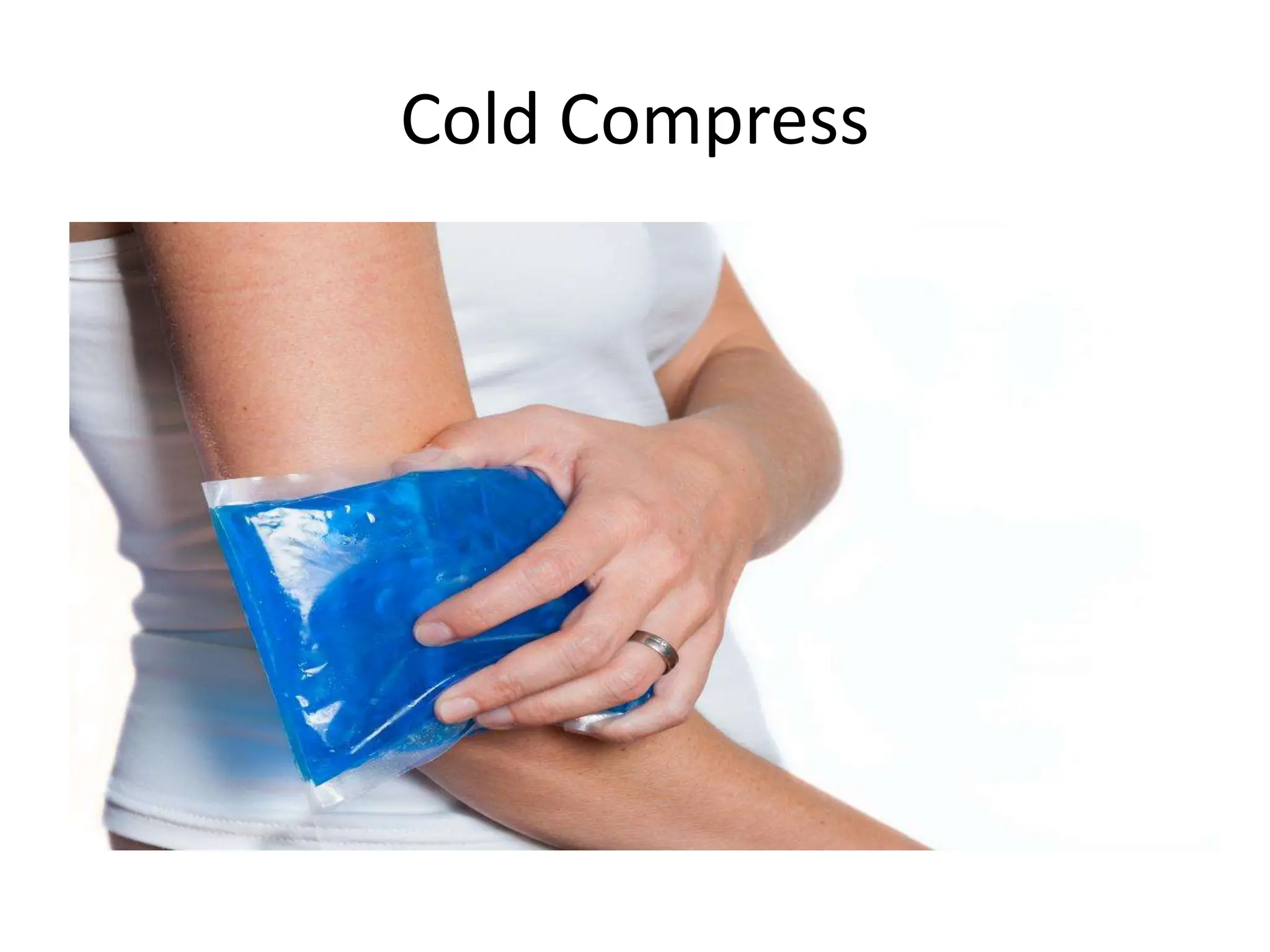
• It is the application of moist cold to a body part by means of guaze or wash
cloth.
• Articles required a clean dry tray containing
a. Thermometer
b. Kidney tray
c. Sponge cloth
d. Mackintosh
e. Towel
f. Bowl with cold water(27-37 degree Celcious)
Procedure of Cold Application
(Cold Compress)
• Procedure
a. Identify the patient’s need and explain the procedure.
b. Maintain privacy and wash the hands.
c. Place the patient in comfortable position.
d. Place the mackintosh and towel under the area to be treated.
e. Plug cotton to the ear if it is applied to forehead.
f. Soak sponge cloth in cold water, squeeze gently and apply to required
area.
g. Change it when it becomes warm.
h. Observe skin area frequently for numbness, bluish, and erythema.
i. Continue procedure for 15 minutes to 20 minutes.
j. Check temperature in between.
k. After procedure, dry the area and make patient comfortable.
l. Replace all the articles, wash the hands and record the temperature.
Cold Compress
Procedure of Cold Application
(Cold Sponge Bath)
• It is the application of moist cold using ice water when the patient’s
temperature is raised to more than 103 degree celcious. The purpose of
cooling sponge bath is to reduce temperature by promoting heat loss
through conduction and vaporization.
• Articles required a clean dry tray containing
a. Thermometer
b. Kidney tray
c. Sponge cloth
d. Mackintosh
e. Towel/drawsheet
f. Bowl with cold water(27-37 degree Celcious)
Procedure of Cold Application
(Cold Sponge Bath)
• Procedure
a. Assess patient’s status, monitor temperature and explain the procedure.
b. Maintain privacy and wash the hands.
c. Place the patient in comfortable position.
d. Place the mackintosh and drawsheet under the patient.
e. Expose the body part and drape with top sheet.
f. Dip sponge cloths in the bowl with cold water, squeeze gently and apply.
g. Sponge face ,arms, legs, back, and buttoks.
h. Chest and abdomen are not usually sponged.
i. Place cold wet sponge cloths in hands, axilla, forehead and groin.
j. Check patient’s temperature every 15 minutes.
k. Cold sponging should be given maximally not exceed 20-30 minutes.
l. Stop procedure if temperature reaches 100 degree F.
Procedure of Cold Application
(Cold Sponge Bath)
j. Dry the patient.
k. Remove the wet clothing including drawsheet and the mackintosh.
l. Dress the patient and keep in comfortable position.
m. Replace the articles and wash the hands.
n. Check the temperature after 15 minutes if still high, seek for therapeutic
approach.
o. Record and report properly.
Procedure of Hot Application
(Hot Compress)
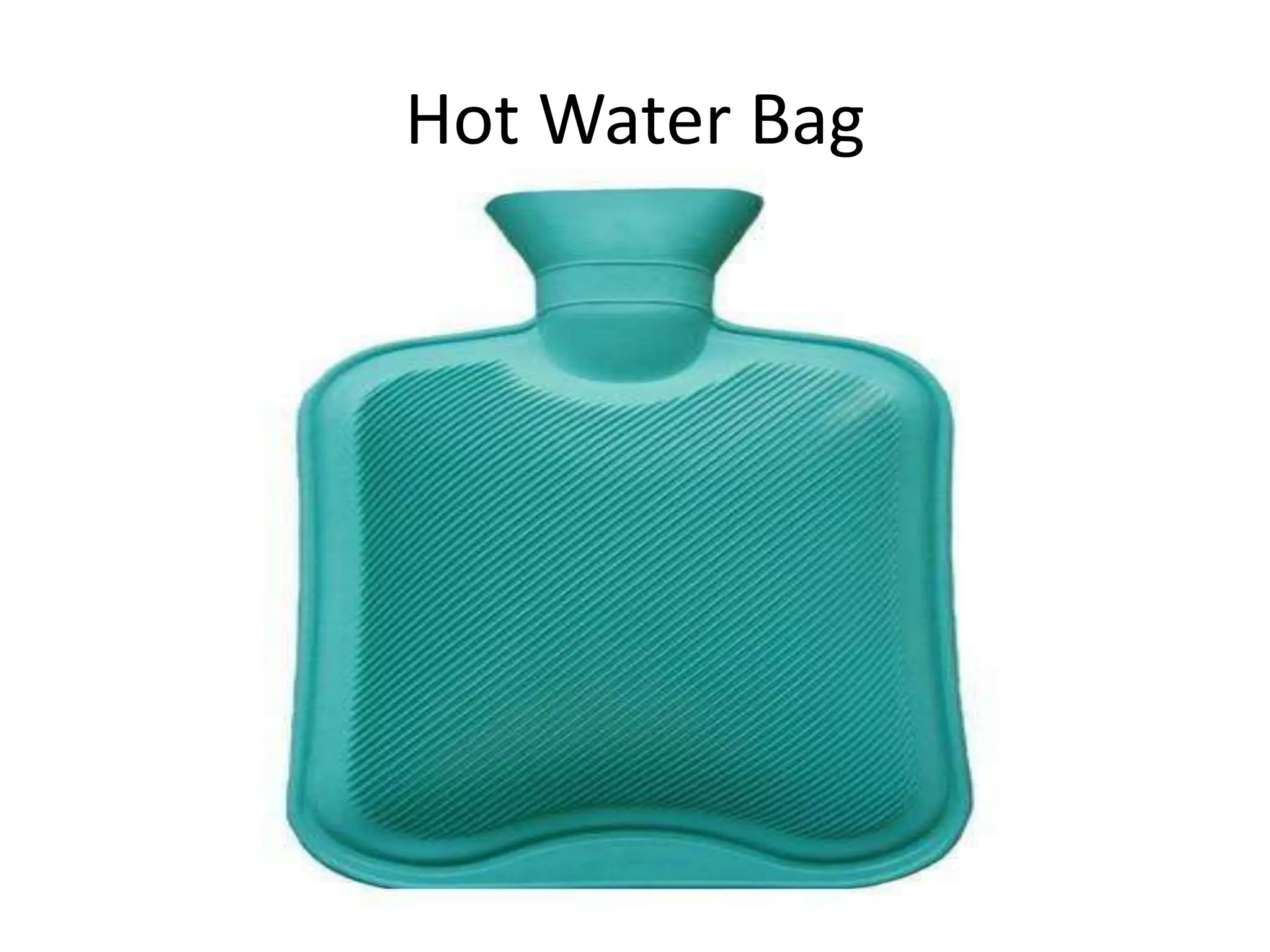
• Dry Hot Compress(Hot Water Bag)
• Articles required a clean dry tray containing
a. Hot water Bag
b. Boiling water
c. Towel
d. Mug to pour water into bag
e. Thermometer and duster
Hot Water Bag
Procedure of Hot Application
(Hot water Bag)
• Procedure
a. Check the patient’s chart for special instruction and explain the procedure.
b. Assess skin surfaces and wash hand.
c. Check temperature of hot water, it must be in between 40-46 degree
celcious.
d. Empty hot water bag and refill till 2/3rd full.
e. Expel air at the top and secure the cap and turn it upside down to ensure
that there are no leaks.
f. Dry outside of bag.
g. Wrap the bag in a towel and apply over required area.
h. Inspect the area carefully in between.
i. Keep the bag for 20-30 minutes.
j. Remove, dry the area and inspect for redness.
k. Make the patient comfortable in bed.
l. Record the time, site, duration and effects observed of application.
Procedure of Hot Application
(Moist Hot Compression)
It is the application of moist guaze dressing over the part of body soaked
with warm water, applied to the affected area to relieve muscle spasm.
This type uses a warm liquid to apply heat to an area. An example of a
moist warm compress is a towel soaked in hot water.
Heating sources can include warm water, microwaveable pads, wheat packs
and electrical or chemical pads.
The most common warm compress is a warm, wet washcloth.
• Articles required a clean dry tray containing
a. Boiling water
b. Small Towel
c. Large Bowl
d. Mackintosh
Procedure of Hot Application
(Moist Hot Compression)
• Procedure
a. Check the patient’s chart for special instruction and explain the procedure.
b. Wash hand.
c. Check temperature of hot water, it must be in between 40-46 degree
celcious.
d. Fold towel up enough to cover the area to be placed on.
e. Dip the folded towel into the bowl having warm water carefully.
f. Test towel to make sure it isn’t too hot; place it on the affected region.
g. Soak the towel when it cool off and repeat the procedure till time desired.
h. Perform for 20-30 minutes.
i. Remove, dry the area and inspect for redness.
j. Make the patient comfortable in bed.
k. Record the time, site, duration and effects observed of application.
Procedure of Hot Application
(Sitz Bath)
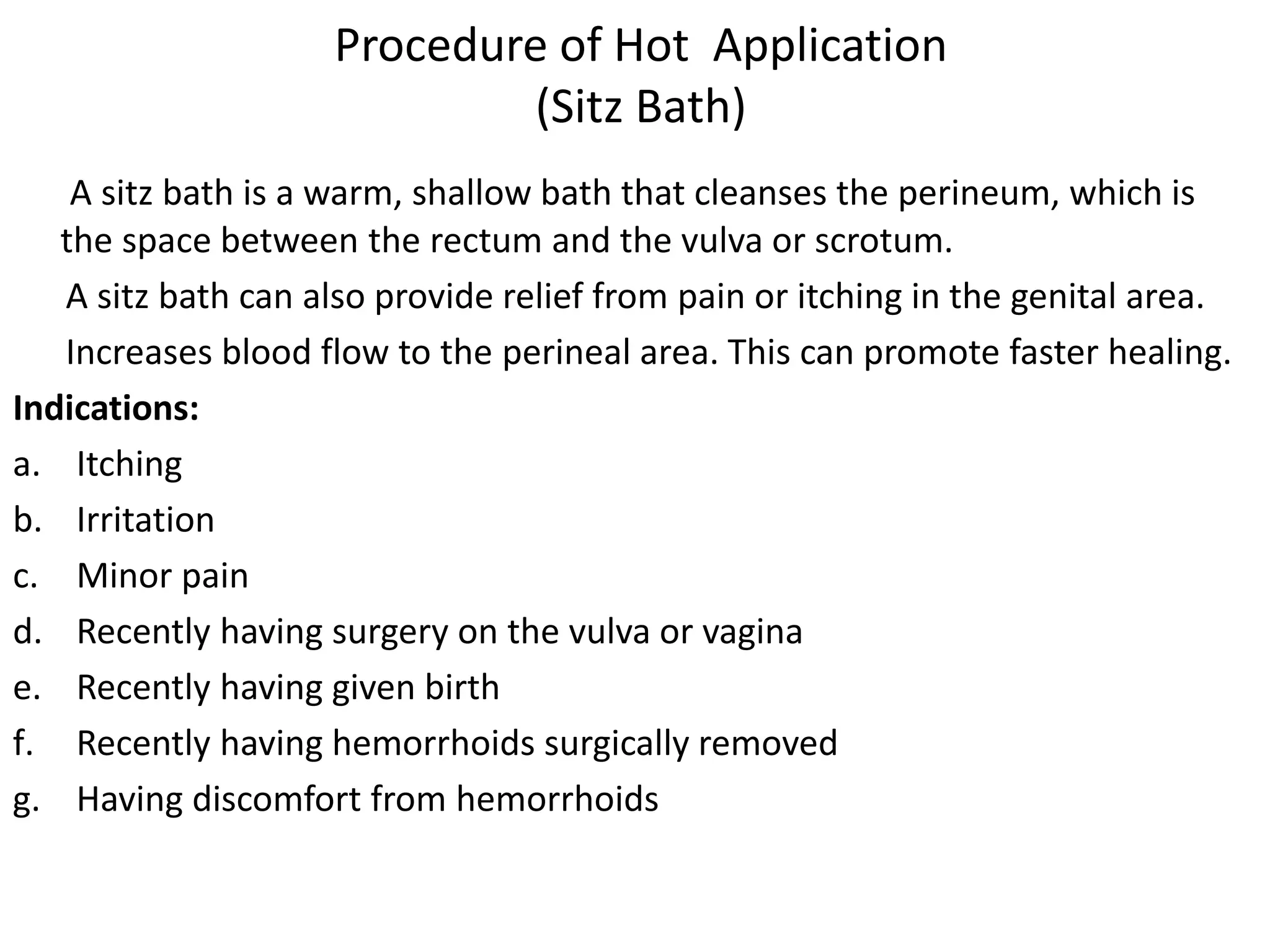
A sitz bath is a warm, shallow bath that cleanses the perineum, which is
the space between the rectum and the vulva or scrotum.
A sitz bath can also provide relief from pain or itching in the genital area.
Increases blood flow to the perineal area. This can promote faster healing.
Indications:
a. Itching
b. Irritation
c. Minor pain
d. Recently having surgery on the vulva or vagina
e. Recently having given birth
f. Recently having hemorrhoids surgically removed
g. Having discomfort from hemorrhoids
Procedure of Hot Application
(Sitz Bath)
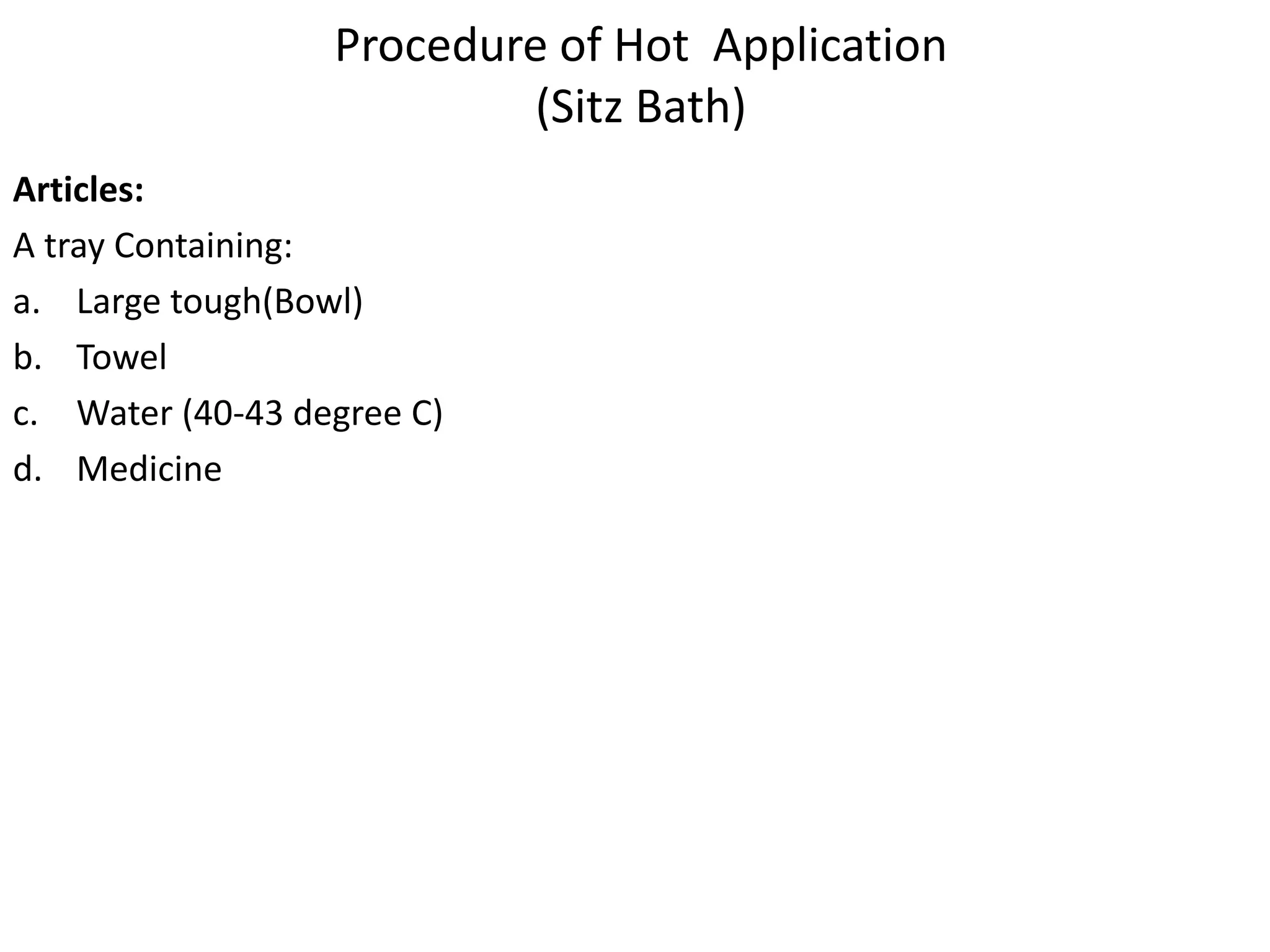
Articles:
A tray Containing:
a. Large tough(Bowl)
b. Towel
c. Water (40-43 degree C)
d. Medicine
Procedure of Hot Application
(Sitz Bath)
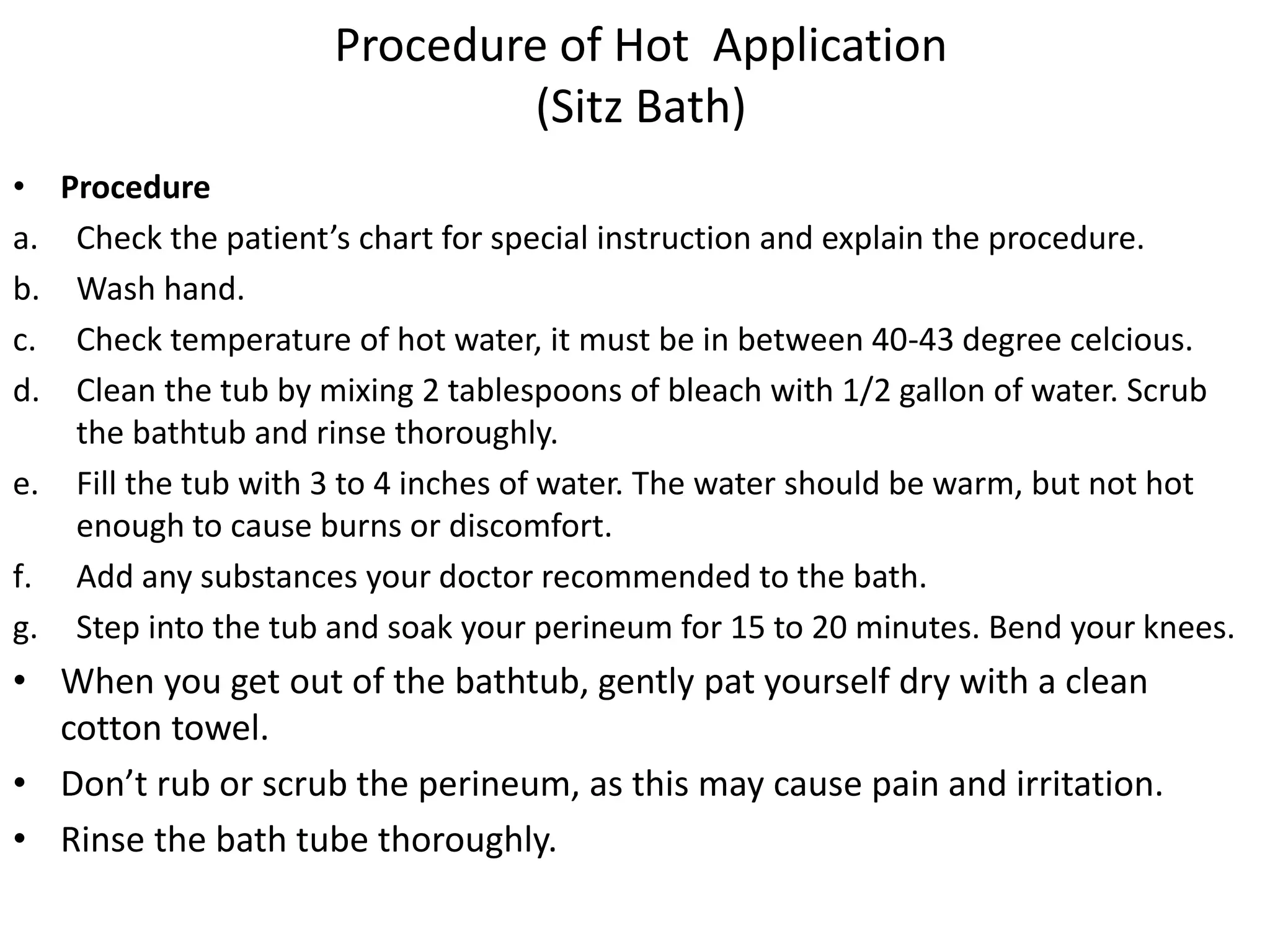
• Procedure
a. Check the patient’s chart for special instruction and explain the procedure.
b. Wash hand.
c. Check temperature of hot water, it must be in between 40-43 degree celcious.
d. Clean the tub by mixing 2 tablespoons of bleach with 1/2 gallon of water. Scrub
the bathtub and rinse thoroughly.
e. Fill the tub with 3 to 4 inches of water. The water should be warm, but not hot
enough to cause burns or discomfort.
f. Add any substances your doctor recommended to the bath.
g. Step into the tub and soak your perineum for 15 to 20 minutes. Bend your knees.
• When you get out of the bathtub, gently pat yourself dry with a clean
cotton towel.
• Don’t rub or scrub the perineum, as this may cause pain and irritation.
• Rinse the bath tube thoroughly.
Nursing Responsibilities during Hot & Cold
Application
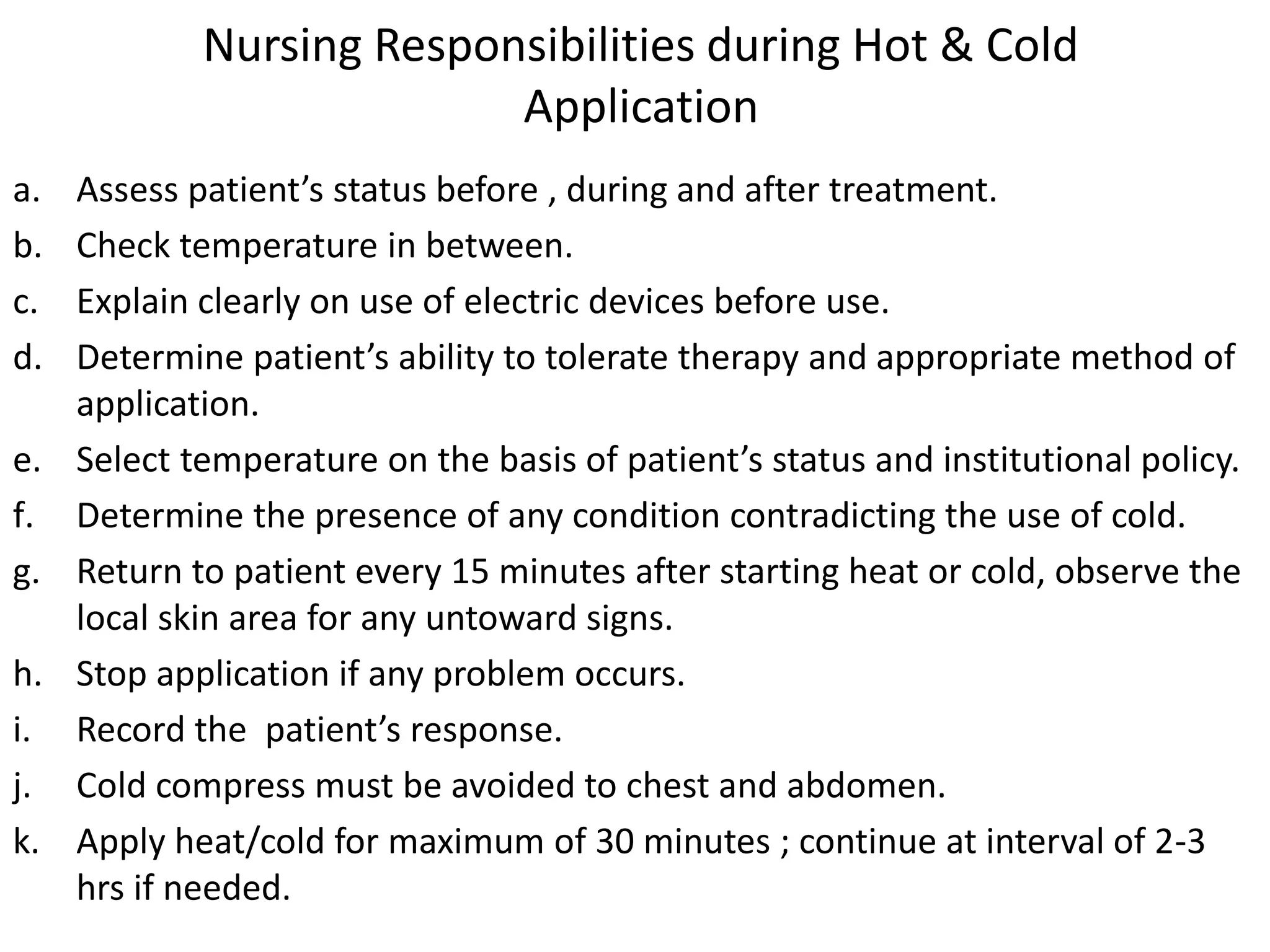
a. Assess patient’s status before , during and after treatment.
b. Check temperature in between.
c. Explain clearly on use of electric devices before use.
d. Determine patient’s ability to tolerate therapy and appropriate method of
application.
e. Select temperature on the basis of patient’s status and institutional policy.
f. Determine the presence of any condition contradicting the use of cold.
g. Return to patient every 15 minutes after starting heat or cold, observe the
local skin area for any untoward signs.
h. Stop application if any problem occurs.
i. Record the patient’s response.
j. Cold compress must be avoided to chest and abdomen.
k. Apply heat/cold for maximum of 30 minutes ; continue at interval of 2-3
hrs if needed.
THANK YOU

Unit14 FON.pptx lecture notes for nurses

  • 1.
    Unit: 14 Hot &Cold Application Mr Yogendra Mehta Assist. Professor TU,IOM,BNC, Biratnagar
  • 2.
    Definition Hot application • Applicationof hot agent, warmer than skin either in a moist or dry form on the surface of the body to relieve pain and congestion, to provide warmth. • To promote suppuration & healing. • To decrease muscle tone and softens the exudates. Cold application • Application of cold agent, cooler than skin either in a moist or dry form on the surface of the body to relieve pain and body temperature. • To anaesthetize an area. • To check hemorrhage. • To control growth of bacteria and prevent gangrene. • To prevent oedema and reduce inflammation.
  • 3.
    Effects of HotApplication • Peripheral Vasodilatation • Increased capillary permeability, • Increased local metabolism • Increased oxygen requirement. • Decreased blood viscosity • Increased blood flow • Increased lymph flow • Increased the action of phagocytosis & removal of the waste products of infection • Reduce muscle tension by muscles relaxation, make connective tissue flexible and pain relief. • Decrease the abdominal peristalsis.
  • 4.
    Effects of ColdApplication • Pheripheral Vasoconstriction • Decreased capillary permeability • Decreased local metabolism • Decreased oxygen requirement. • Increased blood viscosity • Decreased blood flow &lymph flow • Decreased muscle tension • Slows bacterial Growth
  • 5.
    Secondary Effects ofHot &Cold Application If the heat is applied for one hour or more vasodilatation • It will be always followed by vasoconstriction due to the reflex action as the body attempts to control excessive heat loss from the area. • Continuous exposure to heat also damages the epithelial cells, localized tenderness and even blistering. If the cold application is prolonged • It results in reflex vasodilatation to prevent tissue ischemia, which occurs due to inability to receive an adequate flow of blood and nutrients in the cells, Initially, the skin appears reddened, followed by bluish purple with numbness and a burning type of pain.
  • 6.
    Principles of Hot&Cold Application • Heat & Cold is transmitted through conduction, convection and radiation. • Nurse must know the recommended temperature in applying the heat and cold. • Individual patient differ on their degree of heat and cold toleration. • Heat flow from hotter area to less hot area. • Moisture left on the skin causes rapid cooling due to evaporation of moisture. • Heat is distributed throughout the body and by direct conduction throughout the tissue. • Oil acts as the insulator and delays the transmission of the heat. • Friction produces heat.
  • 7.
    Common Indications ofHot &Cold Application S. No Indications Effects of Heat Effects of Cold Muscles Spasm Relaxes muscles & increase contractibility Relaxes muscles & decrease Contractibility 1 Inflammation Increase blood flow, soften exudates Decrease capillary permeability 2 Pain Relieves pain by Promote muscles relaxation, circulation Relieves pain by slowing nerve conduction rate & blocking nerve impulses 3 Contracture Reduces contracture and increase joint range of motion by allowing greater distention of muscles 4 Joint Stiffness Reduce by 5 Traumatic Injuries 6 Fever
  • 8.
    Contraindications of Hot&Cold Application • Hot Application Cold Application Open Bleeding Wound Impaired Mental Status Neuro Sensory Impairement First 24 hr after Traumatic Injuries Local Malignant Tumors Acute Inflammation Open Wound Impaired Circulation Hypothermia
  • 9.
    Purposes of HotApplication • To stimulate circulation by dilating blood vessels, relieving congestion and inflammation and promote muscle relaxation and relieve from pain. • To provide warmth and comfort, soften exudates, promote suppuration and healing. • To stimulate peristalsis and relieve retention of urine. • To decrease joint stiffness by decreasing synovial fluid viscosity.
  • 10.
    Purposes of ColdApplication • To reduce body temperature and control bleeding. • To prevent or reduce inflammation and edema decreasing tissue metabolism. • To anaesthetize an area for short period. • To inhibits bacterial growth and prevent suppuration. • To apply medicinal solution, provide sedative effect and get relief from pain, muscle spasm, sprain, swelling or bruising.
  • 11.
    Classifications Hot application Local HotApplication General Hot Application DRY HEAT Hot water Bottles Heating Lamps Electric Heating pads UV Rays, Infrared Rays Aquathermia pads MOIST HEAT Warm Soak, Local Bath Paraffin bath DRY HEAT Sun Bath, Electric Craddles, Blanket Bed MOIST HEAT Steam Bath,Hot Packs Full Immersion bath
  • 12.
    Classifications Cold application Local ColdApplication General Cold Application DRY COLD Ice bags, Ice Pack, Ice Craddle MOIST COLD Cold Compress, Evaporating Lotion(Beta Hydroxy Acid, emulsion) DRY COLD Hypothermia MOIST COLD Cold Sponging Cold Bath Cold Pack
  • 13.
    Procedure of ColdApplication (Ice Collar or Ice Bag) • It is small rubber bags filled with small pieces of ice and salt, shaped as collar and serve as device for cold application. • Articles required a. Ice cap with cover b. Ice in a bowl c. towel d. Kidney tray e. Mackintosh f. Salt g. Duster to wipe ice cap after filling
  • 14.
    Procedure of ColdApplication (Ice Collar or Ice Bag) • Procedure a. Assess patient’s condition and explain the procedure to the patient. b. position patient in such a way that the injured body part is above the heart. c. Prepare compress. Fill the 2/3rd ice cap with ice cubes and expels air before closing the cap. d. Gently place the cold compress on the injured area. e. Remove the cold compress after 20 minutes to prevent skin from frost bitten. f. Reapply cold compress after 2 hours and check the tolerance of patient in between. g. Position the patient in a comfortable position. h. Replace the articles after cleaning and drying. i. Wash hands. j. Record the procedure including time , purposes and patient’s response. k. Report to the seniors.
  • 15.
  • 16.
    Procedure of ColdApplication (Cold Compress) • It is the application of moist cold to a body part by means of guaze or wash cloth. • Articles required a clean dry tray containing a. Thermometer b. Kidney tray c. Sponge cloth d. Mackintosh e. Towel f. Bowl with cold water(27-37 degree Celcious)
  • 17.
    Procedure of ColdApplication (Cold Compress) • Procedure a. Identify the patient’s need and explain the procedure. b. Maintain privacy and wash the hands. c. Place the patient in comfortable position. d. Place the mackintosh and towel under the area to be treated. e. Plug cotton to the ear if it is applied to forehead. f. Soak sponge cloth in cold water, squeeze gently and apply to required area. g. Change it when it becomes warm. h. Observe skin area frequently for numbness, bluish, and erythema. i. Continue procedure for 15 minutes to 20 minutes. j. Check temperature in between. k. After procedure, dry the area and make patient comfortable. l. Replace all the articles, wash the hands and record the temperature.
  • 18.
  • 19.
    Procedure of ColdApplication (Cold Sponge Bath) • It is the application of moist cold using ice water when the patient’s temperature is raised to more than 103 degree celcious. The purpose of cooling sponge bath is to reduce temperature by promoting heat loss through conduction and vaporization. • Articles required a clean dry tray containing a. Thermometer b. Kidney tray c. Sponge cloth d. Mackintosh e. Towel/drawsheet f. Bowl with cold water(27-37 degree Celcious)
  • 20.
    Procedure of ColdApplication (Cold Sponge Bath) • Procedure a. Assess patient’s status, monitor temperature and explain the procedure. b. Maintain privacy and wash the hands. c. Place the patient in comfortable position. d. Place the mackintosh and drawsheet under the patient. e. Expose the body part and drape with top sheet. f. Dip sponge cloths in the bowl with cold water, squeeze gently and apply. g. Sponge face ,arms, legs, back, and buttoks. h. Chest and abdomen are not usually sponged. i. Place cold wet sponge cloths in hands, axilla, forehead and groin. j. Check patient’s temperature every 15 minutes. k. Cold sponging should be given maximally not exceed 20-30 minutes. l. Stop procedure if temperature reaches 100 degree F.
  • 21.
    Procedure of ColdApplication (Cold Sponge Bath) j. Dry the patient. k. Remove the wet clothing including drawsheet and the mackintosh. l. Dress the patient and keep in comfortable position. m. Replace the articles and wash the hands. n. Check the temperature after 15 minutes if still high, seek for therapeutic approach. o. Record and report properly.
  • 22.
    Procedure of HotApplication (Hot Compress) • Dry Hot Compress(Hot Water Bag) • Articles required a clean dry tray containing a. Hot water Bag b. Boiling water c. Towel d. Mug to pour water into bag e. Thermometer and duster
  • 23.
  • 24.
    Procedure of HotApplication (Hot water Bag) • Procedure a. Check the patient’s chart for special instruction and explain the procedure. b. Assess skin surfaces and wash hand. c. Check temperature of hot water, it must be in between 40-46 degree celcious. d. Empty hot water bag and refill till 2/3rd full. e. Expel air at the top and secure the cap and turn it upside down to ensure that there are no leaks. f. Dry outside of bag. g. Wrap the bag in a towel and apply over required area. h. Inspect the area carefully in between. i. Keep the bag for 20-30 minutes. j. Remove, dry the area and inspect for redness. k. Make the patient comfortable in bed. l. Record the time, site, duration and effects observed of application.
  • 25.
    Procedure of HotApplication (Moist Hot Compression) It is the application of moist guaze dressing over the part of body soaked with warm water, applied to the affected area to relieve muscle spasm. This type uses a warm liquid to apply heat to an area. An example of a moist warm compress is a towel soaked in hot water. Heating sources can include warm water, microwaveable pads, wheat packs and electrical or chemical pads. The most common warm compress is a warm, wet washcloth. • Articles required a clean dry tray containing a. Boiling water b. Small Towel c. Large Bowl d. Mackintosh
  • 26.
    Procedure of HotApplication (Moist Hot Compression) • Procedure a. Check the patient’s chart for special instruction and explain the procedure. b. Wash hand. c. Check temperature of hot water, it must be in between 40-46 degree celcious. d. Fold towel up enough to cover the area to be placed on. e. Dip the folded towel into the bowl having warm water carefully. f. Test towel to make sure it isn’t too hot; place it on the affected region. g. Soak the towel when it cool off and repeat the procedure till time desired. h. Perform for 20-30 minutes. i. Remove, dry the area and inspect for redness. j. Make the patient comfortable in bed. k. Record the time, site, duration and effects observed of application.
  • 27.
    Procedure of HotApplication (Sitz Bath) A sitz bath is a warm, shallow bath that cleanses the perineum, which is the space between the rectum and the vulva or scrotum. A sitz bath can also provide relief from pain or itching in the genital area. Increases blood flow to the perineal area. This can promote faster healing. Indications: a. Itching b. Irritation c. Minor pain d. Recently having surgery on the vulva or vagina e. Recently having given birth f. Recently having hemorrhoids surgically removed g. Having discomfort from hemorrhoids
  • 28.
    Procedure of HotApplication (Sitz Bath) Articles: A tray Containing: a. Large tough(Bowl) b. Towel c. Water (40-43 degree C) d. Medicine
  • 29.
    Procedure of HotApplication (Sitz Bath) • Procedure a. Check the patient’s chart for special instruction and explain the procedure. b. Wash hand. c. Check temperature of hot water, it must be in between 40-43 degree celcious. d. Clean the tub by mixing 2 tablespoons of bleach with 1/2 gallon of water. Scrub the bathtub and rinse thoroughly. e. Fill the tub with 3 to 4 inches of water. The water should be warm, but not hot enough to cause burns or discomfort. f. Add any substances your doctor recommended to the bath. g. Step into the tub and soak your perineum for 15 to 20 minutes. Bend your knees. • When you get out of the bathtub, gently pat yourself dry with a clean cotton towel. • Don’t rub or scrub the perineum, as this may cause pain and irritation. • Rinse the bath tube thoroughly.
  • 30.
    Nursing Responsibilities duringHot & Cold Application a. Assess patient’s status before , during and after treatment. b. Check temperature in between. c. Explain clearly on use of electric devices before use. d. Determine patient’s ability to tolerate therapy and appropriate method of application. e. Select temperature on the basis of patient’s status and institutional policy. f. Determine the presence of any condition contradicting the use of cold. g. Return to patient every 15 minutes after starting heat or cold, observe the local skin area for any untoward signs. h. Stop application if any problem occurs. i. Record the patient’s response. j. Cold compress must be avoided to chest and abdomen. k. Apply heat/cold for maximum of 30 minutes ; continue at interval of 2-3 hrs if needed.
  • 31.