Hot application
Hot application is the
application of a hot agent, warmer
than skin either in a moist or dry
from on the surface of the body
Purpose
 To relive pain and congestion,
 To provide warmth,
 To promote healing,
 To decrease muscle tone
 To soften the exudates.
COLD APPLICATION
Cold application is the
application of a cold agent cooler
than skin either in a moist or dry
form, on the surface of the skin.
Purpose
 To reduce pain and body temperature,
 To anaesthetize an area,
 To control hemorrhage,
 To control the growth of bacteria,
 To prevent gangrene,
 To prevent edema and
 To reduce inflammation.
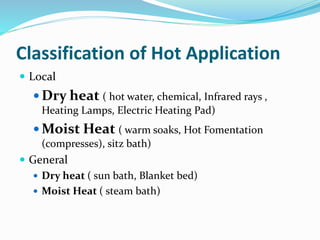
Classification of Hot Application
 Local
 Dry heat ( hot water, chemical, Infrared rays ,
Heating Lamps, Electric Heating Pad)
 Moist Heat ( warm soaks, Hot Fomentation
(compresses), sitz bath)
 General
 Dry heat ( sun bath, Blanket bed)
 Moist Heat ( steam bath)
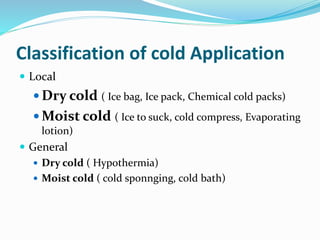
Classification of cold Application
 Local
 Dry cold ( Ice bag, Ice pack, Chemical cold packs)
 Moist cold ( Ice to suck, cold compress, Evaporating
lotion)
 General
 Dry cold ( Hypothermia)
 Moist cold ( cold sponnging, cold bath)
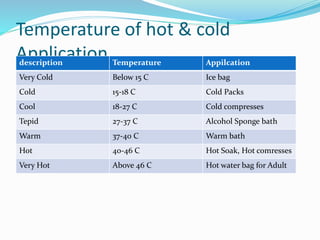
Temperature of hot & cold
Application
description Temperature Appilcation
Very Cold Below 15 C Ice bag
Cold 15-18 C Cold Packs
Cool 18-27 C Cold compresses
Tepid 27-37 C Alcohol Sponge bath
Warm 37-40 C Warm bath
Hot 40-46 C Hot Soak, Hot comresses
Very Hot Above 46 C Hot water bag for Adult
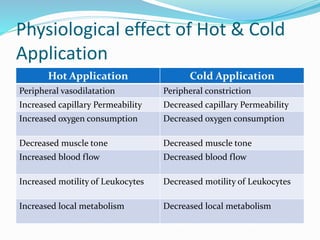
Physiological effect of Hot & Cold
Application
Hot Application Cold Application
Peripheral vasodilatation Peripheral constriction
Increased capillary Permeability Decreased capillary Permeability
Increased oxygen consumption Decreased oxygen consumption
Decreased muscle tone Decreased muscle tone
Increased blood flow Decreased blood flow
Increased motility of Leukocytes Decreased motility of Leukocytes
Increased local metabolism Decreased local metabolism
Contra indication for hot
application
 Malignancies
 Impaired kidney, Heart or Lung Function
 Acute inflamed Areas
 Edema
 Headache
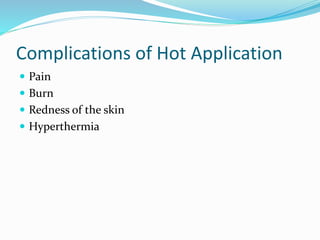
Complications of Hot Application
 Pain
 Burn
 Redness of the skin
 Hyperthermia
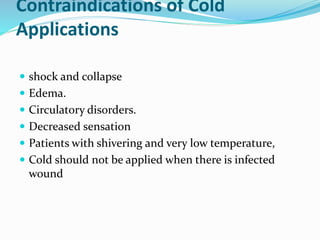
Contraindications of Cold
Applications
 shock and collapse
 Edema.
 Circulatory disorders.
 Decreased sensation
 Patients with shivering and very low temperature,
 Cold should not be applied when there is infected
wound
Complication of Cold Application
 Pain
 Blister
 Thrombus formation
 Redness
 Hypothermia

hot & cold Application.pptx

  • 2.
    Hot application Hot applicationis the application of a hot agent, warmer than skin either in a moist or dry from on the surface of the body
  • 3.
    Purpose  To relivepain and congestion,  To provide warmth,  To promote healing,  To decrease muscle tone  To soften the exudates.
  • 4.
    COLD APPLICATION Cold applicationis the application of a cold agent cooler than skin either in a moist or dry form, on the surface of the skin.
  • 5.
    Purpose  To reducepain and body temperature,  To anaesthetize an area,  To control hemorrhage,  To control the growth of bacteria,  To prevent gangrene,  To prevent edema and  To reduce inflammation.
  • 6.
    Classification of HotApplication  Local  Dry heat ( hot water, chemical, Infrared rays , Heating Lamps, Electric Heating Pad)  Moist Heat ( warm soaks, Hot Fomentation (compresses), sitz bath)  General  Dry heat ( sun bath, Blanket bed)  Moist Heat ( steam bath)
  • 7.
    Classification of coldApplication  Local  Dry cold ( Ice bag, Ice pack, Chemical cold packs)  Moist cold ( Ice to suck, cold compress, Evaporating lotion)  General  Dry cold ( Hypothermia)  Moist cold ( cold sponnging, cold bath)
  • 8.
    Temperature of hot& cold Application description Temperature Appilcation Very Cold Below 15 C Ice bag Cold 15-18 C Cold Packs Cool 18-27 C Cold compresses Tepid 27-37 C Alcohol Sponge bath Warm 37-40 C Warm bath Hot 40-46 C Hot Soak, Hot comresses Very Hot Above 46 C Hot water bag for Adult
  • 9.
    Physiological effect ofHot & Cold Application Hot Application Cold Application Peripheral vasodilatation Peripheral constriction Increased capillary Permeability Decreased capillary Permeability Increased oxygen consumption Decreased oxygen consumption Decreased muscle tone Decreased muscle tone Increased blood flow Decreased blood flow Increased motility of Leukocytes Decreased motility of Leukocytes Increased local metabolism Decreased local metabolism
  • 10.
    Contra indication forhot application  Malignancies  Impaired kidney, Heart or Lung Function  Acute inflamed Areas  Edema  Headache
  • 11.
    Complications of HotApplication  Pain  Burn  Redness of the skin  Hyperthermia
  • 12.
    Contraindications of Cold Applications shock and collapse  Edema.  Circulatory disorders.  Decreased sensation  Patients with shivering and very low temperature,  Cold should not be applied when there is infected wound
  • 13.
    Complication of ColdApplication  Pain  Blister  Thrombus formation  Redness  Hypothermia