Thermal Agents: Heat
Dr Tabassum Saher
Assistant Professor
Heat modalities: Superficial
Heat
 Skin temperature rises but subQ
tissue increase is minimal
 1cm penetration
 depth of penetration is related
amount of fat in area
 Hot Packs
 Whirlpools
 Paraffin Baths
 Infrared Lamp
Heat Modalities: Deep Heat
 Ultrasound and diathermies
 Transmits well through superficial tissue layers
 3-5cm penetration
Factors effecting tissue
temperature rise:
 temperature gradient/rate: high or low vs. time
 volume of tissue: if treatment area is great there may be a
decrease in BP from hypothalamus (vasodilatation)
 Heat Sink: as long as the heat can be dissipated as fast as the modality
adds heat, it is considered safe
 Duration of treatment
 Modality of treatment used
Factors effecting tissue
temperature rise:
 Beyond 113 F protein denaturization and tissue burning may occur
 Best general tissue temperature and blood flow increase is via exercise
Physiological effect of
superficial heat
 Increase circulation 1.5-2x normal
 Increased metabolism (contraindicated in 2-3 days post injury)
 Increased inflammation, phagocytosis, & wound healing
 Decreased pain (analgesia); not as effective as cryotherapy for acute pain
(cryokinetics, anyone?)
 Decreased muscle spasm
 Decreased tissue stiffness (fluids less viscous and collagen releases easier)
Physiological effect of superficial
heat: Hemodynamic
 Depth of effects are not as great as with cold
 Vascular changes are confined to skin (1cm)
 So Why use it?
Physiological effect of superficial
heat: Neuromuscular
 Increase sensory nerve conduction
 Temperature is carried on A-delta fiber
 Analgesic effects both distal and proximal to area treated
 This is why non-acute back patients use heat instead of ice
Physiological effect of superficial
heat: Neuromuscular
 Firing of II fibers results in a decrease in muscle firing, reducing muscle
spasm
 Increased golgi tendon organ firing which inhibits muscle contraction
Contraindications for the use
of superficial heat
 Acute inflammation
 Decrease sensation in area
 Impaired circulation (unable to dissipate Tissue Temperature Rise, TTR)
 Malignancies: increased metabolic rate
 Pregnancies
Moist Heat Packs
 Canvas Pouch with Silica Gel
 Pack is kept in a water-filled heating unit maintained
between 160º F -170 º F
 Pack maintain temperature for 30-45 minutes
 Packs transfer heat by conduction
 Main benefit is superficial heat to 1cm
Moist Heat Packs
 Set-up
Cover pack w/ terry cloth or towel covering
Place pack on patient in comfortable manner
(patient on pack is contraindicated)
Check patient within 5 to 6 minutes for
comfort
Allow 3-4 hr minimum between treatments on
the same day
Moist Heat Pack
 Precaution
 infected areas must be
covered with gauze
 Contraindications
 Acute conditions
 Peripheral vascular
disease
 Impaired circulation
 Poor thermal regulation
 Indications
 Subacute or chronic
inflammatory conditions
 Reduction of subacute or
chronic pain
 Subacute or chronic
muscle spasm
 Decreased ROM
 Hematoma resolution
 Reduction of joint
contractures
 Infection (discuss)
Paraffin Bath
 A mixture of wax an mineral oil in a ratio of 7 parts wax to 1 part oil
 Temperature of 118º F to 126 ºF for upper extremity tx.
 Temperatures of 113 º F to 121 º F for lower extremity (circulation is
less efficient)
 Paraffin can provide approx. 6x the amount of heat as water due to
low specific heat.
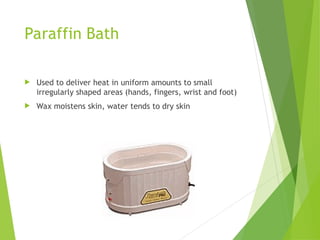
Paraffin Bath
 Used to deliver heat in uniform amounts to small
irregularly shaped areas (hands, fingers, wrist and foot)
 Wax moistens skin, water tends to dry skin
Paraffin Bath Set Up
 Immersion Bath
 Clean body part
 Dip part quickly; allow 10
sec. to dry (turns milky)
 Dip the extremity 6-12 more
times
 Then cover with cellophane
or towel for duration of tx
(10-15 min)
 DO NOT touch sides or
bottom of bath (burns)
 After tx scrape off and
replace in bath
 Pack (Glove) Method
Clean extremity
 Immerse extremity in bath and
allow wax to dry - repeat 7-12
more times
 After final withdrawal from
wax, cover extremity with
plastic bag, or wax paper.
Then wrap in towel
 If indicated elevate body part
 Following tx remove wax and
return to bath
Paraffin Bath
 Precautions
 Sensation is different
from specific heat and
thermal capacity - may
cause burns
 Avoid using with athlete
who are required to
catch or throw a ball -
skin becomes slippery
 Contraindications
 Open wounds (options?)
 Skin infections
 Sensory loss
 Peripheral vascular disease
 Indications
 Subacute and chronic
inflammation
 limitation on ROM after
immobilization
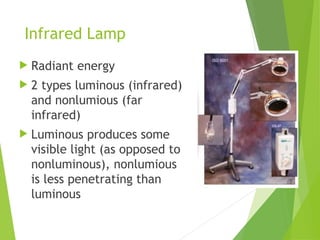
Infrared Lamp
 Radiant energy
 2 types luminous (infrared)
and nonlumious (far
infrared)
 Luminous produces some
visible light (as opposed to
nonluminous), nonlumious
is less penetrating than
luminous
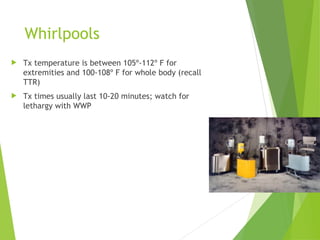
Whirlpools
 Tx temperature is between 105º-112º F for
extremities and 100-108º F for whole body (recall
TTR)
 Tx times usually last 10-20 minutes; watch for
lethargy with WWP
Warm Whirlpool
 Precautions
 Must be connected to ground-fault indicator
 Instruct patient not to turn whirlpool motor on or off while
in whirlpool
 Patient should be continually monitored
 Do not run while turbine is dry
 Clean tank pre and post infectious wound tx
 Patients under the influence of drugs
 Keep clothing and bandages out of whirlpool
Warm Whirlpool
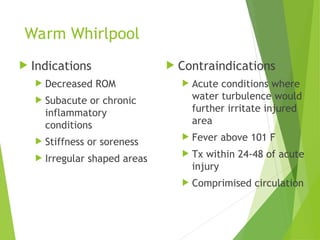
 Indications
 Decreased ROM
 Subacute or chronic
inflammatory
conditions
 Stiffness or soreness
 Irregular shaped areas
 Contraindications
 Acute conditions where
water turbulence would
further irritate injured
area
 Fever above 101 F
 Tx within 24-48 of acute
injury
 Comprimised circulation
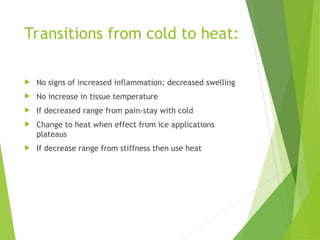
Transitions from cold to heat:
 No signs of increased inflammation; decreased swelling
 No increase in tissue temperature
 If decreased range from pain-stay with cold
 Change to heat when effect from ice applications
plateaus
 If decrease range from stiffness then use heat
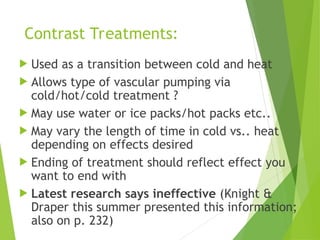
Contrast Treatments:
 Used as a transition between cold and heat
 Allows type of vascular pumping via
cold/hot/cold treatment ?
 May use water or ice packs/hot packs etc..
 May vary the length of time in cold vs.. heat
depending on effects desired
 Ending of treatment should reflect effect you
want to end with
 Latest research says ineffective (Knight &
Draper this summer presented this information;
also on p. 232)
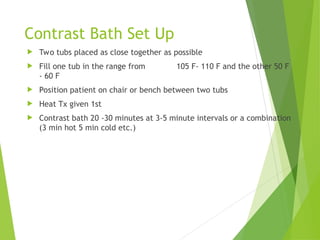
Contrast Bath Set Up
 Two tubs placed as close together as possible
 Fill one tub in the range from 105 F- 110 F and the other 50 F
- 60 F
 Position patient on chair or bench between two tubs
 Heat Tx given 1st
 Contrast bath 20 -30 minutes at 3-5 minute intervals or a combination
(3 min hot 5 min cold etc.)
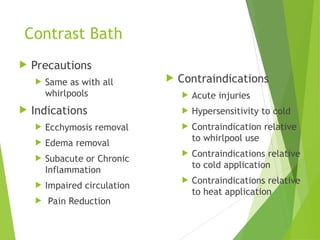
Contrast Bath
 Precautions
 Same as with all
whirlpools
 Indications
 Ecchymosis removal
 Edema removal
 Subacute or Chronic
Inflammation
 Impaired circulation
 Pain Reduction
 Contraindications
 Acute injuries
 Hypersensitivity to cold
 Contraindication relative
to whirlpool use
 Contraindications relative
to cold application
 Contraindications relative
to heat application
Heat Case Study
 Similar to Cold Case Study, use at least 3 primary sources in this assignment.
Appropriateness of source will be reflected in grade.
 Cite source as (Author name, date) within answer and full source in
“Citations” at end of answer.
 Each question should be answered concisely in 3-4 sentences (short
paragraph).

SUPERFICIAL HEATING MODALITIES B ELECTRO PT.ppt

  • 1.
    Thermal Agents: Heat DrTabassum Saher Assistant Professor
  • 2.
    Heat modalities: Superficial Heat Skin temperature rises but subQ tissue increase is minimal  1cm penetration  depth of penetration is related amount of fat in area  Hot Packs  Whirlpools  Paraffin Baths  Infrared Lamp
  • 3.
    Heat Modalities: DeepHeat  Ultrasound and diathermies  Transmits well through superficial tissue layers  3-5cm penetration
  • 4.
    Factors effecting tissue temperaturerise:  temperature gradient/rate: high or low vs. time  volume of tissue: if treatment area is great there may be a decrease in BP from hypothalamus (vasodilatation)  Heat Sink: as long as the heat can be dissipated as fast as the modality adds heat, it is considered safe  Duration of treatment  Modality of treatment used
  • 5.
    Factors effecting tissue temperaturerise:  Beyond 113 F protein denaturization and tissue burning may occur  Best general tissue temperature and blood flow increase is via exercise
  • 6.
    Physiological effect of superficialheat  Increase circulation 1.5-2x normal  Increased metabolism (contraindicated in 2-3 days post injury)  Increased inflammation, phagocytosis, & wound healing  Decreased pain (analgesia); not as effective as cryotherapy for acute pain (cryokinetics, anyone?)  Decreased muscle spasm  Decreased tissue stiffness (fluids less viscous and collagen releases easier)
  • 7.
    Physiological effect ofsuperficial heat: Hemodynamic  Depth of effects are not as great as with cold  Vascular changes are confined to skin (1cm)  So Why use it?
  • 8.
    Physiological effect ofsuperficial heat: Neuromuscular  Increase sensory nerve conduction  Temperature is carried on A-delta fiber  Analgesic effects both distal and proximal to area treated  This is why non-acute back patients use heat instead of ice
  • 9.
    Physiological effect ofsuperficial heat: Neuromuscular  Firing of II fibers results in a decrease in muscle firing, reducing muscle spasm  Increased golgi tendon organ firing which inhibits muscle contraction
  • 10.
    Contraindications for theuse of superficial heat  Acute inflammation  Decrease sensation in area  Impaired circulation (unable to dissipate Tissue Temperature Rise, TTR)  Malignancies: increased metabolic rate  Pregnancies
  • 11.
    Moist Heat Packs Canvas Pouch with Silica Gel  Pack is kept in a water-filled heating unit maintained between 160º F -170 º F  Pack maintain temperature for 30-45 minutes  Packs transfer heat by conduction  Main benefit is superficial heat to 1cm
  • 12.
    Moist Heat Packs Set-up Cover pack w/ terry cloth or towel covering Place pack on patient in comfortable manner (patient on pack is contraindicated) Check patient within 5 to 6 minutes for comfort Allow 3-4 hr minimum between treatments on the same day
  • 13.
    Moist Heat Pack Precaution  infected areas must be covered with gauze  Contraindications  Acute conditions  Peripheral vascular disease  Impaired circulation  Poor thermal regulation  Indications  Subacute or chronic inflammatory conditions  Reduction of subacute or chronic pain  Subacute or chronic muscle spasm  Decreased ROM  Hematoma resolution  Reduction of joint contractures  Infection (discuss)
  • 14.
    Paraffin Bath  Amixture of wax an mineral oil in a ratio of 7 parts wax to 1 part oil  Temperature of 118º F to 126 ºF for upper extremity tx.  Temperatures of 113 º F to 121 º F for lower extremity (circulation is less efficient)  Paraffin can provide approx. 6x the amount of heat as water due to low specific heat.
  • 15.
    Paraffin Bath  Usedto deliver heat in uniform amounts to small irregularly shaped areas (hands, fingers, wrist and foot)  Wax moistens skin, water tends to dry skin
  • 16.
    Paraffin Bath SetUp  Immersion Bath  Clean body part  Dip part quickly; allow 10 sec. to dry (turns milky)  Dip the extremity 6-12 more times  Then cover with cellophane or towel for duration of tx (10-15 min)  DO NOT touch sides or bottom of bath (burns)  After tx scrape off and replace in bath  Pack (Glove) Method Clean extremity  Immerse extremity in bath and allow wax to dry - repeat 7-12 more times  After final withdrawal from wax, cover extremity with plastic bag, or wax paper. Then wrap in towel  If indicated elevate body part  Following tx remove wax and return to bath
  • 17.
    Paraffin Bath  Precautions Sensation is different from specific heat and thermal capacity - may cause burns  Avoid using with athlete who are required to catch or throw a ball - skin becomes slippery  Contraindications  Open wounds (options?)  Skin infections  Sensory loss  Peripheral vascular disease  Indications  Subacute and chronic inflammation  limitation on ROM after immobilization
  • 18.
    Infrared Lamp  Radiantenergy  2 types luminous (infrared) and nonlumious (far infrared)  Luminous produces some visible light (as opposed to nonluminous), nonlumious is less penetrating than luminous
  • 19.
    Whirlpools  Tx temperatureis between 105º-112º F for extremities and 100-108º F for whole body (recall TTR)  Tx times usually last 10-20 minutes; watch for lethargy with WWP
  • 20.
    Warm Whirlpool  Precautions Must be connected to ground-fault indicator  Instruct patient not to turn whirlpool motor on or off while in whirlpool  Patient should be continually monitored  Do not run while turbine is dry  Clean tank pre and post infectious wound tx  Patients under the influence of drugs  Keep clothing and bandages out of whirlpool
  • 21.
    Warm Whirlpool  Indications Decreased ROM  Subacute or chronic inflammatory conditions  Stiffness or soreness  Irregular shaped areas  Contraindications  Acute conditions where water turbulence would further irritate injured area  Fever above 101 F  Tx within 24-48 of acute injury  Comprimised circulation
  • 22.
    Transitions from coldto heat:  No signs of increased inflammation; decreased swelling  No increase in tissue temperature  If decreased range from pain-stay with cold  Change to heat when effect from ice applications plateaus  If decrease range from stiffness then use heat
  • 23.
    Contrast Treatments:  Usedas a transition between cold and heat  Allows type of vascular pumping via cold/hot/cold treatment ?  May use water or ice packs/hot packs etc..  May vary the length of time in cold vs.. heat depending on effects desired  Ending of treatment should reflect effect you want to end with  Latest research says ineffective (Knight & Draper this summer presented this information; also on p. 232)
  • 24.
    Contrast Bath SetUp  Two tubs placed as close together as possible  Fill one tub in the range from 105 F- 110 F and the other 50 F - 60 F  Position patient on chair or bench between two tubs  Heat Tx given 1st  Contrast bath 20 -30 minutes at 3-5 minute intervals or a combination (3 min hot 5 min cold etc.)
  • 25.
    Contrast Bath  Precautions Same as with all whirlpools  Indications  Ecchymosis removal  Edema removal  Subacute or Chronic Inflammation  Impaired circulation  Pain Reduction  Contraindications  Acute injuries  Hypersensitivity to cold  Contraindication relative to whirlpool use  Contraindications relative to cold application  Contraindications relative to heat application
  • 26.
    Heat Case Study Similar to Cold Case Study, use at least 3 primary sources in this assignment. Appropriateness of source will be reflected in grade.  Cite source as (Author name, date) within answer and full source in “Citations” at end of answer.  Each question should be answered concisely in 3-4 sentences (short paragraph).