TUTORIAL 7 : CHRONIC
OBSTRUCTIVE
PULMONARY DISEASE
(COPD)
MADAM ROZILA BINTI IBRAHIM
MAY SESSION 2024
LEARNING OUTCOME
At the end of the session, learner’s would be
able to;
• Discuss the pathophysiology of COPD
• Select the specific management for patient
with COPD.
• Describe the significant of palliative care with
management of COPD.
• Discuss the concept of self-care management
for patient with COPD.
Chronic Obstructive Pulmonary Disease or Chronic
Obstructive lung disease.
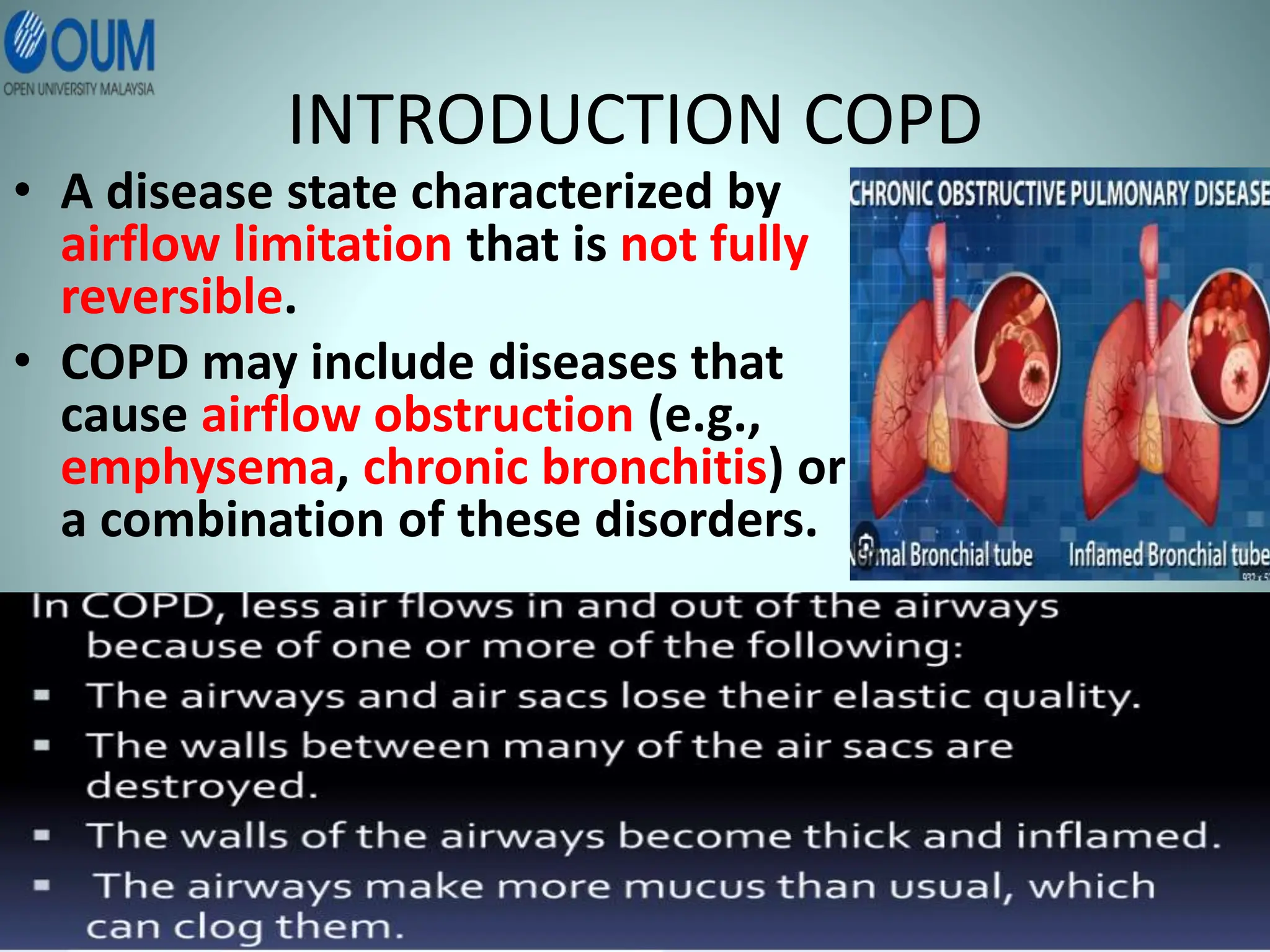
INTRODUCTION COPD
• A disease state characterized by
airflow limitation that is not fully
reversible.
• COPD may include diseases that
cause airflow obstruction (e.g.,
emphysema, chronic bronchitis) or
a combination of these disorders.
CONT..INTRODUCTION
• COPD includes chronic bronchitis and emphysema.
1. Chronic bronchitis: is a chronic inflammation of the
lower respiratory tract characterized by excessive
mucous secretion, cough, & dyspnea associated
with recurrent infections of the lower respiratory
tract.
2. Emphysema: is a complex lung disease
characterized by damage to the gas- exchanging
surfaces of the lungs ( alveoli)
Risk Factors for COPD
1. Exposure to tobacco smoke; estimated 80% to
90% of COPD cases. ( active smoking)
2. Passive smoking
3. Occupational exposure; Asbestos Exposure,
Chemical substances, diesel exhaust etc.
4. Air pollution; Ammonia gasses, haze( jerebu).
5. Genetic abnormalities, including a
deficiency/absent of alpha1-antitrypsin (AAT)
enzyme to protect the lung. Lead to many lung
problem
SMOKING
PATHOPHYSIOLOGY COPD
Clinical Manifestations
• COPD is characterized by three primary symptoms:
1. Cough
2. Sputum production and
3. Dyspnea on exertion (DOE)
• Dyspnea may be severe and often interferes
with the patient’s activities.
• Weight loss is common because dyspnea
interferes with eating.
Key Factors to Assess in the COPD
Patient’s Health History
1. Exposure to risk factors—types, intensity,
duration.
2. Past medical history—respirator
diseases/problems, including asthma, allergy,
sinusitis, nasal polyps, history of respiratory
Infections.
3. Family history of COPD or other chronic
respiratory diseases.
4. Pattern of symptom development.
5. History of exacerbations or previous
hospitalizations for respiratory problems.
Key Factors to Assess in the COPD
Patient’s Health History
6. Presence of comorbidities eg; any other
chronic disease.
7. Impact of the disease on quality of life.
8. Available social and family support for
patient.
9. Potential for reducing risk factors (e.g.,
smoking cessation).
INVESTIGATION
1. Pulmonary function Test (PFT) are used to
help confirm the diagnosis of COPD,
determine disease severity, and follow disease
progression.
2. Spirometry is used to evaluate airflow
obstruction.
3. Arterial blood gas (ABGs) measurements
may also be obtained to assess baseline
oxygenation and gas exchange.
INVESTIGATION
4. Chest x-ray
5. alpha1 antitrypsin
deficiency screening
may be performed for
patients under age 45
or for those with a
strong family history of
COPD.
Complications
1. Respiratory distress and Respiratory failure
are major life-threatening complications of
COPD.
2. Pneumonia & respiratory infection
3. Right-sided heart failure
4. Pulmonary hypertension
5. Pneumothorax
6. Skeletal muscle dysfunction
7. Depression and anxiety disorders
The objective of Management client with COPD
The main objective of COPD management are Following:
1. Relieve symptoms
2. Prevent disease progression
3. Reduce mortality & improve exercise tolerance
4. Prevent and treat complications
Medical Management
1. Risk reduction: Smoking cessation is the single
most effective intervention to prevent COPD or
slow its progression. ( smoking cessation is
major essential to reduce disease progression
and improve survival rate)
Nurses play a key role in promoting smoking
cessation and educating patients about ways to
do so. Patients diagnosed with COPD who
continue to smoke must be encouraged and
assisted to quit.
PHARMACOLOGIC THERAPY
• Bronchodilators: Bronchodilators relieve
bronchospasm and reduce airway obstruction
by allowing increased oxygen distribution
throughout the lungs and improving alveolar
ventilation.
• These medications, which are central in the
management of COPD ; administer through a
metered-dose inhaler (MDI) by nebulizer, or
oral route in pill / liquid.
A metered-dose inhaler(MDI) is a pressurized
device containing an aerosolized powder of
medication.
Metered-dose inhaler(MDI)
Corticosteroids
• Corticosteroids. Inhaled and systemic
corticosteroids (oral or intravenous) may also
be used in COPD but are used more frequently
in asthma.
• corticosteroids may improve the symptoms.
Cont.. Pharmacology treatment
• Other Medications including Patients should
receive a yearly influenza vaccine and the
pneumococcal vaccine every 5 to 7 years as
preventive measures.
MANAGEMENT OF EXACERBATION
• An exacerbation of COPD is difficult to
diagnose, but signs and symptoms may
include increased dyspnea, increased sputum
production and purulence, respiratory failure,
changes in mental status, or worsening blood
gas abnormalities.
• Primary causes for an acute exacerbation
include tracheobronchial infection and air
pollution.
OXYGEN THERAPY
OXYGEN THERAPY
• Oxygen therapy can be administered as long-
term continuous therapy, during exercise, or
to prevent acute dyspnea.
• Long-term oxygen therapy has been shown to
improve the patient’s quality of life and
survival.
PULMONARY REHABILITATION
• The primary goal of rehabilitation is to restore
patients to the highest level of independent
function possible and to improve their quality
of life.
• A successful rehabilitation program is
individualized for each patient, is
multidisciplinary, and attends to both the
physiologic and emotional needs of the
patient.
Components of pulmonary Rehabilitation
The treatment concept of COPD
RISK
REDUCTION
(SMOKING
CESSATION)
BRONCHODILAT
ORS
INHALED
CORTICO
STEROIDS
PULMONARY
REHABILIATION
SURGERY
Nursing Management client with
COPD
1. Assess the Client status ask detail about smoking
(pack per year history), occupational exposure
history, positive family history of respiratory
disease etc.)
2. Note amount, color and consistency of sputum.
3. The nurse should be inspect for use of accessory
muscles during inspiration and expirations.
4. The nurse plays a key role in identifying
potential patient for pulmonary rehabilitation
and in facilitating and reinforcing the material
learned in the rehabilitation program.
Nursing Management client with COPD
• The nurse should teach to patient and family as
well as facilitating specific services for the patient
(e.g., respiratory therapy education, physical
therapy for exercise and breathing technique,
medications using e.g. MDI, Nebulization for
conserving energy during activities of daily living,
and nutritional counseling)
• occupational therapy : promoting independence,
improving quality of life, and max functional
abilities across various settings, including home,
community, and workplace environments.
PATIENT EDUCATION
• Patient education is a major component of
pulmonary rehabilitation and includes a broad
variety of topics.
• Depending on the length and setting of the
program, topics may include normal anatomy
and physiology of the lung, pathophysiology
and changes with COPD, medications and
home oxygen therapy, nutrition, respiratory
therapy treatments, symptom alleviation &
exacerbations, healthy life style, cigarettes
habits.
1. Breathing Exercise
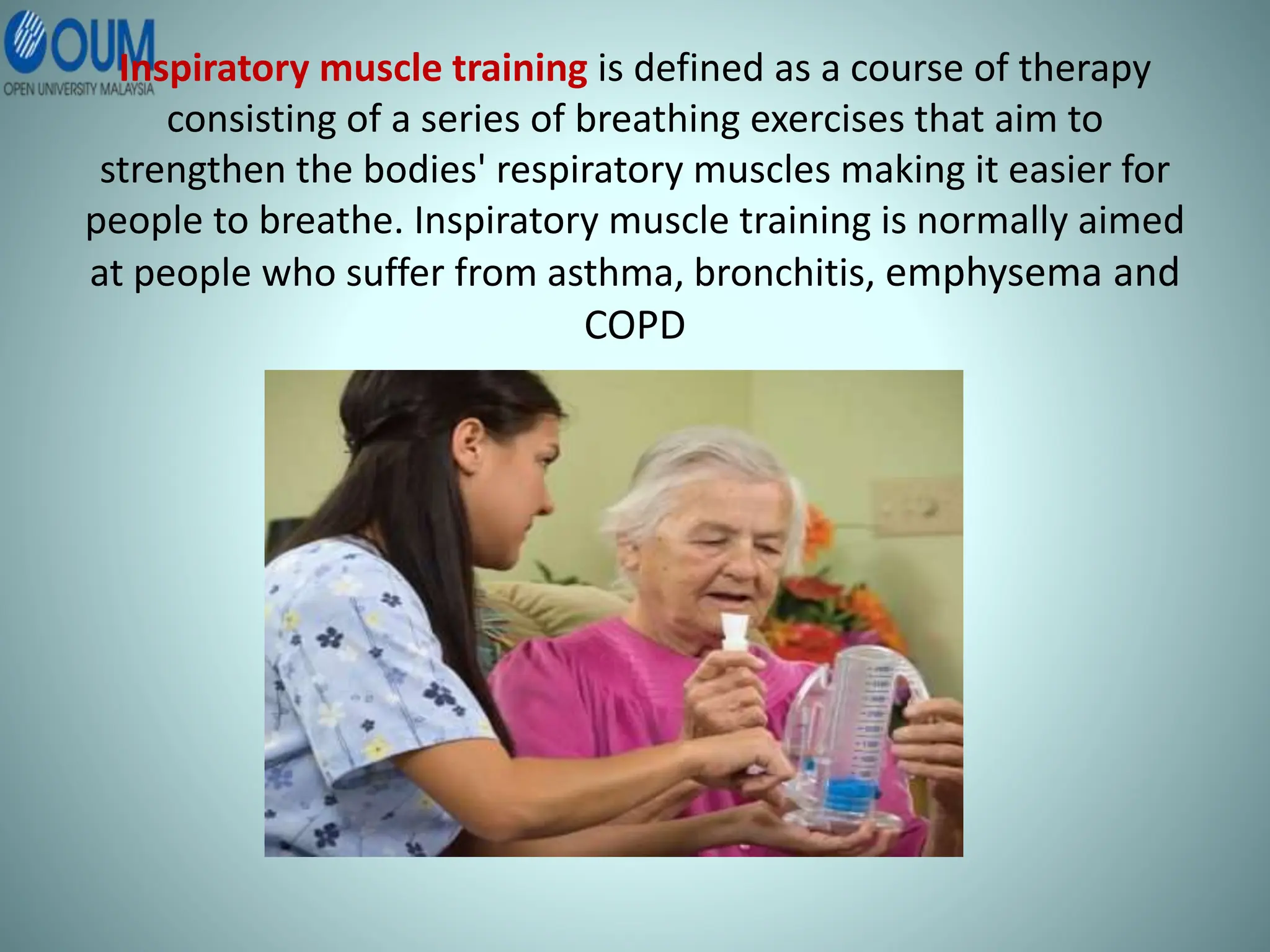
Inspiratory muscle training is defined as a course of therapy
consisting of a series of breathing exercises that aim to
strengthen the bodies' respiratory muscles making it easier for
people to breathe. Inspiratory muscle training is normally aimed
at people who suffer from asthma, bronchitis, emphysema and
COPD
SELF MANAGEMENT
• Self-Care Activities. As gas exchange, airway
clearance, & the breathing pattern improve,
the patient is encouraged to assume
increasing participation in self-care activities.
1. Oxygen Therapy. Oxygen
supplied to the home.
Portable oxygen systems
allow the patient to
exercise, work, and travel.
2. Medication adherence.
3. Smoking Cessation
4. Pulmonary Rehabilitation
5. Nutritional Therapy.
Nutritional assessment and
counseling are important
aspects in the rehabilitation
process for the patient with
COPD.
6. Breathing exercise
7. Avoiding Respiratory Irritants
8. Managing Stress
9. Monitoring Symptoms
10. Regular medical follow-up
Nursing diagnosis
1. Ineffective breathing pattern related to
chronic airflow limitation.
2. Ineffective airway clearance related to
bronchoconstriction, increased mucus
production, ineffective cough, possible
bronchopulmonary infection.
3. Risk for infection related to compromised
pulmonary function, retained secretions and
compromised defense mechanisms.
Nursing diagnosis
4. Imbalanced nutrition: less than body
requirements related to increased work of
breasting, presenting dyspnea & drug effects.
5. Deficient knowledge of self-care strategies to
be performed at home.
TUTORIAL 7 COPD.pptx this slide is discuss about respiratory disease : pneumonia

TUTORIAL 7 COPD.pptx this slide is discuss about respiratory disease : pneumonia

  • 1.
    TUTORIAL 7 :CHRONIC OBSTRUCTIVE PULMONARY DISEASE (COPD) MADAM ROZILA BINTI IBRAHIM MAY SESSION 2024
  • 2.
    LEARNING OUTCOME At theend of the session, learner’s would be able to; • Discuss the pathophysiology of COPD • Select the specific management for patient with COPD. • Describe the significant of palliative care with management of COPD. • Discuss the concept of self-care management for patient with COPD.
  • 3.
    Chronic Obstructive PulmonaryDisease or Chronic Obstructive lung disease.
  • 4.
    INTRODUCTION COPD • Adisease state characterized by airflow limitation that is not fully reversible. • COPD may include diseases that cause airflow obstruction (e.g., emphysema, chronic bronchitis) or a combination of these disorders.
  • 5.
    CONT..INTRODUCTION • COPD includeschronic bronchitis and emphysema. 1. Chronic bronchitis: is a chronic inflammation of the lower respiratory tract characterized by excessive mucous secretion, cough, & dyspnea associated with recurrent infections of the lower respiratory tract. 2. Emphysema: is a complex lung disease characterized by damage to the gas- exchanging surfaces of the lungs ( alveoli)
  • 7.
    Risk Factors forCOPD 1. Exposure to tobacco smoke; estimated 80% to 90% of COPD cases. ( active smoking) 2. Passive smoking 3. Occupational exposure; Asbestos Exposure, Chemical substances, diesel exhaust etc. 4. Air pollution; Ammonia gasses, haze( jerebu). 5. Genetic abnormalities, including a deficiency/absent of alpha1-antitrypsin (AAT) enzyme to protect the lung. Lead to many lung problem
  • 8.
  • 9.
  • 10.
    Clinical Manifestations • COPDis characterized by three primary symptoms: 1. Cough 2. Sputum production and 3. Dyspnea on exertion (DOE) • Dyspnea may be severe and often interferes with the patient’s activities. • Weight loss is common because dyspnea interferes with eating.
  • 12.
    Key Factors toAssess in the COPD Patient’s Health History 1. Exposure to risk factors—types, intensity, duration. 2. Past medical history—respirator diseases/problems, including asthma, allergy, sinusitis, nasal polyps, history of respiratory Infections. 3. Family history of COPD or other chronic respiratory diseases. 4. Pattern of symptom development. 5. History of exacerbations or previous hospitalizations for respiratory problems.
  • 13.
    Key Factors toAssess in the COPD Patient’s Health History 6. Presence of comorbidities eg; any other chronic disease. 7. Impact of the disease on quality of life. 8. Available social and family support for patient. 9. Potential for reducing risk factors (e.g., smoking cessation).
  • 14.
    INVESTIGATION 1. Pulmonary functionTest (PFT) are used to help confirm the diagnosis of COPD, determine disease severity, and follow disease progression. 2. Spirometry is used to evaluate airflow obstruction. 3. Arterial blood gas (ABGs) measurements may also be obtained to assess baseline oxygenation and gas exchange.
  • 15.
    INVESTIGATION 4. Chest x-ray 5.alpha1 antitrypsin deficiency screening may be performed for patients under age 45 or for those with a strong family history of COPD.
  • 16.
    Complications 1. Respiratory distressand Respiratory failure are major life-threatening complications of COPD. 2. Pneumonia & respiratory infection 3. Right-sided heart failure 4. Pulmonary hypertension 5. Pneumothorax 6. Skeletal muscle dysfunction 7. Depression and anxiety disorders
  • 17.
    The objective ofManagement client with COPD The main objective of COPD management are Following: 1. Relieve symptoms 2. Prevent disease progression 3. Reduce mortality & improve exercise tolerance 4. Prevent and treat complications
  • 18.
    Medical Management 1. Riskreduction: Smoking cessation is the single most effective intervention to prevent COPD or slow its progression. ( smoking cessation is major essential to reduce disease progression and improve survival rate) Nurses play a key role in promoting smoking cessation and educating patients about ways to do so. Patients diagnosed with COPD who continue to smoke must be encouraged and assisted to quit.
  • 19.
    PHARMACOLOGIC THERAPY • Bronchodilators:Bronchodilators relieve bronchospasm and reduce airway obstruction by allowing increased oxygen distribution throughout the lungs and improving alveolar ventilation. • These medications, which are central in the management of COPD ; administer through a metered-dose inhaler (MDI) by nebulizer, or oral route in pill / liquid.
  • 20.
    A metered-dose inhaler(MDI)is a pressurized device containing an aerosolized powder of medication.
  • 21.
  • 22.
    Corticosteroids • Corticosteroids. Inhaledand systemic corticosteroids (oral or intravenous) may also be used in COPD but are used more frequently in asthma. • corticosteroids may improve the symptoms.
  • 23.
    Cont.. Pharmacology treatment •Other Medications including Patients should receive a yearly influenza vaccine and the pneumococcal vaccine every 5 to 7 years as preventive measures.
  • 24.
    MANAGEMENT OF EXACERBATION •An exacerbation of COPD is difficult to diagnose, but signs and symptoms may include increased dyspnea, increased sputum production and purulence, respiratory failure, changes in mental status, or worsening blood gas abnormalities. • Primary causes for an acute exacerbation include tracheobronchial infection and air pollution.
  • 25.
  • 26.
    OXYGEN THERAPY • Oxygentherapy can be administered as long- term continuous therapy, during exercise, or to prevent acute dyspnea. • Long-term oxygen therapy has been shown to improve the patient’s quality of life and survival.
  • 28.
    PULMONARY REHABILITATION • Theprimary goal of rehabilitation is to restore patients to the highest level of independent function possible and to improve their quality of life. • A successful rehabilitation program is individualized for each patient, is multidisciplinary, and attends to both the physiologic and emotional needs of the patient.
  • 29.
  • 30.
    The treatment conceptof COPD RISK REDUCTION (SMOKING CESSATION) BRONCHODILAT ORS INHALED CORTICO STEROIDS PULMONARY REHABILIATION SURGERY
  • 31.
    Nursing Management clientwith COPD 1. Assess the Client status ask detail about smoking (pack per year history), occupational exposure history, positive family history of respiratory disease etc.) 2. Note amount, color and consistency of sputum. 3. The nurse should be inspect for use of accessory muscles during inspiration and expirations. 4. The nurse plays a key role in identifying potential patient for pulmonary rehabilitation and in facilitating and reinforcing the material learned in the rehabilitation program.
  • 32.
    Nursing Management clientwith COPD • The nurse should teach to patient and family as well as facilitating specific services for the patient (e.g., respiratory therapy education, physical therapy for exercise and breathing technique, medications using e.g. MDI, Nebulization for conserving energy during activities of daily living, and nutritional counseling) • occupational therapy : promoting independence, improving quality of life, and max functional abilities across various settings, including home, community, and workplace environments.
  • 33.
    PATIENT EDUCATION • Patienteducation is a major component of pulmonary rehabilitation and includes a broad variety of topics. • Depending on the length and setting of the program, topics may include normal anatomy and physiology of the lung, pathophysiology and changes with COPD, medications and home oxygen therapy, nutrition, respiratory therapy treatments, symptom alleviation & exacerbations, healthy life style, cigarettes habits.
  • 34.
  • 35.
    Inspiratory muscle trainingis defined as a course of therapy consisting of a series of breathing exercises that aim to strengthen the bodies' respiratory muscles making it easier for people to breathe. Inspiratory muscle training is normally aimed at people who suffer from asthma, bronchitis, emphysema and COPD
  • 36.
    SELF MANAGEMENT • Self-CareActivities. As gas exchange, airway clearance, & the breathing pattern improve, the patient is encouraged to assume increasing participation in self-care activities.
  • 37.
    1. Oxygen Therapy.Oxygen supplied to the home. Portable oxygen systems allow the patient to exercise, work, and travel. 2. Medication adherence. 3. Smoking Cessation 4. Pulmonary Rehabilitation
  • 38.
    5. Nutritional Therapy. Nutritionalassessment and counseling are important aspects in the rehabilitation process for the patient with COPD. 6. Breathing exercise 7. Avoiding Respiratory Irritants 8. Managing Stress 9. Monitoring Symptoms 10. Regular medical follow-up
  • 39.
    Nursing diagnosis 1. Ineffectivebreathing pattern related to chronic airflow limitation. 2. Ineffective airway clearance related to bronchoconstriction, increased mucus production, ineffective cough, possible bronchopulmonary infection. 3. Risk for infection related to compromised pulmonary function, retained secretions and compromised defense mechanisms.
  • 40.
    Nursing diagnosis 4. Imbalancednutrition: less than body requirements related to increased work of breasting, presenting dyspnea & drug effects. 5. Deficient knowledge of self-care strategies to be performed at home.