Applications of Heat, Cold
& counterirritants For
Therapeutic Effects
Application of heat, cold and counterirritants
for therapeutic effects is known as local
application.
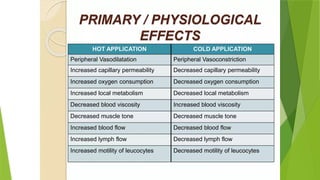
Physiologic effects of Heat and Cold
Heat Cold
1.Vasodilation
2.Increase capillary permeability
3.Increase cellular metabolism (The
process converts eat and drink into energy)
4.Increase inflammation
5.Sedative effect
1.Vasoconstriction
2.Decrease capillary permeability
3.Decrease cellular metabolism
4.Slow bacterial growth. Decrease
inflammation
5.Local anesthetic effect
Heat Application Provides Sedative Effects by:
• Relaxing muscles
• Reducing pain
• Improving circulation
• Activating the parasympathetic nervous system
• Lowering stress hormones
• Offering psychological comfort
 These factors work together to induce a calming, soothing effect on both
the body and mind.
Factors affecting heat and cold
1. Body part
a) Certain areas of the skin have a sensitivity to
temperature variations.
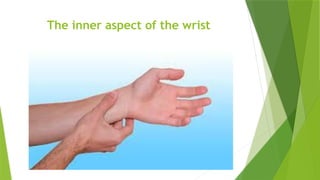
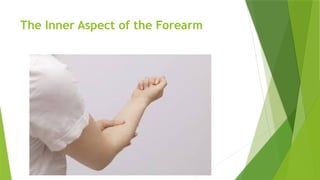
b) The inner aspect of the wrist and fore arm, the neck
and the perineal area are temperature sensitive,
while the back of hand and the foot are not as
sensitive.
The inner aspect of the wrist
The Inner Aspect of the Forearm
Factors affecting heat and cold
2).Area of body exposed
 The larger area exposed to heat and cold, the lower
tolerance to temperature changes.
3). Individual tolerance
 Tolerance to temperature variations is affected by age
and physical condition.
4). Duration of application
a) Tolerance increases as the length of exposure
5). Intactness of the skin
b) Injured skin areas are more sensitive than intact areas
to temperature variations.
Factors affecting heat and cold
Purposes of local applications
1) To reduce pain
2) To stimulate the removal of waste products accumulated in
inflammation
3) To remove excess collection of fluid in the tissue as in sprain
4) To bring pus to the surface of the body and stimulate draining
5) To stimulate the function of organs such as the bladder
6) To relax muscles to which have muscle spasm
7) To constrict the superficial blood vessels
Hot application
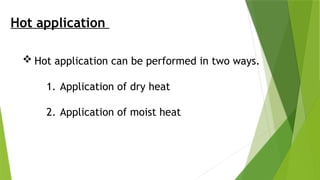
 Hot application can be performed in two ways.
1. Application of dry heat
2. Application of moist heat
Application of Dry heat
 Water is not in contact with the skin
 The application stays at the desired temperature
longer
 Dry heat does not penetrate as deeply as moist heat
 Dry heat needs higher temperatures to achieve desired
effect
 Burns are a risk of dry heat application
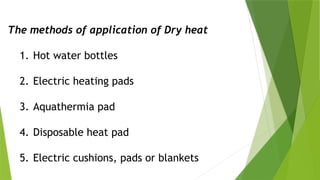
The methods of application of Dry heat
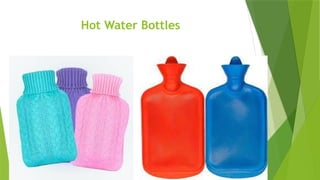
1. Hot water bottles
2. Electric heating pads
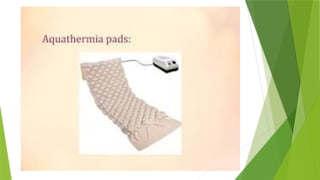
3. Aquathermia pad
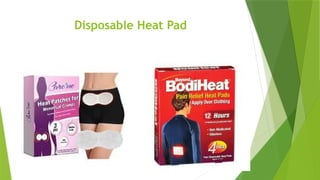
4. Disposable heat pad
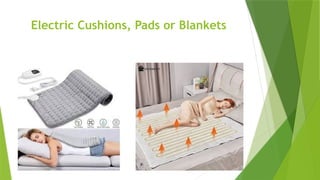
5. Electric cushions, pads or blankets
Hot Water Bottles
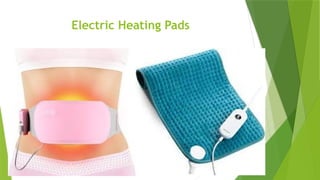
Electric Heating Pads
Disposable Heat Pad
Electric Cushions, Pads or Blankets
Indirect Heat application
 Heat lamp (often called infrared lamps )
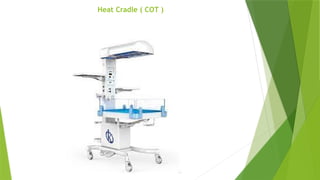
 Heat cradle
Heat Lamp (often called infrared lamps )
Heat Cradle ( COT )
Purposes of dry heat application
1) To dilate blood vessels in the area
2) To encourage suppuration (form pus)
3) To dry or draining wounds
4) To reduce swelling or pain
5) To increase joint flexibility
6) To promote healing
Application of a hot water bottle to a patient
1. To reduces pain and discomfort
2. To relieve retention of urine
3. To provide local warmth
4. To reduce abdominal distension
5. To relieve congestion
Important considerations in application of hot water bottles
1. Identify the patient and explain the procedure
2. Asses the condition of the skin where heat is to be applied.
Ex: Rash, Irritation
3). Read the physician’s order for specific instructions
Ex: Frequency, type of therapy, body area, length of time
4). Fill the water bag
a) Fill the hot water bag with hot water to warm the bag.
b) Then empty it to detect any leaks.
c) Check the temperature of the water with thermometer.
d) Fill the bag with one half to 2/3 full of water.
e) Squeeze the bag until water reaching the neck.
f) Fasten the top and cover bag with absorbent clothing.
5). Close door and curtains and adjust the height of the bed if
necessary.
6). Assist the patient to a comfortable position.
7). Expose the area and drape patient.
8). Put water proof pad under the area to protect the bed.
9). Do not exceed the prescribed length of time for the applications.
10). Documentation after procedure.
Electric heating pads
• Provide constant( continuous), even heat, are light
weight and can easily be molded to a body part.
• Pad covered with cotton or flannel cloth.
• (To prevent burn)
Aquathermia Pad
 Are useful in treating muscle sprains and for areas
with mild inflammation or oedema.
 Pad should be covered with thin cloth.
 Treatment usually continues for 20-30 minutes.
Application of moist heat
• Moist heat as greater and faster effect than dry heat.
• Heat penetrates deeper with a moist application.
• To prevent injury.
Ex: Moist heat application have lower temperature
than dry heat.
Purposes of moist heat application
1. To relieve pain and enhance (increase the quality or
value) comfort of the patient
2. To promote healing, softens exudates
3. To clean the wound of tissue debris or exudates
4. To apply medication to large skin areas
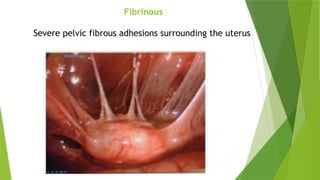
Fibrinous
Severe pelvic fibrous adhesions surrounding the uterus
Serous
Bloody
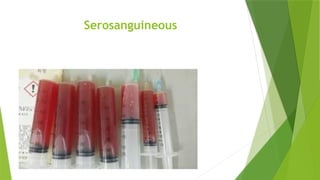
Serosanguineous
Purulent
Classification of Wound Exudate
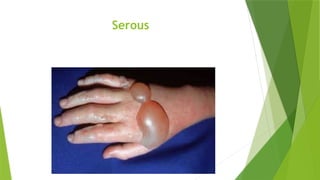
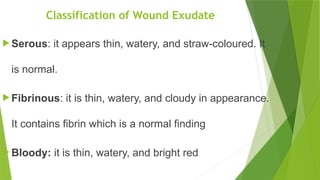
 Serous: it appears thin, watery, and straw-coloured. It
is normal.
 Fibrinous: it is thin, watery, and cloudy in appearance.
It contains fibrin which is a normal finding
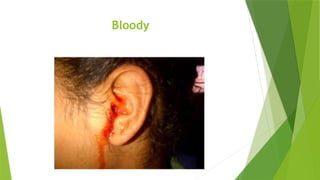
 Bloody: it is thin, watery, and bright red
Classification of Wound Exudate
 Serosanguineous: it is thin, watery inconsistency, and
pale pink to bright red in appearance
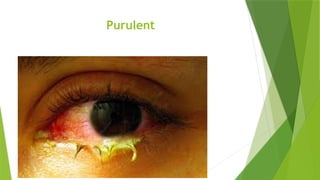
 Purulent: it contains inflammatory cells and debris
resulting from an infection
Methods of application of moist heat
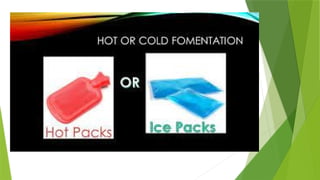
1. Hot fomentation
2. Warm compress
3. Sterile soaks
4. Sitz bath
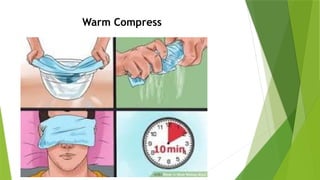
Warm Compress
Sitz bath
Hot Fomentation
 There are two types.
- Medical fomentation
- Surgical fomentation
Medicated fomentation—
Drug is added to boiled water for fomentations and it is applied to
unbroken skin used to relieve tympanites (swelling of the abdomen
with air or gas)by increasing the peristalsis and relaxing the muscle
spasm.
Surgical fomentation—
This is a fomentation to broken part of skin like over an open wound.
Purposes of medical fomentation
1. To stimulate circulation
2. To reduce pain
3. To reduce congestion
4. To relax muscle
Ex: menthol and some evaporation drugs
Warm compresses
• Warm compresses a reapplied to improve circulation,
relieve edema and healing
• Warm compresses are prepared by gauze dressing
and prescribed warm solution
• For open wounds sterile technique should be applied
• Duration 20-30 minutes
Sterile soaks
 Sterile soaks moist heat is applied over the skin
surface by immersing the part (dip or cover
completely) specially an extremity in hot water or
medicated solution
Purposes
 To promote drainage
 To apply medication
 To reduce swelling
 To increase blood circulation
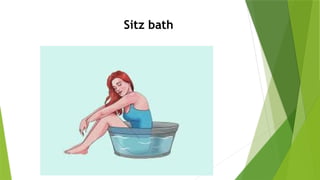
Sitz bath
 A sitz bath is a type of bath in which only the hips
and buttocks are soaked in water or saline solution
Ex: after anal surgeries
Local application of cold
Purposes :-
1) To reduce pain
2) To reduce temperature
3) To relieve headache
4) To control bleeding
5) To prevent inflammatory process
Local effects of cold therapy
1. Lower temperature of the skin and under the tissue
2. Causes vasoconstriction and reduces the blood
circulation to the affected area
3. Local anesthetic effect
Systemic effects of cold therapy
 With extensive(widespread) application,
vasoconstriction causes blood to shut from
peripheral circulation to increase internal
blood pressure and start shivering.
Methods of local application of cold
1) Dry cold application
Ex: ice bag
2) Ice color
3) Disposable cold packs
Application of moist( wet) cold
 Cold compress ( press)
 Cold pack
 Cold or tepid sponging
Purposes
 To relieve headache
 To control bleeding
 To reduce swelling
 To relieve local pain
Heat  Cold for nursing students in BSc Nursing

Heat Cold for nursing students in BSc Nursing

  • 1.
    Applications of Heat,Cold & counterirritants For Therapeutic Effects
  • 2.
    Application of heat,cold and counterirritants for therapeutic effects is known as local application.
  • 3.
    Physiologic effects ofHeat and Cold Heat Cold 1.Vasodilation 2.Increase capillary permeability 3.Increase cellular metabolism (The process converts eat and drink into energy) 4.Increase inflammation 5.Sedative effect 1.Vasoconstriction 2.Decrease capillary permeability 3.Decrease cellular metabolism 4.Slow bacterial growth. Decrease inflammation 5.Local anesthetic effect
  • 4.
    Heat Application ProvidesSedative Effects by: • Relaxing muscles • Reducing pain • Improving circulation • Activating the parasympathetic nervous system • Lowering stress hormones • Offering psychological comfort  These factors work together to induce a calming, soothing effect on both the body and mind.
  • 7.
    Factors affecting heatand cold 1. Body part a) Certain areas of the skin have a sensitivity to temperature variations. b) The inner aspect of the wrist and fore arm, the neck and the perineal area are temperature sensitive, while the back of hand and the foot are not as sensitive.
  • 8.
    The inner aspectof the wrist
  • 9.
    The Inner Aspectof the Forearm
  • 10.
    Factors affecting heatand cold 2).Area of body exposed  The larger area exposed to heat and cold, the lower tolerance to temperature changes. 3). Individual tolerance  Tolerance to temperature variations is affected by age and physical condition.
  • 11.
    4). Duration ofapplication a) Tolerance increases as the length of exposure 5). Intactness of the skin b) Injured skin areas are more sensitive than intact areas to temperature variations. Factors affecting heat and cold
  • 12.
    Purposes of localapplications 1) To reduce pain 2) To stimulate the removal of waste products accumulated in inflammation 3) To remove excess collection of fluid in the tissue as in sprain 4) To bring pus to the surface of the body and stimulate draining 5) To stimulate the function of organs such as the bladder 6) To relax muscles to which have muscle spasm 7) To constrict the superficial blood vessels
  • 13.
    Hot application  Hotapplication can be performed in two ways. 1. Application of dry heat 2. Application of moist heat
  • 14.
    Application of Dryheat  Water is not in contact with the skin  The application stays at the desired temperature longer  Dry heat does not penetrate as deeply as moist heat  Dry heat needs higher temperatures to achieve desired effect  Burns are a risk of dry heat application
  • 15.
    The methods ofapplication of Dry heat 1. Hot water bottles 2. Electric heating pads 3. Aquathermia pad 4. Disposable heat pad 5. Electric cushions, pads or blankets
  • 16.
  • 17.
  • 19.
  • 20.
  • 21.
    Indirect Heat application Heat lamp (often called infrared lamps )  Heat cradle
  • 22.
    Heat Lamp (oftencalled infrared lamps )
  • 23.
  • 24.
    Purposes of dryheat application 1) To dilate blood vessels in the area 2) To encourage suppuration (form pus) 3) To dry or draining wounds 4) To reduce swelling or pain 5) To increase joint flexibility 6) To promote healing
  • 25.
    Application of ahot water bottle to a patient 1. To reduces pain and discomfort 2. To relieve retention of urine 3. To provide local warmth 4. To reduce abdominal distension 5. To relieve congestion
  • 26.
    Important considerations inapplication of hot water bottles 1. Identify the patient and explain the procedure 2. Asses the condition of the skin where heat is to be applied. Ex: Rash, Irritation 3). Read the physician’s order for specific instructions Ex: Frequency, type of therapy, body area, length of time
  • 27.
    4). Fill thewater bag a) Fill the hot water bag with hot water to warm the bag. b) Then empty it to detect any leaks. c) Check the temperature of the water with thermometer. d) Fill the bag with one half to 2/3 full of water. e) Squeeze the bag until water reaching the neck. f) Fasten the top and cover bag with absorbent clothing.
  • 28.
    5). Close doorand curtains and adjust the height of the bed if necessary. 6). Assist the patient to a comfortable position. 7). Expose the area and drape patient. 8). Put water proof pad under the area to protect the bed. 9). Do not exceed the prescribed length of time for the applications. 10). Documentation after procedure.
  • 29.
    Electric heating pads •Provide constant( continuous), even heat, are light weight and can easily be molded to a body part. • Pad covered with cotton or flannel cloth. • (To prevent burn)
  • 30.
    Aquathermia Pad  Areuseful in treating muscle sprains and for areas with mild inflammation or oedema.  Pad should be covered with thin cloth.  Treatment usually continues for 20-30 minutes.
  • 31.
    Application of moistheat • Moist heat as greater and faster effect than dry heat. • Heat penetrates deeper with a moist application. • To prevent injury. Ex: Moist heat application have lower temperature than dry heat.
  • 32.
    Purposes of moistheat application 1. To relieve pain and enhance (increase the quality or value) comfort of the patient 2. To promote healing, softens exudates 3. To clean the wound of tissue debris or exudates 4. To apply medication to large skin areas
  • 35.
    Fibrinous Severe pelvic fibrousadhesions surrounding the uterus
  • 36.
  • 37.
  • 38.
  • 39.
  • 40.
    Classification of WoundExudate  Serous: it appears thin, watery, and straw-coloured. It is normal.  Fibrinous: it is thin, watery, and cloudy in appearance. It contains fibrin which is a normal finding  Bloody: it is thin, watery, and bright red
  • 41.
    Classification of WoundExudate  Serosanguineous: it is thin, watery inconsistency, and pale pink to bright red in appearance  Purulent: it contains inflammatory cells and debris resulting from an infection
  • 42.
    Methods of applicationof moist heat 1. Hot fomentation 2. Warm compress 3. Sterile soaks 4. Sitz bath
  • 44.
  • 45.
  • 46.
    Hot Fomentation  Thereare two types. - Medical fomentation - Surgical fomentation
  • 47.
    Medicated fomentation— Drug isadded to boiled water for fomentations and it is applied to unbroken skin used to relieve tympanites (swelling of the abdomen with air or gas)by increasing the peristalsis and relaxing the muscle spasm. Surgical fomentation— This is a fomentation to broken part of skin like over an open wound.
  • 48.
    Purposes of medicalfomentation 1. To stimulate circulation 2. To reduce pain 3. To reduce congestion 4. To relax muscle Ex: menthol and some evaporation drugs
  • 49.
    Warm compresses • Warmcompresses a reapplied to improve circulation, relieve edema and healing • Warm compresses are prepared by gauze dressing and prescribed warm solution • For open wounds sterile technique should be applied • Duration 20-30 minutes
  • 50.
    Sterile soaks  Sterilesoaks moist heat is applied over the skin surface by immersing the part (dip or cover completely) specially an extremity in hot water or medicated solution
  • 51.
    Purposes  To promotedrainage  To apply medication  To reduce swelling  To increase blood circulation
  • 52.
    Sitz bath  Asitz bath is a type of bath in which only the hips and buttocks are soaked in water or saline solution Ex: after anal surgeries
  • 53.
    Local application ofcold Purposes :- 1) To reduce pain 2) To reduce temperature 3) To relieve headache 4) To control bleeding 5) To prevent inflammatory process
  • 54.
    Local effects ofcold therapy 1. Lower temperature of the skin and under the tissue 2. Causes vasoconstriction and reduces the blood circulation to the affected area 3. Local anesthetic effect
  • 55.
    Systemic effects ofcold therapy  With extensive(widespread) application, vasoconstriction causes blood to shut from peripheral circulation to increase internal blood pressure and start shivering.
  • 56.
    Methods of localapplication of cold 1) Dry cold application Ex: ice bag 2) Ice color 3) Disposable cold packs
  • 57.
    Application of moist(wet) cold  Cold compress ( press)  Cold pack  Cold or tepid sponging
  • 58.
    Purposes  To relieveheadache  To control bleeding  To reduce swelling  To relieve local pain