Sreeraj S R
TENS
Sreeraj S R
Definition
 Transcutaneous Electrical Nerve Stimulation (TENS) is a
method of electrical stimulation which primarily aims to
provide a degree of pain relief (symptomatic) by
specifically exciting sensory nerves and thereby
stimulating either the pain gate mechanism and/or the
opioid system.
Sreeraj S R
Mechanism of Action
 Possible Pain-Relieving Mechanisms;
 Activation of ‘pain-gating’ mechanisms.
 Stimulation of the descending pain suppression system
and endogenous opiate mechanisms.
 The Central Biasing Theory
 Removal of the substances which stimulate pain nerve
endings from within the damaged area
Sreeraj S R
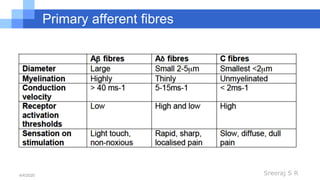
Primary afferent fibres
4/4/2020
Sreeraj S R
Ascending Pain Pathway
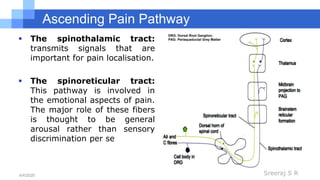
 The spinothalamic tract:
transmits signals that are
important for pain localisation.
 The spinoreticular tract:
This pathway is involved in
the emotional aspects of pain.
The major role of these fibers
is thought to be general
arousal rather than sensory
discrimination per se
4/4/2020
DRG: Dorsal Root Ganglion,
PAG: Periaqueductal Grey Matter
Sreeraj S R
Inhibition of pain transmission
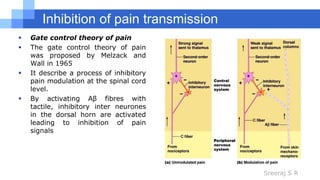
 Gate control theory of pain
 The gate control theory of pain
was proposed by Melzack and
Wall in 1965
 It describe a process of inhibitory
pain modulation at the spinal cord
level.
 By activating Aβ fibres with
tactile, inhibitory inter neurones
in the dorsal horn are activated
leading to inhibition of pain
signals
Sreeraj S R
Inhibition of pain transmission
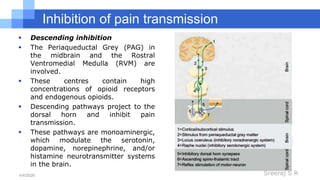
 Descending inhibition
 The Periaqueductal Grey (PAG) in
the midbrain and the Rostral
Ventromedial Medulla (RVM) are
involved.
 These centres contain high
concentrations of opioid receptors
and endogenous opioids.
 Descending pathways project to the
dorsal horn and inhibit pain
transmission.
 These pathways are monoaminergic,
which modulate the serotonin,
dopamine, norepinephrine, and/or
histamine neurotransmitter systems
in the brain.
4/4/2020
Sreeraj S R
Opiate-mediated control
 Endogenous opioids
 Endorphins
 Dynorphins
 Enkephalins
 Neurophysiology background:
 The brain can secrete its own analgesic substance such
as endorphins to modulate pain.
 Endorphins are neuropeptides that act on the CNS and
peripheral nervous system to reduce pain.
 They have the similar pharmacological effect as
morphine.
Sreeraj S R
Parameters used for TENS
 Waveforms
 Frequency or Rate
 Pulse width or Duration
 Amplitude or Intensity
Sreeraj S R
Wave forms
 Square / rectangular
 Instantaneous rise
 Less skin irritating as
approaches sine wave
form
 For nerve damage
associated with pain
pathology
 For hypersensitive and
chronic pain patients
 Delayed, long-lasting
analgesia
Triangular / spike
 Rapidly rising, but not
instantaneous
 More skin irritating
therefore requires
frequent movement of
electrodes or shorter
treatment times to avoid
skin irritation
 For acute pain or resistant
tissue
 Immediate, short lasting
pain relief
4/4/2020
Sreeraj S R
Frequency or Rate
 High Frequency (80-120):
 Large myelinated fibers respond effective > 100Hz
 Immediate relief of pain
 Acute pain
 Low Frequency (1-20):
 Small unmyelinated fibers respond effectively at <100Hz
 Increase endorphin production, thus analgesia following stimulation
 Chronic pain
Sreeraj S R
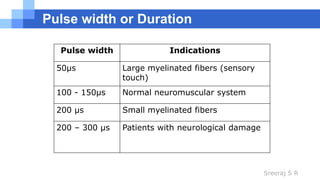
Pulse width or Duration
Pulse width Indications
50μs Large myelinated fibers (sensory
touch)
100 - 150μs Normal neuromuscular system
200 μs Small myelinated fibers
200 – 300 μs Patients with neurological damage
Sreeraj S R
Amplitude or Intensity
 TENS units intensity ranges form 1 mA to 100 mA
 TENS is only effective when the patient actually feels
the stimulus
 Patients need to increase the intensity when the body
accommodates to the stimulus (when they don’t feel the
stimulation anymore)
 Dying batteries can cause fading intensities
Sreeraj S R
Types of TENS
 Conventional TENS or High Frequency TENS
 Acupuncture-like TENS (AL-TENS) or Low Frequency TENS
 Brief TENS or Intense TENS
 Burst TENS
 Modulated TENS or Modified TENS
Sreeraj S R
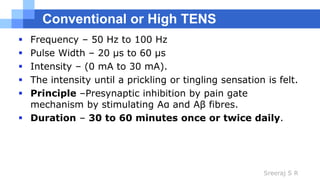
Conventional or High TENS
 Frequency – 50 Hz to 100 Hz
 Pulse Width – 20 μs to 60 μs
 Intensity – (0 mA to 30 mA).
 The intensity until a prickling or tingling sensation is felt.
 Principle –Presynaptic inhibition by pain gate
mechanism by stimulating Aα and Aβ fibres.
 Duration – 30 to 60 minutes once or twice daily.
Sreeraj S R
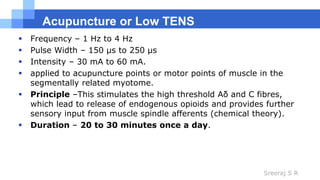
Acupuncture or Low TENS
 Frequency – 1 Hz to 4 Hz
 Pulse Width – 150 μs to 250 μs
 Intensity – 30 mA to 60 mA.
 applied to acupuncture points or motor points of muscle in the
segmentally related myotome.
 Principle –This stimulates the high threshold Aδ and C fibres,
which lead to release of endogenous opioids and provides further
sensory input from muscle spindle afferents (chemical theory).
 Duration – 20 to 30 minutes once a day.
Sreeraj S R
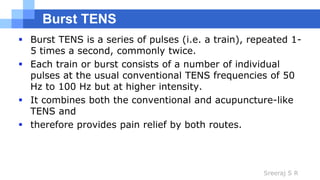
Burst TENS
 Burst TENS is a series of pulses (i.e. a train), repeated 1-
5 times a second, commonly twice.
 Each train or burst consists of a number of individual
pulses at the usual conventional TENS frequencies of 50
Hz to 100 Hz but at higher intensity.
 It combines both the conventional and acupuncture-like
TENS and
 therefore provides pain relief by both routes.
Sreeraj S R
Brief or Intense TENS
 Frequency – More than 100 Hz
 Pulse Width – 150 μs to 250 μs
 Intensity – Highest level tolerated by the patient.
 Principle –Activity in cutaneous Aδ afferents induced by
intense TENS produce peripheral blockade of nociceptive
afferent activity (Central biasing mechanism).
 Duration – 30 to 60 minutes once or twice daily.
Sreeraj S R
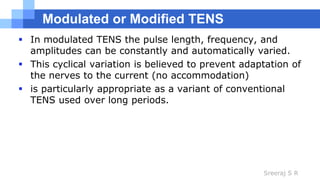
Modulated or Modified TENS
 In modulated TENS the pulse length, frequency, and
amplitudes can be constantly and automatically varied.
 This cyclical variation is believed to prevent adaptation of
the nerves to the current (no accommodation)
 is particularly appropriate as a variant of conventional
TENS used over long periods.
Sreeraj S R
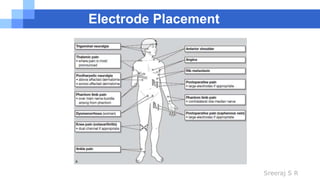
Electrode Placement
Sreeraj S R
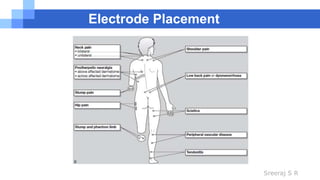
Electrode Placement
Sreeraj S R
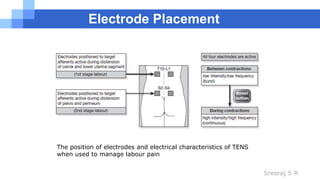
The position of electrodes and electrical characteristics of TENS
when used to manage labour pain
Electrode Placement
Sreeraj S R4/4/2020
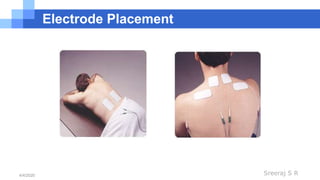
Electrode Placement
Sreeraj S R
Contraindication
 Someone with a pacemaker
 Someone with undiagnosed pain.
 Someone with a heart condition
 On head or neck of someone with epilepsy
 Someone with venous or arterial thrombosis or thrombophlebitis
 Someone with indwelling phrenic nerve or urinary bladder
stimulators
 Near operating diathermy device
Sreeraj S R
Contraindication
 Around the head
 On the eyes
 Over mucosal surfaces
 Using electrodes on infected skin
 Electrodes across the chest of a patient with cardiac disease
 Electrodes should not be placed near carotid artery in the
anterolateral region of the neck. There is a potential risk that
stimulation at this site might cause heart block by exciting the
vagus nerve.
Sreeraj S R
Precautions
 Areas of skin irritation, damage or lesions
 Areas with impaired sensation
 Over abdominal, lumbosacral or pelvic regions during pregnancy
other than for labor/delivery
 Tissues vulnerable to hemorrhage or hematoma
 Athletes should not be permitted to participate in sports while
under the influence of TENS analgesia
 Extreme caution is needed with patients taking narcotic
medication or who are known to have hyposensitive areas.
Sreeraj S R
Precautions
 Incompetent patients may not be able to manage the device and it
must be kept out of reach of children.
 For patients with diagnosed malignancies that have been
diagnosed as terminal, TENS can be used for pain control with
informed consent of the patient.
 Otherwise, TENS should not be used when malignancies are
present.
Sreeraj S R
References
1.Tim Watson. http://www.electrotherapy.org/modality/transcutaneous-electrical-nerve-
stimulation-tens
2.http://www.answers.com/topic/pain-1
3.http://www.david.curtis.care4free.net/painrev.htm
4.Transcutaneous Electrical Nerve Stimulation. McGill Lecture Notes – January 22nd, 2002
5.Mark Johnson. Transcutaneous electrical nerve stimulation (TENS). P 259-286
6.Foster A, Palastanga N. Clayton’s electrotherapy,9th edition, AITBS Publishers, pp 100- 106
7.Singh Jagmohan. Textbook of Electrotherapy, 2 edition, 2012;pp 129 – 133
Sreeraj S R
THANK YOU

Transcutaneous Electrical Nerve Stimulation (TENS) SRS

  • 1.
  • 2.
    Sreeraj S R Definition Transcutaneous Electrical Nerve Stimulation (TENS) is a method of electrical stimulation which primarily aims to provide a degree of pain relief (symptomatic) by specifically exciting sensory nerves and thereby stimulating either the pain gate mechanism and/or the opioid system.
  • 3.
    Sreeraj S R Mechanismof Action  Possible Pain-Relieving Mechanisms;  Activation of ‘pain-gating’ mechanisms.  Stimulation of the descending pain suppression system and endogenous opiate mechanisms.  The Central Biasing Theory  Removal of the substances which stimulate pain nerve endings from within the damaged area
  • 4.
    Sreeraj S R Primaryafferent fibres 4/4/2020
  • 5.
    Sreeraj S R AscendingPain Pathway  The spinothalamic tract: transmits signals that are important for pain localisation.  The spinoreticular tract: This pathway is involved in the emotional aspects of pain. The major role of these fibers is thought to be general arousal rather than sensory discrimination per se 4/4/2020 DRG: Dorsal Root Ganglion, PAG: Periaqueductal Grey Matter
  • 6.
    Sreeraj S R Inhibitionof pain transmission  Gate control theory of pain  The gate control theory of pain was proposed by Melzack and Wall in 1965  It describe a process of inhibitory pain modulation at the spinal cord level.  By activating Aβ fibres with tactile, inhibitory inter neurones in the dorsal horn are activated leading to inhibition of pain signals
  • 7.
    Sreeraj S R Inhibitionof pain transmission  Descending inhibition  The Periaqueductal Grey (PAG) in the midbrain and the Rostral Ventromedial Medulla (RVM) are involved.  These centres contain high concentrations of opioid receptors and endogenous opioids.  Descending pathways project to the dorsal horn and inhibit pain transmission.  These pathways are monoaminergic, which modulate the serotonin, dopamine, norepinephrine, and/or histamine neurotransmitter systems in the brain. 4/4/2020
  • 8.
    Sreeraj S R Opiate-mediatedcontrol  Endogenous opioids  Endorphins  Dynorphins  Enkephalins  Neurophysiology background:  The brain can secrete its own analgesic substance such as endorphins to modulate pain.  Endorphins are neuropeptides that act on the CNS and peripheral nervous system to reduce pain.  They have the similar pharmacological effect as morphine.
  • 9.
    Sreeraj S R Parametersused for TENS  Waveforms  Frequency or Rate  Pulse width or Duration  Amplitude or Intensity
  • 10.
    Sreeraj S R Waveforms  Square / rectangular  Instantaneous rise  Less skin irritating as approaches sine wave form  For nerve damage associated with pain pathology  For hypersensitive and chronic pain patients  Delayed, long-lasting analgesia Triangular / spike  Rapidly rising, but not instantaneous  More skin irritating therefore requires frequent movement of electrodes or shorter treatment times to avoid skin irritation  For acute pain or resistant tissue  Immediate, short lasting pain relief 4/4/2020
  • 11.
    Sreeraj S R Frequencyor Rate  High Frequency (80-120):  Large myelinated fibers respond effective > 100Hz  Immediate relief of pain  Acute pain  Low Frequency (1-20):  Small unmyelinated fibers respond effectively at <100Hz  Increase endorphin production, thus analgesia following stimulation  Chronic pain
  • 12.
    Sreeraj S R Pulsewidth or Duration Pulse width Indications 50μs Large myelinated fibers (sensory touch) 100 - 150μs Normal neuromuscular system 200 μs Small myelinated fibers 200 – 300 μs Patients with neurological damage
  • 13.
    Sreeraj S R Amplitudeor Intensity  TENS units intensity ranges form 1 mA to 100 mA  TENS is only effective when the patient actually feels the stimulus  Patients need to increase the intensity when the body accommodates to the stimulus (when they don’t feel the stimulation anymore)  Dying batteries can cause fading intensities
  • 14.
    Sreeraj S R Typesof TENS  Conventional TENS or High Frequency TENS  Acupuncture-like TENS (AL-TENS) or Low Frequency TENS  Brief TENS or Intense TENS  Burst TENS  Modulated TENS or Modified TENS
  • 15.
    Sreeraj S R Conventionalor High TENS  Frequency – 50 Hz to 100 Hz  Pulse Width – 20 μs to 60 μs  Intensity – (0 mA to 30 mA).  The intensity until a prickling or tingling sensation is felt.  Principle –Presynaptic inhibition by pain gate mechanism by stimulating Aα and Aβ fibres.  Duration – 30 to 60 minutes once or twice daily.
  • 16.
    Sreeraj S R Acupunctureor Low TENS  Frequency – 1 Hz to 4 Hz  Pulse Width – 150 μs to 250 μs  Intensity – 30 mA to 60 mA.  applied to acupuncture points or motor points of muscle in the segmentally related myotome.  Principle –This stimulates the high threshold Aδ and C fibres, which lead to release of endogenous opioids and provides further sensory input from muscle spindle afferents (chemical theory).  Duration – 20 to 30 minutes once a day.
  • 17.
    Sreeraj S R BurstTENS  Burst TENS is a series of pulses (i.e. a train), repeated 1- 5 times a second, commonly twice.  Each train or burst consists of a number of individual pulses at the usual conventional TENS frequencies of 50 Hz to 100 Hz but at higher intensity.  It combines both the conventional and acupuncture-like TENS and  therefore provides pain relief by both routes.
  • 18.
    Sreeraj S R Briefor Intense TENS  Frequency – More than 100 Hz  Pulse Width – 150 μs to 250 μs  Intensity – Highest level tolerated by the patient.  Principle –Activity in cutaneous Aδ afferents induced by intense TENS produce peripheral blockade of nociceptive afferent activity (Central biasing mechanism).  Duration – 30 to 60 minutes once or twice daily.
  • 19.
    Sreeraj S R Modulatedor Modified TENS  In modulated TENS the pulse length, frequency, and amplitudes can be constantly and automatically varied.  This cyclical variation is believed to prevent adaptation of the nerves to the current (no accommodation)  is particularly appropriate as a variant of conventional TENS used over long periods.
  • 20.
  • 21.
  • 22.
    Sreeraj S R Theposition of electrodes and electrical characteristics of TENS when used to manage labour pain Electrode Placement
  • 23.
  • 24.
    Sreeraj S R Contraindication Someone with a pacemaker  Someone with undiagnosed pain.  Someone with a heart condition  On head or neck of someone with epilepsy  Someone with venous or arterial thrombosis or thrombophlebitis  Someone with indwelling phrenic nerve or urinary bladder stimulators  Near operating diathermy device
  • 25.
    Sreeraj S R Contraindication Around the head  On the eyes  Over mucosal surfaces  Using electrodes on infected skin  Electrodes across the chest of a patient with cardiac disease  Electrodes should not be placed near carotid artery in the anterolateral region of the neck. There is a potential risk that stimulation at this site might cause heart block by exciting the vagus nerve.
  • 26.
    Sreeraj S R Precautions Areas of skin irritation, damage or lesions  Areas with impaired sensation  Over abdominal, lumbosacral or pelvic regions during pregnancy other than for labor/delivery  Tissues vulnerable to hemorrhage or hematoma  Athletes should not be permitted to participate in sports while under the influence of TENS analgesia  Extreme caution is needed with patients taking narcotic medication or who are known to have hyposensitive areas.
  • 27.
    Sreeraj S R Precautions Incompetent patients may not be able to manage the device and it must be kept out of reach of children.  For patients with diagnosed malignancies that have been diagnosed as terminal, TENS can be used for pain control with informed consent of the patient.  Otherwise, TENS should not be used when malignancies are present.
  • 28.
    Sreeraj S R References 1.TimWatson. http://www.electrotherapy.org/modality/transcutaneous-electrical-nerve- stimulation-tens 2.http://www.answers.com/topic/pain-1 3.http://www.david.curtis.care4free.net/painrev.htm 4.Transcutaneous Electrical Nerve Stimulation. McGill Lecture Notes – January 22nd, 2002 5.Mark Johnson. Transcutaneous electrical nerve stimulation (TENS). P 259-286 6.Foster A, Palastanga N. Clayton’s electrotherapy,9th edition, AITBS Publishers, pp 100- 106 7.Singh Jagmohan. Textbook of Electrotherapy, 2 edition, 2012;pp 129 – 133
  • 29.