OBJECTIVES
After completing the lesson the student will be able to:
• To describe the physical properties of infrared rays,
ultraviolet rays and light amplification by stimulated
emission of radiation.
• To describe the therapeutic and physiological effects.
• To describe the methods of application.
• To list out the indications, contraindications and
precautions.
• To list out the adverse effects.
DEFINITION
• Infra-red rays are electromagnetic waves with wave
length of 750 to 4,00000nm.
• Infra-red rays may be also called as thermiogenic rays.
CLASSIFICATION
• Based on wavelength infra-red rays are classified into:
• Short wave infra-red:
• Wave length – 750 to 1500nm.
• Long wave infra-red (far infra-red rays):
• Infra-red A-wavelength –750 to 1400nm.
• Infra-red B-wavelength –1400 to 3000nm.
• Infra-red C-wavelength – 3000nm to 1nm.
PRODUCTION
• Any body with high temperature than the surrounding
can emit infra-red rays.
• The natural source of IRR is the sun.
TYPES OF IRR USED IN PT
• The IRR generators used in physiotherapy can be
divided into two types:
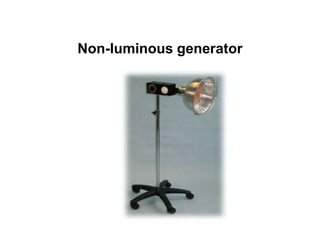
• Non-luminous generator.
• Luminous generator.
Non-luminous generator
Luminous generator
DEPTH OF PENETRATION
• Maximum effective penetration of IRR is 3mms.
• Luminous generators have better penetration effect than
the non-luminous.
Laws regulating the absorption of
radiations
• Grothus law / Grothus - Drapper law:
• The law states that the rays must be absorbed to
produce the effect and the effect will produce at that
point at which the rays are absorbed.
Law of inverse square:
• Law of inverse square explains the effect of distance on
the intensity of infra-red rays.
• It states that the intensity of a beam of rays from a point
source is inversely proportional to the square of the
distance from the source.
Law of inverse square
The inverse square law tells is that the illumination is inversely proportional to the
square of the distance between the point source and the surface, i.e.:
If you have a fixture (which can be treated as a point source if the distance from the
surface is large) and you measure the illumination at 20 feet as 2000 Fc at the beam
center, then at 40 feet the illumination is 500 Fc at the beam center.
Cosine law / Lambert’s cosine law:
• Cosine law explains the effect of angle at which the rays
strike.
• It states that the proportion of rays absorbed varies as
per the cosine of the angle between incident and normal.
• Larger the angle at which the rays strike to the body
surface, lesser will be the absorption and vice versa.
Effective illumination is proportional to the cosine of the angle of incidence of
the light on the surface (angle between the direction of the light and the
perpendicular to the surface)
Illumination at the O point on surfaces 1 and 2:
Here are a few cases:
When the surface is tilted by an angle of 30º, the illumination is reduced by a factor of 0.87
45º - 0.71
60º - 0.5
Beer-Lambert law:
• Degree of absorption depends on the wavelengths of
radiation and nature of absorbing materials.
Beer-Lambert law
• General Beer-Lambert law is usually written as: A = abc,
where A is the measured absorbance, a is a wavelength-
dependent absorptivity coefficient, b is the cell-path
length, and c is the analyte concentration.
Kirchhoff’s law:
• It states that good radiators are good absorbers.
Wien’s law:
• This law states that the wavelength of maximal emission
is inversely proportional to the absolute temperature of
the source so that hotter the source shorter is the
wavelength of emitted rays.
Hotter objects emit most of their radiation at shorter wavelengths; hence they will appear to be
bluer .
Cooler objects emit most of their radiation at longer wavelengths; hence they will appear to be
redder
Stefan-Boltzman law:
• This law states that the output of the infra-red lamp will
depend on the temperature of the element and its
radiating area.
Stefan-Boltzman law
The Sefan-Boltzman law relates the total amount of radiation emitted by an object to it's temperature:
E=sT4
where:
E = total amount of radiation emitted by an object per square meter (Watts m-2)
s is a constant called the Stefan-Boltzman constant = 5.67 x 10⁻⁸ Watts m-2 K-4
T is the temperature of the object in K
Arndt-Schulz principle
• Addition of a sub threshold quantity of energy will not
cause a demonstrable change.
• Addition of threshold and above quantity of energy will
stimulate the absorbing tissue to normal function
• If too great a quantity of energy is absorbed then added
energy will prevent normal function or destroy tissue.
PHYSIOLOGICAL EFFECTS
• When IRR is applied to the body, they are absorbed, and
the electromagnetic energy is converted into thermal
energy, producing heat.
Physiological effects contd:
• Local rise in temperature.
• Increased activity of sweat glands.
• Increased metabolism.
• Vasodilatation.
• Relaxation of muscle tissue.
• Extensive irradiation may even cause a general rise in
body temperature and fall in blood pressure.
THERAPEUTIC EFFECTS
• Analgesia.
• Relief of pain.
• Muscle relaxation.
• Increased blood supply.
• Relaxation of muscle spasm.
INDICATIONS
• Sub acute and chronic inflammation.
• Osteoarthritis.
• Rheumatoid arthritis.
• Inflammatory conditions of the skin folliculitis,furunculitis.
• Prior to stretching.
• Bell’s palsy.
• Muscle spasm of orthopedic origin.
CONTRAINDICATIONS
• Fever.
• Pelvic region in pregnancy.
• Malignancy.
• Impaired sensations.
• Anesthetic area.
• Advanced cardiac disease.
• Eczema.
• Dermatitis.
• Impaired circulation.
• Noninflammatory edema.
• Altered consciousness.
• Hemorrhagic conditions.
• Varicose veins.
• X-ray therapy.
• Extremes of age.
DOSIMETRY
• Acute cases – 10 to 15mins. daily for 1 to 3 times.
• Chronic cases – 30mins. Ones daily or on alternate
days.
PRECAUTIONS
• Cover the face, eyes and hair during irradiation.
• Eyes should be protected by moist cotton packs or
goggles to avoid opacities of lens.
• Check the IRR generator to ensure safety.
EQUIPMENT POSITIONING
• Arrange it in such a way that it is opposite to the center
of the area to be treated and the rays strike at right
angles.
• A distance of 50 – 75cm has to be maintained between
the source and the treatment area.
HAZARDS
• Burns / blisters.
• Electric shock.
• Edema.
• Overdose.
• Faintness.
• Headache.
• Permanent pigmentation of eyes.
IRR.ppt

IRR.ppt

  • 1.
    OBJECTIVES After completing thelesson the student will be able to: • To describe the physical properties of infrared rays, ultraviolet rays and light amplification by stimulated emission of radiation. • To describe the therapeutic and physiological effects. • To describe the methods of application. • To list out the indications, contraindications and precautions. • To list out the adverse effects.
  • 2.
    DEFINITION • Infra-red raysare electromagnetic waves with wave length of 750 to 4,00000nm. • Infra-red rays may be also called as thermiogenic rays.
  • 3.
    CLASSIFICATION • Based onwavelength infra-red rays are classified into: • Short wave infra-red: • Wave length – 750 to 1500nm. • Long wave infra-red (far infra-red rays): • Infra-red A-wavelength –750 to 1400nm. • Infra-red B-wavelength –1400 to 3000nm. • Infra-red C-wavelength – 3000nm to 1nm.
  • 4.
    PRODUCTION • Any bodywith high temperature than the surrounding can emit infra-red rays. • The natural source of IRR is the sun.
  • 5.
    TYPES OF IRRUSED IN PT • The IRR generators used in physiotherapy can be divided into two types: • Non-luminous generator. • Luminous generator.
  • 6.
  • 7.
  • 8.
    DEPTH OF PENETRATION •Maximum effective penetration of IRR is 3mms. • Luminous generators have better penetration effect than the non-luminous.
  • 9.
    Laws regulating theabsorption of radiations • Grothus law / Grothus - Drapper law: • The law states that the rays must be absorbed to produce the effect and the effect will produce at that point at which the rays are absorbed.
  • 10.
    Law of inversesquare: • Law of inverse square explains the effect of distance on the intensity of infra-red rays. • It states that the intensity of a beam of rays from a point source is inversely proportional to the square of the distance from the source.
  • 11.
    Law of inversesquare The inverse square law tells is that the illumination is inversely proportional to the square of the distance between the point source and the surface, i.e.: If you have a fixture (which can be treated as a point source if the distance from the surface is large) and you measure the illumination at 20 feet as 2000 Fc at the beam center, then at 40 feet the illumination is 500 Fc at the beam center.
  • 12.
    Cosine law /Lambert’s cosine law: • Cosine law explains the effect of angle at which the rays strike. • It states that the proportion of rays absorbed varies as per the cosine of the angle between incident and normal. • Larger the angle at which the rays strike to the body surface, lesser will be the absorption and vice versa.
  • 13.
    Effective illumination isproportional to the cosine of the angle of incidence of the light on the surface (angle between the direction of the light and the perpendicular to the surface) Illumination at the O point on surfaces 1 and 2: Here are a few cases: When the surface is tilted by an angle of 30º, the illumination is reduced by a factor of 0.87 45º - 0.71 60º - 0.5
  • 14.
    Beer-Lambert law: • Degreeof absorption depends on the wavelengths of radiation and nature of absorbing materials.
  • 15.
    Beer-Lambert law • GeneralBeer-Lambert law is usually written as: A = abc, where A is the measured absorbance, a is a wavelength- dependent absorptivity coefficient, b is the cell-path length, and c is the analyte concentration.
  • 16.
    Kirchhoff’s law: • Itstates that good radiators are good absorbers.
  • 17.
    Wien’s law: • Thislaw states that the wavelength of maximal emission is inversely proportional to the absolute temperature of the source so that hotter the source shorter is the wavelength of emitted rays.
  • 18.
    Hotter objects emitmost of their radiation at shorter wavelengths; hence they will appear to be bluer . Cooler objects emit most of their radiation at longer wavelengths; hence they will appear to be redder
  • 19.
    Stefan-Boltzman law: • Thislaw states that the output of the infra-red lamp will depend on the temperature of the element and its radiating area.
  • 20.
    Stefan-Boltzman law The Sefan-Boltzmanlaw relates the total amount of radiation emitted by an object to it's temperature: E=sT4 where: E = total amount of radiation emitted by an object per square meter (Watts m-2) s is a constant called the Stefan-Boltzman constant = 5.67 x 10⁻⁸ Watts m-2 K-4 T is the temperature of the object in K
  • 21.
    Arndt-Schulz principle • Additionof a sub threshold quantity of energy will not cause a demonstrable change. • Addition of threshold and above quantity of energy will stimulate the absorbing tissue to normal function • If too great a quantity of energy is absorbed then added energy will prevent normal function or destroy tissue.
  • 22.
    PHYSIOLOGICAL EFFECTS • WhenIRR is applied to the body, they are absorbed, and the electromagnetic energy is converted into thermal energy, producing heat.
  • 23.
    Physiological effects contd: •Local rise in temperature. • Increased activity of sweat glands. • Increased metabolism. • Vasodilatation. • Relaxation of muscle tissue. • Extensive irradiation may even cause a general rise in body temperature and fall in blood pressure.
  • 24.
    THERAPEUTIC EFFECTS • Analgesia. •Relief of pain. • Muscle relaxation. • Increased blood supply. • Relaxation of muscle spasm.
  • 25.
    INDICATIONS • Sub acuteand chronic inflammation. • Osteoarthritis. • Rheumatoid arthritis. • Inflammatory conditions of the skin folliculitis,furunculitis. • Prior to stretching. • Bell’s palsy. • Muscle spasm of orthopedic origin.
  • 26.
    CONTRAINDICATIONS • Fever. • Pelvicregion in pregnancy. • Malignancy. • Impaired sensations. • Anesthetic area. • Advanced cardiac disease. • Eczema.
  • 27.
    • Dermatitis. • Impairedcirculation. • Noninflammatory edema. • Altered consciousness. • Hemorrhagic conditions. • Varicose veins. • X-ray therapy. • Extremes of age.
  • 28.
    DOSIMETRY • Acute cases– 10 to 15mins. daily for 1 to 3 times. • Chronic cases – 30mins. Ones daily or on alternate days.
  • 29.
    PRECAUTIONS • Cover theface, eyes and hair during irradiation. • Eyes should be protected by moist cotton packs or goggles to avoid opacities of lens. • Check the IRR generator to ensure safety.
  • 30.
    EQUIPMENT POSITIONING • Arrangeit in such a way that it is opposite to the center of the area to be treated and the rays strike at right angles. • A distance of 50 – 75cm has to be maintained between the source and the treatment area.
  • 32.
    HAZARDS • Burns /blisters. • Electric shock. • Edema. • Overdose. • Faintness. • Headache. • Permanent pigmentation of eyes.