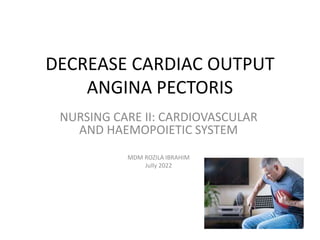
DECREASE CARDIAC OUTPUT
ANGINA PECTORIS
NURSING CARE II: CARDIOVASCULAR
AND HAEMOPOIETIC SYSTEM
MDM ROZILA IBRAHIM
Jully 2022
Learning Outcome
At the end of the session, student would be able to:
• To identify the definition, risk factors, type of angina,
pathophysiology, sign and symptom and treatment related
to angina pectoris.
• To describe the role of medication in treating angina such
as nitro glycerine (GTN), beta blocker, calcium channel
blocker and ranolazine
• To elaborate the nursing intervention and management
patient related to angina pectoris.
• Explain the health education to patient with angina
pectoris.
6/1/2023 Madam Rozila Binti Ibrahim July 2022 2
Heart disease related to decrease
cardiac output
• Angina pectoris
• Acute myocardial infarction (MI)
• Congestive Cardiac Failure (CCF)
• Cor Pamonale
• Acute Pulmonary Edema
• Cardiogenic Shock
6/1/2023 Madam Rozila Binti Ibrahim July 2022 3
Definition Angina Pectoris
• Is a clinical syndrome usually characterized by episodes of
chest pain or pressure in the anterior chest due to the
insufficient coronary blood flow which results in a
decreased oxygen supply (myocardial ischemial) to meet an
increased myocardial demand.
6/1/2023 Madam Rozila Binti Ibrahim July 2022 4
Risk factors/ Etiology
• Arteriosclerosis (thickening of the walls arteries & loss of
elasticity) eg: Artherosclerosis plaques (progressive disease
characterized by formation in arteries walls.
• Chronic disease : Chronic heart disease, DM, HPT, kidney
failure, pulmonary disease
• Trauma of the heart/artery coronary
• Narrowing or constriction of the coronary artery due to
spasm.
• Lifestyle (smoking, obesity: high cholesterol, lack of
exercise, stress)
6/1/2023 Madam Rozila Binti Ibrahim July 2022 5
Cont.. Etiology
• Hypermetabolic condition – exercises, thyrotoxicosis,
hyperthyroidism, stress, stimulation abuse drug eg cocaine
• Chronic disease – anemia, heart failure, pulmonary disease
6/1/2023 Madam Rozila Binti Ibrahim July 2022 6
Risk
factors
6/1/2023 Madam Rozila Binti Ibrahim July 2022 7
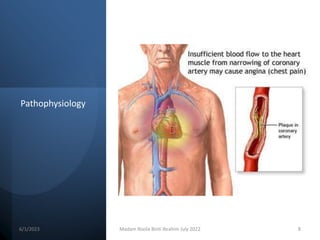
Pathophysiology
6/1/2023 Madam Rozila Binti Ibrahim July 2022 8
Cont.. pathophysiology
• When myocardial oxygen needs are greater than partially
occluded vessels can supply, myocardial cells become
ischemic and shift to anaerobic metabolism.
• Anaerobic metabolism produces lactic acid that stimulates
nerve endings in the muscle, causing pain. Pain subsides
when the oxygen supply again meets myocardial demand.
6/1/2023 Madam Rozila Binti Ibrahim July 2022 9
Type of Angina
1. Stable Angina
2. Unstable Angina
3. Variant Angina (prinzmetal’s angina)
6/1/2023 Madam Rozila Binti Ibrahim July 2022 10
1. Stable Angina
• Most common
• It occur usually when heart is working harder than usual.
• Predictable & consistent pain that occurs on exertion and
relieve by rest and nitrates
• Regular pattern
• Pain will relieve after a few minute
• Not a heart attack
6/1/2023 Madam Rozila Binti Ibrahim July 2022 11
Cont.. Stable angina
risk factors:
• Expose to cold
• Stress
• Physical exertion
• Smoking
6/1/2023 Madam Rozila Binti Ibrahim July 2022 12
2. Unstable angina
• Required emergency treatment and high risk for myocardial
infarct.
• Increasing in frequency, severity and duration.
• Unpredictable – occurs with decrease with activity or stress or
during rest.
• Clinical manifestation:
- Not follow pattern
- Not relieve by rest or medication
- Sign that a heart attack could occur soon
- Symptom occur more frequently and
longer.
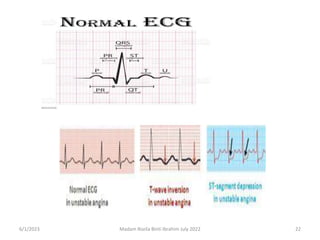
• Potential T wave inversion and ST depression due to the ischemic
with negative cardiac bio markers.
6/1/2023 Madam Rozila Binti Ibrahim July 2022 13
3. Variant or prinzmetal’s angina
• Prinzmetal angina is also called variant angina or
vasospastic angina or inversa angina
• Unpredictable. Not related with activity.
• Rarely occur, but it happen during the night while sleeping
or early morning when you’re at rest
• Due to Spasm at coronary artery.
• It is relieved by the medication
6/1/2023 Madam Rozila Binti Ibrahim July 2022 14
6/1/2023 Madam Rozila Binti Ibrahim July 2022 15
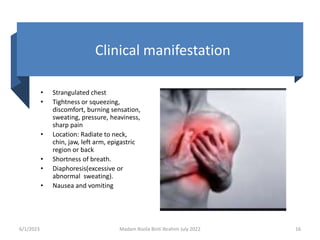
Clinical manifestation
• Strangulated chest
• Tightness or squeezing,
discomfort, burning sensation,
sweating, pressure, heaviness,
sharp pain
• Location: Radiate to neck,
chin, jaw, left arm, epigastric
region or back
• Shortness of breath.
• Diaphoresis(excessive or
abnormal sweating).
• Nausea and vomiting
6/1/2023 Madam Rozila Binti Ibrahim July 2022 16
Conti…manifestation
• Symptom ‘crescendo-decrescendo’ pattern- increasing to a
peak, then gradually decreasing. Lasting 2-5 minutes.
• Dyspnea
• Pallor
• tachycardia
• Great anxiety and fear
6/1/2023 Madam Rozila Binti Ibrahim July 2022 17
Grading of severity of angina
• Class I – not occur with ordinary physical activities. But in
strenuous activity or prolonge physical activity.
• Class II – Occur with prolong walking or stair climbing
• Class III- significantly limits ordinary physical activity
• Class IV- Occur at rest, as well as during activity.
6/1/2023 Madam Rozila Binti Ibrahim July 2022 18
Interdisciplinary Care
• Management focus on maintaining coronary blood flow and
cardiac function
• Stable angina – often can manage by medical therapy
6/1/2023 Madam Rozila Binti Ibrahim July 2022 19
Diagnostic procedure
• ECG – Electrocardiography : usually focus on ST and T wave
. Potential T wave inversion and ST depression due to the
ischemic with negative cardiac bio markers.
• Stress electrocardiography; exercise stress test uses ECG to
monitor cardiac response to increase workload during
progressive exercise.
• Nuclear medicine studies ;(radionuclide testing); use
radioisotope injected intravenously, heart is scan with
radiation detector.
6/1/2023 Madam Rozila Binti Ibrahim July 2022 20
Cont..diagnostic procedure
• Echocardiography (ultrasound) –evaluate cardiac function
and structure.
• Coronary angiography – Catheter introduce into artery
threaded into the coronary artery. Dye is injected guided
with fluoroscopy. Allow visualize main coronary branches
for any abnormality eg obstruction or stenosis.
6/1/2023 Madam Rozila Binti Ibrahim July 2022 21
6/1/2023 Madam Rozila Binti Ibrahim July 2022 22
Stress ECG
6/1/2023 Madam Rozila Binti Ibrahim July 2022 23
Nuclear medicine studies
;(radionuclide testing)
6/1/2023 Madam Rozila Binti Ibrahim July 2022 24
Echocardiography (ultrasound)
6/1/2023 Madam Rozila Binti Ibrahim July 2022 25
Coronary angiography
6/1/2023 Madam Rozila Binti Ibrahim July 2022 26
6/1/2023 Madam Rozila Binti Ibrahim July 2022 27
Pharmacology Treatment
Goal: To reduce oxygen demand and increase oxygen supply to
myocardium.
1. NITRATES
 Nitroglycerin (GTN)
 Route: sublingual (SL)
 Act: 1-2 minutes
 Decrease myocardial work & oxygen demand through
venous and arterial vasodilatation, which is turn reduce
preload and afterload.
6/1/2023 Madam Rozila Binti Ibrahim July 2022 28
CONT..nitrates
• Available = oral tablet,
ointment, transdermal
patches
6/1/2023 Madam Rozila Binti Ibrahim July 2022 29
Pharmacology Treatment
2. BETA BLOCKERS
 Eg: propanalol, metaprolol,nadolol & atenolol
 Block cardiac stimulating affects of noradrenaline and
epinephrine, prevent anginal attacks and reduce heart rate,
myocardial contractility & blood pressure thus reducing
myocardial demand
 * Not use to treat Prinzmetal’s angina
6/1/2023 Madam Rozila Binti Ibrahim July 2022 30
Pharmacology Treatment
3. CALCIUM CHANNEL BLOCKER
 Reduce myocardial demand & increase oxygen supply
 Verapamil, diltiazem, nifedipine
6/1/2023 Madam Rozila Binti Ibrahim July 2022 31
Pharmacology Treatment
4. ASPIRIN
 Low dose aspirin 80 to 325 mg/day
 To reduce risk of platelet aggregation and thrombus
formation
6/1/2023 Madam Rozila Binti Ibrahim July 2022 32
Health education for patient and
family
1. Use only SL, buccal and spray forms of nitrates to treat
acute angina
 If the 1st nitrates dose not relieve within 5 minute take
2nd dose
 After 5 minutes 2nd dose if not relieve take 3rd dose
 If pain not relieve or lasts for 20 minutes seek Doctor
immediately.
6/1/2023 Madam Rozila Binti Ibrahim July 2022 33
Health education for patient and
family
2. Carry nitroglycerin tablet with you, dissolve under the
tongue until completely dissolve
3. Keep tightly in original amber glass bottle to protect from
heat, light and moisture.
4. Get the continuous supply.
5. You may have burning or tingling sensation under the
tongue and develop headache when taken this drug. Headache
will diminish over time.
6/1/2023 Madam Rozila Binti Ibrahim July 2022 34
Health education for patient and
family
6. Caution when standing from sitting position: nitroglycerine
may make you lightheaded
7. Rotate ointment or transdermal patch application sites.
Apply at hairless area: spread ointment without rubbing or
massaging. Remove patch or residual ointment at bedtime .
Apply fresh dose in the morning.
6/1/2023 Madam Rozila Binti Ibrahim July 2022 35
Cont..Diagnostic
• Identify from the sign and symptoms
• Symptomatic treatment eg short of breath: administer an
oxygen, rest, positioning
• Perform ECG – 12 lead
• Blood laboratory eg C-reaction protien (CRP)maker for
inflammation
6/1/2023 Madam Rozila Binti Ibrahim July 2022 36
THANK YOU
6/1/2023 Madam Rozila Binti Ibrahim July 2022 37

ANGINA PECTORIS DECREASE CARDIAC OUTPUT.pptx

  • 1.
    DECREASE CARDIAC OUTPUT ANGINAPECTORIS NURSING CARE II: CARDIOVASCULAR AND HAEMOPOIETIC SYSTEM MDM ROZILA IBRAHIM Jully 2022
  • 2.
    Learning Outcome At theend of the session, student would be able to: • To identify the definition, risk factors, type of angina, pathophysiology, sign and symptom and treatment related to angina pectoris. • To describe the role of medication in treating angina such as nitro glycerine (GTN), beta blocker, calcium channel blocker and ranolazine • To elaborate the nursing intervention and management patient related to angina pectoris. • Explain the health education to patient with angina pectoris. 6/1/2023 Madam Rozila Binti Ibrahim July 2022 2
  • 3.
    Heart disease relatedto decrease cardiac output • Angina pectoris • Acute myocardial infarction (MI) • Congestive Cardiac Failure (CCF) • Cor Pamonale • Acute Pulmonary Edema • Cardiogenic Shock 6/1/2023 Madam Rozila Binti Ibrahim July 2022 3
  • 4.
    Definition Angina Pectoris •Is a clinical syndrome usually characterized by episodes of chest pain or pressure in the anterior chest due to the insufficient coronary blood flow which results in a decreased oxygen supply (myocardial ischemial) to meet an increased myocardial demand. 6/1/2023 Madam Rozila Binti Ibrahim July 2022 4
  • 5.
    Risk factors/ Etiology •Arteriosclerosis (thickening of the walls arteries & loss of elasticity) eg: Artherosclerosis plaques (progressive disease characterized by formation in arteries walls. • Chronic disease : Chronic heart disease, DM, HPT, kidney failure, pulmonary disease • Trauma of the heart/artery coronary • Narrowing or constriction of the coronary artery due to spasm. • Lifestyle (smoking, obesity: high cholesterol, lack of exercise, stress) 6/1/2023 Madam Rozila Binti Ibrahim July 2022 5
  • 6.
    Cont.. Etiology • Hypermetaboliccondition – exercises, thyrotoxicosis, hyperthyroidism, stress, stimulation abuse drug eg cocaine • Chronic disease – anemia, heart failure, pulmonary disease 6/1/2023 Madam Rozila Binti Ibrahim July 2022 6
  • 7.
    Risk factors 6/1/2023 Madam RozilaBinti Ibrahim July 2022 7
  • 8.
    Pathophysiology 6/1/2023 Madam RozilaBinti Ibrahim July 2022 8
  • 9.
    Cont.. pathophysiology • Whenmyocardial oxygen needs are greater than partially occluded vessels can supply, myocardial cells become ischemic and shift to anaerobic metabolism. • Anaerobic metabolism produces lactic acid that stimulates nerve endings in the muscle, causing pain. Pain subsides when the oxygen supply again meets myocardial demand. 6/1/2023 Madam Rozila Binti Ibrahim July 2022 9
  • 10.
    Type of Angina 1.Stable Angina 2. Unstable Angina 3. Variant Angina (prinzmetal’s angina) 6/1/2023 Madam Rozila Binti Ibrahim July 2022 10
  • 11.
    1. Stable Angina •Most common • It occur usually when heart is working harder than usual. • Predictable & consistent pain that occurs on exertion and relieve by rest and nitrates • Regular pattern • Pain will relieve after a few minute • Not a heart attack 6/1/2023 Madam Rozila Binti Ibrahim July 2022 11
  • 12.
    Cont.. Stable angina riskfactors: • Expose to cold • Stress • Physical exertion • Smoking 6/1/2023 Madam Rozila Binti Ibrahim July 2022 12
  • 13.
    2. Unstable angina •Required emergency treatment and high risk for myocardial infarct. • Increasing in frequency, severity and duration. • Unpredictable – occurs with decrease with activity or stress or during rest. • Clinical manifestation: - Not follow pattern - Not relieve by rest or medication - Sign that a heart attack could occur soon - Symptom occur more frequently and longer. • Potential T wave inversion and ST depression due to the ischemic with negative cardiac bio markers. 6/1/2023 Madam Rozila Binti Ibrahim July 2022 13
  • 14.
    3. Variant orprinzmetal’s angina • Prinzmetal angina is also called variant angina or vasospastic angina or inversa angina • Unpredictable. Not related with activity. • Rarely occur, but it happen during the night while sleeping or early morning when you’re at rest • Due to Spasm at coronary artery. • It is relieved by the medication 6/1/2023 Madam Rozila Binti Ibrahim July 2022 14
  • 15.
    6/1/2023 Madam RozilaBinti Ibrahim July 2022 15
  • 16.
    Clinical manifestation • Strangulatedchest • Tightness or squeezing, discomfort, burning sensation, sweating, pressure, heaviness, sharp pain • Location: Radiate to neck, chin, jaw, left arm, epigastric region or back • Shortness of breath. • Diaphoresis(excessive or abnormal sweating). • Nausea and vomiting 6/1/2023 Madam Rozila Binti Ibrahim July 2022 16
  • 17.
    Conti…manifestation • Symptom ‘crescendo-decrescendo’pattern- increasing to a peak, then gradually decreasing. Lasting 2-5 minutes. • Dyspnea • Pallor • tachycardia • Great anxiety and fear 6/1/2023 Madam Rozila Binti Ibrahim July 2022 17
  • 18.
    Grading of severityof angina • Class I – not occur with ordinary physical activities. But in strenuous activity or prolonge physical activity. • Class II – Occur with prolong walking or stair climbing • Class III- significantly limits ordinary physical activity • Class IV- Occur at rest, as well as during activity. 6/1/2023 Madam Rozila Binti Ibrahim July 2022 18
  • 19.
    Interdisciplinary Care • Managementfocus on maintaining coronary blood flow and cardiac function • Stable angina – often can manage by medical therapy 6/1/2023 Madam Rozila Binti Ibrahim July 2022 19
  • 20.
    Diagnostic procedure • ECG– Electrocardiography : usually focus on ST and T wave . Potential T wave inversion and ST depression due to the ischemic with negative cardiac bio markers. • Stress electrocardiography; exercise stress test uses ECG to monitor cardiac response to increase workload during progressive exercise. • Nuclear medicine studies ;(radionuclide testing); use radioisotope injected intravenously, heart is scan with radiation detector. 6/1/2023 Madam Rozila Binti Ibrahim July 2022 20
  • 21.
    Cont..diagnostic procedure • Echocardiography(ultrasound) –evaluate cardiac function and structure. • Coronary angiography – Catheter introduce into artery threaded into the coronary artery. Dye is injected guided with fluoroscopy. Allow visualize main coronary branches for any abnormality eg obstruction or stenosis. 6/1/2023 Madam Rozila Binti Ibrahim July 2022 21
  • 22.
    6/1/2023 Madam RozilaBinti Ibrahim July 2022 22
  • 23.
    Stress ECG 6/1/2023 MadamRozila Binti Ibrahim July 2022 23
  • 24.
    Nuclear medicine studies ;(radionuclidetesting) 6/1/2023 Madam Rozila Binti Ibrahim July 2022 24
  • 25.
    Echocardiography (ultrasound) 6/1/2023 MadamRozila Binti Ibrahim July 2022 25
  • 26.
    Coronary angiography 6/1/2023 MadamRozila Binti Ibrahim July 2022 26
  • 27.
    6/1/2023 Madam RozilaBinti Ibrahim July 2022 27
  • 28.
    Pharmacology Treatment Goal: Toreduce oxygen demand and increase oxygen supply to myocardium. 1. NITRATES  Nitroglycerin (GTN)  Route: sublingual (SL)  Act: 1-2 minutes  Decrease myocardial work & oxygen demand through venous and arterial vasodilatation, which is turn reduce preload and afterload. 6/1/2023 Madam Rozila Binti Ibrahim July 2022 28
  • 29.
    CONT..nitrates • Available =oral tablet, ointment, transdermal patches 6/1/2023 Madam Rozila Binti Ibrahim July 2022 29
  • 30.
    Pharmacology Treatment 2. BETABLOCKERS  Eg: propanalol, metaprolol,nadolol & atenolol  Block cardiac stimulating affects of noradrenaline and epinephrine, prevent anginal attacks and reduce heart rate, myocardial contractility & blood pressure thus reducing myocardial demand  * Not use to treat Prinzmetal’s angina 6/1/2023 Madam Rozila Binti Ibrahim July 2022 30
  • 31.
    Pharmacology Treatment 3. CALCIUMCHANNEL BLOCKER  Reduce myocardial demand & increase oxygen supply  Verapamil, diltiazem, nifedipine 6/1/2023 Madam Rozila Binti Ibrahim July 2022 31
  • 32.
    Pharmacology Treatment 4. ASPIRIN Low dose aspirin 80 to 325 mg/day  To reduce risk of platelet aggregation and thrombus formation 6/1/2023 Madam Rozila Binti Ibrahim July 2022 32
  • 33.
    Health education forpatient and family 1. Use only SL, buccal and spray forms of nitrates to treat acute angina  If the 1st nitrates dose not relieve within 5 minute take 2nd dose  After 5 minutes 2nd dose if not relieve take 3rd dose  If pain not relieve or lasts for 20 minutes seek Doctor immediately. 6/1/2023 Madam Rozila Binti Ibrahim July 2022 33
  • 34.
    Health education forpatient and family 2. Carry nitroglycerin tablet with you, dissolve under the tongue until completely dissolve 3. Keep tightly in original amber glass bottle to protect from heat, light and moisture. 4. Get the continuous supply. 5. You may have burning or tingling sensation under the tongue and develop headache when taken this drug. Headache will diminish over time. 6/1/2023 Madam Rozila Binti Ibrahim July 2022 34
  • 35.
    Health education forpatient and family 6. Caution when standing from sitting position: nitroglycerine may make you lightheaded 7. Rotate ointment or transdermal patch application sites. Apply at hairless area: spread ointment without rubbing or massaging. Remove patch or residual ointment at bedtime . Apply fresh dose in the morning. 6/1/2023 Madam Rozila Binti Ibrahim July 2022 35
  • 36.
    Cont..Diagnostic • Identify fromthe sign and symptoms • Symptomatic treatment eg short of breath: administer an oxygen, rest, positioning • Perform ECG – 12 lead • Blood laboratory eg C-reaction protien (CRP)maker for inflammation 6/1/2023 Madam Rozila Binti Ibrahim July 2022 36
  • 37.
    THANK YOU 6/1/2023 MadamRozila Binti Ibrahim July 2022 37