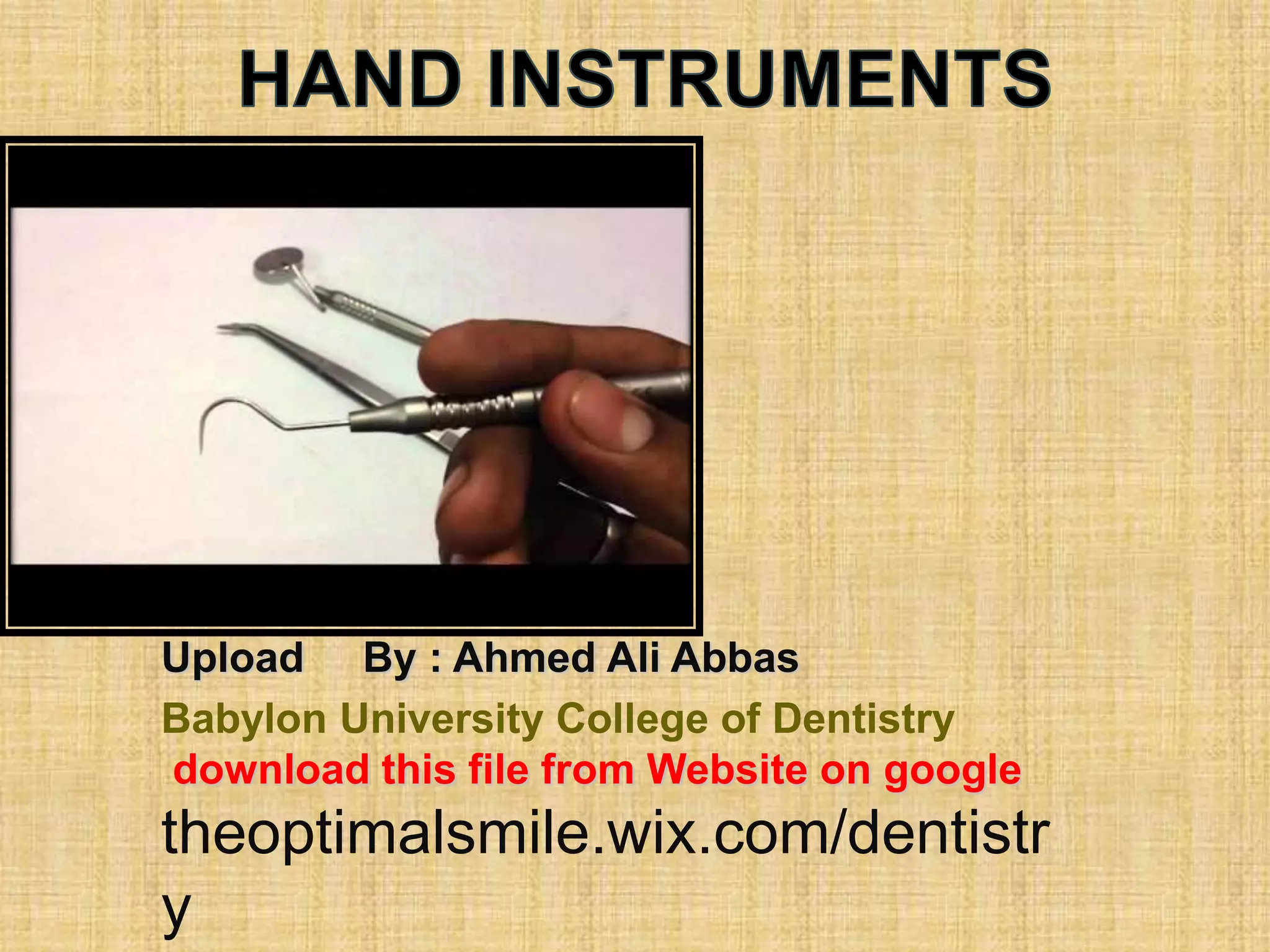
Upload By : Ahmed Ali Abbas 
Babylon University College of Dentistry 
download this file from Website on google 
theoptimalsmile.wix.com/dentistr 
y
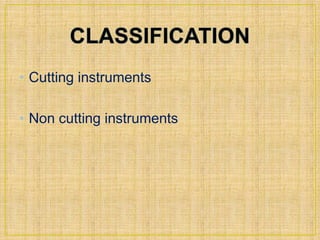
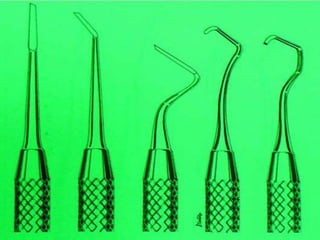
• Cutting instruments 
• Non cutting instruments
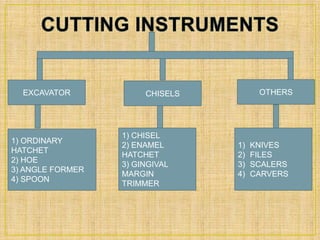
EXCAVATOR CHISELS OTHERS 
1) ORDINARY 
HATCHET 
2) HOE 
3) ANGLE FORMER 
4) SPOON 
1) CHISEL 
2) ENAMEL 
HATCHET 
3) GINGIVAL 
MARGIN 
TRIMMER 
1) KNIVES 
2) FILES 
3) SCALERS 
4) CARVERS
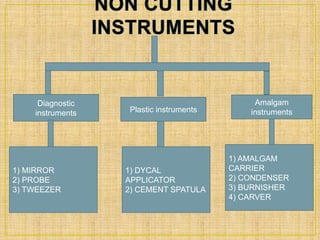
Diagnostic 
instruments Plastic instruments 
1) MIRROR 
2) PROBE 
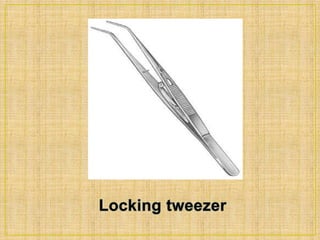
3) TWEEZER 
Amalgam 
instruments 
1) DYCAL 
APPLICATOR 
2) CEMENT SPATULA 
1) AMALGAM 
CARRIER 
2) CONDENSER 
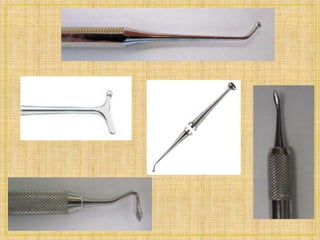
3) BURNISHER 
4) CARVER
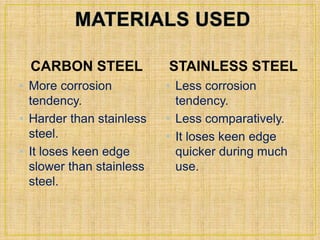
CARBON STEEL 
• More corrosion 
tendency. 
• Harder than stainless 
steel. 
• It loses keen edge 
slower than stainless 
steel. 
STAINLESS STEEL 
• Less corrosion 
tendency. 
• Less comparatively. 
• It loses keen edge 
quicker during much 
use.
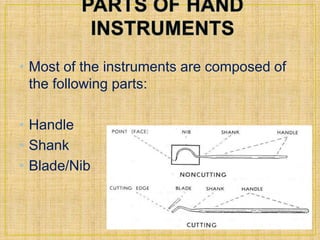
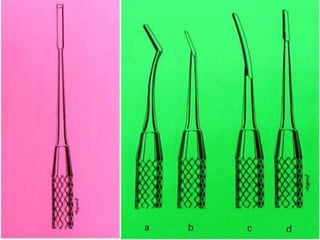
• Most of the instruments are composed of 
the following parts: 
• Handle 
• Shank 
• Blade/Nib
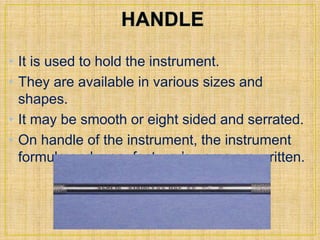
• It is used to hold the instrument. 
• They are available in various sizes and 
shapes. 
• It may be smooth or eight sided and serrated. 
• On handle of the instrument, the instrument 
formula and manufacturer’s name are written.
• It connects the handle with the working point 
or nib of the instrument. 
• It is smooth, round or tapered. 
• It may be straight or bent for better control of 
working point when the force is applied. 
• It has one or more angles to avoid twisting of 
the instrument.
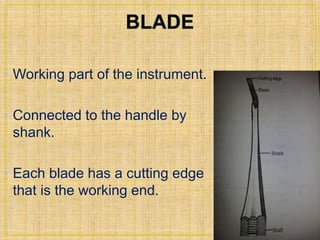
• Working part of the instrument. 
• Connected to the handle by 
shank. 
• Each blade has a cutting edge 
that is the working end.
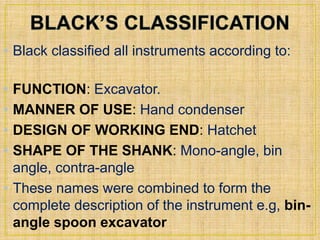
• Black classified all instruments according to: 
• FUNCTION: Excavator. 
• MANNER OF USE: Hand condenser. 
• DESIGN OF WORKING END: Hatchet 
• SHAPE OF THE SHANK: Mono-angle, bin 
angle, contra-angle. 
• These names were combined to form the 
complete description of the instrument e.g, bin-angle 
spoon excavator
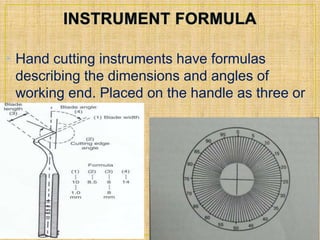
• Hand cutting instruments have formulas 
describing the dimensions and angles of 
working end. Placed on the handle as three or 
four figures.
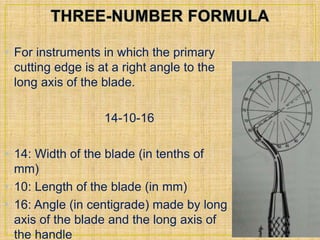
• For instruments in which the primary 
cutting edge is at a right angle to the 
long axis of the blade. 
14-10-16 
• 14: Width of the blade (in tenths of 
mm) 
• 10: Length of the blade (in mm) 
• 16: Angle (in centigrade) made by long 
axis of the blade and the long axis of 
the handle
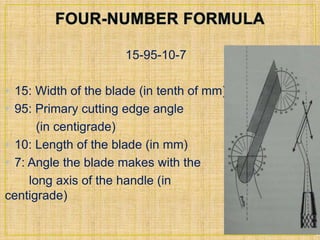
15-95-10-7 
• 15: Width of the blade (in tenth of mm) 
• 95: Primary cutting edge angle 
(in centigrade) 
• 10: Length of the blade (in mm) 
• 7: Angle the blade makes with the 
long axis of the handle (in 
centigrade)
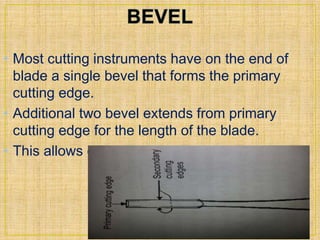
• Most cutting instruments have on the end of 
blade a single bevel that forms the primary 
cutting edge. 
• Additional two bevel extends from primary 
cutting edge for the length of the blade. 
• This allows cutting in three dimensions.
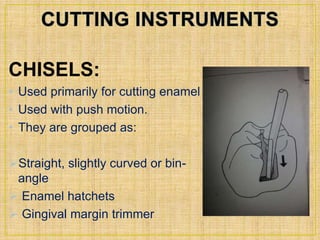
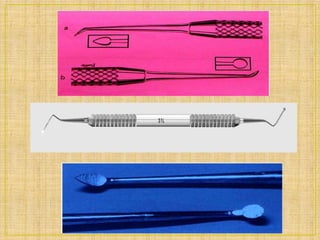
CHISELS: 
• Used primarily for cutting enamel 
• Used with push motion. 
• They are grouped as: 
Straight, slightly curved or bin-angle 
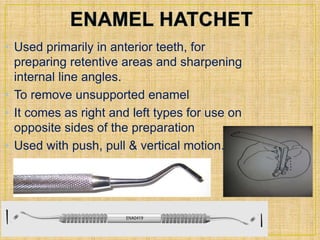
 Enamel hatchets 
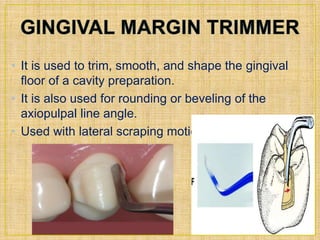
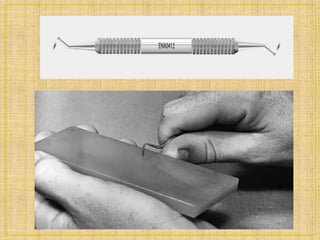
 Gingival margin trimmer
• Used primarily in anterior teeth, for 
preparing retentive areas and sharpening 
internal line angles. 
• To remove unsupported enamel 
• It comes as right and left types for use on 
opposite sides of the preparation 
• Used with push, pull & vertical motion.
• It is used to trim, smooth, and shape the gingival 
floor of a cavity preparation. 
• It is also used for rounding or beveling of the 
axiopulpal line angle. 
• Used with lateral scraping motion.
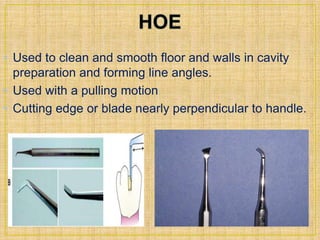
• Used to clean and smooth floor and walls in cavity 
preparation and forming line angles. 
• Used with a pulling motion 
• Cutting edge or blade nearly perpendicular to handle.
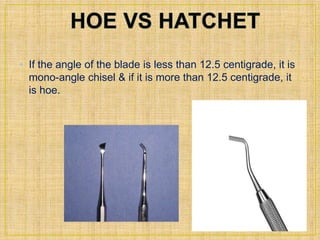
• If the angle of the blade is less than 12.5 centigrade, it is 
mono-angle chisel & if it is more than 12.5 centigrade, it 
is hoe.
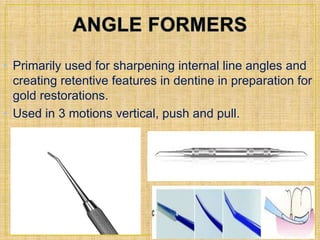
• Primarily used for sharpening internal line angles and 
creating retentive features in dentine in preparation for 
gold restorations. 
• Used in 3 motions vertical, push and pull.
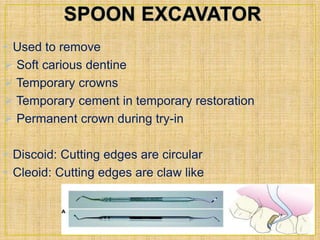
• Used to remove 
 Soft carious dentine 
 Temporary crowns 
 Temporary cement in temporary restoration 
 Permanent crown during try-in 
• Discoid: Cutting edges are circular 
• Cleoid: Cutting edges are claw like
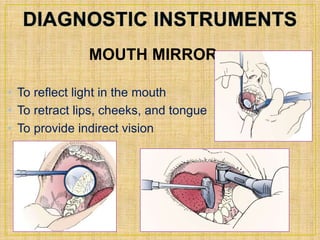
MOUTH MIRROR: 
• To reflect light in the mouth 
• To retract lips, cheeks, and tongue 
• To provide indirect vision
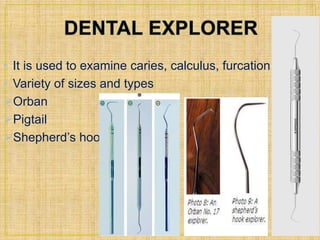
• It is used to examine caries, calculus, furcation. 
• Variety of sizes and types 
Orban 
Pigtail 
Shepherd’s hook
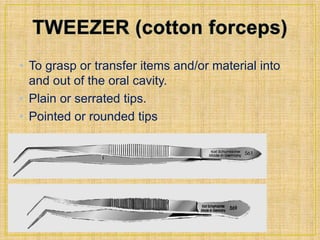
• To grasp or transfer items and/or material into 
and out of the oral cavity. 
• Plain or serrated tips. 
• Pointed or rounded tips
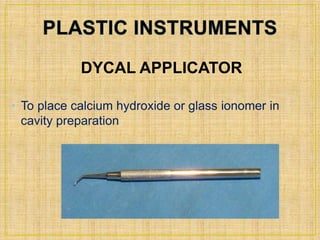
DYCAL APPLICATOR 
• To place calcium hydroxide or glass ionomer in 
cavity preparation.
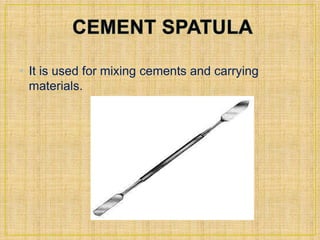
• It is used for mixing cements and carrying 
materials.
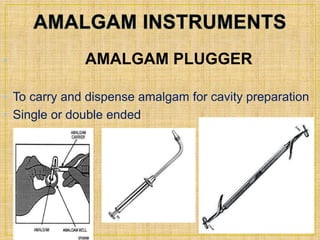
• AMALGAM PLUGGER 
• To carry and dispense amalgam for cavity preparation 
• Single or double ended
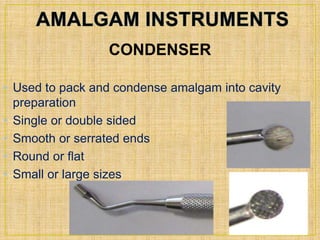
CONDENSER 
• Used to pack and condense amalgam into cavity 
preparation 
• Single or double sided 
• Smooth or serrated ends 
• Round or flat 
• Small or large sizes
• Used to smooth amalgam after condensing. 
• Burnish amalgam. 
• It is also used to contour matrix band before 
placement. 
• It may be single or double ended.
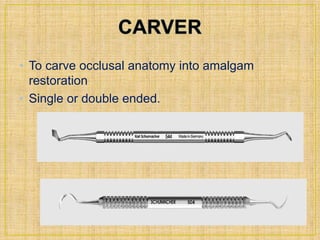
• To carve occlusal anatomy into amalgam 
restoration 
• Single or double ended.
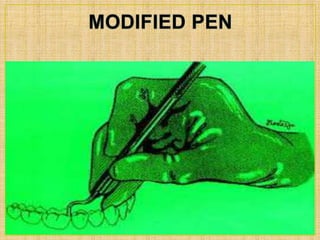
• Modified pen 
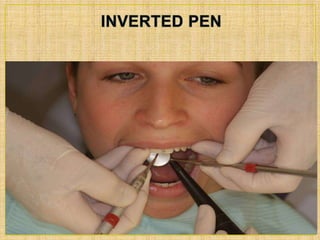
• Inverted pen 
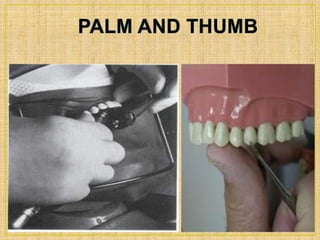
• Palm and thumb 
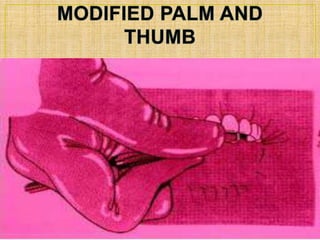
• Modified palm and thumb
• Summit 
• Art and science 
• Google
Hand instruments

Hand instruments

  • 1.
    Upload By :Ahmed Ali Abbas Babylon University College of Dentistry download this file from Website on google theoptimalsmile.wix.com/dentistr y
  • 2.
    • Cutting instruments • Non cutting instruments
  • 3.
    EXCAVATOR CHISELS OTHERS 1) ORDINARY HATCHET 2) HOE 3) ANGLE FORMER 4) SPOON 1) CHISEL 2) ENAMEL HATCHET 3) GINGIVAL MARGIN TRIMMER 1) KNIVES 2) FILES 3) SCALERS 4) CARVERS
  • 4.
    Diagnostic instruments Plasticinstruments 1) MIRROR 2) PROBE 3) TWEEZER Amalgam instruments 1) DYCAL APPLICATOR 2) CEMENT SPATULA 1) AMALGAM CARRIER 2) CONDENSER 3) BURNISHER 4) CARVER
  • 5.
    CARBON STEEL •More corrosion tendency. • Harder than stainless steel. • It loses keen edge slower than stainless steel. STAINLESS STEEL • Less corrosion tendency. • Less comparatively. • It loses keen edge quicker during much use.
  • 6.
    • Most ofthe instruments are composed of the following parts: • Handle • Shank • Blade/Nib
  • 7.
    • It isused to hold the instrument. • They are available in various sizes and shapes. • It may be smooth or eight sided and serrated. • On handle of the instrument, the instrument formula and manufacturer’s name are written.
  • 8.
    • It connectsthe handle with the working point or nib of the instrument. • It is smooth, round or tapered. • It may be straight or bent for better control of working point when the force is applied. • It has one or more angles to avoid twisting of the instrument.
  • 10.
    • Working partof the instrument. • Connected to the handle by shank. • Each blade has a cutting edge that is the working end.
  • 11.
    • Black classifiedall instruments according to: • FUNCTION: Excavator. • MANNER OF USE: Hand condenser. • DESIGN OF WORKING END: Hatchet • SHAPE OF THE SHANK: Mono-angle, bin angle, contra-angle. • These names were combined to form the complete description of the instrument e.g, bin-angle spoon excavator
  • 12.
    • Hand cuttinginstruments have formulas describing the dimensions and angles of working end. Placed on the handle as three or four figures.
  • 13.
    • For instrumentsin which the primary cutting edge is at a right angle to the long axis of the blade. 14-10-16 • 14: Width of the blade (in tenths of mm) • 10: Length of the blade (in mm) • 16: Angle (in centigrade) made by long axis of the blade and the long axis of the handle
  • 14.
    15-95-10-7 • 15:Width of the blade (in tenth of mm) • 95: Primary cutting edge angle (in centigrade) • 10: Length of the blade (in mm) • 7: Angle the blade makes with the long axis of the handle (in centigrade)
  • 15.
    • Most cuttinginstruments have on the end of blade a single bevel that forms the primary cutting edge. • Additional two bevel extends from primary cutting edge for the length of the blade. • This allows cutting in three dimensions.
  • 16.
    CHISELS: • Usedprimarily for cutting enamel • Used with push motion. • They are grouped as: Straight, slightly curved or bin-angle  Enamel hatchets  Gingival margin trimmer
  • 18.
    • Used primarilyin anterior teeth, for preparing retentive areas and sharpening internal line angles. • To remove unsupported enamel • It comes as right and left types for use on opposite sides of the preparation • Used with push, pull & vertical motion.
  • 19.
    • It isused to trim, smooth, and shape the gingival floor of a cavity preparation. • It is also used for rounding or beveling of the axiopulpal line angle. • Used with lateral scraping motion.
  • 21.
    • Used toclean and smooth floor and walls in cavity preparation and forming line angles. • Used with a pulling motion • Cutting edge or blade nearly perpendicular to handle.
  • 22.
    • If theangle of the blade is less than 12.5 centigrade, it is mono-angle chisel & if it is more than 12.5 centigrade, it is hoe.
  • 23.
    • Primarily usedfor sharpening internal line angles and creating retentive features in dentine in preparation for gold restorations. • Used in 3 motions vertical, push and pull.
  • 24.
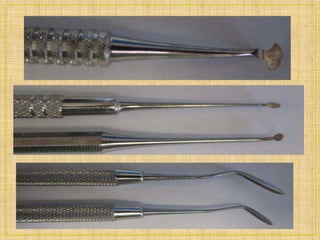
    • Used toremove  Soft carious dentine  Temporary crowns  Temporary cement in temporary restoration  Permanent crown during try-in • Discoid: Cutting edges are circular • Cleoid: Cutting edges are claw like
  • 27.
    MOUTH MIRROR: •To reflect light in the mouth • To retract lips, cheeks, and tongue • To provide indirect vision
  • 28.
    • It isused to examine caries, calculus, furcation. • Variety of sizes and types Orban Pigtail Shepherd’s hook
  • 29.
    • To graspor transfer items and/or material into and out of the oral cavity. • Plain or serrated tips. • Pointed or rounded tips
  • 31.
    DYCAL APPLICATOR •To place calcium hydroxide or glass ionomer in cavity preparation.
  • 32.
    • It isused for mixing cements and carrying materials.
  • 33.
    • AMALGAM PLUGGER • To carry and dispense amalgam for cavity preparation • Single or double ended
  • 34.
    CONDENSER • Usedto pack and condense amalgam into cavity preparation • Single or double sided • Smooth or serrated ends • Round or flat • Small or large sizes
  • 35.
    • Used tosmooth amalgam after condensing. • Burnish amalgam. • It is also used to contour matrix band before placement. • It may be single or double ended.
  • 37.
    • To carveocclusal anatomy into amalgam restoration • Single or double ended.
  • 39.
    • Modified pen • Inverted pen • Palm and thumb • Modified palm and thumb
  • 44.
    • Summit •Art and science • Google

Editor's Notes

  • #21 Arkansas stone, silicone carbide.
  • #29 Briault (interproximal)
  • #31 Clips the two beaks firmly against each other. It helps in avoiding slippage of anything carried.
  • #37 Ball burnisher, t ball burnisher, football burnisher, beavertail, acorn burnisher.
  • #38 Frahm, interproximal.
  • #39 Tanner carver, discoid and cleoid carver, hollenback n half hollenback carver