HAND INSTRUMENTS
Hand cutting instruments are manufactured from two main materials:
• Carbon steel
• Stainless steel
CARBON STEEL
Advantage:-
1. Harder
2. Maintains its sharpness
Disadvantage:-
Prone to rusting on sterilisation
STAINLESS STEEL
Advanatages:-
1. Passive
2. Can withstand repeated sterilisation cycles
Disadvantage:-
But it becomes blunt and requires sharpening
Special instruments for placing composite – made up of stainless steel with Teflon or titanium nitride coating
– to prevent sticking of composite to the instrument
CUTTING INSTRUMENTS
1. Hand - Hatchets
- Chisel
- Hoe
- Excavator
2. Rotary - Burs
- Stones
- Disk
CONDENSING INSTRUMENTS
Pluggers
- Hand
- Mechanical
PLASTIC INSTRUMENTS
- Spatulas
- Carvers
- Burnishers
- Packing Instruments
FINISHING AND POLISHING INSTRUMENTS
Hand
- Orange wood sticks
- Polishing points
- Finishing strips
Rotary
- Finishing burs
- Mounted brushes
- Mounted stones
- Rubber cups
- Impregnated disk and wheels
ISOLATING INSTRUMENTS
- Rubber dam frame, Clamps, forceps,
Punch
- Saliva ejectors
- Cotton roll holders
- Evacuating tip and
equipments
MISCELLANEOUS
- Mouth Mirrors
- Probe
- Scissors
- Pliers
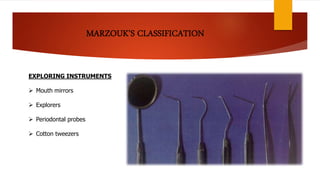
EXPLORING INSTRUMENTS
 Mouth mirrors
 Explorers
 Periodontal probes
 Cotton tweezers
 TOOTH CUTTING INSTRUMENTS
 HAND CUTTING
Excavators - Hatchet excavator
- Hoe
-Spoon excavator
- Cleiod
- Discoid
Chisels - Straight chisel
- Mono angle chisel
- Bin angle chisel
- Triple angle chisel
Special types of chisels or modified chisels
- Wedelsteadt chisel
- Enamel hatchet
- Gingival margin trimmer
- Angle former
ROTARY CUTTING INSTRUMENTS
- handpiece
- burs
- abrasives
RESTORING INSTRUMENTS
 Cement spatulas
 Plastic filling instruments
 Amalgam carriers
 Condensers
 Burnishers
 Carvers
 Files
 knives
FINISHING AND POLISHING INSTRUMENTS
 Finishing strips
 Finishing burs
 Brushes
 Rubber cups
 cloth
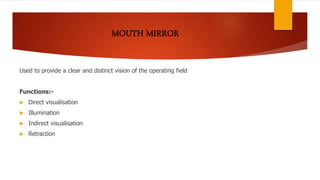
Used to provide a clear and distinct vision of the operating field
Functions:-
 Direct visualisation
 Illumination
 Indirect visualisation
 Retraction
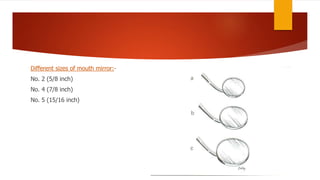
Different sizes of mouth mirror:-
No. 2 (5/8 inch)
No. 4 (7/8 inch)
No. 5 (15/16 inch)
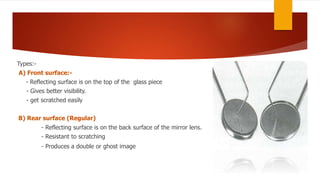
Types:-
A) Front surface:-
- Reflecting surface is on the top of the glass piece
- Gives better visibility.
- get scratched easily
B) Rear surface (Regular)
- Reflecting surface is on the back surface of the mirror lens.
- Resistant to scratching
- Produces a double or ghost image
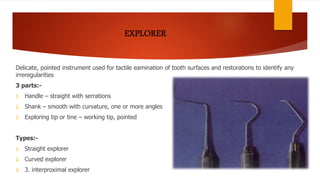
Delicate, pointed instrument used for tactile eamination of tooth surfaces and restorations to identify any
irreregularities
3 parts:-
1. Handle – straight with serrations
2. Shank – smooth with curvature, one or more angles
3. Exploring tip or tine – working tip, pointed
Types:-
1. Straight explorer
2. Curved explorer
3. 3. interproximal explorer
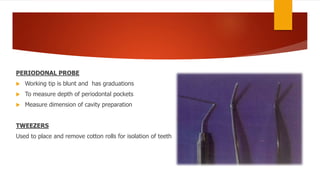
PERIODONAL PROBE
 Working tip is blunt and has graduations
 To measure depth of periodontal pockets
 Measure dimension of cavity preparation
TWEEZERS
Used to place and remove cotton rolls for isolation of teeth
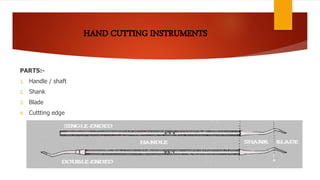
PARTS:-
1. Handle / shaft
2. Shank
3. Blade
4. Cuttting edge
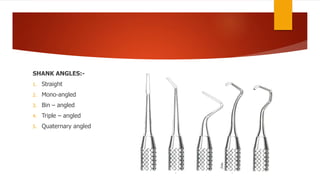
SHANK ANGLES:-
1. Straight
2. Mono-angled
3. Bin – angled
4. Triple – angled
5. Quaternary angled
Dr G.V. Black prescribed four classes similar to biological classification:
 ORDER: Purpose of the instruments
E.g : excavator
 SUBORDER: Position or manner of use
E.g: pull, push
 CLASS: Form of working end
E.g : chisel, hatchet
 SUB CLASS: Shape of the shank
E.g : monoangled, bin angle
Bin-angle Hatchet Push Excavator
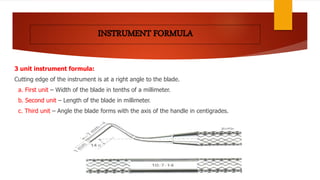
3 unit instrument formula:
Cutting edge of the instrument is at a right angle to the blade.
a. First unit – Width of the blade in tenths of a millimeter.
b. Second unit – Length of the blade in millimeter.
c. Third unit – Angle the blade forms with the axis of the handle in centigrades.
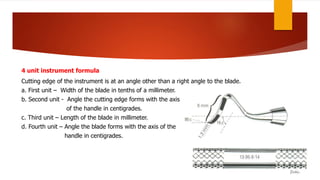
4 unit instrument formula
Cutting edge of the instrument is at an angle other than a right angle to the blade.
a. First unit – Width of the blade in tenths of a millimeter.
b. Second unit - Angle the cutting edge forms with the axis
of the handle in centigrades.
c. Third unit – Length of the blade in millimeter.
d. Fourth unit – Angle the blade forms with the axis of the
handle in centigrades.
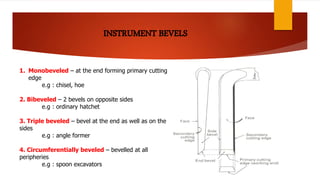
1. Monobeveled – at the end forming primary cutting
edge
e.g : chisel, hoe
2. Bibeveled – 2 bevels on opposite sides
e.g : ordinary hatchet
3. Triple beveled – bevel at the end as well as on the
sides
e.g : angle former
4. Circumferentially beveled – bevelled at all
peripheries
e.g : spoon excavators
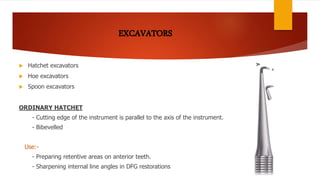
 Hatchet excavators
 Hoe excavators
 Spoon excavators
ORDINARY HATCHET
- Cutting edge of the instrument is parallel to the axis of the instrument.
- Bibevelled
Use:-
- Preparing retentive areas on anterior teeth.
- Sharpening internal line angles in DFG restorations
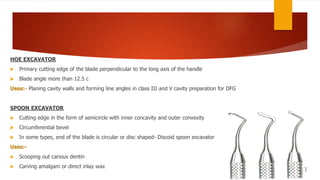
HOE EXCAVATOR
 Primary cutting edge of the blade perpendicular to the long axis of the handle
 Blade angle more than 12.5 c
Uses:- Planing cavity walls and forming line angles in class III and V cavity preparation for DFG
SPOON EXCAVATOR
 Cutting edge in the form of semicircle with inner concavity and outer convexity
 Circumferential bevel
 In some types, end of the blade is circular or disc shaped- Discoid spoon excavator
Uses:-
 Scooping out carious dentin
 Carving amalgam or direct inlay wax
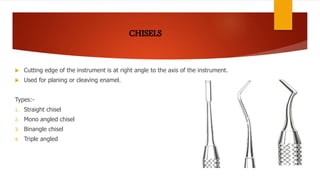
 Cutting edge of the instrument is at right angle to the axis of the instrument.
 Used for planing or cleaving enamel.
Types:-
1. Straight chisel
2. Mono angled chisel
3. Binangle chisel
4. Triple angled
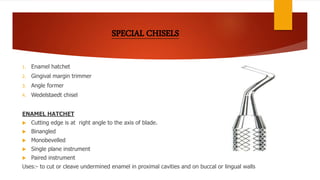
1. Enamel hatchet
2. Gingival margin trimmer
3. Angle former
4. Wedelstaedt chisel
ENAMEL HATCHET
 Cutting edge is at right angle to the axis of blade.
 Binangled
 Monobevelled
 Single plane instrument
 Paired instrument
Uses:- to cut or cleave undermined enamel in proximal cavities and on buccal or lingual walls
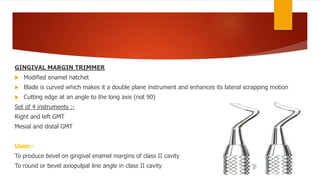
GINGIVAL MARGIN TRIMMER
 Modified enamel hatchet
 Blade is curved which makes it a double plane instrument and enhances its lateral scrapping motion
 Cutting edge at an angle to the long axis (not 90)
Set of 4 instruments :-
Right and left GMT
Mesial and distal GMT
Uses:-
To produce bevel on gingival enamel margins of class II cavity
To round or bevel axiopulpal line angle in class II cavity
Right and left bevelled
The instrument is held in such a way that the primary cutting edge is facing down and pointing away
from the operator
If the bevel appears on the right side- right instrument
If on left side – left sided instrument
Mesial and distal bevels
If the dentist observes the inside of the blade curvature and the primary bevel is not visible- distal
GMT
If visible- mesial GMT
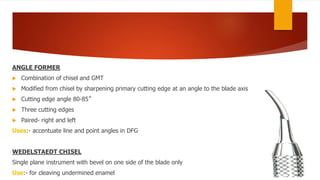
ANGLE FORMER
 Combination of chisel and GMT
 Modified from chisel by sharpening primary cutting edge at an angle to the blade axis
 Cutting edge angle 80-85˚
 Three cutting edges
 Paired- right and left
Uses:- accentuate line and point angles in DFG
WEDELSTAEDT CHISEL
Single plane instrument with bevel on one side of the blade only
Use:- for cleaving undermined enamel
• Maintain and restore a knife like cutting edge
• Preserve the shape and proportional dimensions of the instrument
• Increase work efficiency of the instrument
DETECTION OF A DULL CUTTING INSTRUMENT
1) Visibility of a reflection off the cutting edge.
Sharp edge – not reflect light
Dull edge – reflect light/ presence of a “glint”.
2) Obvious irregularities in the cutting edge
3) Won’t cut tooth structure.
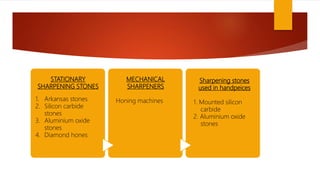
STATIONARY
SHARPENING STONES
1. Arkansas stones
2. Silicon carbide
stones
3. Aluminium oxide
stones
4. Diamond hones
MECHANICAL
SHARPENERS
Honing machines
Sharpening stones
used in handpeices
1. Mounted silicon
carbide
2. Aluminium oxide
stones
Definition:- These are the manners of holding the instruments which if not held
properly it will result in loss of efficiency and accumulation of unnecessary strain on
the operator.
 Different grasps:- 1) Pen grasp
2) Modified pen
3) Inverted pen
4) Palm and thumb
5) Modified palm and thumb
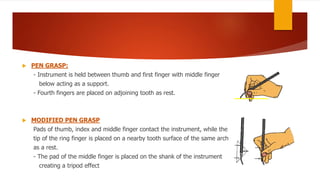
 PEN GRASP:
- Instrument is held between thumb and first finger with middle finger
below acting as a support.
- Fourth fingers are placed on adjoining tooth as rest.
 MODIFIED PEN GRASP
Pads of thumb, index and middle finger contact the instrument, while the
tip of the ring finger is placed on a nearby tooth surface of the same arch
as a rest.
- The pad of the middle finger is placed on the shank of the instrument
creating a tripod effect
INVERTED PEN GRASP
The palm is rotated upwards facing more towards the operator.
Used mostly for the tooth preparation utilizing the lingual approach on maxillary anterior teeth.
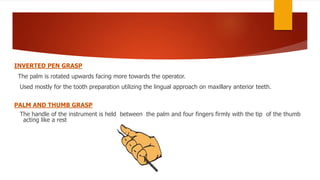
PALM AND THUMB GRASP
The handle of the instrument is held between the palm and four fingers firmly with the tip of the thumb
acting like a rest

Hand cutting instruments

  • 1.
  • 2.
    Hand cutting instrumentsare manufactured from two main materials: • Carbon steel • Stainless steel CARBON STEEL Advantage:- 1. Harder 2. Maintains its sharpness Disadvantage:- Prone to rusting on sterilisation
  • 3.
    STAINLESS STEEL Advanatages:- 1. Passive 2.Can withstand repeated sterilisation cycles Disadvantage:- But it becomes blunt and requires sharpening Special instruments for placing composite – made up of stainless steel with Teflon or titanium nitride coating – to prevent sticking of composite to the instrument
  • 4.
    CUTTING INSTRUMENTS 1. Hand- Hatchets - Chisel - Hoe - Excavator 2. Rotary - Burs - Stones - Disk CONDENSING INSTRUMENTS Pluggers - Hand - Mechanical PLASTIC INSTRUMENTS - Spatulas - Carvers - Burnishers - Packing Instruments
  • 5.
    FINISHING AND POLISHINGINSTRUMENTS Hand - Orange wood sticks - Polishing points - Finishing strips Rotary - Finishing burs - Mounted brushes - Mounted stones - Rubber cups - Impregnated disk and wheels ISOLATING INSTRUMENTS - Rubber dam frame, Clamps, forceps, Punch - Saliva ejectors - Cotton roll holders - Evacuating tip and equipments MISCELLANEOUS - Mouth Mirrors - Probe - Scissors - Pliers
  • 6.
    EXPLORING INSTRUMENTS  Mouthmirrors  Explorers  Periodontal probes  Cotton tweezers
  • 7.
     TOOTH CUTTINGINSTRUMENTS  HAND CUTTING Excavators - Hatchet excavator - Hoe -Spoon excavator - Cleiod - Discoid Chisels - Straight chisel - Mono angle chisel - Bin angle chisel - Triple angle chisel Special types of chisels or modified chisels - Wedelsteadt chisel - Enamel hatchet - Gingival margin trimmer - Angle former ROTARY CUTTING INSTRUMENTS - handpiece - burs - abrasives
  • 8.
    RESTORING INSTRUMENTS  Cementspatulas  Plastic filling instruments  Amalgam carriers  Condensers  Burnishers  Carvers  Files  knives FINISHING AND POLISHING INSTRUMENTS  Finishing strips  Finishing burs  Brushes  Rubber cups  cloth
  • 9.
    Used to providea clear and distinct vision of the operating field Functions:-  Direct visualisation  Illumination  Indirect visualisation  Retraction
  • 10.
    Different sizes ofmouth mirror:- No. 2 (5/8 inch) No. 4 (7/8 inch) No. 5 (15/16 inch)
  • 11.
    Types:- A) Front surface:- -Reflecting surface is on the top of the glass piece - Gives better visibility. - get scratched easily B) Rear surface (Regular) - Reflecting surface is on the back surface of the mirror lens. - Resistant to scratching - Produces a double or ghost image
  • 12.
    Delicate, pointed instrumentused for tactile eamination of tooth surfaces and restorations to identify any irreregularities 3 parts:- 1. Handle – straight with serrations 2. Shank – smooth with curvature, one or more angles 3. Exploring tip or tine – working tip, pointed Types:- 1. Straight explorer 2. Curved explorer 3. 3. interproximal explorer
  • 13.
    PERIODONAL PROBE  Workingtip is blunt and has graduations  To measure depth of periodontal pockets  Measure dimension of cavity preparation TWEEZERS Used to place and remove cotton rolls for isolation of teeth
  • 14.
    PARTS:- 1. Handle /shaft 2. Shank 3. Blade 4. Cuttting edge
  • 15.
    SHANK ANGLES:- 1. Straight 2.Mono-angled 3. Bin – angled 4. Triple – angled 5. Quaternary angled
  • 16.
    Dr G.V. Blackprescribed four classes similar to biological classification:  ORDER: Purpose of the instruments E.g : excavator  SUBORDER: Position or manner of use E.g: pull, push  CLASS: Form of working end E.g : chisel, hatchet  SUB CLASS: Shape of the shank E.g : monoangled, bin angle Bin-angle Hatchet Push Excavator
  • 17.
    3 unit instrumentformula: Cutting edge of the instrument is at a right angle to the blade. a. First unit – Width of the blade in tenths of a millimeter. b. Second unit – Length of the blade in millimeter. c. Third unit – Angle the blade forms with the axis of the handle in centigrades.
  • 18.
    4 unit instrumentformula Cutting edge of the instrument is at an angle other than a right angle to the blade. a. First unit – Width of the blade in tenths of a millimeter. b. Second unit - Angle the cutting edge forms with the axis of the handle in centigrades. c. Third unit – Length of the blade in millimeter. d. Fourth unit – Angle the blade forms with the axis of the handle in centigrades.
  • 19.
    1. Monobeveled –at the end forming primary cutting edge e.g : chisel, hoe 2. Bibeveled – 2 bevels on opposite sides e.g : ordinary hatchet 3. Triple beveled – bevel at the end as well as on the sides e.g : angle former 4. Circumferentially beveled – bevelled at all peripheries e.g : spoon excavators
  • 20.
     Hatchet excavators Hoe excavators  Spoon excavators ORDINARY HATCHET - Cutting edge of the instrument is parallel to the axis of the instrument. - Bibevelled Use:- - Preparing retentive areas on anterior teeth. - Sharpening internal line angles in DFG restorations
  • 21.
    HOE EXCAVATOR  Primarycutting edge of the blade perpendicular to the long axis of the handle  Blade angle more than 12.5 c Uses:- Planing cavity walls and forming line angles in class III and V cavity preparation for DFG SPOON EXCAVATOR  Cutting edge in the form of semicircle with inner concavity and outer convexity  Circumferential bevel  In some types, end of the blade is circular or disc shaped- Discoid spoon excavator Uses:-  Scooping out carious dentin  Carving amalgam or direct inlay wax
  • 22.
     Cutting edgeof the instrument is at right angle to the axis of the instrument.  Used for planing or cleaving enamel. Types:- 1. Straight chisel 2. Mono angled chisel 3. Binangle chisel 4. Triple angled
  • 23.
    1. Enamel hatchet 2.Gingival margin trimmer 3. Angle former 4. Wedelstaedt chisel ENAMEL HATCHET  Cutting edge is at right angle to the axis of blade.  Binangled  Monobevelled  Single plane instrument  Paired instrument Uses:- to cut or cleave undermined enamel in proximal cavities and on buccal or lingual walls
  • 24.
    GINGIVAL MARGIN TRIMMER Modified enamel hatchet  Blade is curved which makes it a double plane instrument and enhances its lateral scrapping motion  Cutting edge at an angle to the long axis (not 90) Set of 4 instruments :- Right and left GMT Mesial and distal GMT Uses:- To produce bevel on gingival enamel margins of class II cavity To round or bevel axiopulpal line angle in class II cavity
  • 25.
    Right and leftbevelled The instrument is held in such a way that the primary cutting edge is facing down and pointing away from the operator If the bevel appears on the right side- right instrument If on left side – left sided instrument Mesial and distal bevels If the dentist observes the inside of the blade curvature and the primary bevel is not visible- distal GMT If visible- mesial GMT
  • 26.
    ANGLE FORMER  Combinationof chisel and GMT  Modified from chisel by sharpening primary cutting edge at an angle to the blade axis  Cutting edge angle 80-85˚  Three cutting edges  Paired- right and left Uses:- accentuate line and point angles in DFG WEDELSTAEDT CHISEL Single plane instrument with bevel on one side of the blade only Use:- for cleaving undermined enamel
  • 27.
    • Maintain andrestore a knife like cutting edge • Preserve the shape and proportional dimensions of the instrument • Increase work efficiency of the instrument DETECTION OF A DULL CUTTING INSTRUMENT 1) Visibility of a reflection off the cutting edge. Sharp edge – not reflect light Dull edge – reflect light/ presence of a “glint”. 2) Obvious irregularities in the cutting edge 3) Won’t cut tooth structure.
  • 28.
    STATIONARY SHARPENING STONES 1. Arkansasstones 2. Silicon carbide stones 3. Aluminium oxide stones 4. Diamond hones MECHANICAL SHARPENERS Honing machines Sharpening stones used in handpeices 1. Mounted silicon carbide 2. Aluminium oxide stones
  • 29.
    Definition:- These arethe manners of holding the instruments which if not held properly it will result in loss of efficiency and accumulation of unnecessary strain on the operator.  Different grasps:- 1) Pen grasp 2) Modified pen 3) Inverted pen 4) Palm and thumb 5) Modified palm and thumb
  • 30.
     PEN GRASP: -Instrument is held between thumb and first finger with middle finger below acting as a support. - Fourth fingers are placed on adjoining tooth as rest.  MODIFIED PEN GRASP Pads of thumb, index and middle finger contact the instrument, while the tip of the ring finger is placed on a nearby tooth surface of the same arch as a rest. - The pad of the middle finger is placed on the shank of the instrument creating a tripod effect
  • 31.
    INVERTED PEN GRASP Thepalm is rotated upwards facing more towards the operator. Used mostly for the tooth preparation utilizing the lingual approach on maxillary anterior teeth. PALM AND THUMB GRASP The handle of the instrument is held between the palm and four fingers firmly with the tip of the thumb acting like a rest