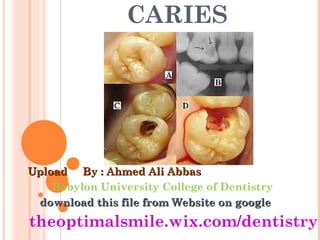
DENTAL 
CARIES 
Upload BByy :: AAhhmmeedd AAllii AAbbbbaass 
Babylon University College of Dentistry 
ddoowwnnllooaadd tthhiiss ffiillee ffrroomm WWeebbssiittee oonn ggooooggllee 
theoptimalsmile.wix.com/dentistry 
GROUP: C
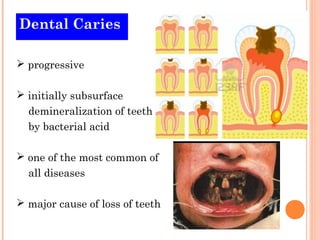
Dental Caries 
 progressive 
 initially subsurface 
demineralization of teeth 
by bacterial acid 
 one of the most common of 
all diseases 
 major cause of loss of teeth
Dental Caries 
 may be considered a 
disease of modern 
civilization 
 since prehistoric man 
rarely suffered from 
this form of tooth
Dental Caries 
 biological process of tooth 
decay with mutifactorial 
etiology 
 microbial disease of calcified 
tissues of teeth 
 characterized by demineralization 
of inorganic portion 
 destruction of organic substance 
of tooth
Etiology of Dental Caries 
 generally agreed to be 
complex problem 
 complicated by many 
indirect factors 
 obscure the direct cause 
or causes
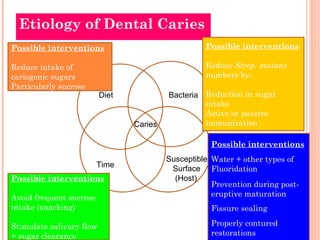
Etiology of Dental Caries 
Diet 
Caries 
Bacteria 
Time 
Susceptible 
Surface 
(Host) 
Possible interventions 
Reduce intake of 
cariogenic sugars 
Particularly sucrose 
Possible interventions 
Avoid frequent sucrose 
intake (snacking) 
Stimulate salivary flow 
+ sugar clearance 
Possible interventions 
Reduce Strep. mutans 
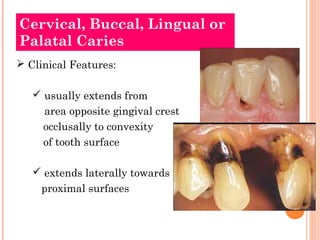
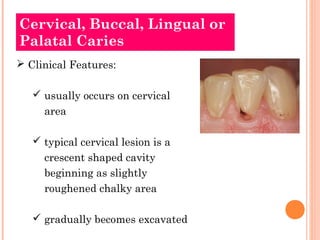
numbers by: 
Reduction in sugar 
intake 
Active or passive 
immunization 
Possible interventions 
Water + other types of 
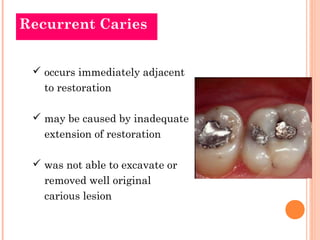
Fluoridation 
Prevention during post-eruptive 
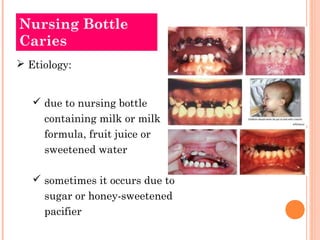
maturation 
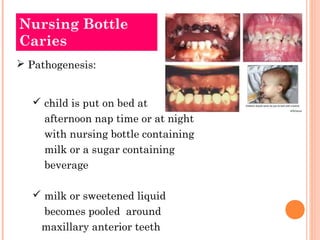
Fissure sealing 
Properly contured 
restorations
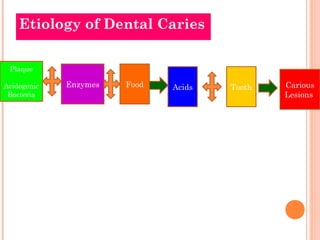
Etiology of Dental Caries 
Plaque 
Acidogenic 
Bacteria 
Enzymes Food Acids Tooth Carious 
Lesions
Etiology of Dental Caries 
 Old Theories 
 Exogenous Theories 
• (1) Legend of worm 
• (2) Chemical Theory 
• (3) Parasitic or Septic Theory
Etiology of Dental Caries 
 Old Theories 
 Endogenous Theories 
• (1) Humoral Theory 
• (2) Vital Theory
Etiology of Dental Caries 
 New Theories 
 (1) Acidogenic Theory 
 (2) Proteolytic Theory 
 (3) Proteolysis-chelation Theory
Old Theories 
(Exogenous Theory) 
 (1) Legend of Worm 
 5000 BC 
 ancient Sumerian text 
 obtained from Mesopotamian 
area 
 caused by worm that drank 
blood of teeth 
 fed on roots of jaws
Old Theories 
(Exogenous Theory) 
 (2) Chemical Theory 
 1819 
 proposed by Parmly 
 unidentified chemical 
agent 
 responsible for caries
Old Theories 
(Exogenous Theory) 
 (2) Chemical Theory 
 stated that caries began 
on enamel surface where 
food putrefied 
 acquired sufficient dissolving 
power to produce disease 
chemically
Old Theories 
(Exogenous Theory) 
 (3) Parasitic or Septic 
Theory 
 1843 
 proposed by Erdl 
 filamentous parasite in 
plaque 
• he termed as “Denticolae” 
• responsible for dental caries
OOlldd TThheeoorriieess 
(Endogenous Theory) 
 (1) Humoral Theory 
 4 humors of body 
• blood 
• phelgm 
• black bile 
• yellow bile 
 any change in relative 
proportion of these elements 
causes disease
OOlldd TThheeoorriieess 
(Endogenous Theory) 
 (2) Vital Theory 
 18 century 
 tooth decay originated 
like bone gangrene, from 
within the tooth itself
NOledw T Thheeoorrieiess 
(Exogenous Theory) 
 (1) Acidogenic/Chemoparasitic 
Theory 
 1890 
 WD Miller 
 dental decay is a chemoparasitic 
process consisting of 2 stages 
• decalcification of enamel 
 results in total 
destruction
NOledw T Thheeoorrieiess 
(Exogenous Theory) 
 (1) Acidogenic/Chemoparasitic 
Theory 
• decalcification of dentin 
as a preliminary stage 
 followed by dissolution 
of softened residue
NOledw T Thheeoorrieiess 
(Exogenous Theory) 
 (1) Acidogenic/Chemoparasitic 
Theory 
 following factors cause 
decay: 
• (1) Role of carbohydrates 
• (2) Role of microorganisms 
• (3) Role of acids 
• (4) Role of dental plaque
(O1l)dA cTihdeoogreineisc / 
Chemoparasitic Theory 
 (1) Role of carbohydrates 
 food substances act as 
substrate for microorganisms 
of dental plaque 
 various carbohydrates have 
been examined for cariogenic 
potential
(O1l)dA cTihdeoogreineisc / 
Chemoparasitic Theory 
 (1) Role of carbohydrates 
 cariogenicity of carbohydrate 
varies with: 
• (1) frequency of ingestion 
• (2) physical form 
• (3) chemical composition 
• (4) route of administration 
• (5) presence of other food 
constituents
(O1l)dA cTihdeoogreineisc / 
Chemoparasitic Theory 
 (1) Role of carbohydrates 
• (1) frequency of ingestion 
 taken repeatedly in 
between two major 
meals 
 provides constant supply 
of carbohydrate to plaque 
bacteria for fermentation + 
production of acids
(O1l)dA cTihdeoogreineisc / 
Chemoparasitic Theory 
 (1) Role of carbohydrates 
• (2) physical form 
 sticky 
 solid carbohydrates
(O1l)dA cTihdeoogreineisc / 
Chemoparasitic Theory 
 (1) Role of carbohydrates 
• (3) chemical composition 
 in the form of glucose, 
sucrose + fructose 
due to low molecular weight 
 rapidly diffuse into plaque 
 make themselves easily 
available for fermentation 
by plaque bacteria
(1)Acidogenic/ 
Chemoparasitic Theory 
 (1) Role of carbohydrates 
• (4) Route of administration 
 oral intake of sticky 
food
(1)Acidogenic/ 
Chemoparasitic Theory 
 (1) Role of carbohydrates 
• (5) Presence of other food 
constituents 
 refined pure carbohydrates 
more caries producing
(1)Acidogenic/ 
Chemoparasitic Theory 
 (2) Role of microorganisms 
 caused by acid resulting from 
action of microorganisms 
on carbohydrates
(1)Acidogenic/ 
Chemoparasitic Theory 
 (2) Role of microorganisms 
Initiation of Dental 
Caries 
Progression of Dental 
Caries 
Streptococci 
• S. mutans 
• S. milleri 
• S. mitior 
• S. sanguis 
• S. salivaris 
Streptococcal species: 
Streptoccal species in deep 
dentinal caries and root 
caries 
Lactobacilli 
• L. acidophillus 
• L. casei 
Lactobacilli in dentin 
• L. acidophillus 
• L. casei 
Actinomycoses 
• A. viscosus 
• A. naeslundii 
Actinomycoses 
• A. Israeli 
• A. odontolyticus
(1)Acidogenic/ 
Chemoparasitic Theory 
 (2) Role of microorganisms 
 S. mutans has been proved 
for the initiation of caries
(1)Acidogenic/ 
Chemoparasitic Theory 
 (3) Role of acids 
 play most important role 
in pathogenesis of dental 
caries 
 pH 5.5 is called critical pH 
 below this pH demineralization 
of tooth substance begins
(1)Acidogenic/ 
Chemoparasitic Theory 
 (4) Role of Dental Plaque 
 found on uncleaned tooth 
surfaces 
 appear as tenacious, thin 
film 
 may accumulate within 24-48 
hours
NOledw T Thheeoorrieiess 
(Exogenous Theory) 
 (2) Proteolytic Theory 
 proteolysis of the organic 
components of tooth 
as an initial process 
 than actual demineralization 
+ dissolution of inorganic 
substances
NOledw T Thheeoorrieiess 
(Exogenous Theory) 
 (2) Proteolytic Theory 
 proposed that enamel 
lamellae or rod sheath 
(proteins) may be lysed 
 which means proteolysis 
as first event in further 
progression of bacterial 
invasion + demineralization 
carious lesions
NOledw T Thheeoorrieiess 
(Exogenous Theory) 
 (3) Proteolysis Chelation Theory 
 suggests that caries is 
caused by simultaneous 
events of proteolysis + 
chelation 
 proteolysis 
• destruction of organic 
portion of tooth by 
proteolytic microorganisms
NOledw T Thheeoorrieiess 
(Exogenous Theory) 
 (3) Proteolysis Chelation Theory 
 chelation 
•removal of calcium by 
forming soluble chelates 
 oral bacteria attack organic 
component of enamel (proteolysis) 
 breakdown products have chelating 
ability and this dissolves tooth minerals
COllads Tsihfiecoartiieosn 
 (1) Depending on nature of attack 
 (2) Depending on progression of 
caries 
 (3) Depending on surfaces involved 
 (4) Based on direction of attack 
 (5) Based on number of surfaces involved
COllads Tsihfiecoartiieosn 
 (6) GV Black Classification 
based on treatment and 
restoration design 
 (7) Based on location of lesion 
 (8) Based on tissue involved
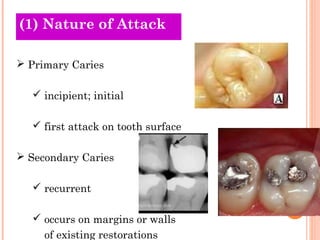
(O1l)d N Tahtueoreri oefs Attack 
 Primary Caries 
 incipient; initial 
 first attack on tooth surface 
 Secondary Caries 
 recurrent 
 occurs on margins or walls 
of existing restorations
(O2l)d P Trhogeorersiessio n of Caries 
 Acute 
 rapidly invading process 
 involves several teeth 
 lesions are soft + light colored
(O2l)d P Trhogeorersiessio n of Caries 
 Acute 
 usually pulp is involved 
at early stage 
• Rampant caries 
• Nursing bottle caries 
• Radiation caries
(O2l)d P Trhogeorersiessio n of Caries 
 Chronic 
 lesions are long standing 
 fewer in number
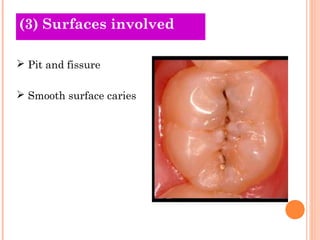
(O3l)d S Tuhrfeaocreies si nvolved 
 Pit and fissure 
 Smooth surface caries
(O4l)d D Tirheecotriioens of caries 
attack 
 Forward Caries 
 proceeds from enamel 
to dentin 
 lesion is triangle in shaped 
with base of triangle at enamel 
surface + apex towards 
dentin 
 in pits + fissures base is at DEJ 
+ apex is in the pit
(O4l)d D Tirheecotriioens of caries 
attack 
 Backward Caries 
 proceeds from DEJ towards 
enamel surface 
 also triangle shaped with 
base at DEJ + apex towards 
enamel surface
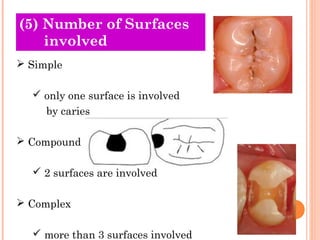
(O5l)d N Tuhmeobreire os f Surfaces 
involved 
 Simple 
 only one surface is involved 
by caries 
 Compound 
 2 surfaces are involved 
 Complex 
 more than 3 surfaces involved
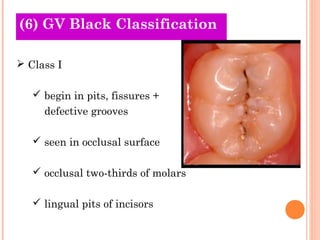
(O6l)d G TVh Beolariceks Classification 
 Class I 
 begin in pits, fissures + 
defective grooves 
 seen in occlusal surface 
 occlusal two-thirds of molars 
 lingual pits of incisors
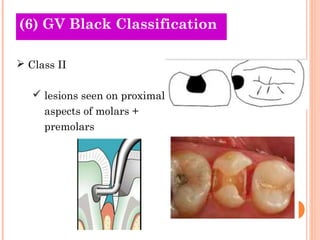
(O6l)d G TVh Beolariceks Classification 
 Class II 
 lesions seen on proximal 
aspects of molars + 
premolars
(O6l)d G TVh Beolariceks Classification 
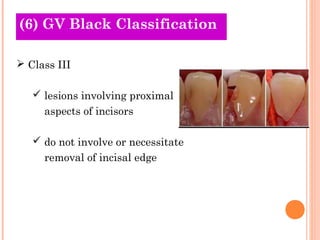
 Class III 
 lesions involving proximal 
aspects of incisors 
 do not involve or necessitate 
removal of incisal edge
(O6l)d G TVh Beolariceks Classification 
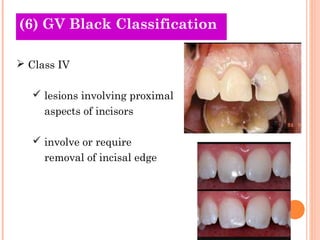
 Class IV 
 lesions involving proximal 
aspects of incisors 
 involve or require 
removal of incisal edge
(O6l)d G TVh Beolariceks Classification 
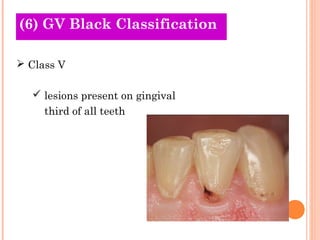
 Class V 
 lesions present on gingival 
third of all teeth
(O6l)d G TVh Beolariceks Classification 
 Class VI 
 lesions found on incisal 
edges + cusp tips
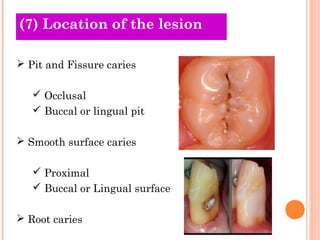
(O7l)d L Tohcaeotiroines o f the lesion 
 Pit and Fissure caries 
 Occlusal 
 Buccal or lingual pit 
 Smooth surface caries 
 Proximal 
 Buccal or Lingual surface 
 Root caries
(O8l)d T Tishseuoer iiensv olved 
 Enamel Caries 
 Dentinal Caries 
 Cemental Caries
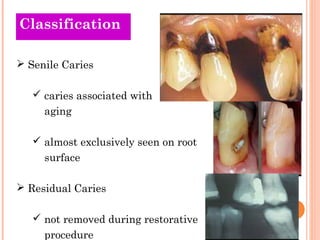
Classification 
 Senile Caries 
 caries associated with 
aging 
 almost exclusively seen on root 
surface 
 Residual Caries 
 not removed during restorative 
procedure
Clinical Features: Smooth 
Surface Caries 
 Interproximal Caries 
 opaque chalky region 
(white spot) 
 some cases yellow or brown 
pigment area 
 spots are generally located on 
outer surface of enamel 
between contact point + height 
of free gingival margin
Clinical Features: Smooth 
Surface Caries 
 Interproximal Caries 
 as caries penetrates 
enamel, enamel surrounding 
the lesion assumes bluish white 
appearance 
• usally apparent as laterally 
spreading caries at DEJ
Clinical Features: Smooth 
Surface Caries 
 Interproximal Caries 
 common for proximal 
caries to extend both 
bucally + lingually
Cervical, Buccal, Lingual or 
Palatal Caries 
 Clinical Features: 
 usually extends from 
area opposite gingival crest 
occlusally to convexity 
of tooth surface 
 extends laterally towards 
proximal surfaces
Cervical, Buccal, Lingual or 
Palatal Caries 
 Clinical Features: 
 usually occurs on cervical 
area 
 typical cervical lesion is a 
crescent shaped cavity 
beginning as slightly 
roughened chalky area 
 gradually becomes excavated
Pit and Fissure Caries 
 Clinical Features: 
 appears brown or black 
 feel slightly soft 
 catch a fine explorer point
Pit and Fissure Caries 
 Clinical Features: 
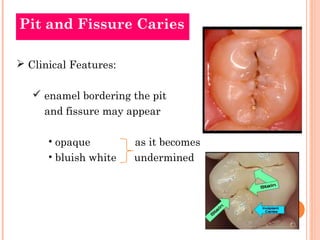
 enamel bordering the pit 
and fissure may appear 
• opaque as it becomes 
• bluish white undermined
Pit and Fissure Caries 
 Clinical Features: 
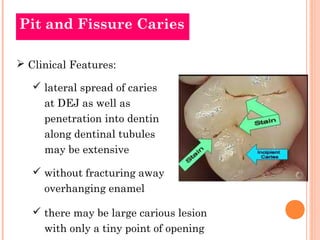
 lateral spread of caries 
at DEJ as well as 
penetration into dentin 
along dentinal tubules 
may be extensive 
 without fracturing away 
overhanging enamel 
 there may be large carious lesion 
with only a tiny point of opening
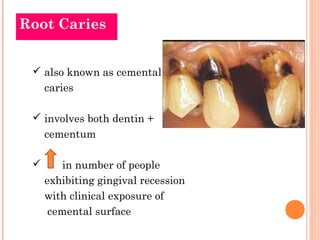
Root Caries 
 also known as cemental 
caries 
 involves both dentin + 
cementum 
 in number of people 
exhibiting gingival recession 
with clinical exposure of 
cemental surface
Root Caries 
 Clinical Features: 
 slowly progressing 
chronic lesion 
 usually found in mandibular 
molar area + premolar 
region 
 gingival recession is associated 
with root surface caries
Recurrent Caries 
 occurs immediately adjacent 
to restoration 
 may be caused by inadequate 
extension of restoration 
 was not able to excavate or 
removed well original 
carious lesion
Recurrent Caries 
 Clinical Features: 
 restoration with poor 
margins 
• permitted leakage + 
entrance of both bacteria + 
substrate
Nursing Bottle 
Caries 
 Etiology: 
 due to nursing bottle 
containing milk or milk 
formula, fruit juice or 
sweetened water 
 sometimes it occurs due to 
sugar or honey-sweetened 
pacifier
Nursing Bottle 
Caries 
 Pathogenesis: 
 child is put on bed at 
afternoon nap time or at night 
with nursing bottle containing 
milk or a sugar containing 
beverage 
 milk or sweetened liquid 
becomes pooled around 
maxillary anterior teeth
Nursing Bottle 
Caries 
 Pathogenesis: 
 carbohydrate containing 
liquid provide an excellent 
culture medium for 
acidogenic microorganisms
Nursing Bottle 
Caries 
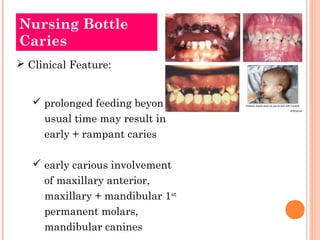
 Clinical Feature: 
 prolonged feeding beyond 
usual time may result in 
early + rampant caries 
 early carious involvement 
of maxillary anterior, 
maxillary + mandibular 1st 
permanent molars, 
mandibular canines
Nursing Bottle 
Caries 
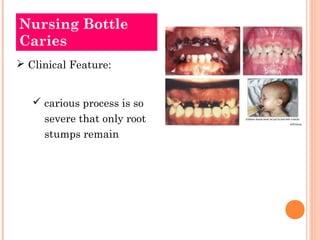
 Clinical Feature: 
 carious process is so 
severe that only root 
stumps remain
Nursing Bottle 
Caries 
 Prevention: 
 parent should start brushing 
the child teeth as soon 
as they erupt in oral 
cavity 
 discontinue bottle feeding as 
soon as child can drink from 
a cup, at approximately 
12-15 months of age
Rampant Caries 
 suddenly appearing 
 widespread 
 resulting in early involvement 
of pulp
Rampant Caries 
 Etiology: 
 may be due to nutritional 
deficiency 
 malnutrition 
 emotional disturbances
Rampant Caries 
 Clinical Features: 
 occurs in children with 
poor dietary habits 
 extensive inter-proximal 
+ smooth surface caries
Rampant Caries 
 Management: 
 extensive dental care 
 parent education
Arrested Caries 
 Clinical Features: 
 both deciduous + permanent 
are affected 
 large open cavities 
 brown-stained polished 
appearance + hard
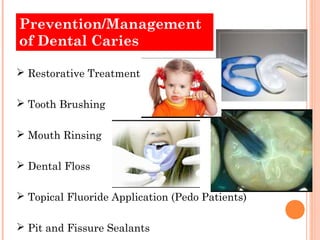
Prevention/Management 
of Dental Caries 
 Restorative Treatment 
 Tooth Brushing 
 Mouth Rinsing 
 Dental Floss 
 Topical Fluoride Application (Pedo Patients) 
 Pit and Fissure Sealants
RReeffeerreenncceess:: 
 BBooookkss 
 CCaawwssoonn,, RR..AA:: CCaawwssoonn’’ss EEsssseennttiiaallss ooff OOrraall 
OOrraall PPaatthhoollooggyy aanndd OOrraall MMeeddiicciinnee,, 
88tthh EEddiittiioonn 
• ((ppaaggee 4400)) 
 GGhhoomm,, AAllii && MMhhaasskkee,, SShhuubbhhaannggii:: TTeexxttbbooookk ooff 
OOrraall PPaatthhoollooggyy 
• ((ppaaggeess 440011--441199)) 
SShhaaffeerr,, eett aall:: AA tteexxttbbooookk ooff OOrraall PPaatthhoollooggyy,, 
33rrdd EEddiittiioonn 
• ((ppaaggeess 336699,,339944,, 440077))

Dental caries

  • 1.
    DENTAL CARIES UploadBByy :: AAhhmmeedd AAllii AAbbbbaass Babylon University College of Dentistry ddoowwnnllooaadd tthhiiss ffiillee ffrroomm WWeebbssiittee oonn ggooooggllee theoptimalsmile.wix.com/dentistry GROUP: C
  • 2.
    Dental Caries progressive  initially subsurface demineralization of teeth by bacterial acid  one of the most common of all diseases  major cause of loss of teeth
  • 3.
    Dental Caries may be considered a disease of modern civilization  since prehistoric man rarely suffered from this form of tooth
  • 4.
    Dental Caries biological process of tooth decay with mutifactorial etiology  microbial disease of calcified tissues of teeth  characterized by demineralization of inorganic portion  destruction of organic substance of tooth
  • 5.
    Etiology of DentalCaries  generally agreed to be complex problem  complicated by many indirect factors  obscure the direct cause or causes
  • 6.
    Etiology of DentalCaries Diet Caries Bacteria Time Susceptible Surface (Host) Possible interventions Reduce intake of cariogenic sugars Particularly sucrose Possible interventions Avoid frequent sucrose intake (snacking) Stimulate salivary flow + sugar clearance Possible interventions Reduce Strep. mutans numbers by: Reduction in sugar intake Active or passive immunization Possible interventions Water + other types of Fluoridation Prevention during post-eruptive maturation Fissure sealing Properly contured restorations
  • 7.
    Etiology of DentalCaries Plaque Acidogenic Bacteria Enzymes Food Acids Tooth Carious Lesions
  • 8.
    Etiology of DentalCaries  Old Theories  Exogenous Theories • (1) Legend of worm • (2) Chemical Theory • (3) Parasitic or Septic Theory
  • 9.
    Etiology of DentalCaries  Old Theories  Endogenous Theories • (1) Humoral Theory • (2) Vital Theory
  • 10.
    Etiology of DentalCaries  New Theories  (1) Acidogenic Theory  (2) Proteolytic Theory  (3) Proteolysis-chelation Theory
  • 11.
    Old Theories (ExogenousTheory)  (1) Legend of Worm  5000 BC  ancient Sumerian text  obtained from Mesopotamian area  caused by worm that drank blood of teeth  fed on roots of jaws
  • 12.
    Old Theories (ExogenousTheory)  (2) Chemical Theory  1819  proposed by Parmly  unidentified chemical agent  responsible for caries
  • 13.
    Old Theories (ExogenousTheory)  (2) Chemical Theory  stated that caries began on enamel surface where food putrefied  acquired sufficient dissolving power to produce disease chemically
  • 14.
    Old Theories (ExogenousTheory)  (3) Parasitic or Septic Theory  1843  proposed by Erdl  filamentous parasite in plaque • he termed as “Denticolae” • responsible for dental caries
  • 15.
    OOlldd TThheeoorriieess (EndogenousTheory)  (1) Humoral Theory  4 humors of body • blood • phelgm • black bile • yellow bile  any change in relative proportion of these elements causes disease
  • 16.
    OOlldd TThheeoorriieess (EndogenousTheory)  (2) Vital Theory  18 century  tooth decay originated like bone gangrene, from within the tooth itself
  • 17.
    NOledw T Thheeoorrieiess (Exogenous Theory)  (1) Acidogenic/Chemoparasitic Theory  1890  WD Miller  dental decay is a chemoparasitic process consisting of 2 stages • decalcification of enamel  results in total destruction
  • 18.
    NOledw T Thheeoorrieiess (Exogenous Theory)  (1) Acidogenic/Chemoparasitic Theory • decalcification of dentin as a preliminary stage  followed by dissolution of softened residue
  • 19.
    NOledw T Thheeoorrieiess (Exogenous Theory)  (1) Acidogenic/Chemoparasitic Theory  following factors cause decay: • (1) Role of carbohydrates • (2) Role of microorganisms • (3) Role of acids • (4) Role of dental plaque
  • 20.
    (O1l)dA cTihdeoogreineisc / Chemoparasitic Theory  (1) Role of carbohydrates  food substances act as substrate for microorganisms of dental plaque  various carbohydrates have been examined for cariogenic potential
  • 21.
    (O1l)dA cTihdeoogreineisc / Chemoparasitic Theory  (1) Role of carbohydrates  cariogenicity of carbohydrate varies with: • (1) frequency of ingestion • (2) physical form • (3) chemical composition • (4) route of administration • (5) presence of other food constituents
  • 22.
    (O1l)dA cTihdeoogreineisc / Chemoparasitic Theory  (1) Role of carbohydrates • (1) frequency of ingestion  taken repeatedly in between two major meals  provides constant supply of carbohydrate to plaque bacteria for fermentation + production of acids
  • 23.
    (O1l)dA cTihdeoogreineisc / Chemoparasitic Theory  (1) Role of carbohydrates • (2) physical form  sticky  solid carbohydrates
  • 24.
    (O1l)dA cTihdeoogreineisc / Chemoparasitic Theory  (1) Role of carbohydrates • (3) chemical composition  in the form of glucose, sucrose + fructose due to low molecular weight  rapidly diffuse into plaque  make themselves easily available for fermentation by plaque bacteria
  • 25.
    (1)Acidogenic/ Chemoparasitic Theory  (1) Role of carbohydrates • (4) Route of administration  oral intake of sticky food
  • 26.
    (1)Acidogenic/ Chemoparasitic Theory  (1) Role of carbohydrates • (5) Presence of other food constituents  refined pure carbohydrates more caries producing
  • 27.
    (1)Acidogenic/ Chemoparasitic Theory  (2) Role of microorganisms  caused by acid resulting from action of microorganisms on carbohydrates
  • 28.
    (1)Acidogenic/ Chemoparasitic Theory  (2) Role of microorganisms Initiation of Dental Caries Progression of Dental Caries Streptococci • S. mutans • S. milleri • S. mitior • S. sanguis • S. salivaris Streptococcal species: Streptoccal species in deep dentinal caries and root caries Lactobacilli • L. acidophillus • L. casei Lactobacilli in dentin • L. acidophillus • L. casei Actinomycoses • A. viscosus • A. naeslundii Actinomycoses • A. Israeli • A. odontolyticus
  • 29.
    (1)Acidogenic/ Chemoparasitic Theory  (2) Role of microorganisms  S. mutans has been proved for the initiation of caries
  • 30.
    (1)Acidogenic/ Chemoparasitic Theory  (3) Role of acids  play most important role in pathogenesis of dental caries  pH 5.5 is called critical pH  below this pH demineralization of tooth substance begins
  • 31.
    (1)Acidogenic/ Chemoparasitic Theory  (4) Role of Dental Plaque  found on uncleaned tooth surfaces  appear as tenacious, thin film  may accumulate within 24-48 hours
  • 32.
    NOledw T Thheeoorrieiess (Exogenous Theory)  (2) Proteolytic Theory  proteolysis of the organic components of tooth as an initial process  than actual demineralization + dissolution of inorganic substances
  • 33.
    NOledw T Thheeoorrieiess (Exogenous Theory)  (2) Proteolytic Theory  proposed that enamel lamellae or rod sheath (proteins) may be lysed  which means proteolysis as first event in further progression of bacterial invasion + demineralization carious lesions
  • 34.
    NOledw T Thheeoorrieiess (Exogenous Theory)  (3) Proteolysis Chelation Theory  suggests that caries is caused by simultaneous events of proteolysis + chelation  proteolysis • destruction of organic portion of tooth by proteolytic microorganisms
  • 35.
    NOledw T Thheeoorrieiess (Exogenous Theory)  (3) Proteolysis Chelation Theory  chelation •removal of calcium by forming soluble chelates  oral bacteria attack organic component of enamel (proteolysis)  breakdown products have chelating ability and this dissolves tooth minerals
  • 36.
    COllads Tsihfiecoartiieosn (1) Depending on nature of attack  (2) Depending on progression of caries  (3) Depending on surfaces involved  (4) Based on direction of attack  (5) Based on number of surfaces involved
  • 37.
    COllads Tsihfiecoartiieosn (6) GV Black Classification based on treatment and restoration design  (7) Based on location of lesion  (8) Based on tissue involved
  • 38.
    (O1l)d N Tahtueorerioefs Attack  Primary Caries  incipient; initial  first attack on tooth surface  Secondary Caries  recurrent  occurs on margins or walls of existing restorations
  • 39.
    (O2l)d P Trhogeorersiession of Caries  Acute  rapidly invading process  involves several teeth  lesions are soft + light colored
  • 40.
    (O2l)d P Trhogeorersiession of Caries  Acute  usually pulp is involved at early stage • Rampant caries • Nursing bottle caries • Radiation caries
  • 41.
    (O2l)d P Trhogeorersiession of Caries  Chronic  lesions are long standing  fewer in number
  • 42.
    (O3l)d S Tuhrfeaocreiessi nvolved  Pit and fissure  Smooth surface caries
  • 43.
    (O4l)d D Tirheecotriioensof caries attack  Forward Caries  proceeds from enamel to dentin  lesion is triangle in shaped with base of triangle at enamel surface + apex towards dentin  in pits + fissures base is at DEJ + apex is in the pit
  • 44.
    (O4l)d D Tirheecotriioensof caries attack  Backward Caries  proceeds from DEJ towards enamel surface  also triangle shaped with base at DEJ + apex towards enamel surface
  • 45.
    (O5l)d N Tuhmeobreireos f Surfaces involved  Simple  only one surface is involved by caries  Compound  2 surfaces are involved  Complex  more than 3 surfaces involved
  • 46.
    (O6l)d G TVhBeolariceks Classification  Class I  begin in pits, fissures + defective grooves  seen in occlusal surface  occlusal two-thirds of molars  lingual pits of incisors
  • 47.
    (O6l)d G TVhBeolariceks Classification  Class II  lesions seen on proximal aspects of molars + premolars
  • 48.
    (O6l)d G TVhBeolariceks Classification  Class III  lesions involving proximal aspects of incisors  do not involve or necessitate removal of incisal edge
  • 49.
    (O6l)d G TVhBeolariceks Classification  Class IV  lesions involving proximal aspects of incisors  involve or require removal of incisal edge
  • 50.
    (O6l)d G TVhBeolariceks Classification  Class V  lesions present on gingival third of all teeth
  • 51.
    (O6l)d G TVhBeolariceks Classification  Class VI  lesions found on incisal edges + cusp tips
  • 52.
    (O7l)d L Tohcaeotiroineso f the lesion  Pit and Fissure caries  Occlusal  Buccal or lingual pit  Smooth surface caries  Proximal  Buccal or Lingual surface  Root caries
  • 53.
    (O8l)d T Tishseuoeriiensv olved  Enamel Caries  Dentinal Caries  Cemental Caries
  • 54.
    Classification  SenileCaries  caries associated with aging  almost exclusively seen on root surface  Residual Caries  not removed during restorative procedure
  • 55.
    Clinical Features: Smooth Surface Caries  Interproximal Caries  opaque chalky region (white spot)  some cases yellow or brown pigment area  spots are generally located on outer surface of enamel between contact point + height of free gingival margin
  • 56.
    Clinical Features: Smooth Surface Caries  Interproximal Caries  as caries penetrates enamel, enamel surrounding the lesion assumes bluish white appearance • usally apparent as laterally spreading caries at DEJ
  • 57.
    Clinical Features: Smooth Surface Caries  Interproximal Caries  common for proximal caries to extend both bucally + lingually
  • 58.
    Cervical, Buccal, Lingualor Palatal Caries  Clinical Features:  usually extends from area opposite gingival crest occlusally to convexity of tooth surface  extends laterally towards proximal surfaces
  • 59.
    Cervical, Buccal, Lingualor Palatal Caries  Clinical Features:  usually occurs on cervical area  typical cervical lesion is a crescent shaped cavity beginning as slightly roughened chalky area  gradually becomes excavated
  • 60.
    Pit and FissureCaries  Clinical Features:  appears brown or black  feel slightly soft  catch a fine explorer point
  • 61.
    Pit and FissureCaries  Clinical Features:  enamel bordering the pit and fissure may appear • opaque as it becomes • bluish white undermined
  • 62.
    Pit and FissureCaries  Clinical Features:  lateral spread of caries at DEJ as well as penetration into dentin along dentinal tubules may be extensive  without fracturing away overhanging enamel  there may be large carious lesion with only a tiny point of opening
  • 63.
    Root Caries also known as cemental caries  involves both dentin + cementum  in number of people exhibiting gingival recession with clinical exposure of cemental surface
  • 64.
    Root Caries Clinical Features:  slowly progressing chronic lesion  usually found in mandibular molar area + premolar region  gingival recession is associated with root surface caries
  • 65.
    Recurrent Caries occurs immediately adjacent to restoration  may be caused by inadequate extension of restoration  was not able to excavate or removed well original carious lesion
  • 66.
    Recurrent Caries Clinical Features:  restoration with poor margins • permitted leakage + entrance of both bacteria + substrate
  • 67.
    Nursing Bottle Caries  Etiology:  due to nursing bottle containing milk or milk formula, fruit juice or sweetened water  sometimes it occurs due to sugar or honey-sweetened pacifier
  • 68.
    Nursing Bottle Caries  Pathogenesis:  child is put on bed at afternoon nap time or at night with nursing bottle containing milk or a sugar containing beverage  milk or sweetened liquid becomes pooled around maxillary anterior teeth
  • 69.
    Nursing Bottle Caries  Pathogenesis:  carbohydrate containing liquid provide an excellent culture medium for acidogenic microorganisms
  • 70.
    Nursing Bottle Caries  Clinical Feature:  prolonged feeding beyond usual time may result in early + rampant caries  early carious involvement of maxillary anterior, maxillary + mandibular 1st permanent molars, mandibular canines
  • 71.
    Nursing Bottle Caries  Clinical Feature:  carious process is so severe that only root stumps remain
  • 72.
    Nursing Bottle Caries  Prevention:  parent should start brushing the child teeth as soon as they erupt in oral cavity  discontinue bottle feeding as soon as child can drink from a cup, at approximately 12-15 months of age
  • 73.
    Rampant Caries suddenly appearing  widespread  resulting in early involvement of pulp
  • 74.
    Rampant Caries Etiology:  may be due to nutritional deficiency  malnutrition  emotional disturbances
  • 75.
    Rampant Caries Clinical Features:  occurs in children with poor dietary habits  extensive inter-proximal + smooth surface caries
  • 76.
    Rampant Caries Management:  extensive dental care  parent education
  • 77.
    Arrested Caries Clinical Features:  both deciduous + permanent are affected  large open cavities  brown-stained polished appearance + hard
  • 78.
    Prevention/Management of DentalCaries  Restorative Treatment  Tooth Brushing  Mouth Rinsing  Dental Floss  Topical Fluoride Application (Pedo Patients)  Pit and Fissure Sealants
  • 79.
    RReeffeerreenncceess::  BBooookkss  CCaawwssoonn,, RR..AA:: CCaawwssoonn’’ss EEsssseennttiiaallss ooff OOrraall OOrraall PPaatthhoollooggyy aanndd OOrraall MMeeddiicciinnee,, 88tthh EEddiittiioonn • ((ppaaggee 4400))  GGhhoomm,, AAllii && MMhhaasskkee,, SShhuubbhhaannggii:: TTeexxttbbooookk ooff OOrraall PPaatthhoollooggyy • ((ppaaggeess 440011--441199)) SShhaaffeerr,, eett aall:: AA tteexxttbbooookk ooff OOrraall PPaatthhoollooggyy,, 33rrdd EEddiittiioonn • ((ppaaggeess 336699,,339944,, 440077))