

PRINCIPLES OF ELEVATOR
AND FORCEPS USE
1
PRINCIPLES OF ELEVATOR AND FORCEPS USE
The primary instruments used to remove a tooth from the alveolar process
are the elevator and extraction forceps.
Elevators help in the luxation of a tooth, and forceps continue that process
through bone expansion and disruption of periodontal attachments.
2
PRINCIPLES OF ELEVATOR AND FORCEPS USE 3
The goal of forceps use is twofold:
(1) expansion of the bony socket by use of the wedge-shaped beaks of the forceps
and the movements of the tooth itself with the forceps, and (2) removal of the tooth
from the socket.
PRINCIPLES OF ELEVATOR AND FORCEPS USE
• The dental elevator consists of a handle, a shank, and a blade.
• Blades can be straight, triangular (Cryer), curved (Potts), or pointed (Crane pick).
4
PRINCIPLES OF ELEVATOR AND FORCEPS USE
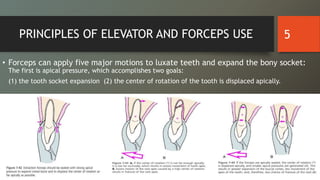
• Forceps can apply five major motions to luxate teeth and expand the bony socket:
The first is apical pressure, which accomplishes two goals:
(1) the tooth socket expansion (2) the center of rotation of the tooth is displaced apically.
5
PRINCIPLES OF ELEVATOR AND FORCEPS USE
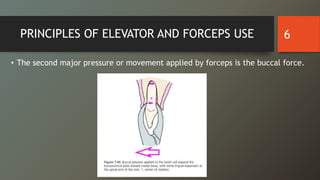
• The second major pressure or movement applied by forceps is the buccal force.
6
PRINCIPLES OF ELEVATOR AND FORCEPS USE
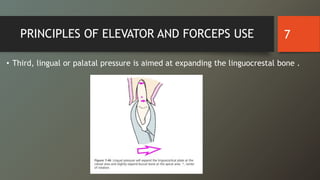
• Third, lingual or palatal pressure is aimed at expanding the linguocrestal bone .
7
PRINCIPLES OF ELEVATOR AND FORCEPS USE
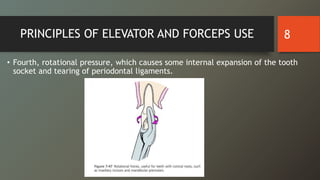
• Fourth, rotational pressure, which causes some internal expansion of the tooth
socket and tearing of periodontal ligaments.
8
PRINCIPLES OF ELEVATOR AND FORCEPS USE
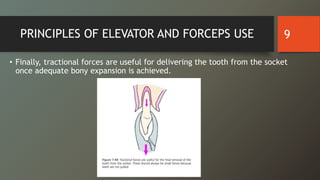
• Finally, tractional forces are useful for delivering the tooth from the socket
once adequate bony expansion is achieved.
9
Thank you for listening
Ahmed Abdulwahab
1330095

Principles of elevator and forceps use (Dentistry)

  • 1.
  • 2.
    PRINCIPLES OF ELEVATORAND FORCEPS USE The primary instruments used to remove a tooth from the alveolar process are the elevator and extraction forceps. Elevators help in the luxation of a tooth, and forceps continue that process through bone expansion and disruption of periodontal attachments. 2
  • 3.
    PRINCIPLES OF ELEVATORAND FORCEPS USE 3 The goal of forceps use is twofold: (1) expansion of the bony socket by use of the wedge-shaped beaks of the forceps and the movements of the tooth itself with the forceps, and (2) removal of the tooth from the socket.
  • 4.
    PRINCIPLES OF ELEVATORAND FORCEPS USE • The dental elevator consists of a handle, a shank, and a blade. • Blades can be straight, triangular (Cryer), curved (Potts), or pointed (Crane pick). 4
  • 5.
    PRINCIPLES OF ELEVATORAND FORCEPS USE • Forceps can apply five major motions to luxate teeth and expand the bony socket: The first is apical pressure, which accomplishes two goals: (1) the tooth socket expansion (2) the center of rotation of the tooth is displaced apically. 5
  • 6.
    PRINCIPLES OF ELEVATORAND FORCEPS USE • The second major pressure or movement applied by forceps is the buccal force. 6
  • 7.
    PRINCIPLES OF ELEVATORAND FORCEPS USE • Third, lingual or palatal pressure is aimed at expanding the linguocrestal bone . 7
  • 8.
    PRINCIPLES OF ELEVATORAND FORCEPS USE • Fourth, rotational pressure, which causes some internal expansion of the tooth socket and tearing of periodontal ligaments. 8
  • 9.
    PRINCIPLES OF ELEVATORAND FORCEPS USE • Finally, tractional forces are useful for delivering the tooth from the socket once adequate bony expansion is achieved. 9
  • 10.
    Thank you forlistening Ahmed Abdulwahab 1330095