o p e ra ti
v e
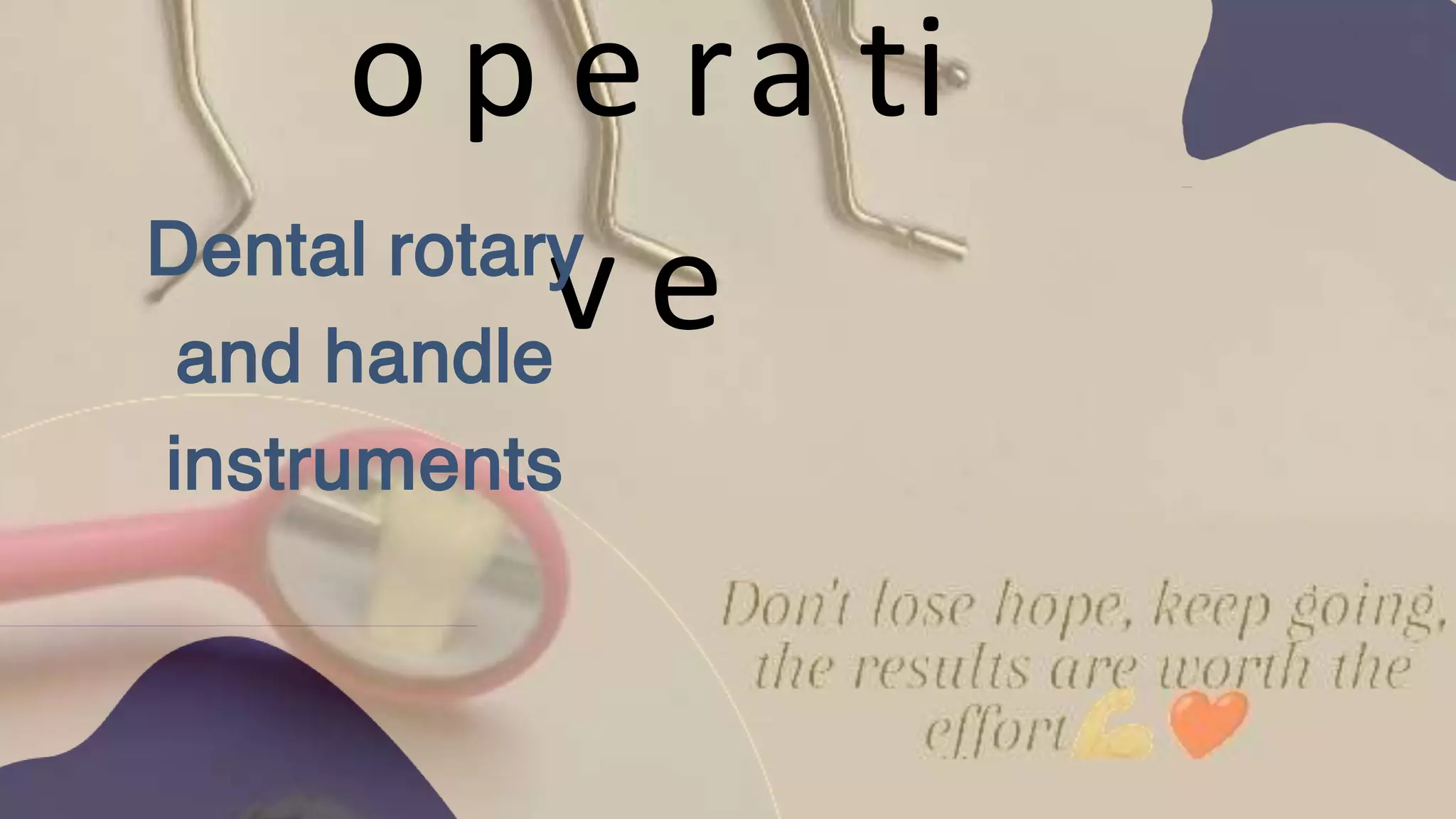
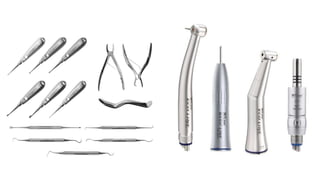
Dental rotary
and handle
instruments
im p o rta n t
q u e s tio n s !
what is function of chisel chisel? -1
2-explain the 3dental formula
instruments?
3-function of hatchet?
4-Enumerate the plastic instruments
and function?
5-Enumerate the type of grasp
instruments.?
6-function of fissure bur?
The removal and shaping of tooth
structure are essential aspects of
restorative dentistry.
Initially this was a difficult process
accomplished entirely by the use of
- Hand instruments.
G.V. Black is credited with the first acceptable
nomenclature and classification
of hand instruments. His classification system enabled
both dentists and
manufacturers to communicate more clearly and
effectively in regard to
instrument design and function.
H a n d
in s tru m e n ts
It is hand-powered dental instruments.
Stainless steel is now the preferred material because stainless steel instrument
remains bright with steam or dry heat sterilization, and because the properties of
stainless steel have improved by incorporating a significant amount of chromium
imparts corrosion resistance and carbon imparts hardness.
For many years, carbon steel was the primary
material used in hand instruments
because they were harder and maintained
sharpness better than stainless steel.
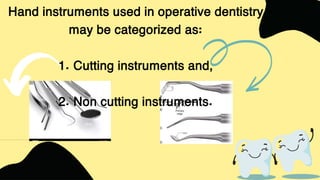
Hand instruments used in operative dentistry
may be categorized as:
1. Cutting instruments and,
2. Non cutting instruments.
Cutting instruments
These instruments are used to cut hard or
soft tissue of the mouth.
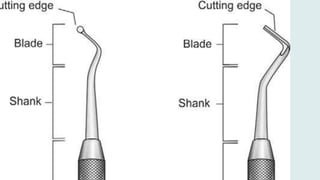
Hand cutting instruments are composed of
three parts: handle, shank and blade (Fig 1).
For non cutting instruments; the part
corresponding to the blade is termed the nib
The blade or nib; is the working end of the
instrument and is connected to the shank.
Some instrument have a blade on both ends of
the handle and are known as double ended
instrument. The blades have many designs and
sizes, depending on the function they are
to perform
The Shank; serves to connect the handle
to the blade of the instrument. The shank
may
be straight, mon-angle (with one angle),
bin-angle (with two angles) , triple-angle
(three
angles) , or quadr-angle (four angles)
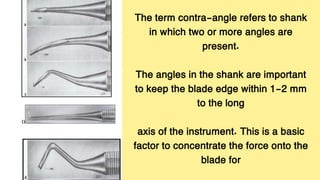
The term contra-angle refers to shank
in which two or more angles are
present.
The angles in the shank are important
to keep the blade edge within 1-2 mm
to the long
axis of the instrument. This is a basic
factor to concentrate the force onto the
blade for
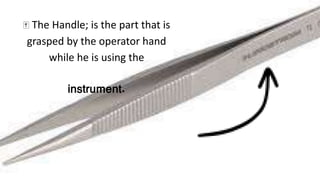
The Handle; is the part that is
grasped by the operator hand
while he is using the
instrument.
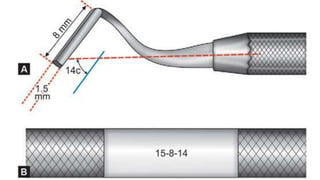
In s tru m e n t F o rm u la
G iv e n b y G .V .B la c k :
3 N u m b e r in s tru m e n t fo rm u la :
C u ttin g e d g e o f th e In s tru m e n t is
a t a rig h t a n g le to th e
b la d e .
a. First number- Width of the blade in tenths of a millimeter.
b. Second number - Length of the blade in millimeter.
c. Third number - Angle the blade forms with the axis of the
handle in centigrade.
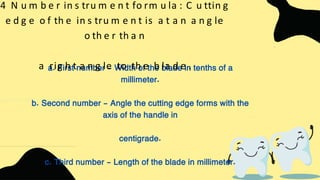
a. First number - Width of the blade in tenths of a
millimeter.
b. Second number - Angle the cutting edge forms with the
axis of the handle in
centigrade.
c. Third number - Length of the blade in millimeter.
4 N u m b e r in s tru m e n t fo rm u la : C u ttin g
e d g e o f th e in s tru m e n t is a t a n a n g le
o th e r th a n
a rig h t a n g le to th e b la d e .
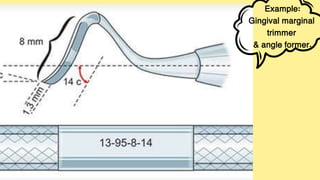
Example:
Gingival marginal
trimmer
& angle former.
E x a m p le s o f th e c u ttin g
in s tru m e n ts :
1. Chisel: - either has a straight shank or with slight blade
curvature or bin-angle chisel,
and the blade has bevel only on one side of the edge. Its cutting
edge is perpendicular to
the axis of the handle. The chisels are used for cutting enamel and
dentin with pushing
motion. The shank and blade of the chise
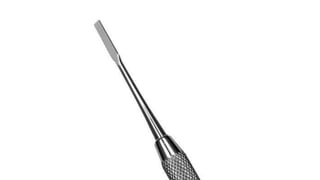
2. Hoe: - It is like chisel with cutting edge
is perpendicular to the axis of the handle
(Fig.
4 D), however its blade has a greater angle
from the long axis of the handle than does
that
of the chisel. It has the same uses of the
chisel.
3. Hatchet: - also called enamel hatchet.
The cutting edge of the hatchet is parallel to
the
long axis of the handle and beveled only from
one side (Fig. 5 A). It is used for cutting
enamel and dentin and comes as right or left
types for using on opposite sides of the
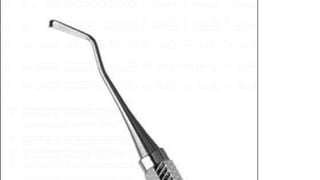
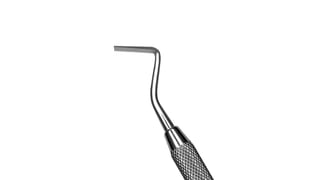
4. Gingival margin trimmer: - This instrument is used for
beveling of the gingival
enamel margin of proximo-occlusal preparations. Also it is
used for beveling of
axiopulpal line angle of two surface preparation as in class II
cavities.
It is similar in design to the hatchet, except the blade is
curved, and cutting edge is at
an angle (other than parallel) to the long axis of the blade (Fig.
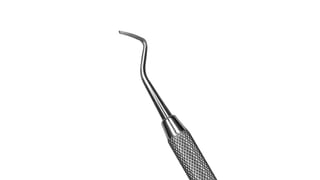
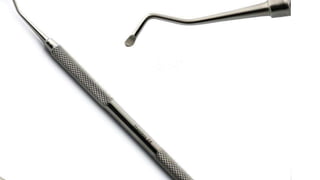
Spoon excavator:- The blade is curved and the
cutting edge at the end of the blade is
in the form of a semicircle. This gives the
instrument an outer convexity and inner
concaving that makes it looks like a spoon Fig.
(6). Like the hatchet the cutting edge at
the end of the blade is parallel to the handle, ae
therefore there are left cutting and right
cutting spoons. The shank of some
spoons holds a small circular (disk
blade) or claw –
like blade at its end. The disk blade is
known as a discoid, where the claw -
like blade is
N o n -c u ttin g
in s tru m e n ts
In these instruments the blade is replaced
by a nib or point. These are
divided according to function into:
1- Diagnostic instruments
2- Plastic instruments
3- Amalgam instruments
D ia g n o s tic
in s tru m e n ts
These are basic instruments that will be
needed during each appointment for
diagnosis and treatment.
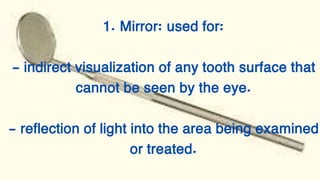
1. Mirror: used for:
- indirect visualization of any tooth surface that
cannot be seen by the eye.
- reflection of light into the area being examined
or treated.
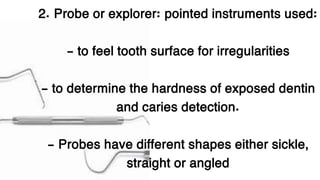
2. Probe or explorer: pointed instruments used:
- to feel tooth surface for irregularities
- to determine the hardness of exposed dentin
and caries detection.
- Probes have different shapes either sickle,
straight or angled
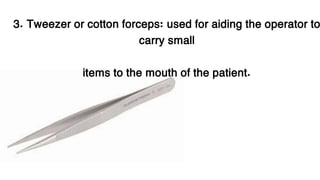
3. Tweezer or cotton forceps: used for aiding the operator to
carry small
items to the mouth of the patient.
Plastic instruments: Or plastic filling instrument are used to:
- carry and shape tooth colored restorative material such as
composite
resin and glass ionomer.
- packing temporary filling material inside unfilled cavities
preparation.
- or for placing of basing and lining material into the cavities.
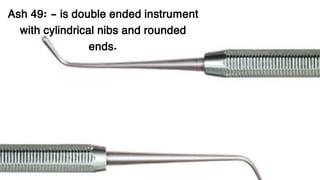
Ash 49: - is double ended instrument
with cylindrical nibs and rounded
ends.
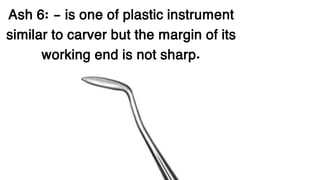
Ash 6: - is one of plastic instrument
similar to carver but the margin of its
working end is not sharp.
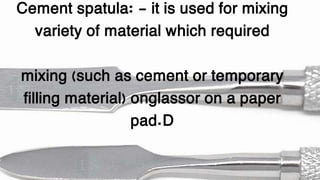
Cement spatula: - it is used for mixing
variety of material which required
mixing (such as cement or temporary
filling material) onglassor on a paper
pad.D
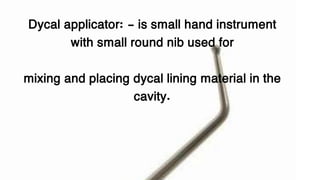
Dycal applicator: - is small hand instrument
with small round nib used for
mixing and placing dycal lining material in the
cavity.
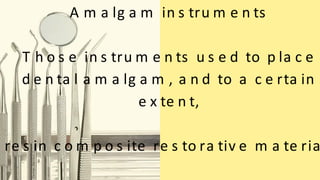
A m a lg a m in s tru m e n ts
T h o s e in s tru m e n ts u s e d to p la c e
d e n ta l a m a lg a m , a n d to a c e rta in
e x te n t,
re s in c o m p o s ite re s to ra tiv e m a te ria
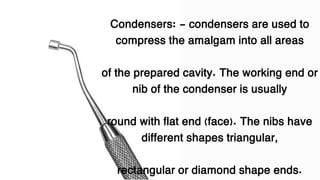
Condensers: - condensers are used to
compress the amalgam into all areas
of the prepared cavity. The working end or
nib of the condenser is usually
round with flat end (face). The nibs have
different shapes triangular,
rectangular or diamond shape ends.
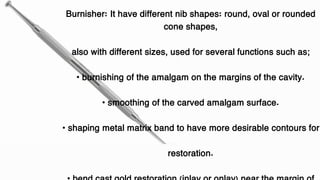
Burnisher: It have different nib shapes: round, oval or rounded
cone shapes,
also with different sizes, used for several functions such as;
• burnishing of the amalgam on the margins of the cavity.
• smoothing of the carved amalgam surface.
• shaping metal matrix band to have more desirable contours for
restoration.
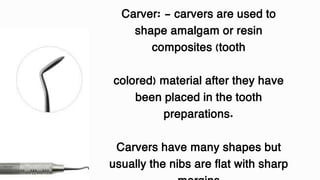
Carver: - carvers are used to
shape amalgam or resin
composites (tooth
colored) material after they have
been placed in the tooth
preparations.
Carvers have many shapes but
usually the nibs are flat with sharp
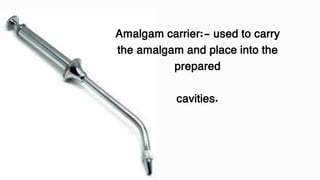
Amalgam carrier:- used to carry
the amalgam and place into the
prepared
cavities.
H a n d in s tru m e n t
g ra s p in g
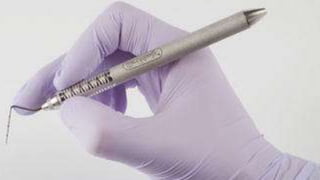
1. Pen grasp: - It is similar to that used in holding a pen.
Pads of the thumb,
index and middle fingers hold the instrument, while the
tip of the ring finger
, or tips of ring and little fingers, is placed on a nearby
tooth surface of the
same arch as arrest. The palm of the hand generally is
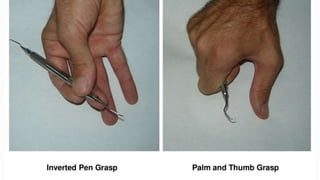
2. Inverted pen grasp: - The finger position is the same as
of pen grasp, but
the hand is rotated so that the palm more toward the
operator. This grasping
is used mostly for preparing of upper teeth with indirect
viewing technique
3-Palm and thumb grasp: - The handle
of the instrument is placed in the
palm of the hand and grasped by all
fingers, while the thumb is free of the
instrument and used for resting on a
nearby tooth of the same arch
R o ta ry
in s tru m e n ts :
Handpieces:-
Two basic types of handpieces:
- Straight handpiece: used for
laboratory work
contra angle handpiece: used in the mouth.
The contra – angle handpiece are classified according to their
speed of
rotation into:
Low speed handpiece: have a free running speed range from 500 to
15,000
rpm (revolution per minute).
- used for removal of carious dentin with round bur rotating slowly.
- used with different bur shapes to finish the prepared cavity (e.g.
rounding of sharp edges, or flatting of the floor).
High speed handpiece: - have a free running speed above 160,000
rpm and
some have speed up to 500,000 rpm.
- Preferred for cutting enamel and dentin.
- Penetration through enamel and extension of the cavities outline
are
more efficient at high speed.
- Small diameter burs should be used in the high speed handpiece.
A group of instruments that can turn on an axis with
different speed of
rotation to perform different types of work.
- Its work are either cutting , abrasive, finishing or
polishing.
-Burs used for cutting are manufactured from different
materials, which may
B u rs :
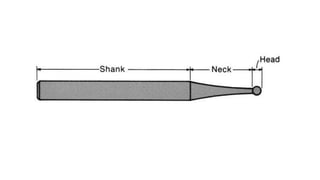
Parts of bur:
Shank is the part that fit into the handpiece, accepts the rotation
motion
from handpiece, and which the bur is locked inside the handpiece
head.
Neck is the part of the bur that connects the head to the shank.
Head is the working part of the bur which contains the cutting
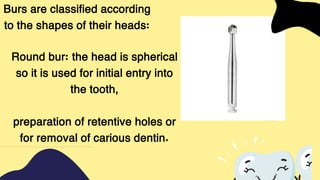
Burs are classified according
to the shapes of their heads:
Round bur: the head is spherical
so it is used for initial entry into
the tooth,
preparation of retentive holes or
for removal of carious dentin.
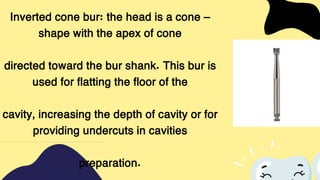
Inverted cone bur: the head is a cone –
shape with the apex of cone
directed toward the bur shank. This bur is
used for flatting the floor of the
cavity, increasing the depth of cavity or for
providing undercuts in cavities
preparation.
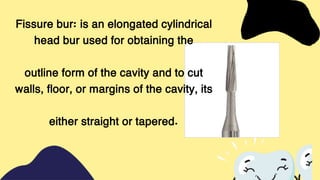
Fissure bur: is an elongated cylindrical
head bur used for obtaining the
outline form of the cavity and to cut
walls, floor, or margins of the cavity, its
either straight or tapered.
opertve instruments
opertve instruments

opertve instruments

  • 1.
    o p era ti v e Dental rotary and handle instruments
  • 2.
    im p orta n t q u e s tio n s ! what is function of chisel chisel? -1 2-explain the 3dental formula instruments? 3-function of hatchet? 4-Enumerate the plastic instruments and function? 5-Enumerate the type of grasp instruments.? 6-function of fissure bur?
  • 3.
    The removal andshaping of tooth structure are essential aspects of restorative dentistry. Initially this was a difficult process accomplished entirely by the use of - Hand instruments.
  • 5.
    G.V. Black iscredited with the first acceptable nomenclature and classification of hand instruments. His classification system enabled both dentists and manufacturers to communicate more clearly and effectively in regard to instrument design and function. H a n d in s tru m e n ts It is hand-powered dental instruments.
  • 6.
    Stainless steel isnow the preferred material because stainless steel instrument remains bright with steam or dry heat sterilization, and because the properties of stainless steel have improved by incorporating a significant amount of chromium imparts corrosion resistance and carbon imparts hardness. For many years, carbon steel was the primary material used in hand instruments because they were harder and maintained sharpness better than stainless steel.
  • 7.
    Hand instruments usedin operative dentistry may be categorized as: 1. Cutting instruments and, 2. Non cutting instruments.
  • 8.
    Cutting instruments These instrumentsare used to cut hard or soft tissue of the mouth. Hand cutting instruments are composed of three parts: handle, shank and blade (Fig 1). For non cutting instruments; the part corresponding to the blade is termed the nib
  • 9.
    The blade ornib; is the working end of the instrument and is connected to the shank. Some instrument have a blade on both ends of the handle and are known as double ended instrument. The blades have many designs and sizes, depending on the function they are to perform
  • 11.
    The Shank; servesto connect the handle to the blade of the instrument. The shank may be straight, mon-angle (with one angle), bin-angle (with two angles) , triple-angle (three angles) , or quadr-angle (four angles)
  • 12.
    The term contra-anglerefers to shank in which two or more angles are present. The angles in the shank are important to keep the blade edge within 1-2 mm to the long axis of the instrument. This is a basic factor to concentrate the force onto the blade for
  • 13.
    The Handle; isthe part that is grasped by the operator hand while he is using the instrument.
  • 14.
    In s trum e n t F o rm u la G iv e n b y G .V .B la c k :
  • 15.
    3 N um b e r in s tru m e n t fo rm u la : C u ttin g e d g e o f th e In s tru m e n t is a t a rig h t a n g le to th e b la d e . a. First number- Width of the blade in tenths of a millimeter. b. Second number - Length of the blade in millimeter. c. Third number - Angle the blade forms with the axis of the handle in centigrade.
  • 17.
    a. First number- Width of the blade in tenths of a millimeter. b. Second number - Angle the cutting edge forms with the axis of the handle in centigrade. c. Third number - Length of the blade in millimeter. 4 N u m b e r in s tru m e n t fo rm u la : C u ttin g e d g e o f th e in s tru m e n t is a t a n a n g le o th e r th a n a rig h t a n g le to th e b la d e .
  • 18.
  • 19.
    E x am p le s o f th e c u ttin g in s tru m e n ts : 1. Chisel: - either has a straight shank or with slight blade curvature or bin-angle chisel, and the blade has bevel only on one side of the edge. Its cutting edge is perpendicular to the axis of the handle. The chisels are used for cutting enamel and dentin with pushing motion. The shank and blade of the chise
  • 21.
    2. Hoe: -It is like chisel with cutting edge is perpendicular to the axis of the handle (Fig. 4 D), however its blade has a greater angle from the long axis of the handle than does that of the chisel. It has the same uses of the chisel.
  • 23.
    3. Hatchet: -also called enamel hatchet. The cutting edge of the hatchet is parallel to the long axis of the handle and beveled only from one side (Fig. 5 A). It is used for cutting enamel and dentin and comes as right or left types for using on opposite sides of the
  • 25.
    4. Gingival margintrimmer: - This instrument is used for beveling of the gingival enamel margin of proximo-occlusal preparations. Also it is used for beveling of axiopulpal line angle of two surface preparation as in class II cavities. It is similar in design to the hatchet, except the blade is curved, and cutting edge is at an angle (other than parallel) to the long axis of the blade (Fig.
  • 27.
    Spoon excavator:- Theblade is curved and the cutting edge at the end of the blade is in the form of a semicircle. This gives the instrument an outer convexity and inner concaving that makes it looks like a spoon Fig. (6). Like the hatchet the cutting edge at the end of the blade is parallel to the handle, ae
  • 28.
    therefore there areleft cutting and right cutting spoons. The shank of some spoons holds a small circular (disk blade) or claw – like blade at its end. The disk blade is known as a discoid, where the claw - like blade is
  • 30.
    N o n-c u ttin g in s tru m e n ts In these instruments the blade is replaced by a nib or point. These are divided according to function into: 1- Diagnostic instruments 2- Plastic instruments 3- Amalgam instruments
  • 31.
    D ia gn o s tic in s tru m e n ts These are basic instruments that will be needed during each appointment for diagnosis and treatment.
  • 32.
    1. Mirror: usedfor: - indirect visualization of any tooth surface that cannot be seen by the eye. - reflection of light into the area being examined or treated.
  • 33.
    2. Probe orexplorer: pointed instruments used: - to feel tooth surface for irregularities - to determine the hardness of exposed dentin and caries detection. - Probes have different shapes either sickle, straight or angled
  • 34.
    3. Tweezer orcotton forceps: used for aiding the operator to carry small items to the mouth of the patient.
  • 35.
    Plastic instruments: Orplastic filling instrument are used to: - carry and shape tooth colored restorative material such as composite resin and glass ionomer. - packing temporary filling material inside unfilled cavities preparation. - or for placing of basing and lining material into the cavities.
  • 36.
    Ash 49: -is double ended instrument with cylindrical nibs and rounded ends.
  • 37.
    Ash 6: -is one of plastic instrument similar to carver but the margin of its working end is not sharp.
  • 38.
    Cement spatula: -it is used for mixing variety of material which required mixing (such as cement or temporary filling material) onglassor on a paper pad.D
  • 39.
    Dycal applicator: -is small hand instrument with small round nib used for mixing and placing dycal lining material in the cavity.
  • 40.
    A m alg a m in s tru m e n ts T h o s e in s tru m e n ts u s e d to p la c e d e n ta l a m a lg a m , a n d to a c e rta in e x te n t, re s in c o m p o s ite re s to ra tiv e m a te ria
  • 41.
    Condensers: - condensersare used to compress the amalgam into all areas of the prepared cavity. The working end or nib of the condenser is usually round with flat end (face). The nibs have different shapes triangular, rectangular or diamond shape ends.
  • 42.
    Burnisher: It havedifferent nib shapes: round, oval or rounded cone shapes, also with different sizes, used for several functions such as; • burnishing of the amalgam on the margins of the cavity. • smoothing of the carved amalgam surface. • shaping metal matrix band to have more desirable contours for restoration.
  • 43.
    Carver: - carversare used to shape amalgam or resin composites (tooth colored) material after they have been placed in the tooth preparations. Carvers have many shapes but usually the nibs are flat with sharp
  • 44.
    Amalgam carrier:- usedto carry the amalgam and place into the prepared cavities.
  • 45.
    H a nd in s tru m e n t g ra s p in g 1. Pen grasp: - It is similar to that used in holding a pen. Pads of the thumb, index and middle fingers hold the instrument, while the tip of the ring finger , or tips of ring and little fingers, is placed on a nearby tooth surface of the same arch as arrest. The palm of the hand generally is
  • 47.
    2. Inverted pengrasp: - The finger position is the same as of pen grasp, but the hand is rotated so that the palm more toward the operator. This grasping is used mostly for preparing of upper teeth with indirect viewing technique
  • 49.
    3-Palm and thumbgrasp: - The handle of the instrument is placed in the palm of the hand and grasped by all fingers, while the thumb is free of the instrument and used for resting on a nearby tooth of the same arch
  • 50.
    R o tary in s tru m e n ts : Handpieces:- Two basic types of handpieces: - Straight handpiece: used for laboratory work contra angle handpiece: used in the mouth.
  • 51.
    The contra –angle handpiece are classified according to their speed of rotation into: Low speed handpiece: have a free running speed range from 500 to 15,000 rpm (revolution per minute). - used for removal of carious dentin with round bur rotating slowly. - used with different bur shapes to finish the prepared cavity (e.g. rounding of sharp edges, or flatting of the floor).
  • 52.
    High speed handpiece:- have a free running speed above 160,000 rpm and some have speed up to 500,000 rpm. - Preferred for cutting enamel and dentin. - Penetration through enamel and extension of the cavities outline are more efficient at high speed. - Small diameter burs should be used in the high speed handpiece.
  • 53.
    A group ofinstruments that can turn on an axis with different speed of rotation to perform different types of work. - Its work are either cutting , abrasive, finishing or polishing. -Burs used for cutting are manufactured from different materials, which may B u rs :
  • 54.
    Parts of bur: Shankis the part that fit into the handpiece, accepts the rotation motion from handpiece, and which the bur is locked inside the handpiece head. Neck is the part of the bur that connects the head to the shank. Head is the working part of the bur which contains the cutting
  • 56.
    Burs are classifiedaccording to the shapes of their heads: Round bur: the head is spherical so it is used for initial entry into the tooth, preparation of retentive holes or for removal of carious dentin.
  • 57.
    Inverted cone bur:the head is a cone – shape with the apex of cone directed toward the bur shank. This bur is used for flatting the floor of the cavity, increasing the depth of cavity or for providing undercuts in cavities preparation.
  • 58.
    Fissure bur: isan elongated cylindrical head bur used for obtaining the outline form of the cavity and to cut walls, floor, or margins of the cavity, its either straight or tapered.