HAND INSTRUMENT
presented by Dr\ Mohammed Sa'ed Fadaly dental student Alazhar university
Contantes • Instrument grasp Modified pen.   Inverted pen. Palm and thumb. Modified palm and thumb. • Non cutting  instrument Amalgam condenser Mouth mirror Others • Cleaning and Sterilization • Introduction   Definition History • Classification Cutting instrument Non cutting • Cutting  instrument MATERIALS Hardening and Tempering  Heat Treatments Design Shank angles Nomenclature Formula Bevels • Cutting instrument applications Excavators Chisels • Sharpening Stationary sharpening Mechanical sharpening
Introduction Definition : It is hand-powered dental instruments.  History : The early hand-operated instruments  characterized by:  Large, heavy handles and inferior metal alloys in the  blades.  cumbersome, difficult to use, and ineffective in many  situations.
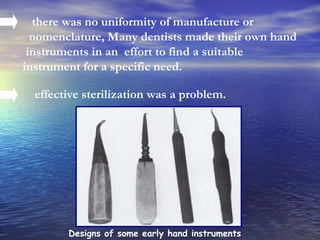
there was no uniformity of manufacture or  nomenclature, Many dentists made their own hand  instruments in   an  effort to find a suitable  instrument for a specific need.  effective sterilization was a problem.  Designs of some early hand instruments
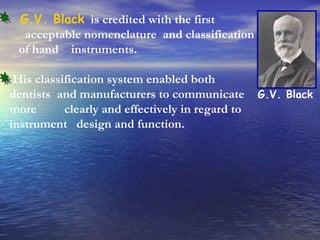
G.V. Black   is credited with the first  acceptable nomenclature  and classification  of hand  instruments.  His classification system enabled both dentists  and manufacturers to communicate more  clearly and effectively in regard to instrument  design and function. G.V. Black
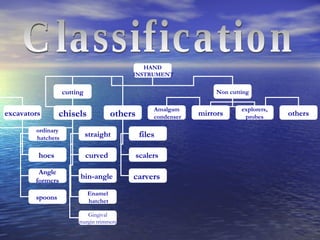
Classification HAND INSTRUMENT cutting Non cutting excavators chisels others ordinary hatchets hoes  Angle formers  spoons  straight curved  bin-angle  Enamel hatchet files  scalers  carvers  Amalgam condenser mirrors explorers, probes  Gingival margin trimmers  others
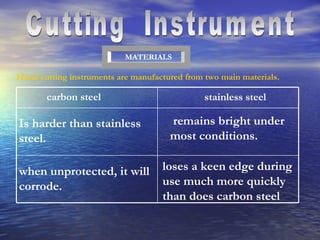
Cutting  Instrument Hand cutting instruments are manufactured from two main materials. MATERIALS carbon steel stainless steel Is harder than stainless steel. remains bright under  most conditions. loses a keen edge during use much more quickly than does carbon steel when unprotected, it will corrode.
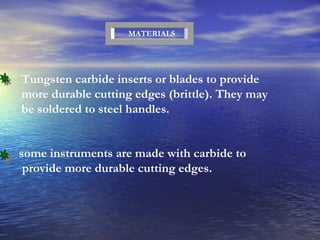
MATERIALS Tungsten carbide inserts or blades to provide more durable cutting edges (brittle). They may be soldered to steel handles. some instruments are made with carbide to provide more durable cutting edges.
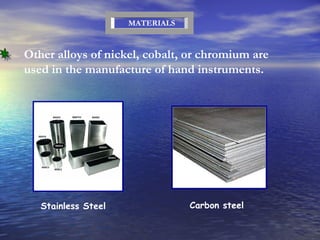
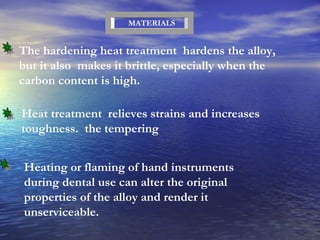
Stainless Steel Carbon steel Other alloys of nickel, cobalt, or chromium are used in the manufacture of hand instruments. MATERIALS
To gain maximal benefits from carbon steel or stainless steel, the manufacturer must submit them to two heat treatments: hardening and tempering .  Hardening and Tempering Heat Treatments : Heat treatment  Furnace MATERIALS
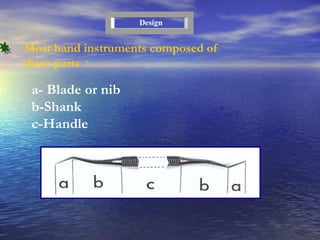
The hardening heat treatment  hardens the alloy, but it also  makes it brittle, especially when the carbon content is high. Heat treatment  relieves strains and increases toughness.  the tempering MATERIALS Heating or flaming of hand instruments during dental use can alter the original properties of the alloy and render it unserviceable.
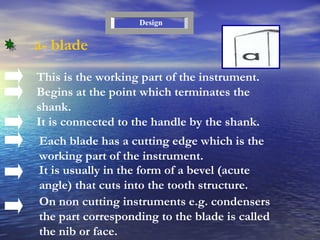
Most hand instruments composed of three parts  : Design a- Blade or nib b-Shank c-Handle
a- blade This is the working part of the instrument. Begins at the point which terminates the shank. It is connected to the handle by the shank. Each blade has a cutting edge which is the working part of the instrument. It is usually in the form of a bevel (acute angle) that cuts into the tooth structure. On non cutting instruments e.g. condensers   the part corresponding to the blade is called the nib or face. Design
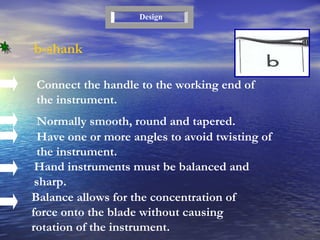
b-shank Connect the handle to the working end of the instrument. Normally smooth, round and tapered. Design Have one or more angles to avoid twisting of the instrument. Hand instruments must be balanced and sharp. Balance allows for the concentration of force onto the blade without causing rotation of the instrument.
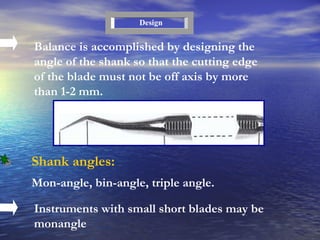
Balance is accomplished by designing the angle of the shank so that the cutting edge of the blade must not be off axis by more than 1-2 mm. Design Shank angles : Mon-angle, bin-angle, triple angle . Instruments with small short blades may be monangle
Instruments with long blades may required two or three angles in the shank to bring the cutting edge near to the long axis of the handle.  Such shanks are termed contra angled. Design
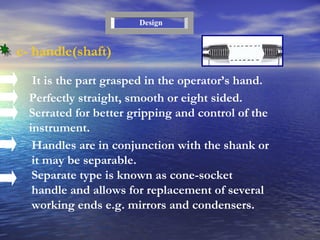
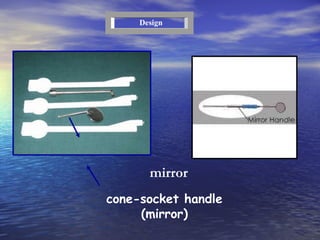
c- handle(shaft) It is the part grasped in the operator’s hand. Perfectly straight, smooth or eight sided. Serrated for better gripping and control of the instrument. Design Handles are in conjunction with the shank or it may be separable. Separate type is known as cone-socket handle and allows for replacement of several working ends e.g. mirrors and condensers.
cone-socket handle (mirror) mirror Design
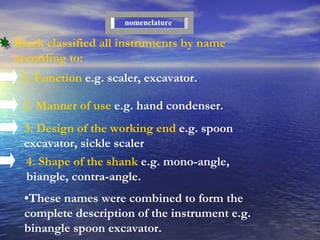
Black classified all instruments by name according to: 1. Function  e . g .  scaler, excavator . 2. Manner of use  e.g. hand condenser. 3. Design of the working end  e.g. spoon excavator, sickle scaler nomenclature 4. Shape of the shank  e.g. mono-angle, biangle, contra-angle. • These names were combined to form the complete description of the instrument e.g. binangle spoon excavator.
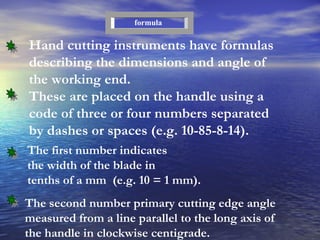
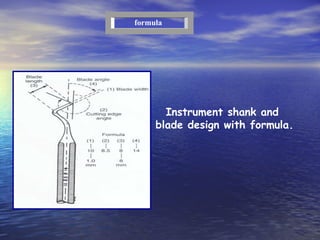
Hand cutting instruments have formulas describing the dimensions and angle of the working end.  These are placed on the handle using a code of three or four numbers separated by dashes or spaces (e.g. 10-85-8-14). formula The first number indicates the width of the blade in tenths of a mm  (e.g. 10 = 1 mm). The second number primary cutting edge angle measured from a line parallel to the long axis of the handle in clockwise centigrade.
Instrument shank and  blade design with formula. formula
If the edge is perpendicular to the blade, this number is omitted resulting in a 3 numbers code. The third number indicates the blade length in mm (e.g. 8 = 8 mm). formula The fourth number indicates the blade angle relative to the long axis of the handle in clockwise centigrade e.g. (14) Additional number on the handle is the manufacturer’s identification number.
Additional number   should not be confused with the formula number. formula
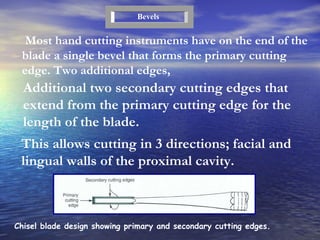
Additional two secondary cutting edges that extend from the primary cutting edge for the  length of the blade. Most hand cutting instruments have on the end of the blade a single bevel that forms the primary cutting edge. Two additional edges, Bevels This allows cutting in 3 directions; facial and lingual walls of the proximal cavity. Chisel blade design showing primary and secondary cutting edges.
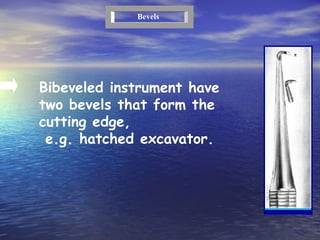
Bibeveled instrument have two bevels that form the cutting edge, e.g. hatched excavator. Bevels
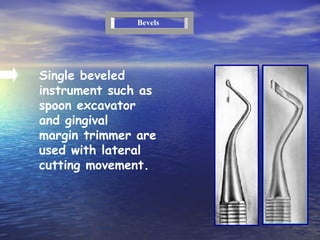
Single beveled instrument such as spoon excavator and gingival  margin trimmer are used with lateral cutting movement. Bevels
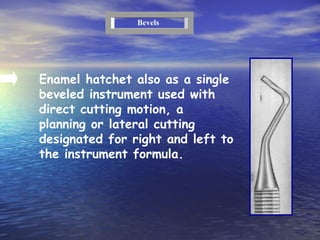
Enamel hatchet also as a single beveled instrument used with direct cutting motion, a planning or lateral cutting  designated for right and left to the instrument formula. Bevels
To determine this, the primary cutting edge is held down and pointing away. If the bevel appears on the right, it is in the right instrument of the pair, when used it is moved from right to left. Right and left bevels Bevels The opposite is true for the left instrument of the pair. One instrument is used for work on one side of the preparation and the other for the opposite side of the preparation.
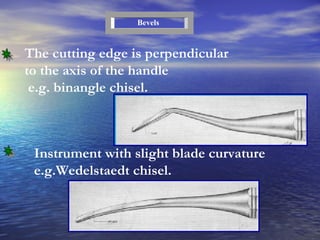
The cutting edge is perpendicular to the axis of the handle e.g. binangle chisel. Bevels Instrument with slight blade curvature e . g . Wedelstaedt chisel .
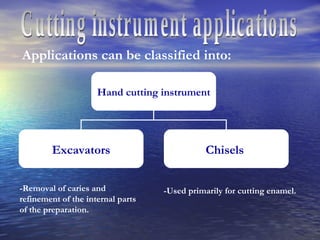
Applications can be classified into:  -Removal of caries and refinement of the internal parts of the preparation. -Used primarily for cutting enamel.   Cutting instrument applications Hand cutting instrument Excavators Chisels
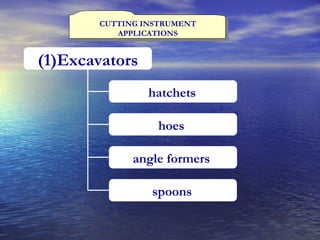
CUTTING INSTRUMENT APPLICATIONS (1)Excavators hatchets   hoes   angle formers   spoons
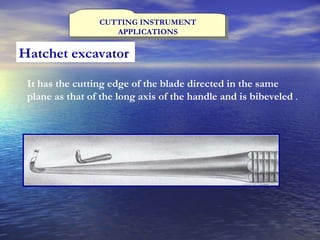
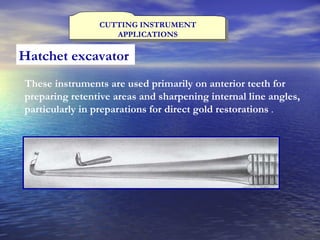
CUTTING INSTRUMENT APPLICATIONS It has the cutting edge of the blade directed in the same plane as that of the long axis of the handle and is bibeveled  . Hatchet excavator
CUTTING INSTRUMENT APPLICATIONS Hatchet excavator   These instruments are used primarily on anterior teeth for preparing retentive areas and sharpening internal line angles, particularly in preparations for direct gold restorations  .
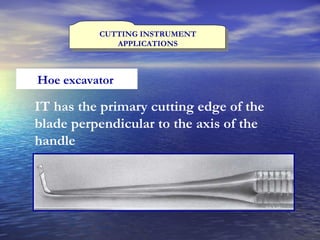
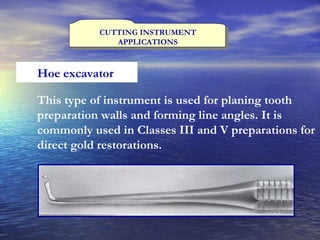
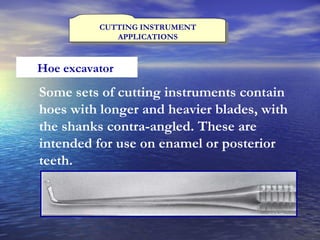
CUTTING INSTRUMENT APPLICATIONS Hoe excavator  IT has the primary cutting edge of the blade perpendicular to the axis of the handle
CUTTING INSTRUMENT APPLICATIONS Hoe excavator  This type of instrument is used for planing tooth preparation walls and forming line angles. It is commonly used in Classes III and V preparations for direct gold restorations.
CUTTING INSTRUMENT APPLICATIONS Hoe excavator  Some sets of cutting instruments contain hoes with longer and heavier blades, with the shanks contra-angled. These are intended for use on enamel or posterior teeth.
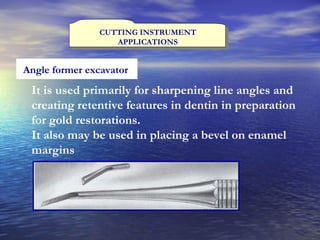
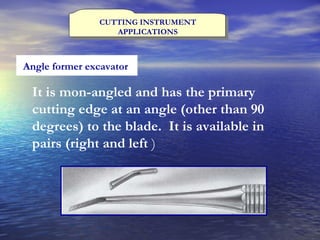
CUTTING INSTRUMENT APPLICATIONS Angle former excavator  It is mon-angled and has the primary cutting edge at an angle (other than 90 degrees) to the blade.  It is available in pairs (right and left  )
CUTTING INSTRUMENT APPLICATIONS Angle former excavator  It is used primarily for sharpening line angles and creating retentive features in dentin in preparation for gold restorations.   It also may be used in placing a bevel on enamel margins
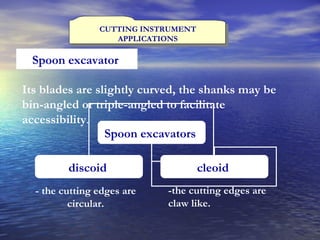
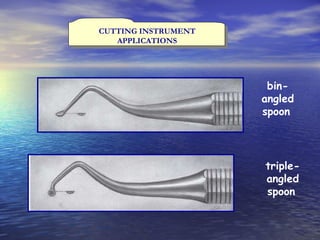
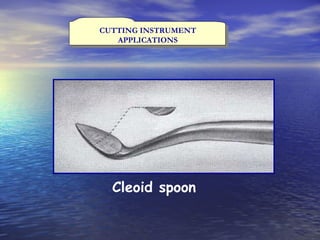
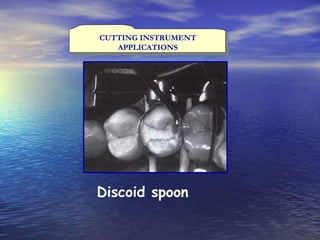
CUTTING INSTRUMENT APPLICATIONS Spoon excavator  Its blades are slightly curved, the shanks may be bin-angled or triple-angled to facilitate accessibility . - the cutting edges are circular. -the cutting edges are claw like. Spoon excavators  discoid   cleoid
CUTTING INSTRUMENT APPLICATIONS bin-angled spoon   triple-angled spoon
CUTTING INSTRUMENT APPLICATIONS Cleoid spoon
CUTTING INSTRUMENT APPLICATIONS Discoid spoon
CUTTING INSTRUMENT APPLICATIONS (2)Chisels   enamel hatchets   gingival margin trimmers   straight, slightly curved, or bin-angle
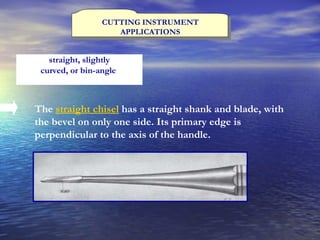
CUTTING INSTRUMENT APPLICATIONS straight, slightly curved, or bin-angle   The  straight chisel  has a straight shank and blade, with   the bevel on only one side. Its primary edge is perpendicular to the axis of the handle.
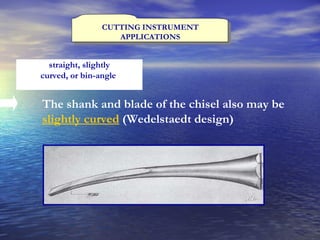
CUTTING INSTRUMENT APPLICATIONS straight, slightly curved, or bin-angle   The shank and blade of the chisel also may be  slightly curved  (Wedelstaedt design)
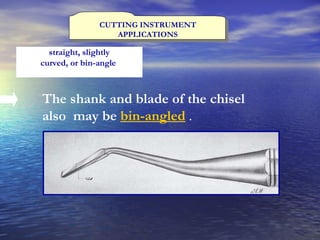
CUTTING INSTRUMENT APPLICATIONS The shank and blade of the chisel also   may be  bin-angled  . straight, slightly curved, or bin-angle
CUTTING INSTRUMENT APPLICATIONS The force used with all these chisels is essentially a straight thrust. There is no need for a right and left type in a straight chisel, since a 180-degree turn of the instrument allows for its use on either side of the preparation. straight, slightly curved, or bin-angle
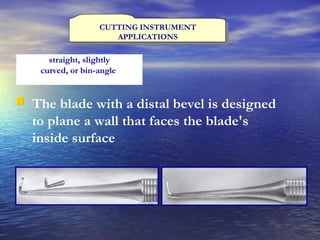
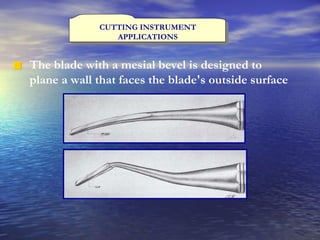
CUTTING INSTRUMENT APPLICATIONS The bin-angle and Wedelstaedt chisels have the primary cutting edges in a plane perpendicular to   the axis of the handle and may have either a distal bevel or a mesial (reverse) bevel.   straight, slightly curved, or bin-angle
CUTTING INSTRUMENT APPLICATIONS The blade with a distal bevel is designed to plane a wall that faces the blade's inside surface   straight, slightly curved, or bin-angle
CUTTING INSTRUMENT APPLICATIONS The blade with a mesial bevel is designed to  plane a wall that faces the blade's outside surface
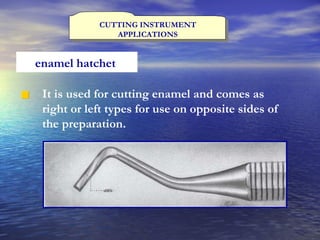
CUTTING INSTRUMENT APPLICATIONS enamel hatchet   It  is a chisel similar in design to the ordinary hatchet excavator except that the blade is larger, heavier, and is beveled on only one side It has its cutting edges in a plane that is parallel with the axis of the handle.
CUTTING INSTRUMENT APPLICATIONS enamel hatchet   It is used for cutting enamel and comes as right or left types for use on opposite sides of the preparation.
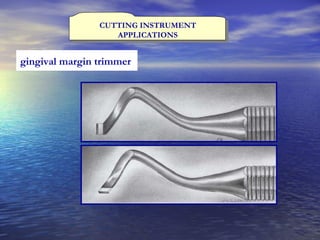
CUTTING INSTRUMENT APPLICATIONS gingival margin trimmer   Similar in design to enamel hatchet except the blade is curved. Right and left types: Right pair is for either a mesial or distal gingival margins. Left pair is for a mesial or distal margins
CUTTING INSTRUMENT APPLICATIONS gingival margin trimmer
CUTTING INSTRUMENT APPLICATIONS gingival margin trimmer   When the second number in the formula is 90-100, it is used for distal gingival margins. When this number is 75-85, the pair is used to bevel the mesial margins. 100 and 75 pairs for steep margins for inlay preparation while 90-85 for slight bevel in amalgam preparations.
CUTTING INSTRUMENT APPLICATIONS gingival margin trimmer   Uses of GMT : Beveling of the gingival margins of proximoocclusal preparations. Beveling of the axiopulpal line angle. 1 2
CUTTING INSTRUMENT APPLICATIONS gingival margin trimmer   Performing a gingival lock (reverse bevel), placed on the gingival seat. e.g. GMT 100 for the distal and GMT 75 for the mesial. 3
cutting  instrument sharpening The cutting edge of the hand instrument should always be kept sharp as  dull instruments may cause: 1.  Loss of control. 2.  More pain.  3.  Prolonged time for the operative procedure. 4.  Reduce the quality and precision of tooth preparation. Sharpening
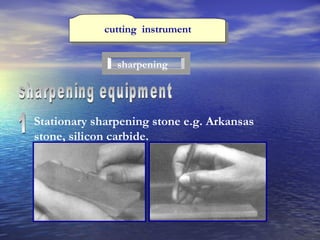
cutting  instrument sharpening sharpening equipment  Stationary sharpening stone e.g. Arkansas stone, silicon carbide. 1
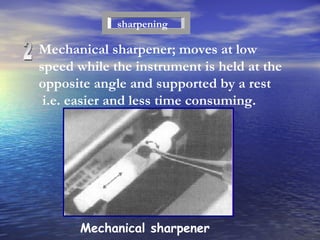
sharpening Mechanical sharpener; moves at low speed while the instrument is held at the opposite angle and supported by a rest i.e. easier and less time consuming. 2 Mechanical sharpener
There are four grasps used with the hand instruments: Modified pen. Inverted pen. Palm and thumb. Modified palm and thumb. With each grasp proper rest and guard is important. 1 2 3 4 Instrument grasp
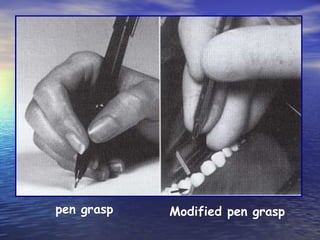
1.  Modified pen grasp It is similar to that used in holding a pen except that the thumb, index and middle fingers contact the instrument while the tips of the ring and little fingers are placed on the working tooth as a rest.. The palm of the hand is facing away from the operator.
pen grasp Modified pen grasp
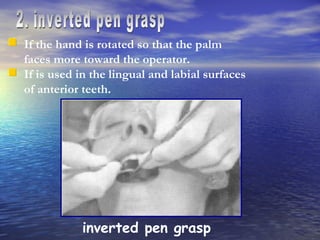
2. inverted pen grasp If the hand is rotated so that the palm faces more toward the operator. If is used in the lingual and labial surfaces of anterior teeth. inverted pen grasp
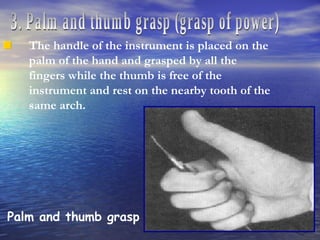
3. Palm and thumb grasp (grasp of power) The handle of the instrument is placed on the palm of the hand and grasped by all the fingers while the thumb is free of the instrument and rest on the nearby tooth of the same arch. Palm and thumb grasp
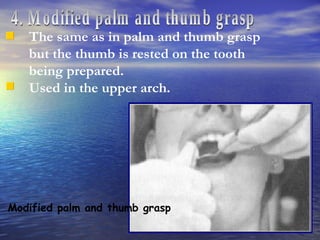
4. Modified palm and thumb grasp The same as in palm and thumb grasp but the thumb is rested on the tooth being prepared. Used in the upper arch. Modified palm and thumb grasp
rests : A proper instrument grasp must include a firm rest (support) to steady the hand during operative procedures. The support may be gained from hard tissue. Soft tissue rest or too distant hard tissue rest does not afford a reliable control. Instrument rest
Indirect rest may be gained by using the index finger of the opposite hand to rest on the shank of the instrument. The operating hand rests on the opposite hand which rests on stable oral structures.
Instrument guards guards : The use of interproximal wedges to protect soft tissues from contact with sharp rotary cutting instruments.
Cleaning and Sterilization Instrument Cleaning and Sterilization Cleaning and Sterilization
Cleaning and Sterilization Cleaning All instruments need to be cleaned and thoroughly dried before they are sterilized. Cleaning Hand   Scrubbing   Ultrasonic Cleaning   Automated Washer
1-Hand Scrubbing Advantages -Effective if performed properly Disadvantages -Increases chances for operator injury. -Increases spread of contamination through splatter. -Labor-intensive. -Need proper care of scrub brush
2-Ultrasonic Cleaning Advantages -Safer than hand scrubbing. -Effectively cleans all instruments . Reduces chances for spread of  contaminants through splatter. -Allows for more efficient use of staff time Disadvantages -Microorganisms may accumulate in cleaning solution. -Ultrasonic cleaning will not remove hardened Permanent cement. (Solution: remove cement while it is still soft.).
3-Automated Washer Advantages -Safer than hand scrubbing. -Reduces chances for spread of contaminants of contaminants through splatter and aerosols. -Allows for more efficient use of staff time. -Effectively cleans instruments. Disadvantages -Not all instruments are compatible with automated washers. -Please see manufacturer's instructions for detailed requirements.
Sterilization process by which an article, surface or medium is freed of all living microorganisms. -Most dental offices have a designated area for instrument reprocessing that is separate from the dental treatment room. This is ideal, since cleaning, sterilizing and storing instruments in the same room where the delivery of patient care is provided increases the risk of cross-contamination.
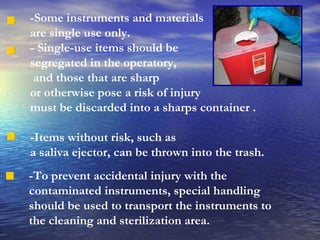
-Some instruments and materials  are single use only. - Single-use items should be  segregated in the operatory, and those that are sharp  or otherwise pose a risk of injury  must be discarded into a sharps container .  -Items without risk, such as  a saliva ejector, can be thrown into the trash. -To prevent accidental injury with the contaminated instruments, special handling should be used to transport the instruments to the cleaning and sterilization area.
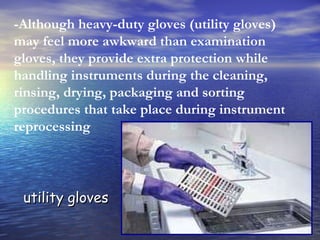
-Although heavy-duty gloves (utility gloves) may feel more awkward than examination gloves, they provide extra protection while handling instruments during the cleaning, rinsing, drying, packaging and sorting procedures that take place during instrument reprocessing utility gloves
Sterilization   Steam   pressure   sterilization   ( autoclave)   Dry heat sterilization (dryclave ) Ethylene oxide sterilization  Chemical vapor pressure sterilization  (chemiclave)
1-Steam preasure strillization  (autoclaving) -Sterilization with steam under pressure is performed in a steam autoclave . -For a light load of instruments, the time required at 250'F (121° C) is a minimum of 15 minutes at 15 lbs of pressure. -Time for wrapped instruments can be reduced to 7 minutes if the temperature is raised to approximately 273° F (134° C) to give30 pounds of pressure.
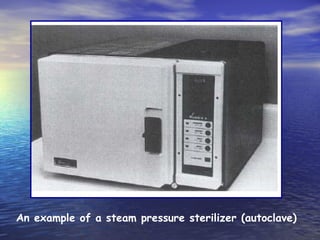
An example of a steam pressure sterilizer (autoclave)
Advantages of Autoclaves.  -Autoclaving is the most rapid and effective method for  sterilizing cloth surgical packs and towel packs.  -Automated models are available. -although they still can be misused or fail almost as often as nonautomated ones; they must be evaluated with a biologic spore test monitoring system.
Disadvantages of autoclaves -Items sensitive to the elevated  temperature can not be autoclaved.  -Autoclaving tends to rust carbon steel instruments.
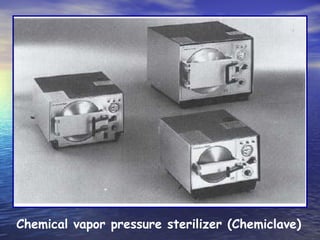
2-CHEMICAL VAPOR PRESSURE STERILIZATION (CHEMICLAVING ) -Sterilization by chemical vapor under pressure is performed in a Chemiclave. -Chemical vapor pressure sterilizers operate at 270° F (131° C) and 20 pounds of pressure.  -They are similar to steam sterilizers and have a cycle time of approximately half an hour.
Advantages of Chemiclaves .  -Carbon steel and other corrosion-sensitive burs, instruments, and pliers are said to be sterilized without rust or corrosion. Disadvantages of Chemiclaves . - Items sensitive to the elevated temperature will be damaged.  -Instruments must be lightly packaged in bags obtained from the sterilizer manufacturer. - Towels and heavy cloth wrappings of surgical instruments may not be penetrated to provide sterilization. - Routinely use biologic spore test monitoring strips to confirm heat penetration of heavy packs before use.
Chemical vapor pressure sterilizer (Chemiclave)
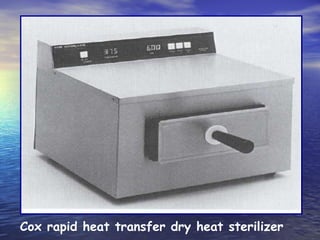
3. Dry heat sterilization (dryclave) Is  an excellent means of sterilization sharp instrument but rubber and plastic material can not be sterilized by this method . -Dry heat sterilizers for use in dental offices are  available, but all that is necessary is an oven that will maintain a temperature of 160°C(320°F) -It imperative that all debris be removed from an instrument before it placed in a dry heat sterilizer . * Holding period : 160°C(320°F),1 hour  .
Advantages of this method   1-is an excellent means of sterilization sharp instrument. 2-instrument not corrode or rust.  Disadvantages  1-a lower temperature or a shorter period will not produce the desired result . 2-The higher temperature of a dry-heat sterilizer means that paper will scorch and plastic will melt. 3-some hand pieces can not be sterilized by this method
Cox rapid heat transfer dry heat sterilizer
4-ETHYLENE OXIDE STERILIZATION - Ethylene oxide sterilization is the best method for sterilizing complex instruments and delicate materials.  -ethylene oxide gas is toxic for all viruses and bacteria at room temperature on exposure for  8-10 hr at elevated temperature . -this method requires rather expensive equipment .
Room temperature ethylene oxide sterilizer
BOILING WATER *Boiling water does not kill spores and cannot sterilize instruments. However, heat can reach and kill blood borne pathogens in places that liquid sterilants and disinfectants used at room temperature cannot reach.  *Boiling is a method of high-level disinfection that has been used when actual sterilization cannot be achieved (e.g., in case of a sterilizer breakdown)
New methods of sterlization **Various new methods of sterilization are under investigation and development.  -The microwave oven has major limitations for sterilizing metal items, by either damaging the machine or not reaching all sides of the instruments. microwave oven
- Ultraviolet light is not highly effective against RNA viruses such as HIV and is not very effective against bacterial spores Ultraviolet light
-Incomplete exposures of all surfaces and poor penetration of oil and debris are other limitations. - Ultraviolet irradiation may be useful for sanitizing room air to help control tuberculosis bacteria .
Instrument storage in dental cabinet 1-After the instrument are sterilized, they are placed in proper place in a dry condition . 2-The portions of dental cabinet designated for hand instrument contain grooved glass or metal trays. 3-These instrument containers must be kept in clean and aseptic condition. 4-hey should also contain protective medium for  cutting edges of the instrument .
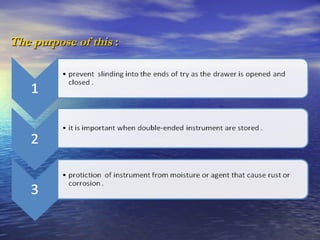
The purpose of this  :
Effects of Sterilization  Sterilizing carbon steel instruments by any of (cold disinfection, boiling water, steam under pressure (autoclave) causes  discoloration, rust, and corrosion. minimizing these problems are available. 1-electroplate the instrument. This affords protection, except on the blade, where use and sharpening remove the plating.
2- use of rust inhibitors, which are soluble alkaline compounds. 3-is to remove the instruments promptly at the end of the recommended sterilizing period, dry them thoroughly, and place them in the instrument cabinet or on the tray setup.
Non cutting  instrument Non cutting  instrument Amalgam condenser Mouth mirror others
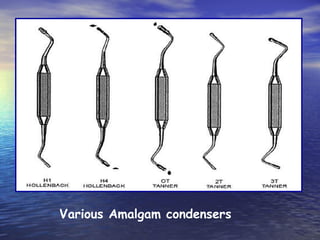
1.  Amalgam condenser It is a dental instrument used for compacting silver amalgam while in a plastic state, used for restoring teeth to a natural contour.  Condensers come in single- and double-ended designs. They have various shaped and sized working ends, which may be smooth or serrated.
Various Amalgam condensers
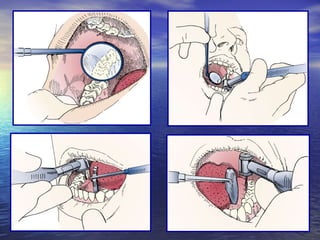
2. mouth mirror mouth mirror or dentist's mirror is an instrument used in dentistry.  The head of the mirror is usually round, and the most common sizes used are the No. 4 and No. 5. A No. 2 is sometimes used when a smaller mirror is needed, such as when working on back teeth with a dental dam in place.   its most important functions are: allowing indirect vision by the dentist . reflecting light onto desired surfaces. retraction of soft tissue.
 
 
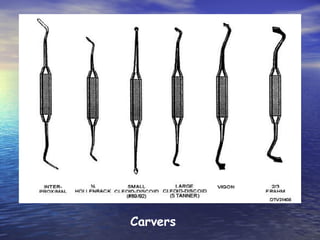
4. others A.  Carvers.  After the amalgam is condensed, it must then be carved to approximately the same original tooth structure.  Carvers have sharp cutting edges that are used to shape, form, or cut tooth anatomy into amalgam restorations.
Carvers
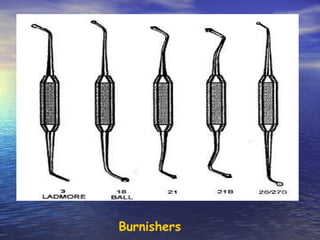
B.  Burnishers. When the carving is complete, the dentist may use burnishers. used to  smooth and polish the restoration.  remove scratches left on the amalgam surface by a carving instrument.
Burnishers
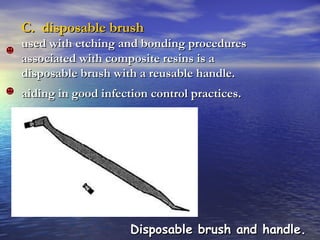
C.  disposable brush used with etching and bonding procedures associated with composite resins is a disposable brush with a reusable handle.  aiding in good infection control practices.  Disposable brush and handle.
Thanks  for attention

Dental Hand Instruments

  • 1.
  • 2.
    presented by Dr\Mohammed Sa'ed Fadaly dental student Alazhar university
  • 3.
    Contantes • Instrumentgrasp Modified pen. Inverted pen. Palm and thumb. Modified palm and thumb. • Non cutting instrument Amalgam condenser Mouth mirror Others • Cleaning and Sterilization • Introduction Definition History • Classification Cutting instrument Non cutting • Cutting instrument MATERIALS Hardening and Tempering Heat Treatments Design Shank angles Nomenclature Formula Bevels • Cutting instrument applications Excavators Chisels • Sharpening Stationary sharpening Mechanical sharpening
  • 4.
    Introduction Definition :It is hand-powered dental instruments. History : The early hand-operated instruments characterized by: Large, heavy handles and inferior metal alloys in the blades. cumbersome, difficult to use, and ineffective in many situations.
  • 5.
    there was nouniformity of manufacture or nomenclature, Many dentists made their own hand instruments in an effort to find a suitable instrument for a specific need. effective sterilization was a problem. Designs of some early hand instruments
  • 6.
    G.V. Black is credited with the first acceptable nomenclature and classification of hand instruments. His classification system enabled both dentists and manufacturers to communicate more clearly and effectively in regard to instrument design and function. G.V. Black
  • 7.
    Classification HAND INSTRUMENTcutting Non cutting excavators chisels others ordinary hatchets hoes Angle formers spoons straight curved bin-angle Enamel hatchet files scalers carvers Amalgam condenser mirrors explorers, probes Gingival margin trimmers others
  • 8.
    Cutting InstrumentHand cutting instruments are manufactured from two main materials. MATERIALS carbon steel stainless steel Is harder than stainless steel. remains bright under most conditions. loses a keen edge during use much more quickly than does carbon steel when unprotected, it will corrode.
  • 9.
    MATERIALS Tungsten carbideinserts or blades to provide more durable cutting edges (brittle). They may be soldered to steel handles. some instruments are made with carbide to provide more durable cutting edges.
  • 10.
    Stainless Steel Carbonsteel Other alloys of nickel, cobalt, or chromium are used in the manufacture of hand instruments. MATERIALS
  • 11.
    To gain maximalbenefits from carbon steel or stainless steel, the manufacturer must submit them to two heat treatments: hardening and tempering . Hardening and Tempering Heat Treatments : Heat treatment Furnace MATERIALS
  • 12.
    The hardening heattreatment hardens the alloy, but it also makes it brittle, especially when the carbon content is high. Heat treatment relieves strains and increases toughness. the tempering MATERIALS Heating or flaming of hand instruments during dental use can alter the original properties of the alloy and render it unserviceable.
  • 13.
    Most hand instrumentscomposed of three parts : Design a- Blade or nib b-Shank c-Handle
  • 14.
    a- blade Thisis the working part of the instrument. Begins at the point which terminates the shank. It is connected to the handle by the shank. Each blade has a cutting edge which is the working part of the instrument. It is usually in the form of a bevel (acute angle) that cuts into the tooth structure. On non cutting instruments e.g. condensers the part corresponding to the blade is called the nib or face. Design
  • 15.
    b-shank Connect thehandle to the working end of the instrument. Normally smooth, round and tapered. Design Have one or more angles to avoid twisting of the instrument. Hand instruments must be balanced and sharp. Balance allows for the concentration of force onto the blade without causing rotation of the instrument.
  • 16.
    Balance is accomplishedby designing the angle of the shank so that the cutting edge of the blade must not be off axis by more than 1-2 mm. Design Shank angles : Mon-angle, bin-angle, triple angle . Instruments with small short blades may be monangle
  • 17.
    Instruments with longblades may required two or three angles in the shank to bring the cutting edge near to the long axis of the handle. Such shanks are termed contra angled. Design
  • 18.
    c- handle(shaft) Itis the part grasped in the operator’s hand. Perfectly straight, smooth or eight sided. Serrated for better gripping and control of the instrument. Design Handles are in conjunction with the shank or it may be separable. Separate type is known as cone-socket handle and allows for replacement of several working ends e.g. mirrors and condensers.
  • 19.
  • 20.
    Black classified allinstruments by name according to: 1. Function e . g . scaler, excavator . 2. Manner of use e.g. hand condenser. 3. Design of the working end e.g. spoon excavator, sickle scaler nomenclature 4. Shape of the shank e.g. mono-angle, biangle, contra-angle. • These names were combined to form the complete description of the instrument e.g. binangle spoon excavator.
  • 21.
    Hand cutting instrumentshave formulas describing the dimensions and angle of the working end. These are placed on the handle using a code of three or four numbers separated by dashes or spaces (e.g. 10-85-8-14). formula The first number indicates the width of the blade in tenths of a mm (e.g. 10 = 1 mm). The second number primary cutting edge angle measured from a line parallel to the long axis of the handle in clockwise centigrade.
  • 22.
    Instrument shank and blade design with formula. formula
  • 23.
    If the edgeis perpendicular to the blade, this number is omitted resulting in a 3 numbers code. The third number indicates the blade length in mm (e.g. 8 = 8 mm). formula The fourth number indicates the blade angle relative to the long axis of the handle in clockwise centigrade e.g. (14) Additional number on the handle is the manufacturer’s identification number.
  • 24.
    Additional number should not be confused with the formula number. formula
  • 25.
    Additional two secondarycutting edges that extend from the primary cutting edge for the length of the blade. Most hand cutting instruments have on the end of the blade a single bevel that forms the primary cutting edge. Two additional edges, Bevels This allows cutting in 3 directions; facial and lingual walls of the proximal cavity. Chisel blade design showing primary and secondary cutting edges.
  • 26.
    Bibeveled instrument havetwo bevels that form the cutting edge, e.g. hatched excavator. Bevels
  • 27.
    Single beveled instrumentsuch as spoon excavator and gingival margin trimmer are used with lateral cutting movement. Bevels
  • 28.
    Enamel hatchet alsoas a single beveled instrument used with direct cutting motion, a planning or lateral cutting designated for right and left to the instrument formula. Bevels
  • 29.
    To determine this,the primary cutting edge is held down and pointing away. If the bevel appears on the right, it is in the right instrument of the pair, when used it is moved from right to left. Right and left bevels Bevels The opposite is true for the left instrument of the pair. One instrument is used for work on one side of the preparation and the other for the opposite side of the preparation.
  • 30.
    The cutting edgeis perpendicular to the axis of the handle e.g. binangle chisel. Bevels Instrument with slight blade curvature e . g . Wedelstaedt chisel .
  • 31.
    Applications can beclassified into: -Removal of caries and refinement of the internal parts of the preparation. -Used primarily for cutting enamel. Cutting instrument applications Hand cutting instrument Excavators Chisels
  • 32.
    CUTTING INSTRUMENT APPLICATIONS(1)Excavators hatchets hoes angle formers spoons
  • 33.
    CUTTING INSTRUMENT APPLICATIONSIt has the cutting edge of the blade directed in the same plane as that of the long axis of the handle and is bibeveled . Hatchet excavator
  • 34.
    CUTTING INSTRUMENT APPLICATIONSHatchet excavator These instruments are used primarily on anterior teeth for preparing retentive areas and sharpening internal line angles, particularly in preparations for direct gold restorations .
  • 35.
    CUTTING INSTRUMENT APPLICATIONSHoe excavator IT has the primary cutting edge of the blade perpendicular to the axis of the handle
  • 36.
    CUTTING INSTRUMENT APPLICATIONSHoe excavator This type of instrument is used for planing tooth preparation walls and forming line angles. It is commonly used in Classes III and V preparations for direct gold restorations.
  • 37.
    CUTTING INSTRUMENT APPLICATIONSHoe excavator Some sets of cutting instruments contain hoes with longer and heavier blades, with the shanks contra-angled. These are intended for use on enamel or posterior teeth.
  • 38.
    CUTTING INSTRUMENT APPLICATIONSAngle former excavator It is mon-angled and has the primary cutting edge at an angle (other than 90 degrees) to the blade. It is available in pairs (right and left )
  • 39.
    CUTTING INSTRUMENT APPLICATIONSAngle former excavator It is used primarily for sharpening line angles and creating retentive features in dentin in preparation for gold restorations. It also may be used in placing a bevel on enamel margins
  • 40.
    CUTTING INSTRUMENT APPLICATIONSSpoon excavator Its blades are slightly curved, the shanks may be bin-angled or triple-angled to facilitate accessibility . - the cutting edges are circular. -the cutting edges are claw like. Spoon excavators discoid cleoid
  • 41.
    CUTTING INSTRUMENT APPLICATIONSbin-angled spoon triple-angled spoon
  • 42.
  • 43.
  • 44.
    CUTTING INSTRUMENT APPLICATIONS(2)Chisels enamel hatchets gingival margin trimmers straight, slightly curved, or bin-angle
  • 45.
    CUTTING INSTRUMENT APPLICATIONSstraight, slightly curved, or bin-angle The straight chisel has a straight shank and blade, with the bevel on only one side. Its primary edge is perpendicular to the axis of the handle.
  • 46.
    CUTTING INSTRUMENT APPLICATIONSstraight, slightly curved, or bin-angle The shank and blade of the chisel also may be slightly curved (Wedelstaedt design)
  • 47.
    CUTTING INSTRUMENT APPLICATIONSThe shank and blade of the chisel also may be bin-angled . straight, slightly curved, or bin-angle
  • 48.
    CUTTING INSTRUMENT APPLICATIONSThe force used with all these chisels is essentially a straight thrust. There is no need for a right and left type in a straight chisel, since a 180-degree turn of the instrument allows for its use on either side of the preparation. straight, slightly curved, or bin-angle
  • 49.
    CUTTING INSTRUMENT APPLICATIONSThe bin-angle and Wedelstaedt chisels have the primary cutting edges in a plane perpendicular to the axis of the handle and may have either a distal bevel or a mesial (reverse) bevel. straight, slightly curved, or bin-angle
  • 50.
    CUTTING INSTRUMENT APPLICATIONSThe blade with a distal bevel is designed to plane a wall that faces the blade's inside surface straight, slightly curved, or bin-angle
  • 51.
    CUTTING INSTRUMENT APPLICATIONSThe blade with a mesial bevel is designed to plane a wall that faces the blade's outside surface
  • 52.
    CUTTING INSTRUMENT APPLICATIONSenamel hatchet It is a chisel similar in design to the ordinary hatchet excavator except that the blade is larger, heavier, and is beveled on only one side It has its cutting edges in a plane that is parallel with the axis of the handle.
  • 53.
    CUTTING INSTRUMENT APPLICATIONSenamel hatchet It is used for cutting enamel and comes as right or left types for use on opposite sides of the preparation.
  • 54.
    CUTTING INSTRUMENT APPLICATIONSgingival margin trimmer Similar in design to enamel hatchet except the blade is curved. Right and left types: Right pair is for either a mesial or distal gingival margins. Left pair is for a mesial or distal margins
  • 55.
    CUTTING INSTRUMENT APPLICATIONSgingival margin trimmer
  • 56.
    CUTTING INSTRUMENT APPLICATIONSgingival margin trimmer When the second number in the formula is 90-100, it is used for distal gingival margins. When this number is 75-85, the pair is used to bevel the mesial margins. 100 and 75 pairs for steep margins for inlay preparation while 90-85 for slight bevel in amalgam preparations.
  • 57.
    CUTTING INSTRUMENT APPLICATIONSgingival margin trimmer Uses of GMT : Beveling of the gingival margins of proximoocclusal preparations. Beveling of the axiopulpal line angle. 1 2
  • 58.
    CUTTING INSTRUMENT APPLICATIONSgingival margin trimmer Performing a gingival lock (reverse bevel), placed on the gingival seat. e.g. GMT 100 for the distal and GMT 75 for the mesial. 3
  • 59.
    cutting instrumentsharpening The cutting edge of the hand instrument should always be kept sharp as dull instruments may cause: 1. Loss of control. 2. More pain. 3. Prolonged time for the operative procedure. 4. Reduce the quality and precision of tooth preparation. Sharpening
  • 60.
    cutting instrumentsharpening sharpening equipment Stationary sharpening stone e.g. Arkansas stone, silicon carbide. 1
  • 61.
    sharpening Mechanical sharpener;moves at low speed while the instrument is held at the opposite angle and supported by a rest i.e. easier and less time consuming. 2 Mechanical sharpener
  • 62.
    There are fourgrasps used with the hand instruments: Modified pen. Inverted pen. Palm and thumb. Modified palm and thumb. With each grasp proper rest and guard is important. 1 2 3 4 Instrument grasp
  • 63.
    1. Modifiedpen grasp It is similar to that used in holding a pen except that the thumb, index and middle fingers contact the instrument while the tips of the ring and little fingers are placed on the working tooth as a rest.. The palm of the hand is facing away from the operator.
  • 64.
  • 65.
    2. inverted pengrasp If the hand is rotated so that the palm faces more toward the operator. If is used in the lingual and labial surfaces of anterior teeth. inverted pen grasp
  • 66.
    3. Palm andthumb grasp (grasp of power) The handle of the instrument is placed on the palm of the hand and grasped by all the fingers while the thumb is free of the instrument and rest on the nearby tooth of the same arch. Palm and thumb grasp
  • 67.
    4. Modified palmand thumb grasp The same as in palm and thumb grasp but the thumb is rested on the tooth being prepared. Used in the upper arch. Modified palm and thumb grasp
  • 68.
    rests : Aproper instrument grasp must include a firm rest (support) to steady the hand during operative procedures. The support may be gained from hard tissue. Soft tissue rest or too distant hard tissue rest does not afford a reliable control. Instrument rest
  • 69.
    Indirect rest maybe gained by using the index finger of the opposite hand to rest on the shank of the instrument. The operating hand rests on the opposite hand which rests on stable oral structures.
  • 70.
    Instrument guards guards: The use of interproximal wedges to protect soft tissues from contact with sharp rotary cutting instruments.
  • 71.
    Cleaning and SterilizationInstrument Cleaning and Sterilization Cleaning and Sterilization
  • 72.
    Cleaning and SterilizationCleaning All instruments need to be cleaned and thoroughly dried before they are sterilized. Cleaning Hand Scrubbing Ultrasonic Cleaning Automated Washer
  • 73.
    1-Hand Scrubbing Advantages-Effective if performed properly Disadvantages -Increases chances for operator injury. -Increases spread of contamination through splatter. -Labor-intensive. -Need proper care of scrub brush
  • 74.
    2-Ultrasonic Cleaning Advantages-Safer than hand scrubbing. -Effectively cleans all instruments . Reduces chances for spread of contaminants through splatter. -Allows for more efficient use of staff time Disadvantages -Microorganisms may accumulate in cleaning solution. -Ultrasonic cleaning will not remove hardened Permanent cement. (Solution: remove cement while it is still soft.).
  • 75.
    3-Automated Washer Advantages-Safer than hand scrubbing. -Reduces chances for spread of contaminants of contaminants through splatter and aerosols. -Allows for more efficient use of staff time. -Effectively cleans instruments. Disadvantages -Not all instruments are compatible with automated washers. -Please see manufacturer's instructions for detailed requirements.
  • 76.
    Sterilization process bywhich an article, surface or medium is freed of all living microorganisms. -Most dental offices have a designated area for instrument reprocessing that is separate from the dental treatment room. This is ideal, since cleaning, sterilizing and storing instruments in the same room where the delivery of patient care is provided increases the risk of cross-contamination.
  • 77.
    -Some instruments andmaterials are single use only. - Single-use items should be segregated in the operatory, and those that are sharp or otherwise pose a risk of injury must be discarded into a sharps container . -Items without risk, such as a saliva ejector, can be thrown into the trash. -To prevent accidental injury with the contaminated instruments, special handling should be used to transport the instruments to the cleaning and sterilization area.
  • 78.
    -Although heavy-duty gloves(utility gloves) may feel more awkward than examination gloves, they provide extra protection while handling instruments during the cleaning, rinsing, drying, packaging and sorting procedures that take place during instrument reprocessing utility gloves
  • 79.
    Sterilization Steam pressure sterilization ( autoclave) Dry heat sterilization (dryclave ) Ethylene oxide sterilization Chemical vapor pressure sterilization (chemiclave)
  • 80.
    1-Steam preasure strillization (autoclaving) -Sterilization with steam under pressure is performed in a steam autoclave . -For a light load of instruments, the time required at 250'F (121° C) is a minimum of 15 minutes at 15 lbs of pressure. -Time for wrapped instruments can be reduced to 7 minutes if the temperature is raised to approximately 273° F (134° C) to give30 pounds of pressure.
  • 81.
    An example ofa steam pressure sterilizer (autoclave)
  • 82.
    Advantages of Autoclaves. -Autoclaving is the most rapid and effective method for sterilizing cloth surgical packs and towel packs. -Automated models are available. -although they still can be misused or fail almost as often as nonautomated ones; they must be evaluated with a biologic spore test monitoring system.
  • 83.
    Disadvantages of autoclaves-Items sensitive to the elevated temperature can not be autoclaved. -Autoclaving tends to rust carbon steel instruments.
  • 84.
    2-CHEMICAL VAPOR PRESSURESTERILIZATION (CHEMICLAVING ) -Sterilization by chemical vapor under pressure is performed in a Chemiclave. -Chemical vapor pressure sterilizers operate at 270° F (131° C) and 20 pounds of pressure. -They are similar to steam sterilizers and have a cycle time of approximately half an hour.
  • 85.
    Advantages of Chemiclaves. -Carbon steel and other corrosion-sensitive burs, instruments, and pliers are said to be sterilized without rust or corrosion. Disadvantages of Chemiclaves . - Items sensitive to the elevated temperature will be damaged. -Instruments must be lightly packaged in bags obtained from the sterilizer manufacturer. - Towels and heavy cloth wrappings of surgical instruments may not be penetrated to provide sterilization. - Routinely use biologic spore test monitoring strips to confirm heat penetration of heavy packs before use.
  • 86.
    Chemical vapor pressuresterilizer (Chemiclave)
  • 87.
    3. Dry heatsterilization (dryclave) Is an excellent means of sterilization sharp instrument but rubber and plastic material can not be sterilized by this method . -Dry heat sterilizers for use in dental offices are available, but all that is necessary is an oven that will maintain a temperature of 160°C(320°F) -It imperative that all debris be removed from an instrument before it placed in a dry heat sterilizer . * Holding period : 160°C(320°F),1 hour .
  • 88.
    Advantages of thismethod 1-is an excellent means of sterilization sharp instrument. 2-instrument not corrode or rust. Disadvantages 1-a lower temperature or a shorter period will not produce the desired result . 2-The higher temperature of a dry-heat sterilizer means that paper will scorch and plastic will melt. 3-some hand pieces can not be sterilized by this method
  • 89.
    Cox rapid heattransfer dry heat sterilizer
  • 90.
    4-ETHYLENE OXIDE STERILIZATION- Ethylene oxide sterilization is the best method for sterilizing complex instruments and delicate materials. -ethylene oxide gas is toxic for all viruses and bacteria at room temperature on exposure for 8-10 hr at elevated temperature . -this method requires rather expensive equipment .
  • 91.
    Room temperature ethyleneoxide sterilizer
  • 92.
    BOILING WATER *Boilingwater does not kill spores and cannot sterilize instruments. However, heat can reach and kill blood borne pathogens in places that liquid sterilants and disinfectants used at room temperature cannot reach. *Boiling is a method of high-level disinfection that has been used when actual sterilization cannot be achieved (e.g., in case of a sterilizer breakdown)
  • 93.
    New methods ofsterlization **Various new methods of sterilization are under investigation and development. -The microwave oven has major limitations for sterilizing metal items, by either damaging the machine or not reaching all sides of the instruments. microwave oven
  • 94.
    - Ultraviolet lightis not highly effective against RNA viruses such as HIV and is not very effective against bacterial spores Ultraviolet light
  • 95.
    -Incomplete exposures ofall surfaces and poor penetration of oil and debris are other limitations. - Ultraviolet irradiation may be useful for sanitizing room air to help control tuberculosis bacteria .
  • 96.
    Instrument storage indental cabinet 1-After the instrument are sterilized, they are placed in proper place in a dry condition . 2-The portions of dental cabinet designated for hand instrument contain grooved glass or metal trays. 3-These instrument containers must be kept in clean and aseptic condition. 4-hey should also contain protective medium for cutting edges of the instrument .
  • 97.
  • 98.
    Effects of Sterilization Sterilizing carbon steel instruments by any of (cold disinfection, boiling water, steam under pressure (autoclave) causes discoloration, rust, and corrosion. minimizing these problems are available. 1-electroplate the instrument. This affords protection, except on the blade, where use and sharpening remove the plating.
  • 99.
    2- use ofrust inhibitors, which are soluble alkaline compounds. 3-is to remove the instruments promptly at the end of the recommended sterilizing period, dry them thoroughly, and place them in the instrument cabinet or on the tray setup.
  • 100.
    Non cutting instrument Non cutting instrument Amalgam condenser Mouth mirror others
  • 101.
    1. Amalgamcondenser It is a dental instrument used for compacting silver amalgam while in a plastic state, used for restoring teeth to a natural contour. Condensers come in single- and double-ended designs. They have various shaped and sized working ends, which may be smooth or serrated.
  • 102.
  • 103.
    2. mouth mirrormouth mirror or dentist's mirror is an instrument used in dentistry. The head of the mirror is usually round, and the most common sizes used are the No. 4 and No. 5. A No. 2 is sometimes used when a smaller mirror is needed, such as when working on back teeth with a dental dam in place. its most important functions are: allowing indirect vision by the dentist . reflecting light onto desired surfaces. retraction of soft tissue.
  • 104.
  • 105.
  • 106.
    4. others A. Carvers. After the amalgam is condensed, it must then be carved to approximately the same original tooth structure. Carvers have sharp cutting edges that are used to shape, form, or cut tooth anatomy into amalgam restorations.
  • 107.
  • 108.
    B. Burnishers.When the carving is complete, the dentist may use burnishers. used to smooth and polish the restoration. remove scratches left on the amalgam surface by a carving instrument.

  • 109.
  • 110.
    C. disposablebrush used with etching and bonding procedures associated with composite resins is a disposable brush with a reusable handle. aiding in good infection control practices. Disposable brush and handle.

  • 111.
    Thanks forattention

Editor's Notes

  • #2 Designed by : Ahmed maky
  • #4 Designed by : Ahmed maky
  • #5 Designed by : Ahmed maky
  • #6 Designed by : Ahmed maky
  • #8 Designed by : Ahmed maky
  • #9 Designed by : Ahmed maky
  • #32 written and designed by - Ahmed Maky
  • #33 written and designed by - Ahmed Maky
  • #34 written and designed by - Ahmed Maky
  • #35 written and designed by - Ahmed Maky
  • #36 written and designed by - Ahmed Maky
  • #37 written and designed by - Ahmed Maky
  • #38 written and designed by - Ahmed Maky
  • #39 written and designed by - Ahmed Maky
  • #40 written and designed by - Ahmed Maky
  • #41 written and designed by - Ahmed Maky
  • #42 written and designed by - Ahmed Maky
  • #43 written and designed by - Ahmed Maky
  • #44 written and designed by - Ahmed Maky
  • #45 written and designed by - Ahmed Maky
  • #46 written and designed by - Ahmed Maky
  • #47 written and designed by - Ahmed Maky
  • #48 written and designed by - Ahmed Maky
  • #49 written and designed by - Ahmed Maky
  • #50 written and designed by - Ahmed Maky
  • #51 written and designed by - Ahmed Maky
  • #52 written and designed by - Ahmed Maky
  • #53 written and designed by - Ahmed Maky
  • #54 written and designed by - Ahmed Maky
  • #55 written and designed by - Ahmed Maky
  • #56 written and designed by - Ahmed Maky
  • #57 written and designed by - Ahmed Maky
  • #58 written and designed by - Ahmed Maky
  • #59 written and designed by - Ahmed Maky