Perio I
( pre-clinic periodontology course )
By /shaker al.samea
periodontal instrumentation
1. Periodontal probes.
2. Scaling and root planning instruments.
3. Polishing instruments.
4. Periodontal surgical instruments.
8-Sep-13
2
Periodontal probes
8-Sep-13
3
 Function : to measure the depth of the pockets.
 General characteristics :
- tapered
- straight
- millimeter calibration
- blunt, rounded tip
- thin ( 0,5 mm at the end )
- the shank is angled to allow easy insertion
in the pocket.
8-Sep-13
4
8-Sep-13
UNC-15 :
• a 15-mm-long probe with markings at each millimeter
• Color coding between 4-5 mm, 9-10 mm, 14-15 mm .
• very useful in periodontal research
Types of periodontal probes
UNC-15
8-Sep-13
6
Williams probe
 Williams marking at :
1, 2, 3, 5, 7, 8, 9,10 mm
Williamsprobe
8-Sep-13
Williams Goldman-Fox
- Goldman-Fox probe same as Williams probe`s calibration
- But it is flattened not round
8-Sep-13
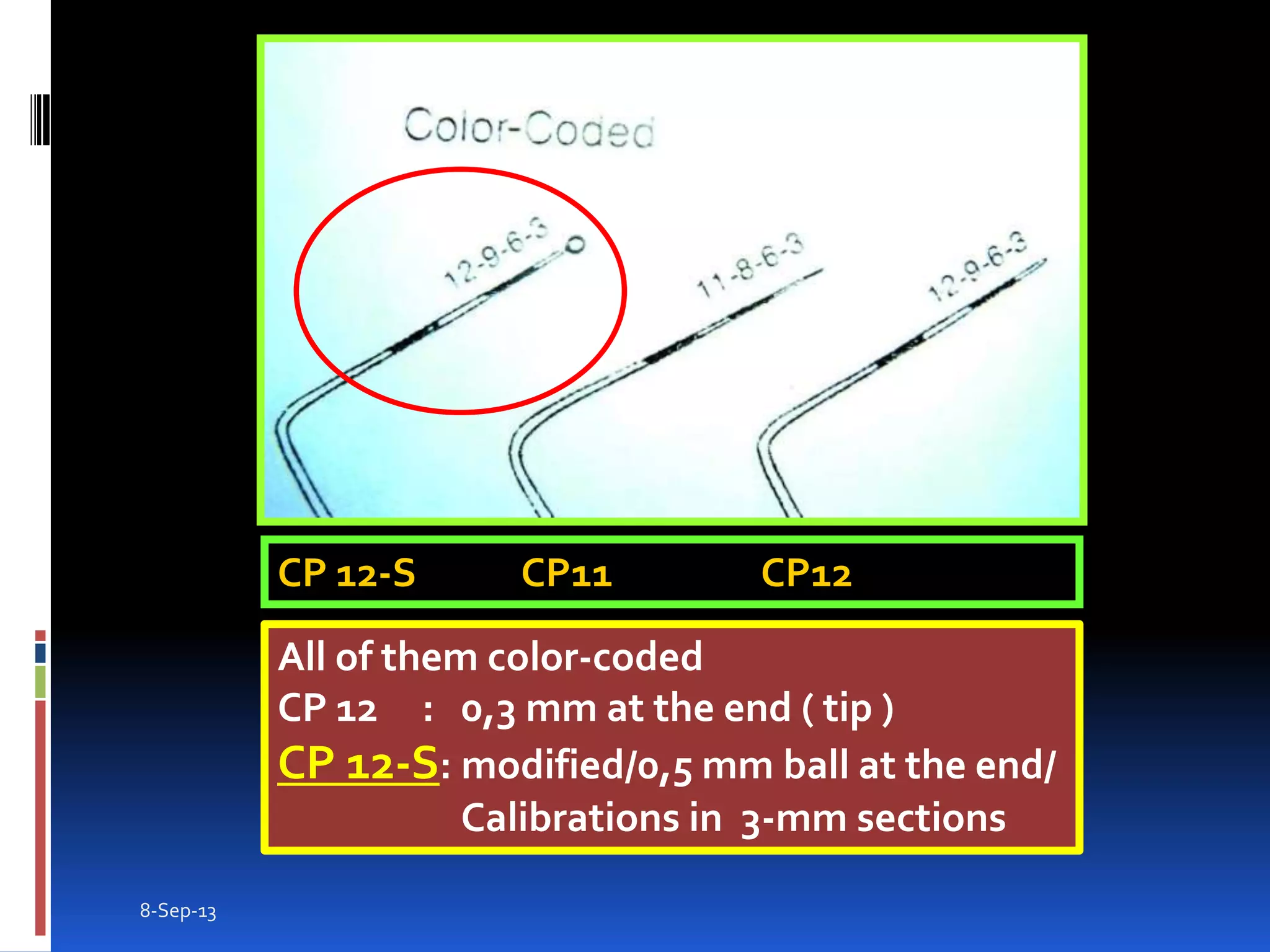
CP 12-S CP11 CP12
All of them color-coded
CP 12 : 0,3 mm at the end ( tip )
CP 12-S: modified/0,5 mm ball at the end/
Calibrations in 3-mm sections
8-Sep-13
WHO probe
• 0,5 mm ball at the tip
• millimeter markings
at 3,5/ 5,5/ 8,5/ 11,5 mm
• color coding from
3,5 to 5,5 mm
WilliamsWHO CP12
Nabers probe :
 Curved
 Blunt for furcation
areas
 we can detect the
furcation areas
also with straight
probe.
8-Sep-13
8-Sep-13
11
Scaling
and root planning
instruments
instrument design
8-Sep-13
12
Parts of each instrument
Working end
( blade )
Shank handle
The blade at the
same level with the
handle.
Different handles,
Diameter range
between 5 to 10 mm
8-Sep-13
13
From A to B
is the shank
(The lower part is
Terminal shank )
functional shank
length
8-Sep-13
14
8-Sep-13
15
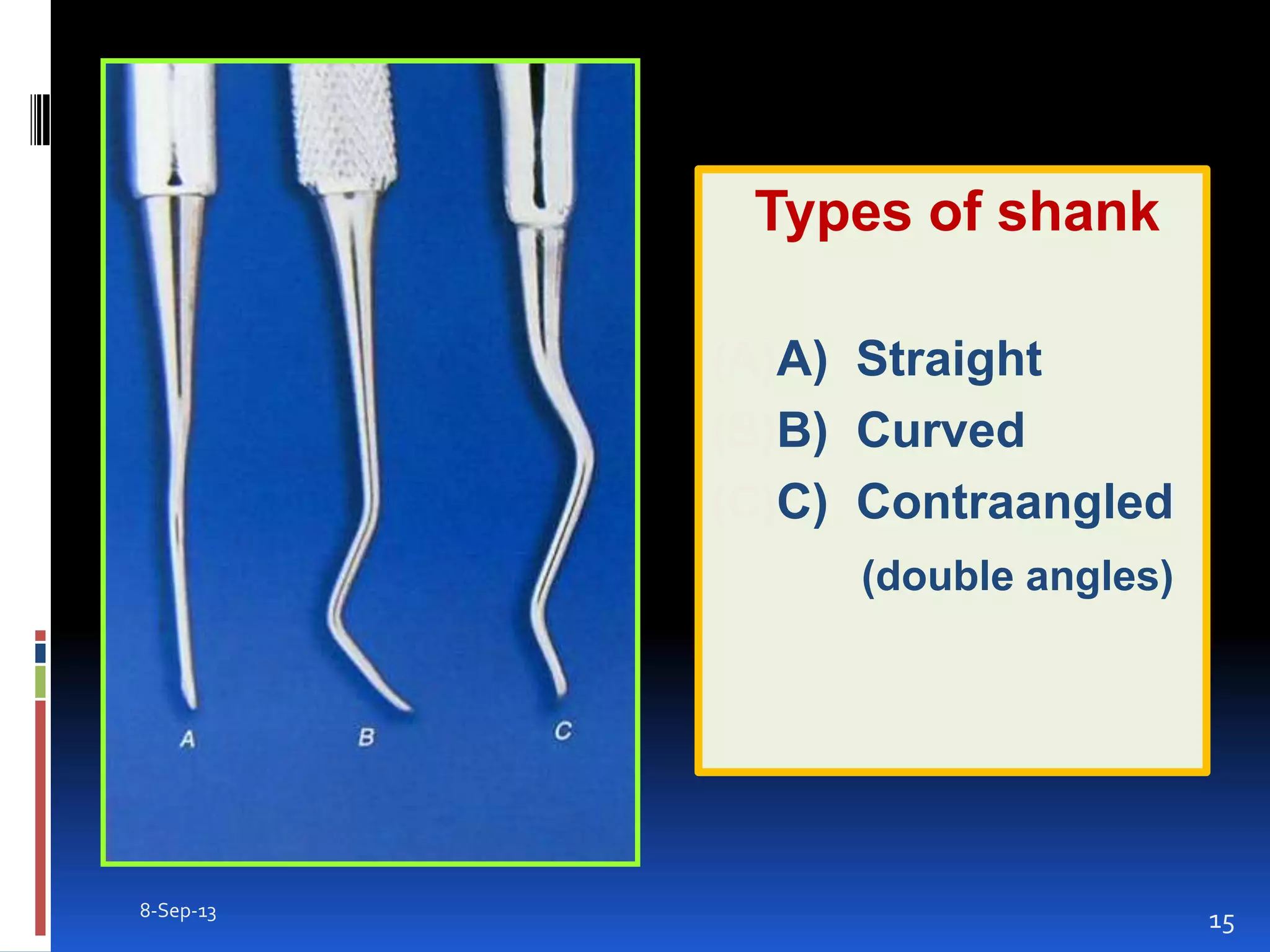
Types of shank
(A)A) Straight
(B)B) Curved
(C)C) Contraangled
(double angles)
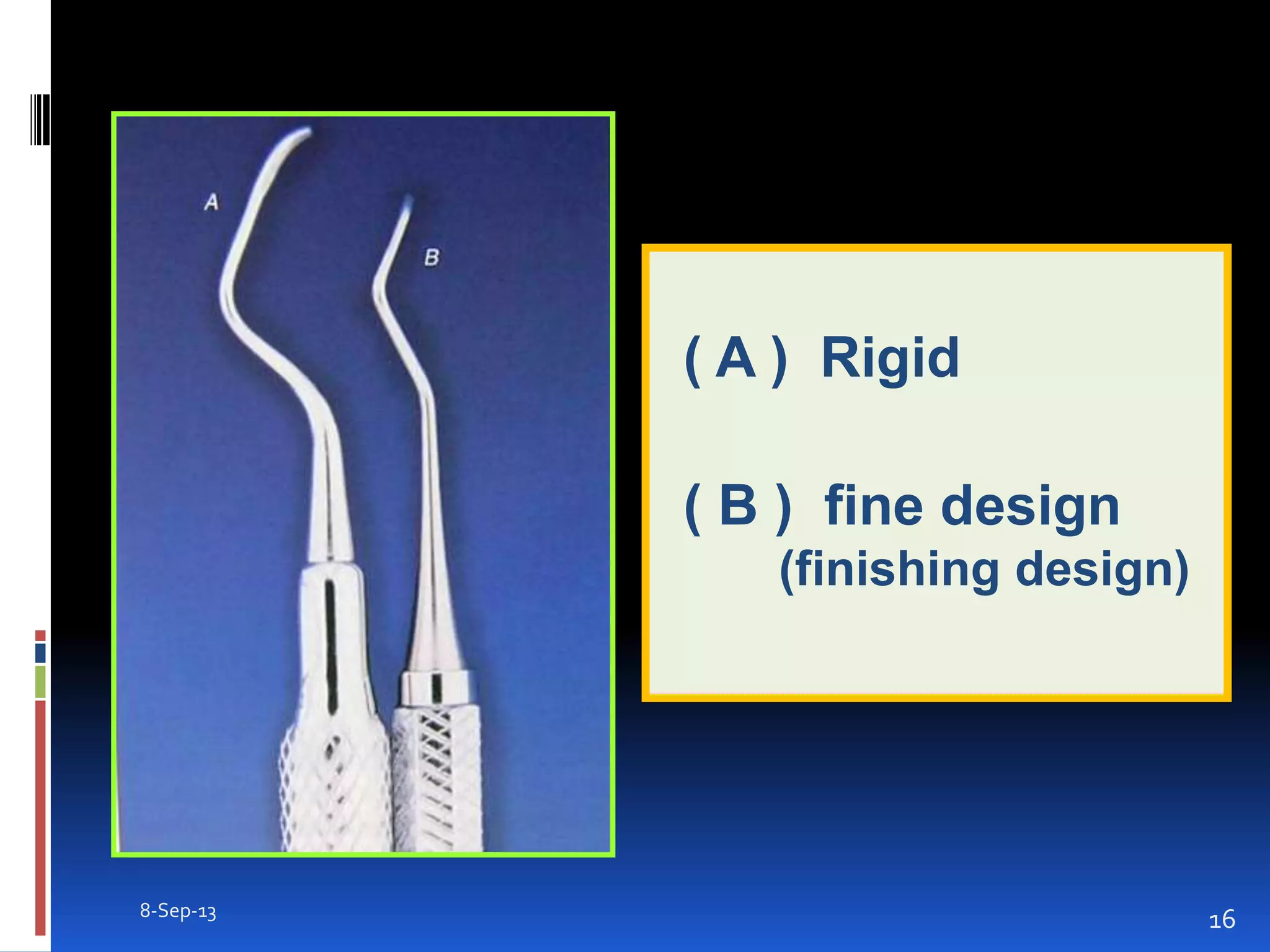
( A ) Rigid
( B ) fine design
(finishing design)
8-Sep-13
16
8-Sep-13
17
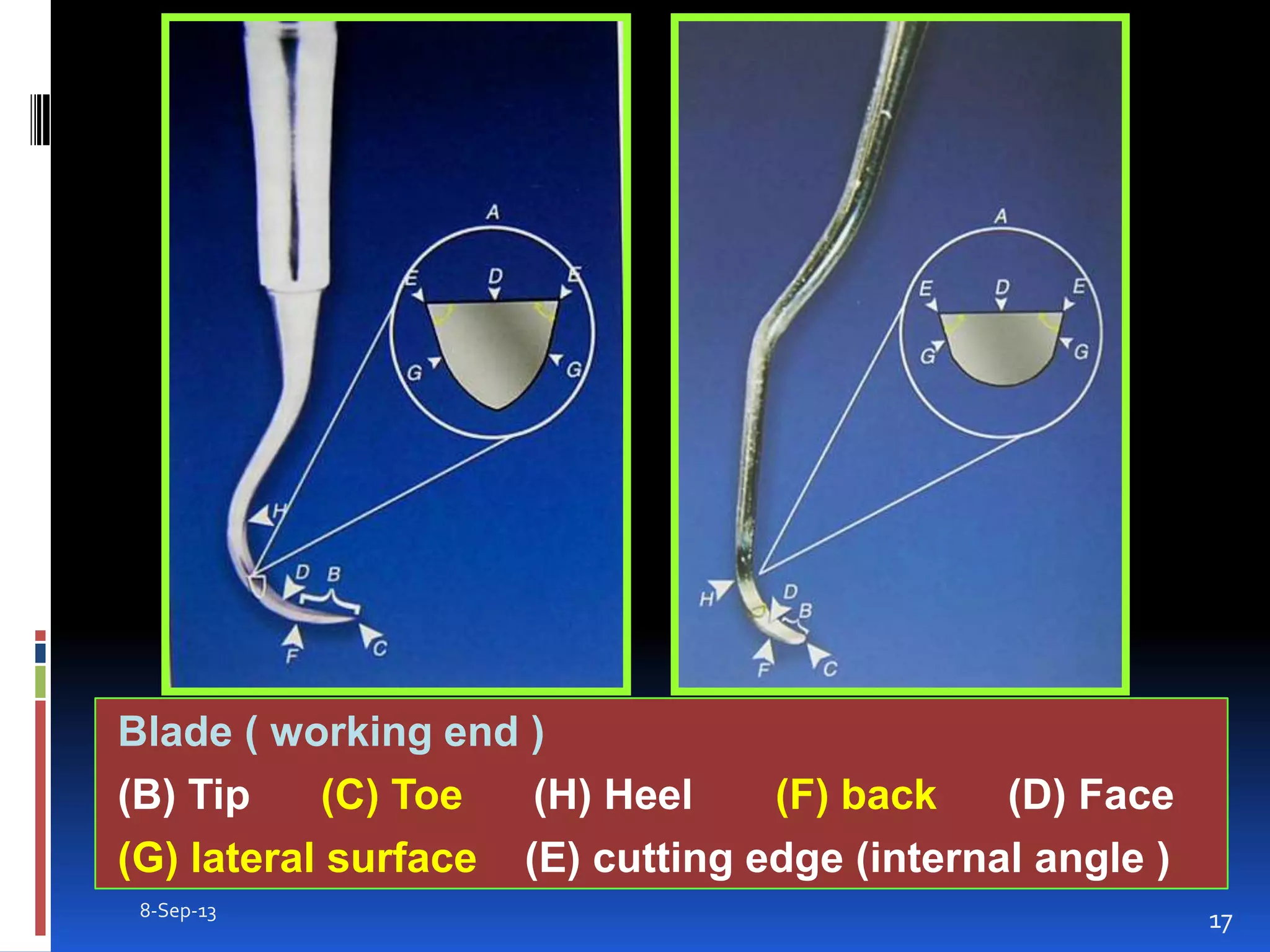
Blade ( working end )
(B) Tip (C) Toe (H) Heel (F) back (D) Face
(G) lateral surface (E) cutting edge (internal angle )
8-Sep-13
18
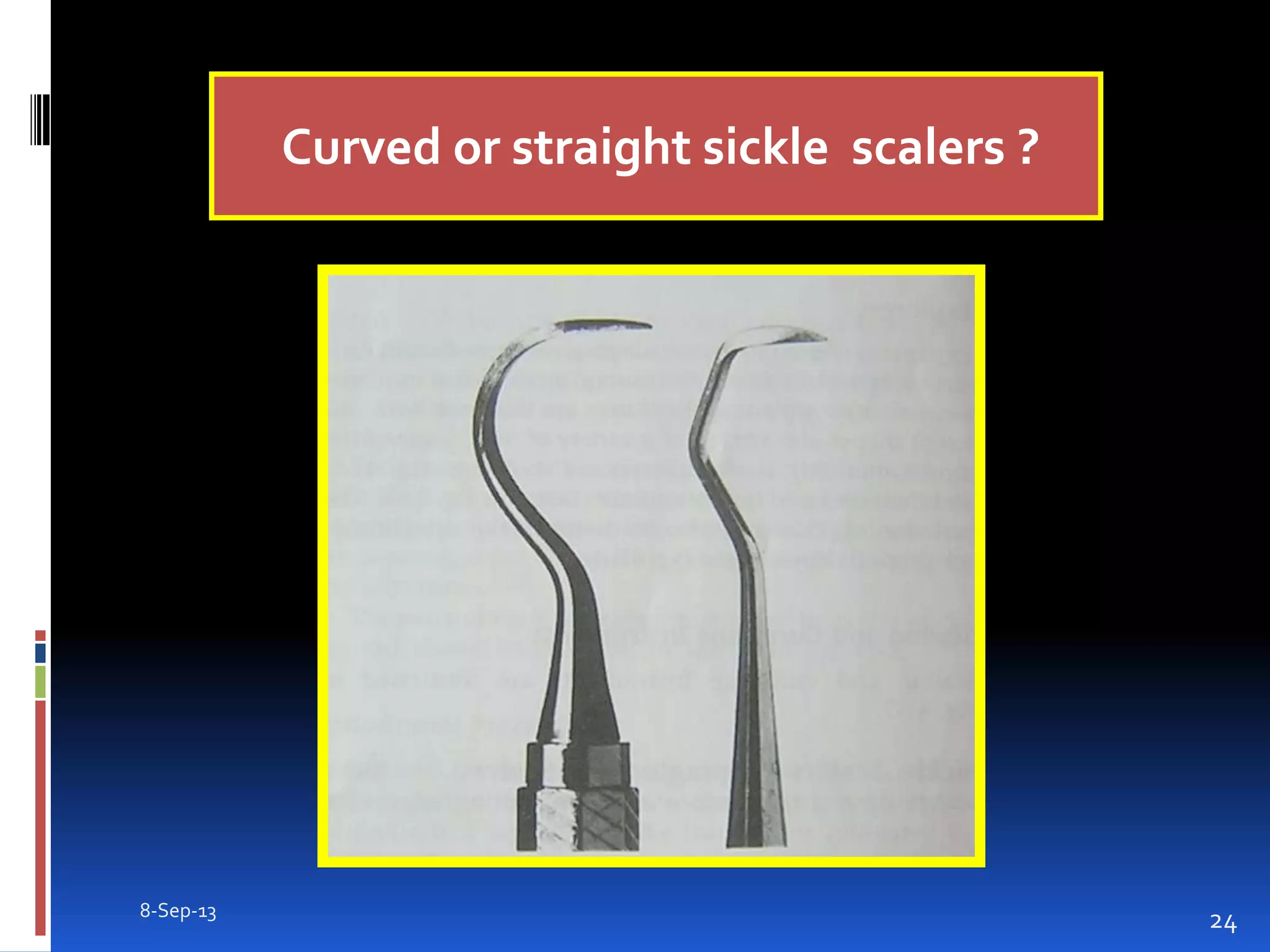
 Sickle scaler
 Curette
 File
 Chisel not more be used
 hoe
8-Sep-13
19
Types of scaling and
root planning instrument
 Characteristics ( design ) :
1.Triangular shape in cross section .
2.Two cutting edges . 3. pointed tip .
3.The angle between the blade and terminal shank is 90
8-Sep-13
20
Sickle scaler
Function :
 It is used primarily to remove supragingival calculus
 Some sickle scalers are small , curved , thin enough
to be inserted a few mm below the gingiva .
8-Sep-13
21
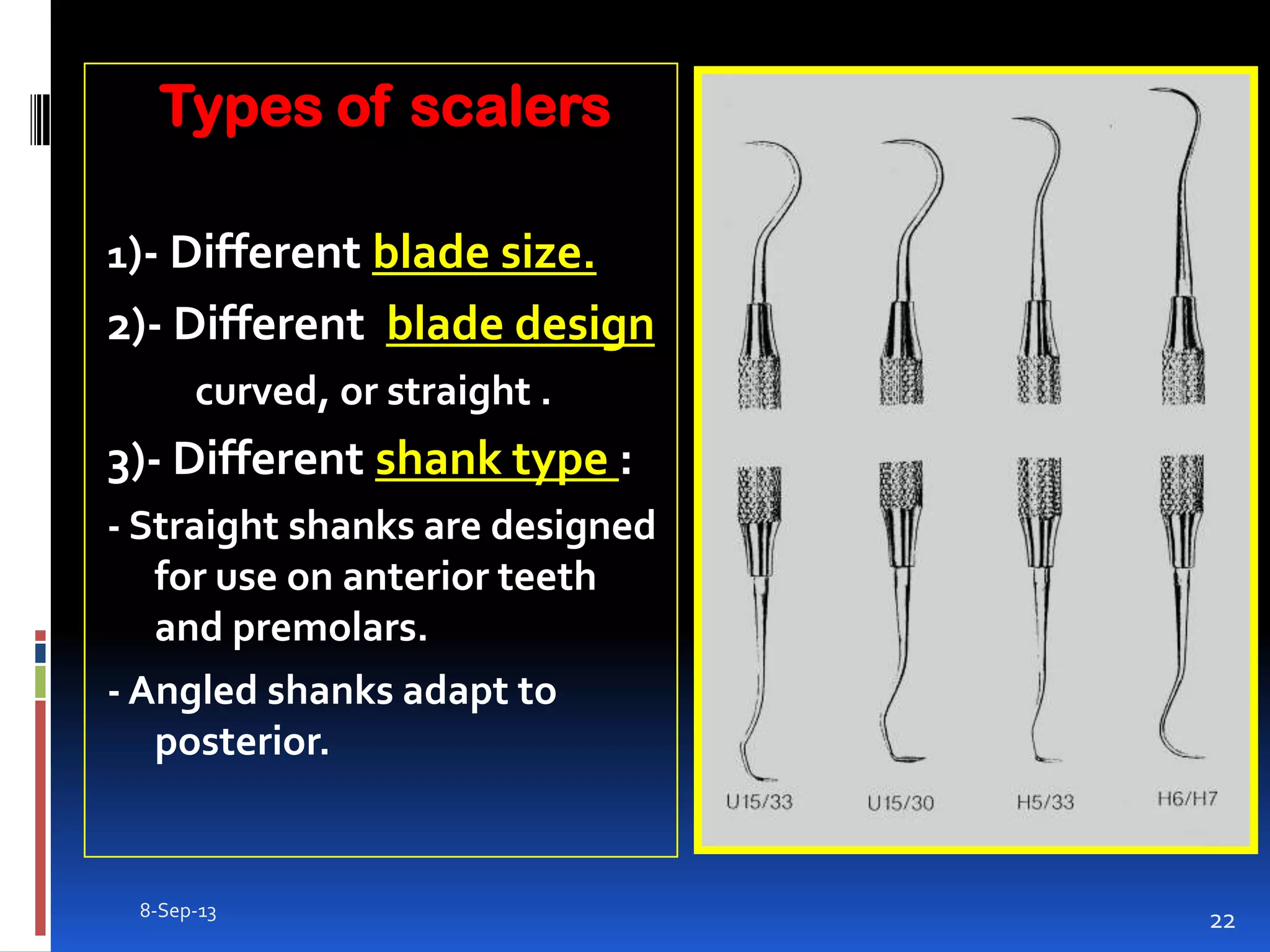
Types of scalers
1)- Different blade size.
2)- Different blade design
curved, or straight .
3)- Different shank type :
- Straight shanks are designed
for use on anterior teeth
and premolars.
- Angled shanks adapt to
posterior.
8-Sep-13
22
8-Sep-13
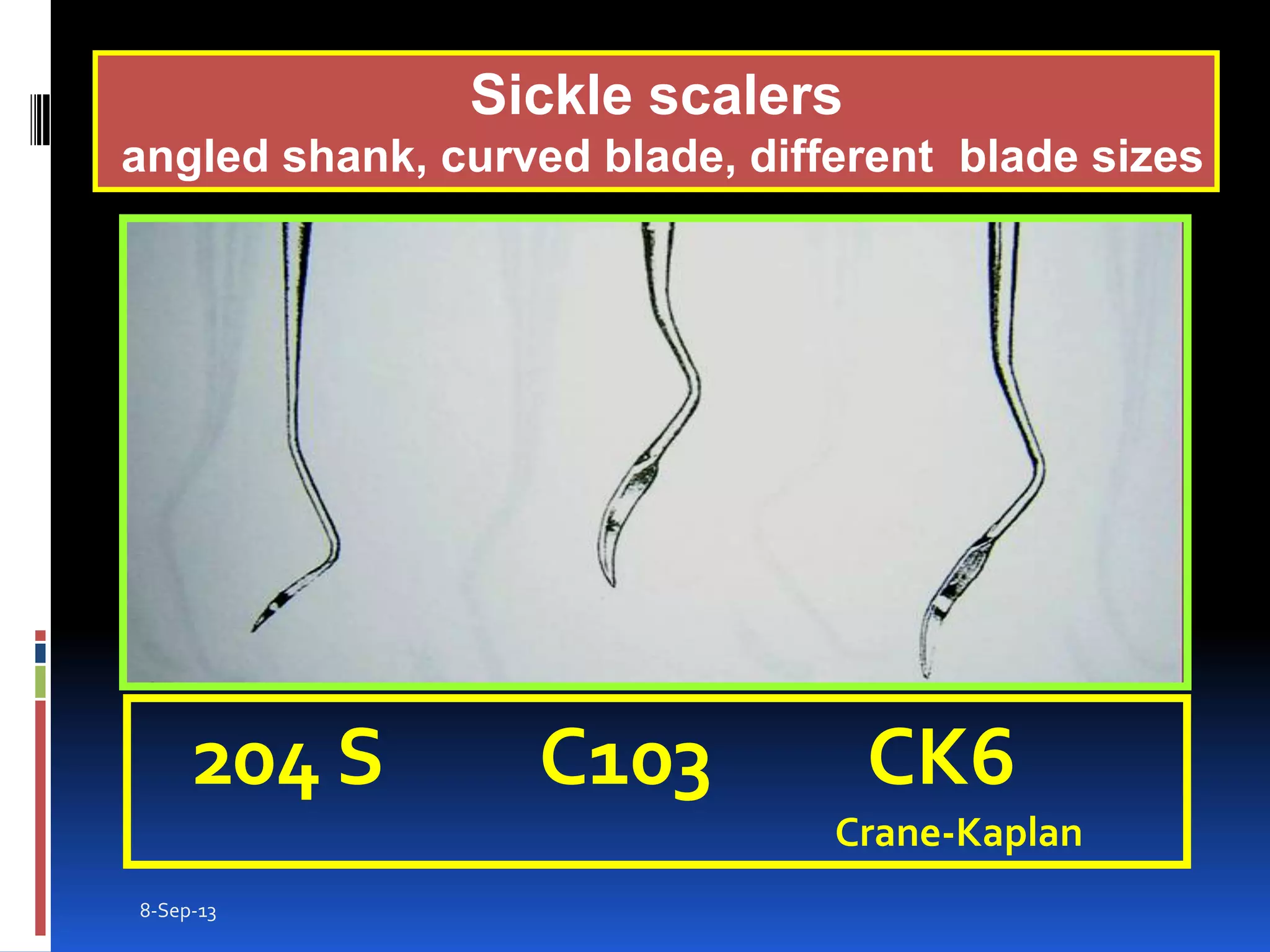
204 S C103 CK6
Crane-Kaplan
Sickle scalers
angled shank, curved blade, different blade sizes
Curved or straight sickle scalers ?
8-Sep-13
24
8-Sep-13
U15 CK6
General characteristics ( design ) :
1. Rounded toe, no sharp points, can be inserted
into deep pockets with minimal soft tissue
trauma.
2. In cross section , the blade
appear semicircular
( spoon-shaped blade )
3. Fine blade.
4. Curved blade.
8-Sep-13
26
curettes
Function :
 Removing deep subgingival calculus
 Root planning
Two basic types :
 Universal.
 Area-specific.
8-Sep-13
27
 The face is at a 90-degree angle with
terminal ( lower ) shank.
 Two cutting edge.
 What is the difference
between universal
Curette and sickle scaler?
8-Sep-13
28
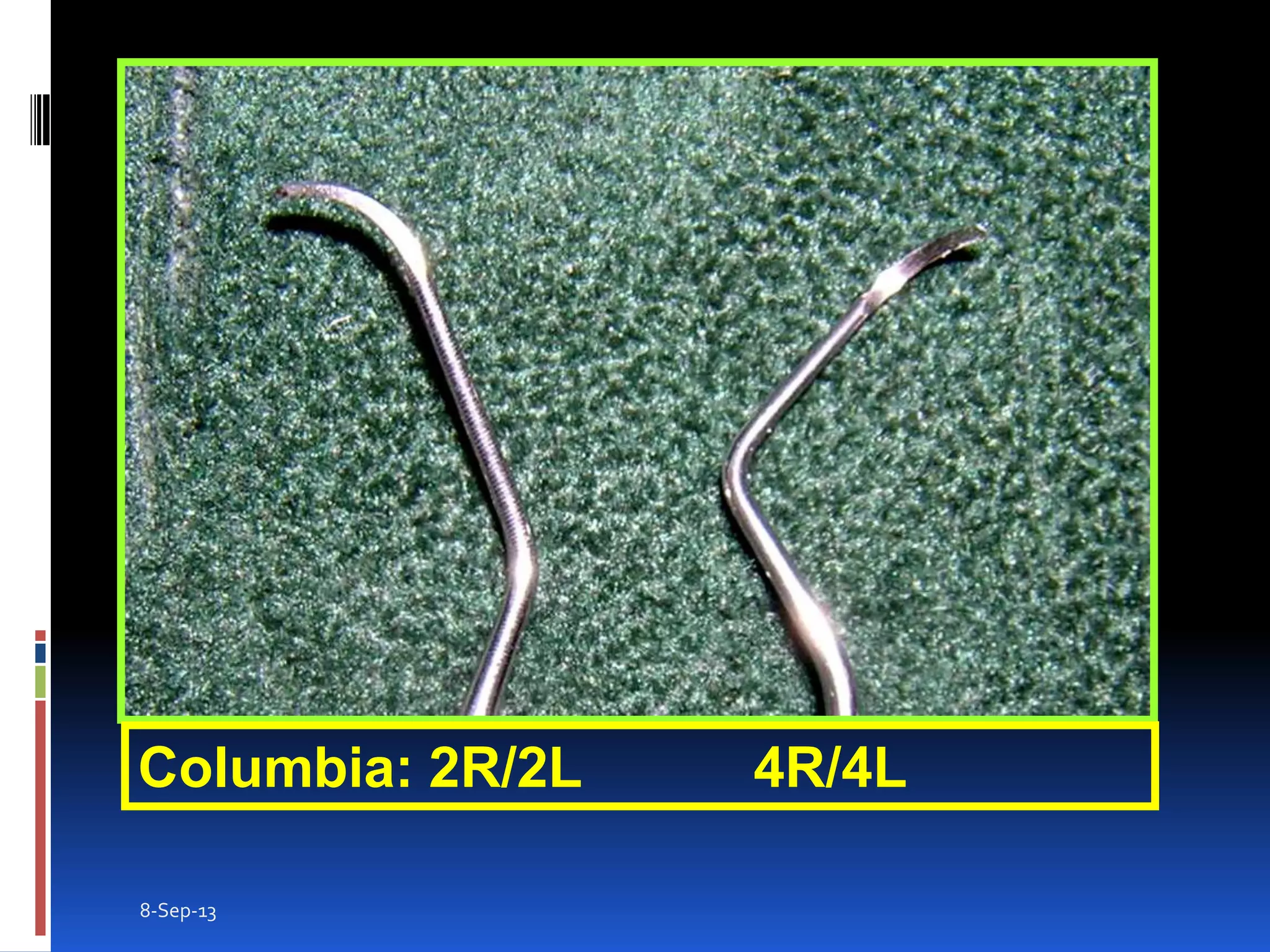
Universal curettes
-Universal curettes-
Columbia curettes
8-Sep-13
29
8-Sep-13
Columbia: 2R/2L 4R/4L
 Gracey curettes are a set of several
instruments designed to adapt to specific
anatomic areas of the dentition.
 The best instruments for subgingival scaling
and root planning because :
- they provide the best adaptation to
complex root surface anatomy.
- only one cutting edge, less damage to the
gingival soft tissues.
8-Sep-13
31
Area-specific curettes
( Gracey curettes )
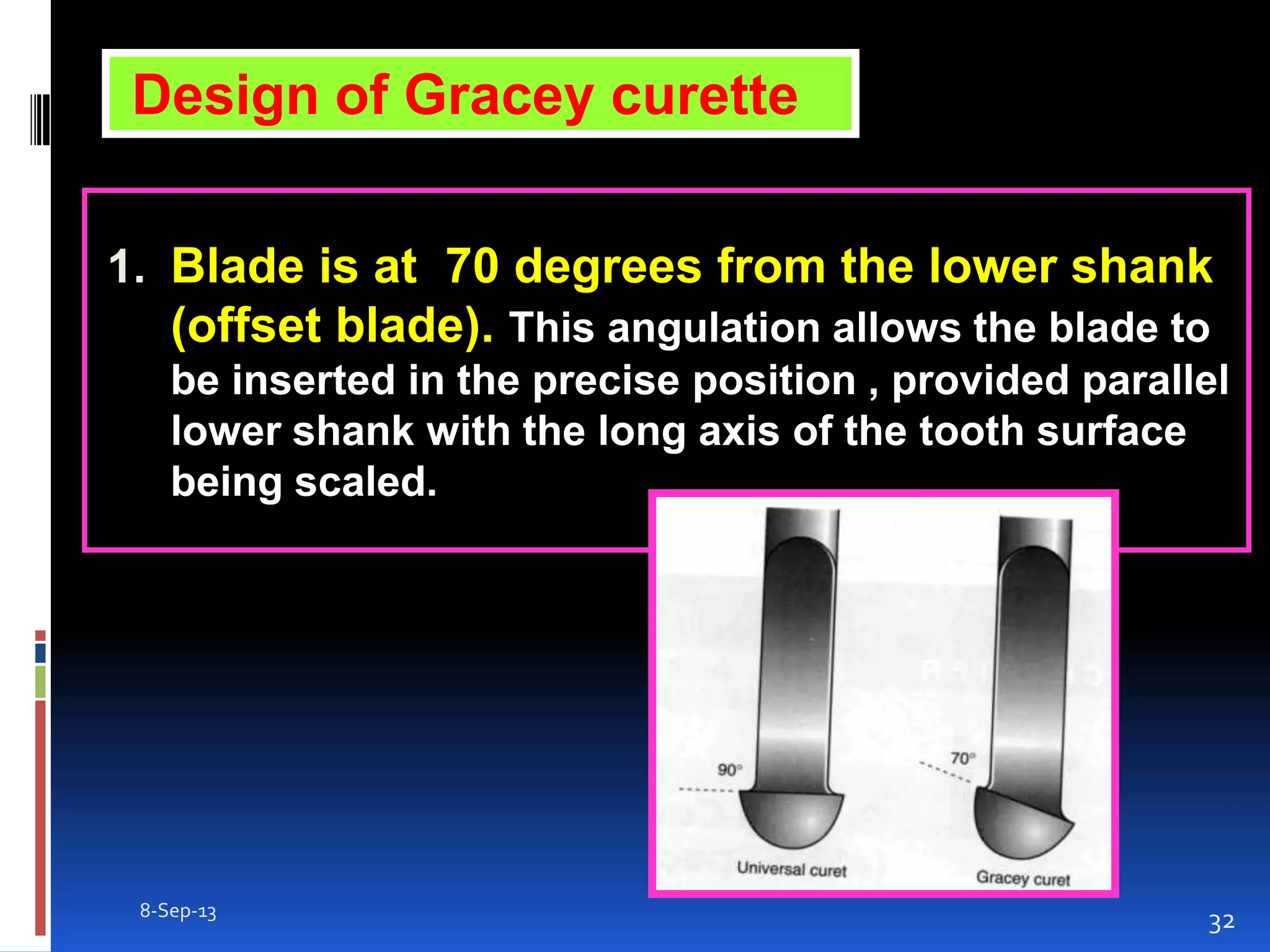
1. Blade is at 70 degrees from the lower shank
(offset blade). This angulation allows the blade to
be inserted in the precise position , provided parallel
lower shank with the long axis of the tooth surface
being scaled.
8-Sep-13
32
Design of Gracey curette
2. Curved blade in two planes
blade curves up and to the side
3. One cutting edge.
8-Sep-13
33
Universal curetteGracey curette
All areas and surfacesspecific surfacesArea of use
two cutting edgeOne cutting edgeUse of cutting edge
Curved in one planeCurved in two planesCutting edge curvature
Not Offset , 90 degreesOffset blade, 70Blade angle
8-Sep-13
Universal curetteGracey curette
8-Sep-13
35
• Larger, stronger, and less
flexible shank and blade
• Used to remove moderate-
to-heavy calculus
Rigid
design(A)
• Thinner shank, more
flexible,
• Enhanced tactile sensitivity,
used to finish root planning.
Finishing
design (B)
Rigidity type of shank
 Gracey # 1-2 and 3-4 : anterior teeth.
 Gracey # 5-6 : anterior teeth (and premolars).
 Gracey # 7-8 and 9-10: posterior teeth : facial and ligual.
 Gracey # 11-12 : posterior teeth : mesial
 Gracey # 13-14 : posterior teeth : distal .
8-Sep-13
36
Double-ended Gracey curettes
are 7 instruments
8-Sep-13
Standard Gracey Curettes
Reduced set of Gracey
8-Sep-13
38
# 5-6 # 7-8 # 11-12 # 13-14
 It is a modification of the
standard 11-12
 Combines a Gracey :
#11-12 blade with a
#13-14 shank .
 It is allows better
adaptation to posterior
mesial surfaces, especially
on the mandibular molars
with an intraoral finger rest.
8-Sep-13
39
Gracey #15-16
8-Sep-13
40
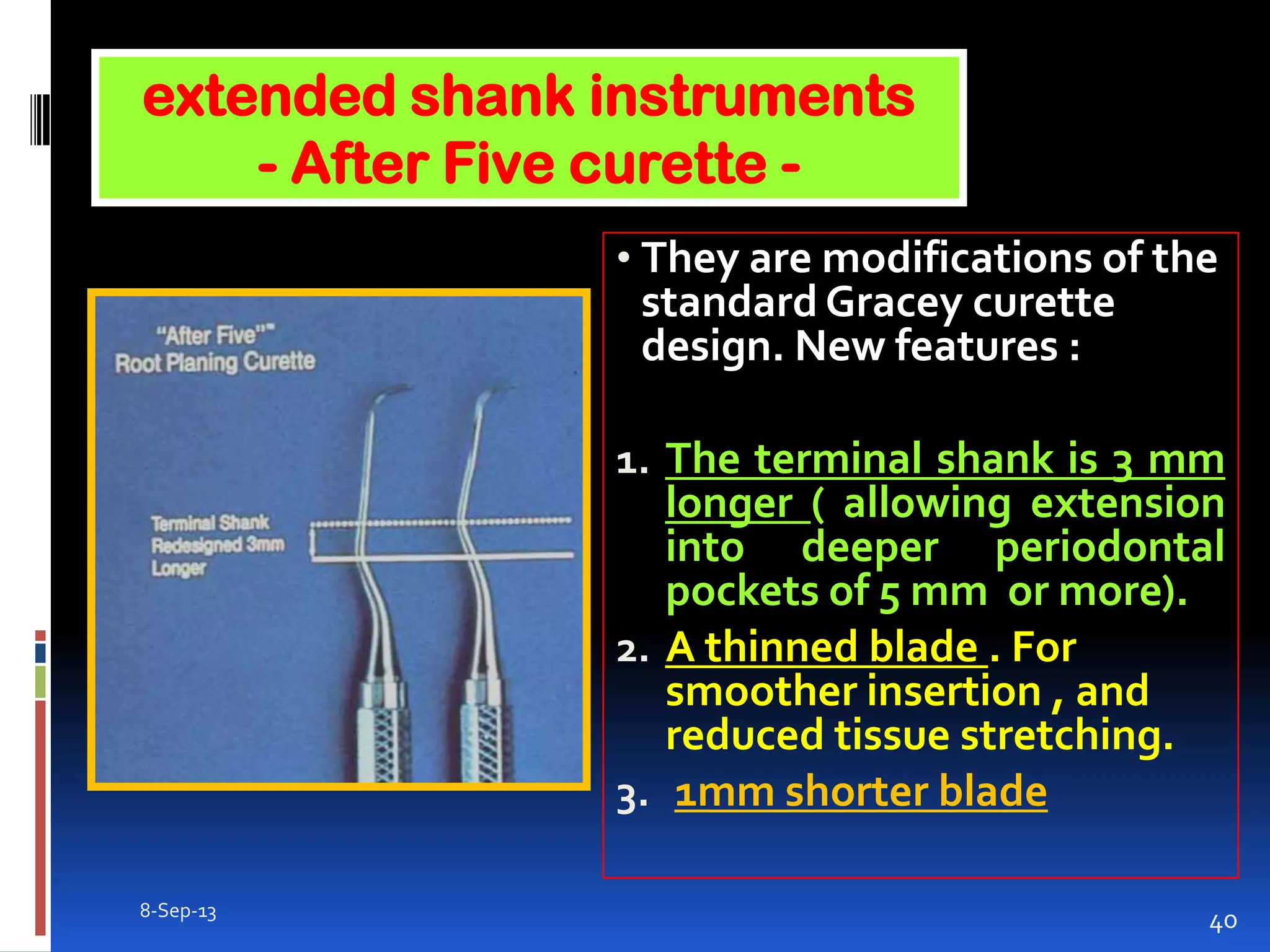
• They are modifications of the
standard Gracey curette
design. New features :
1. The terminal shank is 3 mm
longer ( allowing extension
into deeper periodontal
pockets of 5 mm or more).
2. A thinned blade . For
smoother insertion , and
reduced tissue stretching.
3. 1mm shorter blade
extended shank instruments
- After Five curette -
 Available After Five instruments :
#1-2, 3-4, 5-6, 7-8, 9-10 , 11-12, 13-14
 Available in finishing (fine) or rigid designs:
- rigid After Five Gracey curettes
- finishing After Five Gracey curettes
8-Sep-13
41
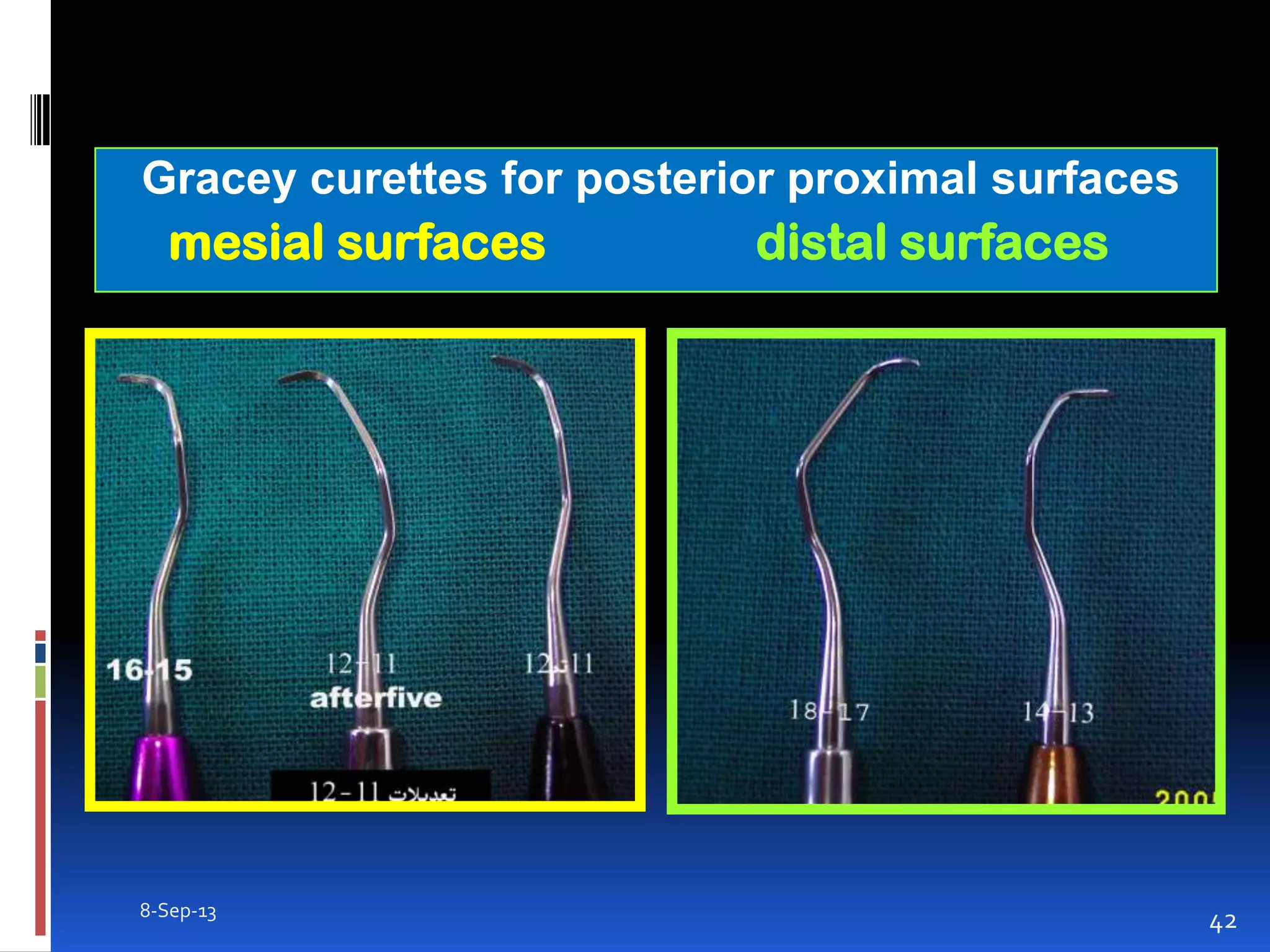
Gracey curettes for posterior proximal surfaces
mesial surfaces distal surfaces
8-Sep-13
42
 Rigid standard #13-14 adapted to the distal surface
of the first molar. And rigid After Five #13-14
adapted to the distal surface of the second molar.
 Notice the extra long shank which allows deeper
insertion and better access.
8-Sep-13
43
They are modifications of
the After Five curettes
Features:
1. Blades are half the
length of the After Five
or standard Gracey
curettes.
2. Extended shank
8-Sep-13
44
Mini-bladed curettes
- Mini Five-
Function
Easier insertion and adaptation in any area
where root morphology or tight tissue
prevents full insertion of standard Gracey or
After Five blade :
1. deep, narrow pockets,
2. furcations,
3. developmental grooves,
4. line angles,
5. Deep, tight pockets.
8-Sep-13
45
Comparison of a standard Gracey # 5-6
with a Mini Five # 5-6 curette on the palatal
surfaces of the maxillary central incisors.
The Mini Five can be inserted to the base of
these tight pockets with vertical stroke.
8-Sep-13
46
- Available in both:
- rigid Mini Five Gracey curette
- finishing Mini Five Gracey curette
- available in all standard Gracey numbers
except for the # 9-10
- advantages :
1. can be used easily with vertical strokes,
2. With reduced tissue distention,
3. and without tissue trauma.
8-Sep-13
47
 Plastic instruments be used to avoid
scratching and damage to the implants.
8-Sep-13
48
Plastic instruments
for implants
8-Sep-13
49
Oscillating scaler
Ultrasonic sonic
Used to remove
plaque,
Calculus,
stains.
Oscillating scaler systems
- power-driven scalers-
 The vibrations range from 20000 to
45000 cycle/second.
8-Sep-13
50
ultraonic scaler
8-Sep-13
51
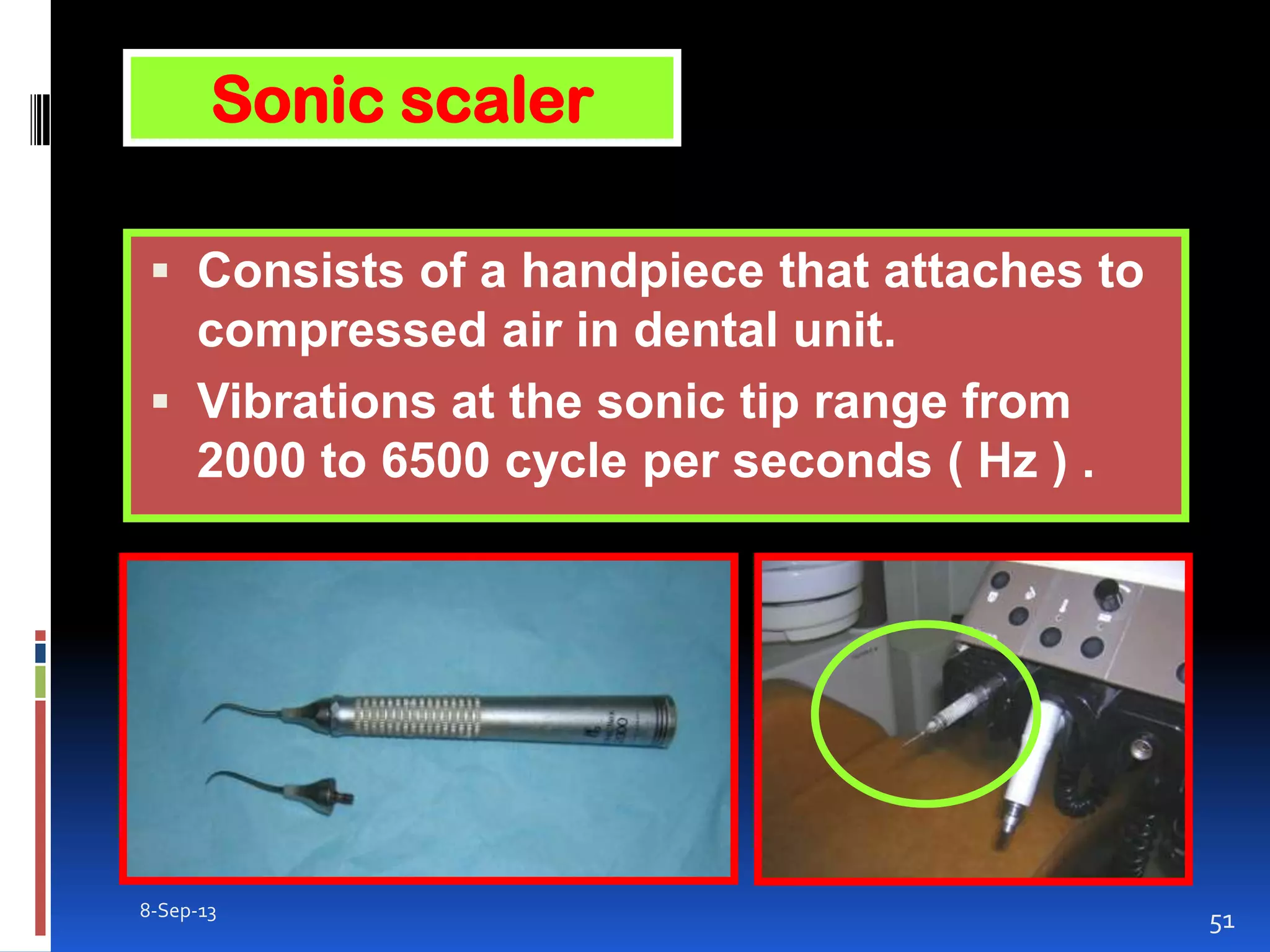
 Consists of a handpiece that attaches to
compressed air in dental unit.
 Vibrations at the sonic tip range from
2000 to 6500 cycle per seconds ( Hz ) .
Sonic scaler
8-Sep-13
52
Polishing instruments
Goals of polishing
Remove stains
Smoothening
tooth surfaces
Polishing
instruments
Rubber
cup
Bristle
brush
Dental
tape
Air-powder
polishing
8-Sep-13
53
 Used in the handpiece with paste.
 There is disposable plastic prophylaxis angle
and rubber cup, may be used and then
discarded.
8-Sep-13
54
Rubber cup
 Are available in wheel and cup shapes.
 Is used in the handpiece with a polishing
paste.
 Should be used with low speed .
8-Sep-13
55
Bristle brushes
8-Sep-13
56
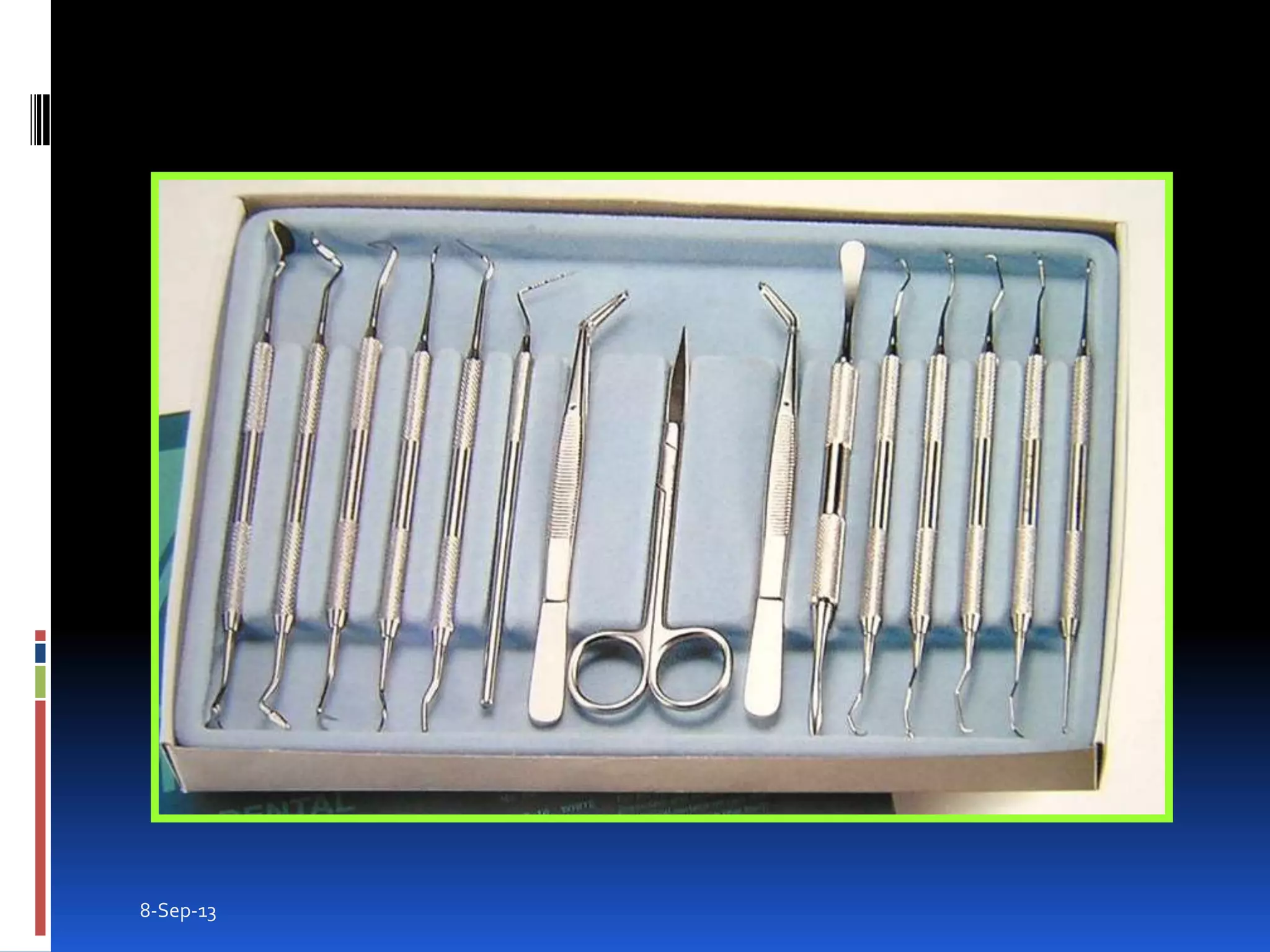
Periodontal surgical
instruments
8-Sep-13
Instruments will be used in Perio I
8-Sep-13
58
- blade 15 ( 2 pieces )
- scalpel
- silk suture (000)
- needle holder
- periodontal probe
- U15/30 , CK6 , or another fine sickle scalers available
in dental market ( like H5/33 , H6/H7 , … )
- Gracey curettes : / 5-6 / 7-8 / 11-12 / 13-14 /
- toothbrush
thanks

Perio. instrumentation

  • 1.
    Perio I ( pre-clinicperiodontology course ) By /shaker al.samea periodontal instrumentation
  • 2.
    1. Periodontal probes. 2.Scaling and root planning instruments. 3. Polishing instruments. 4. Periodontal surgical instruments. 8-Sep-13 2
  • 3.
  • 4.
     Function :to measure the depth of the pockets.  General characteristics : - tapered - straight - millimeter calibration - blunt, rounded tip - thin ( 0,5 mm at the end ) - the shank is angled to allow easy insertion in the pocket. 8-Sep-13 4
  • 5.
    8-Sep-13 UNC-15 : • a15-mm-long probe with markings at each millimeter • Color coding between 4-5 mm, 9-10 mm, 14-15 mm . • very useful in periodontal research Types of periodontal probes UNC-15
  • 6.
    8-Sep-13 6 Williams probe  Williamsmarking at : 1, 2, 3, 5, 7, 8, 9,10 mm Williamsprobe
  • 7.
    8-Sep-13 Williams Goldman-Fox - Goldman-Foxprobe same as Williams probe`s calibration - But it is flattened not round
  • 8.
    8-Sep-13 CP 12-S CP11CP12 All of them color-coded CP 12 : 0,3 mm at the end ( tip ) CP 12-S: modified/0,5 mm ball at the end/ Calibrations in 3-mm sections
  • 9.
    8-Sep-13 WHO probe • 0,5mm ball at the tip • millimeter markings at 3,5/ 5,5/ 8,5/ 11,5 mm • color coding from 3,5 to 5,5 mm WilliamsWHO CP12
  • 10.
    Nabers probe : Curved  Blunt for furcation areas  we can detect the furcation areas also with straight probe. 8-Sep-13
  • 11.
  • 12.
    instrument design 8-Sep-13 12 Parts ofeach instrument Working end ( blade ) Shank handle
  • 13.
    The blade atthe same level with the handle. Different handles, Diameter range between 5 to 10 mm 8-Sep-13 13
  • 14.
    From A toB is the shank (The lower part is Terminal shank ) functional shank length 8-Sep-13 14
  • 15.
    8-Sep-13 15 Types of shank (A)A)Straight (B)B) Curved (C)C) Contraangled (double angles)
  • 16.
    ( A )Rigid ( B ) fine design (finishing design) 8-Sep-13 16
  • 17.
    8-Sep-13 17 Blade ( workingend ) (B) Tip (C) Toe (H) Heel (F) back (D) Face (G) lateral surface (E) cutting edge (internal angle )
  • 18.
  • 19.
     Sickle scaler Curette  File  Chisel not more be used  hoe 8-Sep-13 19 Types of scaling and root planning instrument
  • 20.
     Characteristics (design ) : 1.Triangular shape in cross section . 2.Two cutting edges . 3. pointed tip . 3.The angle between the blade and terminal shank is 90 8-Sep-13 20 Sickle scaler
  • 21.
    Function :  Itis used primarily to remove supragingival calculus  Some sickle scalers are small , curved , thin enough to be inserted a few mm below the gingiva . 8-Sep-13 21
  • 22.
    Types of scalers 1)-Different blade size. 2)- Different blade design curved, or straight . 3)- Different shank type : - Straight shanks are designed for use on anterior teeth and premolars. - Angled shanks adapt to posterior. 8-Sep-13 22
  • 23.
    8-Sep-13 204 S C103CK6 Crane-Kaplan Sickle scalers angled shank, curved blade, different blade sizes
  • 24.
    Curved or straightsickle scalers ? 8-Sep-13 24
  • 25.
  • 26.
    General characteristics (design ) : 1. Rounded toe, no sharp points, can be inserted into deep pockets with minimal soft tissue trauma. 2. In cross section , the blade appear semicircular ( spoon-shaped blade ) 3. Fine blade. 4. Curved blade. 8-Sep-13 26 curettes
  • 27.
    Function :  Removingdeep subgingival calculus  Root planning Two basic types :  Universal.  Area-specific. 8-Sep-13 27
  • 28.
     The faceis at a 90-degree angle with terminal ( lower ) shank.  Two cutting edge.  What is the difference between universal Curette and sickle scaler? 8-Sep-13 28 Universal curettes
  • 29.
  • 30.
  • 31.
     Gracey curettesare a set of several instruments designed to adapt to specific anatomic areas of the dentition.  The best instruments for subgingival scaling and root planning because : - they provide the best adaptation to complex root surface anatomy. - only one cutting edge, less damage to the gingival soft tissues. 8-Sep-13 31 Area-specific curettes ( Gracey curettes )
  • 32.
    1. Blade isat 70 degrees from the lower shank (offset blade). This angulation allows the blade to be inserted in the precise position , provided parallel lower shank with the long axis of the tooth surface being scaled. 8-Sep-13 32 Design of Gracey curette
  • 33.
    2. Curved bladein two planes blade curves up and to the side 3. One cutting edge. 8-Sep-13 33
  • 34.
    Universal curetteGracey curette Allareas and surfacesspecific surfacesArea of use two cutting edgeOne cutting edgeUse of cutting edge Curved in one planeCurved in two planesCutting edge curvature Not Offset , 90 degreesOffset blade, 70Blade angle 8-Sep-13 Universal curetteGracey curette
  • 35.
    8-Sep-13 35 • Larger, stronger,and less flexible shank and blade • Used to remove moderate- to-heavy calculus Rigid design(A) • Thinner shank, more flexible, • Enhanced tactile sensitivity, used to finish root planning. Finishing design (B) Rigidity type of shank
  • 36.
     Gracey #1-2 and 3-4 : anterior teeth.  Gracey # 5-6 : anterior teeth (and premolars).  Gracey # 7-8 and 9-10: posterior teeth : facial and ligual.  Gracey # 11-12 : posterior teeth : mesial  Gracey # 13-14 : posterior teeth : distal . 8-Sep-13 36 Double-ended Gracey curettes are 7 instruments
  • 37.
  • 38.
    Reduced set ofGracey 8-Sep-13 38 # 5-6 # 7-8 # 11-12 # 13-14
  • 39.
     It isa modification of the standard 11-12  Combines a Gracey : #11-12 blade with a #13-14 shank .  It is allows better adaptation to posterior mesial surfaces, especially on the mandibular molars with an intraoral finger rest. 8-Sep-13 39 Gracey #15-16
  • 40.
    8-Sep-13 40 • They aremodifications of the standard Gracey curette design. New features : 1. The terminal shank is 3 mm longer ( allowing extension into deeper periodontal pockets of 5 mm or more). 2. A thinned blade . For smoother insertion , and reduced tissue stretching. 3. 1mm shorter blade extended shank instruments - After Five curette -
  • 41.
     Available AfterFive instruments : #1-2, 3-4, 5-6, 7-8, 9-10 , 11-12, 13-14  Available in finishing (fine) or rigid designs: - rigid After Five Gracey curettes - finishing After Five Gracey curettes 8-Sep-13 41
  • 42.
    Gracey curettes forposterior proximal surfaces mesial surfaces distal surfaces 8-Sep-13 42
  • 43.
     Rigid standard#13-14 adapted to the distal surface of the first molar. And rigid After Five #13-14 adapted to the distal surface of the second molar.  Notice the extra long shank which allows deeper insertion and better access. 8-Sep-13 43
  • 44.
    They are modificationsof the After Five curettes Features: 1. Blades are half the length of the After Five or standard Gracey curettes. 2. Extended shank 8-Sep-13 44 Mini-bladed curettes - Mini Five-
  • 45.
    Function Easier insertion andadaptation in any area where root morphology or tight tissue prevents full insertion of standard Gracey or After Five blade : 1. deep, narrow pockets, 2. furcations, 3. developmental grooves, 4. line angles, 5. Deep, tight pockets. 8-Sep-13 45
  • 46.
    Comparison of astandard Gracey # 5-6 with a Mini Five # 5-6 curette on the palatal surfaces of the maxillary central incisors. The Mini Five can be inserted to the base of these tight pockets with vertical stroke. 8-Sep-13 46
  • 47.
    - Available inboth: - rigid Mini Five Gracey curette - finishing Mini Five Gracey curette - available in all standard Gracey numbers except for the # 9-10 - advantages : 1. can be used easily with vertical strokes, 2. With reduced tissue distention, 3. and without tissue trauma. 8-Sep-13 47
  • 48.
     Plastic instrumentsbe used to avoid scratching and damage to the implants. 8-Sep-13 48 Plastic instruments for implants
  • 49.
    8-Sep-13 49 Oscillating scaler Ultrasonic sonic Usedto remove plaque, Calculus, stains. Oscillating scaler systems - power-driven scalers-
  • 50.
     The vibrationsrange from 20000 to 45000 cycle/second. 8-Sep-13 50 ultraonic scaler
  • 51.
    8-Sep-13 51  Consists ofa handpiece that attaches to compressed air in dental unit.  Vibrations at the sonic tip range from 2000 to 6500 cycle per seconds ( Hz ) . Sonic scaler
  • 52.
  • 53.
    Goals of polishing Removestains Smoothening tooth surfaces Polishing instruments Rubber cup Bristle brush Dental tape Air-powder polishing 8-Sep-13 53
  • 54.
     Used inthe handpiece with paste.  There is disposable plastic prophylaxis angle and rubber cup, may be used and then discarded. 8-Sep-13 54 Rubber cup
  • 55.
     Are availablein wheel and cup shapes.  Is used in the handpiece with a polishing paste.  Should be used with low speed . 8-Sep-13 55 Bristle brushes
  • 56.
  • 57.
  • 58.
    Instruments will beused in Perio I 8-Sep-13 58 - blade 15 ( 2 pieces ) - scalpel - silk suture (000) - needle holder - periodontal probe - U15/30 , CK6 , or another fine sickle scalers available in dental market ( like H5/33 , H6/H7 , … ) - Gracey curettes : / 5-6 / 7-8 / 11-12 / 13-14 / - toothbrush
  • 59.