The science of dental materials involves
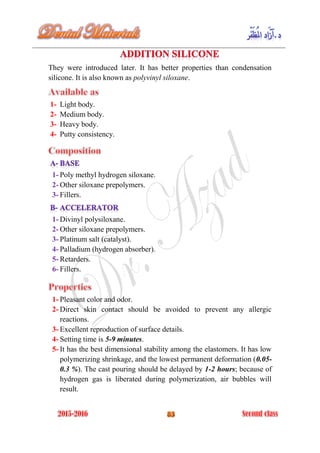
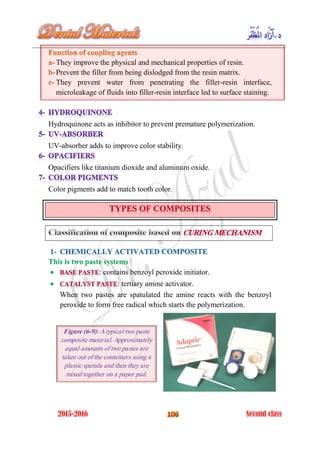
a study of the composition and properties
of materials and the way in which they
interact with the environment in which
they are placed.
B.D.S., M.Sc. (Prosth.)
FOURTH EDITION 2015-2016
You can download these lectures from:
 (moodle) electronic-learning platform.
 or use this link: www.uobabylon.edu.iq/uobcoleges/default.aspx?fid=4
E-mail of lecturer: azadontics@gmail.com
The science of dental materials involves a study of the composition and
properties of materials and the way in which they interact with the
environment in which they are placed.
1- Prevention.
2- Restoration.
3- Rehabilitation.
Prevention
a- Materials of brushing and flossing.
b- Fluoride therapy.
c- Fissure sealants.
Restoration
a- Filling materials (temporary filling, silver filling, tooth colored filling, gold
inlay, ceramic inlay).
b- Materials have soothing and promote healing of the pulp (calcium
hydroxide).
c- Root canal treatment (solutions used to clean the canal, materials which fill
the canal like gutta percha, silver cone, and sealing paste)
d- Crown and onlay.
e- Post and core.
f- Cements.
g- Model of teeth to fabricate restorations (gypsum products).
h- Impression materials.
Rehabilitation
a- Artificial teeth (acrylic, porcelain).
b- Implant (titanium screw).
c- Fixed partial denture materials.
d- Cements.
e- Removable partial denture materials (metal framework and plastic (acrylic)
denture base, or made entirely of plastic).
Forms of matter
Change of state
Matter exists in three forms (solid, liquid, and gas). The difference in form
is mainly due to different in force that held the atoms together (bonds).
Atoms are held together by some forces. These interatomic bonding forces
that hold atoms together are cohesive forces. Interatomic bonds may be
classified as:
1- Primary bonds.
2- Secondary bonds.
These are chemical in nature.
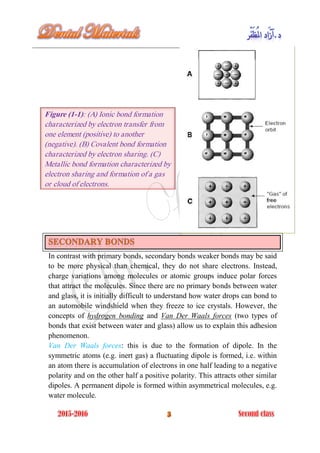
a- Ionic bonds: these are simple chemical bonds, resulting from mutual
attraction of positive and negative charges; the classic example is
sodium chloride.
b- Covalent bonds: in many chemical compounds, two valence electrons
are shared. The hydrogen molecule is an example of this bond.
c- Metallic bonds: The third type of primary atomic interaction is the
metallic bond which results from the increased spatial extension of
valence-electron wave functions when an aggregate of metal atoms is
brought close together. This type of bonding can be understood best
by studying a metallic crystal such as pure gold. Such a crystal
consists only of gold atoms. Like all other metals, gold atoms can
easily donate electrons from their outer shell and form a "cloud" of
free electrons. The contribution of free electrons to this cloud results
in the formation of positive ions that can be neutralized by acquiring
new valence electrons from adjacent atoms.
In contrast with primary bonds, secondary bonds weaker bonds may be said
to be more physical than chemical, they do not share electrons. Instead,
charge variations among molecules or atomic groups induce polar forces
that attract the molecules. Since there are no primary bonds between water
and glass, it is initially difficult to understand how water drops can bond to
an automobile windshield when they freeze to ice crystals. However, the
concepts of hydrogen bonding and Van Der Waals forces (two types of
bonds that exist between water and glass) allow us to explain this adhesion
phenomenon.
Van Der Waals forces: this is due to the formation of dipole. In the
symmetric atoms (e.g. inert gas) a fluctuating dipole is formed, i.e. within
an atom there is accumulation of electrons in one half leading to a negative
polarity and on the other half a positive polarity. This attracts other similar
dipoles. A permanent dipole is formed within asymmetrical molecules, e.g.
water molecule.
Figure (1-1): (A) Ionic bond formation
characterized by electron transfer from
one element (positive) to another
(negative). (B) Covalent bond formation
characterized by electron sharing. (C)
Metallic bond formation characterized by
electron sharing and formation of a gas
or cloud of electrons.
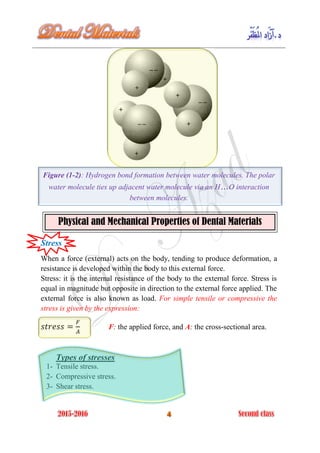
Figure (1-2): Hydrogen bond formation between water molecules. The polar
water molecule ties up adjacent water molecule via an H…O interaction
between molecules.
Physical and Mechanical Properties of Dental Materials
Stress
When a force (external) acts on the body, tending to produce deformation, a
resistance is developed within the body to this external force.
Stress: it is the internal resistance of the body to the external force. Stress is
equal in magnitude but opposite in direction to the external force applied. The
external force is also known as load. For simple tensile or compressive the
stress is given by the expression:
F: the applied force, and A: the cross-sectional area.
Types of stresses
1- Tensile stress.
2- Compressive stress.
3- Shear stress.
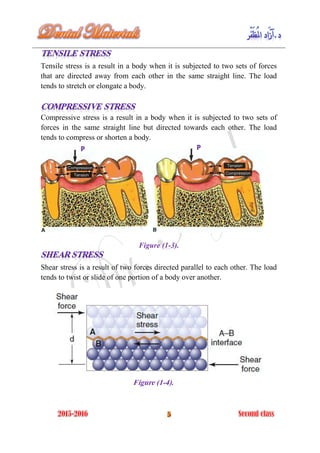
Tensile stress is a result in a body when it is subjected to two sets of forces
that are directed away from each other in the same straight line. The load
tends to stretch or elongate a body.
Compressive stress is a result in a body when it is subjected to two sets of
forces in the same straight line but directed towards each other. The load
tends to compress or shorten a body.
Figure (1-3).
Shear stress is a result of two forces directed parallel to each other. The load
tends to twist or slide of one portion of a body over another.
Figure (1-4).
Strain
The application of an external force to a body results in a change in dimension
(shape) of that body (deformation).
For example, when a tensile force is applied the body undergoes an extension,
the magnitude of which depends on the applied force and the properties of the
material.
The numerical value of strain is given by the expression:
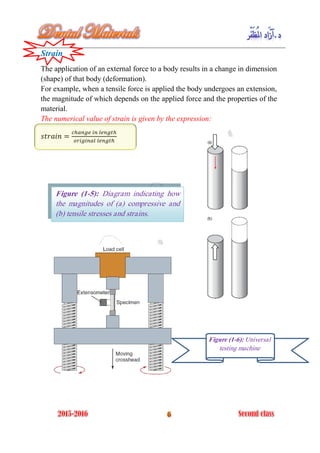
Figure (1-5): Diagram indicating how
the magnitudes of (a) compressive and
(b) tensile stresses and strains.
Figure (1-6): Universal
testing machine
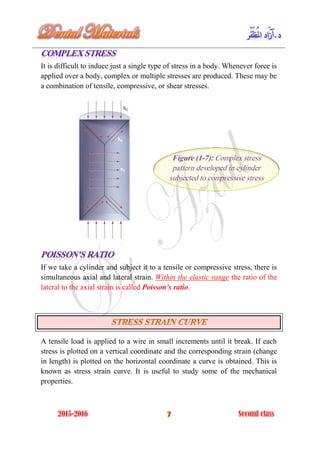
It is difficult to induce just a single type of stress in a body. Whenever force is
applied over a body, complex or multiple stresses are produced. These may be
a combination of tensile, compressive, or shear stresses.
If we take a cylinder and subject it to a tensile or compressive stress, there is
simultaneous axial and lateral strain. Within the elastic range the ratio of the
lateral to the axial strain is called Poisson's ratio.
A tensile load is applied to a wire in small increments until it break. If each
stress is plotted on a vertical coordinate and the corresponding strain (change
in length) is plotted on the horizontal coordinate a curve is obtained. This is
known as stress strain curve. It is useful to study some of the mechanical
properties.
Figure (1-7): Complex stress
pattern developed in cylinder
subjected to compressive stress
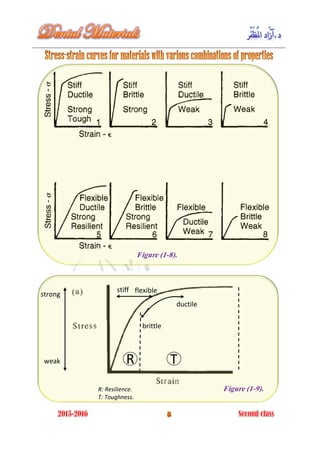
Figure (1-8).
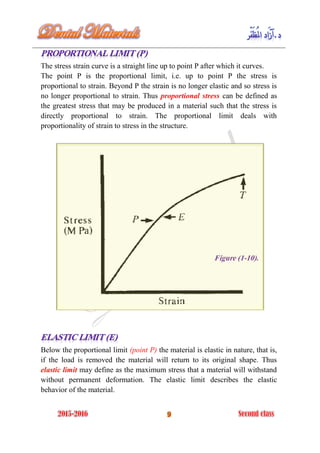
ductile
brittle
R
stiff flexible
R: Resilience.
T: Toughness.
Figure (1-9).
Tweak
strong
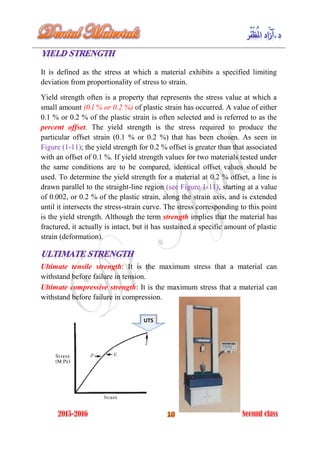
The stress strain curve is a straight line up to point P after which it curves.
The point P is the proportional limit, i.e. up to point P the stress is
proportional to strain. Beyond P the strain is no longer elastic and so stress is
no longer proportional to strain. Thus proportional stress can be defined as
the greatest stress that may be produced in a material such that the stress is
directly proportional to strain. The proportional limit deals with
proportionality of strain to stress in the structure.
Below the proportional limit (point P) the material is elastic in nature, that is,
if the load is removed the material will return to its original shape. Thus
elastic limit may define as the maximum stress that a material will withstand
without permanent deformation. The elastic limit describes the elastic
behavior of the material.
Figure (1-10).
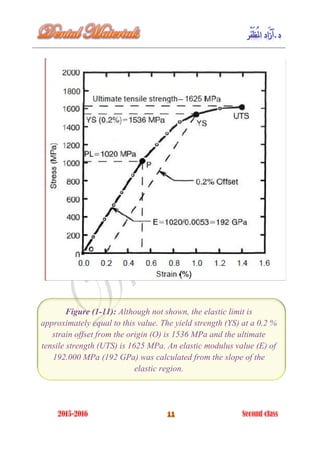
It is defined as the stress at which a material exhibits a specified limiting
deviation from proportionality of stress to strain.
Yield strength often is a property that represents the stress value at which a
small amount (0.l % or 0.2 %) of plastic strain has occurred. A value of either
0.1 % or 0.2 % of the plastic strain is often selected and is referred to as the
percent offset. The yield strength is the stress required to produce the
particular offset strain (0.1 % or 0.2 %) that has been chosen. As seen in
Figure (1-11); the yield strength for 0.2 % offset is greater than that associated
with an offset of 0.1 %. If yield strength values for two materials tested under
the same conditions are to be compared, identical offset values should be
used. To determine the yield strength for a material at 0.2 % offset, a line is
drawn parallel to the straight-line region (see Figure 1-11), starting at a value
of 0.002, or 0.2 % of the plastic strain, along the strain axis, and is extended
until it intersects the stress-strain curve. The stress corresponding to this point
is the yield strength. Although the term strength implies that the material has
fractured, it actually is intact, but it has sustained a specific amount of plastic
strain (deformation).
Ultimate tensile strength: It is the maximum stress that a material can
withstand before failure in tension.
Ultimate compressive strength: It is the maximum stress that a material can
withstand before failure in compression.
UTS
Figure (1-9): Stress strain plot for stainless steel orthodontic wire that
has been subjected to tension. The proportional limit (PL) is 1020 MPa.
Figure (1-11): Although not shown, the elastic limit is
approximately equal to this value. The yield strength (YS) at a 0.2 %
strain offset from the origin (O) is 1536 MPa and the ultimate
tensile strength (UTS) is 1625 MPa. An elastic modulus value (E) of
192.000 MPa (192 GPa) was calculated from the slope of the
elastic region.
Once the elastic limit of a material is crossed by a specific amount of
stress, the further increase in strain is called permanent deformation, i.e.
the resulting change in dimension is permanent. If the material is
deformed by a stress at a point above the proportional limit before
fracture, the removal of the applied force will reduce the stress to zero,
but the strain does not decrease to zero because plastic deformation has
occurred. Thus, the object does not return to its original dimension when
the force is removed. It remains bent, stretched, compressed, or otherwise
plastically deformed.
As shown in figure (1-11); the stress-strain graph is no longer a straight
line above the proportional limit (PL), but rather it curves until the
structure fractures. The stress strain graph shown in figure (1-11) is more
typical of actual stress-strain curves for ductile materials. Unlike the
linear portion of the graph at stresses below the proportional limit, the
shape of the curve above (P) is not possible to extrapolate because stress
is no longer proportional to strain.
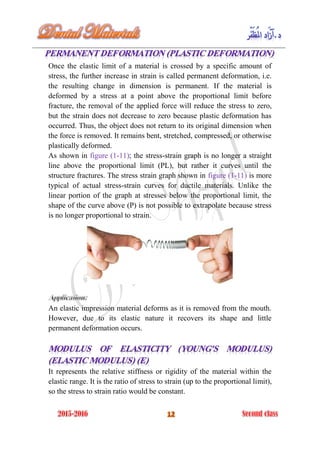
An elastic impression material deforms as it is removed from the mouth.
However, due to its elastic nature it recovers its shape and little
permanent deformation occurs.
It represents the relative stiffness or rigidity of the material within the
elastic range. It is the ratio of stress to strain (up to the proportional limit),
so the stress to strain ratio would be constant.
It therefore follows that the less the strain for a given stress, the greater will
be the stiffness, e.g. if a wire is difficult to bend, considerable stress must
be placed before a notable strain or deformation results. Such a material
would possess a comparatively high modulus of elasticity.
The metal frame of metal-ceramic bridge should have high stiffness. If the
metal flexes, the porcelain veneer on it might crack or separate.
Generally in dental practice, the material used as a restoration should
withstand high stresses and show minimum deformation. However, there
are instances where a large strain is needed with a moderate or slight stress.
For example in orthodontic appliance, a spring is often bent a considerable
distance under the influence of a small stress. In such a case, the structure
is said to be flexible and it possesses the property of flexibility. The
maximum flexibility is defined as the strain that occurs when the material
is stressed to its proportional limit.
It is useful to know the flexibility of elastic impression materials to
determine how easily they may be withdrawn over undercuts in the mouth.
It is the amount of energy absorbed by a structure when it is stressed not to
exceed its proportional limit.
Resilience can be measured by calculating the area under the elastic portion
(straight line portion) of the stress strain curve calculating (the area of the
triangle=1/2 bh).
Resilience has particular importance in the evaluation of orthodontic wires.
An example: The amount of work expected from a spring to move a tooth.
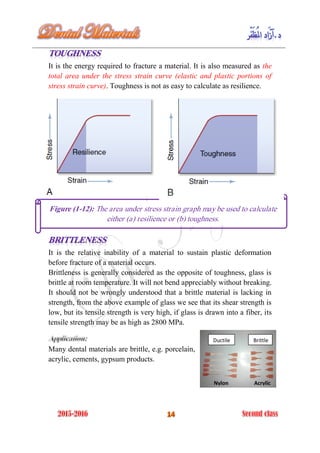
It is the energy required to fracture a material. It is also measured as the
total area under the stress strain curve (elastic and plastic portions of
stress strain curve). Toughness is not as easy to calculate as resilience.
It is the relative inability of a material to sustain plastic deformation
before fracture of a material occurs.
Brittleness is generally considered as the opposite of toughness, glass is
brittle at room temperature. It will not bend appreciably without breaking.
It should not be wrongly understood that a brittle material is lacking in
strength, from the above example of glass we see that its shear strength is
low, but its tensile strength is very high, if glass is drawn into a fiber, its
tensile strength may be as high as 2800 MPa.
Many dental materials are brittle, e.g. porcelain,
acrylic, cements, gypsum products.
Figure (1-12): The area under stress strain graph may be used to calculate
either (a) resilience or (b) toughness.
Ductile Brittle
Nylon Acrylic
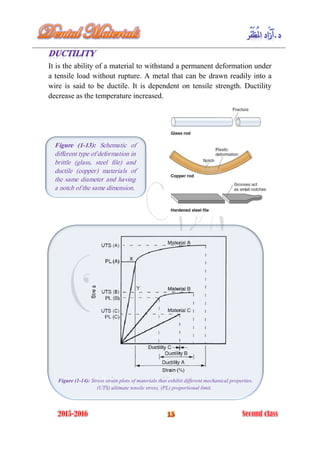
It is the ability of a material to withstand a permanent deformation under
a tensile load without rupture. A metal that can be drawn readily into a
wire is said to be ductile. It is dependent on tensile strength. Ductility
decrease as the temperature increased.
Figure (1-14): Stress strain plots of materials that exhibit different mechanical properties.
(UTS) ultimate tensile stress, (PL) proportional limit.
Figure (1-13): Schematic of
different type of deformation in
brittle (glass, steel file) and
ductile (copper) materials of
the same diameter and having
a notch of the same dimension.
It is the ability of a material to withstand considerable permanent
deformation without rupture under compression as in hammering or rolling
into a sheet. It is not dependent on strength as is ductility. It increases with
raise in temperature.
Gold is the most ductile and malleable metal. This enables
manufacturer to beat it into thin foils. Silver is the second.
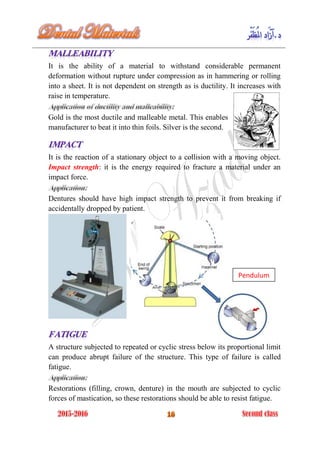
It is the reaction of a stationary object to a collision with a moving object.
Impact strength: it is the energy required to fracture a material under an
impact force.
Dentures should have high impact strength to prevent it from breaking if
accidentally dropped by patient.
A structure subjected to repeated or cyclic stress below its proportional limit
can produce abrupt failure of the structure. This type of failure is called
fatigue.
Restorations (filling, crown, denture) in the mouth are subjected to cyclic
forces of mastication, so these restorations should be able to resist fatigue.
Pendulum
The hardness is the resistance to permanent surface indentation or
penetration.
The value of hardness, often referred to as the hardness number, depends
on the method used for its evaluation. Generally, low values of hardness
number indicate a soft material and vice versa.
Used for measuring hardness of metal and plastic materials.
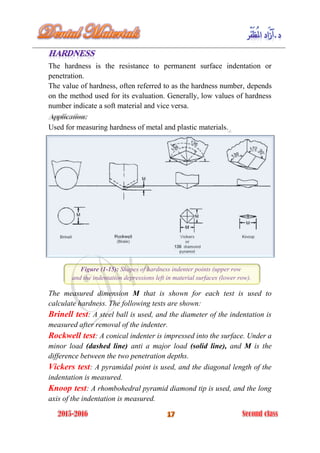
Figure (1-15): Shapes of hardness indenter points (upper row
and the indentation depressions left in material surfaces (lower row).
The measured dimension M that is shown for each test is used to
calculate hardness. The following tests are shown:
Brinell test: A steel ball is used, and the diameter of the indentation is
measured after removal of the indenter.
Rockwell test: A conical indenter is impressed into the surface. Under a
minor load (dashed line) anti a major load (solid line), and M is the
difference between the two penetration depths.
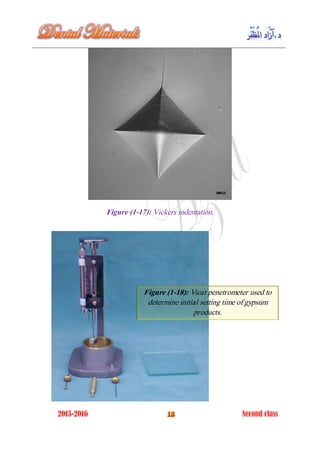
Vickers test: A pyramidal point is used, and the diagonal length of the
indentation is measured.
Knoop test: A rhombohedral pyramid diamond tip is used, and the long
axis of the indentation is measured.
Figure (1-17): Vickers indentation.
Figure (1-18): Vicat penetrometer used to
determine initial setting time of gypsum
products.
After a substance has been permanently deformed (plastic deformation),
there are trapped internal stresses; such situations are unstable. The
displaced atoms are not in equilibrium positions through a solid-state
diffusion process driven by thermal energy, the atoms can move back
slowly to their equilibrium positions, the result is a change in the shape or
contour of the solid as the atoms or molecules change positions. The
material warps or distorts.
This stress relaxation leads to distortion of elastomeric impressions.
Waxes and other thermoplastic materials like compound undergo
relaxation after they are manipulated.
It is the maximal stress required to fracture a structure.
The three basic types of strength are:
1- Tensile strength.
2- Compressive strength.
3- Shear strength.
It is the maximal tensile stress the structure will
withstand before rupture.
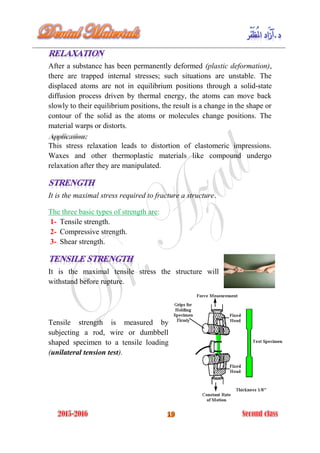
Tensile strength is measured by
subjecting a rod, wire or dumbbell
shaped specimen to a tensile loading
(unilateral tension test).
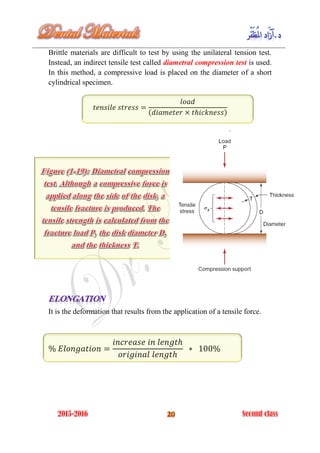
Brittle materials are difficult to test by using the unilateral tension test.
Instead, an indirect tensile test called diametral compression test is used.
In this method, a compressive load is placed on the diameter of a short
cylindrical specimen.
( )
It is the deformation that results from the application of a tensile force.
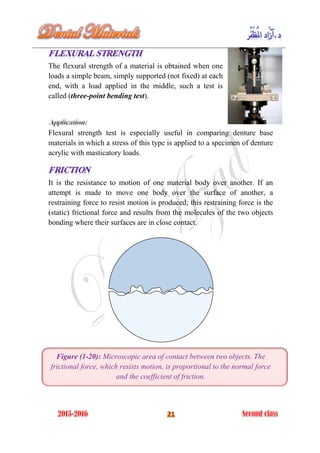
The flexural strength of a material is obtained when one
loads a simple beam, simply supported (not fixed) at each
end, with a load applied in the middle, such a test is
called (three-point bending test).
Flexural strength test is especially useful in comparing denture base
materials in which a stress of this type is applied to a specimen of denture
acrylic with masticatory loads.
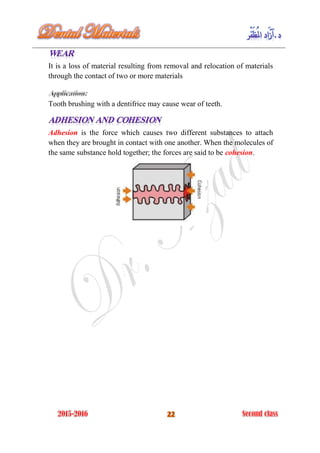
It is the resistance to motion of one material body over another. If an
attempt is made to move one body over the surface of another, a
restraining force to resist motion is produced; this restraining force is the
(static) frictional force and results from the molecules of the two objects
bonding where their surfaces are in close contact.
Figure (1-20): Microscopic area of contact between two objects. The
frictional force, which resists motion, is proportional to the normal force
and the coefficient of friction.
It is a loss of material resulting from removal and relocation of materials
through the contact of two or more materials
Tooth brushing with a dentifrice may cause wear of teeth.
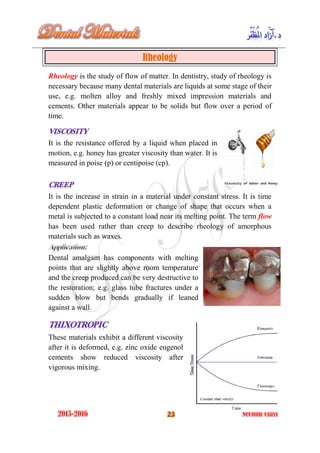
Adhesion is the force which causes two different substances to attach
when they are brought in contact with one another. When the molecules of
the same substance hold together; the forces are said to be cohesion.
Rheology
Rheology is the study of flow of matter. In dentistry, study of rheology is
necessary because many dental materials are liquids at some stage of their
use, e.g. molten alloy and freshly mixed impression materials and
cements. Other materials appear to be solids but flow over a period of
time.
It is the resistance offered by a liquid when placed in
motion, e.g. honey has greater viscosity than water. It is
measured in poise (p) or centipoise (cp).
It is the increase in strain in a material under constant stress. It is time
dependent plastic deformation or change of shape that occurs when a
metal is subjected to a constant load near its melting point. The term flow
has been used rather than creep to describe rheology of amorphous
materials such as waxes.
Dental amalgam has components with melting
points that are slightly above room temperature
and the creep produced can be very destructive to
the restoration; e.g. glass tube fractures under a
sudden blow but bends gradually if leaned
against a wall.
These materials exhibit a different viscosity
after it is deformed, e.g. zinc oxide eugenol
cements show reduced viscosity after
vigorous mixing.
Thermal Properties of Dental Materials
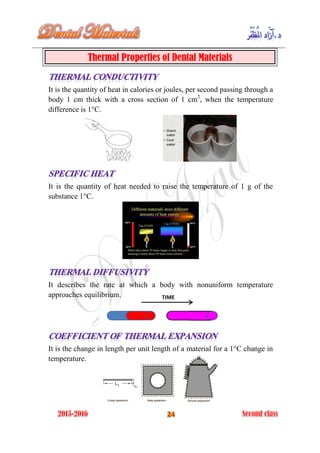
It is the quantity of heat in calories or joules, per second passing through a
body 1 cm thick with a cross section of 1 cm2
, when the temperature
difference is 1°C.
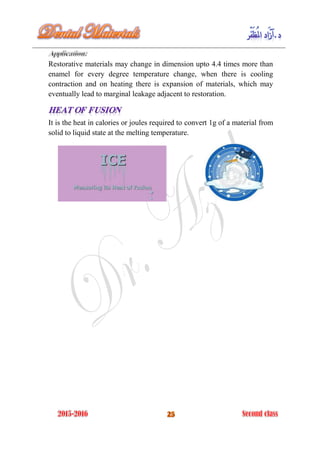
It is the quantity of heat needed to raise the temperature of 1 g of the
substance 1°C.
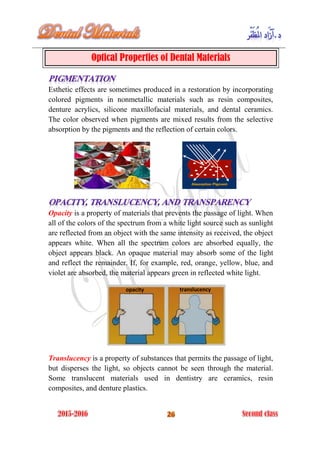
It describes the rate at which a body with nonuniform temperature
approaches equilibrium.
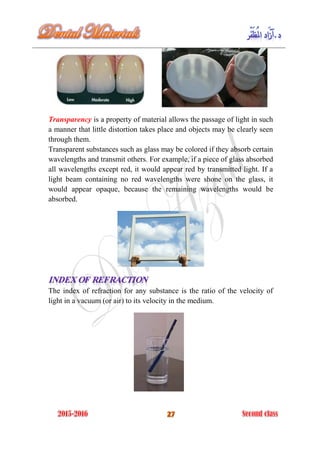
It is the change in length per unit length of a material for a 1°C change in
temperature.
TIME
Restorative materials may change in dimension upto 4.4 times more than
enamel for every degree temperature change, when there is cooling
contraction and on heating there is expansion of materials, which may
eventually lead to marginal leakage adjacent to restoration.
It is the heat in calories or joules required to convert 1g of a material from
solid to liquid state at the melting temperature.
Optical Properties of Dental Materials
Esthetic effects are sometimes produced in a restoration by incorporating
colored pigments in nonmetallic materials such as resin composites,
denture acrylics, silicone maxillofacial materials, and dental ceramics.
The color observed when pigments are mixed results from the selective
absorption by the pigments and the reflection of certain colors.
Opacity is a property of materials that prevents the passage of light. When
all of the colors of the spectrum from a white light source such as sunlight
are reflected from an object with the same intensity as received, the object
appears white. When all the spectrum colors are absorbed equally, the
object appears black. An opaque material may absorb some of the light
and reflect the remainder. If, for example, red, orange, yellow, blue, and
violet are absorbed, the material appears green in reflected white light.
Translucency is a property of substances that permits the passage of light,
but disperses the light, so objects cannot be seen through the material.
Some translucent materials used in dentistry are ceramics, resin
composites, and denture plastics.
opacity translucency
Transparency is a property of material allows the passage of light in such
a manner that little distortion takes place and objects may be clearly seen
through them.
Transparent substances such as glass may be colored if they absorb certain
wavelengths and transmit others. For example, if a piece of glass absorbed
all wavelengths except red, it would appear red by transmitted light. If a
light beam containing no red wavelengths were shone on the glass, it
would appear opaque, because the remaining wavelengths would be
absorbed.
The index of refraction for any substance is the ratio of the velocity of
light in a vacuum (or air) to its velocity in the medium.
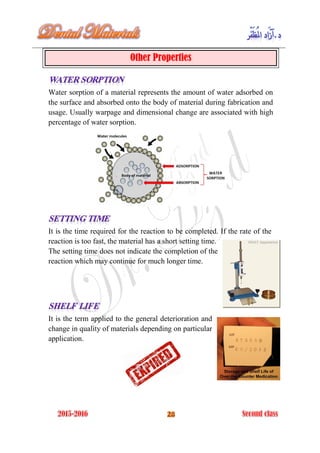
Other Properties
Water sorption of a material represents the amount of water adsorbed on
the surface and absorbed onto the body of material during fabrication and
usage. Usually warpage and dimensional change are associated with high
percentage of water sorption.
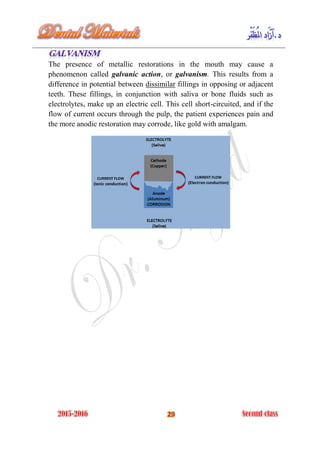
It is the time required for the reaction to be completed. If the rate of the
reaction is too fast, the material has a short setting time.
The setting time does not indicate the completion of the
reaction which may continue for much longer time.
It is the term applied to the general deterioration and
change in quality of materials depending on particular
application.
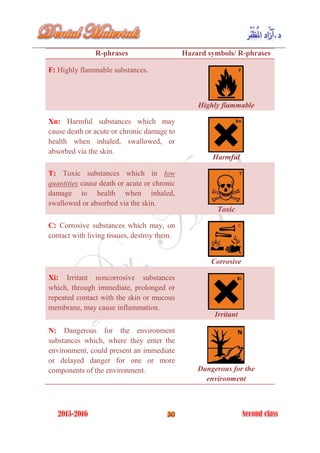
The presence of metallic restorations in the mouth may cause a
phenomenon called galvanic action, or galvanism. This results from a
difference in potential between dissimilar fillings in opposing or adjacent
teeth. These fillings, in conjunction with saliva or bone fluids such as
electrolytes, make up an electric cell. This cell short-circuited, and if the
flow of current occurs through the pulp, the patient experiences pain and
the more anodic restoration may corrode, like gold with amalgam.
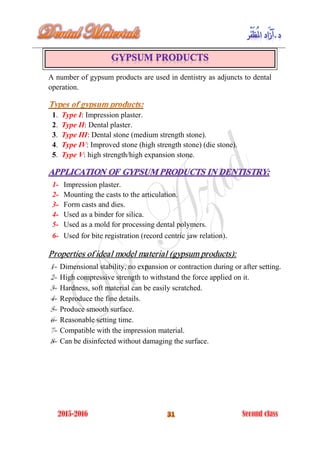
R-phrases Hazard symbols/ R-phrases
F: Highly flammable substances.
Highly flammable
Xn: Harmful substances which may
cause death or acute or chronic damage to
health when inhaled, swallowed, or
absorbed via the skin.
Harmful
T: Toxic substances which in low
quantities cause death or acute or chronic
damage to health when inhaled,
swallowed or absorbed via the skin.
Toxic
C: Corrosive substances which may, on
contact with living tissues, destroy them.
Corrosive
Xi: Irritant noncorrosive substances
which, through immediate, prolonged or
repeated contact with the skin or mucous
membrane, may cause inflammation.
Irritant
N: Dangerous for the environment
substances which, where they enter the
environment, could present an immediate
or delayed danger for one or more
components of the environment. Dangerous for the
environment
A number of gypsum products are used in dentistry as adjuncts to dental
operation.
1. Type I: Impression plaster.
2. Type II: Dental plaster.
3. Type III: Dental stone (medium strength stone).
4. Type IV: Improved stone (high strength stone) (die stone).
5. Type V: high strength/high expansion stone.
1- Impression plaster.
2- Mounting the casts to the articulation.
3- Form casts and dies.
4- Used as a binder for silica.
5- Used as a mold for processing dental polymers.
6- Used for bite registration (record centric jaw relation).
Properties of ideal model material (gypsum products):
Dimensional stability, no expansion or contraction during or after setting.
High compressive strength to withstand the force applied on it.
Hardness, soft material can be easily scratched.
Reproduce the fine details.
Produce smooth surface.
Reasonable setting time.
Compatible with the impression material.
Can be disinfected without damaging the surface.
Most gypsum products are obtained from natural gypsum rock. Because
gypsum is the dihydrate form of calcium sulfate (CaSO4. 2H2O), on
heating, it loses 1.5 g mol of its 2 g mol of H2O and is converted to
calcium sulfate hemihydrate (CaSO4. 0.5H2O). When calcium sulfate
hemihydrate is mixed with water, the reverse reaction takes place, and the
calcium sulfate hemihydrate is converted back to calcium sulfate
dihydrate.
1- Plasters are produced when the gypsum mineral is heated in an open
kettle at a temperature of about 110° to 120°C (dry calcination). The
hemihydrate produced is called β-calcium sulfate hemihydrate. Such
a powder is known to have a somewhat irregular shape and is porous
in nature. These plasters are used in formulating model and lab
plasters.
2- Stones are produced when the gypsum is dehydrated under pressure
and in the presence of water vapor at about 125°C (wet calcination),
the product is called hydrocal. The powder particles of this product
are more uniform in shape and denser than the particles of plaster.
Calcium sulfate hemihydrate produced in this manner is designated as
α-calcium sulfate hemihydrate. Hydrocal is used in making low- to
moderate-strength dental stones.
3- High-strength stones are produced when the gypsum rock is boiling
in a 30% calcium chloride solution, after which the chloride is
washed away with hot water (100°C), the product is called densite,
and the material is ground to the desired fineness. This variety is
made by gypsum The calcium sulfate hemihydrate in the presence of
100°C water does not react to form calcium sulfate dihydrate because
at this temperature their solubilities are the same. The powder
obtained by this process is the densest of the types.
Potassium sulfate, and terra alba (set calcium sulfate dihydrate) are1-
effective accelerators.
Sodium chloride in small amounts shortens the setting reaction but2-
increases the setting expansion of the gypsum mass.
Sodium citrate is a dependable retarder.3-
A mixture of calcium oxide (0.1%) and gum arabic (1%) reduces the4-
amount of water necessary to mix gypsum products, resulting in
improved properties.
The setting reaction is explained on the basis of difference in the
solubilities of calcium sulfate dihydrate and hemihydrate. Hemihydrate is
four times more soluble than dihydrate.
 When hemihydrate is mixed in water a suspension is formed which is
fluid and workable.
 Hemihydrate dissolves until it forms a saturated solution. Some dihydrate
is formed due to the reaction.
 Since solubility of dihydrate is much less than hemihydrate, the saturated
hemihydrate is supersaturated with respect to the dihydrate.
 All supersaturated solutions are unstable. So the dihydrate crystals
precipitate out.
 As the dihydrate precipitates out, the solution is no longer saturated with
hemihydrate and so it continues to dissolve. The process continues until
all hemihydrate converts to dihydrate.
Other theories include .
The mixing process, called spatulation, has a definite effect on the setting
time and setting expansion of the material. Within practical limits an
increase in the amount of spatulation (either speed of spatulation or time
or both) shortens the setting time. Obviously when the powder is placed
in water, the chemical reaction starts, and some calcium sulfate dihydrate
is formed. During spatulation the newly formed calcium sulfate dihydrate
breaks down to smaller crystals and starts new centers of nucleation,
around which the calcium sulfate dihydrate can be precipitated. Because
an increased amount of spatulation causes more nuclei centers to be
formed, the conversion of calcium sulfate hemihydrate to dihydrate
requires somewhat less time.
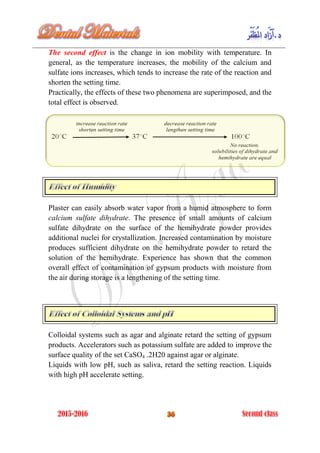
The first effect of increasing temperature is a change in the relative
solubilities of calcium sulfate hemihydrate and calcium sulfate dihydrate,
which alters the rate of the reaction. As the temperature increases, the
solubility ratios decrease, until 100°C is reached and the ratio becomes
one. As the ratio of the solubilities becomes lower, the reaction is slowed,
and the setting time is increased.
The second effect is the change in ion mobility with temperature. In
general, as the temperature increases, the mobility of the calcium and
sulfate ions increases, which tends to increase the rate of the reaction and
shorten the setting time.
Practically, the effects of these two phenomena are superimposed, and the
total effect is observed.
Plaster can easily absorb water vapor from a humid atmosphere to form
calcium sulfate dihydrate. The presence of small amounts of calcium
sulfate dihydrate on the surface of the hemihydrate powder provides
additional nuclei for crystallization. Increased contamination by moisture
produces sufficient dihydrate on the hemihydrate powder to retard the
solution of the hemihydrate. Experience has shown that the common
overall effect of contamination of gypsum products with moisture from
the air during storage is a lengthening of the setting time.
Colloidal systems such as agar and alginate retard the setting of gypsum
products. Accelerators such as potassium sulfate are added to improve the
surface quality of the set CaSO4 .2H20 against agar or alginate.
Liquids with low pH, such as saliva, retard the setting reaction. Liquids
with high pH accelerate setting.
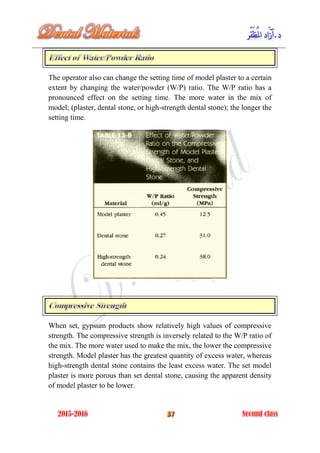
The operator also can change the setting time of model plaster to a certain
extent by changing the water/powder (W/P) ratio. The W/P ratio has a
pronounced effect on the setting time. The more water in the mix of
model; (plaster, dental stone, or high-strength dental stone); the longer the
setting time.
When set, gypsum products show relatively high values of compressive
strength. The compressive strength is inversely related to the W/P ratio of
the mix. The more water used to make the mix, the lower the compressive
strength. Model plaster has the greatest quantity of excess water, whereas
high-strength dental stone contains the least excess water. The set model
plaster is more porous than set dental stone, causing the apparent density
of model plaster to be lower.
After most excess water is evaporated from the surface, the hardness will
increase. Attempts have been made to increase the hardness of gypsum
products by impregnating the set gypsum with epoxy or methyl
methacrylate monomer that is allowed to polymerize.
The tensile strength of model plaster and dental stone is important in
structures in which bending tends to occur because of lateral force
applications, such as the removal of casts from flexible impressions.
Because of the brittle nature of gypsum materials, the teeth on the cast
may fracture rather than bend.
ANSI/ADA Specification No. 25 requires that types I and II reproduce a
groove 75 μm in width, whereas types III, IV, and V reproduce a groove
50 μm in width. Air bubbles are often formed at the interface of the
impression and gypsum cast because freshly mixed gypsum does not wet
some rubber impression materials (e.g., some silicone types). The use of
vibration during the pouring of a cast reduces the presence of air bubbles.
Contamination of the impression with saliva or blood can also affect the
detail reproduction.
When set, all gypsum products show a measurable linear expansion.
Under ordinary conditions, plasters have (0.2-0.3 %) setting expansion,
low to moderate strength dental stone about (0.15-0.25 %), and high-
strength dental stone only (0.08-0.10 %). Typically, (over 75 %) of the
expansion observed at 24 hours occurs during the first hour of setting.
Increasing the W/P ratio; reducing the setting expansion. If during the
setting process, the gypsum materials are immersed in water, the setting
expansion increases slightly. This is called hygroscopic expansion.
When any of the gypsum products is mixed with water, it should be
spatulated properly to obtain a smooth mix. Water is dispensed into a
mixing bowl of an appropriate size and design. The powder is added and
allowed to settle into the water for about 30 seconds. This technique
minimizes the amount of air incorporated into the mix.
The spatulation can be continued either by:
1- Hand using a spatula.
2- Hand-mechanical spatulator.
3- Power-driven mechanical spatulator.
Spatulation by hand involves stirring the mixture vigorously while wiping
the inside surfaces of the bowl with the spatula. Spatulation to wet and
mix the powder uniformly with the water requires about 1 minute at 2
revolutions per second.
Vacuuming during mixing reduces the air entrapped in the mix. Vibration
immediately after mixing and during pouring of the gypsum minimizes
air bubbles in the set mass.
Pouring an impression with gypsum requires care to avoid trapping air in
critical areas. The mixed gypsum should be poured slowly or added to the
impression with a small instrument such as a wax spatula. Once poured,
the gypsum material should be allowed to harden for 45 to 60 minutes
before the impression and cast are separated.
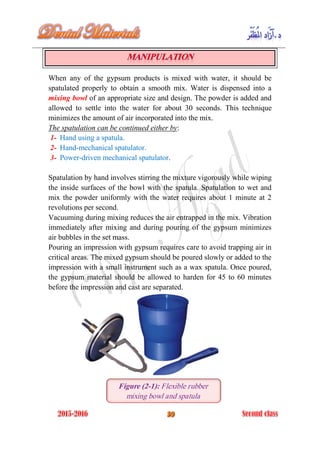
Figure (2-1): Flexible rubber
mixing bowl and spatula
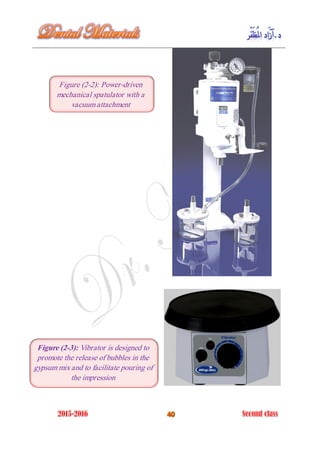
Figure (2-2): Power-driven
mechanical spatulator with a
vacuum attachment
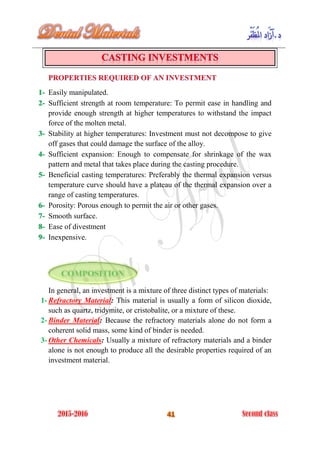
Figure (2-3): Vibrator is designed to
promote the release of bubbles in the
gypsum mix and to facilitate pouring of
the impression
Easily manipulated.1-
Sufficient strength at room temperature: To permit ease in handling and2-
provide enough strength at higher temperatures to withstand the impact
force of the molten metal.
Stability at higher temperatures: Investment must not decompose to give3-
off gases that could damage the surface of the alloy.
Sufficient expansion: Enough to compensate for shrinkage of the wax4-
pattern and metal that takes place during the casting procedure.
Beneficial casting temperatures: Preferably the thermal expansion versus5-
temperature curve should have a plateau of the thermal expansion over a
range of casting temperatures.
Porosity: Porous enough to permit the air or other gases.6-
Smooth surface.7-
Ease of divestment8-
Inexpensive.9-
In general, an investment is a mixture of three distinct types of materials:
1- Refractory Material: This material is usually a form of silicon dioxide,
such as quartz, tridymite, or cristobalite, or a mixture of these.
2- Binder Material: Because the refractory materials alone do not form a
coherent solid mass, some kind of binder is needed.
3- Other Chemicals: Usually a mixture of refractory materials and a binder
alone is not enough to produce all the desirable properties required of an
investment material.
The investments suitable for casting gold alloys contain (65-75 %) quartz
or cristobalite, or a blend of the two, in varying proportions, (25-35 %) of
α-calcium sulfate hemihydrate, and about (2-3 %) chemical modifiers.
The calcium sulfate-bonded investment is usually limited to gold
castings, and is not heated above 700°C. The calcium sulfate portion of
the investment decomposes into sulfur dioxide and sulfur trioxide at
temperatures over 700°C, tending to embrittle the casting metal.
Therefore, the calcium sulfate type of binder is usually not used in
investments for making castings of palladium or base metal alloys.
It is the most common type of investment for casting high-melting point
alloys. This type of investment consists of three different components.
One component contains a water-soluble phosphate ion. The second
component reacts with phosphate ions at room temperature. The third
component is a refractory, such as silica. Different materials can be used
in each component to develop different physical properties.
Another type of binding material for investments used with casting high-
melting point alloys is a silica bonding ingredient. This type of
investment may derive its silica bond from ethyl silicate, an aqueous
dispersion of colloidal silica, or from sodium silicate. One such
investment consists of a silica refractory, which is bonded by the
hydrolysis of ethyl silicate in the presence of hydrochloric acid.
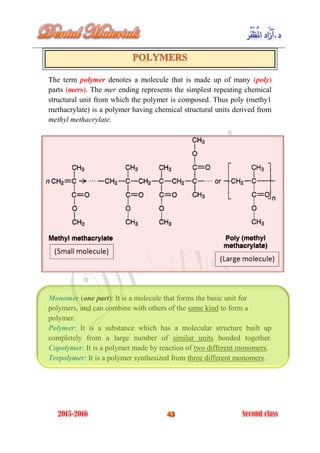
The term polymer denotes a molecule that is made up of many (poly)
parts (mers). The mer ending represents the simplest repeating chemical
structural unit from which the polymer is composed. Thus poly (methy1
methacrylate) is a polymer having chemical structural units derived from
methyl methacrylate.
Monomer (one part): It is a molecule that forms the basic unit for
polymers, and can combine with others of the same kind to form a
polymer.
Polymer: It is a substance which has a molecular structure built up
completely from a large number of similar units bonded together.
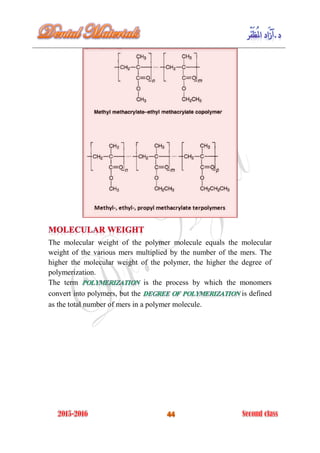
Copolymer: It is a polymer made by reaction of two different monomers.
Terpolymer: It is a polymer synthesized from three different monomers.
The molecular weight of the polymer molecule equals the molecular
weight of the various mers multiplied by the number of the mers. The
higher the molecular weight of the polymer, the higher the degree of
polymerization.
The term is the process by which the monomers
convert into polymers, but the is defined
as the total number of mers in a polymer molecule.
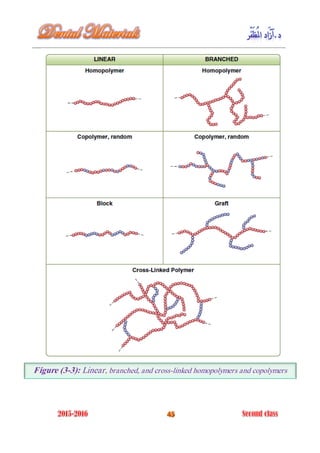
Figure (3-3): Linear, branched, and cross-linked homopolymers and copolymers
Denture base, special tray, record base.
Artificial teeth.
Obturators for cleft palate.
Composite tooth restoration.
Orthodontic space maintainer.
Crown and bridge.
Endodontic filling.
Impressions.
Maxillofacial prosthesis.
Dies.
Endodontic filling material.
Splints and stents.
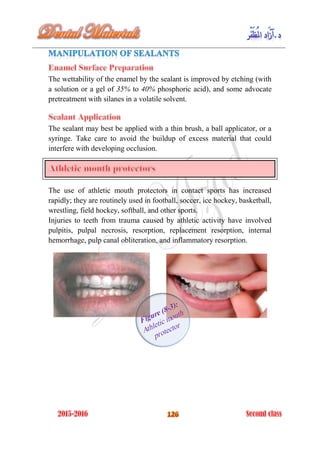
Athletic mouth protectors.
Cements.
Polymerization reactions fall into two basic types:
1- Addition polymerization.
2- Condensation polymerization.
(Free-Radical Polymerization)
Most dental resins are polymerized by addition polymerization which
simply involves the joining together of monomer molecules to form
polymer chain. In this type of reaction, no byproduct is obtained.
The reaction takes place in three :
1- Initiation stage.
2- Propagation stage.
3- Termination stage.
1- Activation and initiation stage
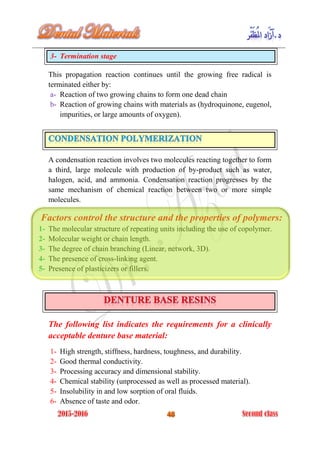
To start the addition polymerization process a free radicals must be
present. (Free radicals are very reactive chemical species that have an
unpaired electron).
The free radicals are produced by reactive agents called initiators.
(Initiators are molecules which contain one relatively weak bond which
is able to undergo decomposition to form two reactive species (free
radical), the decomposition of bond of initiator need source of energy
(activator) such as heat, chemical compound, light, electromagnetic
radiation).
Initiator is used extensively in dental polymers is (Benzoyl peroxide).
Addition polymerization reaction is initiated when the free radical reacts
with monomer molecules producing another active free radical species
which is capable of further reaction.
2- Propagation stage
The initiation stage is followed by the rapid addition of other monomer
molecules to the free radical and the shifting of the free electron to the
end of the growing chain.
3- Termination stage
This propagation reaction continues until the growing free radical is
terminated either by:
a- Reaction of two growing chains to form one dead chain
b- Reaction of growing chains with materials as (hydroquinone, eugenol,
impurities, or large amounts of oxygen).
A condensation reaction involves two molecules reacting together to form
a third, large molecule with production of by-product such as water,
halogen, acid, and ammonia. Condensation reaction progresses by the
same mechanism of chemical reaction between two or more simple
molecules.
Factors control the structure and the properties of polymers:
1- The molecular structure of repeating units including the use of copolymer.
2- Molecular weight or chain length.
3- The degree of chain branching (Linear, network, 3D).
4- The presence of cross-linking agent.
5- Presence of plasticizers or fillers.
The following list indicates the requirements for a clinically
acceptable denture base material:
1- High strength, stiffness, hardness, toughness, and durability.
2- Good thermal conductivity.
3- Processing accuracy and dimensional stability.
4- Chemical stability (unprocessed as well as processed material).
5- Insolubility in and low sorption of oral fluids.
6- Absence of taste and odor.
7- Biocompatible.
8- Natural appearance.
9- Color stability.
10- Adhesion to plastics, metals, and porcelain.
11- Ease of fabrication and repair.
12- Moderate cost.
13- Accurate reproduction of surface detail.
14- Resistance to bacterial growth.
15- Radiopaque.
16- Easy to clean.
1- Heat cured resin.
2- Cold cured resin.
3- Visible light cured resin.
4- Microwave activated resin.
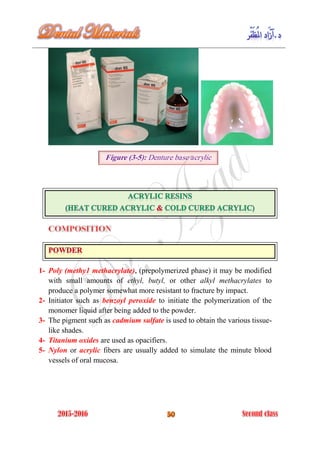
Figure (3-4): Chest radiographs in
which a segment of denture base has
been placed over the lower right half
of the chest.
1- Poly (methy1 methacrylate), (prepolymerized phase) it may be modified
with small amounts of ethyl, butyl, or other alkyl methacrylates to
produce a polymer somewhat more resistant to fracture by impact.
2- Initiator such as benzoyl peroxide to initiate the polymerization of the
monomer liquid after being added to the powder.
3- The pigment such as cadmium sulfate is used to obtain the various tissue-
like shades.
4- Titanium oxides are used as opacifiers.
5- Nylon or acrylic fibers are usually added to simulate the minute blood
vessels of oral mucosa.
Figure (3-5): Denture base acrylic
1- Methyl methacrylate monomer: it is clear, colorless, low viscosity liquid,
boiling point is 100.3°C, and distinct odor exaggerated by a high vapor
pressure at room temperature Care should be taken to avoid breathing the
monomer vapor. Animal studies have shown that the monomer can affect
respiration, cardiac function, and blood pressure.
2- Hydroquinone inhibitors are added to give the liquid adequate shelf life.
The inhibitor is a chemical material added to prevent polymerization
during storage and in order to provide enough working time.
3- Plasticizers are sometimes added to produce a softer, more resilient
polymer. They are relatively low-molecular weight esters, such as dibutyl
phthalate.
4- If a cross-linked polymer is desired, organic compounds such as Ethylene
glycol dimethacrylate (EGDMA) are added to the monomer, using cross-
linking agents (chemical bonds between different chains) provides greater
resistance to minute surface cracking, termed crazing, and may decrease
solubility and water sorption.
5- With chemical cured acrylic an accelerator is included in the liquid.
These accelerators are tertiary amines (N,N-dimethyl-para-toluidine).
These acrylics also called self-curing, cold-curing, or autopolymerizing
resins.
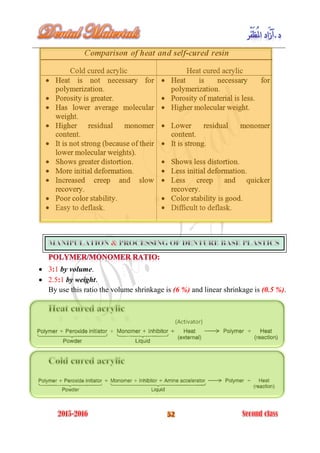
 3:1 by volume.
 2.5:1 by weight.
By use this ratio the volume shrinkage is (6 %) and linear shrinkage is (0.5 %).
The liquid placed in clean, dry mixing jar followed by slow addition of
powder, allowing each powder particle to become wetted by monomer.
After mixing the powder with liquid the mixture is left until it reaches a
consistency suitable for packing. During this period, a lid should be
placed on the mixing jar to prevent evaporation of monomer.
The polymer-monomer mixture, on standing, goes through several
, which may be qualitatively described as:
The polymer gradually settles into the monomer forming a fluid,
incoherent mass.
The monomer attacks the polymer by penetrating into the polymer. The
mass is sticky and stringy (cobweb like) when touched or pulled apart.
As the monomer diffuses into the polymer, it becomes smooth and dough
like. It does not adhere to the wall of the jar. It consists of undissolved
polymer particles suspended in a plastic matrix of monomer and
dissolved polymer. The mass is plastic and homogenous and can be
packed into the mold at this stage.
The monomer disappears by further penetration into the polymer and/or
evaporation. The mass is rubber like, non-plastic, and cannot be molded.
The curing temperature must be maintained close to 74° C, because the
polymerization reaction is strongly exothermic. The heat of reaction will
be added to the heat used to raise the material to the polymerization
temperature.
Because of the excessive temperature rise, porosity will more likely occur
in thick sections of the denture. Porosity also results when insufficient
pressure is maintained on the flask during processing.
:
: heat the flask in water at 60-70 °C for 9 hours.
: heat the flask in water at 74 °C for 90 minutes, then
boil for 1 hour for adequate polymerization of the thinner portions.
Other problems associated with rapid initial heating of the acrylic dough
above 74°C is production of internal stresses, warpage of the denture after
deflasking, and checking or crazing around the necks of the artificial teeth.
1- Urethane dimethacrylate matrix.
2- Acrylic copolymer.
3- Microfine silica filler.
4- Camphoroquinone-amine photo initiator system.
It is supplied in premixed sheets having clay like consistency. It is
provided in opaque light-tight packages to avoid premature
polymerization. The denture base material is adapted to the cast while it
is in a plastic state. It is polymerized in a light chamber (curing unit) with
blue light of 400-500 nm from high intensity quartz-halogen bulbs. The
denture is rotated continuously in the chamber to provide uniform
exposure to the light source.
Completely polymerized acrylic resin is tasteless and odorless. Denture
with porosity can absorb food and bacteria, resulting in an unpleasant
odor and taste.
The esthetic of acrylic is acceptable, because it is a clear transparent resin
which can be easily pigmented and it is compatible with dyed synthetic
fibers.
The polymer has a density of 1.19 gm/cm3
.
They have adequate compressive and tensile strength for complete or
partial denture applications. Ideally denture base resins should have high
impact strength to prevent breakage when it is accidentally dropped. Cold
cured acrylic has lower impact strength, but addition of plasticizers
increase the impact strength.
The strength is affected by:
a- Composition of the resin.
b- Technique of the processing.
c- Degree of polymerization.
d- Water sorption.
e- Subsequent environment of the denture.
Acrylic resins have low hardness; they can be easily scratched and
abraded.
Heat cured acrylic resin: 18-20 KHN.
Cold cured acrylic resin: 16-18 KHN.
They have sufficient stiffness (2400 MPa) for use in complete dentures.
However, when compared with metal denture bases they are low. Self-
cured acrylic has slightly lower values.
A well processed acrylic denture has good dimensional stability.
Acrylic resins shrink during processing due to:
a- Thermal shrinkage on cooling.
b- Polymerization shrinkage.
However, in spite of the high shrinkage, the fit of the denture is not
affected because the shrinkage is uniformly distributed over all surfaces
of the denture; the processing shrinkage is balanced by the expansion due
to water sorption.
 Volume shrinkage: 8 %.
 Linear shrinkage: 0.53 %.
Self-cured type has a lower shrinkage (linear shrinkage: 0.26 %).
Acrylic resin absorbs water and expands. This partially compensates for
its processing shrinkage. This process is reversible. Thus, on drying they
lose water and shrinkage. However, repeated wetting and drying should
be avoided as it may cause warpage of the denture.
Acrylic is virtually insoluble in water and oral fluids. They are soluble in
ketones, esters, and aromatic and chlorinated hydrocarbons. Alcohol
causes crazing in some resins.
Stability to heat: poly methyl methacrylate is chemically stable to heat up
to a point. It softens at 125 °C.
Thermal conductivity: they are poor conductors of heat and electricity.
Coefficient of thermal expansion: acrylics have a high coefficient of
thermal expansion.
Heat cured acrylics have good color stability. Cold cured has lower color
stability, due to oxidation of amine accelerator.
Completely polymerized acrylic resins are biocompatible. True allergic
reaction to acrylic resins is rarely seen in the oral cavity. Direct contact of
the monomer over a period of time may provoke dermatitis.
The highest residual monomer level is observed with cold cured acrylic.
The adhesion of acrylic to metal and porcelain is poor, and mechanical
retention is required. Adhesion to plastic denture teeth is good (chemical
adhesion).
Acrylic resins dispensed as powder/liquid have the best shelf life. The gel
type has a lower shelf life and has to be stored in a refrigerator.
Dental impression: It is a negative record of tissue of the mouth. It is
used to reproduce the form of the teeth and surrounding tissues. A
positive reproduction is obtained by pouring dental stone or other suitable
material into the impression and allowing it to harden.
The positive reproduction of a single tooth is described as die, and when
several teeth or a whole arch is reproduced, it is called cast or model. The
impression material is carried to the mouth in a tray, which either stock
tray or special tray.
Accurate reproduction of surface details.
A pleasant odor, taste, and esthetic color.
Absence of toxic or irritant constituents.
Adequate shelf life for requirements of storage and distribution.
Reasonable cost.
Easy to use with the minimum of equipment.
Setting characteristics that meet clinical requirements.
Satisfactory consistency and texture.
Readily wets oral tissues.
Elastic properties with freedom from permanent deformation after
strain.
Adequate strength so it will not break or tear on removal from the
mouth.
Dimensional stability over temperature and humidity ranges normally
found in clinical and laboratory procedures for a period long enough
to permit the production of a cast or die.
Compatibility with cast and die materials.
Readily disinfected without loss of accuracy.
No release of gas during the setting of the impression or cast and die
materials.
They cannot engage undercuts, so their use is restricted to edentulous
patient without undercut.
a- Impression plaster.
b- Impression compound.
c- Zinc oxide eugenol.
d- Impression wax.
They can engage undercuts, and they may be used in edentulous,
partially dentate, and fully dentate patients.
:
a- Reversible hydrocolloid (agar-agar).
b- Irreversible hydrocolloid (alginate).
a- Polysulfide.
b- Silicone:
- Condensation polymerizing silicone.
- Addition polymerizing silicone.
c- Polyether.
 Impression plaster.
 Zinc oxide eugenol.
 Alginate.
 Polysulfide.
 Polyether.
 Silicones.
 Impression compound.
 Impression wax.
 Agar-agar.
It is not compress tissue during seating of the impression.
 Impression plaster.
 Zinc oxide eugenol.
 Alginate.
 Agar-agar.
2-
It compresses tissue during seating of impression, the material more
viscous.
 Impression compound.
Material fairly viscous whilst under low stress conditions may
become fluid during recording of impression.
 Polysulfide.
The material is compatible with moisture and saliva.
 Impression plaster.
 Alginate.
 Addition polymerizing silicone.
 Polyether.
Ability of material to repel saliva, a dry field is essential for such
materials.
 Polysulfide.
 Condensation polymerizing silicone.
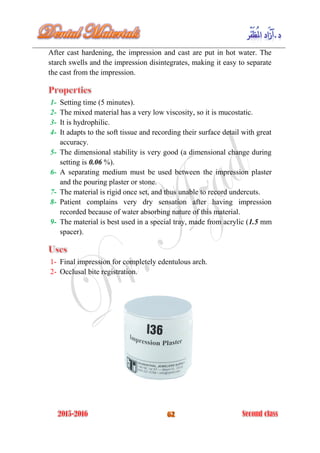
It presents as powder mixed with water in water/powder ratio
(W/P= 0.60), 100 g powder/60 ml water.
1- Calcium sulfate β-hemihydrate.
2- Potassium sulfate: to reduce expansion, and to accelerate the setting
reaction.
3- Borax: to reduce the rate of setting.
4- Starch: to help disintegration of impression on separation from the
plaster or stone cast.
After cast hardening, the impression and cast are put in hot water. The
starch swells and the impression disintegrates, making it easy to separate
the cast from the impression.
1- Setting time (5 minutes).
2- The mixed material has a very low viscosity, so it is mucostatic.
3- It is hydrophilic.
4- It adapts to the soft tissue and recording their surface detail with great
accuracy.
5- The dimensional stability is very good (a dimensional change during
setting is 0.06 %).
6- A separating medium must be used between the impression plaster
and the pouring plaster or stone.
7- The material is rigid once set, and thus unable to record undercuts.
8- Patient complains very dry sensation after having impression
recorded because of water absorbing nature of this material.
9- The material is best used in a special tray, made from acrylic (1.5 mm
spacer).
1- Final impression for completely edentulous arch.
2- Occlusal bite registration.
Impression compound is described as a rigid, reversible impression
material which sets by physical changes. On applying heat, it softens and
on cooling it hardens.
They supplied as sheet, stick, and cake.
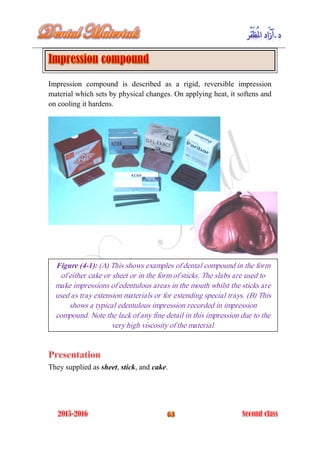
Figure (4-1): (A) This shows examples of dental compound in the form
of either cake or sheet or in the form of sticks. The slabs are used to
make impressions of edentulous areas in the mouth whilst the sticks are
used as tray extension materials or for extending special trays. (B) This
shows a typical edentulous impression recorded in impression
compound. Note the lack of any fine detail in this impression due to the
very high viscosity of the material.
1- Thermoplastic resins.
2- Wax.
3- Plasticizer: stearic acid: addition of plasticizer to overcome brittleness.
4- Filler: talc, calcium carbonate added to:
a- Overcome tackiness.
b- Control degree of flow.
c- Minimize shrinkage due to thermal contraction.
d- Improve rigidity of impression material.
 Sheet form material: it is softened using water bath, a temperature in
range (55-60 °C), knead the material after it has been heated in water
to ensure its being at a uniform temperature. Storage in hot water
should not be long that important constituents such as stearic acid may
be leached out. Overheating make the compound sticky and difficult
to handle.
 Stick form material: it is softened over a flame. The compound should
not be allowed to boil; otherwise, the plasticizers are volatilized.
It is used to prepare a tray for making an impression. It is generally
stiffer and has less flow than regular impression compound.
1- It is mucocompressive.
2- Because of high viscosity and low flow; therefore, the reproduction of
surface detail is not very good.
3- It is not used to record the undercut, because it is rigid once cooled.
4- Poor dimensional stability. It has high value of coefficient of thermal
expansion and undergoes considerable shrinkage on removal from the
mouth. Also because pressure is applied during formation of an impression
(mucocompressive), residual stress exists in cool impression, the gradual
relief of internal stresses may cause distortion of impression (the cast
should be poured as soon as possible or at least within the hour).
5- Impression compound has low thermal conductivity, therefore, time must
be allowed during heating or cooling to allow impression compound to
come to uniform softening.
6- This material can be reused a number of times for the same patient only, in
case of errors.
7- The material has sufficient body to support itself to an extent especially in
the peripheral portions.
1- Difficult to record details because of its high viscosity.
2- Compress soft tissues while making impression.
3- Distortion due to its poor dimensional stability.
4- Difficult to remove it if there are severe undercuts.
5- There is always the possibility of overextension especially in the peripheral
portions.
1- Type I sheet form: It is used for recording primary impression of
edentulous ridges using stock tray.
2- Type I stick form: It is used for border molding of an acrylic special tray
during fitting of the tray.
3- Type II tray compound: It is used to make a special tray (now largely
replaced by acrylic tray).
1- Cementing and insulating medium.
2- Temporary filling.
3- Root canal filling material.
4- Surgical pack in periodontal surgical procedures.
5- Bite registration paste.
6- Temporary relining material for dentures.
7- Impression material for edentulous area.
1- Type I (Hard).
2- Type II (Soft).
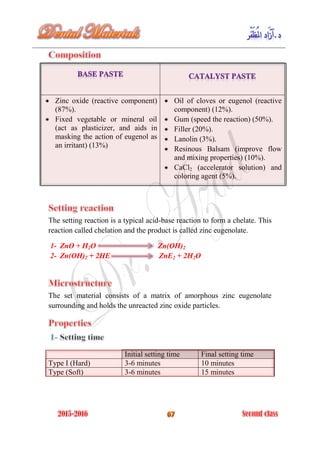
1- Base paste (white in color).
2- Accelerator or reactor or catalyst paste (red in color).
.
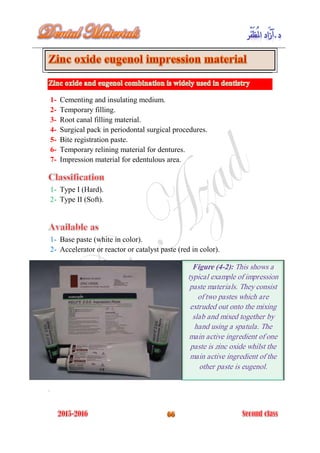
Figure (4-2): This shows a
typical example of impression
paste materials. They consist
of two pastes which are
extruded out onto the mixing
slab and mixed together by
hand using a spatula. The
main active ingredient of one
paste is zinc oxide whilst the
main active ingredient of the
other paste is eugenol.
Zinc oxide (reactive component)
(87%).
Fixed vegetable or mineral oil
(act as plasticizer, and aids in
masking the action of eugenol as
an irritant) (13%)
Oil of cloves or eugenol (reactive
component) (12%).
Gum (speed the reaction) (50%).
Filler (20%).
Lanolin (3%).
Resinous Balsam (improve flow
and mixing properties) (10%).
CaCl2 (accelerator solution) and
coloring agent (5%).
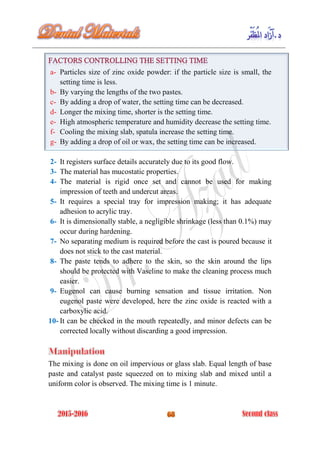
The setting reaction is a typical acid-base reaction to form a chelate. This
reaction called chelation and the product is called zinc eugenolate.
1- ZnO + H2O Zn(OH)2
2- Zn(OH)2 + 2HE ZnE2 + 2H2O
The set material consists of a matrix of amorphous zinc eugenolate
surrounding and holds the unreacted zinc oxide particles.
Initial setting time Final setting time
Type I (Hard) 3-6 minutes 10 minutes
Type (Soft) 3-6 minutes 15 minutes
a- Particles size of zinc oxide powder: if the particle size is small, the
setting time is less.
b- By varying the lengths of the two pastes.
c- By adding a drop of water, the setting time can be decreased.
d- Longer the mixing time, shorter is the setting time.
e- High atmospheric temperature and humidity decrease the setting time.
f- Cooling the mixing slab, spatula increase the setting time.
g- By adding a drop of oil or wax, the setting time can be increased.
2- It registers surface details accurately due to its good flow.
3- The material has mucostatic properties.
4- The material is rigid once set and cannot be used for making
impression of teeth and undercut areas.
5- It requires a special tray for impression making; it has adequate
adhesion to acrylic tray.
6- It is dimensionally stable, a negligible shrinkage (less than 0.1%) may
occur during hardening.
7- No separating medium is required before the cast is poured because it
does not stick to the cast material.
8- The paste tends to adhere to the skin, so the skin around the lips
should be protected with Vaseline to make the cleaning process much
easier.
9- Eugenol can cause burning sensation and tissue irritation. Non
eugenol paste were developed, here the zinc oxide is reacted with a
carboxylic acid.
10- It can be checked in the mouth repeatedly, and minor defects can be
corrected locally without discarding a good impression.
The mixing is done on oil impervious or glass slab. Equal length of base
paste and catalyst paste squeezed on to mixing slab and mixed until a
uniform color is observed. The mixing time is 1 minute.
1- Final impression of edentulous ridge.
2- Occlusal bite registration.
Impression waxes are rarely used to record complete impression but are
used to correct small imperfection in other impression. Waxes are
generally used in combination with other impression materials
These materials consist of a mixture of low melting paraffin wax and
beeswax in ratio about 3:1. It may also contain metal particles. The flow
at 37°C is 100 %. These waxes are subjected to distortion during removal
from the mouth. They should be poured immediately.
Waxes have larger coefficient of thermal expansion of any material used
in restorative dentistry.
1- To make functional impression of free end saddles (class I and class II
removable partial dentures).
2- To record posterior palatal seal in dentures.
3- Functional impression for obturators.
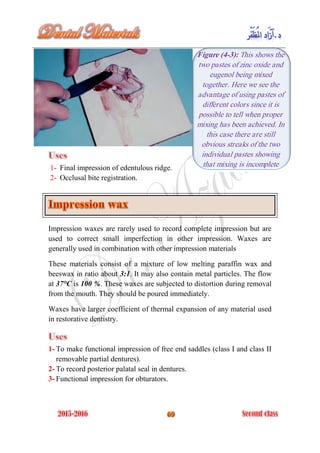
Figure (4-3): This shows the
two pastes of zinc oxide and
eugenol being mixed
together. Here we see the
advantage of using pastes of
different colors since it is
possible to tell when proper
mixing has been achieved. In
this case there are still
obvious streaks of the two
individual pastes showing
that mixing is incomplete
The colloids are often classed as the fourth state of matter known as
colloidal state, they can exist in the form of viscous liquid known as a sol,
or a jelly like elastic semi-solid described as a gel.
If the particles are suspended in water, the suspension is called
hydrocolloid.
Hydrocolloid impression materials are based on the colloidal suspension
of polysaccharide in water.
 In sol form: There is random arrangement of polysaccharide chain.
 In gel form: The long polysaccharide chains become aligned and material
becomes viscous and develops elastic properties.
Gelation: It is conversion of sol to gel.
Based on the mode of gelation, they are classified as:
1-
Set by lowering the temperature e.g. Agar. This makes them reusable.
2-
Set by a chemical reaction. Once set it is usually permanent e.g. Alginate.
Agar hydrocolloid was the first successful elastic
impression material to be used in dentistry. It is an
organic hydrophilic colloid extracted from certain
types of seaweed. Although it is an excellent
impression material and yields accurate
impressions, presently it has been largely replaced
by alginate hydrocolloid and rubber impression
materials.
1- For cast duplication (during fabrication of cast metal removable
partial denture).
2- For full mouth impressions without deep undercuts.
3- For crown and bridge impressions before elastomers came to the
market.
4- As tissue conditioner.
1- Gel in collapsible tubes (for impressions with water cooled tray).
2- A number of cylinders in a glass jar (syringe material).
3- In bulk containers (for duplication).
 Agar (12%)
 Water (85%)
 Borates (0.2%)
 Potassium sulfate (1-2%)
 Alkyl benzoate (0.1%)
 Glycerin
 Coloring and flavoring agents
(traces)
Colloid
It acts as dispersion medium.
To improve the strength of gel.
To ensure proper setting of gypsum
cast against agar (accelerator for
cast material)
Preservative.
Thixotropic material (it acts as
plasticizer).
Agar hydrocolloid requires special equipment:
1- Hydrocolloid conditioner.
2- Water cooled rim lock tray.
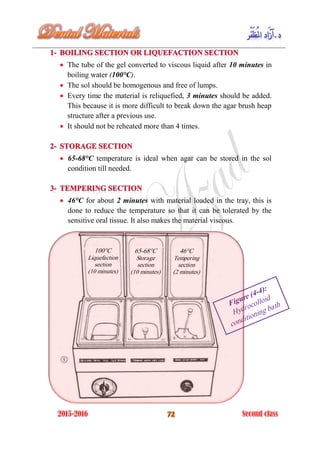
Agar is normally conditioned prior to use by specially designed
conditioning bath (temperature controlled water bath). The conditioning
bath consist of three compartments each hold at different temperature.
 The tube of the gel converted to viscous liquid after 10 minutes in
boiling water (100°C).
 The sol should be homogenous and free of lumps.
 Every time the material is reliquefied, 3 minutes should be added.
This because it is more difficult to break down the agar brush heap
structure after a previous use.
 It should not be reheated more than 4 times.
 65-68°C temperature is ideal when agar can be stored in the sol
condition till needed.
 46°C for about 2 minutes with material loaded in the tray, this is
done to reduce the temperature so that it can be tolerated by the
sensitive oral tissue. It also makes the material viscous.
100°C
Liquefaction
section
(10 minutes)
65-68°C
Storage
section
(10 minutes)
46°C
Tempering
section
(2 minutes)
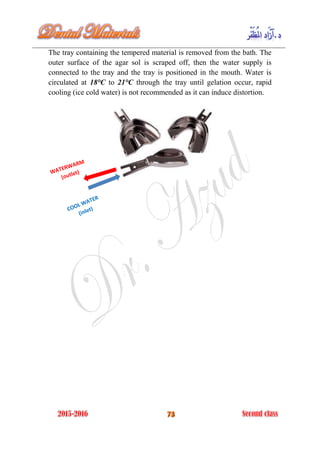
The tray containing the tempered material is removed from the bath. The
outer surface of the agar sol is scraped off, then the water supply is
connected to the tray and the tray is positioned in the mouth. Water is
circulated at 18°C to 21°C through the tray until gelation occur, rapid
cooling (ice cold water) is not recommended as it can induce distortion.
Alginate was developed as a substitute for agar when it became scarce
due to World War II (Japan was a prime source of agar). Currently,
alginate is more popular than agar for dental impression, because it has
many advantages.
1- Fast setting.
2- Normal setting.
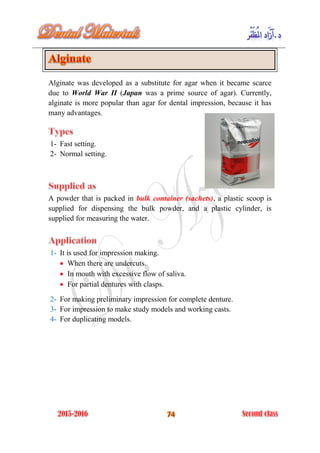
A powder that is packed in bulk container (sachets), a plastic scoop is
supplied for dispensing the bulk powder, and a plastic cylinder, is
supplied for measuring the water.
1- It is used for impression making.
 When there are undercuts.
 In mouth with excessive flow of saliva.
 For partial dentures with clasps.
2- For making preliminary impression for complete denture.
3- For impression to make study models and working casts.
4- For duplicating models.
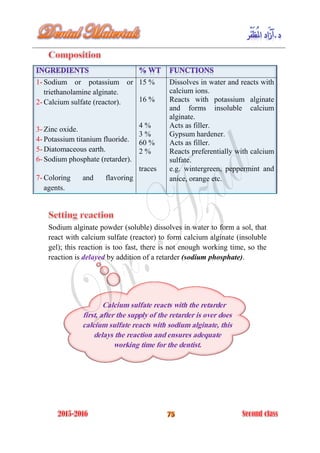
1- Sodium or potassium or
triethanolamine alginate.
2- Calcium sulfate (reactor).
3- Zinc oxide.
4- Potassium titanium fluoride.
5- Diatomaceous earth.
6- Sodium phosphate (retarder).
7- Coloring and flavoring
agents.
15 %
16 %
4 %
3 %
60 %
2 %
traces
Dissolves in water and reacts with
calcium ions.
Reacts with potassium alginate
and forms insoluble calcium
alginate.
Acts as filler.
Gypsum hardener.
Acts as filler.
Reacts preferentially with calcium
sulfate.
e.g. wintergreen, peppermint and
anice, orange etc.
Sodium alginate powder (soluble) dissolves in water to form a sol, that
react with calcium sulfate (reactor) to form calcium alginate (insoluble
gel); this reaction is too fast, there is not enough working time, so the
reaction is delayed by addition of a retarder (sodium phosphate).
Calcium sulfate reacts with the retarder
first, after the supply of the retarder is over does
calcium sulfate reacts with sodium alginate, this
delays the reaction and ensures adequate
working time for the dentist.
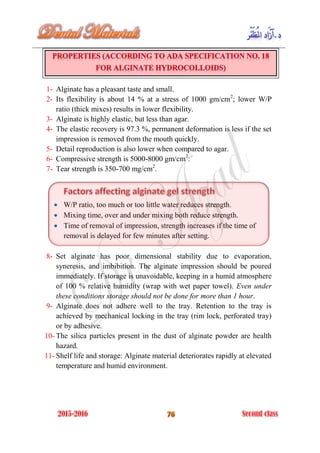
1- Alginate has a pleasant taste and small.
2- Its flexibility is about 14 % at a stress of 1000 gm/cm2
; lower W/P
ratio (thick mixes) results in lower flexibility.
3- Alginate is highly elastic, but less than agar.
4- The elastic recovery is 97.3 %, permanent deformation is less if the set
impression is removed from the mouth quickly.
5- Detail reproduction is also lower when compared to agar.
6- Compressive strength is 5000-8000 gm/cm2
.
7- Tear strength is 350-700 mg/cm2
.
 W/P ratio, too much or too little water reduces strength.
 Mixing time, over and under mixing both reduce strength.
 Time of removal of impression, strength increases if the time of
removal is delayed for few minutes after setting.
8- Set alginate has poor dimensional stability due to evaporation,
syneresis, and imbibition. The alginate impression should be poured
immediately. If storage is unavoidable, keeping in a humid atmosphere
of 100 % relative humidity (wrap with wet paper towel). Even under
these conditions storage should not be done for more than 1 hour.
9- Alginate does not adhere well to the tray. Retention to the tray is
achieved by mechanical locking in the tray (rim lock, perforated tray)
or by adhesive.
10- The silica particles present in the dust of alginate powder are health
hazard.
11- Shelf life and storage: Alginate material deteriorates rapidly at elevated
temperature and humid environment.
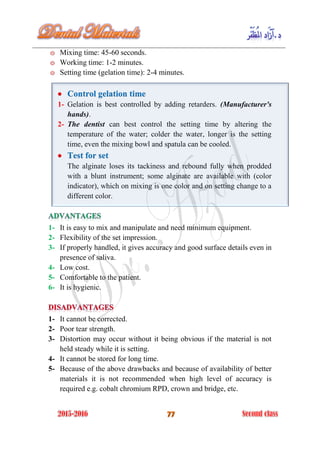
Mixing time: 45-60 seconds.
Working time: 1-2 minutes.
Setting time (gelation time): 2-4 minutes.
 Control gelation time
1- Gelation is best controlled by adding retarders. (Manufacturer's
hands).
2- The dentist can best control the setting time by altering the
temperature of the water; colder the water, longer is the setting
time, even the mixing bowl and spatula can be cooled.
 Test for set
The alginate loses its tackiness and rebound fully when prodded
with a blunt instrument; some alginate are available with (color
indicator), which on mixing is one color and on setting change to a
different color.
1- It is easy to mix and manipulate and need minimum equipment.
2- Flexibility of the set impression.
3- If properly handled, it gives accuracy and good surface details even in
presence of saliva.
4- Low cost.
5- Comfortable to the patient.
6- It is hygienic.
1- It cannot be corrected.
2- Poor tear strength.
3- Distortion may occur without it being obvious if the material is not
held steady while it is setting.
4- It cannot be stored for long time.
5- Because of the above drawbacks and because of availability of better
materials it is not recommended when high level of accuracy is
required e.g. cobalt chromium RPD, crown and bridge, etc.
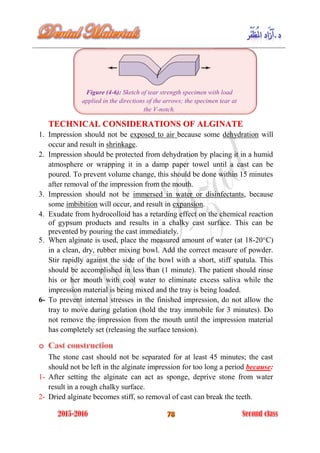
Figure (4-6): Sketch of tear strength specimen with load
applied in the directions of the arrows; the specimen tear at
the V-notch.
TECHNICAL CONSIDERATIONS OF ALGINATE
1. Impression should not be exposed to air because some dehydration will
occur and result in shrinkage.
2. Impression should be protected from dehydration by placing it in a humid
atmosphere or wrapping it in a damp paper towel until a cast can be
poured. To prevent volume change, this should be done within 15 minutes
after removal of the impression from the mouth.
3. Impression should not be immersed in water or disinfectants, because
some imbibition will occur, and result in expansion.
4. Exudate from hydrocolloid has a retarding effect on the chemical reaction
of gypsum products and results in a chalky cast surface. This can be
prevented by pouring the cast immediately.
5. When alginate is used, place the measured amount of water (at 18-20°C)
in a clean, dry, rubber mixing bowl. Add the correct measure of powder.
Stir rapidly against the side of the bowl with a short, stiff spatula. This
should be accomplished in less than (1 minute). The patient should rinse
his or her mouth with cool water to eliminate excess saliva while the
impression material is being mixed and the tray is being loaded.
6- To prevent internal stresses in the finished impression, do not allow the
tray to move during gelation (hold the tray immobile for 3 minutes). Do
not remove the impression from the mouth until the impression material
has completely set (releasing the surface tension).
The stone cast should not be separated for at least 45 minutes; the cast
should not be left in the alginate impression for too long a period because:
1- After setting the alginate can act as sponge, deprive stone from water
result in a rough chalky surface.
2- Dried alginate becomes stiff, so removal of cast can break the teeth.
In addition to the hydrocolloids there is another group of elastic
impression materials, they are soft rubber like and are known as
elastomers, or synthetic rubbers, or rubber base, or rubber impression
materials, or elastomeric impression materials.
They are non-aqueous elastomeric dental impression materials.
1- Polysulfide.
2- Poly ether.
3- Silicon.
a- Condensation polymerizing.
b-Addition polymerizing.
1- Light body.
2- Medium or regular body.
3- Heavy body or tray consistency.
4- Very heavy or putty consistency.
1- Impressions of prepared teeth for fixed partial dentures.
2- Impression for removable partial dentures.
3- Impression of edentulous mouth for complete dentures.
4- Polyether is used for border molding of special tray.
5- For bite registration.
6- Silicon duplicating material is used for making refractory cast.
 Regardless of type all elastomeric impression materials are supplied
as two paste system (base and catalyst) in collapsible tubes.
 Putty consistency is supplied in jar.
This was first elastomeric impression material to be introduced. It is also
known as Mercaptan or Thiokol.
1- Light body.
2- Medium body.
3- Heavy body.
1- Liquid polysulfide polymer. (80-85 %).
2- Inert fillers (titanium dioxide, zinc sulfate, copper carbonate, or
silica). (16-18 %).
1- Lead dioxide. (60-68 %).
2- Dibutyl phthalate (30- 35 %).
3- Sulfur. (3 %).
4- Other substances like (deodorant, and magnesium stearate (retarder) (2 %).
Figure (4-7): Polysulfide
impression material.
The two pastes with
contrasting colors are
mixed together on a
mixing pad with a metal
spatula.
1- Unpleasant odor and color.
2- It is extremely viscous and sticky, mixing is difficult. However, they
exhibit pseudoplasticity.
3- It has long setting time (12 minutes). Heat and moisture accelerate
the setting time.
4- Excellent reproduction of surface details.
5- It has highest permanent deformation (3-5 %) among the elastomers,
so pouring of the cast should be delayed by half an hour. Further
delay is avoided to minimize curing shrinkage, and shrinkage from
loss of by-product (water).
6- It has high tear strength (4000 gm/cm2
).
7- It has good flexibility and low hardness.
8- It is hydrophobic so the mouth should be dried thoroughly before
making an impression.
1- Unpleasant odor.
2- Dirty staining.
3- High amount of effort required for mixing.
4- Long setting time.
5- High shrinkage on setting.
6- High permanent deformation.
These materials were developed to overcome some of the disadvantages
of polysulfide.
This was the earlier of the two silicone impression materials. It is also
known as conventional silicone.
1- Light body.
2- Putty consistency.
1- Polydimethyl siloxane.
2- Colloidal silica or metal oxide fillers (35-75 %) depending on viscosity.
3- Color pigments.
1- Stannous octoate (catalyst).
2- Orthoethyl silicate (cross linking agent).
1- Pleasant color and odor.
2- Setting time is 8-9 minutes.
3- Excellent reproduction of surface details.
4- Dimensional stability is comparatively less because of the high
polymerizing shrinkage, and shrinkage from loss of by-product (ethyl
alcohol). The cast should be poured immediately, the permanent
deformation is also high (1-3 %).
5- The tear strength is lower than polysulfide (3000 gm/cm2
).
6- It is stiffer and harder than polysulfide, care should be taken while
removing the stone cast from the impression to avoid any breakage.
7- It is hydrophobic.
8- Direct skin contact should be avoided to prevent any allergic
reactions.
They were introduced later. It has better properties than condensation
silicone. It is also known as polyvinyl siloxane.
1- Light body.
2- Medium body.
3- Heavy body.
4- Putty consistency.
1- Poly methyl hydrogen siloxane.
2- Other siloxane prepolymers.
3- Fillers.
1- Divinyl polysiloxane.
2- Other siloxane prepolymers.
3- Platinum salt (catalyst).
4- Palladium (hydrogen absorber).
5- Retarders.
6- Fillers.
1- Pleasant color and odor.
2- Direct skin contact should be avoided to prevent any allergic
reactions.
3- Excellent reproduction of surface details.
4- Setting time is 5-9 minutes.
5- It has the best dimensional stability among the elastomers. It has low
polymerizing shrinkage, and the lowest permanent deformation (0.05-
0.3 %). The cast pouring should be delayed by 1-2 hours; because of
hydrogen gas is liberated during polymerization, air bubbles will
result.
6- It hydrophobic, so similar care should be taken while making the
impression and pouring the wet stone. Some manufactures add a
surfactant (detergent) to make it more hydrophilic.
7- It has low flexibility and it harder than polysulfide; care should be
taken while removing the stone cast from the impression to avoid any
breakage.
Polyether was introduced in the 1970. It has good mechanical properties
and dimensional stability.
1- Light body.
2- Medium body.
3- Heavy body.
Figure (4-8): Section of an
impression in which heavy
body (A), and light body
(B) materials have been
used to obtain optimal
accuracy and dimensional
stability.
Figure (7-9): Polyether impression material. The two pastes have been
extruded on to the mixing pad ready for mixing using a metal blade spatula.
1- Polyether polymer.
2- Colloidal silica (filler).
3- Glycol ether or phthalate (plasticizer).
1- Aromatic sulfonate ester (cross-linking agent).
2- Colloidal silica (filler).
3- Phthalate or glycolether (plasticizer).
1- Pleasant color and odor.
2- The sulfonic ester may cause skin reaction; direct skin contact
should be avoided.
3- Setting time is around (8 minutes), heat decrease setting time.
4- Dimensional stability is very good. Polymerizing shrinkage is low.
The permanent deformation is low (1-2 %). The impression should
not be stored in water or in humid climate, because polyethers
absorb water and can change dimension.
5- It is extremely stiff (flexibility 3 %). Its hardness is higher than
polysulfide and increase with time; care should be taken while
removing the stone cast from the impression to avoid any breakage.
6- The tear strength is good (3000 gm/cm2
).
7- It is hydrophilic, so moisture in the impression field is not so
critical. It has the best compatibility with stone.
1- The working time was short.
2- The material was very stiff.
3- It is expensive.
1- Impressions are usually made in special trays. Perforated stock trays are
used only for making impression in putty consistency.
2- The spacing given is between 2-4 mm.
3- Elastomers do not adhere well to the tray. An adhesive should be
applied onto the tray and allowed to dry before making impression.
4- The bulk of the impression should be made with a heavier consistency
(to reduce shrinkage), light body should only be used in a thin layer as a
wash impression.
 Tray used: spaced special tray.
 Viscosity used: regular body only.
Method
The paste is mixed and material is loaded onto the tray, the tray with
material is seated over the impression area, the material is allowed to set.
 Tray used: spaced special tray.
 Viscosity used: (a) heavy body and (b) light body.
Method
The two viscosities are mixed simultaneously but on separate pads. The
heavy body is loaded onto the tray while the light body is loaded into the
syringe. The syringe material is injected onto the area of impression. The
tray containing the heavy body if then seated over it. Both materials set
together to produce a single impression.
 Tray used: perforated stock tray.
 Viscosity used: (a) putty (b) light body.
Method
First a primary impression is made with putty in the stock tray. After
setting it is kept aside. Light body is mixed and spread into the putty
impression. The primary impression is then seated over the impression
area and held till it is set.
1- More uniform mix.
2- Less air bubbles incorporated in mix.
3- Reduced working time.
Figure (4-10): Addition silicone impression materials packaged with auto-mixed
cartridges, mixing gun, and static mixing tips, and dynamic mechanical mixer.
Figure (4-11): The bulk
packaging of an elastomeric
impression material. The
pastes are extruded through
the mixing nozzle using an
electrically powered motor
inside the device. The mixed
material can be extruded
directly into an impression
tray which is held underneath
the nozzle. The nozzle itself is
disposable and is replaced
with a fresh nozzle for each
individual mix.
Figure (4-12): Top left,
impression tray containing
elastomeric impression is
seated too late as elasticity
starts to develop. Top right,
increased seating pressure is
applied to overcome the
stiffness of impression
material. Lower left,
distortion develops because
of recovery of excessive
elastic deformation. Lower
right, the die produced in the
distorted (inaccurate)
impression is too narrow and
too short.
It is a metal containing two or more elements, at least one of which is
metal, and all of which are mutually soluble in the molten state.
: They are materials resist corrosion in the mouth. (gold,
platinum, palladium, silver, rhodium, ruthenium, iridium, osmium).
: This term indicates the intrinsic value of the metal.
The eight noble metals are also precious metal, but all precious metals are
not noble.
: Pure gold is soft, ductile, yellow hue. The density is 19.3
gm/cm3
, melting point is 1063°C, good chemical stability, not corrode
and not tarnish.
: Whitest metal, its density is 10.4 gm/cm3
, melting point is
961°C.
: Its density is 12.02 gm/cm3
, melting point is 1552°C.
: its density is 21.65 gm/cm3
, melting point is 1769°C.
: These are not noble metals, (chromium, cobalt, nickel,
copper,…..etc).
They are important components of dental casting alloy because:
a- Their influence on physical properties.
b-Control of the amount and type of oxidation.
c- Their strengthening effect.
 Type I: soft.
 Type II: medium.
 Type III: hard.
 Type IV: extra-hard.
1- Binary (2 elements).
2- Ternary (3 elements).
3- Quaternary (4 elements).
1- Alloys for all metal; metal with resin veneer restorations.
2- Alloys for metal ceramic restorations.
3- Alloy for removable dentures.
1- It should not tarnish and corrode in the mouth.
2- It should strong.
3- Biocompatible (non-toxic, non-allergic).
4- It should be easy to fabricate (melt, cast, cut, and grind).
5- It should flow well, and duplicate fine details during casting.
6- It should have minimal shrinkage on cooling after casting.
7- It should easy to solder.
Alloys for all metal restorations
1- Gold alloys (composed of gold, copper, silver, platinum, palladium, and
other additives).
2- Silver-palladium alloys.
3- Nickel-chromium alloys.
4- Cobalt-chromium alloys.
Alloys for metal ceramic restorations
1- Gold-palladium-platinum alloys.
2- Palladium-silver alloys. Cheap
3- Nickel-chromium alloys.
Figure (5-1):
Cutaways of all-
ceramic crown
(left) and
porcelain fused to
metal crown
(right).
HOW DOES PORCELAIN BOND TO THE ALLOY?
Ceramic adheres to metal primarily by chemical bond. A covalent bond is
established by sharing 02 in the elements in the porcelain and the metal
alloy.
These elements include silicon dioxide (Si02 in the porcelain and
oxidizing elements such as silicon, indium, and iridium in the metal alloy.
Alloys for removable dentures
8- It should be light weight.
9- It should have high stiffness (to make the framework thin).
10- It should have good fatigue resistance.
11- It should not react to commercial denture cleanser.
12- Economical consideration.
Alloy used:
a- Cobalt (to give hardness, strength, rigidity).
b- Chromium (to ensure corrosion resistance by passivating effect).
c- Nickel (to decrease fusion temperature and increase ductility).
d- Molybdenum or tungsten (to increase hardness).
e- Iron and copper (to increase hardness).
f- Manganese and silicon (to prevent oxidation).
g- Boron (to increase hardness and deoxidizer).
h- Carbon (to strengthen the alloy).
a- Nickel.
b- Chromium.
c- Molybdenum.
d- Other minor additions like aluminum, iron, silicon, copper, manganese, tin.
The function of each ingredient is discussed previously
Filling materials are used to replace missing parts of the tooth.
1- Dental caries.
2- Trauma.
3- Abrasion.
Parts of teeth which require replacement by restorative materials vary in size
of cavity, shape, and location in the mouth; no single restorative material is
suitable for all cases. For some situations, the strength and abrasion
resistance of material may be the prime consideration, in other situation
appearance and adhesive properties may become more important.
1- Working time should be sufficiently long, to enable manipulation and
placement of material before setting.
2- Setting time should be short for comfort of both the patient and clinician.
3- The material must withstand large variation in pH and a variety of solvents
which may be taken into mouth in drink food stuffs and medicaments.
4- Metallic materials should not undergo excessive corrosion, or be involve in
the development of electrical currents which may cause "Galvanic pain".
5- Filling should be good thermal insulator, protecting the dental pulp from the
harmful effect of the hot and cold stimuli (low thermal diffusivity).
6- Materials should have values of coefficient of thermal expansion similar to
those of enamel and dentin.
7- Materials should have satisfactory mechanical properties to withstand the
force applied, e.g. abrasion resistance, compression and tensile strength,
modulus of elasticity.
8- They should adhere well to the tooth walls and seal the margin prevent
ingress of fluid and bacteria. Also reduces the amount of cavity preparation
required in order to achieve retention of the filling.
9- They should be harmless to the operator and to the patient and should not
irritant to dental pulp and soft tissue.
10- Easily polished.
11- Should be bacteriostatic and anticariogenic.
12- It should be radiopaque to diagnose the marginal caries.
 Amalgam.
 Direct gold filling.
 Polymeric
o Filled resin (composite).
o Unfilled resin (acrylic).
 Non-polymeric:
o Silicate cement.
o Glass ionomer cement.
 Silicate cement.
 Acrylic.
 Composite.
It is a special type of alloy in which mercury is one of the components.
Mercury is able to react with other metals to form a plastic mass, which is
conveniently packed into a prepared cavity in a tooth, and then this mass
is hardened. It is the most widely used filling material for posterior teeth.
Figure (6-1): Amalgam restorations.
1- As a permanent filling material in:
a- Class I and class II cavities.
b- Class V cavities where esthetic is not important.
2- In combination with retentive pins to restore a crown.
3- For making a die.
4- In retrograde root canal fillings.
5- As a core material.
I- Based on copper content
1- Low copper alloys: contain less than 6 % copper (conventional alloy).
2- High copper alloys: contain more than 6 % copper.
II- Based on shape of alloy particles
1- Lathe-cut alloys: (irregular shape often needle-like either coarse
grain or fine grain which is preferred because ease of carving).
2- Spherical alloys.
3- Blend of lathe-cut and spherical particles.
III- Based on size of alloy particles
1- Microcut.
2- Macrocut.
Figure (6-2): Dental amalgam alloys (Lathe-cut alloy particles).
Figure (6-3): Spherical alloy particles.
Figure (6-4): Lathe-cut particles of conventional alloy and spherical particles.
Bulk powder and mercury.
Alloy and mercury in disposable capsules mixed by amalgamator
machine; figure (6-5).
(It is the major element in the reaction).
Whitens the alloy.
Decrease the creep.
Increase the strength.
Increase the expansion on setting.
Increase the tarnish resistance in the amalgam filling.
Control the reaction between silver and mercury, without tin the
reaction is too fast and the setting expansion is unacceptable, but it
decrease strength and hardness, and reduce tarnish and corrosion
resistance, so the amount of tin should be controlled.
Figure (6-5)
Increase hardness and strength.
Increase setting expansion.
It is not affect the reaction and properties, but it is added in small
amount to act as deoxidizer thus prevents oxidation of major elements
during manufacturing.
When alloy powder and mercury are triturated, the silver and tin in the
outer portion of the particles dissolve into the mercury. At the same time
mercury diffuses into the alloy particles and starts reacting with silver and
tin present in it, forming (silver-mercury) and (tin-mercury) compounds.
 The silver-tin compound (unreacted alloy powders) known as gamma
phase (γ).
 The silver-mercury compound is known as gamma one phase (γ 1).
 The tin-mercury compound is known as gamma two phase (γ 2).
Gamma
(Unreacted particle)
Gamma 2 (Tin-Mercury)
Gamma 1 (Matrix)
Microleakage:
With age the amalgam has self-sealing property that decreases the
microleakage due to the corrosion products that forms in the tooth-
restoration interface.
Effect of moisture contamination (delayed expansion):
If a zinc-containing amalgam is contaminated by moisture during
condensation large expansion can take place. It usually starts after 3-5
days and may continue for months. It may reach 4 % that produce
pressure on the pulp and cause post-operative sensitivity.
Figure (6-7): An occlusal amalgam filling which has caused the tooth to
crack. The most likely cause of this cracking is the expansion of the
amalgam during or shortly after setting.
Effect of trituration:
Under- and over-trituration will decrease the strength.
Effect of mercury content:
 Low mercury in mixing lead to dry, granular mix resulting in rough
pitted surface that invites corrosion.
 High mercury can produce a marked reduction in strength.
Effect of condensation:
Higher condensation pressure results in higher compressive strength
this happen only in lathe-cut alloys. The condensation will decrease
porosity, and remove excess mercury from lathe-cut amalgam. If
heavy pressure is used in spherical amalgam, the condensation will
punch through. However, spherical amalgam condensed with lighter
pressure produces adequate strength.
Effect of cavity design:
 Should be designed to reduce tensile stresses.
 The cavity should have adequate depth, because amalgam has
strength in bulk.
Creep value:
Creep is related to marginal breakdown.
 Low-copper amalgam 0.8-8 %.
 High- copper amalgam 0.4-1 %.
Figure (6-8): Creep of amalgam causes the formation of unsupported
edges which can fracture.
Amalgam does not adhere to tooth structure, so retention is obtained
through mechanical locking.
Amalgam restorations often tarnish and corrode in the mouth. This
corrosion can be reduced by:
 Smoothing and polishing the restoration.
 Correct Hg/alloy ratio and proper manipulation.
 Avoid dissimilar metals including mixing of high, and low copper
amalgams.
Reasonably easy to insert.
Maintains anatomic form well.
Has adequate resistance to fracture.
After a period of time prevents marginal leakage.
Cheap.
Have long service life.
The color does not match tooth structure.
Brittle.
Corrosion and galvanic action.
They eventually show marginal breakdown.
They do not bond to tooth structure.
Risk of mercury toxicity.
Mercury is toxic, free mercury should not be sprayed or exposed to the
atmosphere. This hazard can arise during trituration, condensation, and
finishing, and also during the removal of old restorations at high speed.
Avoid mercury vapors inhalation and skin contact with mercury as it can
be absorbed.
Approximately 80 % of the mercury vapor will be absorbed in the lungs,
and 5–10 % of the mercury (saliva) will be resorbed in the
gastrointestinal tract. The hypothesized intake of mercury via oral mucosa
or dental pulp, however, seems to be negligible.
There are no scientific studies that show that having dental amalgams is
harmful, or that removing your amalgam fillings will improve your
health. (U.S. Food and Drug Administration, consumer information, October 2006)
It has been determined that the dental amalgam fillings do not pose a
health risk, although they do account for some mercury exposure to those
having such fillings.
Mercury has a cumulative toxic effect. Dentists are at high risk. Through
it can be absorbed by skin or by ingestion; the primary risk is from
inhalation.
Mercury accumulates in the kidneys. If the dose exceeds the capacity
limit, direct toxic damage of the proximal renal tubules.
The target organ of prime concern is the central nervous system. Tremor
and psychological disturbances (erethism) are classical symptoms of a
chronic mercury intoxication caused by extensive occupational exposure.
Erethism is characterized by acute irritability, abnormal shyness, timidity,
and overreaction to criticism. Disturbance of memory, loss of appetite,
depression, fatigue, and weakness may also occur. Further symptoms of
chronic intoxication with inorganic mercury are decreased nerve
conduction velocity and gastrointestinal disturbances. Oral symptoms,
including metallic taste, swollen salivary glands, disturbed salivation,
severe gingivitis, mucosal ulcerations, necrosis, and even tooth loss have
also been reported. Clinical symptoms of mercury poisoning that may be
found in heavily exposed persons.
The clinic should be well ventilated.
The mercury should be stored in well-sealed container.
Amalgam scrap and materials contaminated with mercury or amalgam
should not be subject to heat sterilization.
Vacuum cleansers are not used because they disperse the mercury.
Skin contacted with mercury should be washed with soap and water.
While removing the old fillings, a water spray, mouth mask, and suction
should be used.
The use of ultrasonic amalgam condenser is not recommended as a spray of
small mercury droplets is observed.
If the mercury contact the gold jewelry the mercury bonds permanently to
the gold and ruins, but boiling it in coconut oil can fix it.
Annually, a (programme for handling toxic materials) is monitored for actual
exposure levels.
It is pulpal irritation due to low pH (5-3.5).
Brittle and has weak mechanical properties.
Shrinkage on setting.
High solubility and disintegration.
Unfilled acrylic polymer where introduced about 1945 and were improved
so that they were in moderate usage in the 1960s. The unfilled acrylic
material possessed improved resistance to solubility and has no problems
with dehydration, although staining was a problem. The undesirable qualities
of unfilled acrylics were large dimensional change on setting and with
temperature, resulting in percolation of saliva at margins; low mechanical
strength and stiffness; low resistance to wear; and recurrent decay.
The term composite material may be defined as a compound of two or
more distinctly different materials with properties that are superior or
intermediate to those of the individual constituents.
Composite is polymeric filling material reinforced with filler particles.
It was developed in 1962s to overcome the disadvantages in physical and
mechanical properties of acrylic filling and of silicate cement. It is most
popular anterior filling material. Nowadays, composite is used as anterior
and posterior filling materials.
Bisphenol -A- glycidyl methacrylate monomer (Bis-GMA) or urethane
dimethacrylate. Bis-GMA monomer is most commonly used. Its
properties were superior to those of acrylic resins. It has a high viscosity
which required the use of diluent monomers. The commonly used
diluents monomer is tetraethyl glycol dimethacrylate (TEGDMA).
Types of filler
They are obtained by grinding or milling the quartz. They are mainly
used in conventional composites. They are chemically inert and very
hard. This make restoration more difficult to polish and can cause
abrasion of opposing teeth and restoration.
They are microfiller; added in small amount (5 wt %) to modify the
paste viscosity. Colloidal silica particles have large surface area thus
even small amount of microfiller thicken the resin. In microfilled
composites, it is only inorganic filler used.
These filler provide radiopacity to resin restoration. Its refractive
index is 1.5 e.g. barium, zirconium, and strontium glasses. The most
commonly used is barium glass. It is not as inert as quartz some
barium may leach out.
As less resin is present, the curing shrinkage is reduced.
Reduced water sorption and coefficient of thermal expansion.
Improves mechanical properties like strength, stiffness, hardness, and
abrasion resistance.
Amount of filler added.a-
Size of particles and its distributionb-
In order to increase the amount of filler in the resin, it is necessary to
add the filler in a range of particles size. If a single particle size is
used, a space will exist between particles, smaller particles can then
fill up these spaces.
Index of refractionc-
For esthetic, the filler should have a translucency similar to tooth
structure. To achieve this, the refractive index of filler should closely
match that of the resin. Most glass and quartz filler have a refractive
index 1.5, which much than that of bis-GMA.
Its hardnessd-
Radiopacitye-
Coupling agents bond the filler particles to the resin matrix. This allows
the more plastic resin matrix to transfer stress to stiffer filler particles.
The most commonly used coupling agent is organosilane.
They improve the physical and mechanical properties of resin.
Prevent the filler from being dislodged from the resin matrix.
They prevent water from penetrating the filler-resin interface,
microleakage of fluids into filler-resin interface led to surface staining.
Hydroquinone acts as inhibitor to prevent premature polymerization.
UV-absorber adds to improve color stability.
Opacifiers like titanium dioxide and aluminum oxide.
Color pigments add to match tooth color.
This is two paste systems
 : contains benzoyl peroxide initiator.
 : tertiary amine activator.
When two pastes are spatulated the amine reacts with the benzoyl
peroxide to form free radical which starts the polymerization.
Figure (6-9): Atypical two paste
composite material. Approximately
equal amounts of two pastes are
taken out of the containers using a
plastic spatula and then they are
mixed together on a paper pad.
The earliest system used, but it is not used nowadays.
a- Limited penetration of the light into the resin.
b- Lack of penetration through tooth structure.
c- Irritant to the soft tissue.
These totally replaced the UV-light system. They are widely used than
the chemically activated resins. These are single paste system containing:
 Photo-initiator (Camphoroquinone 0.25 wt %).
 Amine accelerator: diethyl-amino-ethyl-methacrylate (DEAEMA)
0.15 wt %.
Under normal light they don’t interact. However, when exposed to light
of the correct wave length the photo-initiator is activated and reacts with
amine to form free radical. Camphoroquinone has an absorption range
between 400-800 nm. This is in the blue region of visible light spectrum.
In some cases inhibitors are added to enhance its ability to room light or
dental operatory light.
Required light of correct wave
length for its activation.
Cure only where sufficient
intensity of light is received.
Working time under control of
operator.
Supplied as single component
in light tight syringe.
Less chance of air entrapment
during manipulation, more
homogenous mix.
Activated by peroxide-amine
system.
Cures throughout its bulk.
Working time is limited.
Supplied as two component
system.
Air may get incorporated during
mixing resulting in reduction of
properties.
Figure (6-10): This shows the
three most common means of
supplying composite filling
materials. On the left we have
the two paste chemically
activated materials supplied
in pots. In the middle we see
the syringe format and on the
right we see capsule format.
Both the syringe and capsule
format are used for light-
activated materials.
Figure (6-11): Visible-light
source for photo-initiation of
light activated restorative
materials.
Ground quartz is most commonly used as filler. There is a wide
distribution of particle size. Average size 8-12 μm, particles as large as
50-100 μm is also be present.
Filler loading is 70-80 wt % or 50-60 vol %.
The conventional composite have improved properties compared to
unfilled restorative resin, it has more compressive strength, tensile
strength, elastic modulus, and hardness, and it has less water sorption and
coefficient of thermal expansion.
Although the conventional composites were superior to unfilled resin, but
they had certain
Polishing was difficult and results in a rough surface. This is due to
selective wear of the softer resin matrix leaving the hard filler particles
elevated.
Poor resistance to occlusal wear.
Tendency to discolor, the rough surface tends to stain.
Small particles composite were introduced in an attempt to have good
surface smoothness (like microfilled composite) and improve the physical
and mechanical properties of conventional composite. The small particles
composite use fillers that have been ground to smaller size.
Glass containing heavy metals.
Ground quartz.
Colloidal silica is added in small amount 5 wt % to adjust the paste
viscosity.
The average fillers size is 1-5 μm; however the distribution is fairly broad
(it helps to increase the filler loading).
The filler content is 65-77 vol % or 80-90 wt %.
Due to the higher filler content the best physical and mechanical
properties are observed with this type.
Due to their improved strength and abrasion resistance they can be
used in areas of stress such as class II and class III restorations.
Some of the products have reasonably smooth surface for anterior are
still not as good as the microfilled and hybrid composite in this
regard.
Composites containing heavy metal glasses as filler are radiopaque.
They were developed to overcome the problems of surface roughness of
conventional composites. The resin achieved the smoothness of unfilled
acrylic direct filling resins and yet had advantages of having filler. The
smoother surface is due to the incorporation of microfillers. Colloidal
silica is used as microfiller. The problem with colloidal silica was that it
had a larger surface area that could not be adequately wetted by matrix
resin. Thus addition even small amounts of microfiller result in
thickening of the resin matrix. Thus it was not possible to achieve the
same filler loading as conventional composite.
: with the inclusion of prepolymerized fillers, the filler
content is 80 wt % or 70 vol %. However, the actual inorganic content is
only 50 wt %.
With exception of compress strength their mechanical properties are
inferior to other type. This is because of their higher resin content (50 vol
%). Their biggest advantage is their esthetic. The microfilled composite is
the resin of choice for esthetics restoration of anterior teeth, especially in
non-stress bearing area. In stress bearing situation like class IV and class
II restoration, they have a greater potential for fracture.
The nanofilled composites are technically just a category of microfilled
composite, the diameter of filler is less than 100 nanometers (nm),
Nanofilled composites are the newest addition to the composite filling
materials. They are becoming popular among dentists because they are
advertised to have superior esthetic and wear characteristics, high
polishability, and superior handling characteristics.
The individual nano-particles fill in the spaces between the micro
particles.
These were developed so as to obtain better surface smoothness than that
of small particles, but yet maintain the properties of latter.
The hybrid composites have a surface smoothness and esthetics
competitive with microfilled composite for anterior restoration.
Colloidal silica: present in a higher concentration 10-20 wt % and
contributes significantly to the properties.
Heavy metal glasses: average particles size is 0.6-1 μm. 75 % of
ground particles are smaller than 1 μm.
: 70-80 wt % or 50-60 vol %, the overall filler loading is
not as high as small particle composition.
The particles size range between conventional and small particle. They
are generally superior to microfilled composite.
The hybrid composites are widely used for anterior restorations, including
class IV, because of its smooth surface and good strength.
The hybrid are also being widely employed for stress bearing restoration,
even though its mechanical properties are somewhat inferior to small
particle composites.
Low-viscosity, high-flow composites marketed as flowable composites
are advocated for a wide variety of applications, such as preventive resin
restorations, cavity liners, restoration repairs, and cervical restorations.
These applications are not well supported with data, but their clinical use
is widespread.
Figure (6-12): two dimensional
diagrams of composites with (A) fine
and (B) Microfine particles
Figure (6-13): Flowable composite
It should be non-toxic, and non-irritant to pulp and tissue.
It should be insoluble in saliva and liquid.
Mechanical properties must meet the requirements for their particular
application.
Protection of the pulp:
 Thermal insulation.
 Chemical protection.
 Electrical insulation.
Optical properties.
Cements should be adhesive to tooth structures and restorations, but
not to dental instruments.
Should be bacteriostatic.
Should have soothing effect on the pulp.
The luting cement should have low viscosity to give a low film
thickness.
Figure (6-14): Shrinkage of a filling
material during polymerization can
potentially cause the formation of a
marginal gap. This may seriously
compromise the long term viability of
the restored tooth; top freshly placed
restoration before polymerization.
Bottom after polymerization, illustration
the formation of a gap.
It has a sedative effect on exposed dentin. It is the least irritating of all
dental cements.
It has reasonable sealing of the cavity.
It is the cement of low strength, low abrasive resistance, and low flow
after setting, so placement of zinc oxide eugenol temporary filling
should not be more than few days, maximum few weeks. The strength
and abrasive resistance could be improved by adding 20-40 % weight
of fine polymer particles and treating the surface of zinc oxide
particles with carboxylic acid (reinforced zinc oxide eugenol type).
Sufficient powder should be added to the liquid to achieve putty
consistency.
It is the material of choice as temporary filling.
Zinc oxide (principal ingredient).
Zinc stearate (accelerator, plasticizer).
Zinc acetate (accelerator, improve strength).
White rosin (to reduce brittleness of set cement).
Eugenol (react with zinc oxide).
Olive oil (plasticizer).
4-10 minutes (zinc oxide eugenol cement sets quickly in
the mouth due to moisture and heat).
(4/1 to 6/1 by weight).
1- Particle size: smaller particles set faster.
2- Heat: cool the glass slab slows the reaction.
3- Powder /liquid ratio: higher the ratio, faster the setting reaction.
4- Water acts as accelerator.
5- Glycerin acts as retarder.
Luting of restorations (cementation).
High strength bases.
Temporary restoration.
Luting of orthodontic bands.
1- Has higher strength and abrasive resistance than zinc oxide eugenol,
and has a relatively low solubility in oral fluids, but still has low
abrasive resistance in area subjected to high load of mastication.
2- Higher powder/ liquid ratio is required for low acidity and high
strength.
3- Reinforced zinc phosphate is more durable and could be used when
longer time for temporary filling is required.
Zinc oxide (principal constituent).
Magnesium oxide (aids in sintering).
Calcium oxide (improves smoothness of mix).
Silica (filler).
Phosphoric acid (react with zinc oxide).
Water (control rate of reaction).
Aluminum phosphate (buffers, to reduce rate of reaction).
Aluminum (cohesive).
15 seconds (maximum 1 minute).
5-9 minutes.
Temperature: higher temperature will accelerate the reaction.
Powder/liquid ratio: (1.4 g/0.5 ml) more the liquid, slower the
reaction.
Rate of addition of powder is incorporated slowly.
Mixing time: the longer mixing time (within practical limits), the
slower is the rate of reaction.
They are adhesive teeth colored anticariogenic cements. It was named
glass ionomer because, the powder is glass and the setting reaction and
adhesive bonding to tooth structure is due to ionic bond.
Anterior esthetic restorative material for class III cavities.
For eroded areas and class V restorations.
As luting agent.
As liners and bases.
It is not recommended for class II and class IV restorations, since they
lack fracture toughness and are susceptible to wear.
Silica.
Alumina (Al2O3).
Aluminum florid (AlF3).
Calcium florid (CaF2). Act as ceramic flux.
Sodium florid (NaF).
Aluminum phosphate (AlPo4).
Barium (provide radiopacity).
Polyacrylic acid (increase reaction, decrease viscosity).
Tartaric acid (increase working time).
Water (it is the medium of reaction and it hydrates the reaction products).
5-7 minutes.
Conditioning of the tooth surface.
Proper manipulation.
Protection of cement during setting.
Finishing.
Figure (7-2):
diagrammatic
illustration of the
setting of glass
ionomer cement
This cement contains two main reactive ingredients, zinc oxide and
polyacrylic acid and both are in the powder; the bottle is filled with water
by the dentist. Powder and water are dispensed onto the mixing pad and
mixed with a spatula.
In other products the powder contains only the zinc oxide and the liquid
is an aqueous solution of polyacid.
Primary for luting permanent restorations.
As liners and bases.
Used in cementation of orthodontic bands.
Also used as root canal fillings in endodontics.
Zinc oxide (basic ingredient).
Magnesium oxide (modifier).
Stannous fluoride (increase strength; anticariogenic).
Polyacrylic acid.
Unsaturated carboxylic acid (iticonic acid, maleic acid).
30-40 seconds.
7-9 minutes (can be increased by cooling the glass slab).
1.5 powder: 1 liquid by weight.
Figure (7-3):
Polycarboxylate cement.
A chemically active resin luting cement which is used to bond laboratory
made dental appliances and restorations to teeth.
Resin matrix.
Inorganic fillers.
Coupling agent.
Chemical or photo initiators and activators.
Chemically by peroxide-amine system.
By light activation.
Dual cure (by both chemical and light activation).
Etching the restoration.
Etching the tooth surface.
Cementing the restoration.
Cementation of crowns and bridges (etched
cast restorations).
Cementation of porcelain veneers and inlay.
For bonding of orthodontic brackets to acid
etched enamel.
This material is provided as two pastes. Approximately equal amounts of
each paste are dispensed onto the mixing pad and mixed with a spatula.
One of the active ingredients is a salicylate compound which has a very
distinctive ‘medicated’ odor.
Direct and indirect pulp capping.
As bases beneath composite restoration for pulp protection.
Apexification procedure in young permanent teeth where root
formation is incomplete.
Glycol salicylate (react with CaOH2).
Titanium dioxide (inert filler, pigment).
Barium sulfate (radiopacity).
Calcium sulfate.
Zinc oxide.
Zinc stearate (accelerator).
Sulfonamide (oily compound act as carrier).
Ethylene toluene.
2.5-5.5 minutes.
The reaction is accelerated by moisture
and accelerators. It therefore sets fast in the oral cavity.
The cement is alkaline in nature. The high pH is due to
the presence of free CaOH2 in the set cement. The pH ranges from (9.2 to
11.7).
The high alkaline and antibacterial and
protein lysing effect helps in the formation of reparative dentin.
Equal length of the two pastes are dispensed on a paper and mixed to a
uniform color, then use dycal applicator (a ball ended instrument) to carry
the mixed material and apply to deep area of the cavity or directly over
mildly exposed pulp (contraindicated if there is active bleeding).
A cavity liner and cavity varnish is used to provide a barrier against the
passage of irritants from cements or other restorative materials and to
reduce the sensitivity of freshly cut dentin, and to reduce microleakage.
It is a suspension of calcium hydroxide in a volatile solvent upon the
evaporation of the solvent, the liner form a thin film on the prepared tooth
surface.
A variety of formulation e.g. glass ionomer cement liner, zinc oxide
eugenol liner.
Supplied as solution, powder and liquid, or light cured paste in tube.
It is a solution of one or more resins which applied onto the cavity wall,
evaporates leaving a thin resin film, that serve as a barrier between the
restoration and the dentinal tubules.
Supplied as liquid in dark colored tightly capped bottles.
Fluoride was documented as a chemotherapeutic measure providing
resistance in tooth enamel to in vivo demineralization.
Fluoride can also be provided systemically as a dietary supplement to
inhibit caries where drinking water is not fluoridated.
For patients who are at high risk for the development of caries in spite of
systemic fluoride administration, various means of topical application
have been developed to increase caries protection, such as tooth pastes,
mouth rinses, gels, and varnishes.
The major function of toothpaste is to enhance cleaning of the exposed
tooth surfaces and removal of pellicle, plaque, and debris left from
salivary deposits and the mastication of food.
As a secondary function, toothpaste can be used as a carrier for fluorides,
detergents, abrasives, and whitening agents to improve the quality and
esthetics of erupted teeth.
The general composition of most tooth pastes include the following:
This agent acts as a carrier for the more active ingredients. Sodium
alginate or methylcellulose will thicken the vehicle and prevent
separation of the components in the tube during storage.
An example is glycerin, which is used to stabilize the composition and
reduce water loss by evaporation.
Preservatives are used to inhibit bacterial growth within the material.
Peppermint, wintergreen, and cinnamon are added to enhance consumer
appeal and to combat oral malodors.
Abrasives are incorporated into all pastes to aid in the removal of heavy
plaque, adhered stains, and calculus deposits. Calcium pyrophosphate,
dicalcium phosphate, calcium carbonate, hydrated silica, and sodium
bicarbonate are used in varying amounts to obtain this effect.
An example is sodium lauryl sulfate, which is used to reduce surface
tension and enhance the removal of debris from the tooth surface.
The use of stannous fluorides has been demonstrated effective in the
uptake of the fluoride ion and improved resistance of fluorapatite to acid
demineralization in the initiation of carious lesions.
Minor miscellaneous ingredients are included to reduce tube corrosion,
stabilize viscosity, and provide pleasing coloration. Minor amounts of
peroxides are included in some pastes, with marketing claims that they
will remove innate discolorations and improve esthetics.
Mouthwash is a liquid solution that is applied as a rinse on a regular basis
to enhance oral health, esthetics, and breath freshening. Mouthwashes are
most effective when applied in the morning or the evening following
mechanical cleansing of the tooth surfaces with a brush and toothpaste.
Mouthwashes are composed of three main ingredients.
is selected for a specific health care benefit, such as1- An active agent
anticaries activity (fluoride), antimicrobial effect (Chlorhexidine
0.1% and 0.2%), and reduction of plaque adhesion.
are also added to most mouthwashes to help remove2- Surfactants
debris from the teeth and dissolve other ingredients, like sodium
lauryl sulfate.
added for breath freshening include eucalyptol,3- Flavoring agents
menthol, thymol, and methyl salicylate.
Fluoride containing varnishes provide an additional means of delivering
fluoride topically to the surfaces of teeth in patients at risk for caries.
The one advantage of the varnish mode of application is the extended
time of exposure for the active fluoride ingredient against the tooth
surface; it may be hours before a varnish wears off, instead of seconds, as
with a mouthwash.
Pits and fissures in the occlusal surfaces of permanent teeth are
particularly susceptible to decay, and fluoride treatments have been least
effective in preventing caries in these areas.
The most common sealants are based on Bis-GMA resin and are light
cured, although some self-cured products are still available. Also Glass
Ionomer sealants are available.
Figure (8-1): Pack of
fissure sealant material
which is similar in
composition to the
enamel bonding agent.
Figure (8-2): Flowable composite.
The wettability of the enamel by the sealant is improved by etching (with
a solution or a gel of 35% to 40% phosphoric acid), and some advocate
pretreatment with silanes in a volatile solvent.
The sealant may best be applied with a thin brush, a ball applicator, or a
syringe. Take care to avoid the buildup of excess material that could
interfere with developing occlusion.
The use of athletic mouth protectors in contact sports has increased
rapidly; they are routinely used in football, soccer, ice hockey, basketball,
wrestling, field hockey, softball, and other sports.
Injuries to teeth from trauma caused by athletic activity have involved
pulpitis, pulpal necrosis, resorption, replacement resorption, internal
hemorrhage, pulp canal obliteration, and inflammatory resorption.
The fabrication of a custom-made mouth protector involves the following
general steps:
Making an alginate impression of the maxillary arch.
Pouring a dental stone or high-strength stone model into the
impression, minus the palate.
Vacuum-forming a heated thermoplastic sheet.
Trimming the excess around the model.
Smoothing the edges of the mouth protector.
In addition to athletic mouth protectors, vacuum forming is used to
prepare trays for impression materials, fluoride treatments, bleaching
procedures, surgical splints, and orthodontic retainer.
Figure (8-3): Typical
vacuum-forming
machine.
L
K
Figure (8-4): Illustration showing the essential parts:
A: the sheet of mouth protector material.
B and K: upper and lower clamp that hold the sheet.
D: the cast is centered on (E) the perforated support plate.
F: the heater.
H: switch.
I: the heating continued until the sheet sags about 3 cm.
G: the vacuum switch.
When the vacuum switch turned ON, the heated sheet is quickly lowered
over the cast using the attached plastic handles (C).
The sheet is vacuum-sealed to the support plate via the perforations and
is then vacuum-formed over the cast. The heater is turned OFF and
swings away 90 degrees using the attached handles (L). The vacuum is
turned OFF after 30-60 seconds. The vacuum-formed mouth protector
remains on the cast until cool and then trimming and finishing.
The primary use of waxes in dentistry is to make a pattern of appliances
prior to casting as many dental restorations are made by lost-wax
technique, in which a pattern is made in wax and put in the mold
(investment materials). After setting, the wax is burnt out and the space is
filled with molten metal or plastic acrylic.
Chemically waxes are polymers consisting of hydrocarbon and their
derivatives like ester and alcohol.
Dental waxes are mixture of natural and synthetic waxes gums, fat, oils,
natural and synthetic resins and coloring agents.
Must conform to the exact size and shape and contour of the
appliance which is to be made.
Should have enough flow when melted to reproduce the fine details.
No dimensional changes should takes place once it is formed.
Boiling out of the wax without any residue.
Easily carved and smooth surface can be produce.
Definite contrast in color to facilitate proper finishing of the margins.
Refined from crude oil, has relatively low melting point (50-70°C) and
relatively brittle.
Refined from petroleum, has medium melting range (60°C).
Obtained from palm trees, it is hard, tough, and has high melting point
(80-85°C).
It is hard, tough, and has high melting point (80-85°C), used to increase
the melting point and reduce flow at mouth temperature.
Obtained from beef fat, has low melting point.
Obtained from honey-comb, consist of partially crystalline natural
polyester. It is brittle, has medium melting temperature (60-70°C).
They are used to modify some properties of natural waxes like
polyethylene.
It should be hard and brittle in order to fracture rather than to distort when
removal from undercut areas.
The wax is blue in color. They are used to make inlays, crowns and
pontic replicas. They are mostly paraffin with carnauba wax. There are
two types:
a- Type 1: for direct technique.
b- Type 2: for indirect technique.
It is used to produce the metal components of cobalt/chromium partial
denture. It is based on paraffin wax with bees wax to give softness
necessary for molding and stickiness necessary to ensure adhering to an
investment cast material of refractory cast. It is green in color.
It is used to form the base of the denture and in setting of teeth. It is pink
in color.
Waxes are used during processing of the appliance:
It is used to make beading around the impression before pouring gypsum
to protect the margins of the cast.
It is used to make box around the impression to make pouring gypsum
into the impression easier and more perfect.
It is used to block out undercut areas on cast during processing of co/cr
metal framework.
It is used to make pattern simulate veneer facing in crowns.
It is used to join and stabilize temporary broken pieces of the broken
denture before repair.
They are previously used to make impression, but they distort when
removal from undercut areas, they have high flow.
It is used to make the impression.
It is used to record selected areas of soft tissues in edentulous arches.
Properties
They are thermoplastic materials that are soft when heated and are solid1-
at room temperature.
They have high coefficient of thermal expansion and contraction. They2-
are the highest of dental materials; it is about 300*10-6
to 1000*10-6
cm/cm C. The shrinkage of wax from liquid to solid at room temperature
is 0.4 %. Thermal contraction of wax is compensated by expansion of
investment.
They are poor thermal conductivity. After softening of the wax, it is3-
allowed to cool, which accompanied by contraction because of poor
thermal conductivity only the outer layer solidify and the inner solidify
later which will produce internal stress. Relief of the stresses accrues later
especially when temperature increases, greater stresses may be
incorporated if the wax is not properly softened. The best way to soften
the wax is to be held in the warm raising air above the flame and not in
the flame itself.
They should have high flow when softened, but should little or no flow at4-
room temperature or mouth temperature in order not to distort.
Inlay should be brittle in order to fracture rather than distort when5-
removed from undercut of the cavity.
Endodontic materials are used to obturate the root canal system of teeth
when the pulp tissue has been destroyed either as a consequence of
trauma or subsequent to tooth decay involving the pulp and infection of
the pulp tissue.
Clean and shape the root canal system to within 0.5 mm of the point of
maximum constriction of the root canal close to the periapex.
Obturate the canal with a combination of materials that will allow a full
three-dimensional obturation of the canal system with a material that is
inert and biocompatible.
Provide an adequate seal at the coronal extent of the root canal to prevent
the ingress of bacteria from the oral cavity re-infecting the root canal
system.
Figure (10-1): Cold lateral condensation is
one of the classic techniques for obturation
of root canals. A gutta percha ‘master cone’
is selected which matches the instrument size
used to prepare the apical portion of the
canal. The cone is inserted coated in sealant
to length (A) and then a finger spreader is
used to squash the gutta percha apically and
laterally within the canal (B). An accessory
cone is then inserted into the space created
by spreader (C) and the spreader re-
inserted. This process is repeated until the
canal is completely filled in three dimensions
with the combination of gutta percha and
sealant.
The purpose of endodontic irrigants is to flush the debris from
preparation of the root canal out of the prepared area, to help to both
disturb debris in the canal and finally to disinfect the canal.
The most effective of the currently available materials is sodium
hypochlorite which is usually used at a concentration of (2 to 10 %).
One of the of sodium hypochlorite is that it is a tissuedisadvantages
irritant resulting in ulceration of the oral and esophageal mucosa if it is
allowed into the mouth and painful inflammatory response if it is
expressed out of the tooth into the bone around the tooth.
The most appropriate alternative is chlorhexidine gluconate in a 0.2 %.
All of the solutions that are used as irrigants will to an extent lubricate the
passage of instruments into the root canal. In addition, gel preparations
containing ethylene diamine tetra acetic acid (EDTA) have been
described as custom lubricants. In addition to their lubricating role the
EDTA will also soften the walls that is very important where there has
been internal mineralization of the canal.
Figure (10-2): Facial swelling caused by a
‘hypochlorite accident’. Hypochlorite is highly
irritant to bone and soft tissue resulting in rapid
development of pain and swelling.
This responds to analgesia and takes 10–14 days
to recover. Removal of the tooth is of no benefit.
This disinfectant is used to reduce the risk of recurrent infection of the
root canal system between visits. Unfortunately its effectiveness is very
short-lived within root canals as it is denatured in the presence of calcium
and there is currently no clinical indication for use of this medicament.
Non-setting calcium hydroxide has a very high pH (of the order of 11)
and has a potent antimicrobial action as a consequence.
This is a proprietary poly-antibiotic paste that contains a mixture of
corticosteroid, sulphonamide and tetracycline.
Silver points that had a matching taper to the files or reamers used to
prepare the canal were used at one time to obturate the canal space. The
points were sealed into place with an appropriate sealant (see later).
Conventional dental amalgam has also been used as a retrograde root
filling material with specialized amalgam carriers and pluggers designed
to allow the mixed material to be carried to the apex of the root and then
condensed into place.
The contemporary approach to obturating the root canal space is to use a
malleable bulk fill material in association with a thin sealant that is used
to fill the spaces around the bulk fill material and to refine adaptation of
the materials particularly to the walls of the prepared root canal.
The most widely used bulk fill material is gutta percha.
Composition
Trans-polyisoprene (19-22 %), zinc oxide 60-75 %, and a variety of other
components including coloring agents, resins, waxes, antioxidants, and
metal salts (to give radiopacity).
Supplied as
Tapered cones which may be matched to the size of the instrument used
to prepare the canal mechanically or as pellets of material to be loaded
into a gun-type delivery system.
Disadvantages
Lack ability to seal the cavity, this lead to microleakage.A-
Heat, lead to pain to the patient.B-
Lower strength.C-
Thermafil obturation technique
®
It is a commercially available material which is based on thermoplastic
synthetic polyester, barium sulfate, bismuth chlorate and a bioactive
glass. It is claimed that the bioactive glass releases calcium and phosphate
ions from its surface on exposure to bodily fluids stimulating bone
growth. This material is also available in both tapered and pelleted forms
for use with either cold or thermoplastic filling techniques.
4- Sealants
The purpose of a sealant is to fill the spaces between increments of the
bulk fill material and to improve the quality of adaptation of the
composite of sealant and bulk fill to the walls of the root canal to help to
maintain the seal around the root filling.
There have been a number of dental cements adapted for this purpose
including glass ionomer, zinc oxide eugenol, and calcium hydroxide
based products. Resins and dentine bonding agents are also used as
sealants with the polyester bulk fill materials.
Figure (10-3):
Thermoplastic gutta percha
unit designed with accurate
temperature control and to
give a standard rate of
delivery (flow) of material
from the tip of the unit into
the root canal system.
Relining is the procedure used to resurface the tissue-side of the denture
with new base material to make it fit more accurately.
Relining materials are classified into 3 types
Tissue conditioner.1-
Soft liners.2-
Hard reline materials.3-
They are soft plastic materials used primarily to treat irritated mucosa
supporting the denture. They are used for short term application and
should be replaced every 3 days.
The purpose of using tissue conditioners is to absorb some of the energy
produced by the impact of masticatory forces. It serves as shock absorber
between the occlusal surface of the denture and the underlying oral tissue
therefore they promote healing of the inflamed tissue.
Figure (11-1): Denture tissue
conditioner supplied for the purpose of
applying a temporary soft layer to the
fitting surface of a denture. The two
large containers contain the powder
and liquid components. The powder
component consists of beads of
polyethyl methacrylate. The liquid
component consists of a mixture of a
plasticizer and a solvent, normally ethyl
alcohol. The various other items shown
are the containers used for measuring
out, mixing and applying the material.
Figure (11-2): Tissue conditioner applied to the surface of an upper denture.
It allows the patient to adapt to the new denture with minimum
discomfort.
Tissue conditioning before denture fabrication.
Record base stabilization.
Improve soft tissue healing underneath the denture.
Functional impression.
(Polyethyl methacrylate).
(Ester plasticizer as butyl phthalate, butyl gluconate, and
ethyl alcohol up to 30 %).
They are mixed and placed in the inner side of the denture and seated in
the patient mouth. The mix passes into several phases from mixing to
gelation to elastic phase which lasts for several days then become hard
and rough as the plasticizer and alcohol are leached rapidly and water is
absorbed. There is weight loss of 4-9 % after 24 hours.
High bond strength to the denture base.
Dimensional stability of the liner during and after processing.
Low solubility and water absorption.
Permanent softness and resiliency.
Color stability.
Easy manipulation and process.
Biocompatible to tissue.
Absence of odor and taste.
Soft liners are classified into two types
Silicon elastomer (autopolymerized or heat polymerized).a-
Soft acrylic (autopolymerized or heat polymerized).b-
It is the most successful material for soft liners, they are not dependent on
leachable plasticizer therefore, they retain resiliency for prolonged period
they are well tolerated by oral mucosa, odorless, tasteless, excellent
elastic properties but they have poor adhesion to polymethyl methacrylate
denture.
Autocured silicon is supplied as paste and liquid.
Composition
(Hydroxyl terminated polydimethyl siloxane).
(Tetraethyl silicate and dibutyl tindilurate).
Setting is condensation reaction. Heat cured silicon liner is supplied as
one component system.
Figure (12-1): Silicone denture soft lining material. It is provided in the
form of a cartridge containing two pastes which are mixed when the
pastes are extruded through the nozzle. The other items shown are those
which are required to achieve bonding of the silicone to the acrylic
denture base, for trimming the soft lining material and for coating the
soft lining material after setting.
They are composed of plasticized acrylic polymers or copolymers which
could be chemically activated or heat activated. Self-cure type is supplied
as powder and liquid.
Composition
(Polymethyl or polyethyl methacrylate and peroxide
initiator).
(Ester such as dibutyl phthalate and methyl methacrylate
and tertiary amine activator).
They are similar to tissue conditioner but they are not as soft as them and
retain their softness for longer time.
Figure (12-2): Acrylic type denture soft lining material used for applying
a permanent soft lining to the fitting surface of an acrylic denture. It
consists of a powder and a liquid which are mixed and applied to the
fitting surface of the denture. The two other items of equipment shown are
used for proportioning the powder and liquid.
Improve the comfort or fit of old denture until the new denture is
made for a period of several weeks.
Provide comfort for patients who cannot tolerate occlusal pressure
such as in case of (alveolar ridge resorption, knife edge ridge, and
sharp lingual mylohyoid ridge when surgery is contraindicated),
chronic soreness because of (heavy bruxism, poor health, vitamin
deficiency, with oral cancer).
Treatment of congenital or acquired defects of palate.
None of soft liners is permanent; it may last 6 months.
1- Good oral health
Good oral health is maintained by:
Resisting the accumulation of food debris and pathogenic bacteria bya-
reducing the roughness of the surface.
Smooth surfaces are easier to maintain in hygienic state, also withb-
some metal restoration, tarnish and corrosion activity can be reduced
if the surface is highly polished.
2- Function
Function is enhanced because food glides more freely over occlusal
surface and embrasure surface during mastication.
3- Esthetic
It is a material which is harder than the material which needs to be
abraded (restoration or appliance). The abrasive particles should possess
sharp edges that cut rough surface of the abraded material.
The abrasive particles could be bonded together to form grinding wheel
or may be carried across the surface of bristles of a revolving brush or
buff or bonded to a piece of cloth or paper and rubbed across the surface.
1- . The abrasiveHardness and shape of the abrasive particles
particles should be harder than the material which is abraded and
should be strong and its elastic limit should equal to its maximum
strength so that it will fracture cleanly to form new cutting edges
without permanent deformation.
2- . Large particles have wide cutting edge andSize of the particles
cut more than smaller size, start with large size then fine size.
3- . The slower speed of movement, the deeperSpeed of movement
the scratches which are produces but in slow speed and in high speed,
the total amount of material removed will be approximately the same
(1450-3000 rpm).
To increase the speed of the abrasion, it is suggested to use
compressed air to blast an abrasive powder on to the surface
(sandblasting), it is useful for cobalt/chromium alloy; or to use
ultrasonic frequency vibration.
4- . Always, only slight guiding pressure should be applied,Pressure
high pressure will lead to increase the rate of wear of the abrasive,
also the heat produced.
: It could be embedded in porcelainDiamond dust
binder which is the most efficient abrasive for dental
use.
: It is an intermediate abrasive for removing theSand
coarse scratches.
: It is obtained by crushing sandQuartz particles
stone and bonded to paper.
: It is extremely hard and brittle, used forCarbide
cutting tooth surface and for metal, ceramic and
plastic.
: It is silicate of aluminum, cobalt, orGarnet
magnesium.
: It is natural oxide of aluminumEmery
(carborundum).
: It is fine abrasive, the powder is obtainedPumice
by crushing pumice stone; porous volcanic rock. It is
excellent for denture polymer; it is suitable for gold
alloy, tooth surface and amalgam. Pumice powder is
mixed with water and sometimes with glycerin with
low speed.
Polishing materials
It is the material which causes the fine scratches to be filled and to
produce smooth surface probably due to that; the rapid movement of the
polishing agent across the surface heats the top layer of the material and
cause it to flow and fill in the scratches.
: It is red powder or cake, it is ratherRouge (iron oxide)
dirty to handle, but it produces excellent shine on gold
alloy, it is not used with stainless steel, instead we
should use chromic oxide.
: It is mild abrasive usedWhiting (precipitated chalk)
for softer materials and polymers, it is mixed with
water.
: It is obtained from porous rocks.Tripoli
: It is extremely fine used for polishing teethTin oxide
and restoration inside the mouth.
Denture cleansers
The most satisfactory method to keep the denture clean is by regular
cleaning with soft brush, soap and water.
Coarse abrasive cause rapid wear of denture polymer and patient should
not use them.
1- : They consistPowder and paste
mainly of finely divided chalk,
zirconium, or pumice and flavoring
agents; it is quite abrasive and should not
be used vigorously over a period of time.
2- : Powder or tablets, contain sodium perboratePeroxide cleansers
mixed with alkaline materials such as trisodium phosphate also detergent
and flavoring. A solution is made by water and the denture is immersed in
it for a period of time.
3- : ItDilute hypochlorite solution (chlorine)
should not be used with metals, causing tarnish. If high
concentration is used it may bleach the polymers if
immersed regularly in it.
4- : This dissolves calcifiedDilute hydrochloric acid
deposits; it is applied locally to heavily contaminated
areas of denture.
House hold cleansers, bathroom abrasives, and dentifrices with
chloroform are contraindicated.
Denture adhesives
They are pastes, powders or adhesive pads that may be placed
in dentures to help them stay in place.
They are self-
adjusting product used to hold a dental prosthesis in position.

Dental Materials Science 2016

  • 1.
    The science ofdental materials involves a study of the composition and properties of materials and the way in which they interact with the environment in which they are placed. B.D.S., M.Sc. (Prosth.) FOURTH EDITION 2015-2016 You can download these lectures from:  (moodle) electronic-learning platform.  or use this link: www.uobabylon.edu.iq/uobcoleges/default.aspx?fid=4 E-mail of lecturer: azadontics@gmail.com
  • 2.
    The science ofdental materials involves a study of the composition and properties of materials and the way in which they interact with the environment in which they are placed. 1- Prevention. 2- Restoration. 3- Rehabilitation. Prevention a- Materials of brushing and flossing. b- Fluoride therapy. c- Fissure sealants. Restoration a- Filling materials (temporary filling, silver filling, tooth colored filling, gold inlay, ceramic inlay). b- Materials have soothing and promote healing of the pulp (calcium hydroxide). c- Root canal treatment (solutions used to clean the canal, materials which fill the canal like gutta percha, silver cone, and sealing paste) d- Crown and onlay. e- Post and core. f- Cements. g- Model of teeth to fabricate restorations (gypsum products). h- Impression materials. Rehabilitation a- Artificial teeth (acrylic, porcelain). b- Implant (titanium screw). c- Fixed partial denture materials. d- Cements. e- Removable partial denture materials (metal framework and plastic (acrylic) denture base, or made entirely of plastic).
  • 3.
    Forms of matter Changeof state Matter exists in three forms (solid, liquid, and gas). The difference in form is mainly due to different in force that held the atoms together (bonds). Atoms are held together by some forces. These interatomic bonding forces that hold atoms together are cohesive forces. Interatomic bonds may be classified as: 1- Primary bonds. 2- Secondary bonds. These are chemical in nature. a- Ionic bonds: these are simple chemical bonds, resulting from mutual attraction of positive and negative charges; the classic example is sodium chloride. b- Covalent bonds: in many chemical compounds, two valence electrons are shared. The hydrogen molecule is an example of this bond. c- Metallic bonds: The third type of primary atomic interaction is the metallic bond which results from the increased spatial extension of valence-electron wave functions when an aggregate of metal atoms is brought close together. This type of bonding can be understood best by studying a metallic crystal such as pure gold. Such a crystal consists only of gold atoms. Like all other metals, gold atoms can easily donate electrons from their outer shell and form a "cloud" of free electrons. The contribution of free electrons to this cloud results in the formation of positive ions that can be neutralized by acquiring new valence electrons from adjacent atoms.
  • 4.
    In contrast withprimary bonds, secondary bonds weaker bonds may be said to be more physical than chemical, they do not share electrons. Instead, charge variations among molecules or atomic groups induce polar forces that attract the molecules. Since there are no primary bonds between water and glass, it is initially difficult to understand how water drops can bond to an automobile windshield when they freeze to ice crystals. However, the concepts of hydrogen bonding and Van Der Waals forces (two types of bonds that exist between water and glass) allow us to explain this adhesion phenomenon. Van Der Waals forces: this is due to the formation of dipole. In the symmetric atoms (e.g. inert gas) a fluctuating dipole is formed, i.e. within an atom there is accumulation of electrons in one half leading to a negative polarity and on the other half a positive polarity. This attracts other similar dipoles. A permanent dipole is formed within asymmetrical molecules, e.g. water molecule. Figure (1-1): (A) Ionic bond formation characterized by electron transfer from one element (positive) to another (negative). (B) Covalent bond formation characterized by electron sharing. (C) Metallic bond formation characterized by electron sharing and formation of a gas or cloud of electrons.
  • 5.
    Figure (1-2): Hydrogenbond formation between water molecules. The polar water molecule ties up adjacent water molecule via an H…O interaction between molecules. Physical and Mechanical Properties of Dental Materials Stress When a force (external) acts on the body, tending to produce deformation, a resistance is developed within the body to this external force. Stress: it is the internal resistance of the body to the external force. Stress is equal in magnitude but opposite in direction to the external force applied. The external force is also known as load. For simple tensile or compressive the stress is given by the expression: F: the applied force, and A: the cross-sectional area. Types of stresses 1- Tensile stress. 2- Compressive stress. 3- Shear stress.
  • 6.
    Tensile stress isa result in a body when it is subjected to two sets of forces that are directed away from each other in the same straight line. The load tends to stretch or elongate a body. Compressive stress is a result in a body when it is subjected to two sets of forces in the same straight line but directed towards each other. The load tends to compress or shorten a body. Figure (1-3). Shear stress is a result of two forces directed parallel to each other. The load tends to twist or slide of one portion of a body over another. Figure (1-4).
  • 7.
    Strain The application ofan external force to a body results in a change in dimension (shape) of that body (deformation). For example, when a tensile force is applied the body undergoes an extension, the magnitude of which depends on the applied force and the properties of the material. The numerical value of strain is given by the expression: Figure (1-5): Diagram indicating how the magnitudes of (a) compressive and (b) tensile stresses and strains. Figure (1-6): Universal testing machine
  • 8.
    It is difficultto induce just a single type of stress in a body. Whenever force is applied over a body, complex or multiple stresses are produced. These may be a combination of tensile, compressive, or shear stresses. If we take a cylinder and subject it to a tensile or compressive stress, there is simultaneous axial and lateral strain. Within the elastic range the ratio of the lateral to the axial strain is called Poisson's ratio. A tensile load is applied to a wire in small increments until it break. If each stress is plotted on a vertical coordinate and the corresponding strain (change in length) is plotted on the horizontal coordinate a curve is obtained. This is known as stress strain curve. It is useful to study some of the mechanical properties. Figure (1-7): Complex stress pattern developed in cylinder subjected to compressive stress
  • 9.
    Figure (1-8). ductile brittle R stiff flexible R:Resilience. T: Toughness. Figure (1-9). Tweak strong
  • 10.
    The stress straincurve is a straight line up to point P after which it curves. The point P is the proportional limit, i.e. up to point P the stress is proportional to strain. Beyond P the strain is no longer elastic and so stress is no longer proportional to strain. Thus proportional stress can be defined as the greatest stress that may be produced in a material such that the stress is directly proportional to strain. The proportional limit deals with proportionality of strain to stress in the structure. Below the proportional limit (point P) the material is elastic in nature, that is, if the load is removed the material will return to its original shape. Thus elastic limit may define as the maximum stress that a material will withstand without permanent deformation. The elastic limit describes the elastic behavior of the material. Figure (1-10).
  • 11.
    It is definedas the stress at which a material exhibits a specified limiting deviation from proportionality of stress to strain. Yield strength often is a property that represents the stress value at which a small amount (0.l % or 0.2 %) of plastic strain has occurred. A value of either 0.1 % or 0.2 % of the plastic strain is often selected and is referred to as the percent offset. The yield strength is the stress required to produce the particular offset strain (0.1 % or 0.2 %) that has been chosen. As seen in Figure (1-11); the yield strength for 0.2 % offset is greater than that associated with an offset of 0.1 %. If yield strength values for two materials tested under the same conditions are to be compared, identical offset values should be used. To determine the yield strength for a material at 0.2 % offset, a line is drawn parallel to the straight-line region (see Figure 1-11), starting at a value of 0.002, or 0.2 % of the plastic strain, along the strain axis, and is extended until it intersects the stress-strain curve. The stress corresponding to this point is the yield strength. Although the term strength implies that the material has fractured, it actually is intact, but it has sustained a specific amount of plastic strain (deformation). Ultimate tensile strength: It is the maximum stress that a material can withstand before failure in tension. Ultimate compressive strength: It is the maximum stress that a material can withstand before failure in compression. UTS
  • 12.
    Figure (1-9): Stressstrain plot for stainless steel orthodontic wire that has been subjected to tension. The proportional limit (PL) is 1020 MPa. Figure (1-11): Although not shown, the elastic limit is approximately equal to this value. The yield strength (YS) at a 0.2 % strain offset from the origin (O) is 1536 MPa and the ultimate tensile strength (UTS) is 1625 MPa. An elastic modulus value (E) of 192.000 MPa (192 GPa) was calculated from the slope of the elastic region.
  • 13.
    Once the elasticlimit of a material is crossed by a specific amount of stress, the further increase in strain is called permanent deformation, i.e. the resulting change in dimension is permanent. If the material is deformed by a stress at a point above the proportional limit before fracture, the removal of the applied force will reduce the stress to zero, but the strain does not decrease to zero because plastic deformation has occurred. Thus, the object does not return to its original dimension when the force is removed. It remains bent, stretched, compressed, or otherwise plastically deformed. As shown in figure (1-11); the stress-strain graph is no longer a straight line above the proportional limit (PL), but rather it curves until the structure fractures. The stress strain graph shown in figure (1-11) is more typical of actual stress-strain curves for ductile materials. Unlike the linear portion of the graph at stresses below the proportional limit, the shape of the curve above (P) is not possible to extrapolate because stress is no longer proportional to strain. An elastic impression material deforms as it is removed from the mouth. However, due to its elastic nature it recovers its shape and little permanent deformation occurs. It represents the relative stiffness or rigidity of the material within the elastic range. It is the ratio of stress to strain (up to the proportional limit), so the stress to strain ratio would be constant.
  • 14.
    It therefore followsthat the less the strain for a given stress, the greater will be the stiffness, e.g. if a wire is difficult to bend, considerable stress must be placed before a notable strain or deformation results. Such a material would possess a comparatively high modulus of elasticity. The metal frame of metal-ceramic bridge should have high stiffness. If the metal flexes, the porcelain veneer on it might crack or separate. Generally in dental practice, the material used as a restoration should withstand high stresses and show minimum deformation. However, there are instances where a large strain is needed with a moderate or slight stress. For example in orthodontic appliance, a spring is often bent a considerable distance under the influence of a small stress. In such a case, the structure is said to be flexible and it possesses the property of flexibility. The maximum flexibility is defined as the strain that occurs when the material is stressed to its proportional limit. It is useful to know the flexibility of elastic impression materials to determine how easily they may be withdrawn over undercuts in the mouth. It is the amount of energy absorbed by a structure when it is stressed not to exceed its proportional limit. Resilience can be measured by calculating the area under the elastic portion (straight line portion) of the stress strain curve calculating (the area of the triangle=1/2 bh). Resilience has particular importance in the evaluation of orthodontic wires. An example: The amount of work expected from a spring to move a tooth.
  • 15.
    It is theenergy required to fracture a material. It is also measured as the total area under the stress strain curve (elastic and plastic portions of stress strain curve). Toughness is not as easy to calculate as resilience. It is the relative inability of a material to sustain plastic deformation before fracture of a material occurs. Brittleness is generally considered as the opposite of toughness, glass is brittle at room temperature. It will not bend appreciably without breaking. It should not be wrongly understood that a brittle material is lacking in strength, from the above example of glass we see that its shear strength is low, but its tensile strength is very high, if glass is drawn into a fiber, its tensile strength may be as high as 2800 MPa. Many dental materials are brittle, e.g. porcelain, acrylic, cements, gypsum products. Figure (1-12): The area under stress strain graph may be used to calculate either (a) resilience or (b) toughness. Ductile Brittle Nylon Acrylic
  • 16.
    It is theability of a material to withstand a permanent deformation under a tensile load without rupture. A metal that can be drawn readily into a wire is said to be ductile. It is dependent on tensile strength. Ductility decrease as the temperature increased. Figure (1-14): Stress strain plots of materials that exhibit different mechanical properties. (UTS) ultimate tensile stress, (PL) proportional limit. Figure (1-13): Schematic of different type of deformation in brittle (glass, steel file) and ductile (copper) materials of the same diameter and having a notch of the same dimension.
  • 17.
    It is theability of a material to withstand considerable permanent deformation without rupture under compression as in hammering or rolling into a sheet. It is not dependent on strength as is ductility. It increases with raise in temperature. Gold is the most ductile and malleable metal. This enables manufacturer to beat it into thin foils. Silver is the second. It is the reaction of a stationary object to a collision with a moving object. Impact strength: it is the energy required to fracture a material under an impact force. Dentures should have high impact strength to prevent it from breaking if accidentally dropped by patient. A structure subjected to repeated or cyclic stress below its proportional limit can produce abrupt failure of the structure. This type of failure is called fatigue. Restorations (filling, crown, denture) in the mouth are subjected to cyclic forces of mastication, so these restorations should be able to resist fatigue. Pendulum
  • 18.
    The hardness isthe resistance to permanent surface indentation or penetration. The value of hardness, often referred to as the hardness number, depends on the method used for its evaluation. Generally, low values of hardness number indicate a soft material and vice versa. Used for measuring hardness of metal and plastic materials. Figure (1-15): Shapes of hardness indenter points (upper row and the indentation depressions left in material surfaces (lower row). The measured dimension M that is shown for each test is used to calculate hardness. The following tests are shown: Brinell test: A steel ball is used, and the diameter of the indentation is measured after removal of the indenter. Rockwell test: A conical indenter is impressed into the surface. Under a minor load (dashed line) anti a major load (solid line), and M is the difference between the two penetration depths. Vickers test: A pyramidal point is used, and the diagonal length of the indentation is measured. Knoop test: A rhombohedral pyramid diamond tip is used, and the long axis of the indentation is measured.
  • 19.
    Figure (1-17): Vickersindentation. Figure (1-18): Vicat penetrometer used to determine initial setting time of gypsum products.
  • 20.
    After a substancehas been permanently deformed (plastic deformation), there are trapped internal stresses; such situations are unstable. The displaced atoms are not in equilibrium positions through a solid-state diffusion process driven by thermal energy, the atoms can move back slowly to their equilibrium positions, the result is a change in the shape or contour of the solid as the atoms or molecules change positions. The material warps or distorts. This stress relaxation leads to distortion of elastomeric impressions. Waxes and other thermoplastic materials like compound undergo relaxation after they are manipulated. It is the maximal stress required to fracture a structure. The three basic types of strength are: 1- Tensile strength. 2- Compressive strength. 3- Shear strength. It is the maximal tensile stress the structure will withstand before rupture. Tensile strength is measured by subjecting a rod, wire or dumbbell shaped specimen to a tensile loading (unilateral tension test).
  • 21.
    Brittle materials aredifficult to test by using the unilateral tension test. Instead, an indirect tensile test called diametral compression test is used. In this method, a compressive load is placed on the diameter of a short cylindrical specimen. ( ) It is the deformation that results from the application of a tensile force.
  • 22.
    The flexural strengthof a material is obtained when one loads a simple beam, simply supported (not fixed) at each end, with a load applied in the middle, such a test is called (three-point bending test). Flexural strength test is especially useful in comparing denture base materials in which a stress of this type is applied to a specimen of denture acrylic with masticatory loads. It is the resistance to motion of one material body over another. If an attempt is made to move one body over the surface of another, a restraining force to resist motion is produced; this restraining force is the (static) frictional force and results from the molecules of the two objects bonding where their surfaces are in close contact. Figure (1-20): Microscopic area of contact between two objects. The frictional force, which resists motion, is proportional to the normal force and the coefficient of friction.
  • 23.
    It is aloss of material resulting from removal and relocation of materials through the contact of two or more materials Tooth brushing with a dentifrice may cause wear of teeth. Adhesion is the force which causes two different substances to attach when they are brought in contact with one another. When the molecules of the same substance hold together; the forces are said to be cohesion.
  • 24.
    Rheology Rheology is thestudy of flow of matter. In dentistry, study of rheology is necessary because many dental materials are liquids at some stage of their use, e.g. molten alloy and freshly mixed impression materials and cements. Other materials appear to be solids but flow over a period of time. It is the resistance offered by a liquid when placed in motion, e.g. honey has greater viscosity than water. It is measured in poise (p) or centipoise (cp). It is the increase in strain in a material under constant stress. It is time dependent plastic deformation or change of shape that occurs when a metal is subjected to a constant load near its melting point. The term flow has been used rather than creep to describe rheology of amorphous materials such as waxes. Dental amalgam has components with melting points that are slightly above room temperature and the creep produced can be very destructive to the restoration; e.g. glass tube fractures under a sudden blow but bends gradually if leaned against a wall. These materials exhibit a different viscosity after it is deformed, e.g. zinc oxide eugenol cements show reduced viscosity after vigorous mixing.
  • 25.
    Thermal Properties ofDental Materials It is the quantity of heat in calories or joules, per second passing through a body 1 cm thick with a cross section of 1 cm2 , when the temperature difference is 1°C. It is the quantity of heat needed to raise the temperature of 1 g of the substance 1°C. It describes the rate at which a body with nonuniform temperature approaches equilibrium. It is the change in length per unit length of a material for a 1°C change in temperature. TIME
  • 26.
    Restorative materials maychange in dimension upto 4.4 times more than enamel for every degree temperature change, when there is cooling contraction and on heating there is expansion of materials, which may eventually lead to marginal leakage adjacent to restoration. It is the heat in calories or joules required to convert 1g of a material from solid to liquid state at the melting temperature.
  • 27.
    Optical Properties ofDental Materials Esthetic effects are sometimes produced in a restoration by incorporating colored pigments in nonmetallic materials such as resin composites, denture acrylics, silicone maxillofacial materials, and dental ceramics. The color observed when pigments are mixed results from the selective absorption by the pigments and the reflection of certain colors. Opacity is a property of materials that prevents the passage of light. When all of the colors of the spectrum from a white light source such as sunlight are reflected from an object with the same intensity as received, the object appears white. When all the spectrum colors are absorbed equally, the object appears black. An opaque material may absorb some of the light and reflect the remainder. If, for example, red, orange, yellow, blue, and violet are absorbed, the material appears green in reflected white light. Translucency is a property of substances that permits the passage of light, but disperses the light, so objects cannot be seen through the material. Some translucent materials used in dentistry are ceramics, resin composites, and denture plastics. opacity translucency
  • 28.
    Transparency is aproperty of material allows the passage of light in such a manner that little distortion takes place and objects may be clearly seen through them. Transparent substances such as glass may be colored if they absorb certain wavelengths and transmit others. For example, if a piece of glass absorbed all wavelengths except red, it would appear red by transmitted light. If a light beam containing no red wavelengths were shone on the glass, it would appear opaque, because the remaining wavelengths would be absorbed. The index of refraction for any substance is the ratio of the velocity of light in a vacuum (or air) to its velocity in the medium.
  • 29.
    Other Properties Water sorptionof a material represents the amount of water adsorbed on the surface and absorbed onto the body of material during fabrication and usage. Usually warpage and dimensional change are associated with high percentage of water sorption. It is the time required for the reaction to be completed. If the rate of the reaction is too fast, the material has a short setting time. The setting time does not indicate the completion of the reaction which may continue for much longer time. It is the term applied to the general deterioration and change in quality of materials depending on particular application.
  • 30.
    The presence ofmetallic restorations in the mouth may cause a phenomenon called galvanic action, or galvanism. This results from a difference in potential between dissimilar fillings in opposing or adjacent teeth. These fillings, in conjunction with saliva or bone fluids such as electrolytes, make up an electric cell. This cell short-circuited, and if the flow of current occurs through the pulp, the patient experiences pain and the more anodic restoration may corrode, like gold with amalgam.
  • 31.
    R-phrases Hazard symbols/R-phrases F: Highly flammable substances. Highly flammable Xn: Harmful substances which may cause death or acute or chronic damage to health when inhaled, swallowed, or absorbed via the skin. Harmful T: Toxic substances which in low quantities cause death or acute or chronic damage to health when inhaled, swallowed or absorbed via the skin. Toxic C: Corrosive substances which may, on contact with living tissues, destroy them. Corrosive Xi: Irritant noncorrosive substances which, through immediate, prolonged or repeated contact with the skin or mucous membrane, may cause inflammation. Irritant N: Dangerous for the environment substances which, where they enter the environment, could present an immediate or delayed danger for one or more components of the environment. Dangerous for the environment
  • 32.
    A number ofgypsum products are used in dentistry as adjuncts to dental operation. 1. Type I: Impression plaster. 2. Type II: Dental plaster. 3. Type III: Dental stone (medium strength stone). 4. Type IV: Improved stone (high strength stone) (die stone). 5. Type V: high strength/high expansion stone. 1- Impression plaster. 2- Mounting the casts to the articulation. 3- Form casts and dies. 4- Used as a binder for silica. 5- Used as a mold for processing dental polymers. 6- Used for bite registration (record centric jaw relation). Properties of ideal model material (gypsum products): Dimensional stability, no expansion or contraction during or after setting. High compressive strength to withstand the force applied on it. Hardness, soft material can be easily scratched. Reproduce the fine details. Produce smooth surface. Reasonable setting time. Compatible with the impression material. Can be disinfected without damaging the surface.
  • 33.
    Most gypsum productsare obtained from natural gypsum rock. Because gypsum is the dihydrate form of calcium sulfate (CaSO4. 2H2O), on heating, it loses 1.5 g mol of its 2 g mol of H2O and is converted to calcium sulfate hemihydrate (CaSO4. 0.5H2O). When calcium sulfate hemihydrate is mixed with water, the reverse reaction takes place, and the calcium sulfate hemihydrate is converted back to calcium sulfate dihydrate. 1- Plasters are produced when the gypsum mineral is heated in an open kettle at a temperature of about 110° to 120°C (dry calcination). The hemihydrate produced is called β-calcium sulfate hemihydrate. Such a powder is known to have a somewhat irregular shape and is porous in nature. These plasters are used in formulating model and lab plasters.
  • 34.
    2- Stones areproduced when the gypsum is dehydrated under pressure and in the presence of water vapor at about 125°C (wet calcination), the product is called hydrocal. The powder particles of this product are more uniform in shape and denser than the particles of plaster. Calcium sulfate hemihydrate produced in this manner is designated as α-calcium sulfate hemihydrate. Hydrocal is used in making low- to moderate-strength dental stones. 3- High-strength stones are produced when the gypsum rock is boiling in a 30% calcium chloride solution, after which the chloride is washed away with hot water (100°C), the product is called densite, and the material is ground to the desired fineness. This variety is made by gypsum The calcium sulfate hemihydrate in the presence of 100°C water does not react to form calcium sulfate dihydrate because at this temperature their solubilities are the same. The powder obtained by this process is the densest of the types. Potassium sulfate, and terra alba (set calcium sulfate dihydrate) are1- effective accelerators. Sodium chloride in small amounts shortens the setting reaction but2- increases the setting expansion of the gypsum mass. Sodium citrate is a dependable retarder.3- A mixture of calcium oxide (0.1%) and gum arabic (1%) reduces the4- amount of water necessary to mix gypsum products, resulting in improved properties.
  • 35.
    The setting reactionis explained on the basis of difference in the solubilities of calcium sulfate dihydrate and hemihydrate. Hemihydrate is four times more soluble than dihydrate.  When hemihydrate is mixed in water a suspension is formed which is fluid and workable.  Hemihydrate dissolves until it forms a saturated solution. Some dihydrate is formed due to the reaction.  Since solubility of dihydrate is much less than hemihydrate, the saturated hemihydrate is supersaturated with respect to the dihydrate.  All supersaturated solutions are unstable. So the dihydrate crystals precipitate out.  As the dihydrate precipitates out, the solution is no longer saturated with hemihydrate and so it continues to dissolve. The process continues until all hemihydrate converts to dihydrate. Other theories include .
  • 36.
    The mixing process,called spatulation, has a definite effect on the setting time and setting expansion of the material. Within practical limits an increase in the amount of spatulation (either speed of spatulation or time or both) shortens the setting time. Obviously when the powder is placed in water, the chemical reaction starts, and some calcium sulfate dihydrate is formed. During spatulation the newly formed calcium sulfate dihydrate breaks down to smaller crystals and starts new centers of nucleation, around which the calcium sulfate dihydrate can be precipitated. Because an increased amount of spatulation causes more nuclei centers to be formed, the conversion of calcium sulfate hemihydrate to dihydrate requires somewhat less time. The first effect of increasing temperature is a change in the relative solubilities of calcium sulfate hemihydrate and calcium sulfate dihydrate, which alters the rate of the reaction. As the temperature increases, the solubility ratios decrease, until 100°C is reached and the ratio becomes one. As the ratio of the solubilities becomes lower, the reaction is slowed, and the setting time is increased.
  • 37.
    The second effectis the change in ion mobility with temperature. In general, as the temperature increases, the mobility of the calcium and sulfate ions increases, which tends to increase the rate of the reaction and shorten the setting time. Practically, the effects of these two phenomena are superimposed, and the total effect is observed. Plaster can easily absorb water vapor from a humid atmosphere to form calcium sulfate dihydrate. The presence of small amounts of calcium sulfate dihydrate on the surface of the hemihydrate powder provides additional nuclei for crystallization. Increased contamination by moisture produces sufficient dihydrate on the hemihydrate powder to retard the solution of the hemihydrate. Experience has shown that the common overall effect of contamination of gypsum products with moisture from the air during storage is a lengthening of the setting time. Colloidal systems such as agar and alginate retard the setting of gypsum products. Accelerators such as potassium sulfate are added to improve the surface quality of the set CaSO4 .2H20 against agar or alginate. Liquids with low pH, such as saliva, retard the setting reaction. Liquids with high pH accelerate setting.
  • 38.
    The operator alsocan change the setting time of model plaster to a certain extent by changing the water/powder (W/P) ratio. The W/P ratio has a pronounced effect on the setting time. The more water in the mix of model; (plaster, dental stone, or high-strength dental stone); the longer the setting time. When set, gypsum products show relatively high values of compressive strength. The compressive strength is inversely related to the W/P ratio of the mix. The more water used to make the mix, the lower the compressive strength. Model plaster has the greatest quantity of excess water, whereas high-strength dental stone contains the least excess water. The set model plaster is more porous than set dental stone, causing the apparent density of model plaster to be lower.
  • 39.
    After most excesswater is evaporated from the surface, the hardness will increase. Attempts have been made to increase the hardness of gypsum products by impregnating the set gypsum with epoxy or methyl methacrylate monomer that is allowed to polymerize. The tensile strength of model plaster and dental stone is important in structures in which bending tends to occur because of lateral force applications, such as the removal of casts from flexible impressions. Because of the brittle nature of gypsum materials, the teeth on the cast may fracture rather than bend. ANSI/ADA Specification No. 25 requires that types I and II reproduce a groove 75 μm in width, whereas types III, IV, and V reproduce a groove 50 μm in width. Air bubbles are often formed at the interface of the impression and gypsum cast because freshly mixed gypsum does not wet some rubber impression materials (e.g., some silicone types). The use of vibration during the pouring of a cast reduces the presence of air bubbles. Contamination of the impression with saliva or blood can also affect the detail reproduction. When set, all gypsum products show a measurable linear expansion. Under ordinary conditions, plasters have (0.2-0.3 %) setting expansion, low to moderate strength dental stone about (0.15-0.25 %), and high- strength dental stone only (0.08-0.10 %). Typically, (over 75 %) of the expansion observed at 24 hours occurs during the first hour of setting. Increasing the W/P ratio; reducing the setting expansion. If during the setting process, the gypsum materials are immersed in water, the setting expansion increases slightly. This is called hygroscopic expansion.
  • 40.
    When any ofthe gypsum products is mixed with water, it should be spatulated properly to obtain a smooth mix. Water is dispensed into a mixing bowl of an appropriate size and design. The powder is added and allowed to settle into the water for about 30 seconds. This technique minimizes the amount of air incorporated into the mix. The spatulation can be continued either by: 1- Hand using a spatula. 2- Hand-mechanical spatulator. 3- Power-driven mechanical spatulator. Spatulation by hand involves stirring the mixture vigorously while wiping the inside surfaces of the bowl with the spatula. Spatulation to wet and mix the powder uniformly with the water requires about 1 minute at 2 revolutions per second. Vacuuming during mixing reduces the air entrapped in the mix. Vibration immediately after mixing and during pouring of the gypsum minimizes air bubbles in the set mass. Pouring an impression with gypsum requires care to avoid trapping air in critical areas. The mixed gypsum should be poured slowly or added to the impression with a small instrument such as a wax spatula. Once poured, the gypsum material should be allowed to harden for 45 to 60 minutes before the impression and cast are separated. Figure (2-1): Flexible rubber mixing bowl and spatula
  • 41.
    Figure (2-2): Power-driven mechanicalspatulator with a vacuum attachment Figure (2-3): Vibrator is designed to promote the release of bubbles in the gypsum mix and to facilitate pouring of the impression
  • 42.
    Easily manipulated.1- Sufficient strengthat room temperature: To permit ease in handling and2- provide enough strength at higher temperatures to withstand the impact force of the molten metal. Stability at higher temperatures: Investment must not decompose to give3- off gases that could damage the surface of the alloy. Sufficient expansion: Enough to compensate for shrinkage of the wax4- pattern and metal that takes place during the casting procedure. Beneficial casting temperatures: Preferably the thermal expansion versus5- temperature curve should have a plateau of the thermal expansion over a range of casting temperatures. Porosity: Porous enough to permit the air or other gases.6- Smooth surface.7- Ease of divestment8- Inexpensive.9- In general, an investment is a mixture of three distinct types of materials: 1- Refractory Material: This material is usually a form of silicon dioxide, such as quartz, tridymite, or cristobalite, or a mixture of these. 2- Binder Material: Because the refractory materials alone do not form a coherent solid mass, some kind of binder is needed. 3- Other Chemicals: Usually a mixture of refractory materials and a binder alone is not enough to produce all the desirable properties required of an investment material.
  • 43.
    The investments suitablefor casting gold alloys contain (65-75 %) quartz or cristobalite, or a blend of the two, in varying proportions, (25-35 %) of α-calcium sulfate hemihydrate, and about (2-3 %) chemical modifiers. The calcium sulfate-bonded investment is usually limited to gold castings, and is not heated above 700°C. The calcium sulfate portion of the investment decomposes into sulfur dioxide and sulfur trioxide at temperatures over 700°C, tending to embrittle the casting metal. Therefore, the calcium sulfate type of binder is usually not used in investments for making castings of palladium or base metal alloys. It is the most common type of investment for casting high-melting point alloys. This type of investment consists of three different components. One component contains a water-soluble phosphate ion. The second component reacts with phosphate ions at room temperature. The third component is a refractory, such as silica. Different materials can be used in each component to develop different physical properties. Another type of binding material for investments used with casting high- melting point alloys is a silica bonding ingredient. This type of investment may derive its silica bond from ethyl silicate, an aqueous dispersion of colloidal silica, or from sodium silicate. One such investment consists of a silica refractory, which is bonded by the hydrolysis of ethyl silicate in the presence of hydrochloric acid.
  • 44.
    The term polymerdenotes a molecule that is made up of many (poly) parts (mers). The mer ending represents the simplest repeating chemical structural unit from which the polymer is composed. Thus poly (methy1 methacrylate) is a polymer having chemical structural units derived from methyl methacrylate. Monomer (one part): It is a molecule that forms the basic unit for polymers, and can combine with others of the same kind to form a polymer. Polymer: It is a substance which has a molecular structure built up completely from a large number of similar units bonded together. Copolymer: It is a polymer made by reaction of two different monomers. Terpolymer: It is a polymer synthesized from three different monomers.
  • 45.
    The molecular weightof the polymer molecule equals the molecular weight of the various mers multiplied by the number of the mers. The higher the molecular weight of the polymer, the higher the degree of polymerization. The term is the process by which the monomers convert into polymers, but the is defined as the total number of mers in a polymer molecule.
  • 46.
    Figure (3-3): Linear,branched, and cross-linked homopolymers and copolymers
  • 47.
    Denture base, specialtray, record base. Artificial teeth. Obturators for cleft palate. Composite tooth restoration. Orthodontic space maintainer. Crown and bridge. Endodontic filling. Impressions. Maxillofacial prosthesis. Dies. Endodontic filling material. Splints and stents. Athletic mouth protectors. Cements. Polymerization reactions fall into two basic types: 1- Addition polymerization. 2- Condensation polymerization. (Free-Radical Polymerization) Most dental resins are polymerized by addition polymerization which simply involves the joining together of monomer molecules to form polymer chain. In this type of reaction, no byproduct is obtained. The reaction takes place in three : 1- Initiation stage. 2- Propagation stage. 3- Termination stage.
  • 48.
    1- Activation andinitiation stage To start the addition polymerization process a free radicals must be present. (Free radicals are very reactive chemical species that have an unpaired electron). The free radicals are produced by reactive agents called initiators. (Initiators are molecules which contain one relatively weak bond which is able to undergo decomposition to form two reactive species (free radical), the decomposition of bond of initiator need source of energy (activator) such as heat, chemical compound, light, electromagnetic radiation). Initiator is used extensively in dental polymers is (Benzoyl peroxide). Addition polymerization reaction is initiated when the free radical reacts with monomer molecules producing another active free radical species which is capable of further reaction. 2- Propagation stage The initiation stage is followed by the rapid addition of other monomer molecules to the free radical and the shifting of the free electron to the end of the growing chain.
  • 49.
    3- Termination stage Thispropagation reaction continues until the growing free radical is terminated either by: a- Reaction of two growing chains to form one dead chain b- Reaction of growing chains with materials as (hydroquinone, eugenol, impurities, or large amounts of oxygen). A condensation reaction involves two molecules reacting together to form a third, large molecule with production of by-product such as water, halogen, acid, and ammonia. Condensation reaction progresses by the same mechanism of chemical reaction between two or more simple molecules. Factors control the structure and the properties of polymers: 1- The molecular structure of repeating units including the use of copolymer. 2- Molecular weight or chain length. 3- The degree of chain branching (Linear, network, 3D). 4- The presence of cross-linking agent. 5- Presence of plasticizers or fillers. The following list indicates the requirements for a clinically acceptable denture base material: 1- High strength, stiffness, hardness, toughness, and durability. 2- Good thermal conductivity. 3- Processing accuracy and dimensional stability. 4- Chemical stability (unprocessed as well as processed material). 5- Insolubility in and low sorption of oral fluids. 6- Absence of taste and odor.
  • 50.
    7- Biocompatible. 8- Naturalappearance. 9- Color stability. 10- Adhesion to plastics, metals, and porcelain. 11- Ease of fabrication and repair. 12- Moderate cost. 13- Accurate reproduction of surface detail. 14- Resistance to bacterial growth. 15- Radiopaque. 16- Easy to clean. 1- Heat cured resin. 2- Cold cured resin. 3- Visible light cured resin. 4- Microwave activated resin. Figure (3-4): Chest radiographs in which a segment of denture base has been placed over the lower right half of the chest.
  • 51.
    1- Poly (methy1methacrylate), (prepolymerized phase) it may be modified with small amounts of ethyl, butyl, or other alkyl methacrylates to produce a polymer somewhat more resistant to fracture by impact. 2- Initiator such as benzoyl peroxide to initiate the polymerization of the monomer liquid after being added to the powder. 3- The pigment such as cadmium sulfate is used to obtain the various tissue- like shades. 4- Titanium oxides are used as opacifiers. 5- Nylon or acrylic fibers are usually added to simulate the minute blood vessels of oral mucosa. Figure (3-5): Denture base acrylic
  • 52.
    1- Methyl methacrylatemonomer: it is clear, colorless, low viscosity liquid, boiling point is 100.3°C, and distinct odor exaggerated by a high vapor pressure at room temperature Care should be taken to avoid breathing the monomer vapor. Animal studies have shown that the monomer can affect respiration, cardiac function, and blood pressure. 2- Hydroquinone inhibitors are added to give the liquid adequate shelf life. The inhibitor is a chemical material added to prevent polymerization during storage and in order to provide enough working time. 3- Plasticizers are sometimes added to produce a softer, more resilient polymer. They are relatively low-molecular weight esters, such as dibutyl phthalate. 4- If a cross-linked polymer is desired, organic compounds such as Ethylene glycol dimethacrylate (EGDMA) are added to the monomer, using cross- linking agents (chemical bonds between different chains) provides greater resistance to minute surface cracking, termed crazing, and may decrease solubility and water sorption. 5- With chemical cured acrylic an accelerator is included in the liquid. These accelerators are tertiary amines (N,N-dimethyl-para-toluidine). These acrylics also called self-curing, cold-curing, or autopolymerizing resins.
  • 53.
     3:1 byvolume.  2.5:1 by weight. By use this ratio the volume shrinkage is (6 %) and linear shrinkage is (0.5 %).
  • 54.
    The liquid placedin clean, dry mixing jar followed by slow addition of powder, allowing each powder particle to become wetted by monomer. After mixing the powder with liquid the mixture is left until it reaches a consistency suitable for packing. During this period, a lid should be placed on the mixing jar to prevent evaporation of monomer. The polymer-monomer mixture, on standing, goes through several , which may be qualitatively described as: The polymer gradually settles into the monomer forming a fluid, incoherent mass. The monomer attacks the polymer by penetrating into the polymer. The mass is sticky and stringy (cobweb like) when touched or pulled apart. As the monomer diffuses into the polymer, it becomes smooth and dough like. It does not adhere to the wall of the jar. It consists of undissolved polymer particles suspended in a plastic matrix of monomer and dissolved polymer. The mass is plastic and homogenous and can be packed into the mold at this stage. The monomer disappears by further penetration into the polymer and/or evaporation. The mass is rubber like, non-plastic, and cannot be molded. The curing temperature must be maintained close to 74° C, because the polymerization reaction is strongly exothermic. The heat of reaction will be added to the heat used to raise the material to the polymerization temperature.
  • 55.
    Because of theexcessive temperature rise, porosity will more likely occur in thick sections of the denture. Porosity also results when insufficient pressure is maintained on the flask during processing. : : heat the flask in water at 60-70 °C for 9 hours. : heat the flask in water at 74 °C for 90 minutes, then boil for 1 hour for adequate polymerization of the thinner portions. Other problems associated with rapid initial heating of the acrylic dough above 74°C is production of internal stresses, warpage of the denture after deflasking, and checking or crazing around the necks of the artificial teeth. 1- Urethane dimethacrylate matrix. 2- Acrylic copolymer. 3- Microfine silica filler. 4- Camphoroquinone-amine photo initiator system. It is supplied in premixed sheets having clay like consistency. It is provided in opaque light-tight packages to avoid premature polymerization. The denture base material is adapted to the cast while it is in a plastic state. It is polymerized in a light chamber (curing unit) with blue light of 400-500 nm from high intensity quartz-halogen bulbs. The denture is rotated continuously in the chamber to provide uniform exposure to the light source.
  • 56.
    Completely polymerized acrylicresin is tasteless and odorless. Denture with porosity can absorb food and bacteria, resulting in an unpleasant odor and taste. The esthetic of acrylic is acceptable, because it is a clear transparent resin which can be easily pigmented and it is compatible with dyed synthetic fibers. The polymer has a density of 1.19 gm/cm3 . They have adequate compressive and tensile strength for complete or partial denture applications. Ideally denture base resins should have high impact strength to prevent breakage when it is accidentally dropped. Cold cured acrylic has lower impact strength, but addition of plasticizers increase the impact strength. The strength is affected by: a- Composition of the resin. b- Technique of the processing. c- Degree of polymerization. d- Water sorption. e- Subsequent environment of the denture. Acrylic resins have low hardness; they can be easily scratched and abraded. Heat cured acrylic resin: 18-20 KHN. Cold cured acrylic resin: 16-18 KHN.
  • 57.
    They have sufficientstiffness (2400 MPa) for use in complete dentures. However, when compared with metal denture bases they are low. Self- cured acrylic has slightly lower values. A well processed acrylic denture has good dimensional stability. Acrylic resins shrink during processing due to: a- Thermal shrinkage on cooling. b- Polymerization shrinkage. However, in spite of the high shrinkage, the fit of the denture is not affected because the shrinkage is uniformly distributed over all surfaces of the denture; the processing shrinkage is balanced by the expansion due to water sorption.  Volume shrinkage: 8 %.  Linear shrinkage: 0.53 %. Self-cured type has a lower shrinkage (linear shrinkage: 0.26 %). Acrylic resin absorbs water and expands. This partially compensates for its processing shrinkage. This process is reversible. Thus, on drying they lose water and shrinkage. However, repeated wetting and drying should be avoided as it may cause warpage of the denture. Acrylic is virtually insoluble in water and oral fluids. They are soluble in ketones, esters, and aromatic and chlorinated hydrocarbons. Alcohol causes crazing in some resins.
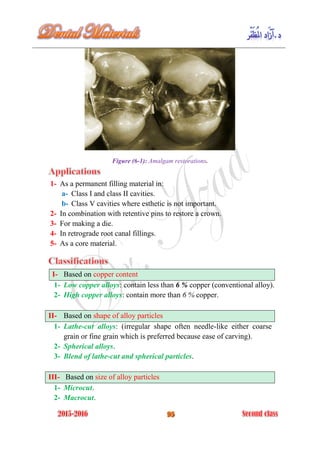
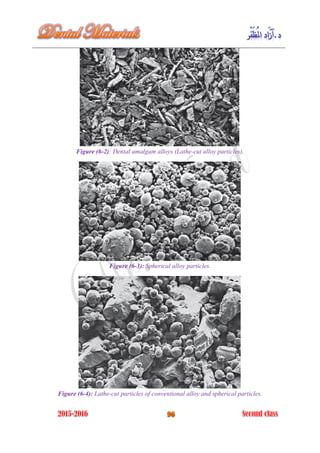
  • 58.
    Stability to heat:poly methyl methacrylate is chemically stable to heat up to a point. It softens at 125 °C. Thermal conductivity: they are poor conductors of heat and electricity. Coefficient of thermal expansion: acrylics have a high coefficient of thermal expansion. Heat cured acrylics have good color stability. Cold cured has lower color stability, due to oxidation of amine accelerator. Completely polymerized acrylic resins are biocompatible. True allergic reaction to acrylic resins is rarely seen in the oral cavity. Direct contact of the monomer over a period of time may provoke dermatitis. The highest residual monomer level is observed with cold cured acrylic. The adhesion of acrylic to metal and porcelain is poor, and mechanical retention is required. Adhesion to plastic denture teeth is good (chemical adhesion). Acrylic resins dispensed as powder/liquid have the best shelf life. The gel type has a lower shelf life and has to be stored in a refrigerator.
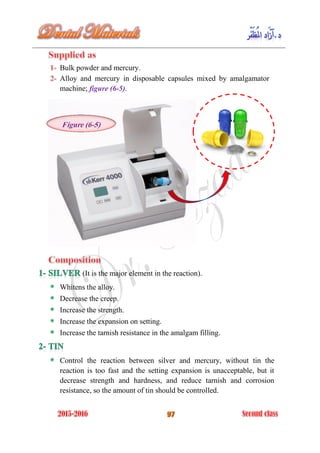
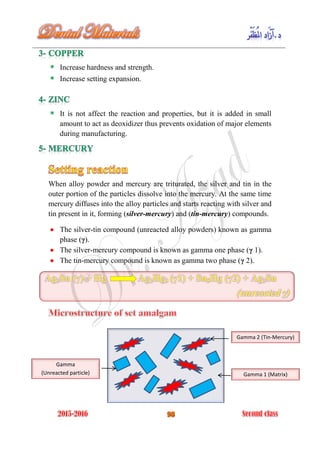
  • 59.
    Dental impression: Itis a negative record of tissue of the mouth. It is used to reproduce the form of the teeth and surrounding tissues. A positive reproduction is obtained by pouring dental stone or other suitable material into the impression and allowing it to harden. The positive reproduction of a single tooth is described as die, and when several teeth or a whole arch is reproduced, it is called cast or model. The impression material is carried to the mouth in a tray, which either stock tray or special tray. Accurate reproduction of surface details. A pleasant odor, taste, and esthetic color. Absence of toxic or irritant constituents. Adequate shelf life for requirements of storage and distribution. Reasonable cost. Easy to use with the minimum of equipment. Setting characteristics that meet clinical requirements. Satisfactory consistency and texture. Readily wets oral tissues. Elastic properties with freedom from permanent deformation after strain. Adequate strength so it will not break or tear on removal from the mouth. Dimensional stability over temperature and humidity ranges normally found in clinical and laboratory procedures for a period long enough to permit the production of a cast or die. Compatibility with cast and die materials. Readily disinfected without loss of accuracy. No release of gas during the setting of the impression or cast and die materials.
  • 60.
    They cannot engageundercuts, so their use is restricted to edentulous patient without undercut. a- Impression plaster. b- Impression compound. c- Zinc oxide eugenol. d- Impression wax. They can engage undercuts, and they may be used in edentulous, partially dentate, and fully dentate patients. : a- Reversible hydrocolloid (agar-agar). b- Irreversible hydrocolloid (alginate). a- Polysulfide. b- Silicone: - Condensation polymerizing silicone. - Addition polymerizing silicone. c- Polyether.
  • 61.
     Impression plaster. Zinc oxide eugenol.  Alginate.  Polysulfide.  Polyether.  Silicones.  Impression compound.  Impression wax.  Agar-agar. It is not compress tissue during seating of the impression.  Impression plaster.  Zinc oxide eugenol.  Alginate.  Agar-agar. 2- It compresses tissue during seating of impression, the material more viscous.  Impression compound. Material fairly viscous whilst under low stress conditions may become fluid during recording of impression.  Polysulfide.
  • 62.
    The material iscompatible with moisture and saliva.  Impression plaster.  Alginate.  Addition polymerizing silicone.  Polyether. Ability of material to repel saliva, a dry field is essential for such materials.  Polysulfide.  Condensation polymerizing silicone. It presents as powder mixed with water in water/powder ratio (W/P= 0.60), 100 g powder/60 ml water. 1- Calcium sulfate β-hemihydrate. 2- Potassium sulfate: to reduce expansion, and to accelerate the setting reaction. 3- Borax: to reduce the rate of setting. 4- Starch: to help disintegration of impression on separation from the plaster or stone cast.
  • 63.
    After cast hardening,the impression and cast are put in hot water. The starch swells and the impression disintegrates, making it easy to separate the cast from the impression. 1- Setting time (5 minutes). 2- The mixed material has a very low viscosity, so it is mucostatic. 3- It is hydrophilic. 4- It adapts to the soft tissue and recording their surface detail with great accuracy. 5- The dimensional stability is very good (a dimensional change during setting is 0.06 %). 6- A separating medium must be used between the impression plaster and the pouring plaster or stone. 7- The material is rigid once set, and thus unable to record undercuts. 8- Patient complains very dry sensation after having impression recorded because of water absorbing nature of this material. 9- The material is best used in a special tray, made from acrylic (1.5 mm spacer). 1- Final impression for completely edentulous arch. 2- Occlusal bite registration.
  • 64.
    Impression compound isdescribed as a rigid, reversible impression material which sets by physical changes. On applying heat, it softens and on cooling it hardens. They supplied as sheet, stick, and cake. Figure (4-1): (A) This shows examples of dental compound in the form of either cake or sheet or in the form of sticks. The slabs are used to make impressions of edentulous areas in the mouth whilst the sticks are used as tray extension materials or for extending special trays. (B) This shows a typical edentulous impression recorded in impression compound. Note the lack of any fine detail in this impression due to the very high viscosity of the material.
  • 65.
    1- Thermoplastic resins. 2-Wax. 3- Plasticizer: stearic acid: addition of plasticizer to overcome brittleness. 4- Filler: talc, calcium carbonate added to: a- Overcome tackiness. b- Control degree of flow. c- Minimize shrinkage due to thermal contraction. d- Improve rigidity of impression material.  Sheet form material: it is softened using water bath, a temperature in range (55-60 °C), knead the material after it has been heated in water to ensure its being at a uniform temperature. Storage in hot water should not be long that important constituents such as stearic acid may be leached out. Overheating make the compound sticky and difficult to handle.  Stick form material: it is softened over a flame. The compound should not be allowed to boil; otherwise, the plasticizers are volatilized. It is used to prepare a tray for making an impression. It is generally stiffer and has less flow than regular impression compound. 1- It is mucocompressive. 2- Because of high viscosity and low flow; therefore, the reproduction of surface detail is not very good. 3- It is not used to record the undercut, because it is rigid once cooled. 4- Poor dimensional stability. It has high value of coefficient of thermal expansion and undergoes considerable shrinkage on removal from the mouth. Also because pressure is applied during formation of an impression (mucocompressive), residual stress exists in cool impression, the gradual relief of internal stresses may cause distortion of impression (the cast should be poured as soon as possible or at least within the hour).
  • 66.
    5- Impression compoundhas low thermal conductivity, therefore, time must be allowed during heating or cooling to allow impression compound to come to uniform softening. 6- This material can be reused a number of times for the same patient only, in case of errors. 7- The material has sufficient body to support itself to an extent especially in the peripheral portions. 1- Difficult to record details because of its high viscosity. 2- Compress soft tissues while making impression. 3- Distortion due to its poor dimensional stability. 4- Difficult to remove it if there are severe undercuts. 5- There is always the possibility of overextension especially in the peripheral portions. 1- Type I sheet form: It is used for recording primary impression of edentulous ridges using stock tray. 2- Type I stick form: It is used for border molding of an acrylic special tray during fitting of the tray. 3- Type II tray compound: It is used to make a special tray (now largely replaced by acrylic tray).
  • 67.
    1- Cementing andinsulating medium. 2- Temporary filling. 3- Root canal filling material. 4- Surgical pack in periodontal surgical procedures. 5- Bite registration paste. 6- Temporary relining material for dentures. 7- Impression material for edentulous area. 1- Type I (Hard). 2- Type II (Soft). 1- Base paste (white in color). 2- Accelerator or reactor or catalyst paste (red in color). . Figure (4-2): This shows a typical example of impression paste materials. They consist of two pastes which are extruded out onto the mixing slab and mixed together by hand using a spatula. The main active ingredient of one paste is zinc oxide whilst the main active ingredient of the other paste is eugenol.
  • 68.
    Zinc oxide (reactivecomponent) (87%). Fixed vegetable or mineral oil (act as plasticizer, and aids in masking the action of eugenol as an irritant) (13%) Oil of cloves or eugenol (reactive component) (12%). Gum (speed the reaction) (50%). Filler (20%). Lanolin (3%). Resinous Balsam (improve flow and mixing properties) (10%). CaCl2 (accelerator solution) and coloring agent (5%). The setting reaction is a typical acid-base reaction to form a chelate. This reaction called chelation and the product is called zinc eugenolate. 1- ZnO + H2O Zn(OH)2 2- Zn(OH)2 + 2HE ZnE2 + 2H2O The set material consists of a matrix of amorphous zinc eugenolate surrounding and holds the unreacted zinc oxide particles. Initial setting time Final setting time Type I (Hard) 3-6 minutes 10 minutes Type (Soft) 3-6 minutes 15 minutes
  • 69.
    a- Particles sizeof zinc oxide powder: if the particle size is small, the setting time is less. b- By varying the lengths of the two pastes. c- By adding a drop of water, the setting time can be decreased. d- Longer the mixing time, shorter is the setting time. e- High atmospheric temperature and humidity decrease the setting time. f- Cooling the mixing slab, spatula increase the setting time. g- By adding a drop of oil or wax, the setting time can be increased. 2- It registers surface details accurately due to its good flow. 3- The material has mucostatic properties. 4- The material is rigid once set and cannot be used for making impression of teeth and undercut areas. 5- It requires a special tray for impression making; it has adequate adhesion to acrylic tray. 6- It is dimensionally stable, a negligible shrinkage (less than 0.1%) may occur during hardening. 7- No separating medium is required before the cast is poured because it does not stick to the cast material. 8- The paste tends to adhere to the skin, so the skin around the lips should be protected with Vaseline to make the cleaning process much easier. 9- Eugenol can cause burning sensation and tissue irritation. Non eugenol paste were developed, here the zinc oxide is reacted with a carboxylic acid. 10- It can be checked in the mouth repeatedly, and minor defects can be corrected locally without discarding a good impression. The mixing is done on oil impervious or glass slab. Equal length of base paste and catalyst paste squeezed on to mixing slab and mixed until a uniform color is observed. The mixing time is 1 minute.
  • 70.
    1- Final impressionof edentulous ridge. 2- Occlusal bite registration. Impression waxes are rarely used to record complete impression but are used to correct small imperfection in other impression. Waxes are generally used in combination with other impression materials These materials consist of a mixture of low melting paraffin wax and beeswax in ratio about 3:1. It may also contain metal particles. The flow at 37°C is 100 %. These waxes are subjected to distortion during removal from the mouth. They should be poured immediately. Waxes have larger coefficient of thermal expansion of any material used in restorative dentistry. 1- To make functional impression of free end saddles (class I and class II removable partial dentures). 2- To record posterior palatal seal in dentures. 3- Functional impression for obturators. Figure (4-3): This shows the two pastes of zinc oxide and eugenol being mixed together. Here we see the advantage of using pastes of different colors since it is possible to tell when proper mixing has been achieved. In this case there are still obvious streaks of the two individual pastes showing that mixing is incomplete
  • 71.
    The colloids areoften classed as the fourth state of matter known as colloidal state, they can exist in the form of viscous liquid known as a sol, or a jelly like elastic semi-solid described as a gel. If the particles are suspended in water, the suspension is called hydrocolloid. Hydrocolloid impression materials are based on the colloidal suspension of polysaccharide in water.  In sol form: There is random arrangement of polysaccharide chain.  In gel form: The long polysaccharide chains become aligned and material becomes viscous and develops elastic properties. Gelation: It is conversion of sol to gel. Based on the mode of gelation, they are classified as: 1- Set by lowering the temperature e.g. Agar. This makes them reusable. 2- Set by a chemical reaction. Once set it is usually permanent e.g. Alginate. Agar hydrocolloid was the first successful elastic impression material to be used in dentistry. It is an organic hydrophilic colloid extracted from certain types of seaweed. Although it is an excellent impression material and yields accurate impressions, presently it has been largely replaced by alginate hydrocolloid and rubber impression materials.
  • 72.
    1- For castduplication (during fabrication of cast metal removable partial denture). 2- For full mouth impressions without deep undercuts. 3- For crown and bridge impressions before elastomers came to the market. 4- As tissue conditioner. 1- Gel in collapsible tubes (for impressions with water cooled tray). 2- A number of cylinders in a glass jar (syringe material). 3- In bulk containers (for duplication).  Agar (12%)  Water (85%)  Borates (0.2%)  Potassium sulfate (1-2%)  Alkyl benzoate (0.1%)  Glycerin  Coloring and flavoring agents (traces) Colloid It acts as dispersion medium. To improve the strength of gel. To ensure proper setting of gypsum cast against agar (accelerator for cast material) Preservative. Thixotropic material (it acts as plasticizer). Agar hydrocolloid requires special equipment: 1- Hydrocolloid conditioner. 2- Water cooled rim lock tray. Agar is normally conditioned prior to use by specially designed conditioning bath (temperature controlled water bath). The conditioning bath consist of three compartments each hold at different temperature.
  • 73.
     The tubeof the gel converted to viscous liquid after 10 minutes in boiling water (100°C).  The sol should be homogenous and free of lumps.  Every time the material is reliquefied, 3 minutes should be added. This because it is more difficult to break down the agar brush heap structure after a previous use.  It should not be reheated more than 4 times.  65-68°C temperature is ideal when agar can be stored in the sol condition till needed.  46°C for about 2 minutes with material loaded in the tray, this is done to reduce the temperature so that it can be tolerated by the sensitive oral tissue. It also makes the material viscous. 100°C Liquefaction section (10 minutes) 65-68°C Storage section (10 minutes) 46°C Tempering section (2 minutes)
  • 74.
    The tray containingthe tempered material is removed from the bath. The outer surface of the agar sol is scraped off, then the water supply is connected to the tray and the tray is positioned in the mouth. Water is circulated at 18°C to 21°C through the tray until gelation occur, rapid cooling (ice cold water) is not recommended as it can induce distortion.
  • 75.
    Alginate was developedas a substitute for agar when it became scarce due to World War II (Japan was a prime source of agar). Currently, alginate is more popular than agar for dental impression, because it has many advantages. 1- Fast setting. 2- Normal setting. A powder that is packed in bulk container (sachets), a plastic scoop is supplied for dispensing the bulk powder, and a plastic cylinder, is supplied for measuring the water. 1- It is used for impression making.  When there are undercuts.  In mouth with excessive flow of saliva.  For partial dentures with clasps. 2- For making preliminary impression for complete denture. 3- For impression to make study models and working casts. 4- For duplicating models.
  • 76.
    1- Sodium orpotassium or triethanolamine alginate. 2- Calcium sulfate (reactor). 3- Zinc oxide. 4- Potassium titanium fluoride. 5- Diatomaceous earth. 6- Sodium phosphate (retarder). 7- Coloring and flavoring agents. 15 % 16 % 4 % 3 % 60 % 2 % traces Dissolves in water and reacts with calcium ions. Reacts with potassium alginate and forms insoluble calcium alginate. Acts as filler. Gypsum hardener. Acts as filler. Reacts preferentially with calcium sulfate. e.g. wintergreen, peppermint and anice, orange etc. Sodium alginate powder (soluble) dissolves in water to form a sol, that react with calcium sulfate (reactor) to form calcium alginate (insoluble gel); this reaction is too fast, there is not enough working time, so the reaction is delayed by addition of a retarder (sodium phosphate). Calcium sulfate reacts with the retarder first, after the supply of the retarder is over does calcium sulfate reacts with sodium alginate, this delays the reaction and ensures adequate working time for the dentist.
  • 77.
    1- Alginate hasa pleasant taste and small. 2- Its flexibility is about 14 % at a stress of 1000 gm/cm2 ; lower W/P ratio (thick mixes) results in lower flexibility. 3- Alginate is highly elastic, but less than agar. 4- The elastic recovery is 97.3 %, permanent deformation is less if the set impression is removed from the mouth quickly. 5- Detail reproduction is also lower when compared to agar. 6- Compressive strength is 5000-8000 gm/cm2 . 7- Tear strength is 350-700 mg/cm2 .  W/P ratio, too much or too little water reduces strength.  Mixing time, over and under mixing both reduce strength.  Time of removal of impression, strength increases if the time of removal is delayed for few minutes after setting. 8- Set alginate has poor dimensional stability due to evaporation, syneresis, and imbibition. The alginate impression should be poured immediately. If storage is unavoidable, keeping in a humid atmosphere of 100 % relative humidity (wrap with wet paper towel). Even under these conditions storage should not be done for more than 1 hour. 9- Alginate does not adhere well to the tray. Retention to the tray is achieved by mechanical locking in the tray (rim lock, perforated tray) or by adhesive. 10- The silica particles present in the dust of alginate powder are health hazard. 11- Shelf life and storage: Alginate material deteriorates rapidly at elevated temperature and humid environment.
  • 78.
    Mixing time: 45-60seconds. Working time: 1-2 minutes. Setting time (gelation time): 2-4 minutes.  Control gelation time 1- Gelation is best controlled by adding retarders. (Manufacturer's hands). 2- The dentist can best control the setting time by altering the temperature of the water; colder the water, longer is the setting time, even the mixing bowl and spatula can be cooled.  Test for set The alginate loses its tackiness and rebound fully when prodded with a blunt instrument; some alginate are available with (color indicator), which on mixing is one color and on setting change to a different color. 1- It is easy to mix and manipulate and need minimum equipment. 2- Flexibility of the set impression. 3- If properly handled, it gives accuracy and good surface details even in presence of saliva. 4- Low cost. 5- Comfortable to the patient. 6- It is hygienic. 1- It cannot be corrected. 2- Poor tear strength. 3- Distortion may occur without it being obvious if the material is not held steady while it is setting. 4- It cannot be stored for long time. 5- Because of the above drawbacks and because of availability of better materials it is not recommended when high level of accuracy is required e.g. cobalt chromium RPD, crown and bridge, etc.
  • 79.
    Figure (4-6): Sketchof tear strength specimen with load applied in the directions of the arrows; the specimen tear at the V-notch. TECHNICAL CONSIDERATIONS OF ALGINATE 1. Impression should not be exposed to air because some dehydration will occur and result in shrinkage. 2. Impression should be protected from dehydration by placing it in a humid atmosphere or wrapping it in a damp paper towel until a cast can be poured. To prevent volume change, this should be done within 15 minutes after removal of the impression from the mouth. 3. Impression should not be immersed in water or disinfectants, because some imbibition will occur, and result in expansion. 4. Exudate from hydrocolloid has a retarding effect on the chemical reaction of gypsum products and results in a chalky cast surface. This can be prevented by pouring the cast immediately. 5. When alginate is used, place the measured amount of water (at 18-20°C) in a clean, dry, rubber mixing bowl. Add the correct measure of powder. Stir rapidly against the side of the bowl with a short, stiff spatula. This should be accomplished in less than (1 minute). The patient should rinse his or her mouth with cool water to eliminate excess saliva while the impression material is being mixed and the tray is being loaded. 6- To prevent internal stresses in the finished impression, do not allow the tray to move during gelation (hold the tray immobile for 3 minutes). Do not remove the impression from the mouth until the impression material has completely set (releasing the surface tension). The stone cast should not be separated for at least 45 minutes; the cast should not be left in the alginate impression for too long a period because: 1- After setting the alginate can act as sponge, deprive stone from water result in a rough chalky surface. 2- Dried alginate becomes stiff, so removal of cast can break the teeth.
  • 80.
    In addition tothe hydrocolloids there is another group of elastic impression materials, they are soft rubber like and are known as elastomers, or synthetic rubbers, or rubber base, or rubber impression materials, or elastomeric impression materials. They are non-aqueous elastomeric dental impression materials. 1- Polysulfide. 2- Poly ether. 3- Silicon. a- Condensation polymerizing. b-Addition polymerizing. 1- Light body. 2- Medium or regular body. 3- Heavy body or tray consistency. 4- Very heavy or putty consistency. 1- Impressions of prepared teeth for fixed partial dentures. 2- Impression for removable partial dentures. 3- Impression of edentulous mouth for complete dentures. 4- Polyether is used for border molding of special tray. 5- For bite registration. 6- Silicon duplicating material is used for making refractory cast.  Regardless of type all elastomeric impression materials are supplied as two paste system (base and catalyst) in collapsible tubes.  Putty consistency is supplied in jar.
  • 81.
    This was firstelastomeric impression material to be introduced. It is also known as Mercaptan or Thiokol. 1- Light body. 2- Medium body. 3- Heavy body. 1- Liquid polysulfide polymer. (80-85 %). 2- Inert fillers (titanium dioxide, zinc sulfate, copper carbonate, or silica). (16-18 %). 1- Lead dioxide. (60-68 %). 2- Dibutyl phthalate (30- 35 %). 3- Sulfur. (3 %). 4- Other substances like (deodorant, and magnesium stearate (retarder) (2 %). Figure (4-7): Polysulfide impression material. The two pastes with contrasting colors are mixed together on a mixing pad with a metal spatula.
  • 82.
    1- Unpleasant odorand color. 2- It is extremely viscous and sticky, mixing is difficult. However, they exhibit pseudoplasticity. 3- It has long setting time (12 minutes). Heat and moisture accelerate the setting time. 4- Excellent reproduction of surface details. 5- It has highest permanent deformation (3-5 %) among the elastomers, so pouring of the cast should be delayed by half an hour. Further delay is avoided to minimize curing shrinkage, and shrinkage from loss of by-product (water). 6- It has high tear strength (4000 gm/cm2 ). 7- It has good flexibility and low hardness. 8- It is hydrophobic so the mouth should be dried thoroughly before making an impression. 1- Unpleasant odor. 2- Dirty staining. 3- High amount of effort required for mixing. 4- Long setting time. 5- High shrinkage on setting. 6- High permanent deformation.
  • 83.
    These materials weredeveloped to overcome some of the disadvantages of polysulfide. This was the earlier of the two silicone impression materials. It is also known as conventional silicone. 1- Light body. 2- Putty consistency. 1- Polydimethyl siloxane. 2- Colloidal silica or metal oxide fillers (35-75 %) depending on viscosity. 3- Color pigments. 1- Stannous octoate (catalyst). 2- Orthoethyl silicate (cross linking agent). 1- Pleasant color and odor. 2- Setting time is 8-9 minutes. 3- Excellent reproduction of surface details. 4- Dimensional stability is comparatively less because of the high polymerizing shrinkage, and shrinkage from loss of by-product (ethyl alcohol). The cast should be poured immediately, the permanent deformation is also high (1-3 %). 5- The tear strength is lower than polysulfide (3000 gm/cm2 ). 6- It is stiffer and harder than polysulfide, care should be taken while removing the stone cast from the impression to avoid any breakage. 7- It is hydrophobic. 8- Direct skin contact should be avoided to prevent any allergic reactions.
  • 84.
    They were introducedlater. It has better properties than condensation silicone. It is also known as polyvinyl siloxane. 1- Light body. 2- Medium body. 3- Heavy body. 4- Putty consistency. 1- Poly methyl hydrogen siloxane. 2- Other siloxane prepolymers. 3- Fillers. 1- Divinyl polysiloxane. 2- Other siloxane prepolymers. 3- Platinum salt (catalyst). 4- Palladium (hydrogen absorber). 5- Retarders. 6- Fillers. 1- Pleasant color and odor. 2- Direct skin contact should be avoided to prevent any allergic reactions. 3- Excellent reproduction of surface details. 4- Setting time is 5-9 minutes. 5- It has the best dimensional stability among the elastomers. It has low polymerizing shrinkage, and the lowest permanent deformation (0.05- 0.3 %). The cast pouring should be delayed by 1-2 hours; because of hydrogen gas is liberated during polymerization, air bubbles will result.
  • 85.
    6- It hydrophobic,so similar care should be taken while making the impression and pouring the wet stone. Some manufactures add a surfactant (detergent) to make it more hydrophilic. 7- It has low flexibility and it harder than polysulfide; care should be taken while removing the stone cast from the impression to avoid any breakage. Polyether was introduced in the 1970. It has good mechanical properties and dimensional stability. 1- Light body. 2- Medium body. 3- Heavy body. Figure (4-8): Section of an impression in which heavy body (A), and light body (B) materials have been used to obtain optimal accuracy and dimensional stability. Figure (7-9): Polyether impression material. The two pastes have been extruded on to the mixing pad ready for mixing using a metal blade spatula.
  • 86.
    1- Polyether polymer. 2-Colloidal silica (filler). 3- Glycol ether or phthalate (plasticizer). 1- Aromatic sulfonate ester (cross-linking agent). 2- Colloidal silica (filler). 3- Phthalate or glycolether (plasticizer). 1- Pleasant color and odor. 2- The sulfonic ester may cause skin reaction; direct skin contact should be avoided. 3- Setting time is around (8 minutes), heat decrease setting time. 4- Dimensional stability is very good. Polymerizing shrinkage is low. The permanent deformation is low (1-2 %). The impression should not be stored in water or in humid climate, because polyethers absorb water and can change dimension. 5- It is extremely stiff (flexibility 3 %). Its hardness is higher than polysulfide and increase with time; care should be taken while removing the stone cast from the impression to avoid any breakage. 6- The tear strength is good (3000 gm/cm2 ). 7- It is hydrophilic, so moisture in the impression field is not so critical. It has the best compatibility with stone. 1- The working time was short. 2- The material was very stiff. 3- It is expensive.
  • 87.
    1- Impressions areusually made in special trays. Perforated stock trays are used only for making impression in putty consistency. 2- The spacing given is between 2-4 mm. 3- Elastomers do not adhere well to the tray. An adhesive should be applied onto the tray and allowed to dry before making impression. 4- The bulk of the impression should be made with a heavier consistency (to reduce shrinkage), light body should only be used in a thin layer as a wash impression.  Tray used: spaced special tray.  Viscosity used: regular body only. Method The paste is mixed and material is loaded onto the tray, the tray with material is seated over the impression area, the material is allowed to set.  Tray used: spaced special tray.  Viscosity used: (a) heavy body and (b) light body. Method The two viscosities are mixed simultaneously but on separate pads. The heavy body is loaded onto the tray while the light body is loaded into the syringe. The syringe material is injected onto the area of impression. The tray containing the heavy body if then seated over it. Both materials set together to produce a single impression.
  • 88.
     Tray used:perforated stock tray.  Viscosity used: (a) putty (b) light body. Method First a primary impression is made with putty in the stock tray. After setting it is kept aside. Light body is mixed and spread into the putty impression. The primary impression is then seated over the impression area and held till it is set. 1- More uniform mix. 2- Less air bubbles incorporated in mix. 3- Reduced working time. Figure (4-10): Addition silicone impression materials packaged with auto-mixed cartridges, mixing gun, and static mixing tips, and dynamic mechanical mixer.
  • 89.
    Figure (4-11): Thebulk packaging of an elastomeric impression material. The pastes are extruded through the mixing nozzle using an electrically powered motor inside the device. The mixed material can be extruded directly into an impression tray which is held underneath the nozzle. The nozzle itself is disposable and is replaced with a fresh nozzle for each individual mix. Figure (4-12): Top left, impression tray containing elastomeric impression is seated too late as elasticity starts to develop. Top right, increased seating pressure is applied to overcome the stiffness of impression material. Lower left, distortion develops because of recovery of excessive elastic deformation. Lower right, the die produced in the distorted (inaccurate) impression is too narrow and too short.
  • 90.
    It is ametal containing two or more elements, at least one of which is metal, and all of which are mutually soluble in the molten state. : They are materials resist corrosion in the mouth. (gold, platinum, palladium, silver, rhodium, ruthenium, iridium, osmium). : This term indicates the intrinsic value of the metal. The eight noble metals are also precious metal, but all precious metals are not noble. : Pure gold is soft, ductile, yellow hue. The density is 19.3 gm/cm3 , melting point is 1063°C, good chemical stability, not corrode and not tarnish. : Whitest metal, its density is 10.4 gm/cm3 , melting point is 961°C. : Its density is 12.02 gm/cm3 , melting point is 1552°C. : its density is 21.65 gm/cm3 , melting point is 1769°C. : These are not noble metals, (chromium, cobalt, nickel, copper,…..etc). They are important components of dental casting alloy because: a- Their influence on physical properties. b-Control of the amount and type of oxidation. c- Their strengthening effect.
  • 91.
     Type I:soft.  Type II: medium.  Type III: hard.  Type IV: extra-hard. 1- Binary (2 elements). 2- Ternary (3 elements). 3- Quaternary (4 elements). 1- Alloys for all metal; metal with resin veneer restorations. 2- Alloys for metal ceramic restorations. 3- Alloy for removable dentures. 1- It should not tarnish and corrode in the mouth. 2- It should strong. 3- Biocompatible (non-toxic, non-allergic). 4- It should be easy to fabricate (melt, cast, cut, and grind). 5- It should flow well, and duplicate fine details during casting. 6- It should have minimal shrinkage on cooling after casting. 7- It should easy to solder.
  • 92.
    Alloys for allmetal restorations 1- Gold alloys (composed of gold, copper, silver, platinum, palladium, and other additives). 2- Silver-palladium alloys. 3- Nickel-chromium alloys. 4- Cobalt-chromium alloys. Alloys for metal ceramic restorations 1- Gold-palladium-platinum alloys. 2- Palladium-silver alloys. Cheap 3- Nickel-chromium alloys. Figure (5-1): Cutaways of all- ceramic crown (left) and porcelain fused to metal crown (right).
  • 93.
    HOW DOES PORCELAINBOND TO THE ALLOY? Ceramic adheres to metal primarily by chemical bond. A covalent bond is established by sharing 02 in the elements in the porcelain and the metal alloy. These elements include silicon dioxide (Si02 in the porcelain and oxidizing elements such as silicon, indium, and iridium in the metal alloy. Alloys for removable dentures 8- It should be light weight. 9- It should have high stiffness (to make the framework thin). 10- It should have good fatigue resistance. 11- It should not react to commercial denture cleanser. 12- Economical consideration. Alloy used: a- Cobalt (to give hardness, strength, rigidity). b- Chromium (to ensure corrosion resistance by passivating effect). c- Nickel (to decrease fusion temperature and increase ductility). d- Molybdenum or tungsten (to increase hardness). e- Iron and copper (to increase hardness). f- Manganese and silicon (to prevent oxidation). g- Boron (to increase hardness and deoxidizer). h- Carbon (to strengthen the alloy). a- Nickel. b- Chromium. c- Molybdenum. d- Other minor additions like aluminum, iron, silicon, copper, manganese, tin. The function of each ingredient is discussed previously
  • 94.
    Filling materials areused to replace missing parts of the tooth. 1- Dental caries. 2- Trauma. 3- Abrasion. Parts of teeth which require replacement by restorative materials vary in size of cavity, shape, and location in the mouth; no single restorative material is suitable for all cases. For some situations, the strength and abrasion resistance of material may be the prime consideration, in other situation appearance and adhesive properties may become more important. 1- Working time should be sufficiently long, to enable manipulation and placement of material before setting. 2- Setting time should be short for comfort of both the patient and clinician. 3- The material must withstand large variation in pH and a variety of solvents which may be taken into mouth in drink food stuffs and medicaments. 4- Metallic materials should not undergo excessive corrosion, or be involve in the development of electrical currents which may cause "Galvanic pain". 5- Filling should be good thermal insulator, protecting the dental pulp from the harmful effect of the hot and cold stimuli (low thermal diffusivity). 6- Materials should have values of coefficient of thermal expansion similar to those of enamel and dentin. 7- Materials should have satisfactory mechanical properties to withstand the force applied, e.g. abrasion resistance, compression and tensile strength, modulus of elasticity. 8- They should adhere well to the tooth walls and seal the margin prevent ingress of fluid and bacteria. Also reduces the amount of cavity preparation required in order to achieve retention of the filling. 9- They should be harmless to the operator and to the patient and should not irritant to dental pulp and soft tissue. 10- Easily polished. 11- Should be bacteriostatic and anticariogenic. 12- It should be radiopaque to diagnose the marginal caries.
  • 95.
     Amalgam.  Directgold filling.  Polymeric o Filled resin (composite). o Unfilled resin (acrylic).  Non-polymeric: o Silicate cement. o Glass ionomer cement.  Silicate cement.  Acrylic.  Composite. It is a special type of alloy in which mercury is one of the components. Mercury is able to react with other metals to form a plastic mass, which is conveniently packed into a prepared cavity in a tooth, and then this mass is hardened. It is the most widely used filling material for posterior teeth.
  • 96.
    Figure (6-1): Amalgamrestorations. 1- As a permanent filling material in: a- Class I and class II cavities. b- Class V cavities where esthetic is not important. 2- In combination with retentive pins to restore a crown. 3- For making a die. 4- In retrograde root canal fillings. 5- As a core material. I- Based on copper content 1- Low copper alloys: contain less than 6 % copper (conventional alloy). 2- High copper alloys: contain more than 6 % copper. II- Based on shape of alloy particles 1- Lathe-cut alloys: (irregular shape often needle-like either coarse grain or fine grain which is preferred because ease of carving). 2- Spherical alloys. 3- Blend of lathe-cut and spherical particles. III- Based on size of alloy particles 1- Microcut. 2- Macrocut.
  • 97.
    Figure (6-2): Dentalamalgam alloys (Lathe-cut alloy particles). Figure (6-3): Spherical alloy particles. Figure (6-4): Lathe-cut particles of conventional alloy and spherical particles.
  • 98.
    Bulk powder andmercury. Alloy and mercury in disposable capsules mixed by amalgamator machine; figure (6-5). (It is the major element in the reaction). Whitens the alloy. Decrease the creep. Increase the strength. Increase the expansion on setting. Increase the tarnish resistance in the amalgam filling. Control the reaction between silver and mercury, without tin the reaction is too fast and the setting expansion is unacceptable, but it decrease strength and hardness, and reduce tarnish and corrosion resistance, so the amount of tin should be controlled. Figure (6-5)
  • 99.
    Increase hardness andstrength. Increase setting expansion. It is not affect the reaction and properties, but it is added in small amount to act as deoxidizer thus prevents oxidation of major elements during manufacturing. When alloy powder and mercury are triturated, the silver and tin in the outer portion of the particles dissolve into the mercury. At the same time mercury diffuses into the alloy particles and starts reacting with silver and tin present in it, forming (silver-mercury) and (tin-mercury) compounds.  The silver-tin compound (unreacted alloy powders) known as gamma phase (γ).  The silver-mercury compound is known as gamma one phase (γ 1).  The tin-mercury compound is known as gamma two phase (γ 2). Gamma (Unreacted particle) Gamma 2 (Tin-Mercury) Gamma 1 (Matrix)
  • 100.
    Microleakage: With age theamalgam has self-sealing property that decreases the microleakage due to the corrosion products that forms in the tooth- restoration interface. Effect of moisture contamination (delayed expansion): If a zinc-containing amalgam is contaminated by moisture during condensation large expansion can take place. It usually starts after 3-5 days and may continue for months. It may reach 4 % that produce pressure on the pulp and cause post-operative sensitivity. Figure (6-7): An occlusal amalgam filling which has caused the tooth to crack. The most likely cause of this cracking is the expansion of the amalgam during or shortly after setting. Effect of trituration: Under- and over-trituration will decrease the strength.
  • 101.
    Effect of mercurycontent:  Low mercury in mixing lead to dry, granular mix resulting in rough pitted surface that invites corrosion.  High mercury can produce a marked reduction in strength. Effect of condensation: Higher condensation pressure results in higher compressive strength this happen only in lathe-cut alloys. The condensation will decrease porosity, and remove excess mercury from lathe-cut amalgam. If heavy pressure is used in spherical amalgam, the condensation will punch through. However, spherical amalgam condensed with lighter pressure produces adequate strength. Effect of cavity design:  Should be designed to reduce tensile stresses.  The cavity should have adequate depth, because amalgam has strength in bulk. Creep value: Creep is related to marginal breakdown.  Low-copper amalgam 0.8-8 %.  High- copper amalgam 0.4-1 %. Figure (6-8): Creep of amalgam causes the formation of unsupported edges which can fracture. Amalgam does not adhere to tooth structure, so retention is obtained through mechanical locking.
  • 102.
    Amalgam restorations oftentarnish and corrode in the mouth. This corrosion can be reduced by:  Smoothing and polishing the restoration.  Correct Hg/alloy ratio and proper manipulation.  Avoid dissimilar metals including mixing of high, and low copper amalgams. Reasonably easy to insert. Maintains anatomic form well. Has adequate resistance to fracture. After a period of time prevents marginal leakage. Cheap. Have long service life. The color does not match tooth structure. Brittle. Corrosion and galvanic action. They eventually show marginal breakdown. They do not bond to tooth structure. Risk of mercury toxicity. Mercury is toxic, free mercury should not be sprayed or exposed to the atmosphere. This hazard can arise during trituration, condensation, and finishing, and also during the removal of old restorations at high speed. Avoid mercury vapors inhalation and skin contact with mercury as it can be absorbed.
  • 103.
    Approximately 80 %of the mercury vapor will be absorbed in the lungs, and 5–10 % of the mercury (saliva) will be resorbed in the gastrointestinal tract. The hypothesized intake of mercury via oral mucosa or dental pulp, however, seems to be negligible. There are no scientific studies that show that having dental amalgams is harmful, or that removing your amalgam fillings will improve your health. (U.S. Food and Drug Administration, consumer information, October 2006) It has been determined that the dental amalgam fillings do not pose a health risk, although they do account for some mercury exposure to those having such fillings. Mercury has a cumulative toxic effect. Dentists are at high risk. Through it can be absorbed by skin or by ingestion; the primary risk is from inhalation. Mercury accumulates in the kidneys. If the dose exceeds the capacity limit, direct toxic damage of the proximal renal tubules. The target organ of prime concern is the central nervous system. Tremor and psychological disturbances (erethism) are classical symptoms of a chronic mercury intoxication caused by extensive occupational exposure. Erethism is characterized by acute irritability, abnormal shyness, timidity, and overreaction to criticism. Disturbance of memory, loss of appetite, depression, fatigue, and weakness may also occur. Further symptoms of chronic intoxication with inorganic mercury are decreased nerve conduction velocity and gastrointestinal disturbances. Oral symptoms, including metallic taste, swollen salivary glands, disturbed salivation, severe gingivitis, mucosal ulcerations, necrosis, and even tooth loss have also been reported. Clinical symptoms of mercury poisoning that may be found in heavily exposed persons.
  • 104.
    The clinic shouldbe well ventilated. The mercury should be stored in well-sealed container. Amalgam scrap and materials contaminated with mercury or amalgam should not be subject to heat sterilization. Vacuum cleansers are not used because they disperse the mercury. Skin contacted with mercury should be washed with soap and water. While removing the old fillings, a water spray, mouth mask, and suction should be used. The use of ultrasonic amalgam condenser is not recommended as a spray of small mercury droplets is observed. If the mercury contact the gold jewelry the mercury bonds permanently to the gold and ruins, but boiling it in coconut oil can fix it. Annually, a (programme for handling toxic materials) is monitored for actual exposure levels. It is pulpal irritation due to low pH (5-3.5). Brittle and has weak mechanical properties. Shrinkage on setting. High solubility and disintegration. Unfilled acrylic polymer where introduced about 1945 and were improved so that they were in moderate usage in the 1960s. The unfilled acrylic material possessed improved resistance to solubility and has no problems with dehydration, although staining was a problem. The undesirable qualities of unfilled acrylics were large dimensional change on setting and with temperature, resulting in percolation of saliva at margins; low mechanical strength and stiffness; low resistance to wear; and recurrent decay.
  • 105.
    The term compositematerial may be defined as a compound of two or more distinctly different materials with properties that are superior or intermediate to those of the individual constituents. Composite is polymeric filling material reinforced with filler particles. It was developed in 1962s to overcome the disadvantages in physical and mechanical properties of acrylic filling and of silicate cement. It is most popular anterior filling material. Nowadays, composite is used as anterior and posterior filling materials. Bisphenol -A- glycidyl methacrylate monomer (Bis-GMA) or urethane dimethacrylate. Bis-GMA monomer is most commonly used. Its properties were superior to those of acrylic resins. It has a high viscosity which required the use of diluent monomers. The commonly used diluents monomer is tetraethyl glycol dimethacrylate (TEGDMA). Types of filler They are obtained by grinding or milling the quartz. They are mainly used in conventional composites. They are chemically inert and very hard. This make restoration more difficult to polish and can cause abrasion of opposing teeth and restoration. They are microfiller; added in small amount (5 wt %) to modify the paste viscosity. Colloidal silica particles have large surface area thus even small amount of microfiller thicken the resin. In microfilled composites, it is only inorganic filler used.
  • 106.
    These filler provideradiopacity to resin restoration. Its refractive index is 1.5 e.g. barium, zirconium, and strontium glasses. The most commonly used is barium glass. It is not as inert as quartz some barium may leach out. As less resin is present, the curing shrinkage is reduced. Reduced water sorption and coefficient of thermal expansion. Improves mechanical properties like strength, stiffness, hardness, and abrasion resistance. Amount of filler added.a- Size of particles and its distributionb- In order to increase the amount of filler in the resin, it is necessary to add the filler in a range of particles size. If a single particle size is used, a space will exist between particles, smaller particles can then fill up these spaces. Index of refractionc- For esthetic, the filler should have a translucency similar to tooth structure. To achieve this, the refractive index of filler should closely match that of the resin. Most glass and quartz filler have a refractive index 1.5, which much than that of bis-GMA. Its hardnessd- Radiopacitye- Coupling agents bond the filler particles to the resin matrix. This allows the more plastic resin matrix to transfer stress to stiffer filler particles. The most commonly used coupling agent is organosilane.
  • 107.
    They improve thephysical and mechanical properties of resin. Prevent the filler from being dislodged from the resin matrix. They prevent water from penetrating the filler-resin interface, microleakage of fluids into filler-resin interface led to surface staining. Hydroquinone acts as inhibitor to prevent premature polymerization. UV-absorber adds to improve color stability. Opacifiers like titanium dioxide and aluminum oxide. Color pigments add to match tooth color. This is two paste systems  : contains benzoyl peroxide initiator.  : tertiary amine activator. When two pastes are spatulated the amine reacts with the benzoyl peroxide to form free radical which starts the polymerization. Figure (6-9): Atypical two paste composite material. Approximately equal amounts of two pastes are taken out of the containers using a plastic spatula and then they are mixed together on a paper pad.
  • 108.
    The earliest systemused, but it is not used nowadays. a- Limited penetration of the light into the resin. b- Lack of penetration through tooth structure. c- Irritant to the soft tissue. These totally replaced the UV-light system. They are widely used than the chemically activated resins. These are single paste system containing:  Photo-initiator (Camphoroquinone 0.25 wt %).  Amine accelerator: diethyl-amino-ethyl-methacrylate (DEAEMA) 0.15 wt %. Under normal light they don’t interact. However, when exposed to light of the correct wave length the photo-initiator is activated and reacts with amine to form free radical. Camphoroquinone has an absorption range between 400-800 nm. This is in the blue region of visible light spectrum. In some cases inhibitors are added to enhance its ability to room light or dental operatory light. Required light of correct wave length for its activation. Cure only where sufficient intensity of light is received. Working time under control of operator. Supplied as single component in light tight syringe. Less chance of air entrapment during manipulation, more homogenous mix. Activated by peroxide-amine system. Cures throughout its bulk. Working time is limited. Supplied as two component system. Air may get incorporated during mixing resulting in reduction of properties.
  • 109.
    Figure (6-10): Thisshows the three most common means of supplying composite filling materials. On the left we have the two paste chemically activated materials supplied in pots. In the middle we see the syringe format and on the right we see capsule format. Both the syringe and capsule format are used for light- activated materials. Figure (6-11): Visible-light source for photo-initiation of light activated restorative materials.
  • 110.
    Ground quartz ismost commonly used as filler. There is a wide distribution of particle size. Average size 8-12 μm, particles as large as 50-100 μm is also be present. Filler loading is 70-80 wt % or 50-60 vol %. The conventional composite have improved properties compared to unfilled restorative resin, it has more compressive strength, tensile strength, elastic modulus, and hardness, and it has less water sorption and coefficient of thermal expansion. Although the conventional composites were superior to unfilled resin, but they had certain Polishing was difficult and results in a rough surface. This is due to selective wear of the softer resin matrix leaving the hard filler particles elevated. Poor resistance to occlusal wear. Tendency to discolor, the rough surface tends to stain. Small particles composite were introduced in an attempt to have good surface smoothness (like microfilled composite) and improve the physical and mechanical properties of conventional composite. The small particles composite use fillers that have been ground to smaller size. Glass containing heavy metals. Ground quartz. Colloidal silica is added in small amount 5 wt % to adjust the paste viscosity. The average fillers size is 1-5 μm; however the distribution is fairly broad (it helps to increase the filler loading). The filler content is 65-77 vol % or 80-90 wt %.
  • 111.
    Due to thehigher filler content the best physical and mechanical properties are observed with this type. Due to their improved strength and abrasion resistance they can be used in areas of stress such as class II and class III restorations. Some of the products have reasonably smooth surface for anterior are still not as good as the microfilled and hybrid composite in this regard. Composites containing heavy metal glasses as filler are radiopaque. They were developed to overcome the problems of surface roughness of conventional composites. The resin achieved the smoothness of unfilled acrylic direct filling resins and yet had advantages of having filler. The smoother surface is due to the incorporation of microfillers. Colloidal silica is used as microfiller. The problem with colloidal silica was that it had a larger surface area that could not be adequately wetted by matrix resin. Thus addition even small amounts of microfiller result in thickening of the resin matrix. Thus it was not possible to achieve the same filler loading as conventional composite. : with the inclusion of prepolymerized fillers, the filler content is 80 wt % or 70 vol %. However, the actual inorganic content is only 50 wt %. With exception of compress strength their mechanical properties are inferior to other type. This is because of their higher resin content (50 vol %). Their biggest advantage is their esthetic. The microfilled composite is the resin of choice for esthetics restoration of anterior teeth, especially in non-stress bearing area. In stress bearing situation like class IV and class II restoration, they have a greater potential for fracture.
  • 112.
    The nanofilled compositesare technically just a category of microfilled composite, the diameter of filler is less than 100 nanometers (nm), Nanofilled composites are the newest addition to the composite filling materials. They are becoming popular among dentists because they are advertised to have superior esthetic and wear characteristics, high polishability, and superior handling characteristics. The individual nano-particles fill in the spaces between the micro particles. These were developed so as to obtain better surface smoothness than that of small particles, but yet maintain the properties of latter. The hybrid composites have a surface smoothness and esthetics competitive with microfilled composite for anterior restoration. Colloidal silica: present in a higher concentration 10-20 wt % and contributes significantly to the properties. Heavy metal glasses: average particles size is 0.6-1 μm. 75 % of ground particles are smaller than 1 μm. : 70-80 wt % or 50-60 vol %, the overall filler loading is not as high as small particle composition. The particles size range between conventional and small particle. They are generally superior to microfilled composite. The hybrid composites are widely used for anterior restorations, including class IV, because of its smooth surface and good strength. The hybrid are also being widely employed for stress bearing restoration, even though its mechanical properties are somewhat inferior to small particle composites.
  • 113.
    Low-viscosity, high-flow compositesmarketed as flowable composites are advocated for a wide variety of applications, such as preventive resin restorations, cavity liners, restoration repairs, and cervical restorations. These applications are not well supported with data, but their clinical use is widespread. Figure (6-12): two dimensional diagrams of composites with (A) fine and (B) Microfine particles Figure (6-13): Flowable composite
  • 114.
    It should benon-toxic, and non-irritant to pulp and tissue. It should be insoluble in saliva and liquid. Mechanical properties must meet the requirements for their particular application. Protection of the pulp:  Thermal insulation.  Chemical protection.  Electrical insulation. Optical properties. Cements should be adhesive to tooth structures and restorations, but not to dental instruments. Should be bacteriostatic. Should have soothing effect on the pulp. The luting cement should have low viscosity to give a low film thickness. Figure (6-14): Shrinkage of a filling material during polymerization can potentially cause the formation of a marginal gap. This may seriously compromise the long term viability of the restored tooth; top freshly placed restoration before polymerization. Bottom after polymerization, illustration the formation of a gap.
  • 115.
    It has asedative effect on exposed dentin. It is the least irritating of all dental cements. It has reasonable sealing of the cavity. It is the cement of low strength, low abrasive resistance, and low flow after setting, so placement of zinc oxide eugenol temporary filling should not be more than few days, maximum few weeks. The strength and abrasive resistance could be improved by adding 20-40 % weight of fine polymer particles and treating the surface of zinc oxide particles with carboxylic acid (reinforced zinc oxide eugenol type). Sufficient powder should be added to the liquid to achieve putty consistency. It is the material of choice as temporary filling. Zinc oxide (principal ingredient). Zinc stearate (accelerator, plasticizer). Zinc acetate (accelerator, improve strength). White rosin (to reduce brittleness of set cement). Eugenol (react with zinc oxide). Olive oil (plasticizer). 4-10 minutes (zinc oxide eugenol cement sets quickly in the mouth due to moisture and heat). (4/1 to 6/1 by weight). 1- Particle size: smaller particles set faster. 2- Heat: cool the glass slab slows the reaction. 3- Powder /liquid ratio: higher the ratio, faster the setting reaction. 4- Water acts as accelerator. 5- Glycerin acts as retarder.
  • 116.
    Luting of restorations(cementation). High strength bases. Temporary restoration. Luting of orthodontic bands. 1- Has higher strength and abrasive resistance than zinc oxide eugenol, and has a relatively low solubility in oral fluids, but still has low abrasive resistance in area subjected to high load of mastication. 2- Higher powder/ liquid ratio is required for low acidity and high strength. 3- Reinforced zinc phosphate is more durable and could be used when longer time for temporary filling is required. Zinc oxide (principal constituent). Magnesium oxide (aids in sintering). Calcium oxide (improves smoothness of mix). Silica (filler). Phosphoric acid (react with zinc oxide). Water (control rate of reaction). Aluminum phosphate (buffers, to reduce rate of reaction). Aluminum (cohesive). 15 seconds (maximum 1 minute). 5-9 minutes.
  • 117.
    Temperature: higher temperaturewill accelerate the reaction. Powder/liquid ratio: (1.4 g/0.5 ml) more the liquid, slower the reaction. Rate of addition of powder is incorporated slowly. Mixing time: the longer mixing time (within practical limits), the slower is the rate of reaction. They are adhesive teeth colored anticariogenic cements. It was named glass ionomer because, the powder is glass and the setting reaction and adhesive bonding to tooth structure is due to ionic bond. Anterior esthetic restorative material for class III cavities. For eroded areas and class V restorations. As luting agent. As liners and bases. It is not recommended for class II and class IV restorations, since they lack fracture toughness and are susceptible to wear.
  • 118.
    Silica. Alumina (Al2O3). Aluminum florid(AlF3). Calcium florid (CaF2). Act as ceramic flux. Sodium florid (NaF). Aluminum phosphate (AlPo4). Barium (provide radiopacity). Polyacrylic acid (increase reaction, decrease viscosity). Tartaric acid (increase working time). Water (it is the medium of reaction and it hydrates the reaction products). 5-7 minutes. Conditioning of the tooth surface. Proper manipulation. Protection of cement during setting. Finishing. Figure (7-2): diagrammatic illustration of the setting of glass ionomer cement
  • 119.
    This cement containstwo main reactive ingredients, zinc oxide and polyacrylic acid and both are in the powder; the bottle is filled with water by the dentist. Powder and water are dispensed onto the mixing pad and mixed with a spatula. In other products the powder contains only the zinc oxide and the liquid is an aqueous solution of polyacid. Primary for luting permanent restorations. As liners and bases. Used in cementation of orthodontic bands. Also used as root canal fillings in endodontics. Zinc oxide (basic ingredient). Magnesium oxide (modifier). Stannous fluoride (increase strength; anticariogenic). Polyacrylic acid. Unsaturated carboxylic acid (iticonic acid, maleic acid). 30-40 seconds. 7-9 minutes (can be increased by cooling the glass slab). 1.5 powder: 1 liquid by weight. Figure (7-3): Polycarboxylate cement.
  • 120.
    A chemically activeresin luting cement which is used to bond laboratory made dental appliances and restorations to teeth. Resin matrix. Inorganic fillers. Coupling agent. Chemical or photo initiators and activators. Chemically by peroxide-amine system. By light activation. Dual cure (by both chemical and light activation). Etching the restoration. Etching the tooth surface. Cementing the restoration. Cementation of crowns and bridges (etched cast restorations). Cementation of porcelain veneers and inlay. For bonding of orthodontic brackets to acid etched enamel.
  • 121.
    This material isprovided as two pastes. Approximately equal amounts of each paste are dispensed onto the mixing pad and mixed with a spatula. One of the active ingredients is a salicylate compound which has a very distinctive ‘medicated’ odor. Direct and indirect pulp capping. As bases beneath composite restoration for pulp protection. Apexification procedure in young permanent teeth where root formation is incomplete. Glycol salicylate (react with CaOH2). Titanium dioxide (inert filler, pigment). Barium sulfate (radiopacity). Calcium sulfate. Zinc oxide. Zinc stearate (accelerator). Sulfonamide (oily compound act as carrier). Ethylene toluene.
  • 122.
    2.5-5.5 minutes. The reactionis accelerated by moisture and accelerators. It therefore sets fast in the oral cavity. The cement is alkaline in nature. The high pH is due to the presence of free CaOH2 in the set cement. The pH ranges from (9.2 to 11.7). The high alkaline and antibacterial and protein lysing effect helps in the formation of reparative dentin. Equal length of the two pastes are dispensed on a paper and mixed to a uniform color, then use dycal applicator (a ball ended instrument) to carry the mixed material and apply to deep area of the cavity or directly over mildly exposed pulp (contraindicated if there is active bleeding). A cavity liner and cavity varnish is used to provide a barrier against the passage of irritants from cements or other restorative materials and to reduce the sensitivity of freshly cut dentin, and to reduce microleakage. It is a suspension of calcium hydroxide in a volatile solvent upon the evaporation of the solvent, the liner form a thin film on the prepared tooth surface. A variety of formulation e.g. glass ionomer cement liner, zinc oxide eugenol liner. Supplied as solution, powder and liquid, or light cured paste in tube. It is a solution of one or more resins which applied onto the cavity wall, evaporates leaving a thin resin film, that serve as a barrier between the restoration and the dentinal tubules. Supplied as liquid in dark colored tightly capped bottles.
  • 123.
    Fluoride was documentedas a chemotherapeutic measure providing resistance in tooth enamel to in vivo demineralization. Fluoride can also be provided systemically as a dietary supplement to inhibit caries where drinking water is not fluoridated. For patients who are at high risk for the development of caries in spite of systemic fluoride administration, various means of topical application have been developed to increase caries protection, such as tooth pastes, mouth rinses, gels, and varnishes. The major function of toothpaste is to enhance cleaning of the exposed tooth surfaces and removal of pellicle, plaque, and debris left from salivary deposits and the mastication of food. As a secondary function, toothpaste can be used as a carrier for fluorides, detergents, abrasives, and whitening agents to improve the quality and esthetics of erupted teeth. The general composition of most tooth pastes include the following: This agent acts as a carrier for the more active ingredients. Sodium alginate or methylcellulose will thicken the vehicle and prevent separation of the components in the tube during storage. An example is glycerin, which is used to stabilize the composition and reduce water loss by evaporation.
  • 124.
    Preservatives are usedto inhibit bacterial growth within the material. Peppermint, wintergreen, and cinnamon are added to enhance consumer appeal and to combat oral malodors. Abrasives are incorporated into all pastes to aid in the removal of heavy plaque, adhered stains, and calculus deposits. Calcium pyrophosphate, dicalcium phosphate, calcium carbonate, hydrated silica, and sodium bicarbonate are used in varying amounts to obtain this effect. An example is sodium lauryl sulfate, which is used to reduce surface tension and enhance the removal of debris from the tooth surface. The use of stannous fluorides has been demonstrated effective in the uptake of the fluoride ion and improved resistance of fluorapatite to acid demineralization in the initiation of carious lesions. Minor miscellaneous ingredients are included to reduce tube corrosion, stabilize viscosity, and provide pleasing coloration. Minor amounts of peroxides are included in some pastes, with marketing claims that they will remove innate discolorations and improve esthetics. Mouthwash is a liquid solution that is applied as a rinse on a regular basis to enhance oral health, esthetics, and breath freshening. Mouthwashes are most effective when applied in the morning or the evening following mechanical cleansing of the tooth surfaces with a brush and toothpaste.
  • 125.
    Mouthwashes are composedof three main ingredients. is selected for a specific health care benefit, such as1- An active agent anticaries activity (fluoride), antimicrobial effect (Chlorhexidine 0.1% and 0.2%), and reduction of plaque adhesion. are also added to most mouthwashes to help remove2- Surfactants debris from the teeth and dissolve other ingredients, like sodium lauryl sulfate. added for breath freshening include eucalyptol,3- Flavoring agents menthol, thymol, and methyl salicylate. Fluoride containing varnishes provide an additional means of delivering fluoride topically to the surfaces of teeth in patients at risk for caries. The one advantage of the varnish mode of application is the extended time of exposure for the active fluoride ingredient against the tooth surface; it may be hours before a varnish wears off, instead of seconds, as with a mouthwash. Pits and fissures in the occlusal surfaces of permanent teeth are particularly susceptible to decay, and fluoride treatments have been least effective in preventing caries in these areas.
  • 126.
    The most commonsealants are based on Bis-GMA resin and are light cured, although some self-cured products are still available. Also Glass Ionomer sealants are available. Figure (8-1): Pack of fissure sealant material which is similar in composition to the enamel bonding agent. Figure (8-2): Flowable composite.
  • 127.
    The wettability ofthe enamel by the sealant is improved by etching (with a solution or a gel of 35% to 40% phosphoric acid), and some advocate pretreatment with silanes in a volatile solvent. The sealant may best be applied with a thin brush, a ball applicator, or a syringe. Take care to avoid the buildup of excess material that could interfere with developing occlusion. The use of athletic mouth protectors in contact sports has increased rapidly; they are routinely used in football, soccer, ice hockey, basketball, wrestling, field hockey, softball, and other sports. Injuries to teeth from trauma caused by athletic activity have involved pulpitis, pulpal necrosis, resorption, replacement resorption, internal hemorrhage, pulp canal obliteration, and inflammatory resorption.
  • 128.
    The fabrication ofa custom-made mouth protector involves the following general steps: Making an alginate impression of the maxillary arch. Pouring a dental stone or high-strength stone model into the impression, minus the palate. Vacuum-forming a heated thermoplastic sheet. Trimming the excess around the model. Smoothing the edges of the mouth protector. In addition to athletic mouth protectors, vacuum forming is used to prepare trays for impression materials, fluoride treatments, bleaching procedures, surgical splints, and orthodontic retainer. Figure (8-3): Typical vacuum-forming machine.
  • 129.
    L K Figure (8-4): Illustrationshowing the essential parts: A: the sheet of mouth protector material. B and K: upper and lower clamp that hold the sheet. D: the cast is centered on (E) the perforated support plate. F: the heater. H: switch. I: the heating continued until the sheet sags about 3 cm. G: the vacuum switch. When the vacuum switch turned ON, the heated sheet is quickly lowered over the cast using the attached plastic handles (C). The sheet is vacuum-sealed to the support plate via the perforations and is then vacuum-formed over the cast. The heater is turned OFF and swings away 90 degrees using the attached handles (L). The vacuum is turned OFF after 30-60 seconds. The vacuum-formed mouth protector remains on the cast until cool and then trimming and finishing.
  • 130.
    The primary useof waxes in dentistry is to make a pattern of appliances prior to casting as many dental restorations are made by lost-wax technique, in which a pattern is made in wax and put in the mold (investment materials). After setting, the wax is burnt out and the space is filled with molten metal or plastic acrylic. Chemically waxes are polymers consisting of hydrocarbon and their derivatives like ester and alcohol. Dental waxes are mixture of natural and synthetic waxes gums, fat, oils, natural and synthetic resins and coloring agents. Must conform to the exact size and shape and contour of the appliance which is to be made. Should have enough flow when melted to reproduce the fine details. No dimensional changes should takes place once it is formed. Boiling out of the wax without any residue. Easily carved and smooth surface can be produce. Definite contrast in color to facilitate proper finishing of the margins.
  • 131.
    Refined from crudeoil, has relatively low melting point (50-70°C) and relatively brittle. Refined from petroleum, has medium melting range (60°C). Obtained from palm trees, it is hard, tough, and has high melting point (80-85°C). It is hard, tough, and has high melting point (80-85°C), used to increase the melting point and reduce flow at mouth temperature. Obtained from beef fat, has low melting point. Obtained from honey-comb, consist of partially crystalline natural polyester. It is brittle, has medium melting temperature (60-70°C). They are used to modify some properties of natural waxes like polyethylene.
  • 132.
    It should behard and brittle in order to fracture rather than to distort when removal from undercut areas. The wax is blue in color. They are used to make inlays, crowns and pontic replicas. They are mostly paraffin with carnauba wax. There are two types: a- Type 1: for direct technique. b- Type 2: for indirect technique. It is used to produce the metal components of cobalt/chromium partial denture. It is based on paraffin wax with bees wax to give softness necessary for molding and stickiness necessary to ensure adhering to an investment cast material of refractory cast. It is green in color. It is used to form the base of the denture and in setting of teeth. It is pink in color.
  • 133.
    Waxes are usedduring processing of the appliance: It is used to make beading around the impression before pouring gypsum to protect the margins of the cast. It is used to make box around the impression to make pouring gypsum into the impression easier and more perfect. It is used to block out undercut areas on cast during processing of co/cr metal framework.
  • 134.
    It is usedto make pattern simulate veneer facing in crowns. It is used to join and stabilize temporary broken pieces of the broken denture before repair. They are previously used to make impression, but they distort when removal from undercut areas, they have high flow. It is used to make the impression. It is used to record selected areas of soft tissues in edentulous arches.
  • 135.
    Properties They are thermoplasticmaterials that are soft when heated and are solid1- at room temperature. They have high coefficient of thermal expansion and contraction. They2- are the highest of dental materials; it is about 300*10-6 to 1000*10-6 cm/cm C. The shrinkage of wax from liquid to solid at room temperature is 0.4 %. Thermal contraction of wax is compensated by expansion of investment. They are poor thermal conductivity. After softening of the wax, it is3- allowed to cool, which accompanied by contraction because of poor thermal conductivity only the outer layer solidify and the inner solidify later which will produce internal stress. Relief of the stresses accrues later especially when temperature increases, greater stresses may be incorporated if the wax is not properly softened. The best way to soften the wax is to be held in the warm raising air above the flame and not in the flame itself. They should have high flow when softened, but should little or no flow at4- room temperature or mouth temperature in order not to distort. Inlay should be brittle in order to fracture rather than distort when5- removed from undercut of the cavity.
  • 136.
    Endodontic materials areused to obturate the root canal system of teeth when the pulp tissue has been destroyed either as a consequence of trauma or subsequent to tooth decay involving the pulp and infection of the pulp tissue. Clean and shape the root canal system to within 0.5 mm of the point of maximum constriction of the root canal close to the periapex. Obturate the canal with a combination of materials that will allow a full three-dimensional obturation of the canal system with a material that is inert and biocompatible. Provide an adequate seal at the coronal extent of the root canal to prevent the ingress of bacteria from the oral cavity re-infecting the root canal system. Figure (10-1): Cold lateral condensation is one of the classic techniques for obturation of root canals. A gutta percha ‘master cone’ is selected which matches the instrument size used to prepare the apical portion of the canal. The cone is inserted coated in sealant to length (A) and then a finger spreader is used to squash the gutta percha apically and laterally within the canal (B). An accessory cone is then inserted into the space created by spreader (C) and the spreader re- inserted. This process is repeated until the canal is completely filled in three dimensions with the combination of gutta percha and sealant.
  • 137.
    The purpose ofendodontic irrigants is to flush the debris from preparation of the root canal out of the prepared area, to help to both disturb debris in the canal and finally to disinfect the canal. The most effective of the currently available materials is sodium hypochlorite which is usually used at a concentration of (2 to 10 %). One of the of sodium hypochlorite is that it is a tissuedisadvantages irritant resulting in ulceration of the oral and esophageal mucosa if it is allowed into the mouth and painful inflammatory response if it is expressed out of the tooth into the bone around the tooth. The most appropriate alternative is chlorhexidine gluconate in a 0.2 %. All of the solutions that are used as irrigants will to an extent lubricate the passage of instruments into the root canal. In addition, gel preparations containing ethylene diamine tetra acetic acid (EDTA) have been described as custom lubricants. In addition to their lubricating role the EDTA will also soften the walls that is very important where there has been internal mineralization of the canal. Figure (10-2): Facial swelling caused by a ‘hypochlorite accident’. Hypochlorite is highly irritant to bone and soft tissue resulting in rapid development of pain and swelling. This responds to analgesia and takes 10–14 days to recover. Removal of the tooth is of no benefit.
  • 138.
    This disinfectant isused to reduce the risk of recurrent infection of the root canal system between visits. Unfortunately its effectiveness is very short-lived within root canals as it is denatured in the presence of calcium and there is currently no clinical indication for use of this medicament. Non-setting calcium hydroxide has a very high pH (of the order of 11) and has a potent antimicrobial action as a consequence. This is a proprietary poly-antibiotic paste that contains a mixture of corticosteroid, sulphonamide and tetracycline. Silver points that had a matching taper to the files or reamers used to prepare the canal were used at one time to obturate the canal space. The points were sealed into place with an appropriate sealant (see later). Conventional dental amalgam has also been used as a retrograde root filling material with specialized amalgam carriers and pluggers designed to allow the mixed material to be carried to the apex of the root and then condensed into place. The contemporary approach to obturating the root canal space is to use a malleable bulk fill material in association with a thin sealant that is used to fill the spaces around the bulk fill material and to refine adaptation of the materials particularly to the walls of the prepared root canal.
  • 139.
    The most widelyused bulk fill material is gutta percha. Composition Trans-polyisoprene (19-22 %), zinc oxide 60-75 %, and a variety of other components including coloring agents, resins, waxes, antioxidants, and metal salts (to give radiopacity). Supplied as Tapered cones which may be matched to the size of the instrument used to prepare the canal mechanically or as pellets of material to be loaded into a gun-type delivery system. Disadvantages Lack ability to seal the cavity, this lead to microleakage.A- Heat, lead to pain to the patient.B- Lower strength.C- Thermafil obturation technique
  • 140.
    ® It is acommercially available material which is based on thermoplastic synthetic polyester, barium sulfate, bismuth chlorate and a bioactive glass. It is claimed that the bioactive glass releases calcium and phosphate ions from its surface on exposure to bodily fluids stimulating bone growth. This material is also available in both tapered and pelleted forms for use with either cold or thermoplastic filling techniques. 4- Sealants The purpose of a sealant is to fill the spaces between increments of the bulk fill material and to improve the quality of adaptation of the composite of sealant and bulk fill to the walls of the root canal to help to maintain the seal around the root filling. There have been a number of dental cements adapted for this purpose including glass ionomer, zinc oxide eugenol, and calcium hydroxide based products. Resins and dentine bonding agents are also used as sealants with the polyester bulk fill materials. Figure (10-3): Thermoplastic gutta percha unit designed with accurate temperature control and to give a standard rate of delivery (flow) of material from the tip of the unit into the root canal system.
  • 141.
    Relining is theprocedure used to resurface the tissue-side of the denture with new base material to make it fit more accurately. Relining materials are classified into 3 types Tissue conditioner.1- Soft liners.2- Hard reline materials.3- They are soft plastic materials used primarily to treat irritated mucosa supporting the denture. They are used for short term application and should be replaced every 3 days. The purpose of using tissue conditioners is to absorb some of the energy produced by the impact of masticatory forces. It serves as shock absorber between the occlusal surface of the denture and the underlying oral tissue therefore they promote healing of the inflamed tissue. Figure (11-1): Denture tissue conditioner supplied for the purpose of applying a temporary soft layer to the fitting surface of a denture. The two large containers contain the powder and liquid components. The powder component consists of beads of polyethyl methacrylate. The liquid component consists of a mixture of a plasticizer and a solvent, normally ethyl alcohol. The various other items shown are the containers used for measuring out, mixing and applying the material.
  • 142.
    Figure (11-2): Tissueconditioner applied to the surface of an upper denture. It allows the patient to adapt to the new denture with minimum discomfort. Tissue conditioning before denture fabrication. Record base stabilization. Improve soft tissue healing underneath the denture. Functional impression. (Polyethyl methacrylate). (Ester plasticizer as butyl phthalate, butyl gluconate, and ethyl alcohol up to 30 %). They are mixed and placed in the inner side of the denture and seated in the patient mouth. The mix passes into several phases from mixing to gelation to elastic phase which lasts for several days then become hard and rough as the plasticizer and alcohol are leached rapidly and water is absorbed. There is weight loss of 4-9 % after 24 hours.
  • 143.
    High bond strengthto the denture base. Dimensional stability of the liner during and after processing. Low solubility and water absorption. Permanent softness and resiliency. Color stability. Easy manipulation and process. Biocompatible to tissue. Absence of odor and taste. Soft liners are classified into two types Silicon elastomer (autopolymerized or heat polymerized).a- Soft acrylic (autopolymerized or heat polymerized).b- It is the most successful material for soft liners, they are not dependent on leachable plasticizer therefore, they retain resiliency for prolonged period they are well tolerated by oral mucosa, odorless, tasteless, excellent elastic properties but they have poor adhesion to polymethyl methacrylate denture. Autocured silicon is supplied as paste and liquid. Composition (Hydroxyl terminated polydimethyl siloxane). (Tetraethyl silicate and dibutyl tindilurate). Setting is condensation reaction. Heat cured silicon liner is supplied as one component system.
  • 144.
    Figure (12-1): Siliconedenture soft lining material. It is provided in the form of a cartridge containing two pastes which are mixed when the pastes are extruded through the nozzle. The other items shown are those which are required to achieve bonding of the silicone to the acrylic denture base, for trimming the soft lining material and for coating the soft lining material after setting. They are composed of plasticized acrylic polymers or copolymers which could be chemically activated or heat activated. Self-cure type is supplied as powder and liquid. Composition (Polymethyl or polyethyl methacrylate and peroxide initiator). (Ester such as dibutyl phthalate and methyl methacrylate and tertiary amine activator). They are similar to tissue conditioner but they are not as soft as them and retain their softness for longer time.
  • 145.
    Figure (12-2): Acrylictype denture soft lining material used for applying a permanent soft lining to the fitting surface of an acrylic denture. It consists of a powder and a liquid which are mixed and applied to the fitting surface of the denture. The two other items of equipment shown are used for proportioning the powder and liquid. Improve the comfort or fit of old denture until the new denture is made for a period of several weeks. Provide comfort for patients who cannot tolerate occlusal pressure such as in case of (alveolar ridge resorption, knife edge ridge, and sharp lingual mylohyoid ridge when surgery is contraindicated), chronic soreness because of (heavy bruxism, poor health, vitamin deficiency, with oral cancer). Treatment of congenital or acquired defects of palate. None of soft liners is permanent; it may last 6 months.
  • 146.
    1- Good oralhealth Good oral health is maintained by: Resisting the accumulation of food debris and pathogenic bacteria bya- reducing the roughness of the surface. Smooth surfaces are easier to maintain in hygienic state, also withb- some metal restoration, tarnish and corrosion activity can be reduced if the surface is highly polished. 2- Function Function is enhanced because food glides more freely over occlusal surface and embrasure surface during mastication. 3- Esthetic It is a material which is harder than the material which needs to be abraded (restoration or appliance). The abrasive particles should possess sharp edges that cut rough surface of the abraded material. The abrasive particles could be bonded together to form grinding wheel or may be carried across the surface of bristles of a revolving brush or buff or bonded to a piece of cloth or paper and rubbed across the surface.
  • 147.
    1- . TheabrasiveHardness and shape of the abrasive particles particles should be harder than the material which is abraded and should be strong and its elastic limit should equal to its maximum strength so that it will fracture cleanly to form new cutting edges without permanent deformation. 2- . Large particles have wide cutting edge andSize of the particles cut more than smaller size, start with large size then fine size. 3- . The slower speed of movement, the deeperSpeed of movement the scratches which are produces but in slow speed and in high speed, the total amount of material removed will be approximately the same (1450-3000 rpm). To increase the speed of the abrasion, it is suggested to use compressed air to blast an abrasive powder on to the surface (sandblasting), it is useful for cobalt/chromium alloy; or to use ultrasonic frequency vibration. 4- . Always, only slight guiding pressure should be applied,Pressure high pressure will lead to increase the rate of wear of the abrasive, also the heat produced. : It could be embedded in porcelainDiamond dust binder which is the most efficient abrasive for dental use. : It is an intermediate abrasive for removing theSand coarse scratches. : It is obtained by crushing sandQuartz particles stone and bonded to paper.
  • 148.
    : It isextremely hard and brittle, used forCarbide cutting tooth surface and for metal, ceramic and plastic. : It is silicate of aluminum, cobalt, orGarnet magnesium. : It is natural oxide of aluminumEmery (carborundum). : It is fine abrasive, the powder is obtainedPumice by crushing pumice stone; porous volcanic rock. It is excellent for denture polymer; it is suitable for gold alloy, tooth surface and amalgam. Pumice powder is mixed with water and sometimes with glycerin with low speed. Polishing materials It is the material which causes the fine scratches to be filled and to produce smooth surface probably due to that; the rapid movement of the polishing agent across the surface heats the top layer of the material and cause it to flow and fill in the scratches.
  • 149.
    : It isred powder or cake, it is ratherRouge (iron oxide) dirty to handle, but it produces excellent shine on gold alloy, it is not used with stainless steel, instead we should use chromic oxide. : It is mild abrasive usedWhiting (precipitated chalk) for softer materials and polymers, it is mixed with water. : It is obtained from porous rocks.Tripoli : It is extremely fine used for polishing teethTin oxide and restoration inside the mouth.
  • 150.
    Denture cleansers The mostsatisfactory method to keep the denture clean is by regular cleaning with soft brush, soap and water. Coarse abrasive cause rapid wear of denture polymer and patient should not use them. 1- : They consistPowder and paste mainly of finely divided chalk, zirconium, or pumice and flavoring agents; it is quite abrasive and should not be used vigorously over a period of time. 2- : Powder or tablets, contain sodium perboratePeroxide cleansers mixed with alkaline materials such as trisodium phosphate also detergent and flavoring. A solution is made by water and the denture is immersed in it for a period of time. 3- : ItDilute hypochlorite solution (chlorine) should not be used with metals, causing tarnish. If high concentration is used it may bleach the polymers if immersed regularly in it.
  • 151.
    4- : Thisdissolves calcifiedDilute hydrochloric acid deposits; it is applied locally to heavily contaminated areas of denture. House hold cleansers, bathroom abrasives, and dentifrices with chloroform are contraindicated. Denture adhesives They are pastes, powders or adhesive pads that may be placed in dentures to help them stay in place. They are self- adjusting product used to hold a dental prosthesis in position.