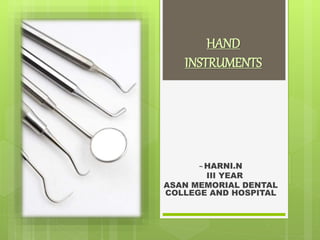
HAND
INSTRUMENTS
~ HARNI.N
III YEAR
ASAN MEMORIAL DENTAL
COLLEGE AND HOSPITAL
Introduction:
 • The term ‘instrument’ refers to a tool, device or
implement used for a specific purpose or type of work
and is preferred in professional or scientific fields as
precision items to perform specific procedures.
 • In order to perform the intricate or detailed
procedures associated with operative dentistry, the
dentist must have a complete knowledge of the
purpose and application of the many instruments
required.
 The instruments available
 The purpose of the instrument
 The position or manner of use
 The application of the instrument.
HISTORY:
 Most hand instruments of the
mid 19th century,
- Large, heavy handles and
inferior metal alloys .
- Cumbersome, awkward to use,
ineffective.
- No uniformity of manufacture
or nomenclature.
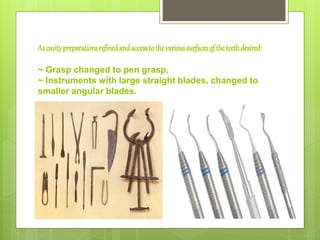
As cavitypreparationsrefinedandaccessto thevarioussurfacesof theteethdesired:
~ Grasp changed to pen grasp,
~ Instruments with large straight blades, changed to
smaller angular blades.
CLASSIFICATION OF HAND
INSTRUMENTS:
Accordind to sturdevant:
 Cutting instruments
 Non cutting instruments
 This classification was proposed by
G.V.Black.
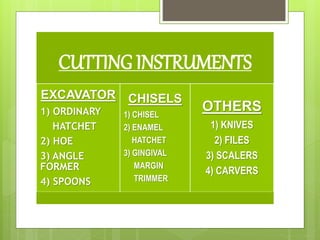
CUTTING INSTRUMENTS
EXCAVATOR
1) ORDINARY
HATCHET
2) HOE
3) ANGLE
FORMER
4) SPOONS
CHISELS
1) CHISEL
2) ENAMEL
HATCHET
3) GINGIVAL
MARGIN
TRIMMER
OTHERS
1) KNIVES
2) FILES
3) SCALERS
4) CARVERS
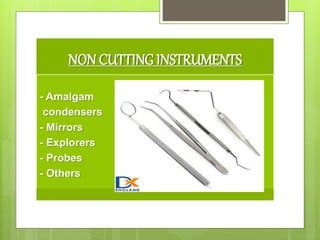
NON CUTTING INSTRUMENTS
- Amalgam
condensers
- Mirrors
- Explorers
- Probes
- Others
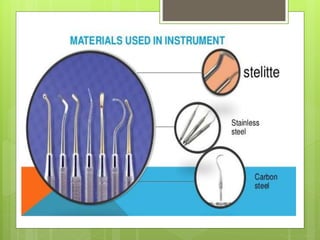
MATERIALS USED
CARBON STEEL
• More corrosion tendency.
• Harder than stainless steel.
STAINLESS STEEL
• Less corrosion tendency.
• It loses keen edge quicker during much use.
Stellite
• High resistance to acid
• Hardness
*Alloys of nickel, cobalt or chromium are also used
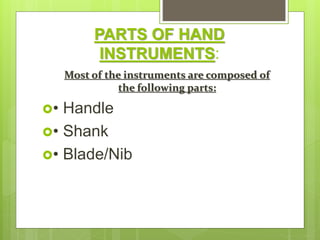
PARTS OF HAND
INSTRUMENTS:
Most of the instruments are composed of
the following parts:
• Handle
• Shank
• Blade/Nib
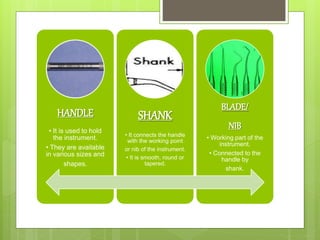
HANDLE
• It is used to hold
the instrument.
• They are available
in various sizes and
shapes.
SHANK
• It connects the handle
with the working point
or nib of the instrument.
• It is smooth, round or
tapered.
BLADE/
NIB
• Working part of the
instrument.
• Connected to the
handle by
shank.
NAMES
 Black classified all instruments according to:
 • FUNCTION: Excavator.
 • MANNER OF USE: Hand condenser.
 • DESIGN OF WORKING END: Hatchet
 • SHAPE OF THE SHANK: Mono-angle, bin
 angle, contra-angle.
 • These names were combined to form the
 complete description of the instrument e.g,
binangle
 spoon excavator
INSTRUMENT FORMULAS
 Hand cutting instruments have formulas
describing the dimensions and angles of
working end.
 Placed on the handle as code of three or four
numbers separated by dashes or spaces.
1. Width of the blade
in 1/10 of a mm.
2. Primary cutting edge
angle-
Measured from line parallel to
Long axis of handle in
clockwise
centigrade in percent of 3600
eg:- 85= 85% x 360= 3060
• If edge is perpendicular to
blade,
this number is omitted
3. Blade length- in mm
4. Blade angle- relative to long
axis of handle in clockwise
centigrade
BEVEL
 Most cutting instruments have
on the end of blade a single
bevel that forms the primary
cutting edge.
 Additional two bevel extends
from primary cutting edge for
the length of the blade.
 This allows cutting in 3
directions; facial and lingual
walls of the proximal cavity.
CUTTING INSTRUMENTS
 CHISELS:
 • Used primarily for cutting enamel
 • Used with push motion.
 • They are grouped as:
 Straight, slightly curved or binangle
 Enamel hatchets
 Gingival margin trimmer
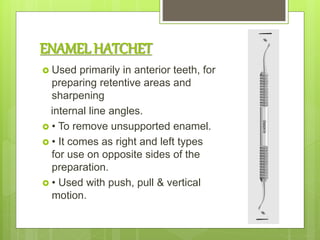
ENAMEL HATCHET
 Used primarily in anterior teeth, for
preparing retentive areas and
sharpening
internal line angles.
 • To remove unsupported enamel.
 • It comes as right and left types
for use on opposite sides of the
preparation.
 • Used with push, pull & vertical
motion.
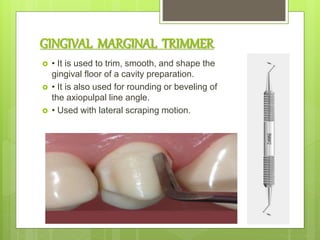
GINGIVAL MARGINAL TRIMMER
 • It is used to trim, smooth, and shape the
gingival floor of a cavity preparation.
 • It is also used for rounding or beveling of
the axiopulpal line angle.
 • Used with lateral scraping motion.
HOE
 Used to clean and smooth floor and walls in
cavity preparation and forming line angles.
 • Used with a pulling motion
 • Cutting edge or blade nearly perpendicular
to handle.
Ordinary hatchet excavator
 Cutting edge of blade directed in the same plane as
that of the long axis of the handle and is bibevelled.
 Used primarily on anterior teeth for preparing retentive
areas and sharpening internal line angles, particularly
in preparations for direct gold restorations.
HOE VS HATCHET
 • If the angle of the blade is less than 12.5
centigrade, it is mono-angle chisel & if it is
more than 12.5 centigrade, it is hoe.
ANGLE FORMERS
• Primarily used for sharpening
internal line angles and creating
retentive features in dentine in
preparation for gold restorations.
• Used in 3 motions vertical, push
and pull.
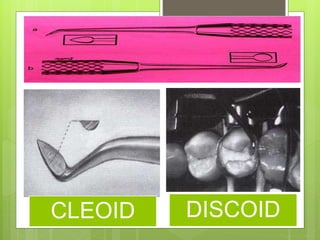
SPOON EXCAVATOR
 Used to remove
 Soft carious dentine
 Temporary crowns
 Temporary cement in temporary restoration
 Permanent crown during try-in
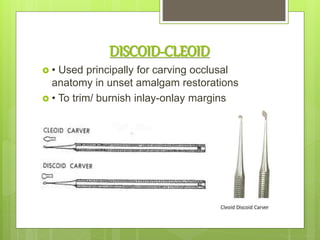
 • Discoid: Cutting edges are circular
 • Cleoid: Cutting edges are claw like.
CLEOID DISCOID
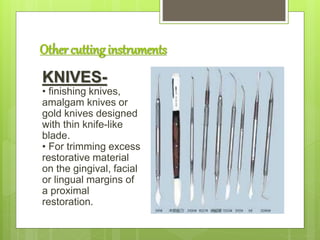
Other cutting instruments
KNIVES-
• finishing knives,
amalgam knives or
gold knives designed
with thin knife-like
blade.
• For trimming excess
restorative material
on the gingival, facial
or lingual margins of
a proximal
restoration.
FILES
 • To trim excess restorative material
 • Particularly useful at gingival margins
 • Blades are very thin & short teeth on cutting
surfaces
 • Either push or pull instrument
DISCOID-CLEOID
 • Used principally for carving occlusal
anatomy in unset amalgam restorations
 • To trim/ burnish inlay-onlay margins
DIAGNOSTICINSTRUMENTS
 MOUTH MIRROR:
 • To reflect light in the mouth
 • To retract lips, cheeks, and
tongue
 • To provide indirect vision
EXPLORER
 • It is used to examine
caries, calculus,
furcation.
 • Variety of sizes and
types
 Orban
 Pigtail
 Shepherd’s hook
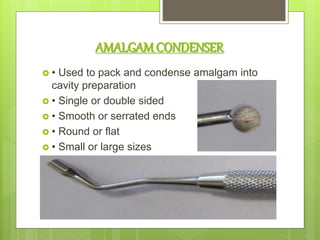
AMALGAMCONDENSER
 • Used to pack and condense amalgam into
cavity preparation
 • Single or double sided
 • Smooth or serrated ends
 • Round or flat
 • Small or large sizes
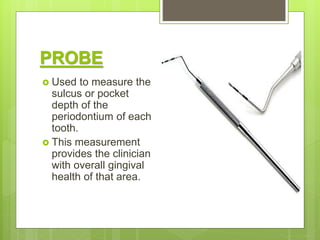
PROBE
 Used to measure the
sulcus or pocket
depth of the
periodontium of each
tooth.
 This measurement
provides the clinician
with overall gingival
health of that area.
Handinstrument techniques
 • Modified pen
 • Inverted pen
 • Palm and thumb
 • Modified palm and thumb
Modified pen grasp
 Pads of thumb, index and middle finger
contact instrument, while tip of the ring finger
and/or little finger is placed on a nearby tooth
of the same arch as REST.
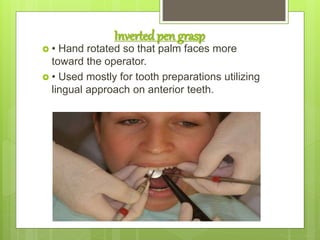
Invertedpen grasp
 • Hand rotated so that palm faces more
toward the operator.
 • Used mostly for tooth preparations utilizing
lingual approach on anterior teeth.
Palm andthumb grasp
 Handle placed in the palm of the hand and
grasped by all the fingers, while thumb is free
of the instrument and rest provided by tip of
thumb on nearby tooth of same arch or on a
firm, stable structure.
Modified palmand thumb grasp
 • Used when its feasible to rest the thumb on the tooth
being prepared or the adjacent tooth
 • Used universally
RESTS
 INTRA-ARCH HARD TISSUE REST:
 In modified pen grasp and inverted pen grasp,
rests are established by placing ring or ring
and little fingers on tooth of the same arch
and as close to operating site as possiblE.
SOFT TISSUE REST
 Soft tissue rest or too distant hard tissue rest
does not afford a reliable control.
INDIRECT REST
 When it is impossible to establish normal
finger rests with the hand holding the
instrument, instrument control maybe gained
using forefinger of the opposite hand on the
shank of the instrument.
GUARDS
 The use of interproximal wedges to protect
soft tissues from contact with sharp rotary
cutting instruments.

HAND INSTRUMENTS IN DENTISTRY

  • 1.
    HAND INSTRUMENTS ~ HARNI.N III YEAR ASANMEMORIAL DENTAL COLLEGE AND HOSPITAL
  • 2.
    Introduction:  • Theterm ‘instrument’ refers to a tool, device or implement used for a specific purpose or type of work and is preferred in professional or scientific fields as precision items to perform specific procedures.  • In order to perform the intricate or detailed procedures associated with operative dentistry, the dentist must have a complete knowledge of the purpose and application of the many instruments required.  The instruments available  The purpose of the instrument  The position or manner of use  The application of the instrument.
  • 3.
    HISTORY:  Most handinstruments of the mid 19th century, - Large, heavy handles and inferior metal alloys . - Cumbersome, awkward to use, ineffective. - No uniformity of manufacture or nomenclature.
  • 4.
    As cavitypreparationsrefinedandaccessto thevarioussurfacesoftheteethdesired: ~ Grasp changed to pen grasp, ~ Instruments with large straight blades, changed to smaller angular blades.
  • 5.
    CLASSIFICATION OF HAND INSTRUMENTS: Accordindto sturdevant:  Cutting instruments  Non cutting instruments  This classification was proposed by G.V.Black.
  • 6.
    CUTTING INSTRUMENTS EXCAVATOR 1) ORDINARY HATCHET 2)HOE 3) ANGLE FORMER 4) SPOONS CHISELS 1) CHISEL 2) ENAMEL HATCHET 3) GINGIVAL MARGIN TRIMMER OTHERS 1) KNIVES 2) FILES 3) SCALERS 4) CARVERS
  • 7.
    NON CUTTING INSTRUMENTS -Amalgam condensers - Mirrors - Explorers - Probes - Others
  • 9.
    MATERIALS USED CARBON STEEL •More corrosion tendency. • Harder than stainless steel. STAINLESS STEEL • Less corrosion tendency. • It loses keen edge quicker during much use. Stellite • High resistance to acid • Hardness *Alloys of nickel, cobalt or chromium are also used
  • 10.
    PARTS OF HAND INSTRUMENTS: Mostof the instruments are composed of the following parts: • Handle • Shank • Blade/Nib
  • 12.
    HANDLE • It isused to hold the instrument. • They are available in various sizes and shapes. SHANK • It connects the handle with the working point or nib of the instrument. • It is smooth, round or tapered. BLADE/ NIB • Working part of the instrument. • Connected to the handle by shank.
  • 13.
    NAMES  Black classifiedall instruments according to:  • FUNCTION: Excavator.  • MANNER OF USE: Hand condenser.  • DESIGN OF WORKING END: Hatchet  • SHAPE OF THE SHANK: Mono-angle, bin  angle, contra-angle.  • These names were combined to form the  complete description of the instrument e.g, binangle  spoon excavator
  • 15.
    INSTRUMENT FORMULAS  Handcutting instruments have formulas describing the dimensions and angles of working end.  Placed on the handle as code of three or four numbers separated by dashes or spaces.
  • 16.
    1. Width ofthe blade in 1/10 of a mm. 2. Primary cutting edge angle- Measured from line parallel to Long axis of handle in clockwise centigrade in percent of 3600 eg:- 85= 85% x 360= 3060 • If edge is perpendicular to blade, this number is omitted 3. Blade length- in mm 4. Blade angle- relative to long axis of handle in clockwise centigrade
  • 17.
    BEVEL  Most cuttinginstruments have on the end of blade a single bevel that forms the primary cutting edge.  Additional two bevel extends from primary cutting edge for the length of the blade.  This allows cutting in 3 directions; facial and lingual walls of the proximal cavity.
  • 18.
    CUTTING INSTRUMENTS  CHISELS: • Used primarily for cutting enamel  • Used with push motion.  • They are grouped as:  Straight, slightly curved or binangle  Enamel hatchets  Gingival margin trimmer
  • 20.
    ENAMEL HATCHET  Usedprimarily in anterior teeth, for preparing retentive areas and sharpening internal line angles.  • To remove unsupported enamel.  • It comes as right and left types for use on opposite sides of the preparation.  • Used with push, pull & vertical motion.
  • 21.
    GINGIVAL MARGINAL TRIMMER • It is used to trim, smooth, and shape the gingival floor of a cavity preparation.  • It is also used for rounding or beveling of the axiopulpal line angle.  • Used with lateral scraping motion.
  • 22.
    HOE  Used toclean and smooth floor and walls in cavity preparation and forming line angles.  • Used with a pulling motion  • Cutting edge or blade nearly perpendicular to handle.
  • 23.
    Ordinary hatchet excavator Cutting edge of blade directed in the same plane as that of the long axis of the handle and is bibevelled.  Used primarily on anterior teeth for preparing retentive areas and sharpening internal line angles, particularly in preparations for direct gold restorations.
  • 24.
    HOE VS HATCHET • If the angle of the blade is less than 12.5 centigrade, it is mono-angle chisel & if it is more than 12.5 centigrade, it is hoe.
  • 25.
    ANGLE FORMERS • Primarilyused for sharpening internal line angles and creating retentive features in dentine in preparation for gold restorations. • Used in 3 motions vertical, push and pull.
  • 26.
    SPOON EXCAVATOR  Usedto remove  Soft carious dentine  Temporary crowns  Temporary cement in temporary restoration  Permanent crown during try-in  • Discoid: Cutting edges are circular  • Cleoid: Cutting edges are claw like.
  • 27.
  • 28.
    Other cutting instruments KNIVES- •finishing knives, amalgam knives or gold knives designed with thin knife-like blade. • For trimming excess restorative material on the gingival, facial or lingual margins of a proximal restoration.
  • 29.
    FILES  • Totrim excess restorative material  • Particularly useful at gingival margins  • Blades are very thin & short teeth on cutting surfaces  • Either push or pull instrument
  • 30.
    DISCOID-CLEOID  • Usedprincipally for carving occlusal anatomy in unset amalgam restorations  • To trim/ burnish inlay-onlay margins
  • 31.
    DIAGNOSTICINSTRUMENTS  MOUTH MIRROR: • To reflect light in the mouth  • To retract lips, cheeks, and tongue  • To provide indirect vision
  • 32.
    EXPLORER  • Itis used to examine caries, calculus, furcation.  • Variety of sizes and types  Orban  Pigtail  Shepherd’s hook
  • 33.
    AMALGAMCONDENSER  • Usedto pack and condense amalgam into cavity preparation  • Single or double sided  • Smooth or serrated ends  • Round or flat  • Small or large sizes
  • 34.
    PROBE  Used tomeasure the sulcus or pocket depth of the periodontium of each tooth.  This measurement provides the clinician with overall gingival health of that area.
  • 35.
    Handinstrument techniques  •Modified pen  • Inverted pen  • Palm and thumb  • Modified palm and thumb
  • 36.
    Modified pen grasp Pads of thumb, index and middle finger contact instrument, while tip of the ring finger and/or little finger is placed on a nearby tooth of the same arch as REST.
  • 37.
    Invertedpen grasp  •Hand rotated so that palm faces more toward the operator.  • Used mostly for tooth preparations utilizing lingual approach on anterior teeth.
  • 38.
    Palm andthumb grasp Handle placed in the palm of the hand and grasped by all the fingers, while thumb is free of the instrument and rest provided by tip of thumb on nearby tooth of same arch or on a firm, stable structure.
  • 39.
    Modified palmand thumbgrasp  • Used when its feasible to rest the thumb on the tooth being prepared or the adjacent tooth  • Used universally
  • 40.
    RESTS  INTRA-ARCH HARDTISSUE REST:  In modified pen grasp and inverted pen grasp, rests are established by placing ring or ring and little fingers on tooth of the same arch and as close to operating site as possiblE.
  • 41.
    SOFT TISSUE REST Soft tissue rest or too distant hard tissue rest does not afford a reliable control. INDIRECT REST  When it is impossible to establish normal finger rests with the hand holding the instrument, instrument control maybe gained using forefinger of the opposite hand on the shank of the instrument.
  • 43.
    GUARDS  The useof interproximal wedges to protect soft tissues from contact with sharp rotary cutting instruments.