DR PRAKASH NIDWANI
MDS
Dept Of Prosthodontics
Navodaya Dental College
DEFINiTION
According to GPT – 9,
It is that component part of a removable partial
denture that is used to retain & prevent
dislodgement consisting of a clasp assembly or
precision attachment.
CLASSIFICATION (According to Stewart)
EXTRACORONAL retainers
• Introduced by Henry R. Boos and later modified by
F . Ewing Roach.
• These retainers consists of components that reside
entirely outside the normal clinical contours of
abutment crowns.
• They derive their retention from closely fitting
components.
• The amount of retention can be varied by depth of
undercut and the flexibility of clasp arm positioned in
the undercut.
Analysis of Tooth Contours for Retentive
Clasps
• Teeth that are engaged by RPD must be contoured to
support, stabilize and retain the prosthesis
• Critical areas of an abutment that provide retention and
reciprocation can be identified using –Dental Surveyor
• Relationship of vertical arm of surveyor to the cast
represent the path of placement of prosthesis
• Vertical arm contacts the tooth at the height of contour
which determines areas for retention and that for support
• Tooth above height of contour (survey line)is accessible to
prosthesis
• Tooth below the height of contour can be accessed by
flexible parts (retentive terminal)
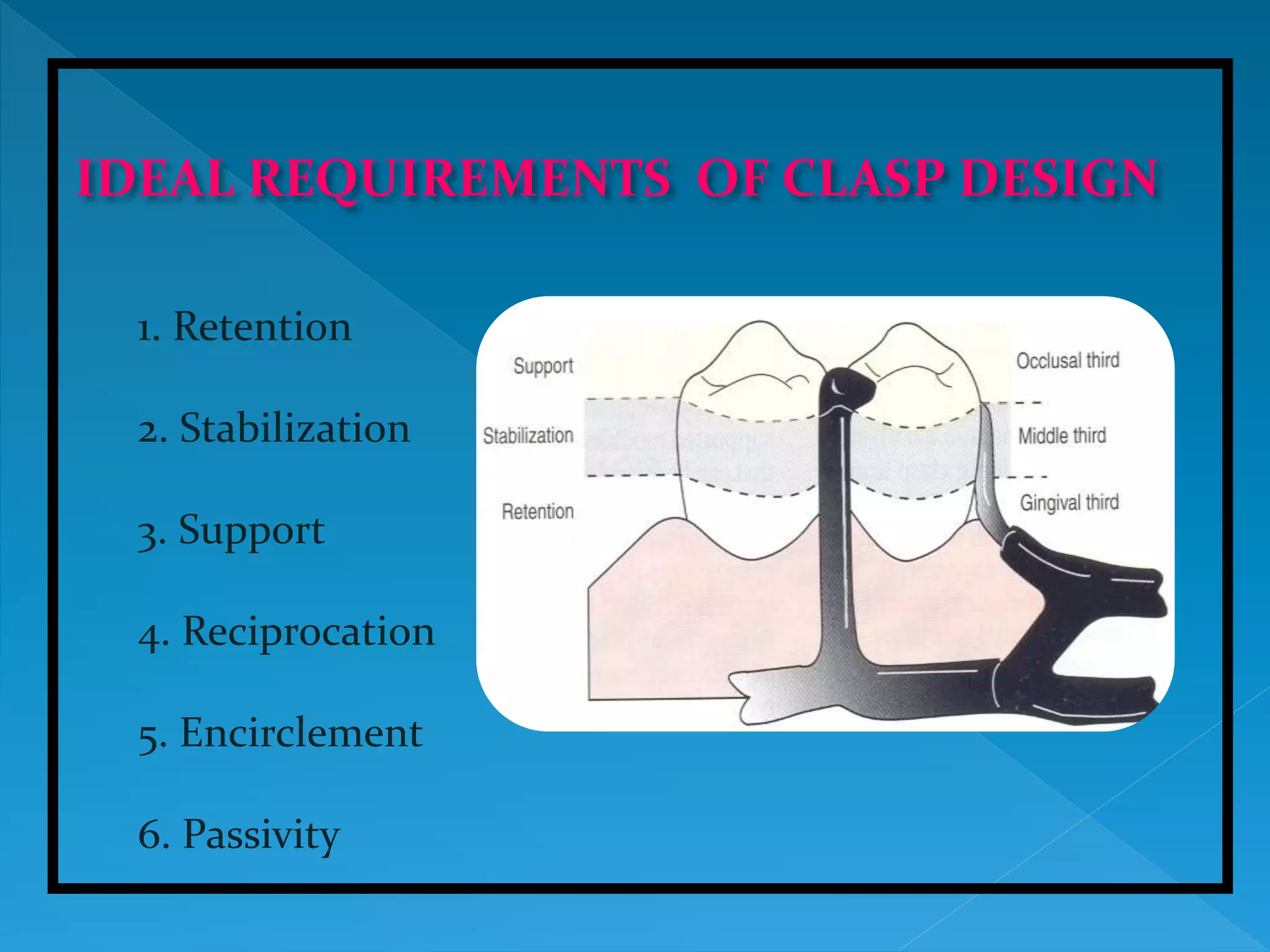
IDEAL REQUIREMENTS OF CLASP DESIGN
1. Retention
2. Stabilization
3. Support
4. Reciprocation
5. Encirclement
6. Passivity
1. RETENTION
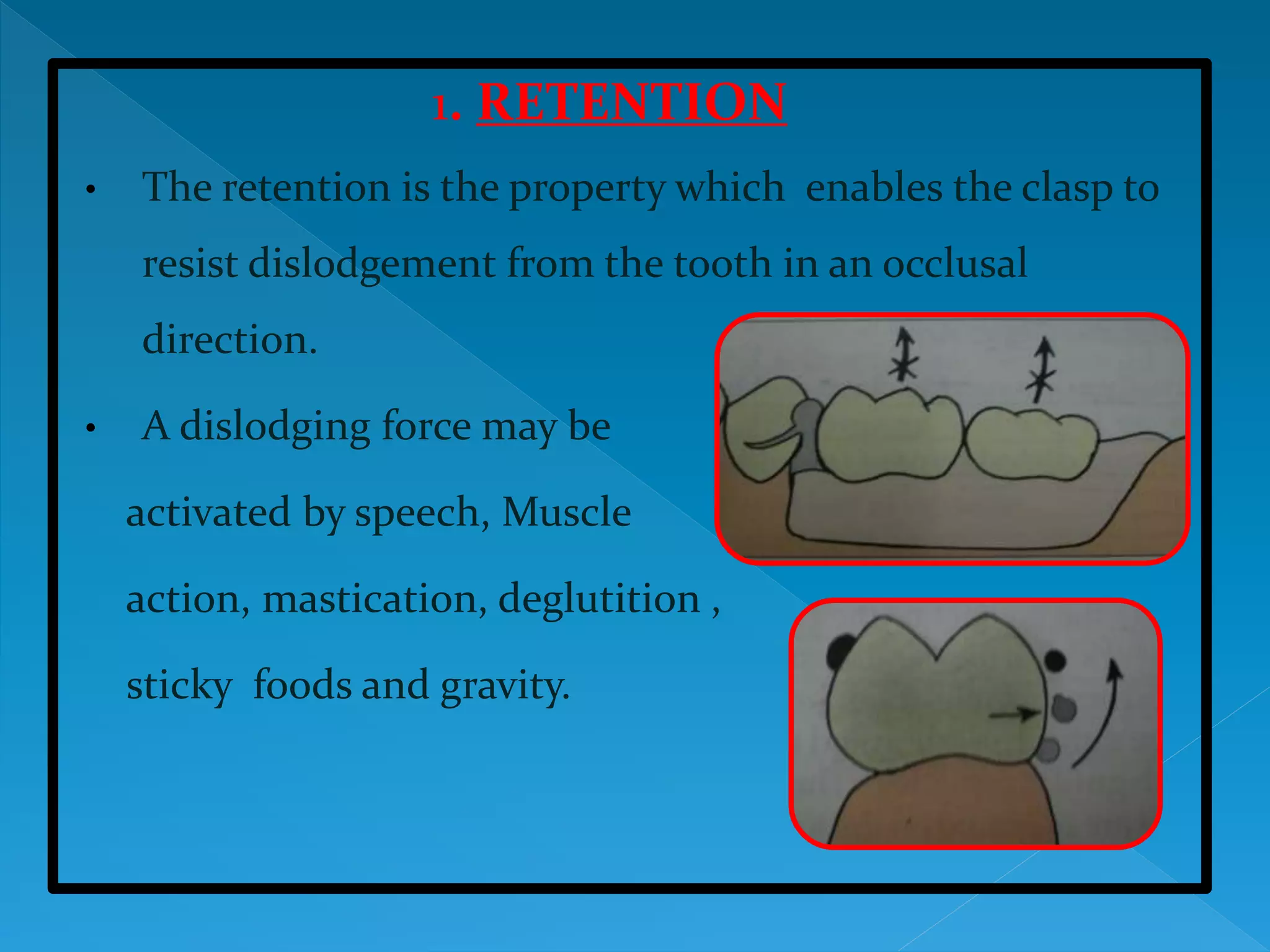
• The retention is the property which enables the clasp to
resist dislodgement from the tooth in an occlusal
direction.
• A dislodging force may be
activated by speech, Muscle
action, mastication, deglutition ,
sticky foods and gravity.
Factors Producing Retention
Tooth
Prosthesis
Size Angle of cervical
convergence
Distance into angle of
cervical convergence
Cross-section
Diameter of clasp arm
Length of clasp arm
Material
flexibility
Size And Distance Into The Angle Of Cervical
Convergence
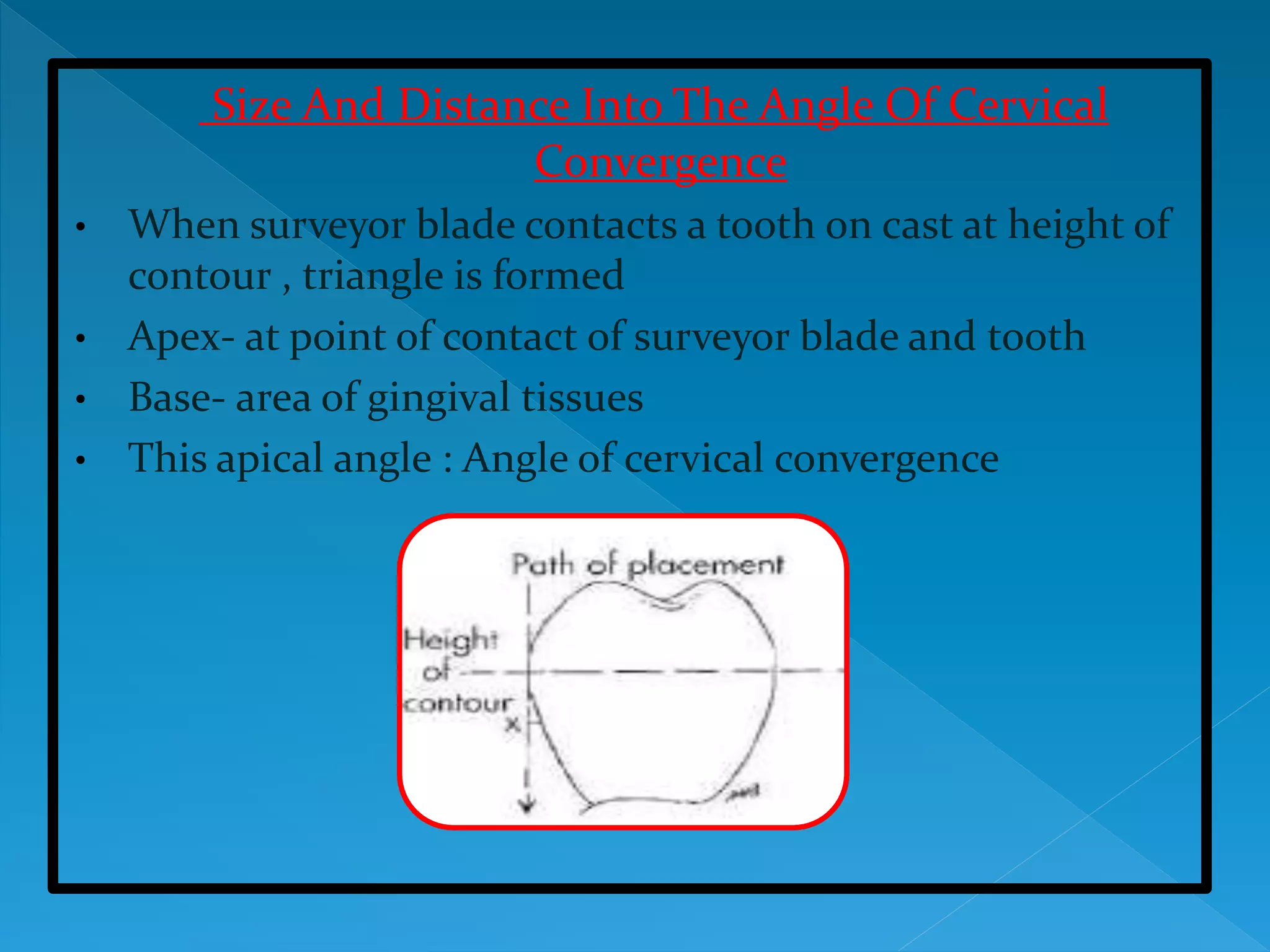
• When surveyor blade contacts a tooth on cast at height of
contour , triangle is formed
• Apex- at point of contact of surveyor blade and tooth
• Base- area of gingival tissues
• This apical angle : Angle of cervical convergence
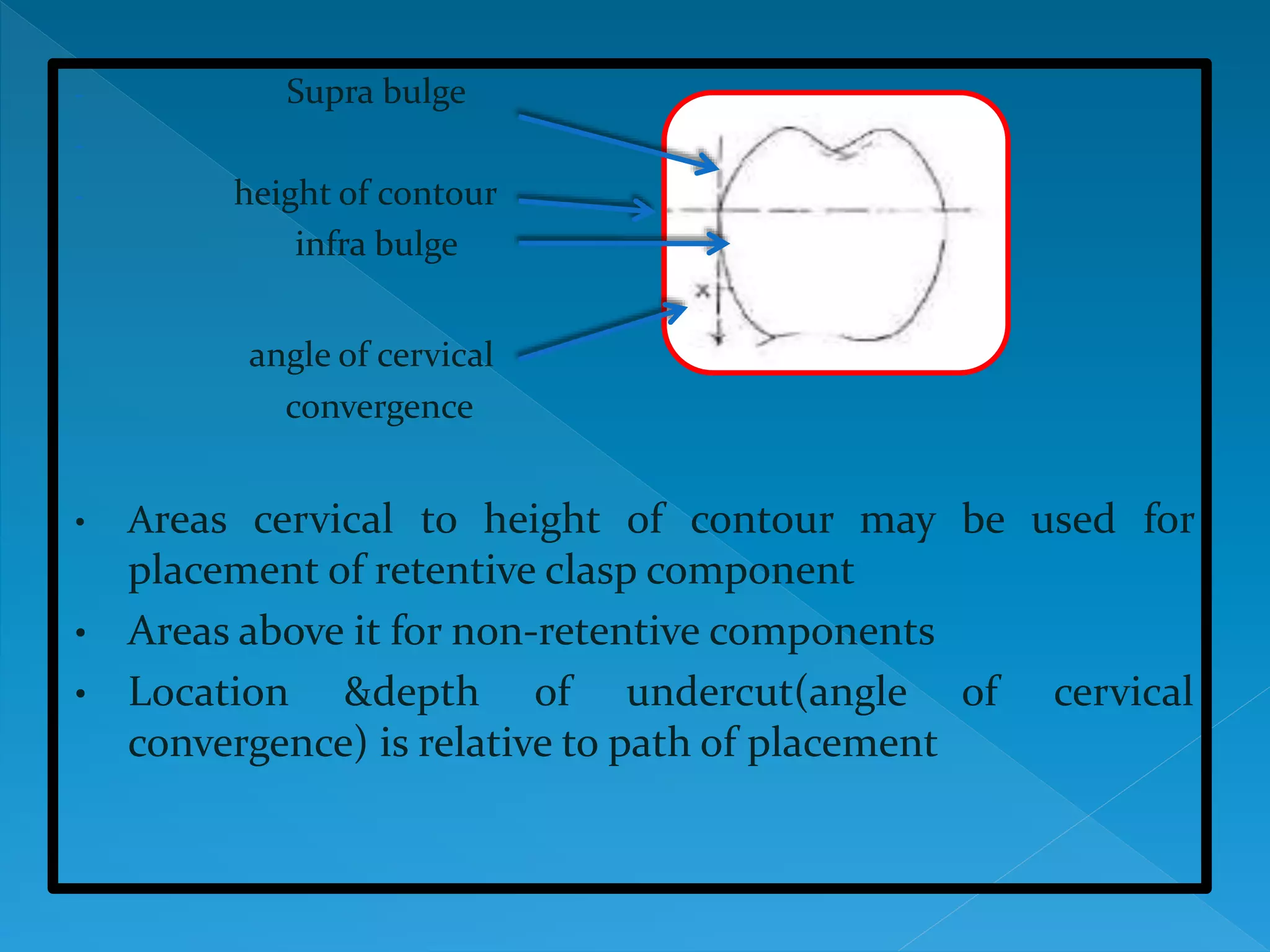
- Supra bulge
-
- height of contour
infra bulge
angle of cervical
convergence
• Areas cervical to height of contour may be used for
placement of retentive clasp component
• Areas above it for non-retentive components
• Location &depth of undercut(angle of cervical
convergence) is relative to path of placement
 According to Stewart,
For a 0.010” undercut - Cast chrome alloy
0.015” undercut - gold alloy
0.020” undercut - wrought wire
 Flexibility Of Clasp
Directly proportional to cube of length
Inversely proportional to diameter
Length Of Clasp Arm
Longer flexibility
Length measured along centre
portion of arm until it joins clasp
body or denture base
Curved clasp increases the flexibility
Diameter Of Clasp Arm
Greater average diameter less flexibility
(all other factors being equal)
Average diameter is at a point midway between clasp origin
and its terminates if taper is uniform
Cross-section Of The Clasp Arm
- half –round one direction
- Round universally flexible
- Tooth –borne: half-round circumferential clasp
(flexes only during placement and removal)
- Distal –extension: round circumferential clasp
(flexes during placement and removal &
during functional movements)
 Taper
Uniform taper
A clasp should be half as thick at its tip as at the origin
Material Used
-Chrome alloys high modulus of elasticity
less flexible
- smaller cross-sectional
- less depth of undercut
- wrought wire internal grain structure
more flexibility
for equal retention deeper
undercut required
2 .STABILITY
 Stabilization or bracing is the resistance which the clasp
contributes to displacement of the prosthesis in a
horizontal plane.
All clasp components except the retentive terminals
contribute to this property in varying degrees.
Greatest amount of stabilization is provided by cast
circumferential clasp
3. SUPPORT
• It is the quality of clasp assembly that resists the
displacement of a prosthesis in an apical direction.
• Body and Shoulder which is placed above the height of
Contour also aids in support.
4. ENCIRCLEMENT
 Clasp assembly must be designed to provide direct
contact over at least 180 degrees of the tooth
circumference.
5. RECIPROCATION
• Reciprocation is the quality of a clasp assembly that
counteracts lateral displacement of an abutment when
the retentive clasp terminal passes over the height of
contour.
• It should be rigid and must contact the abutment tooth
at or occlusal to the height of contour
• During insertion of the prosthesis, the reciprocal element
should contact the abutments slightly before the retentive
arm contacts the abutment.
6. PASSIVITY
• Passivity is the quality of clasp assembly that prevents the
transmission of adverse forces to the associated abutment
when the prosthesis is completely seated.
• When the clasp is in placed on the tooth, it should be
passive.
• It should not exert pressure on the tooth until it is
activated by the movement of the prosthesis in function
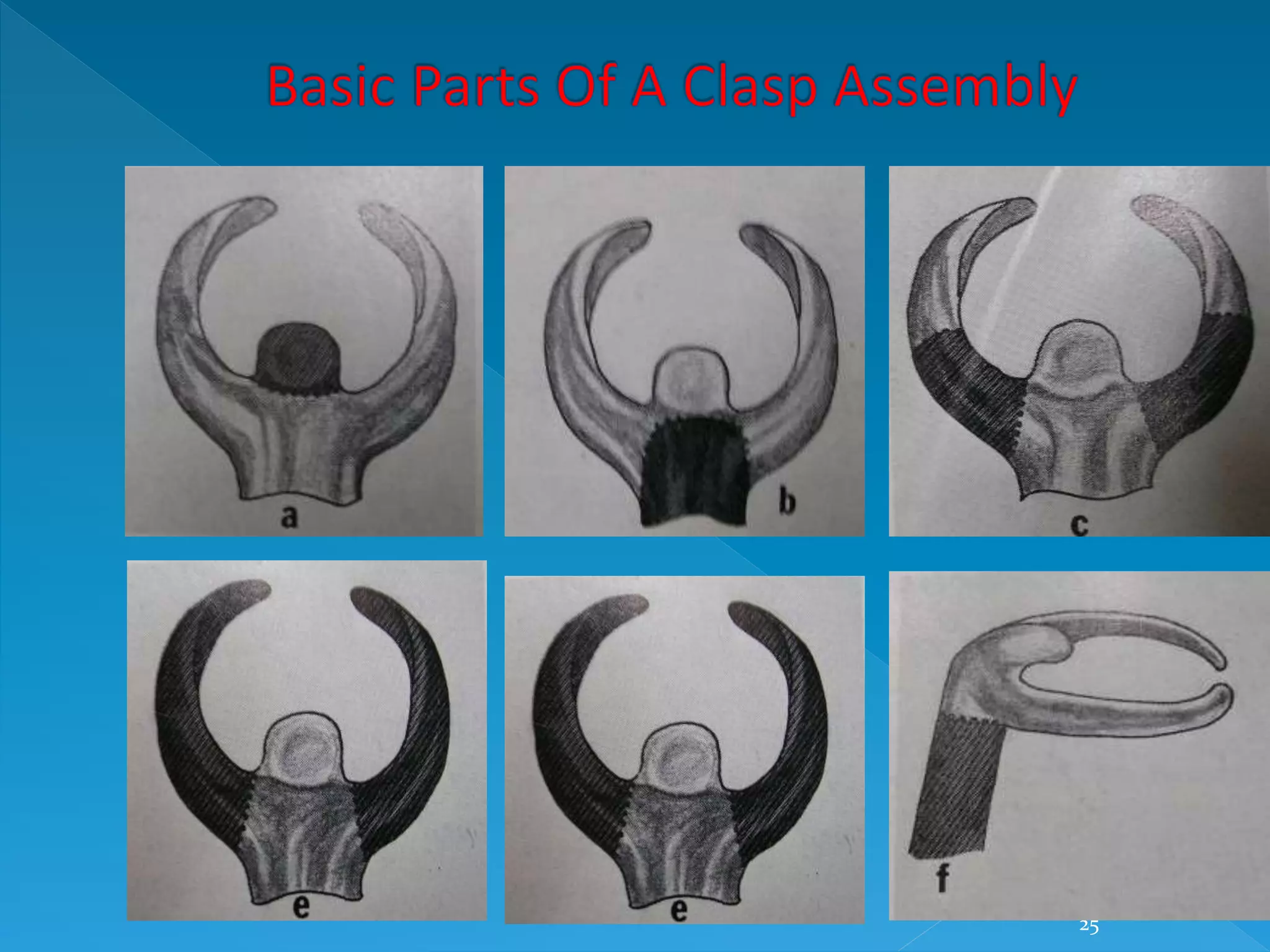
Component Parts Of Clasp
Body
Shoulder
Rest
Retentive arm
Retentive
terminal
Reciprocal arm
25
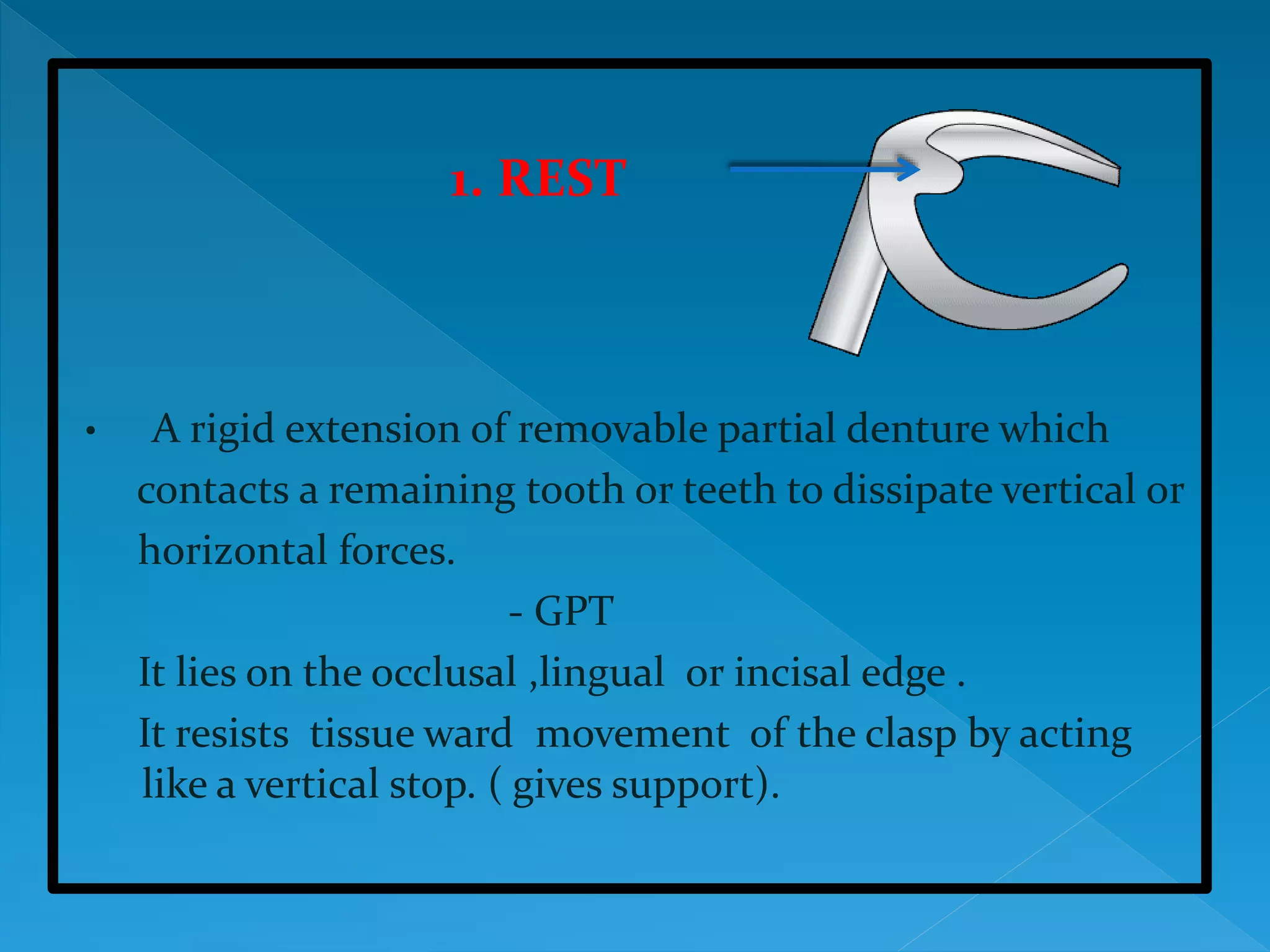
1. REST
• A rigid extension of removable partial denture which
contacts a remaining tooth or teeth to dissipate vertical or
horizontal forces.
- GPT
It lies on the occlusal ,lingual or incisal edge .
It resists tissue ward movement of the clasp by acting
like a vertical stop. ( gives support).
2. BODY
Part of the clasp that connects the rest and shoulders of
the clasp to the minor connectors.
It must be rigid and must be above the height of
contours.
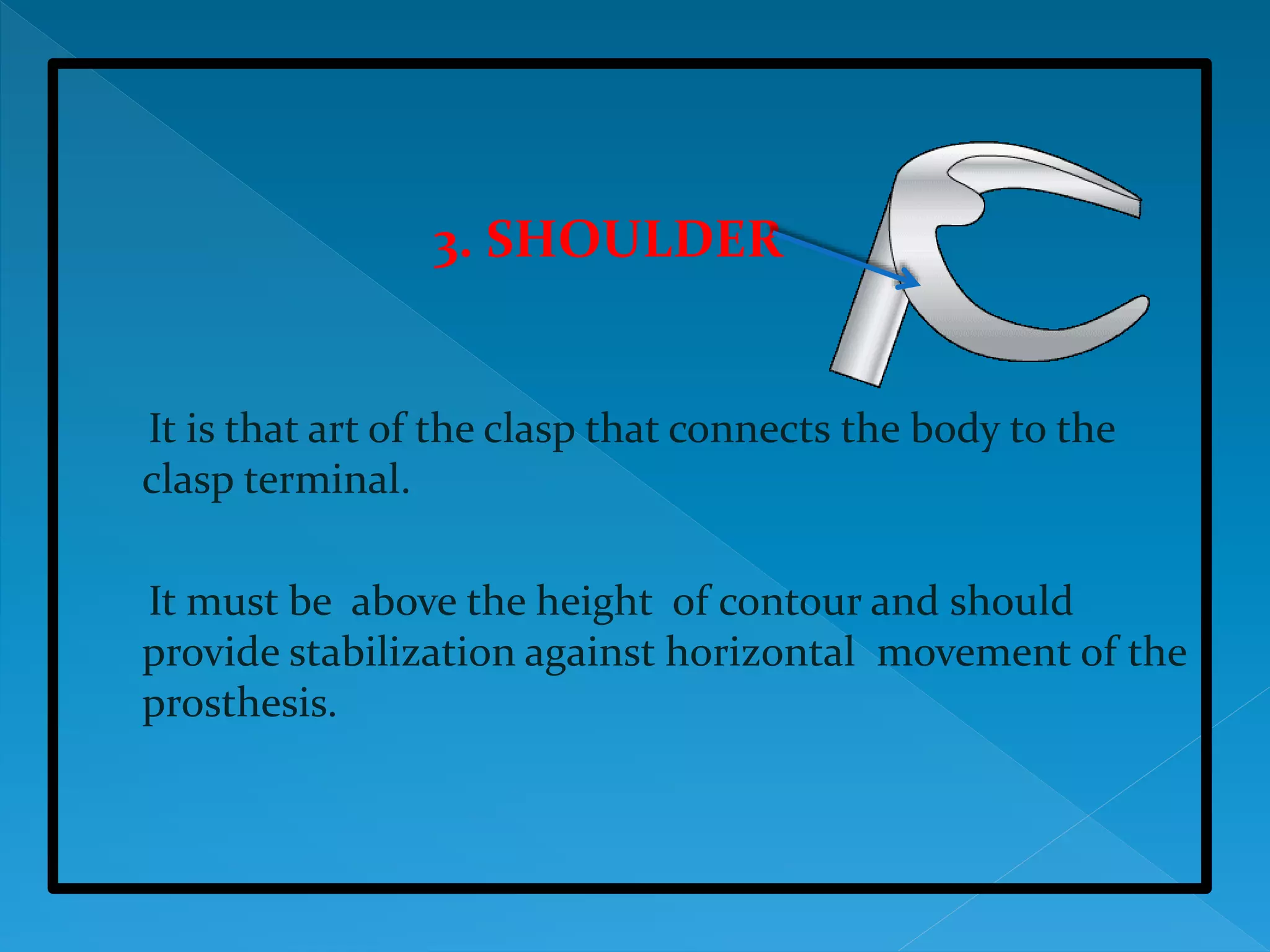
3. SHOULDER
It is that art of the clasp that connects the body to the
clasp terminal.
It must be above the height of contour and should
provide stabilization against horizontal movement of the
prosthesis.
4. RECIPROCAL ARM
A component of the clasp assembly
specifically designed to provide reciprocation by
engaging a reciprocal guiding plane.
- GPT
It is placed above the height of contour on the side of the
tooth opposing the retentive clasp arm
FUNCTION -
1. Stability &reciprocation against retentive arm.
2. Stability against horizontal movement.
3. Indirect retention.
5. RETENTIVE ARM
A flexible segment of a removable partial denture that
engages an undercut on an abutment and that is designed
to retain the prosthesis.
- GPT
It comprises of the retentive clasp arm and retentive
terminal
- Retentive arm , not flexible and is located above the
height of contour
- Retentive terminal is flexible and lies below the
height of contour.
Location Of Retentive Clasp Terminal
• Retentive clasp should be positioned on the facial surface
of the abutment
• Facial placement permits increased length of the retentive
arm and yields improved clasp flexibility
• In contrast, lingual placement of the retentive arm results
in decreased clasp length and an accompanying decrease
in flexibility
• Lingual retentive elements can be used with molar
abutments.
• If retentive clasp on one side of the arch is positioned on
the facial surface of an abutment , at least one retentive
clasp on the contra lateral side of the arch should be
located on the facial surface of an abutment.
35
 Types
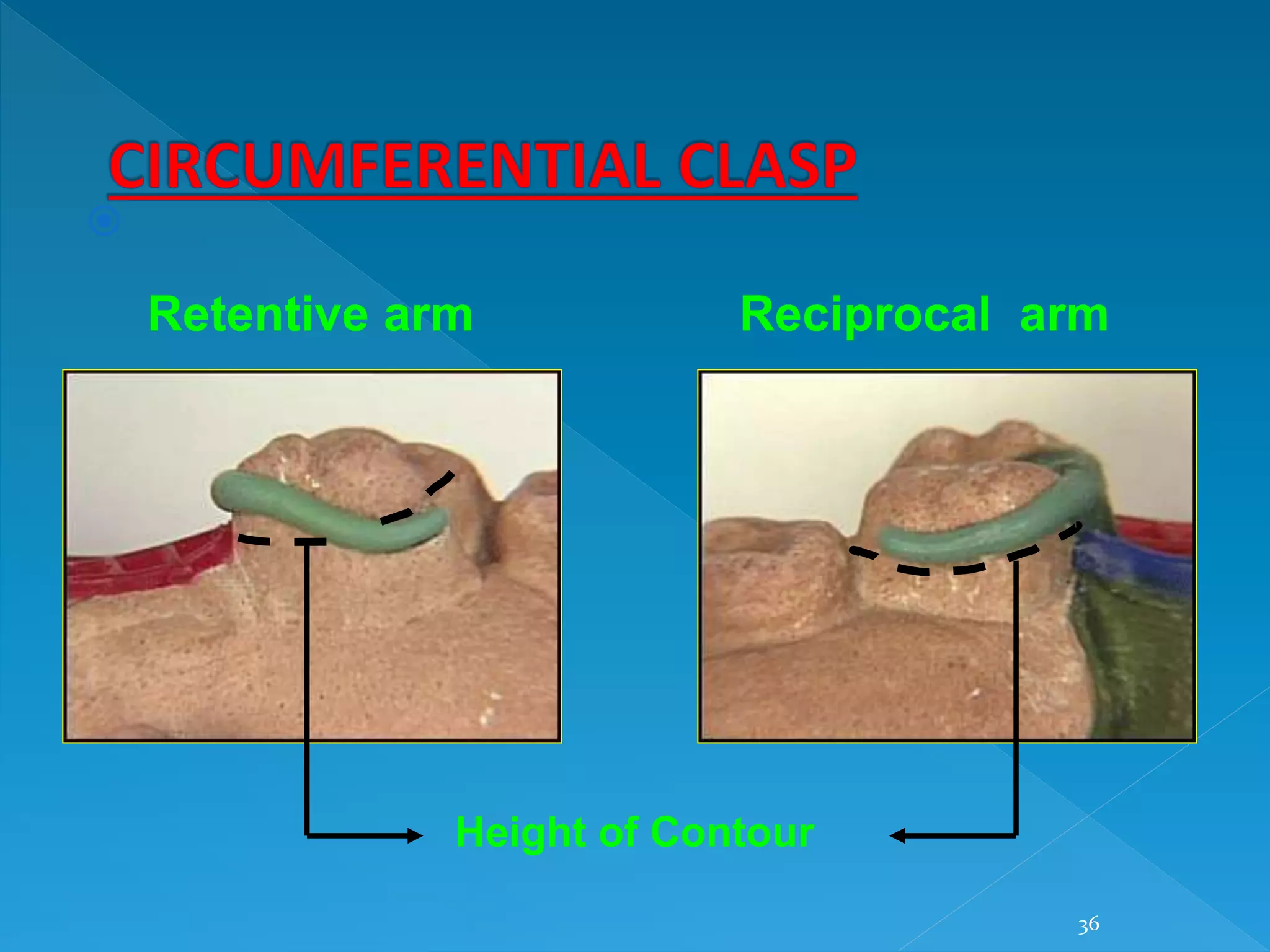
› I. Circumferential clasp
 Approaches undercut : Occlusal direction
› II. Bar clasp / Vertical projection clasp
 Approaches undercut : Cervical direction
36

Height of Contour
Retentive arm Reciprocal arm
37
 Advantages
• Most logical clasp design
• Excellent support, bracing & retention
• Easiest to repair
• Less food retention
38
 Disadvantages
• More tooth surface coverage
• Changes morphology of crown
• Interference in normal food flow pattern
• Poor adjustability
• Poor esthetics
39
 Rules Of Use
Retentive terminal
• Points towards the occlusal surface
• Terminates at the mesial/ distal line angle
40
 1. Simple Circlet Clasp
• Easy to construct
• Indicated in tooth
supported RPD
• Increases crown
circumference
• Poor adjustability
41
 2. Reverse circlet clasp
• Used in distal
extension cases.
• Retentive undercut
adjacent to the
edentulous space.
• Poor esthetics.
• Wedging effect in the
absence of rests
42
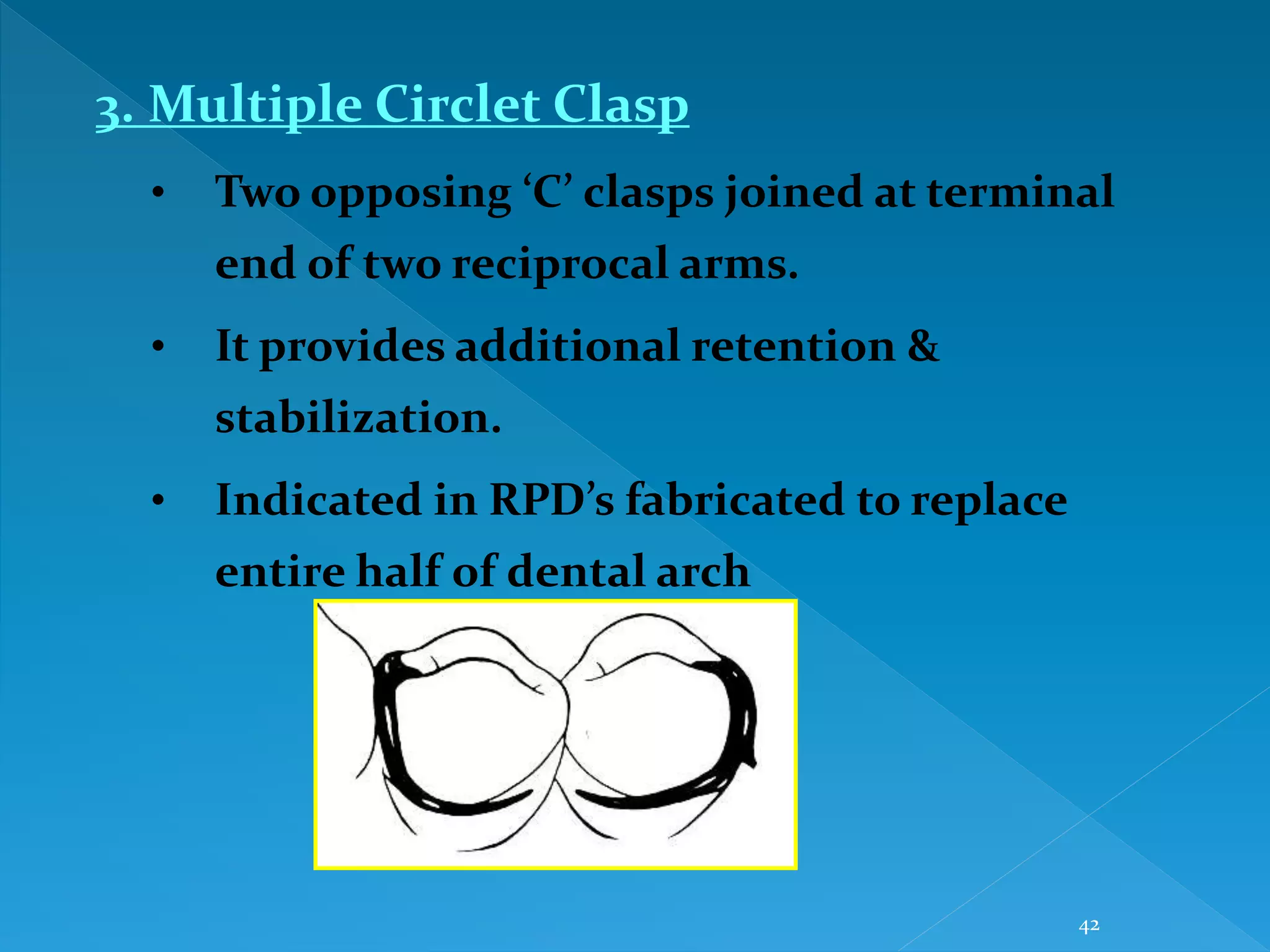
3. Multiple Circlet Clasp
• Two opposing ‘C’ clasps joined at terminal
end of two reciprocal arms.
• It provides additional retention &
stabilization.
• Indicated in RPD’s fabricated to replace
entire half of dental arch
43
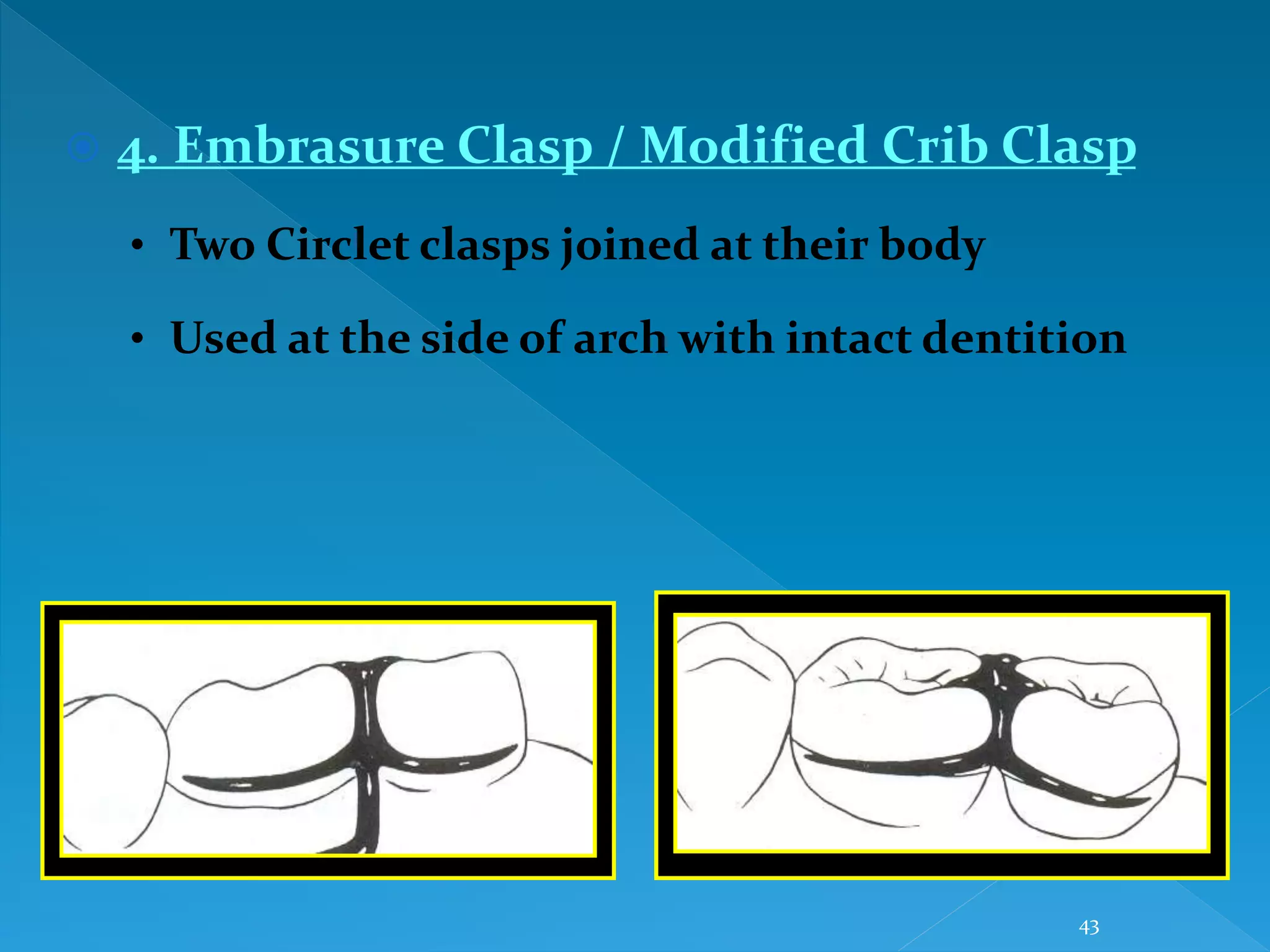
 4. Embrasure Clasp / Modified Crib Clasp
• Two Circlet clasps joined at their body
• Used at the side of arch with intact dentition
44
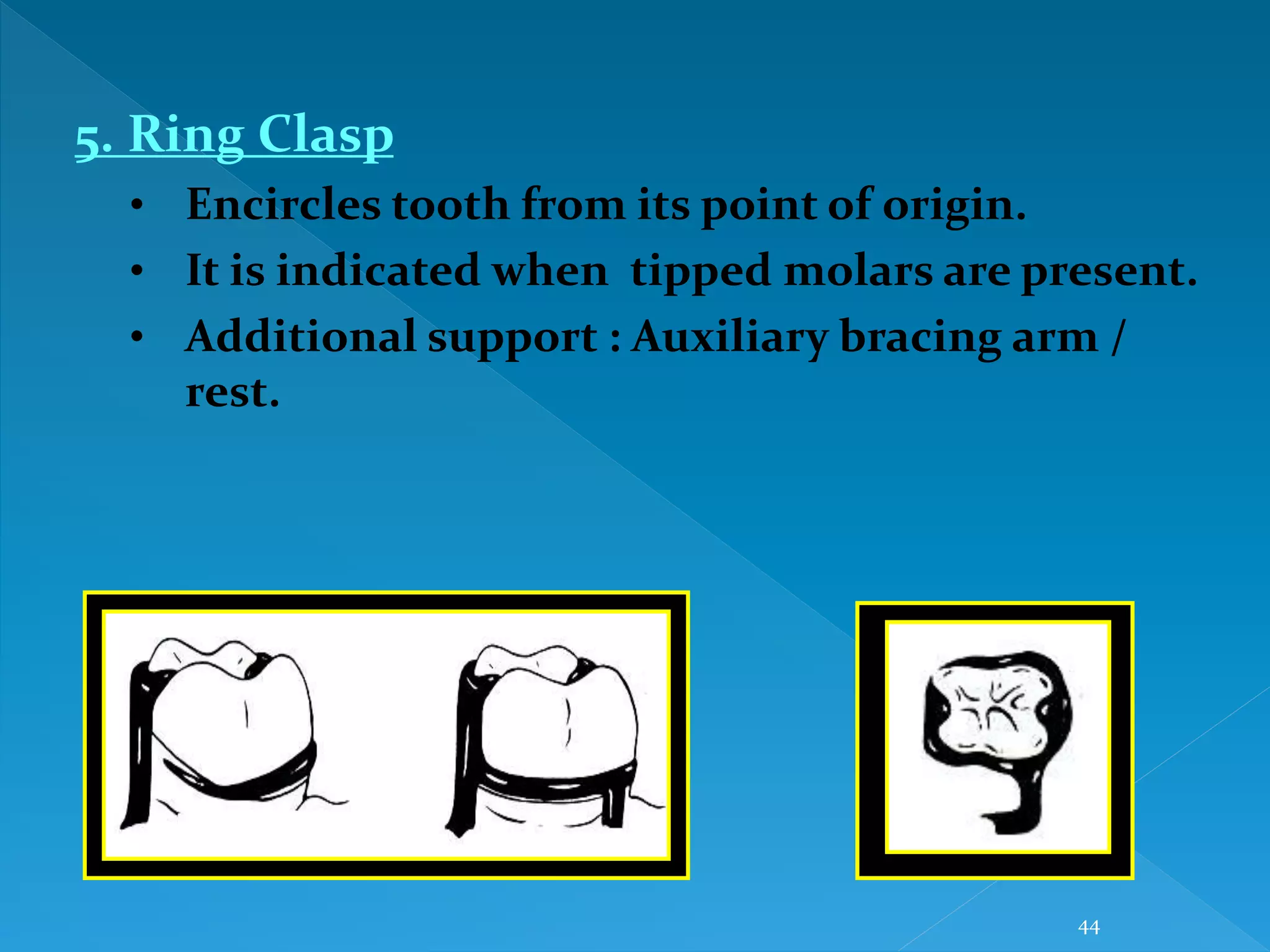
5. Ring Clasp
• Encircles tooth from its point of origin.
• It is indicated when tipped molars are present.
• Additional support : Auxiliary bracing arm /
rest.
45
6. Back action clasp
• This is modified Ring Clasp.
• Used on protected abutments.
46
7. Hairpin / Fishhook / Reverse Action Clasp
• It engages proximal undercut from occlusal
direction.
• This is indicated when RPI clasp cannot be
used.
• Poor esthetics.
47
8. Half and Half Clasp
• In this clasp, retentive & reciprocal arm arises
from opposing direction from two minor
connectors.
• Used in unilateral RPD design.
48
9. Combination Clasp
• It is fabricated using wrought round wire for
retentive arm and cast circumferential for
reciprocal arm.
• This allows functional movements in distal
extension RPD.
49
Advantages
• Flexibility & Adjustability
• Stress equalizer
• Utilizes deep undercut
• Esthetically Superior
50
Disadvantages
• Additional laboratory steps
• Fatigue fracture
• Distortion if carelessly handled
• Poor bracing
51
Indication
• To engage mesiobuccal undercut adjacent to
distal extension bases
• When a RPI clasp is contraindicated
52
10. Onlay Clasp
• Extended occlusal rests with arms.
• Abutments are below the occlusal plane.
• Can cause increased wear of opposing natural
teeth .
THANK
YOU

DIRECT RETAINERS.ppt

  • 1.
    DR PRAKASH NIDWANI MDS DeptOf Prosthodontics Navodaya Dental College
  • 2.
    DEFINiTION According to GPT– 9, It is that component part of a removable partial denture that is used to retain & prevent dislodgement consisting of a clasp assembly or precision attachment.
  • 3.
  • 4.
    EXTRACORONAL retainers • Introducedby Henry R. Boos and later modified by F . Ewing Roach. • These retainers consists of components that reside entirely outside the normal clinical contours of abutment crowns. • They derive their retention from closely fitting components. • The amount of retention can be varied by depth of undercut and the flexibility of clasp arm positioned in the undercut.
  • 5.
    Analysis of ToothContours for Retentive Clasps • Teeth that are engaged by RPD must be contoured to support, stabilize and retain the prosthesis • Critical areas of an abutment that provide retention and reciprocation can be identified using –Dental Surveyor • Relationship of vertical arm of surveyor to the cast represent the path of placement of prosthesis • Vertical arm contacts the tooth at the height of contour which determines areas for retention and that for support
  • 6.
    • Tooth aboveheight of contour (survey line)is accessible to prosthesis • Tooth below the height of contour can be accessed by flexible parts (retentive terminal)
  • 7.
    IDEAL REQUIREMENTS OFCLASP DESIGN 1. Retention 2. Stabilization 3. Support 4. Reciprocation 5. Encirclement 6. Passivity
  • 8.
    1. RETENTION • Theretention is the property which enables the clasp to resist dislodgement from the tooth in an occlusal direction. • A dislodging force may be activated by speech, Muscle action, mastication, deglutition , sticky foods and gravity.
  • 9.
    Factors Producing Retention Tooth Prosthesis SizeAngle of cervical convergence Distance into angle of cervical convergence Cross-section Diameter of clasp arm Length of clasp arm Material flexibility
  • 10.
    Size And DistanceInto The Angle Of Cervical Convergence • When surveyor blade contacts a tooth on cast at height of contour , triangle is formed • Apex- at point of contact of surveyor blade and tooth • Base- area of gingival tissues • This apical angle : Angle of cervical convergence
  • 11.
    - Supra bulge - -height of contour infra bulge angle of cervical convergence • Areas cervical to height of contour may be used for placement of retentive clasp component • Areas above it for non-retentive components • Location &depth of undercut(angle of cervical convergence) is relative to path of placement
  • 12.
     According toStewart, For a 0.010” undercut - Cast chrome alloy 0.015” undercut - gold alloy 0.020” undercut - wrought wire
  • 13.
     Flexibility OfClasp Directly proportional to cube of length Inversely proportional to diameter
  • 14.
    Length Of ClaspArm Longer flexibility Length measured along centre portion of arm until it joins clasp body or denture base Curved clasp increases the flexibility
  • 15.
    Diameter Of ClaspArm Greater average diameter less flexibility (all other factors being equal) Average diameter is at a point midway between clasp origin and its terminates if taper is uniform
  • 16.
    Cross-section Of TheClasp Arm - half –round one direction - Round universally flexible - Tooth –borne: half-round circumferential clasp (flexes only during placement and removal) - Distal –extension: round circumferential clasp (flexes during placement and removal & during functional movements)
  • 17.
     Taper Uniform taper Aclasp should be half as thick at its tip as at the origin
  • 18.
    Material Used -Chrome alloyshigh modulus of elasticity less flexible - smaller cross-sectional - less depth of undercut - wrought wire internal grain structure more flexibility for equal retention deeper undercut required
  • 19.
    2 .STABILITY  Stabilizationor bracing is the resistance which the clasp contributes to displacement of the prosthesis in a horizontal plane. All clasp components except the retentive terminals contribute to this property in varying degrees. Greatest amount of stabilization is provided by cast circumferential clasp
  • 20.
    3. SUPPORT • Itis the quality of clasp assembly that resists the displacement of a prosthesis in an apical direction. • Body and Shoulder which is placed above the height of Contour also aids in support.
  • 21.
    4. ENCIRCLEMENT  Claspassembly must be designed to provide direct contact over at least 180 degrees of the tooth circumference.
  • 22.
    5. RECIPROCATION • Reciprocationis the quality of a clasp assembly that counteracts lateral displacement of an abutment when the retentive clasp terminal passes over the height of contour. • It should be rigid and must contact the abutment tooth at or occlusal to the height of contour • During insertion of the prosthesis, the reciprocal element should contact the abutments slightly before the retentive arm contacts the abutment.
  • 23.
    6. PASSIVITY • Passivityis the quality of clasp assembly that prevents the transmission of adverse forces to the associated abutment when the prosthesis is completely seated. • When the clasp is in placed on the tooth, it should be passive. • It should not exert pressure on the tooth until it is activated by the movement of the prosthesis in function
  • 24.
    Component Parts OfClasp Body Shoulder Rest Retentive arm Retentive terminal Reciprocal arm
  • 25.
  • 26.
    1. REST • Arigid extension of removable partial denture which contacts a remaining tooth or teeth to dissipate vertical or horizontal forces. - GPT It lies on the occlusal ,lingual or incisal edge . It resists tissue ward movement of the clasp by acting like a vertical stop. ( gives support).
  • 27.
    2. BODY Part ofthe clasp that connects the rest and shoulders of the clasp to the minor connectors. It must be rigid and must be above the height of contours.
  • 28.
    3. SHOULDER It isthat art of the clasp that connects the body to the clasp terminal. It must be above the height of contour and should provide stabilization against horizontal movement of the prosthesis.
  • 29.
    4. RECIPROCAL ARM Acomponent of the clasp assembly specifically designed to provide reciprocation by engaging a reciprocal guiding plane. - GPT It is placed above the height of contour on the side of the tooth opposing the retentive clasp arm
  • 30.
    FUNCTION - 1. Stability&reciprocation against retentive arm. 2. Stability against horizontal movement. 3. Indirect retention.
  • 31.
    5. RETENTIVE ARM Aflexible segment of a removable partial denture that engages an undercut on an abutment and that is designed to retain the prosthesis. - GPT It comprises of the retentive clasp arm and retentive terminal
  • 32.
    - Retentive arm, not flexible and is located above the height of contour - Retentive terminal is flexible and lies below the height of contour.
  • 33.
    Location Of RetentiveClasp Terminal • Retentive clasp should be positioned on the facial surface of the abutment • Facial placement permits increased length of the retentive arm and yields improved clasp flexibility • In contrast, lingual placement of the retentive arm results in decreased clasp length and an accompanying decrease in flexibility
  • 34.
    • Lingual retentiveelements can be used with molar abutments. • If retentive clasp on one side of the arch is positioned on the facial surface of an abutment , at least one retentive clasp on the contra lateral side of the arch should be located on the facial surface of an abutment.
  • 35.
    35  Types › I.Circumferential clasp  Approaches undercut : Occlusal direction › II. Bar clasp / Vertical projection clasp  Approaches undercut : Cervical direction
  • 36.
  • 37.
    37  Advantages • Mostlogical clasp design • Excellent support, bracing & retention • Easiest to repair • Less food retention
  • 38.
    38  Disadvantages • Moretooth surface coverage • Changes morphology of crown • Interference in normal food flow pattern • Poor adjustability • Poor esthetics
  • 39.
    39  Rules OfUse Retentive terminal • Points towards the occlusal surface • Terminates at the mesial/ distal line angle
  • 40.
    40  1. SimpleCirclet Clasp • Easy to construct • Indicated in tooth supported RPD • Increases crown circumference • Poor adjustability
  • 41.
    41  2. Reversecirclet clasp • Used in distal extension cases. • Retentive undercut adjacent to the edentulous space. • Poor esthetics. • Wedging effect in the absence of rests
  • 42.
    42 3. Multiple CircletClasp • Two opposing ‘C’ clasps joined at terminal end of two reciprocal arms. • It provides additional retention & stabilization. • Indicated in RPD’s fabricated to replace entire half of dental arch
  • 43.
    43  4. EmbrasureClasp / Modified Crib Clasp • Two Circlet clasps joined at their body • Used at the side of arch with intact dentition
  • 44.
    44 5. Ring Clasp •Encircles tooth from its point of origin. • It is indicated when tipped molars are present. • Additional support : Auxiliary bracing arm / rest.
  • 45.
    45 6. Back actionclasp • This is modified Ring Clasp. • Used on protected abutments.
  • 46.
    46 7. Hairpin /Fishhook / Reverse Action Clasp • It engages proximal undercut from occlusal direction. • This is indicated when RPI clasp cannot be used. • Poor esthetics.
  • 47.
    47 8. Half andHalf Clasp • In this clasp, retentive & reciprocal arm arises from opposing direction from two minor connectors. • Used in unilateral RPD design.
  • 48.
    48 9. Combination Clasp •It is fabricated using wrought round wire for retentive arm and cast circumferential for reciprocal arm. • This allows functional movements in distal extension RPD.
  • 49.
    49 Advantages • Flexibility &Adjustability • Stress equalizer • Utilizes deep undercut • Esthetically Superior
  • 50.
    50 Disadvantages • Additional laboratorysteps • Fatigue fracture • Distortion if carelessly handled • Poor bracing
  • 51.
    51 Indication • To engagemesiobuccal undercut adjacent to distal extension bases • When a RPI clasp is contraindicated
  • 52.
    52 10. Onlay Clasp •Extended occlusal rests with arms. • Abutments are below the occlusal plane. • Can cause increased wear of opposing natural teeth .
  • 53.