UploadUpload By : Ahmed Ali AbbasBy : Ahmed Ali Abbas
Babylon University College of DentistryBabylon University College of Dentistry
downloaddownload this file from Website onthis file from Website on GoogleGoogle
TheOptimalSmile.wix.comTheOptimalSmile.wix.com
choose Lectureschoose Lectures
Then Second StageThen Second Stage
Then choose the lecture you needThen choose the lecture you need
•The parotid
region
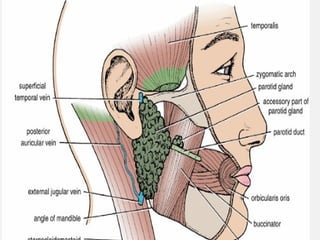
•The parotid region is the part of the
face below and in front of ear and
below the zygomatic arch but above
the limits of the anterior triangle .the
parotid gland lie in this region.
•**The parotid region is actually part of
the neck but it extends into the facial
region as well..
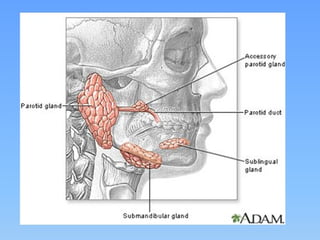
•]parotis-by the side of ear ]is the
largest of the main salivary glands
,lobulated and yellowish brown in color
. it is predominantly serous ,with only
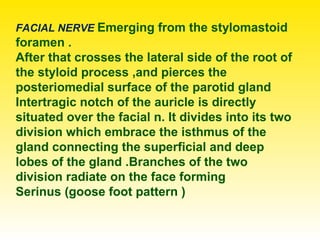
few scattered mucous acini . The
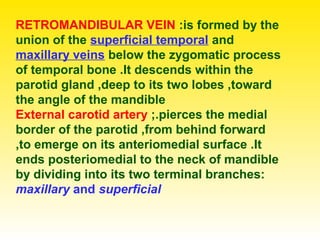
parotid gland divided by facial nerve
into deep part and superficial part ,lies
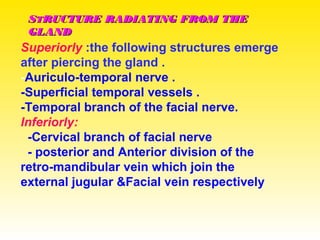
in space called parotid bed or
reteromandibular fossa
The parotid gland
parotid gland
•is a superficial structure located in the upper
neck above the posterior belly of the
digastric muscle. It is a salivary gland that
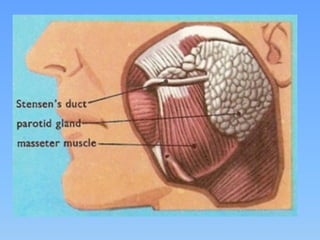
has a large duct which crosses the masseter
muscle to pierce the buccinator muscle
opposite the upper 2nd molar tooth.
frequently be rolled between the finger and
the masseter muscle The parotid gland
divided by facial nerve into deep part and
superficial part
-The parotid gland secrete a hormone
called parotin which:
a. Promotes growth of mesnchymal
tissues.
b. Lowers serum calcium level.
c. Stimulates calcifications
&leucocytes production in bone
marrow.
•**parotid gland enclosed within a fascial
capsule derived from investing layer of deep
cervical fascia of the neck which splits to
ensheath it.
•The superfaicial layer known as parotid fascia
is adherent to the gland and attached above to
the zygomatic arch.
•The deep layer has attachment to the lower
edge of of the tympanic plate of temprol bone
,the styloid process and posterior edge of
tympano- squmous fissure on the base of the
skull
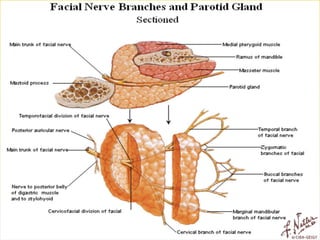
• **]If the parotid gland is carefully
removed , you can identify the
structures located within it. The first
plane is the venous plane and consists
of the retromandibular vein (rm) and its
tributaries and branches
•Boundaries:
•Anteriorly: raums of mandible sandwiched
between the asserter and medial pterygoid
muscles.
•Poseriorly: mastoid process between the
sternomastoid and the posterior belly of
digastric
•Superiorly: exsternal auditory meutus.
•Medially: styloid process with the
styloidhyoid ,styloglosseus and
stylopharyngal muscles
•Laterally :parotid fascia
Lobes and processes
•the gland is often described to consist of a
superficial and a deep lobe connected by a
short narrow part called the isthmus. this
gives the gland the shape of a collar stud
with superficial lobe forming the large part.
the facial nerve with its branches passes
forwards on either side of the neck of the
stud .the plane between the superficial and
deep lobe in which the nerve and the vein lie
has been designated by patey as the
faciovenous plane of the gland.
The superficial lobe:
•extends anteriorly on to the face to
cover part of the masseter ,the neck of
the mandible and the lateral aspect of
the temporo_mandibular joint .it is
called the facial process and may
separate to form the accessory parotid
gland.
The deep lobe:
•The deep lobe which extends medially
to the styloid process may form two
process _the pharyngeal process
which reaches the pharyngeal wall
_the pterygoid process which extends
anteriorly between the ramus of the
mandible and the medial pterygoid
muscle.
•The superior margin of the gland may be
extend superiorly behind the tmg in the
posterior part of mandibular fossa to form
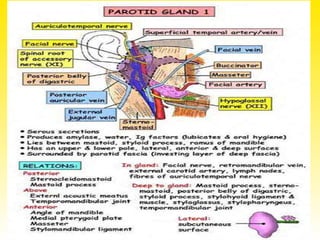
RelationsRelations
•*base :is seen as a small superior surface
and is concave. It is related to _the condyle
of the mandible. - the tympanic plate and the
external auditory meatus
•*apex: lies between the sternomastoid
muscle and the angle of the mandible .it lies
on _the posterior belly of the digastrics.
•*superficial -lateral surface is covered
with ((skin ,superficial fascia with some
fibers of platysma ,parotid fascia ,facial
branches of the great auricular nerve
,superficial parotid lymph nodes(
•*anteromedial surface :is grooved by the
posterior border of the ramus of mandible
and extends anteriorly on its superficial and
deep aspects to get related to _posterior
inferior part of the masseter muscle by the
facial process _lateral aspect of the tempro
mandibular joint.
•*Posteromedial surface is related to
(mastoid process ,sternomastoid muscle,
posterior belly of digastrics,styloid process
and the muscle attached to it are:
•stylohyoid styloglossus and stylopharyngeus(
parotid duct:
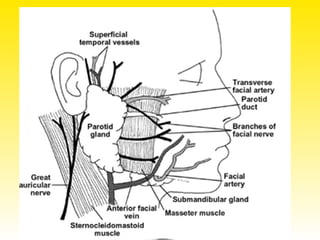
•The duct is about 2 in. (5 cm( long. it emerges
from the anterior border of the gland and
runs forwards across the masseter below the
facial process and the transverse facial
vessels. It turns medially around the anterior
border of the masseter at the level of the
upper lip and pierces the following
structures.:
•buccal pad of fat ,buccopharyngeal
fascia ,buccinator muscle ,mucous
membrane of the mouth. The ducts of the
other two main salivary gland open into the
mouth cavity proper and not into the
vestibule.
STRUCTURE INCIDE THE GLANDSTRUCTURE INCIDE THE GLAND
There are three main structures passing
through the gland . .
1-The most superficial is the facial nerve
2-deep to the nerve is the retro-
mandibular vein .
3-And deepest of all is the external carotid artery
,it also contains lymph nodes
4-and filaments of the auriculo-temporal nerve
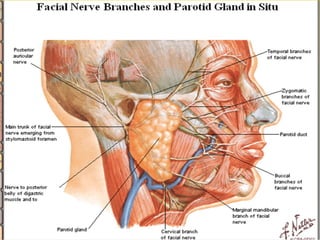
FACIAL NERVE Emerging from the stylomastoid
foramen .
After that crosses the lateral side of the root of
the styloid process ,and pierces the
posteriomedial surface of the parotid gland
Intertragic notch of the auricle is directly
situated over the facial n. It divides into its two
division which embrace the isthmus of the
gland connecting the superficial and deep
lobes of the gland .Branches of the two
division radiate on the face forming
Serinus (goose foot pattern (
RETROMANDIBULAR VEIN :is formed by the
union of the superficial temporal and
maxillary veins below the zygomatic process
of temporal bone .It descends within the
parotid gland ,deep to its two lobes ,toward
the angle of the mandible
External carotid artery ;.pierces the medial
border of the parotid ,from behind forward
,to emerge on its anteriomedial surface .It
ends posteriomedial to the neck of mandible
by dividing into its two terminal branches:
maxillary and superficial
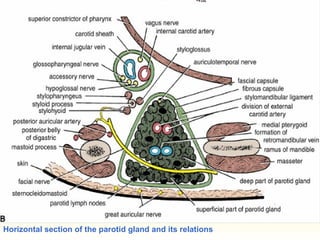
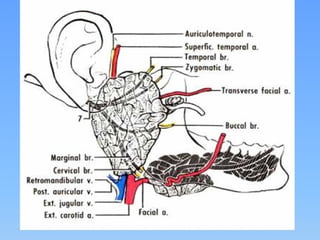
Horizontal section of the parotid gland and its relations
SSTTRUCTURE RADIATING FROM THERUCTURE RADIATING FROM THE
GLANDGLAND
Superiorly :the following structures emerge
after piercing the gland .
-Auriculo-temporal nerve .
-Superficial temporal vessels .
-Temporal branch of the facial nerve.
Inferiorly:
-Cervical branch of facial nerve
- posterior and Anterior division of the
retro-mandibular vein which join the
external jugular &Facial vein respectively
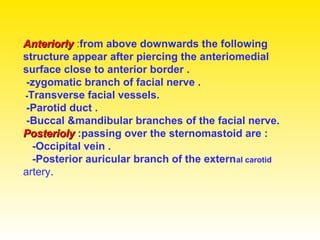
AnteriorlyAnteriorly :from above downwards the following
structure appear after piercing the anteriomedial
surface close to anterior border .
-zygomatic branch of facial nerve .
-Transverse facial vessels.
-Parotid duct .
-Buccal &mandibular branches of the facial nerve.
PosteriolyPosterioly :passing over the sternomastoid are :
-Occipital vein .
-Posterior auricular branch of the external carotid
artery.
;
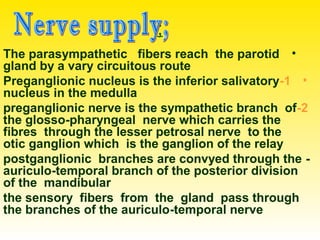
•The parasympathetic fibers reach the parotid
gland by a vary circuitous route
•1-Preganglionic nucleus is the inferior salivatory
nucleus in the medulla
2-preganglionic nerve is the sympathetic branch of
the glosso-pharyngeal nerve which carries the
fibres through the lesser petrosal nerve to the
otic ganglion which is the ganglion of the relay
-postganglionic branches are convyed through the
auriculo-temporal branch of the posterior division
of the mandibular
the sensory fibers from the gland pass through
the branches of the auriculo-temporal nerve
•.
-
the parotid fascia receives its sensory
innervation from the great auricular nerve
come from the external carotid plexus
the sympathetic fibers
(vasoconstrictor)come from the external
carotid plexus with their source in the
first thoracic segment after their relay in
the superior cervical ganglion. (C2)
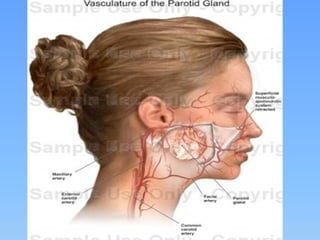
•The arterial supply is from the external
carotidand, the superficial temporal arteries.
•The venous drainage is into the
retromandibular and the external jugular
veins.
•Lymphatic drainage
•The lymphatic drian from superficial and the
deep parotid nodes and ultimately from the
deep cervical nodes.
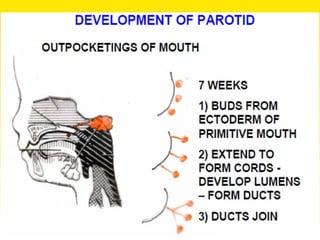
•The salivary gland arise from the
proliferation of the oral fissure and
grows back toward the ear. The bud
branches and canalizes and
differentiates into glandular tissue
•As the check forms:a groove on its
inner aspect closes over to form the
parotid duct.
Clinical
Notes
•1-the tumors of the parotid gland usually arise in the
superficial lobe without involvement of the facial nerve
;but an injury to the nerve during excision causes facial
palsy.
•inflammation of the parotid gland (parotitis) 2-painful
because the gland swells within the tight fibrous
capsule
•3-parotid calculi may form within the gland or the
duct.
•They can be located radiologically by a parotid
sialogram by injecting a radio-opaque contrast material
through the duct
•4-after parotidectomy there may be
regeneration of the secretomotorfibres
of the parotid gland contained in the
auriculo-temporal nerve .this cause
stimulation of the sweat gland in this
area of the auriculo-temporal nerve
producing redness and sweating in
the skin of the temple supplied by the
nerve this is called the Frey's
syndrome
•***Frey's Sdromeyn
•Frey's syndrome is an interesting complication
that sometimes develops after penetrating wounds
of the parotid gland. When the patient eats, beads
of perspiration appear on the skin covering the
parotid. This condition is caused by damage to the
auriculotemporal and great auricular nerves.
During the process of healing, the
parasympathetic secretomotor fibers in the
auriculotemporal nerve grow out and join the
distal end of the great auricular nerve. Eventually,
these fibers reach the sweat glands in the facial
skin. By this means, a stimulus intended for saliva
production produces sweat secretion instead.
•Parotid Duct Injury
•The parotid duct, which is a
comparatively superficial
structure on the face, may be
damaged in injuries to the face or
may be inadvertently cut during
surgical operations on the face.
Parotid region
Parotid region

Parotid region

  • 1.
    UploadUpload By :Ahmed Ali AbbasBy : Ahmed Ali Abbas Babylon University College of DentistryBabylon University College of Dentistry downloaddownload this file from Website onthis file from Website on GoogleGoogle TheOptimalSmile.wix.comTheOptimalSmile.wix.com choose Lectureschoose Lectures Then Second StageThen Second Stage Then choose the lecture you needThen choose the lecture you need
  • 3.
    •The parotid region •The parotidregion is the part of the face below and in front of ear and below the zygomatic arch but above the limits of the anterior triangle .the parotid gland lie in this region. •**The parotid region is actually part of the neck but it extends into the facial region as well..
  • 5.
    •]parotis-by the sideof ear ]is the largest of the main salivary glands ,lobulated and yellowish brown in color . it is predominantly serous ,with only few scattered mucous acini . The parotid gland divided by facial nerve into deep part and superficial part ,lies in space called parotid bed or reteromandibular fossa The parotid gland
  • 6.
    parotid gland •is asuperficial structure located in the upper neck above the posterior belly of the digastric muscle. It is a salivary gland that has a large duct which crosses the masseter muscle to pierce the buccinator muscle opposite the upper 2nd molar tooth. frequently be rolled between the finger and the masseter muscle The parotid gland divided by facial nerve into deep part and superficial part
  • 7.
    -The parotid glandsecrete a hormone called parotin which: a. Promotes growth of mesnchymal tissues. b. Lowers serum calcium level. c. Stimulates calcifications &leucocytes production in bone marrow.
  • 8.
    •**parotid gland enclosedwithin a fascial capsule derived from investing layer of deep cervical fascia of the neck which splits to ensheath it. •The superfaicial layer known as parotid fascia is adherent to the gland and attached above to the zygomatic arch. •The deep layer has attachment to the lower edge of of the tympanic plate of temprol bone ,the styloid process and posterior edge of tympano- squmous fissure on the base of the skull
  • 9.
    • **]If theparotid gland is carefully removed , you can identify the structures located within it. The first plane is the venous plane and consists of the retromandibular vein (rm) and its tributaries and branches
  • 10.
    •Boundaries: •Anteriorly: raums ofmandible sandwiched between the asserter and medial pterygoid muscles. •Poseriorly: mastoid process between the sternomastoid and the posterior belly of digastric •Superiorly: exsternal auditory meutus. •Medially: styloid process with the styloidhyoid ,styloglosseus and stylopharyngal muscles •Laterally :parotid fascia
  • 12.
    Lobes and processes •thegland is often described to consist of a superficial and a deep lobe connected by a short narrow part called the isthmus. this gives the gland the shape of a collar stud with superficial lobe forming the large part. the facial nerve with its branches passes forwards on either side of the neck of the stud .the plane between the superficial and deep lobe in which the nerve and the vein lie has been designated by patey as the faciovenous plane of the gland.
  • 13.
    The superficial lobe: •extendsanteriorly on to the face to cover part of the masseter ,the neck of the mandible and the lateral aspect of the temporo_mandibular joint .it is called the facial process and may separate to form the accessory parotid gland.
  • 14.
    The deep lobe: •Thedeep lobe which extends medially to the styloid process may form two process _the pharyngeal process which reaches the pharyngeal wall _the pterygoid process which extends anteriorly between the ramus of the mandible and the medial pterygoid muscle. •The superior margin of the gland may be extend superiorly behind the tmg in the posterior part of mandibular fossa to form
  • 16.
    RelationsRelations •*base :is seenas a small superior surface and is concave. It is related to _the condyle of the mandible. - the tympanic plate and the external auditory meatus •*apex: lies between the sternomastoid muscle and the angle of the mandible .it lies on _the posterior belly of the digastrics. •*superficial -lateral surface is covered with ((skin ,superficial fascia with some fibers of platysma ,parotid fascia ,facial branches of the great auricular nerve ,superficial parotid lymph nodes(
  • 17.
    •*anteromedial surface :isgrooved by the posterior border of the ramus of mandible and extends anteriorly on its superficial and deep aspects to get related to _posterior inferior part of the masseter muscle by the facial process _lateral aspect of the tempro mandibular joint. •*Posteromedial surface is related to (mastoid process ,sternomastoid muscle, posterior belly of digastrics,styloid process and the muscle attached to it are: •stylohyoid styloglossus and stylopharyngeus(
  • 19.
    parotid duct: •The ductis about 2 in. (5 cm( long. it emerges from the anterior border of the gland and runs forwards across the masseter below the facial process and the transverse facial vessels. It turns medially around the anterior border of the masseter at the level of the upper lip and pierces the following structures.: •buccal pad of fat ,buccopharyngeal fascia ,buccinator muscle ,mucous membrane of the mouth. The ducts of the other two main salivary gland open into the mouth cavity proper and not into the vestibule.
  • 20.
    STRUCTURE INCIDE THEGLANDSTRUCTURE INCIDE THE GLAND There are three main structures passing through the gland . . 1-The most superficial is the facial nerve 2-deep to the nerve is the retro- mandibular vein . 3-And deepest of all is the external carotid artery ,it also contains lymph nodes 4-and filaments of the auriculo-temporal nerve
  • 21.
    FACIAL NERVE Emergingfrom the stylomastoid foramen . After that crosses the lateral side of the root of the styloid process ,and pierces the posteriomedial surface of the parotid gland Intertragic notch of the auricle is directly situated over the facial n. It divides into its two division which embrace the isthmus of the gland connecting the superficial and deep lobes of the gland .Branches of the two division radiate on the face forming Serinus (goose foot pattern (
  • 22.
    RETROMANDIBULAR VEIN :isformed by the union of the superficial temporal and maxillary veins below the zygomatic process of temporal bone .It descends within the parotid gland ,deep to its two lobes ,toward the angle of the mandible External carotid artery ;.pierces the medial border of the parotid ,from behind forward ,to emerge on its anteriomedial surface .It ends posteriomedial to the neck of mandible by dividing into its two terminal branches: maxillary and superficial
  • 23.
    Horizontal section ofthe parotid gland and its relations
  • 24.
    SSTTRUCTURE RADIATING FROMTHERUCTURE RADIATING FROM THE GLANDGLAND Superiorly :the following structures emerge after piercing the gland . -Auriculo-temporal nerve . -Superficial temporal vessels . -Temporal branch of the facial nerve. Inferiorly: -Cervical branch of facial nerve - posterior and Anterior division of the retro-mandibular vein which join the external jugular &Facial vein respectively
  • 25.
    AnteriorlyAnteriorly :from abovedownwards the following structure appear after piercing the anteriomedial surface close to anterior border . -zygomatic branch of facial nerve . -Transverse facial vessels. -Parotid duct . -Buccal &mandibular branches of the facial nerve. PosteriolyPosterioly :passing over the sternomastoid are : -Occipital vein . -Posterior auricular branch of the external carotid artery.
  • 27.
    ; •The parasympathetic fibersreach the parotid gland by a vary circuitous route •1-Preganglionic nucleus is the inferior salivatory nucleus in the medulla 2-preganglionic nerve is the sympathetic branch of the glosso-pharyngeal nerve which carries the fibres through the lesser petrosal nerve to the otic ganglion which is the ganglion of the relay -postganglionic branches are convyed through the auriculo-temporal branch of the posterior division of the mandibular the sensory fibers from the gland pass through the branches of the auriculo-temporal nerve
  • 30.
    •. - the parotid fasciareceives its sensory innervation from the great auricular nerve come from the external carotid plexus the sympathetic fibers (vasoconstrictor)come from the external carotid plexus with their source in the first thoracic segment after their relay in the superior cervical ganglion. (C2)
  • 31.
    •The arterial supplyis from the external carotidand, the superficial temporal arteries. •The venous drainage is into the retromandibular and the external jugular veins. •Lymphatic drainage •The lymphatic drian from superficial and the deep parotid nodes and ultimately from the deep cervical nodes.
  • 34.
    •The salivary glandarise from the proliferation of the oral fissure and grows back toward the ear. The bud branches and canalizes and differentiates into glandular tissue •As the check forms:a groove on its inner aspect closes over to form the parotid duct.
  • 37.
    Clinical Notes •1-the tumors ofthe parotid gland usually arise in the superficial lobe without involvement of the facial nerve ;but an injury to the nerve during excision causes facial palsy. •inflammation of the parotid gland (parotitis) 2-painful because the gland swells within the tight fibrous capsule •3-parotid calculi may form within the gland or the duct. •They can be located radiologically by a parotid sialogram by injecting a radio-opaque contrast material through the duct
  • 38.
    •4-after parotidectomy theremay be regeneration of the secretomotorfibres of the parotid gland contained in the auriculo-temporal nerve .this cause stimulation of the sweat gland in this area of the auriculo-temporal nerve producing redness and sweating in the skin of the temple supplied by the nerve this is called the Frey's syndrome
  • 39.
    •***Frey's Sdromeyn •Frey's syndromeis an interesting complication that sometimes develops after penetrating wounds of the parotid gland. When the patient eats, beads of perspiration appear on the skin covering the parotid. This condition is caused by damage to the auriculotemporal and great auricular nerves. During the process of healing, the parasympathetic secretomotor fibers in the auriculotemporal nerve grow out and join the distal end of the great auricular nerve. Eventually, these fibers reach the sweat glands in the facial skin. By this means, a stimulus intended for saliva production produces sweat secretion instead.
  • 40.
    •Parotid Duct Injury •Theparotid duct, which is a comparatively superficial structure on the face, may be damaged in injuries to the face or may be inadvertently cut during surgical operations on the face.