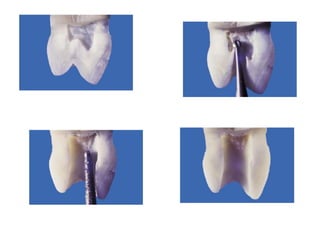
ACCESS CAVITY
PREPARATION
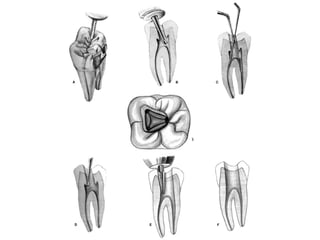
Endodontic access is based on the anatomy and morphology
of each tooth
Access cavity = Pulp space morphology

Objectives :
1.Locating all the canals

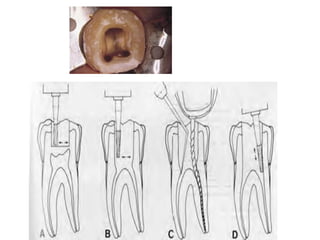
2.Straight line access to the apical third of the canal
3.Removal of the chamber roof and the coronal pulp tissue
4.Conservation of the tooth structure
General principles:
1.Outline form
2.Convenience form
3.Removing the remaining carious dentin and defective
restoration

4.Toilet of the cavity
General considerations:
1.Pre operative radiographic diagnosis to determine the degree
of case difficulty
2.Access opening should be performed under rubber dam
isolation always. In case of abnormal anatomies , rubber dam
may not be used.
3. But no files/broaches should be introduced into the canal
without rubber dam.

4.Care should be taken to prevent the tooth debris or pieces of
restorations from entering the root canals.
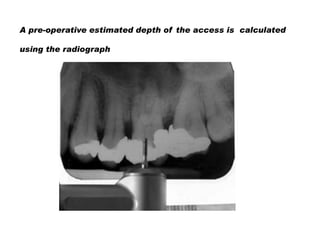
A pre-operative estimated depth of the access is calculated
using the radiograph
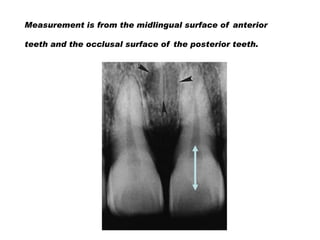
Measurement is from the midlingual surface of anterior

teeth and the occlusal surface of the posterior teeth.
Access

openings

are

made

preferably

with

High

speed

instruments.

The bur should start rotating before touching the tooth surface
and should continue rotating even after you take it out of the
cavity.

There should be good illumination [and magnification]

Once the roof of the chamber is opened, canals are located with
the endodontic probe
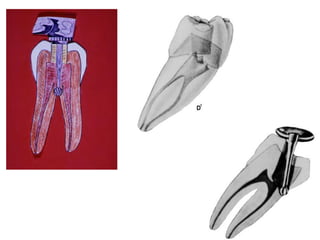
Whenever a tooth is inclined even the bur should be inclined to
be parallel to the long axis of the tooth.

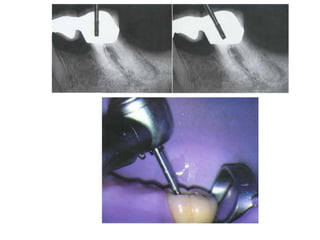
When there is a crown / restoration on the tooth, access
opening can be made through it.
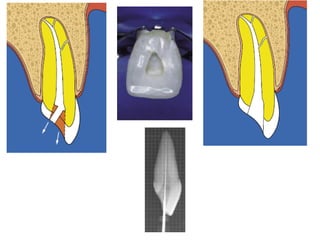
MAXILLARY ANTERIORS:

It has one root and one canal

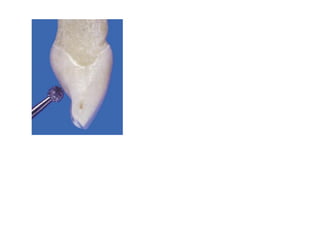
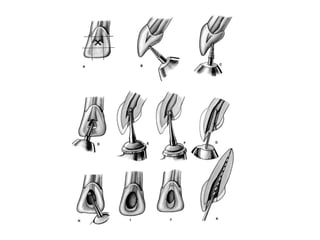
The initial preparation is made with a round bur placed at 45
degrees to the palatal/lingual surface of the tooth.

After penetrating to a depth of about 2-3mm into dentin, the
orientation of the bur is changed .

The bur is now placed parallel to the long axis of the tooth.
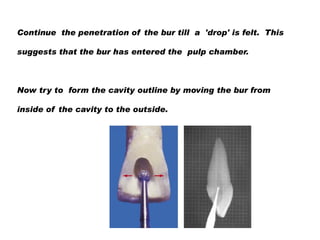
Continue the penetration of the bur till a 'drop' is felt. This
suggests that the bur has entered the pulp chamber.

Now try to form the cavity outline by moving the bur from
inside of the cavity to the outside.
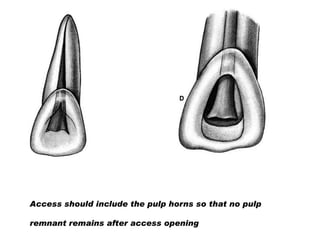
Access should include the pulp horns so that no pulp

remnant remains after access opening
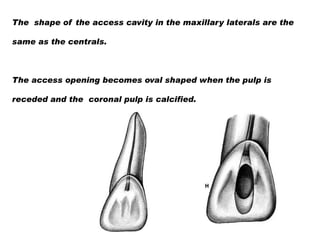
The shape of the access cavity in the maxillary laterals are the
same as the centrals.

The access opening becomes oval shaped when the pulp is
receded and the coronal pulp is calcified.
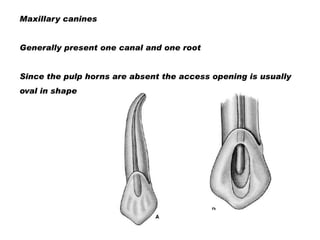
Maxillary canines
Generally present one canal and one root

Since the pulp horns are absent the access opening is usually
oval in shape
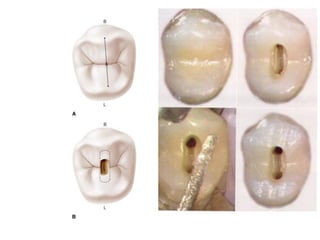
Maxillary premolars:

The maxillary first and second premolars have a similar outline
form.

The access opening is oval in shape in the buccolingual
direction.
Maxillary second Premolar

It usually has one root and one canal in 53-60%

The access opening is similar to the first premolar but it
does not have the bucco lingual extension as much as
the first premolar.
[unless if it has two canals]
Maxillary molars:
The maxillary first and second molars have more or less the same
outline form
The outline form is triangular with the tip of the triangle towards
the palatal surface and the base towards the facial surface.
The access opening is restricted to the mesial half of the
occlusal surface.
The transverse or oblique ridge is mostly left intact
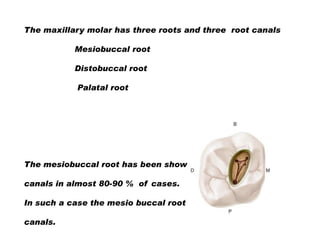
The maxillary molar has three roots and three root canals
Mesiobuccal root
Distobuccal root
Palatal root

The mesiobuccal root has been shown to have two root
canals in almost 80-90 % of cases.
In such a case the mesio buccal root has MB1 and MB2

canals.
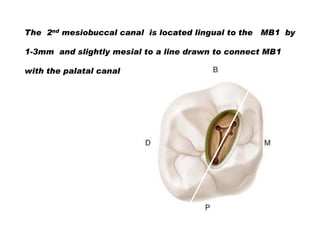
The 2nd mesiobuccal canal is located lingual to the MB1 by
1-3mm and slightly mesial to a line drawn to connect MB1
with the palatal canal
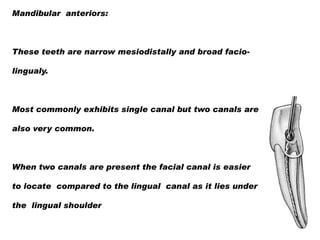
Mandibular anteriors:

These teeth are narrow mesiodistally and broad faciolingualy.

Most commonly exhibits single canal but two canals are
also very common.

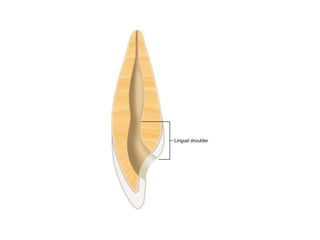
When two canals are present the facial canal is easier
to locate compared to the lingual canal as it lies under
the lingual shoulder
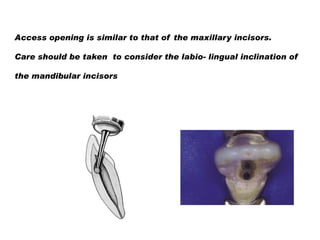
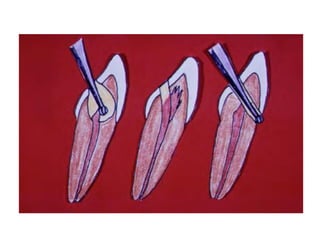
Access opening is similar to that of the maxillary incisors.
Care should be taken to consider the labio- lingual inclination of
the mandibular incisors
Mandibular canines:

•The mandibular canines have a more longer and slender crown
compared to maxillary canines.
•The shape of the access cavity is ovoid.

•The tooth is broader faciolingually compared to mesio distally.
•The tooth may exhibit two canals. The lingual canal is always
under the lingual
shoulder
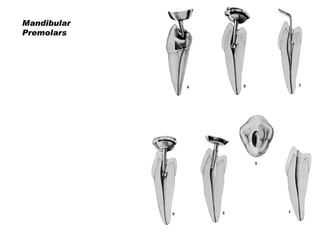
Mandibular
Premolars
Mandibular Molars:

Most commonly the mandibular molar exhibits 2 canals
in the mesial root and 1-2 canals in the distal root.
The canals are

Mesiobuccal
Mesiolingual
Distal
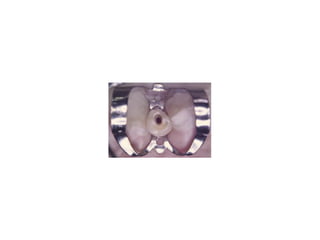
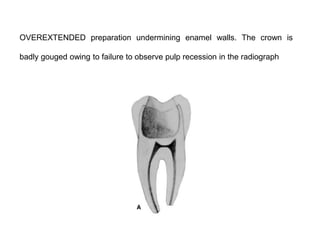
OVEREXTENDED preparation undermining enamel walls. The crown is
badly gouged owing to failure to observe pulp recession in the radiograph
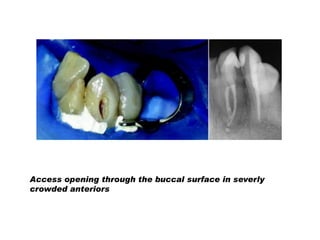
Access opening through the buccal surface in severly
crowded anteriors
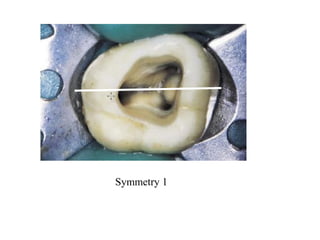
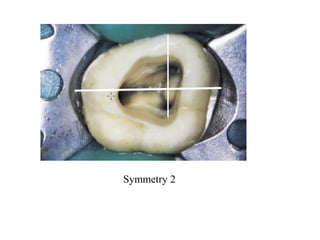
Symmetry 1
Symmetry 2
Locating extra canals
PREOPERATIVE
Tooth morphology:
Extra canals can be expected, when there is :

• Prominent cingulum (maxillary lateral incisors)
•

Prominent lingual cusp (mandibular premolars)

•

Prominent and mesio-distally wide buccal cusp (maxillary

premolars and mandibular molars)
•

Prominent buccal cusp and wider bucco-lingual dimension
on the mesial side (maxillary molars)
Radiographs:
Common features that indicate the presence of extra canals are
•

Short crown root ratio

•

Sudden narrowing or "disappearing" of the pulp space.
However, absence of "disappearance" of a main canal
does not rule out division of the canals.

•

If the pulp chamber in a radiograph appears to deviate
from the normal morphology and seem to be either
triangular in shape or too large.

•

Twin periodontal ligament spaces

• Unusual contour of the tooth.
INTRA OPERATIVE
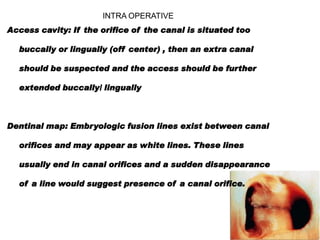
Access cavity: If the orifice of the canal is situated too
buccally or lingually (off center) , then an extra canal
should be suspected and the access should be further
extended buccally/ lingually

Dentinal map: Embryologic fusion lines exist between canal
orifices and may appear as white lines. These lines
usually end in canal orifices and a sudden disappearance
of a line would suggest presence of a canal orifice.
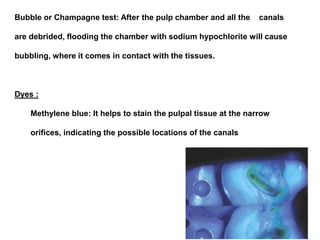
Bubble or Champagne test: After the pulp chamber and all the

canals

are debrided, flooding the chamber with sodium hypochlorite will cause
bubbling, where it comes in contact with the tissues.

Dyes :
Methylene blue: It helps to stain the pulpal tissue at the narrow
orifices, indicating the possible locations of the canals
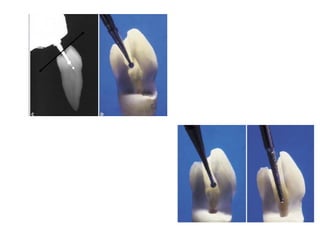
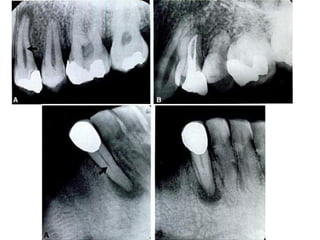
Diagnostic radiograph: An extra dark line apparent in the coronal
third of the root adjacent to the diagnostic file, running parallel
to it, could suggest an extra canal.
POST OPERATIVE
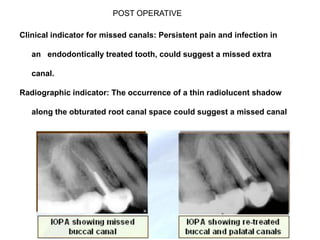
Clinical indicator for missed canals: Persistent pain and infection in
an endodontically treated tooth, could suggest a missed extra

canal.
Radiographic indicator: The occurrence of a thin radiolucent shadow
along the obturated root canal space could suggest a missed canal

Access cavity preparation

  • 1.
  • 2.
    Endodontic access isbased on the anatomy and morphology of each tooth Access cavity = Pulp space morphology Objectives : 1.Locating all the canals 2.Straight line access to the apical third of the canal 3.Removal of the chamber roof and the coronal pulp tissue 4.Conservation of the tooth structure
  • 3.
    General principles: 1.Outline form 2.Convenienceform 3.Removing the remaining carious dentin and defective restoration 4.Toilet of the cavity
  • 4.
    General considerations: 1.Pre operativeradiographic diagnosis to determine the degree of case difficulty 2.Access opening should be performed under rubber dam isolation always. In case of abnormal anatomies , rubber dam may not be used. 3. But no files/broaches should be introduced into the canal without rubber dam. 4.Care should be taken to prevent the tooth debris or pieces of restorations from entering the root canals.
  • 5.
    A pre-operative estimateddepth of the access is calculated using the radiograph
  • 6.
    Measurement is fromthe midlingual surface of anterior teeth and the occlusal surface of the posterior teeth.
  • 7.
    Access openings are made preferably with High speed instruments. The bur shouldstart rotating before touching the tooth surface and should continue rotating even after you take it out of the cavity. There should be good illumination [and magnification] Once the roof of the chamber is opened, canals are located with the endodontic probe
  • 8.
    Whenever a toothis inclined even the bur should be inclined to be parallel to the long axis of the tooth. When there is a crown / restoration on the tooth, access opening can be made through it.
  • 9.
    MAXILLARY ANTERIORS: It hasone root and one canal The initial preparation is made with a round bur placed at 45 degrees to the palatal/lingual surface of the tooth. After penetrating to a depth of about 2-3mm into dentin, the orientation of the bur is changed . The bur is now placed parallel to the long axis of the tooth.
  • 11.
    Continue the penetrationof the bur till a 'drop' is felt. This suggests that the bur has entered the pulp chamber. Now try to form the cavity outline by moving the bur from inside of the cavity to the outside.
  • 13.
    Access should includethe pulp horns so that no pulp remnant remains after access opening
  • 15.
    The shape ofthe access cavity in the maxillary laterals are the same as the centrals. The access opening becomes oval shaped when the pulp is receded and the coronal pulp is calcified.
  • 16.
    Maxillary canines Generally presentone canal and one root Since the pulp horns are absent the access opening is usually oval in shape
  • 18.
    Maxillary premolars: The maxillaryfirst and second premolars have a similar outline form. The access opening is oval in shape in the buccolingual direction.
  • 21.
    Maxillary second Premolar Itusually has one root and one canal in 53-60% The access opening is similar to the first premolar but it does not have the bucco lingual extension as much as the first premolar. [unless if it has two canals]
  • 22.
    Maxillary molars: The maxillaryfirst and second molars have more or less the same outline form The outline form is triangular with the tip of the triangle towards the palatal surface and the base towards the facial surface. The access opening is restricted to the mesial half of the occlusal surface. The transverse or oblique ridge is mostly left intact
  • 23.
    The maxillary molarhas three roots and three root canals Mesiobuccal root Distobuccal root Palatal root The mesiobuccal root has been shown to have two root canals in almost 80-90 % of cases. In such a case the mesio buccal root has MB1 and MB2 canals.
  • 24.
    The 2nd mesiobuccalcanal is located lingual to the MB1 by 1-3mm and slightly mesial to a line drawn to connect MB1 with the palatal canal
  • 25.
    Mandibular anteriors: These teethare narrow mesiodistally and broad faciolingualy. Most commonly exhibits single canal but two canals are also very common. When two canals are present the facial canal is easier to locate compared to the lingual canal as it lies under the lingual shoulder
  • 26.
    Access opening issimilar to that of the maxillary incisors. Care should be taken to consider the labio- lingual inclination of the mandibular incisors
  • 28.
    Mandibular canines: •The mandibularcanines have a more longer and slender crown compared to maxillary canines. •The shape of the access cavity is ovoid. •The tooth is broader faciolingually compared to mesio distally. •The tooth may exhibit two canals. The lingual canal is always under the lingual shoulder
  • 30.
  • 32.
    Mandibular Molars: Most commonlythe mandibular molar exhibits 2 canals in the mesial root and 1-2 canals in the distal root. The canals are Mesiobuccal Mesiolingual Distal
  • 36.
    OVEREXTENDED preparation underminingenamel walls. The crown is badly gouged owing to failure to observe pulp recession in the radiograph
  • 38.
    Access opening throughthe buccal surface in severly crowded anteriors
  • 40.
  • 41.
  • 42.
    Locating extra canals PREOPERATIVE Toothmorphology: Extra canals can be expected, when there is : • Prominent cingulum (maxillary lateral incisors) • Prominent lingual cusp (mandibular premolars) • Prominent and mesio-distally wide buccal cusp (maxillary premolars and mandibular molars) • Prominent buccal cusp and wider bucco-lingual dimension on the mesial side (maxillary molars)
  • 43.
    Radiographs: Common features thatindicate the presence of extra canals are • Short crown root ratio • Sudden narrowing or "disappearing" of the pulp space. However, absence of "disappearance" of a main canal does not rule out division of the canals. • If the pulp chamber in a radiograph appears to deviate from the normal morphology and seem to be either triangular in shape or too large. • Twin periodontal ligament spaces • Unusual contour of the tooth.
  • 45.
    INTRA OPERATIVE Access cavity:If the orifice of the canal is situated too buccally or lingually (off center) , then an extra canal should be suspected and the access should be further extended buccally/ lingually Dentinal map: Embryologic fusion lines exist between canal orifices and may appear as white lines. These lines usually end in canal orifices and a sudden disappearance of a line would suggest presence of a canal orifice.
  • 46.
    Bubble or Champagnetest: After the pulp chamber and all the canals are debrided, flooding the chamber with sodium hypochlorite will cause bubbling, where it comes in contact with the tissues. Dyes : Methylene blue: It helps to stain the pulpal tissue at the narrow orifices, indicating the possible locations of the canals
  • 47.
    Diagnostic radiograph: Anextra dark line apparent in the coronal third of the root adjacent to the diagnostic file, running parallel to it, could suggest an extra canal.
  • 48.
    POST OPERATIVE Clinical indicatorfor missed canals: Persistent pain and infection in an endodontically treated tooth, could suggest a missed extra canal. Radiographic indicator: The occurrence of a thin radiolucent shadow along the obturated root canal space could suggest a missed canal