Deep carious lesions
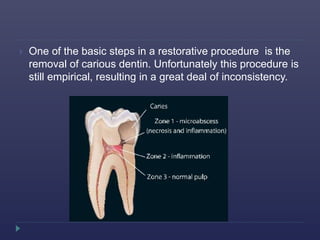
 One of the basic steps in a restorative procedure is the
removal of carious dentin. Unfortunately this procedure is
still empirical, resulting in a great deal of inconsistency.
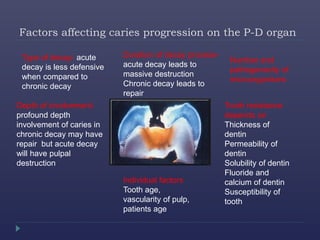
Factors affecting caries progression on the P-D organ
Type of decay- acute
decay is less defensive
when compared to
chronic decay
Duration of decay process-
acute decay leads to
massive destruction
Chronic decay leads to
repair
Depth of involvement-
profound depth
involvement of caries in
chronic decay may have
repair but acute decay
will have pulpal
destruction
Number and
pathogenecity of
microorganisms
Tooth resistance
depends on
Thickness of
dentin
Permeability of
dentin
Solubility of dentin
Fluoride and
calcium of dentin
Susceptibility of
tooth
Individual factors
Tooth age,
vascularity of pulp,
patients age
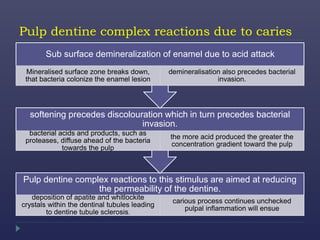
Pulp dentine complex reactions due to caries
Pulp dentine complex reactions to this stimulus are aimed at reducing
the permeability of the dentine.
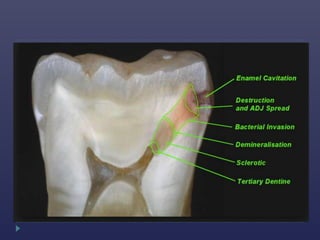
deposition of apatite and whitlockite
crystals within the dentinal tubules leading
to dentine tubule sclerosis.
carious process continues unchecked
pulpal inflammation will ensue
softening precedes discolouration which in turn precedes bacterial
invasion.
bacterial acids and products, such as
proteases, diffuse ahead of the bacteria
towards the pulp
the more acid produced the greater the
concentration gradient toward the pulp
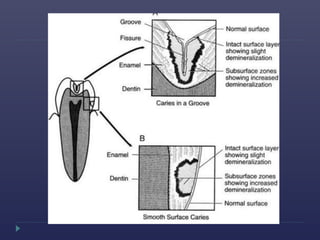
Sub surface demineralization of enamel due to acid attack
Mineralised surface zone breaks down,
that bacteria colonize the enamel lesion
demineralisation also precedes bacterial
invasion.
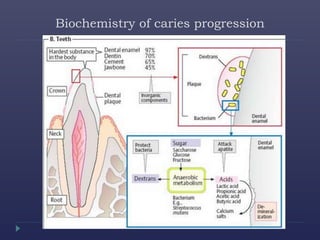
Biochemistry of caries progression
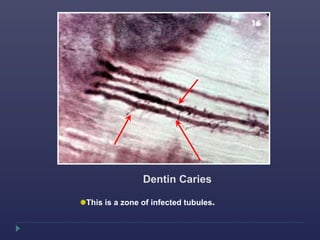
Dentin Caries
This is a zone of infected tubules.
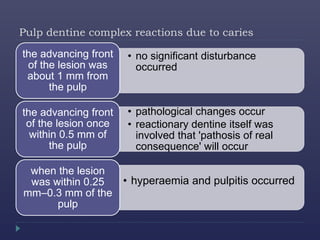
Pulp dentine complex reactions due to caries
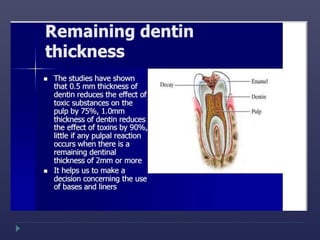
• no significant disturbance
occurred
the advancing front
of the lesion was
about 1 mm from
the pulp
• pathological changes occur
• reactionary dentine itself was
involved that 'pathosis of real
consequence' will occur
the advancing front
of the lesion once
within 0.5 mm of
the pulp
• hyperaemia and pulpitis occurred
when the lesion
was within 0.25
mm–0.3 mm of the
pulp
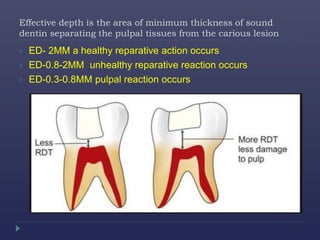
Effective depth is the area of minimum thickness of sound
dentin separating the pulpal tissues from the carious lesion
 ED- 2MM a healthy reparative action occurs
 ED-0.8-2MM unhealthy reparative reaction occurs
 ED-0.3-0.8MM pulpal reaction occurs
Diagnosis of deep carious lesion
 Pain
 Radiographs
 Pulp testing
 Direct pulpal exposure
 Percussion sensitivity
 Selective infiltration
 Dyes- 0.5% basic fuchsin in propylene glycol
Observe pulp exposure
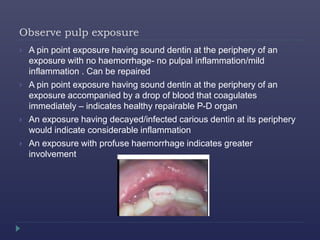
 A pin point exposure having sound dentin at the periphery of an
exposure with no haemorrhage- no pulpal inflammation/mild
inflammation . Can be repaired
 A pin point exposure having sound dentin at the periphery of an
exposure accompanied by a drop of blood that coagulates
immediately – indicates healthy repairable P-D organ
 An exposure having decayed/infected carious dentin at its periphery
would indicate considerable inflammation
 An exposure with profuse haemorrhage indicates greater
involvement
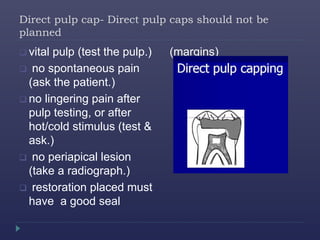
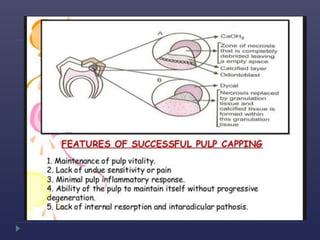
Direct pulp cap- Direct pulp caps should not be
planned
 vital pulp (test the pulp.)
 no spontaneous pain
(ask the patient.)
 no lingering pain after
pulp testing, or after
hot/cold stimulus (test &
ask.)
 no periapical lesion
(take a radiograph.)
 restoration placed must
have a good seal
(margins)
Materials
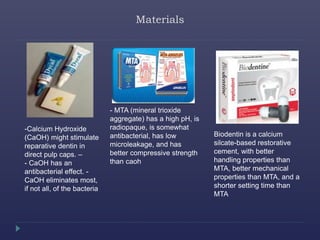
-Calcium Hydroxide
(CaOH) might stimulate
reparative dentin in
direct pulp caps. –
- CaOH has an
antibacterial effect. -
CaOH eliminates most,
if not all, of the bacteria
- MTA (mineral trioxide
aggregate) has a high pH, is
radiopaque, is somewhat
antibacterial, has low
microleakage, and has
better compressive strength
than caoh
Biodentin is a calcium
silcate-based restorative
cement, with better
handling properties than
MTA, better mechanical
properties than MTA, and a
shorter setting time than
MTA
What is the success rate of the pulp cap technique?
Difficult to establish
Prognosis of teeth that have received direct pulp caps as a result of
trauma would appear good
Loss of pulp vitality in these teeth poses a problem
Significant amount of physiological secondary and reactionary
dentine would have developed
Complicates subsequent root canal treatment
The root canal system may have become infected and prognosis for
root treatment is less favorable
Success of the direct pulp cap for carious exposures is
questionable??
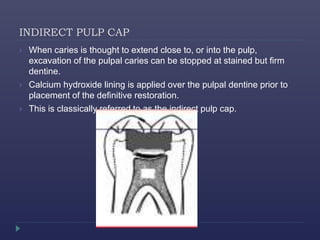
INDIRECT PULP CAP
 When caries is thought to extend close to, or into the pulp,
excavation of the pulpal caries can be stopped at stained but firm
dentine.
 Calcium hydroxide lining is applied over the pulpal dentine prior to
placement of the definitive restoration.
 This is classically referred to as the indirect pulp cap.
 WHY is an indirect pulp cap superior to a direct cap?
 Allows a remaining protective thickness of dentin
 Reparative dentin formation is enhanced
 Lowered chance of introducing bacteria into the pulp
(which causes an inflammatory reaction)
 The difficulty with this technique is knowing how rapid the
carious process has been, how much tertiary dentine has
been formed and knowing exactly when to stop
excavating to avoid pulp exposure
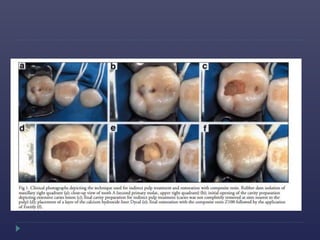
 STEPWISE EXCAVATION –
Caries removal is accomplished over two visits. - The interval
between visits can be anywhere from 3 weeks to 2 years.
Only some of the soft dentin is removed at the first visit. The
lesion is restored.
At the second visit, the tooth is re-opened, and soft caries can
be removed.
The tooth is now restored definitively.
This technique is successful in avoiding a pulp exposure. -
Symptoms are rare.
Dentin often appears altered on re-entry.
Bacterial numbers decrease.
WHY RE-ENTER??
 cavities that were re-entered and the dentine in all
teeth was found to be darker in colour, harder and
drier in consistency.
 By removing some of the carious biomass and
sealing the remaining caries from extrinsic substrate
and oral bacteria, the caries left behind after the first
excavation had become less active.
 It has also been suggested that by changing the
cavity environment from an active lesion into the
condition of a more slowly progressing lesion, this
will be accompanied by more regular tubular tertiary
dentine formation
 Following sealing caries into the tooth carious dentin
becomes dry, harder and darker in colour.
 As a result, there is shrinkage of the tissue leaving a
void beneath the restoration.
 The final excavation is done because it is more
convenient to excavate the harder, darker caries
than the soft yellow demineralized dentin
 ADVANTAGES OF RE-
ENTRY –
 get to evaluate tooth /
pulp
 see proof of
remineralization
 might remove dead
tissue
 DISADVANTAGES OF
RE-ENTRY –
 second fee to patient
anesthesia again
 further trauma to tooth?
second chance to hit
pulp
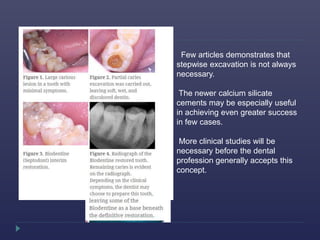
Few articles demonstrates that
stepwise excavation is not always
necessary.
The newer calcium silicate
cements may be especially useful
in achieving even greater success
in few cases.
More clinical studies will be
necessary before the dental
profession generally accepts this
concept.
Deep carious lesions

Deep carious lesions

  • 1.
  • 2.
     One ofthe basic steps in a restorative procedure is the removal of carious dentin. Unfortunately this procedure is still empirical, resulting in a great deal of inconsistency.
  • 3.
    Factors affecting cariesprogression on the P-D organ Type of decay- acute decay is less defensive when compared to chronic decay Duration of decay process- acute decay leads to massive destruction Chronic decay leads to repair Depth of involvement- profound depth involvement of caries in chronic decay may have repair but acute decay will have pulpal destruction Number and pathogenecity of microorganisms Tooth resistance depends on Thickness of dentin Permeability of dentin Solubility of dentin Fluoride and calcium of dentin Susceptibility of tooth Individual factors Tooth age, vascularity of pulp, patients age
  • 4.
    Pulp dentine complexreactions due to caries Pulp dentine complex reactions to this stimulus are aimed at reducing the permeability of the dentine. deposition of apatite and whitlockite crystals within the dentinal tubules leading to dentine tubule sclerosis. carious process continues unchecked pulpal inflammation will ensue softening precedes discolouration which in turn precedes bacterial invasion. bacterial acids and products, such as proteases, diffuse ahead of the bacteria towards the pulp the more acid produced the greater the concentration gradient toward the pulp Sub surface demineralization of enamel due to acid attack Mineralised surface zone breaks down, that bacteria colonize the enamel lesion demineralisation also precedes bacterial invasion.
  • 5.
  • 7.
    Dentin Caries This isa zone of infected tubules.
  • 9.
    Pulp dentine complexreactions due to caries • no significant disturbance occurred the advancing front of the lesion was about 1 mm from the pulp • pathological changes occur • reactionary dentine itself was involved that 'pathosis of real consequence' will occur the advancing front of the lesion once within 0.5 mm of the pulp • hyperaemia and pulpitis occurred when the lesion was within 0.25 mm–0.3 mm of the pulp
  • 10.
    Effective depth isthe area of minimum thickness of sound dentin separating the pulpal tissues from the carious lesion  ED- 2MM a healthy reparative action occurs  ED-0.8-2MM unhealthy reparative reaction occurs  ED-0.3-0.8MM pulpal reaction occurs
  • 12.
    Diagnosis of deepcarious lesion  Pain  Radiographs  Pulp testing  Direct pulpal exposure  Percussion sensitivity  Selective infiltration  Dyes- 0.5% basic fuchsin in propylene glycol
  • 13.
    Observe pulp exposure A pin point exposure having sound dentin at the periphery of an exposure with no haemorrhage- no pulpal inflammation/mild inflammation . Can be repaired  A pin point exposure having sound dentin at the periphery of an exposure accompanied by a drop of blood that coagulates immediately – indicates healthy repairable P-D organ  An exposure having decayed/infected carious dentin at its periphery would indicate considerable inflammation  An exposure with profuse haemorrhage indicates greater involvement
  • 15.
    Direct pulp cap-Direct pulp caps should not be planned  vital pulp (test the pulp.)  no spontaneous pain (ask the patient.)  no lingering pain after pulp testing, or after hot/cold stimulus (test & ask.)  no periapical lesion (take a radiograph.)  restoration placed must have a good seal (margins)
  • 16.
    Materials -Calcium Hydroxide (CaOH) mightstimulate reparative dentin in direct pulp caps. – - CaOH has an antibacterial effect. - CaOH eliminates most, if not all, of the bacteria - MTA (mineral trioxide aggregate) has a high pH, is radiopaque, is somewhat antibacterial, has low microleakage, and has better compressive strength than caoh Biodentin is a calcium silcate-based restorative cement, with better handling properties than MTA, better mechanical properties than MTA, and a shorter setting time than MTA
  • 17.
    What is thesuccess rate of the pulp cap technique? Difficult to establish Prognosis of teeth that have received direct pulp caps as a result of trauma would appear good Loss of pulp vitality in these teeth poses a problem Significant amount of physiological secondary and reactionary dentine would have developed Complicates subsequent root canal treatment The root canal system may have become infected and prognosis for root treatment is less favorable Success of the direct pulp cap for carious exposures is questionable??
  • 18.
    INDIRECT PULP CAP When caries is thought to extend close to, or into the pulp, excavation of the pulpal caries can be stopped at stained but firm dentine.  Calcium hydroxide lining is applied over the pulpal dentine prior to placement of the definitive restoration.  This is classically referred to as the indirect pulp cap.
  • 21.
     WHY isan indirect pulp cap superior to a direct cap?  Allows a remaining protective thickness of dentin  Reparative dentin formation is enhanced  Lowered chance of introducing bacteria into the pulp (which causes an inflammatory reaction)  The difficulty with this technique is knowing how rapid the carious process has been, how much tertiary dentine has been formed and knowing exactly when to stop excavating to avoid pulp exposure
  • 22.
     STEPWISE EXCAVATION– Caries removal is accomplished over two visits. - The interval between visits can be anywhere from 3 weeks to 2 years. Only some of the soft dentin is removed at the first visit. The lesion is restored. At the second visit, the tooth is re-opened, and soft caries can be removed. The tooth is now restored definitively. This technique is successful in avoiding a pulp exposure. - Symptoms are rare. Dentin often appears altered on re-entry. Bacterial numbers decrease.
  • 23.
    WHY RE-ENTER??  cavitiesthat were re-entered and the dentine in all teeth was found to be darker in colour, harder and drier in consistency.  By removing some of the carious biomass and sealing the remaining caries from extrinsic substrate and oral bacteria, the caries left behind after the first excavation had become less active.  It has also been suggested that by changing the cavity environment from an active lesion into the condition of a more slowly progressing lesion, this will be accompanied by more regular tubular tertiary dentine formation
  • 24.
     Following sealingcaries into the tooth carious dentin becomes dry, harder and darker in colour.  As a result, there is shrinkage of the tissue leaving a void beneath the restoration.  The final excavation is done because it is more convenient to excavate the harder, darker caries than the soft yellow demineralized dentin
  • 25.
     ADVANTAGES OFRE- ENTRY –  get to evaluate tooth / pulp  see proof of remineralization  might remove dead tissue  DISADVANTAGES OF RE-ENTRY –  second fee to patient anesthesia again  further trauma to tooth? second chance to hit pulp
  • 26.
    Few articles demonstratesthat stepwise excavation is not always necessary. The newer calcium silicate cements may be especially useful in achieving even greater success in few cases. More clinical studies will be necessary before the dental profession generally accepts this concept.