Organic Pedagogical Electronic
Network
Hammett Parameters
Eric Amerling & Christine Nervig
University of Utah
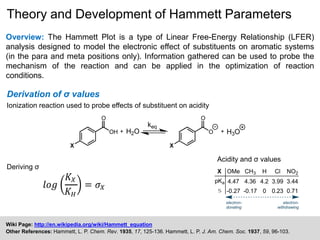
Derivation of σ values
Ionization reaction used to probe effects of substituent on acidity
Deriving σ
Theory and Development of Hammett Parameters
Overview: The Hammett Plot is a type of Linear Free-Energy Relationship (LFER)
analysis designed to model the electronic effect of substituents on aromatic systems
(in the para and meta positions only). Information gathered can be used to probe the
mechanism of the reaction and can be applied in the optimization of reaction
conditions.
Wiki Page: http://en.wikipedia.org/wiki/Hammett_equation
Other References: Hammett, L. P. Chem. Rev. 1935, 17, 125-136. Hammett, L. P. J. Am. Chem. Soc. 1937, 59, 96-103.
Acidity and σ values
X OMe H Cl NO2CH3
pKa
s 0-0.27 -0.17 0.23 0.71
3.443.994.24.47 4.36
electron-
donating
electron-
withdrawing
O
OH
X
O
O
X
H2O H3O
keq
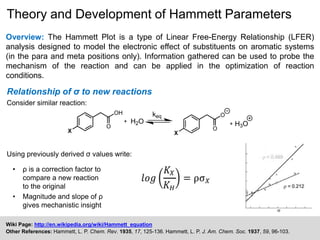
Relationship of σ to new reactions
Consider similar reaction:
Using previously derived σ values write:
Theory and Development of Hammett Parameters
Overview: The Hammett Plot is a type of Linear Free-Energy Relationship (LFER)
analysis designed to model the electronic effect of substituents on aromatic systems
(in the para and meta positions only). Information gathered can be used to probe the
mechanism of the reaction and can be applied in the optimization of reaction
conditions.
Wiki Page: http://en.wikipedia.org/wiki/Hammett_equation
Other References: Hammett, L. P. Chem. Rev. 1935, 17, 125-136. Hammett, L. P. J. Am. Chem. Soc. 1937, 59, 96-103.
X X
H2O H3O
keq
O
OH
O
O
• ρ is a correction factor to
compare a new reaction
to the original
• Magnitude and slope of ρ
gives mechanistic insight
Applications of Hammett Parameters
References: Neu, H. M.; Yang, T.; Baglia, R. A.; Yosca, T. H.; Green, M. T.; Quesne, M. G.; de Visser, S. P.; Goldberg, D. P. J. Am.
Chem. Soc. 2014, 136, 13845-13852
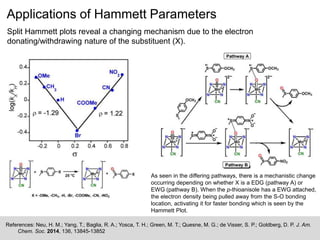
Split Hammett plots reveal a changing mechanism due to the electron
donating/withdrawing nature of the substituent (X).
As seen in the differing pathways, there is a mechanistic change
occurring depending on whether X is a EDG (pathway A) or
EWG (pathway B). When the p-thioanisole has a EWG attached,
the electron density being pulled away from the S-O bonding
location, activating it for faster bonding which is seen by the
Hammett Plot.
Problems
References: Moerdyk, J. P.; Blake, G. A.; Chase, D. T.; Bielawski, C. W. J. Am. Chem. Soc. 2013, 135, 18798-18801.
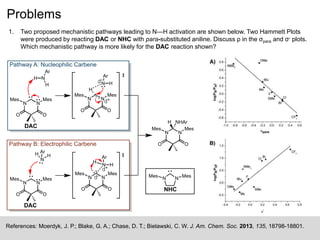
1. Two proposed mechanistic pathways leading to N—H activation are shown below. Two Hammett Plots
were produced by reacting DAC or NHC with para-substituted aniline. Discuss ρ in the σpara and σ- plots.
Which mechanistic pathway is more likely for the DAC reaction shown?
N N
OO
Mes Mes
N N
OO
Mes Mes
H N
Ar
H
N
ArH H
N N
OO
Mes Mes
N N
OO
Mes Mes
H
N H
Ar
N
H
H
Ar
d+
d-
d-
d+
N N
OO
Mes Mes
H NHAr
Pathway B: Electrophilic Carbene
Pathway A: Nucleophilic Carbene
DAC
DAC
NN MesMes
NHC
Problems
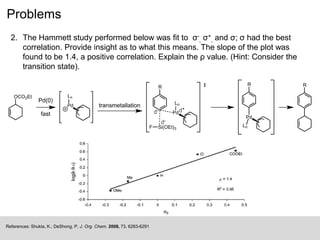
2. The Hammett study performed below was fit to σ-
, σ+
, and σ; σ had the best
correlation. Provide insight as to what this means. The slope of the plot was
found to be 1.4, a positive correlation. Explain the ρ value. (Hint: Consider the
transition state).
References: Shukla, K.; DeShong, P. J. Org. Chem. 2008, 73, 6283-6291
OCO2Et
Pd
Ln
Pd
Ln
R
F Si(OEt)3
d+
d-
d-
Pd
Ln
R R
Pd(0)
fast
transmetallation
Solutions
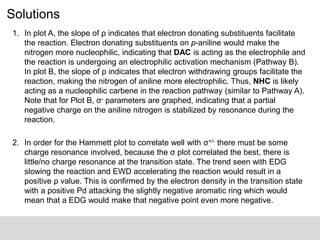
1. In plot A, the slope of ρ indicates that electron donating substituents facilitate
the reaction. Electron donating substituents on p-aniline would make the
nitrogen more nucleophilic, indicating that DAC is acting as the electrophile and
the reaction is undergoing an electrophilic activation mechanism (Pathway B).
In plot B, the slope of ρ indicates that electron withdrawing groups facilitate the
reaction, making the nitrogen of aniline more electrophilic. Thus, NHC is likely
acting as a nucleophilic carbene in the reaction pathway (similar to Pathway A).
Note that for Plot B, σ- parameters are graphed, indicating that a partial
negative charge on the aniline nitrogen is stabilized by resonance during the
reaction.
2. In order for the Hammett plot to correlate well with σ+/- there must be some
charge resonance involved, because the σ plot correlated the best, there is
little/no charge resonance at the transition state. The trend seen with EDG
slowing the reaction and EWD accelerating the reaction would result in a
positive ρ value. This is confirmed by the electron density in the transition state
with a positive Pd attacking the slightly negative aromatic ring which would
mean that a EDG would make that negative point even more negative.
This work is licensed under a
Creative Commons Attribution-
ShareAlike 4.0 International
License.
Contributed by:
Eric Amerling & Christine Nervig (Undergraduates)
University of Utah, 2013

Hammett parameters

  • 1.
    Organic Pedagogical Electronic Network HammettParameters Eric Amerling & Christine Nervig University of Utah
  • 2.
    Derivation of σvalues Ionization reaction used to probe effects of substituent on acidity Deriving σ Theory and Development of Hammett Parameters Overview: The Hammett Plot is a type of Linear Free-Energy Relationship (LFER) analysis designed to model the electronic effect of substituents on aromatic systems (in the para and meta positions only). Information gathered can be used to probe the mechanism of the reaction and can be applied in the optimization of reaction conditions. Wiki Page: http://en.wikipedia.org/wiki/Hammett_equation Other References: Hammett, L. P. Chem. Rev. 1935, 17, 125-136. Hammett, L. P. J. Am. Chem. Soc. 1937, 59, 96-103. Acidity and σ values X OMe H Cl NO2CH3 pKa s 0-0.27 -0.17 0.23 0.71 3.443.994.24.47 4.36 electron- donating electron- withdrawing O OH X O O X H2O H3O keq
  • 3.
    Relationship of σto new reactions Consider similar reaction: Using previously derived σ values write: Theory and Development of Hammett Parameters Overview: The Hammett Plot is a type of Linear Free-Energy Relationship (LFER) analysis designed to model the electronic effect of substituents on aromatic systems (in the para and meta positions only). Information gathered can be used to probe the mechanism of the reaction and can be applied in the optimization of reaction conditions. Wiki Page: http://en.wikipedia.org/wiki/Hammett_equation Other References: Hammett, L. P. Chem. Rev. 1935, 17, 125-136. Hammett, L. P. J. Am. Chem. Soc. 1937, 59, 96-103. X X H2O H3O keq O OH O O • ρ is a correction factor to compare a new reaction to the original • Magnitude and slope of ρ gives mechanistic insight
  • 4.
    Applications of HammettParameters References: Neu, H. M.; Yang, T.; Baglia, R. A.; Yosca, T. H.; Green, M. T.; Quesne, M. G.; de Visser, S. P.; Goldberg, D. P. J. Am. Chem. Soc. 2014, 136, 13845-13852 Split Hammett plots reveal a changing mechanism due to the electron donating/withdrawing nature of the substituent (X). As seen in the differing pathways, there is a mechanistic change occurring depending on whether X is a EDG (pathway A) or EWG (pathway B). When the p-thioanisole has a EWG attached, the electron density being pulled away from the S-O bonding location, activating it for faster bonding which is seen by the Hammett Plot.
  • 5.
    Problems References: Moerdyk, J.P.; Blake, G. A.; Chase, D. T.; Bielawski, C. W. J. Am. Chem. Soc. 2013, 135, 18798-18801. 1. Two proposed mechanistic pathways leading to N—H activation are shown below. Two Hammett Plots were produced by reacting DAC or NHC with para-substituted aniline. Discuss ρ in the σpara and σ- plots. Which mechanistic pathway is more likely for the DAC reaction shown? N N OO Mes Mes N N OO Mes Mes H N Ar H N ArH H N N OO Mes Mes N N OO Mes Mes H N H Ar N H H Ar d+ d- d- d+ N N OO Mes Mes H NHAr Pathway B: Electrophilic Carbene Pathway A: Nucleophilic Carbene DAC DAC NN MesMes NHC
  • 6.
    Problems 2. The Hammettstudy performed below was fit to σ- , σ+ , and σ; σ had the best correlation. Provide insight as to what this means. The slope of the plot was found to be 1.4, a positive correlation. Explain the ρ value. (Hint: Consider the transition state). References: Shukla, K.; DeShong, P. J. Org. Chem. 2008, 73, 6283-6291 OCO2Et Pd Ln Pd Ln R F Si(OEt)3 d+ d- d- Pd Ln R R Pd(0) fast transmetallation
  • 7.
    Solutions 1. In plotA, the slope of ρ indicates that electron donating substituents facilitate the reaction. Electron donating substituents on p-aniline would make the nitrogen more nucleophilic, indicating that DAC is acting as the electrophile and the reaction is undergoing an electrophilic activation mechanism (Pathway B). In plot B, the slope of ρ indicates that electron withdrawing groups facilitate the reaction, making the nitrogen of aniline more electrophilic. Thus, NHC is likely acting as a nucleophilic carbene in the reaction pathway (similar to Pathway A). Note that for Plot B, σ- parameters are graphed, indicating that a partial negative charge on the aniline nitrogen is stabilized by resonance during the reaction. 2. In order for the Hammett plot to correlate well with σ+/- there must be some charge resonance involved, because the σ plot correlated the best, there is little/no charge resonance at the transition state. The trend seen with EDG slowing the reaction and EWD accelerating the reaction would result in a positive ρ value. This is confirmed by the electron density in the transition state with a positive Pd attacking the slightly negative aromatic ring which would mean that a EDG would make that negative point even more negative.
  • 8.
    This work islicensed under a Creative Commons Attribution- ShareAlike 4.0 International License. Contributed by: Eric Amerling & Christine Nervig (Undergraduates) University of Utah, 2013