Organic Pedagogical Electronic
Network
Aryl Fluorination
Zach Niemeyer, Justin Salvant
University of Utah
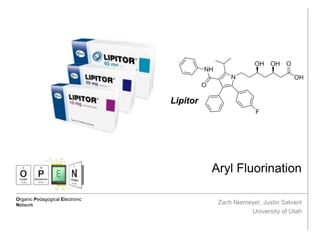
Lipitor
Aryl Fluorination
Wiki Page: http://en.wikipedia.org/wiki/Balz%E2%80%93Schiemann_reaction
Overview: Aryl fluorines are present in two of the top 10 grossing drugs (Lipitor and
Reserdal). The C-F bond is uniquely strong and prevents facile metabolism, giving
these compounds longer T1/2 in vivo. The generalized mechanism for electrophilic aryl
fluorination proceeds through a high valent metal species.
Mechanism:
F
R
MX
R
Transmetalation
F+ source
Reductive
Elimination
[M]
M
R
Oxidation
M
R
F
High Valent Metal
N
N
F
Cl
2 PF6
-
N
F
N
N
F
Cl
2 BF4
-
SelectfluorF-TEDA-PF6
N-fluoro-2,4,6-
trimethylpyridinium
triflate
Aryl Fluorination
Wiki Page: http://en.wikipedia.org/wiki/Balz%E2%80%93Schiemann_reaction
Overview: Aryl fluorines are present in two of the top 10 grossing drugs (Lipitor and
Reserdal). The C-F bond is uniquely strong and prevents facile metabolism, giving
these compounds longer T1/2 in vivo. The generalized mechanism for electrophilic aryl
fluorination proceeds through a high valent metal species.
Early Examples
NH2 N
N
F
BF4
HNO2
HBF4
D
Balz-Schiemann Reaction
-N2
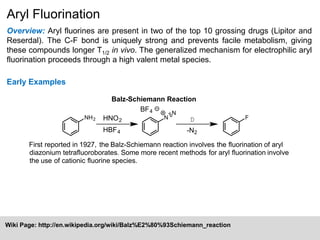
First reported in 1927, the Balz-Schiemann reaction involves the fluorination of aryl
diazonium tetrafluoroborates. Some more recent methods for aryl fluorination involve
the use of cationic fluorine species.
Examples
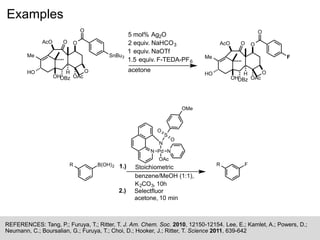
REFERENCES: Tang, P.; Furuya, T.; Ritter, T. J. Am. Chem. Soc. 2010, 12150-12154. Lee, E.; Kamlet, A.; Powers, D.;
Neumann, C.; Boursalian, G.; Furuya, T.; Choi, D.; Hooker, J.; Ritter, T. Science 2011, 639-642
N
N
Pd
S
O
O
OMe
N
OAc
B(OH)2R FR
Stoichiometric
benzene/MeOH (1:1),
K2CO3, 10h
1.)
2.) Selectfluor
acetone, 10 min
Me
O
O
O
O
SnBu3
HO
OBz
H
OAc
AcO
OH
Me
O
O
O
O
F
HO
OBz
H
OAc
AcO
OH
5 mol% Ag2O
2 equiv. NaHCO3
1 equiv. NaOTf
1.5 equiv. F-TEDA-PF6
acetone
Problems
References: Tang, P.; Furuya, T.; Ritter, T. J. Am. Chem. Soc. 2010, 12150-12154.
Assuming the catalytic cycle
shown, predict the product
formed upon the
addition of exogenous water:
F
R
MX
R
Transmetalation
F+ source
Reductive
Elimination
[M]
M
R
Oxidation
M
R
F
High Valent Metal
What is the role of NaOTf in the reaction below? (Hint: Ag2O is only partially soluble)
Me
O
O
O
O
SnBu3
HO
OBz
H
OAc
AcO
OH
Me
O
O
O
O
F
HO
OBz
H
OAc
AcO
OH
5 mol% Ag2O
2 equiv. NaHCO3
1 equiv. NaOTf
1.5 equiv. F-TEDA-PF6
acetone
This work is licensed under a
Creative Commons Attribution-
ShareAlike 4.0 International
License.
Contributed by:
Zach Niemeyer, Justin Salvant (Undergraduates)
University of Utah, 2013

Aryl fluorination

  • 1.
    Organic Pedagogical Electronic Network ArylFluorination Zach Niemeyer, Justin Salvant University of Utah Lipitor
  • 2.
    Aryl Fluorination Wiki Page:http://en.wikipedia.org/wiki/Balz%E2%80%93Schiemann_reaction Overview: Aryl fluorines are present in two of the top 10 grossing drugs (Lipitor and Reserdal). The C-F bond is uniquely strong and prevents facile metabolism, giving these compounds longer T1/2 in vivo. The generalized mechanism for electrophilic aryl fluorination proceeds through a high valent metal species. Mechanism: F R MX R Transmetalation F+ source Reductive Elimination [M] M R Oxidation M R F High Valent Metal N N F Cl 2 PF6 - N F N N F Cl 2 BF4 - SelectfluorF-TEDA-PF6 N-fluoro-2,4,6- trimethylpyridinium triflate
  • 3.
    Aryl Fluorination Wiki Page:http://en.wikipedia.org/wiki/Balz%E2%80%93Schiemann_reaction Overview: Aryl fluorines are present in two of the top 10 grossing drugs (Lipitor and Reserdal). The C-F bond is uniquely strong and prevents facile metabolism, giving these compounds longer T1/2 in vivo. The generalized mechanism for electrophilic aryl fluorination proceeds through a high valent metal species. Early Examples NH2 N N F BF4 HNO2 HBF4 D Balz-Schiemann Reaction -N2 First reported in 1927, the Balz-Schiemann reaction involves the fluorination of aryl diazonium tetrafluoroborates. Some more recent methods for aryl fluorination involve the use of cationic fluorine species.
  • 4.
    Examples REFERENCES: Tang, P.;Furuya, T.; Ritter, T. J. Am. Chem. Soc. 2010, 12150-12154. Lee, E.; Kamlet, A.; Powers, D.; Neumann, C.; Boursalian, G.; Furuya, T.; Choi, D.; Hooker, J.; Ritter, T. Science 2011, 639-642 N N Pd S O O OMe N OAc B(OH)2R FR Stoichiometric benzene/MeOH (1:1), K2CO3, 10h 1.) 2.) Selectfluor acetone, 10 min Me O O O O SnBu3 HO OBz H OAc AcO OH Me O O O O F HO OBz H OAc AcO OH 5 mol% Ag2O 2 equiv. NaHCO3 1 equiv. NaOTf 1.5 equiv. F-TEDA-PF6 acetone
  • 5.
    Problems References: Tang, P.;Furuya, T.; Ritter, T. J. Am. Chem. Soc. 2010, 12150-12154. Assuming the catalytic cycle shown, predict the product formed upon the addition of exogenous water: F R MX R Transmetalation F+ source Reductive Elimination [M] M R Oxidation M R F High Valent Metal What is the role of NaOTf in the reaction below? (Hint: Ag2O is only partially soluble) Me O O O O SnBu3 HO OBz H OAc AcO OH Me O O O O F HO OBz H OAc AcO OH 5 mol% Ag2O 2 equiv. NaHCO3 1 equiv. NaOTf 1.5 equiv. F-TEDA-PF6 acetone
  • 6.
    This work islicensed under a Creative Commons Attribution- ShareAlike 4.0 International License. Contributed by: Zach Niemeyer, Justin Salvant (Undergraduates) University of Utah, 2013