Organic Pedagogical Electronic
Network
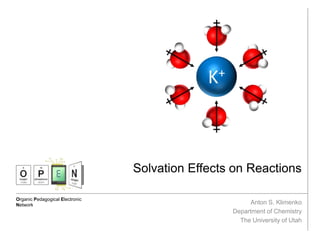
Solvation Effects on Reactions
Anton S. Klimenko
Department of Chemistry
The University of Utah
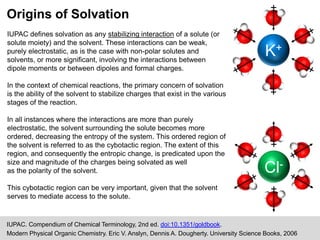
IUPAC defines solvation as any stabilizing interaction of a solute (or
solute moiety) and the solvent. These interactions can be weak,
purely electrostatic, as is the case with non-polar solutes and
solvents, or more significant, involving the interactions between
dipole moments or between dipoles and formal charges.
In the context of chemical reactions, the primary concern of solvation
is the ability of the solvent to stabilize charges that exist in the various
stages of the reaction.
In all instances where the interactions are more than purely
electrostatic, the solvent surrounding the solute becomes more
ordered, decreasing the entropy of the system. This ordered region of
the solvent is referred to as the cybotactic region. The extent of this
region, and consequently the entropic change, is predicated upon the
size and magnitude of the charges being solvated as well
as the polarity of the solvent.
This cybotactic region can be very important, given that the solvent
serves to mediate access to the solute.
Origins of Solvation
IUPAC. Compendium of Chemical Terminology, 2nd ed. doi:10.1351/goldbook.
Modern Physical Organic Chemistry. Eric V. Anslyn, Dennis A. Dougherty. University Science Books, 2006
Cl-
K+
Intermolecular Interactions
Modern Physical Organic Chemistry. Eric V. Anslyn, Dennis A. Dougherty. University Science Books, 2006
There are six types of intermolecular interactions that can occur between
solute and solvent.
van der Waals – a weak but omnipresent attractive electrostatic
intermolecular interaction,present even in non-polar solvents.
Dipole-dipole – a strong attractive intermolecular interaction that stems from
the alignment of dipoles, coupling δ+ to δ-. The magnitude of this interaction
can vary with the magnitude and density of the partial charges involved
Ion-dipole – a stronger variant of the dipole-dipole interaction, where the
coupling becomes between a formal and partial charge. Consequently,
multiple solvent molecules are required to stabilize the formal charge
Intermolecular Interactions
Modern Physical Organic Chemistry. Eric V. Anslyn, Dennis A. Dougherty. University Science Books, 2006
There are six types of intermolecular interactions that can occur between
solute and solvent.
Hydrogen bonding – a special form of dipole-dipole interactions, involving
protic hydrogens bonded to nitrogen, oxygen, or fluorine that interact with the
lone pairs of adjacent nitrogens, oxygens, or fluorines. This interaction allows
for fast exchange of protons between adjacent molecule and long distance
transport of protons
Dipole-induced dipole – a weaker variant of the dipole-dipole interaction,
where the one of the participants has a dipole and, by proximity, induces a
dipole in the other.
Induced dipole-induced dipole – an even weaker variant of the above
interaction, where both dipoles are induced as a result of the participants
coming into proximity
Solvation Effects (Polarity)
Modern Physical Organic Chemistry. Eric V. Anslyn, Dennis A. Dougherty. University Science Books, 2006
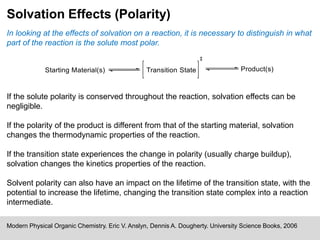
In looking at the effects of solvation on a reaction, it is necessary to distinguish in what
part of the reaction is the solute most polar.
If the solute polarity is conserved throughout the reaction, solvation effects can be
negligible.
If the polarity of the product is different from that of the starting material, solvation
changes the thermodynamic properties of the reaction.
If the transition state experiences the change in polarity (usually charge buildup),
solvation changes the kinetics properties of the reaction.
Solvent polarity can also have an impact on the lifetime of the transition state, with the
potential to increase the lifetime, changing the transition state complex into a reaction
intermediate.
Solvation Effects on Thermodynamics
Modern Physical Organic Chemistry. Eric V. Anslyn, Dennis A. Dougherty. University Science Books, 2006
More Polar Product Less Polar Product
SM
SMP
P
‡ ‡E
Incr.SolventPolarity
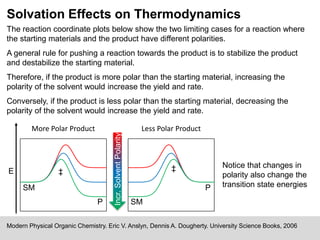
The reaction coordinate plots below show the two limiting cases for a reaction where
the starting materials and the product have different polarities.
A general rule for pushing a reaction towards the product is to stabilize the product
and destabilize the starting material.
Therefore, if the product is more polar than the starting material, increasing the
polarity of the solvent would increase the yield and rate.
Conversely, if the product is less polar than the starting material, decreasing the
polarity of the solvent would increase the yield and rate.
Notice that changes in
polarity also change the
transition state energies
Charged TS
Solvation Effects on Kinetics
Modern Physical Organic Chemistry. Eric V. Anslyn, Dennis A. Dougherty. University Science Books, 2006
SM
P
‡
E
Incr.SolventPolarity
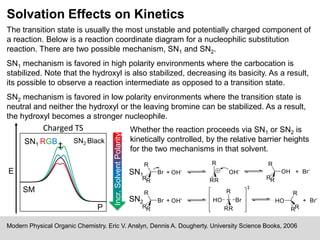
The transition state is usually the most unstable and potentially charged component of
a reaction. Below is a reaction coordinate diagram for a nucleophilic substitution
reaction. There are two possible mechanism, SN1 and SN2.
SN1 mechanism is favored in high polarity environments where the carbocation is
stabilized. Note that the hydroxyl is also stabilized, decreasing its basicity. As a result,
its possible to observe a reaction intermediate as opposed to a transition state.
SN2 mechanism is favored in low polarity environments where the transition state is
neutral and neither the hydroxyl or the leaving bromine can be stabilized. As a result,
the hydroxyl becomes a stronger nucleophile.
SN1
SN2
SN1 RGB SN2 Black
Whether the reaction proceeds via SN1 or SN2 is
kinetically controlled, by the relative barrier heights
for the two mechanisms in that solvent.
Solvation Effects (Cybotactic Region)
Modern Physical Organic Chemistry. Eric V. Anslyn, Dennis A. Dougherty. University Science Books, 2006
Unpublished A. S. Klimenko
The cybotactic region can be thought of as an interface between the solute
encapsulated within and the bulk of the solution. The choice of solvent has a
high impact on the rate of transport to the from the bulk to the solute.
This can be exemplified by the folding of helical peptides in a binary mixture
of water and ethanol.
One of the driving forces in assuming a helical conformation is to maximize
the hydrogen bonding with the amides that make-up the peptide backbone. In
water, the peptide can remain linear, having all of its hydrogen bonds satisfied
by the water. In ethanol, it is helical, having to form intramolecular hydrogen
bonds to stabilize itself.
Solvation Effects (Cybotactic Region)
Modern Physical Organic Chemistry. Eric V. Anslyn, Dennis A. Dougherty. University Science Books, 2006
Unpublished A. S. Klimenko
When ethanol is added to the solvent system, in the presence of solute,
ethanol behaves starts to behave like a surfactant and gathers locally around
the surface of the peptide, forcing the water out. At a approximately 30%
ethanol (varies by polarity of the peptide), the peptide behaves as though no
water is present and it is in pure ethanol.
This is an extreme case, although it is not unusual to requires one of the
reactants to traverse a physical boundary in order for a reaction to take place.
This work is licensed under a
Creative Commons Attribution-
ShareAlike 4.0 International
License.
Contributed by:
Anton S. Klimenko (Undergraduate)
Department of Chemistry, The University of Utah, 2016

Solvation effects on reactions

  • 1.
    Organic Pedagogical Electronic Network SolvationEffects on Reactions Anton S. Klimenko Department of Chemistry The University of Utah
  • 2.
    IUPAC defines solvationas any stabilizing interaction of a solute (or solute moiety) and the solvent. These interactions can be weak, purely electrostatic, as is the case with non-polar solutes and solvents, or more significant, involving the interactions between dipole moments or between dipoles and formal charges. In the context of chemical reactions, the primary concern of solvation is the ability of the solvent to stabilize charges that exist in the various stages of the reaction. In all instances where the interactions are more than purely electrostatic, the solvent surrounding the solute becomes more ordered, decreasing the entropy of the system. This ordered region of the solvent is referred to as the cybotactic region. The extent of this region, and consequently the entropic change, is predicated upon the size and magnitude of the charges being solvated as well as the polarity of the solvent. This cybotactic region can be very important, given that the solvent serves to mediate access to the solute. Origins of Solvation IUPAC. Compendium of Chemical Terminology, 2nd ed. doi:10.1351/goldbook. Modern Physical Organic Chemistry. Eric V. Anslyn, Dennis A. Dougherty. University Science Books, 2006 Cl- K+
  • 3.
    Intermolecular Interactions Modern PhysicalOrganic Chemistry. Eric V. Anslyn, Dennis A. Dougherty. University Science Books, 2006 There are six types of intermolecular interactions that can occur between solute and solvent. van der Waals – a weak but omnipresent attractive electrostatic intermolecular interaction,present even in non-polar solvents. Dipole-dipole – a strong attractive intermolecular interaction that stems from the alignment of dipoles, coupling δ+ to δ-. The magnitude of this interaction can vary with the magnitude and density of the partial charges involved Ion-dipole – a stronger variant of the dipole-dipole interaction, where the coupling becomes between a formal and partial charge. Consequently, multiple solvent molecules are required to stabilize the formal charge
  • 4.
    Intermolecular Interactions Modern PhysicalOrganic Chemistry. Eric V. Anslyn, Dennis A. Dougherty. University Science Books, 2006 There are six types of intermolecular interactions that can occur between solute and solvent. Hydrogen bonding – a special form of dipole-dipole interactions, involving protic hydrogens bonded to nitrogen, oxygen, or fluorine that interact with the lone pairs of adjacent nitrogens, oxygens, or fluorines. This interaction allows for fast exchange of protons between adjacent molecule and long distance transport of protons Dipole-induced dipole – a weaker variant of the dipole-dipole interaction, where the one of the participants has a dipole and, by proximity, induces a dipole in the other. Induced dipole-induced dipole – an even weaker variant of the above interaction, where both dipoles are induced as a result of the participants coming into proximity
  • 5.
    Solvation Effects (Polarity) ModernPhysical Organic Chemistry. Eric V. Anslyn, Dennis A. Dougherty. University Science Books, 2006 In looking at the effects of solvation on a reaction, it is necessary to distinguish in what part of the reaction is the solute most polar. If the solute polarity is conserved throughout the reaction, solvation effects can be negligible. If the polarity of the product is different from that of the starting material, solvation changes the thermodynamic properties of the reaction. If the transition state experiences the change in polarity (usually charge buildup), solvation changes the kinetics properties of the reaction. Solvent polarity can also have an impact on the lifetime of the transition state, with the potential to increase the lifetime, changing the transition state complex into a reaction intermediate.
  • 6.
    Solvation Effects onThermodynamics Modern Physical Organic Chemistry. Eric V. Anslyn, Dennis A. Dougherty. University Science Books, 2006 More Polar Product Less Polar Product SM SMP P ‡ ‡E Incr.SolventPolarity The reaction coordinate plots below show the two limiting cases for a reaction where the starting materials and the product have different polarities. A general rule for pushing a reaction towards the product is to stabilize the product and destabilize the starting material. Therefore, if the product is more polar than the starting material, increasing the polarity of the solvent would increase the yield and rate. Conversely, if the product is less polar than the starting material, decreasing the polarity of the solvent would increase the yield and rate. Notice that changes in polarity also change the transition state energies
  • 7.
    Charged TS Solvation Effectson Kinetics Modern Physical Organic Chemistry. Eric V. Anslyn, Dennis A. Dougherty. University Science Books, 2006 SM P ‡ E Incr.SolventPolarity The transition state is usually the most unstable and potentially charged component of a reaction. Below is a reaction coordinate diagram for a nucleophilic substitution reaction. There are two possible mechanism, SN1 and SN2. SN1 mechanism is favored in high polarity environments where the carbocation is stabilized. Note that the hydroxyl is also stabilized, decreasing its basicity. As a result, its possible to observe a reaction intermediate as opposed to a transition state. SN2 mechanism is favored in low polarity environments where the transition state is neutral and neither the hydroxyl or the leaving bromine can be stabilized. As a result, the hydroxyl becomes a stronger nucleophile. SN1 SN2 SN1 RGB SN2 Black Whether the reaction proceeds via SN1 or SN2 is kinetically controlled, by the relative barrier heights for the two mechanisms in that solvent.
  • 8.
    Solvation Effects (CybotacticRegion) Modern Physical Organic Chemistry. Eric V. Anslyn, Dennis A. Dougherty. University Science Books, 2006 Unpublished A. S. Klimenko The cybotactic region can be thought of as an interface between the solute encapsulated within and the bulk of the solution. The choice of solvent has a high impact on the rate of transport to the from the bulk to the solute. This can be exemplified by the folding of helical peptides in a binary mixture of water and ethanol. One of the driving forces in assuming a helical conformation is to maximize the hydrogen bonding with the amides that make-up the peptide backbone. In water, the peptide can remain linear, having all of its hydrogen bonds satisfied by the water. In ethanol, it is helical, having to form intramolecular hydrogen bonds to stabilize itself.
  • 9.
    Solvation Effects (CybotacticRegion) Modern Physical Organic Chemistry. Eric V. Anslyn, Dennis A. Dougherty. University Science Books, 2006 Unpublished A. S. Klimenko When ethanol is added to the solvent system, in the presence of solute, ethanol behaves starts to behave like a surfactant and gathers locally around the surface of the peptide, forcing the water out. At a approximately 30% ethanol (varies by polarity of the peptide), the peptide behaves as though no water is present and it is in pure ethanol. This is an extreme case, although it is not unusual to requires one of the reactants to traverse a physical boundary in order for a reaction to take place.
  • 10.
    This work islicensed under a Creative Commons Attribution- ShareAlike 4.0 International License. Contributed by: Anton S. Klimenko (Undergraduate) Department of Chemistry, The University of Utah, 2016