ORIENTATION in electrophilic
substitution reaction on benzene ring
• The process in which position of
incoming electrophile in already
substituted benzene is determined.
275
276
The direction of the reaction
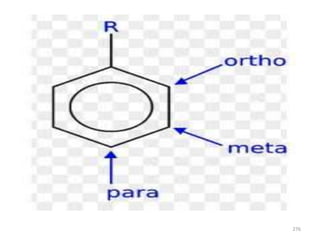
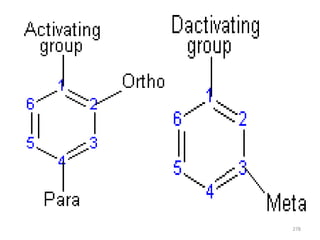
• The activating group directs the reaction to
the ortho or para position, which means the
electrophile substitute the hydrogen that is on
carbon 2 or carbon 4. The deactivating group
directs the reaction to the meta position,
which means the electrophile substitute the
hydrogen that is on carbon 3 with the
exception of the halogens that is a
deactivating group but directs the ortho or
para substitution. 277
278
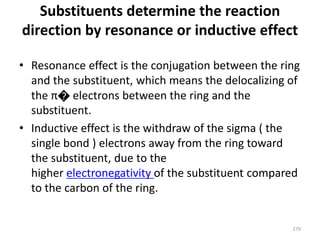
Substituents determine the reaction
direction by resonance or inductive effect
• Resonance effect is the conjugation between the ring
and the substituent, which means the delocalizing of
the π� electrons between the ring and the
substituent.
• Inductive effect is the withdraw of the sigma ( the
single bond ) electrons away from the ring toward
the substituent, due to the
higher electronegativity of the substituent compared
to the carbon of the ring.
279
Activating groups (ortho or para
directors)
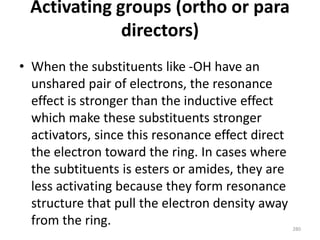
• When the substituents like -OH have an
unshared pair of electrons, the resonance
effect is stronger than the inductive effect
which make these substituents stronger
activators, since this resonance effect direct
the electron toward the ring. In cases where
the subtituents is esters or amides, they are
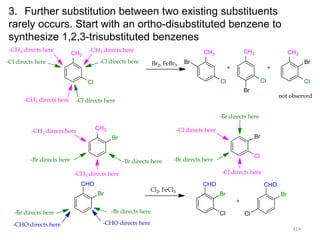
less activating because they form resonance
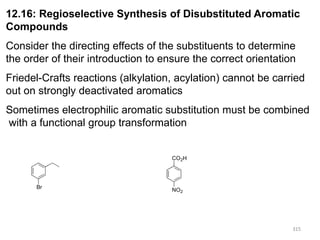
structure that pull the electron density away
from the ring. 280
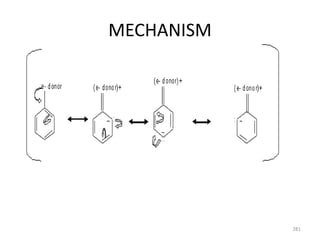
MECHANISM
281
CONTINOU…….
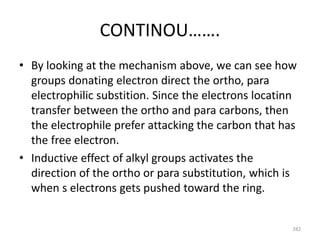
• By looking at the mechanism above, we can see how
groups donating electron direct the ortho, para
electrophilic substition. Since the electrons locatinn
transfer between the ortho and para carbons, then
the electrophile prefer attacking the carbon that has
the free electron.
• Inductive effect of alkyl groups activates the
direction of the ortho or para substitution, which is
when s electrons gets pushed toward the ring.
282
Deactivating group (meta
directors)
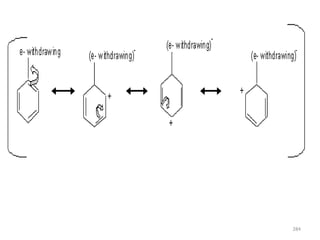
• The deactivating groups deactivate the ring by
the inductive effect in the presence of an
electronegative atom that withdraws the
electrons away from the ring.
• we can see from the mechanism above that
when there is an electron withdraw from the
ring, that leaves the carbons at the ortho, para
positions with a positive charge which is
unfavorable for the electrophile, so the
electrophile attacks the carbon at the meta 283
284
CONTINUE…..
• we can see from the mechanism above that
when there is an electron withdraw from the
ring, that leaves the carbons at the ortho, para
positions with a positive charge which is
unfavorable for the electrophile, so the
electrophile attacks the carbon at the meta
positions.
285
Halogens are an exception
• Halogens are an exception of the deactivating
group that directs the ortho or para
substitution. The halogens deactivate the ring
by inductive effect not by the resonance even
though they have an unpaired pair of
electrons. The unpaired pair of electrons gets
donated to the ring, but the inductive effect
pulls away the s electrons from the ring by the
electronegativity of the halogens.
286
CONTINUE……
• EXAMPLES
287
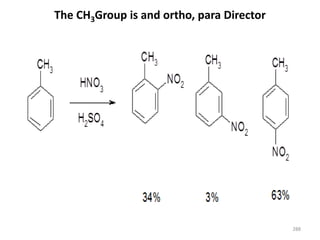
The CH3Group is and ortho, para Director
288
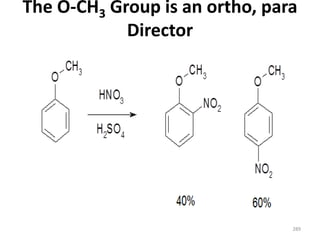
The O-CH3 Group is an ortho, para
Director
289
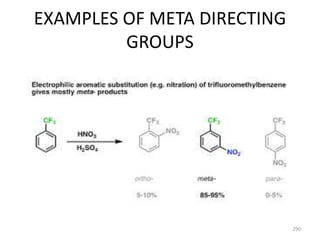
EXAMPLES OF META DIRECTING
GROUPS
290
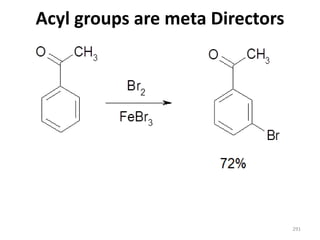
Acyl groups are meta Directors
291
• orientation or directive effect can be
explained by studying the all the possible
resonance structure of the sigma complex
formed as a result of the electrophile at ortho,
meta and para positions for different types of
monosubstituted benzene
292
a) Ortho-para directing groups which having electron
releasing inductive effect (+I effect):
• Ex: Alkyl groups (-R) has +I effect i.e electron
releasing effect. Let’s study the sigma
complexes(carbocation intermediate) which
are formed by attacked of electrophile (+E) at
ortho, para and meta position of mono
substituted benzene ( toluene).
293
294
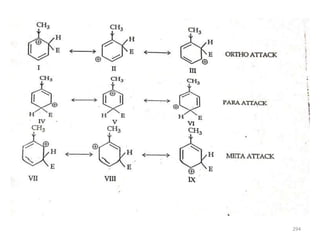
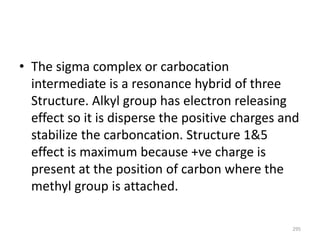
• The sigma complex or carbocation
intermediate is a resonance hybrid of three
Structure. Alkyl group has electron releasing
effect so it is disperse the positive charges and
stabilize the carboncation. Structure 1&5
effect is maximum because +ve charge is
present at the position of carbon where the
methyl group is attached.
295
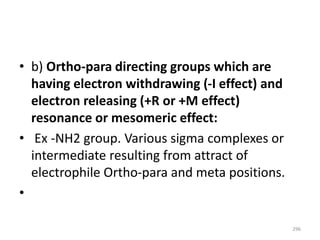
• b) Ortho-para directing groups which are
having electron withdrawing (-I effect) and
electron releasing (+R or +M effect)
resonance or mesomeric effect:
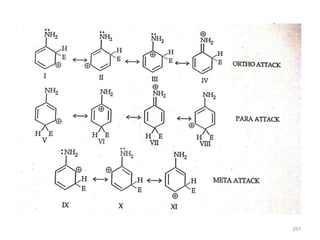
• Ex -NH2 group. Various sigma complexes or
intermediate resulting from attract of
electrophile Ortho-para and meta positions.
•
296
297
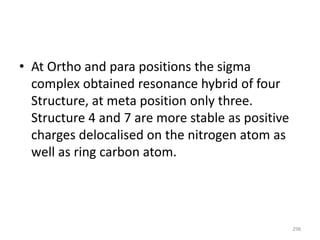
• At Ortho and para positions the sigma
complex obtained resonance hybrid of four
Structure, at meta position only three.
Structure 4 and 7 are more stable as positive
charges delocalised on the nitrogen atom as
well as ring carbon atom.
298
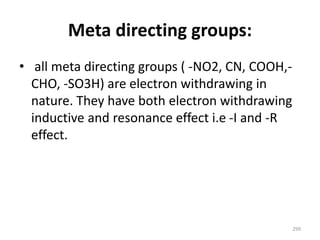
Meta directing groups:
• all meta directing groups ( -NO2, CN, COOH,-
CHO, -SO3H) are electron withdrawing in
nature. They have both electron withdrawing
inductive and resonance effect i.e -I and -R
effect.
299
300
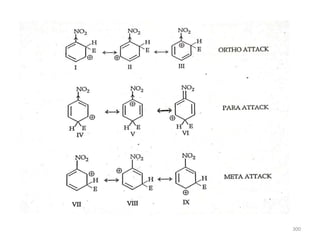
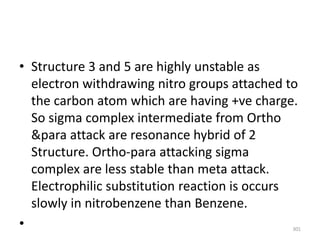
• Structure 3 and 5 are highly unstable as
electron withdrawing nitro groups attached to
the carbon atom which are having +ve charge.
So sigma complex intermediate from Ortho
&para attack are resonance hybrid of 2
Structure. Ortho-para attacking sigma
complex are less stable than meta attack.
Electrophilic substitution reaction is occurs
slowly in nitrobenzene than Benzene.
• 301
302
302
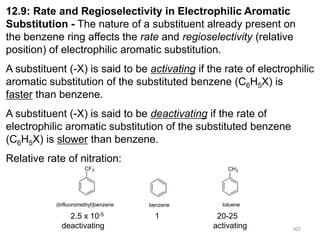
12.9: Rate and Regioselectivity in Electrophilic Aromatic
Substitution - The nature of a substituent already present on
the benzene ring affects the rate and regioselectivity (relative
position) of electrophilic aromatic substitution.
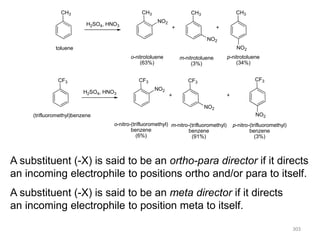
A substituent (-X) is said to be activating if the rate of electrophilic
aromatic substitution of the substituted benzene (C6H5X) is
faster than benzene.
A substituent (-X) is said to be deactivating if the rate of
electrophilic aromatic substitution of the substituted benzene
(C6H5X) is slower than benzene.
Relative rate of nitration:
CF3 CH3
benzene toluene
(trifluoromethyl)benzene
2.5 x 10⁻⁵ 1 20-25
deactivating activating
303
303
(trifluoromethyl)benzene
CH3
toluene
H2SO4, HNO3
CH3
NO2
CH3 CH3
NO2
NO2
+
o-nitrotoluene
(63%)
m-nitrotoluene
(3%)
CF3
H2SO4, HNO3
CF3
NO2
CF3
CF3
NO2
NO2
+
o-nitro-(trifluoromethyl)
benzene
(6%)
m-nitro-(trifluoromethyl)
benzene
(91%)
p-nitro-(trifluoromethyl)
benzene
(3%)
p-nitrotoluene
(34%)
+
+
A substituent (-X) is said to be an ortho-para director if it directs
an incoming electrophile to positions ortho and/or para to itself.
A substituent (-X) is said to be an meta director if it directs
an incoming electrophile to position meta to itself.
304
304
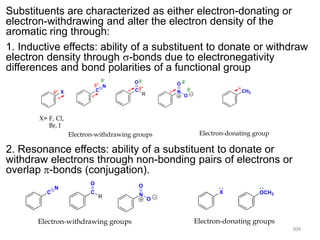
Substituents are characterized as either electron-donating or
electron-withdrawing and alter the electron density of the
aromatic ring through:
1. Inductive effects: ability of a substituent to donate or withdraw
electron density through -bonds due to electronegativity
differences and bond polarities of a functional group
2. Resonance effects: ability of a substituent to donate or
withdraw electrons through non-bonding pairs of electrons or
overlap -bonds (conjugation).
X
X= F, Cl,
Br, I
C
N
C
O
R
+
+
-
+
-
N
O
O
-
-
Electron-withdrawing groups
CH3
Electron-donating group
C
N
C
O
R N
O
O
X OCH3
Electron-donating groups
Electron-withdrawing groups
305
305
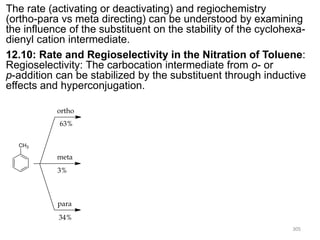
The rate (activating or deactivating) and regiochemistry
(ortho-para vs meta directing) can be understood by examining
the influence of the substituent on the stability of the cyclohexa-
dienyl cation intermediate.
12.10: Rate and Regioselectivity in the Nitration of Toluene:
Regioselectivity: The carbocation intermediate from o- or
p-addition can be stabilized by the substituent through inductive
effects and hyperconjugation.
CH3
ortho
meta
para
63%
3%
34%
306
306
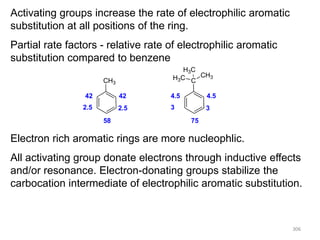
Activating groups increase the rate of electrophilic aromatic
substitution at all positions of the ring.
Partial rate factors - relative rate of electrophilic aromatic
substitution compared to benzene
Electron rich aromatic rings are more nucleophlic.
All activating group donate electrons through inductive effects
and/or resonance. Electron-donating groups stabilize the
carbocation intermediate of electrophilic aromatic substitution.
CH3
42
42
2.5
2.5
58
C
4.5
4.5
3
3
75
CH3
H3C
H3C
307
307
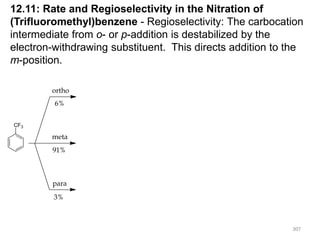
12.11: Rate and Regioselectivity in the Nitration of
(Trifluoromethyl)benzene - Regioselectivity: The carbocation
intermediate from o- or p-addition is destabilized by the
electron-withdrawing substituent. This directs addition to the
m-position.
CF3
ortho
meta
para
6%
91%
3%
308
308
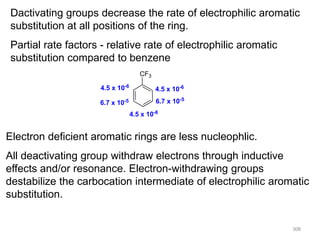
Dactivating groups decrease the rate of electrophilic aromatic
substitution at all positions of the ring.
Partial rate factors - relative rate of electrophilic aromatic
substitution compared to benzene
CF3
4.5 x 10⁻⁶
4.5 x 10⁻⁶
6.7 x 10⁻⁵
6.7 x 10⁻⁵
4.5 x 10⁻⁶
Electron deficient aromatic rings are less nucleophlic.
All deactivating group withdraw electrons through inductive
effects and/or resonance. Electron-withdrawing groups
destabilize the carbocation intermediate of electrophilic aromatic
substitution.
309
309
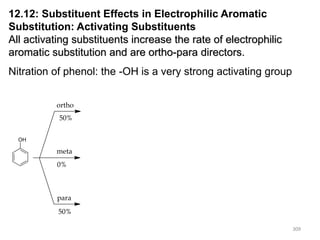
12.12: Substituent Effects in Electrophilic Aromatic
Substitution: Activating Substituents
All activating substituents increase the rate of electrophilic
aromatic substitution and are ortho-para directors.
Nitration of phenol: the -OH is a very strong activating group
OH
ortho
meta
para
50%
0%
50%
310
310
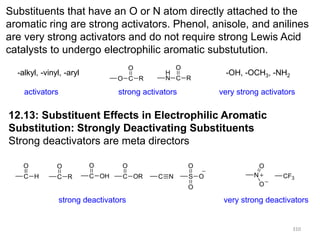
Substituents that have an O or N atom directly attached to the
aromatic ring are strong activators. Phenol, anisole, and anilines
are very strong activators and do not require strong Lewis Acid
catalysts to undergo electrophilic aromatic substutution.
-alkyl, -vinyl, -aryl -OH, -OCH3, -NH2
activators strong activators very strong activators
O C
O
R
H
N C
O
R
12.13: Substituent Effects in Electrophilic Aromatic
Substitution: Strongly Deactivating Substituents
Strong deactivators are meta directors
strong deactivators very strong deactivators
C H
O
C R
O
C OH
O
C OR
O
C N S O
O
O
N
O
O
CF3
311
311
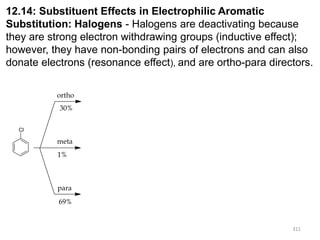
12.14: Substituent Effects in Electrophilic Aromatic
Substitution: Halogens - Halogens are deactivating because
they are strong electron withdrawing groups (inductive effect);
however, they have non-bonding pairs of electrons and can also
donate electrons (resonance effect), and are ortho-para directors.
Cl
ortho
meta
para
30%
1%
69%
312
312
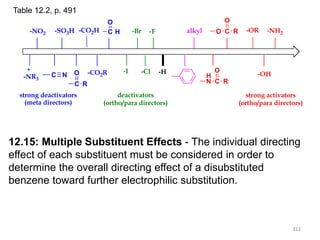
12.15: Multiple Substituent Effects - The individual directing
effect of each substituent must be considered in order to
determine the overall directing effect of a disubstituted
benzene toward further electrophilic substitution.
Table 12.2, p. 491
-NR3
C N
-NO2 -SO3H -CO2H
C R
O -CO2R
C H
O
-I
-Br -F
-Cl -H
alkyl
H
N C R
O
O C R
O
-OR -NH2
-OH
strong deactivators
(meta directors)
strong activators
(ortho/para directors)
deactivators
(ortho/para directors)
313
313
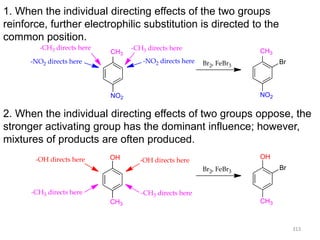
1. When the individual directing effects of the two groups
reinforce, further electrophilic substitution is directed to the
common position.
2. When the individual directing effects of two groups oppose, the
stronger activating group has the dominant influence; however,
mixtures of products are often produced.
CH3
NO2
-CH3 directs here
-NO2 directs here
-CH3 directs here
-NO2 directs here Br2, FeBr3
CH3
NO2
Br
OH
CH3
-OH directs here
-CH3 directs here
-OH directs here
-CH3 directs here
Br2, FeBr3
OH
CH3
Br
314
314
3. Further substitution between two existing substituents
rarely occurs. Start with an ortho-disubstituted benzene to
synthesize 1,2,3-trisubstituted benzenes
CH3
-CH3 directs here
-Cl directs here
-CH3 directs here
-Cl directs here Br2, FeBr3
CH3
Cl Cl
-CH3 directs here -Cl directs here
CH3
Br
Cl
Br
CH3
Cl
Br
+
not observed
+
CHO
Br
-Br directs here
-CHO directs here
-CHO directs here
-Br directs here
CHO
Br
Cl
+
CHO
Br
Cl
Cl2, FeCl3
CH3
Br Br
Cl
-CH3 directs here
-Br directs here -Br directs here
-CH3 directs here
-Br directs here
-Br directs here
-Cl directs here
-Cl directs here
315
315
12.16: Regioselective Synthesis of Disubstituted Aromatic
Compounds
Consider the directing effects of the substituents to determine
the order of their introduction to ensure the correct orientation
Friedel-Crafts reactions (alkylation, acylation) cannot be carried
out on strongly deactivated aromatics
Sometimes electrophilic aromatic substitution must be combined
with a functional group transformation
CO2H
NO2
Br
316
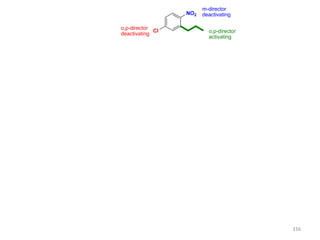
316
NO2
Cl
m-director
deactivating
o,p-director
deactivating o,p-director
activating
Why are halogens ortho-, para-
directors?
• All activating groups are also ortho-, para-
directors.
• Halogens (F, Cl, Br, I) are notable in that they
are deactivating ortho-, para- directors. Why?
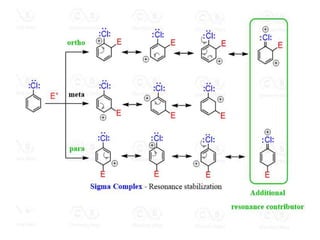
• In electrophilic aromatic substitution (EAS),
addition at the ortho- or para– position results
in a carbocation intermediate with a
resonance form containing a carbocation
directly adjacent to the directing group.
317
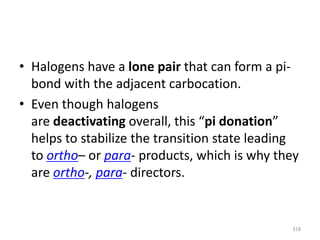
• Halogens have a lone pair that can form a pi-
bond with the adjacent carbocation.
• Even though halogens
are deactivating overall, this “pi donation”
helps to stabilize the transition state leading
to ortho– or para- products, which is why they
are ortho-, para- directors.
318
319
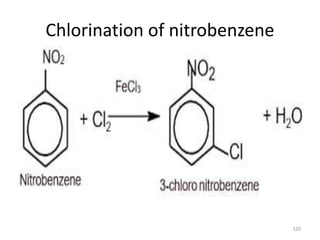
Chlorination of nitrobenzene
320
321
12.17: Substitution in Naphthalene (please read)
12.18: Substitution in Heterocyclic Aromatic Compounds
(please read)
Summary of electrophilic aromatic substitution of benzene
Zanger, M.; Gennaro, A. R.; McKee, J. R. J. Chem. Ed. 1993, 70 (12) , 985-987
SO3H X
(m-) (o-, p-)
NO2 CH2R
O R
(o-, p-)
(m-) (m-)
Br R
(o-, p-)
CO2H
(m-)
HNO3,
H2SO4
X2,
catalyst
RCH2X,
AlCl3
RCOCl,
AlCl3
SO3,
H2SO4
[O]
NBS,
h [O]
[H]

Orientation in Aromatic compounds.ppt

  • 1.
    ORIENTATION in electrophilic substitutionreaction on benzene ring • The process in which position of incoming electrophile in already substituted benzene is determined. 275
  • 2.
  • 3.
    The direction ofthe reaction • The activating group directs the reaction to the ortho or para position, which means the electrophile substitute the hydrogen that is on carbon 2 or carbon 4. The deactivating group directs the reaction to the meta position, which means the electrophile substitute the hydrogen that is on carbon 3 with the exception of the halogens that is a deactivating group but directs the ortho or para substitution. 277
  • 4.
  • 5.
    Substituents determine thereaction direction by resonance or inductive effect • Resonance effect is the conjugation between the ring and the substituent, which means the delocalizing of the π� electrons between the ring and the substituent. • Inductive effect is the withdraw of the sigma ( the single bond ) electrons away from the ring toward the substituent, due to the higher electronegativity of the substituent compared to the carbon of the ring. 279
  • 6.
    Activating groups (orthoor para directors) • When the substituents like -OH have an unshared pair of electrons, the resonance effect is stronger than the inductive effect which make these substituents stronger activators, since this resonance effect direct the electron toward the ring. In cases where the subtituents is esters or amides, they are less activating because they form resonance structure that pull the electron density away from the ring. 280
  • 7.
  • 8.
    CONTINOU……. • By lookingat the mechanism above, we can see how groups donating electron direct the ortho, para electrophilic substition. Since the electrons locatinn transfer between the ortho and para carbons, then the electrophile prefer attacking the carbon that has the free electron. • Inductive effect of alkyl groups activates the direction of the ortho or para substitution, which is when s electrons gets pushed toward the ring. 282
  • 9.
    Deactivating group (meta directors) •The deactivating groups deactivate the ring by the inductive effect in the presence of an electronegative atom that withdraws the electrons away from the ring. • we can see from the mechanism above that when there is an electron withdraw from the ring, that leaves the carbons at the ortho, para positions with a positive charge which is unfavorable for the electrophile, so the electrophile attacks the carbon at the meta 283
  • 10.
  • 11.
    CONTINUE….. • we cansee from the mechanism above that when there is an electron withdraw from the ring, that leaves the carbons at the ortho, para positions with a positive charge which is unfavorable for the electrophile, so the electrophile attacks the carbon at the meta positions. 285
  • 12.
    Halogens are anexception • Halogens are an exception of the deactivating group that directs the ortho or para substitution. The halogens deactivate the ring by inductive effect not by the resonance even though they have an unpaired pair of electrons. The unpaired pair of electrons gets donated to the ring, but the inductive effect pulls away the s electrons from the ring by the electronegativity of the halogens. 286
  • 13.
  • 14.
    The CH3Group isand ortho, para Director 288
  • 15.
    The O-CH3 Groupis an ortho, para Director 289
  • 16.
    EXAMPLES OF METADIRECTING GROUPS 290
  • 17.
    Acyl groups aremeta Directors 291
  • 18.
    • orientation ordirective effect can be explained by studying the all the possible resonance structure of the sigma complex formed as a result of the electrophile at ortho, meta and para positions for different types of monosubstituted benzene 292
  • 19.
    a) Ortho-para directinggroups which having electron releasing inductive effect (+I effect): • Ex: Alkyl groups (-R) has +I effect i.e electron releasing effect. Let’s study the sigma complexes(carbocation intermediate) which are formed by attacked of electrophile (+E) at ortho, para and meta position of mono substituted benzene ( toluene). 293
  • 20.
  • 21.
    • The sigmacomplex or carbocation intermediate is a resonance hybrid of three Structure. Alkyl group has electron releasing effect so it is disperse the positive charges and stabilize the carboncation. Structure 1&5 effect is maximum because +ve charge is present at the position of carbon where the methyl group is attached. 295
  • 22.
    • b) Ortho-paradirecting groups which are having electron withdrawing (-I effect) and electron releasing (+R or +M effect) resonance or mesomeric effect: • Ex -NH2 group. Various sigma complexes or intermediate resulting from attract of electrophile Ortho-para and meta positions. • 296
  • 23.
  • 24.
    • At Orthoand para positions the sigma complex obtained resonance hybrid of four Structure, at meta position only three. Structure 4 and 7 are more stable as positive charges delocalised on the nitrogen atom as well as ring carbon atom. 298
  • 25.
    Meta directing groups: •all meta directing groups ( -NO2, CN, COOH,- CHO, -SO3H) are electron withdrawing in nature. They have both electron withdrawing inductive and resonance effect i.e -I and -R effect. 299
  • 26.
  • 27.
    • Structure 3and 5 are highly unstable as electron withdrawing nitro groups attached to the carbon atom which are having +ve charge. So sigma complex intermediate from Ortho &para attack are resonance hybrid of 2 Structure. Ortho-para attacking sigma complex are less stable than meta attack. Electrophilic substitution reaction is occurs slowly in nitrobenzene than Benzene. • 301
  • 28.
    302 302 12.9: Rate andRegioselectivity in Electrophilic Aromatic Substitution - The nature of a substituent already present on the benzene ring affects the rate and regioselectivity (relative position) of electrophilic aromatic substitution. A substituent (-X) is said to be activating if the rate of electrophilic aromatic substitution of the substituted benzene (C6H5X) is faster than benzene. A substituent (-X) is said to be deactivating if the rate of electrophilic aromatic substitution of the substituted benzene (C6H5X) is slower than benzene. Relative rate of nitration: CF3 CH3 benzene toluene (trifluoromethyl)benzene 2.5 x 10⁻⁵ 1 20-25 deactivating activating
  • 29.
    303 303 (trifluoromethyl)benzene CH3 toluene H2SO4, HNO3 CH3 NO2 CH3 CH3 NO2 NO2 + o-nitrotoluene (63%) m-nitrotoluene (3%) CF3 H2SO4,HNO3 CF3 NO2 CF3 CF3 NO2 NO2 + o-nitro-(trifluoromethyl) benzene (6%) m-nitro-(trifluoromethyl) benzene (91%) p-nitro-(trifluoromethyl) benzene (3%) p-nitrotoluene (34%) + + A substituent (-X) is said to be an ortho-para director if it directs an incoming electrophile to positions ortho and/or para to itself. A substituent (-X) is said to be an meta director if it directs an incoming electrophile to position meta to itself.
  • 30.
    304 304 Substituents are characterizedas either electron-donating or electron-withdrawing and alter the electron density of the aromatic ring through: 1. Inductive effects: ability of a substituent to donate or withdraw electron density through -bonds due to electronegativity differences and bond polarities of a functional group 2. Resonance effects: ability of a substituent to donate or withdraw electrons through non-bonding pairs of electrons or overlap -bonds (conjugation). X X= F, Cl, Br, I C N C O R + + - + - N O O - - Electron-withdrawing groups CH3 Electron-donating group C N C O R N O O X OCH3 Electron-donating groups Electron-withdrawing groups
  • 31.
    305 305 The rate (activatingor deactivating) and regiochemistry (ortho-para vs meta directing) can be understood by examining the influence of the substituent on the stability of the cyclohexa- dienyl cation intermediate. 12.10: Rate and Regioselectivity in the Nitration of Toluene: Regioselectivity: The carbocation intermediate from o- or p-addition can be stabilized by the substituent through inductive effects and hyperconjugation. CH3 ortho meta para 63% 3% 34%
  • 32.
    306 306 Activating groups increasethe rate of electrophilic aromatic substitution at all positions of the ring. Partial rate factors - relative rate of electrophilic aromatic substitution compared to benzene Electron rich aromatic rings are more nucleophlic. All activating group donate electrons through inductive effects and/or resonance. Electron-donating groups stabilize the carbocation intermediate of electrophilic aromatic substitution. CH3 42 42 2.5 2.5 58 C 4.5 4.5 3 3 75 CH3 H3C H3C
  • 33.
    307 307 12.11: Rate andRegioselectivity in the Nitration of (Trifluoromethyl)benzene - Regioselectivity: The carbocation intermediate from o- or p-addition is destabilized by the electron-withdrawing substituent. This directs addition to the m-position. CF3 ortho meta para 6% 91% 3%
  • 34.
    308 308 Dactivating groups decreasethe rate of electrophilic aromatic substitution at all positions of the ring. Partial rate factors - relative rate of electrophilic aromatic substitution compared to benzene CF3 4.5 x 10⁻⁶ 4.5 x 10⁻⁶ 6.7 x 10⁻⁵ 6.7 x 10⁻⁵ 4.5 x 10⁻⁶ Electron deficient aromatic rings are less nucleophlic. All deactivating group withdraw electrons through inductive effects and/or resonance. Electron-withdrawing groups destabilize the carbocation intermediate of electrophilic aromatic substitution.
  • 35.
    309 309 12.12: Substituent Effectsin Electrophilic Aromatic Substitution: Activating Substituents All activating substituents increase the rate of electrophilic aromatic substitution and are ortho-para directors. Nitration of phenol: the -OH is a very strong activating group OH ortho meta para 50% 0% 50%
  • 36.
    310 310 Substituents that havean O or N atom directly attached to the aromatic ring are strong activators. Phenol, anisole, and anilines are very strong activators and do not require strong Lewis Acid catalysts to undergo electrophilic aromatic substutution. -alkyl, -vinyl, -aryl -OH, -OCH3, -NH2 activators strong activators very strong activators O C O R H N C O R 12.13: Substituent Effects in Electrophilic Aromatic Substitution: Strongly Deactivating Substituents Strong deactivators are meta directors strong deactivators very strong deactivators C H O C R O C OH O C OR O C N S O O O N O O CF3
  • 37.
    311 311 12.14: Substituent Effectsin Electrophilic Aromatic Substitution: Halogens - Halogens are deactivating because they are strong electron withdrawing groups (inductive effect); however, they have non-bonding pairs of electrons and can also donate electrons (resonance effect), and are ortho-para directors. Cl ortho meta para 30% 1% 69%
  • 38.
    312 312 12.15: Multiple SubstituentEffects - The individual directing effect of each substituent must be considered in order to determine the overall directing effect of a disubstituted benzene toward further electrophilic substitution. Table 12.2, p. 491 -NR3 C N -NO2 -SO3H -CO2H C R O -CO2R C H O -I -Br -F -Cl -H alkyl H N C R O O C R O -OR -NH2 -OH strong deactivators (meta directors) strong activators (ortho/para directors) deactivators (ortho/para directors)
  • 39.
    313 313 1. When theindividual directing effects of the two groups reinforce, further electrophilic substitution is directed to the common position. 2. When the individual directing effects of two groups oppose, the stronger activating group has the dominant influence; however, mixtures of products are often produced. CH3 NO2 -CH3 directs here -NO2 directs here -CH3 directs here -NO2 directs here Br2, FeBr3 CH3 NO2 Br OH CH3 -OH directs here -CH3 directs here -OH directs here -CH3 directs here Br2, FeBr3 OH CH3 Br
  • 40.
    314 314 3. Further substitutionbetween two existing substituents rarely occurs. Start with an ortho-disubstituted benzene to synthesize 1,2,3-trisubstituted benzenes CH3 -CH3 directs here -Cl directs here -CH3 directs here -Cl directs here Br2, FeBr3 CH3 Cl Cl -CH3 directs here -Cl directs here CH3 Br Cl Br CH3 Cl Br + not observed + CHO Br -Br directs here -CHO directs here -CHO directs here -Br directs here CHO Br Cl + CHO Br Cl Cl2, FeCl3 CH3 Br Br Cl -CH3 directs here -Br directs here -Br directs here -CH3 directs here -Br directs here -Br directs here -Cl directs here -Cl directs here
  • 41.
    315 315 12.16: Regioselective Synthesisof Disubstituted Aromatic Compounds Consider the directing effects of the substituents to determine the order of their introduction to ensure the correct orientation Friedel-Crafts reactions (alkylation, acylation) cannot be carried out on strongly deactivated aromatics Sometimes electrophilic aromatic substitution must be combined with a functional group transformation CO2H NO2 Br
  • 42.
  • 43.
    Why are halogensortho-, para- directors? • All activating groups are also ortho-, para- directors. • Halogens (F, Cl, Br, I) are notable in that they are deactivating ortho-, para- directors. Why? • In electrophilic aromatic substitution (EAS), addition at the ortho- or para– position results in a carbocation intermediate with a resonance form containing a carbocation directly adjacent to the directing group. 317
  • 44.
    • Halogens havea lone pair that can form a pi- bond with the adjacent carbocation. • Even though halogens are deactivating overall, this “pi donation” helps to stabilize the transition state leading to ortho– or para- products, which is why they are ortho-, para- directors. 318
  • 45.
  • 46.
  • 47.
    321 12.17: Substitution inNaphthalene (please read) 12.18: Substitution in Heterocyclic Aromatic Compounds (please read) Summary of electrophilic aromatic substitution of benzene Zanger, M.; Gennaro, A. R.; McKee, J. R. J. Chem. Ed. 1993, 70 (12) , 985-987 SO3H X (m-) (o-, p-) NO2 CH2R O R (o-, p-) (m-) (m-) Br R (o-, p-) CO2H (m-) HNO3, H2SO4 X2, catalyst RCH2X, AlCl3 RCOCl, AlCl3 SO3, H2SO4 [O] NBS, h [O] [H]