Rani T. Bhagat
M . Pharmacy,
(Pharmaceutical Chemistry)
1
CONTENT
 HISTORY
 INTRODUCTION
DRUG DESIGN-CADD
TYPES
TECHNIQUES
APPLICATION
REFERANCES
2
HISTORY
• Early 19th century –extraction of compounds from plants
(morphine , cocain).
• Late 19th century – fewer natural products used ,more synthetic
substances. Dye and chemical companies start research labs and
discover medical application .(Bayer)
• 1905 –John Langley :Theory of receptive substances which
started “The concept of specific receptors that bind drug or
transmitter substances onto the cell, either initiating biological
effects or inhibiting cellular function”
• 1909 – First Rational drug design.
3
• 1960- First successful attept to relate chemical structure to
biological action quantitatively.
• Mid to late 20th century –understand disease states ,
biological structure ,processes, drug transport, distribution,
metabolism.
• Medicinal chemist this knowledge to modify chemical
structure to influence a drug’s activity ,stability.
• The time from conception to approval of a new drug is
typically 10-15 years.
4
DRUG DESIGN
• The primary object of medicinal chemistry is the design and
discovery of new compound that are suitable for use as drug.
• It is inventive process of finding new medication based on the
knowledge of biological target called as drug design.
• Drug design with the help of computer may be used at any of the
following stages of drug discovery.
– Hit identification using vertual screening
– QSAR
5
CADD
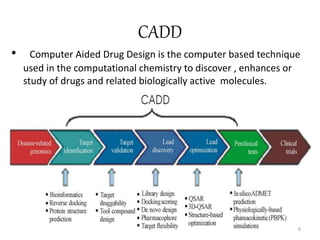
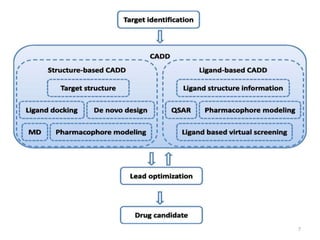
• Computer Aided Drug Design is the computer based technique
used in the computational chemistry to discover , enhances or
study of drugs and related biologically active molecules.
6
7
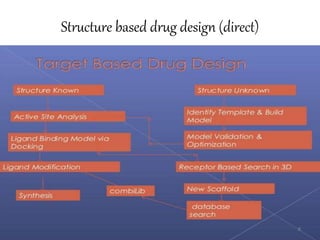
Structure based drug design (direct)
8
DENOVO DRUG DESIGN
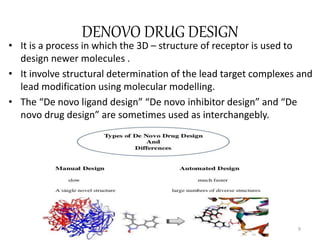
• It is a process in which the 3D – structure of receptor is used to
design newer molecules .
• It involve structural determination of the lead target complexes and
lead modification using molecular modelling.
• The “De novo ligand design” “De novo inhibitor design” and “De
novo drug design” are sometimes used as interchangebly.
9
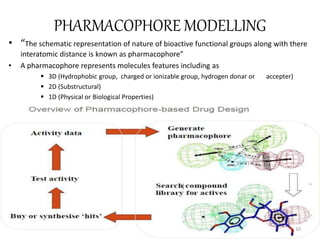
PHARMACOPHORE MODELLING
• “The schematic representation of nature of bioactive functional groups along with there
interatomic distance is known as pharmacophore”
• A pharmacophore represents molecules features including as
 3D (Hydrophobic group, charged or ionizable group, hydrogen donar or accepter)
 2D (Substructural)
 1D (Physical or Biological Properties)
10
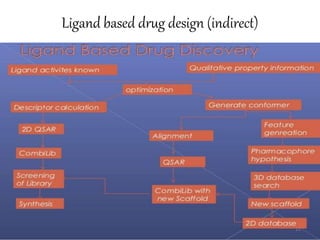
Ligand based drug design (indirect)
11
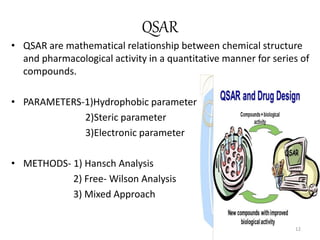
QSAR
• QSAR are mathematical relationship between chemical structure
and pharmacological activity in a quantitative manner for series of
compounds.
• PARAMETERS-1)Hydrophobic parameter
2)Steric parameter
3)Electronic parameter
• METHODS- 1) Hansch Analysis
2) Free- Wilson Analysis
3) Mixed Approach
12
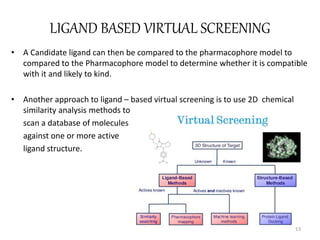
LIGAND BASED VIRTUAL SCREENING
• A Candidate ligand can then be compared to the pharmacophore model to
compared to the Pharmacophore model to determine whether it is compatible
with it and likely to kind.
• Another approach to ligand – based virtual screening is to use 2D chemical
similarity analysis methods to
scan a database of molecules
against one or more active
ligand structure.
13
application
 Determine the lowest free energy structure for the receptor –
ligand complex .
 Search database and rank hits for lead generation.
 Calculate the differential binding of a ligand to two different
macromolecules receptors.
 Study the geometry of particular complex.
 Propose modification of a lead molecules to optimize potency
or other properties.
 De novo design for lead generation.
 Used foe docking study
 Used for SBDD and LBDD.
14
15

COMPUTER AIDED DRUG DESIGN

  • 1.
    Rani T. Bhagat M. Pharmacy, (Pharmaceutical Chemistry) 1
  • 2.
    CONTENT  HISTORY  INTRODUCTION DRUGDESIGN-CADD TYPES TECHNIQUES APPLICATION REFERANCES 2
  • 3.
    HISTORY • Early 19thcentury –extraction of compounds from plants (morphine , cocain). • Late 19th century – fewer natural products used ,more synthetic substances. Dye and chemical companies start research labs and discover medical application .(Bayer) • 1905 –John Langley :Theory of receptive substances which started “The concept of specific receptors that bind drug or transmitter substances onto the cell, either initiating biological effects or inhibiting cellular function” • 1909 – First Rational drug design. 3
  • 4.
    • 1960- Firstsuccessful attept to relate chemical structure to biological action quantitatively. • Mid to late 20th century –understand disease states , biological structure ,processes, drug transport, distribution, metabolism. • Medicinal chemist this knowledge to modify chemical structure to influence a drug’s activity ,stability. • The time from conception to approval of a new drug is typically 10-15 years. 4
  • 5.
    DRUG DESIGN • Theprimary object of medicinal chemistry is the design and discovery of new compound that are suitable for use as drug. • It is inventive process of finding new medication based on the knowledge of biological target called as drug design. • Drug design with the help of computer may be used at any of the following stages of drug discovery. – Hit identification using vertual screening – QSAR 5
  • 6.
    CADD • Computer AidedDrug Design is the computer based technique used in the computational chemistry to discover , enhances or study of drugs and related biologically active molecules. 6
  • 7.
  • 8.
    Structure based drugdesign (direct) 8
  • 9.
    DENOVO DRUG DESIGN •It is a process in which the 3D – structure of receptor is used to design newer molecules . • It involve structural determination of the lead target complexes and lead modification using molecular modelling. • The “De novo ligand design” “De novo inhibitor design” and “De novo drug design” are sometimes used as interchangebly. 9
  • 10.
    PHARMACOPHORE MODELLING • “Theschematic representation of nature of bioactive functional groups along with there interatomic distance is known as pharmacophore” • A pharmacophore represents molecules features including as  3D (Hydrophobic group, charged or ionizable group, hydrogen donar or accepter)  2D (Substructural)  1D (Physical or Biological Properties) 10
  • 11.
    Ligand based drugdesign (indirect) 11
  • 12.
    QSAR • QSAR aremathematical relationship between chemical structure and pharmacological activity in a quantitative manner for series of compounds. • PARAMETERS-1)Hydrophobic parameter 2)Steric parameter 3)Electronic parameter • METHODS- 1) Hansch Analysis 2) Free- Wilson Analysis 3) Mixed Approach 12
  • 13.
    LIGAND BASED VIRTUALSCREENING • A Candidate ligand can then be compared to the pharmacophore model to compared to the Pharmacophore model to determine whether it is compatible with it and likely to kind. • Another approach to ligand – based virtual screening is to use 2D chemical similarity analysis methods to scan a database of molecules against one or more active ligand structure. 13
  • 14.
    application  Determine thelowest free energy structure for the receptor – ligand complex .  Search database and rank hits for lead generation.  Calculate the differential binding of a ligand to two different macromolecules receptors.  Study the geometry of particular complex.  Propose modification of a lead molecules to optimize potency or other properties.  De novo design for lead generation.  Used foe docking study  Used for SBDD and LBDD. 14
  • 15.