Organic Pedagogical Electronic
Network
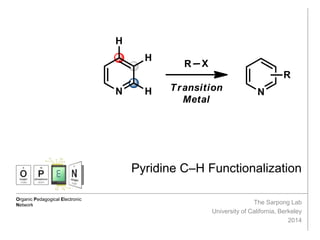
Pyridine C–H Functionalization
The Sarpong Lab
University of California, Berkeley
2014
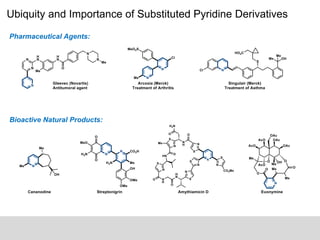
Ubiquity and Importance of Substituted Pyridine Derivatives
Pharmaceutical Agents:
Bioactive Natural Products:
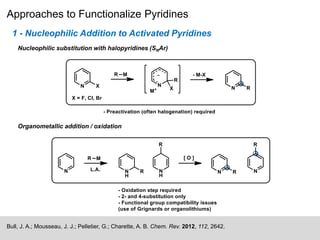
Approaches to Functionalize Pyridines
Bull, J. A.; Mousseau, J. J.; Pelletier, G.; Charette, A. B. Chem. Rev. 2012, 112, 2642.
1 - Nucleophilic Addition to Activated Pyridines
Nucleophilic substitution with halopyridines (SNAr)
Organometallic addition / oxidation
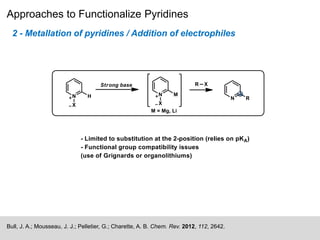
Approaches to Functionalize Pyridines
Bull, J. A.; Mousseau, J. J.; Pelletier, G.; Charette, A. B. Chem. Rev. 2012, 112, 2642.
2 - Metallation of pyridines / Addition of electrophiles
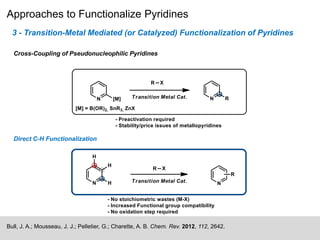
Approaches to Functionalize Pyridines
Bull, J. A.; Mousseau, J. J.; Pelletier, G.; Charette, A. B. Chem. Rev. 2012, 112, 2642.
3 - Transition-Metal Mediated (or Catalyzed) Functionalization of Pyridines
Cross-Coupling of Pseudonucleophilic Pyridines
Direct C-H Functionalization
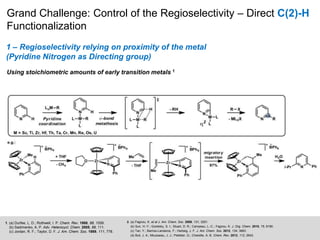
Grand Challenge: Control of the Regioselectivity – Direct C(2)-H
Functionalization
Using stoichiometric amounts of early transition metals 1
1 – Regioselectivity relying on proximity of the metal
(Pyridine Nitrogen as Directing group)
1. (a) Durfee, L. D.; Rothwell, I. P. Chem. Rev. 1988, 88, 1059.
(b) Sadimenko, A. P. Adv. Heterocycl. Chem. 2005, 88, 111.
(c) Jordan, R. F.; Taylor, D. F. J. Am. Chem. Soc. 1989, 111, 778.
2. (a) Fagnou, K. et al J. Am. Chem. Soc. 2009, 131, 3291.
(b) Sun, H.-Y.; Gorelsky, S. I.; Stuart, D. R.; Campeau, L.-C.; Fagnou, K. J. Org. Chem. 2010, 75, 8180.
(c) Tan, Y.; Barrios-Landeros, F.; Hartwig, J. F. J. Am. Chem. Soc. 2012, 134, 3683.
(d) Bull, J. A.; Mousseau, J. J.; Pelletier, G.; Charette, A. B. Chem. Rev. 2012, 112, 2642.
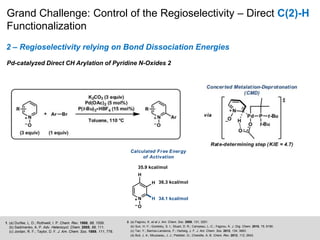
Grand Challenge: Control of the Regioselectivity – Direct C(2)-H
Functionalization
Pd-catalyzed Direct CH Arylation of Pyridine N-Oxides 2
2 – Regioselectivity relying on Bond Dissociation Energies
1. (a) Durfee, L. D.; Rothwell, I. P. Chem. Rev. 1988, 88, 1059.
(b) Sadimenko, A. P. Adv. Heterocycl. Chem. 2005, 88, 111.
(c) Jordan, R. F.; Taylor, D. F. J. Am. Chem. Soc. 1989, 111, 778.
2. (a) Fagnou, K. et al J. Am. Chem. Soc. 2009, 131, 3291.
(b) Sun, H.-Y.; Gorelsky, S. I.; Stuart, D. R.; Campeau, L.-C.; Fagnou, K. J. Org. Chem. 2010, 75, 8180.
(c) Tan, Y.; Barrios-Landeros, F.; Hartwig, J. F. J. Am. Chem. Soc. 2012, 134, 3683.
(d) Bull, J. A.; Mousseau, J. J.; Pelletier, G.; Charette, A. B. Chem. Rev. 2012, 112, 2642.
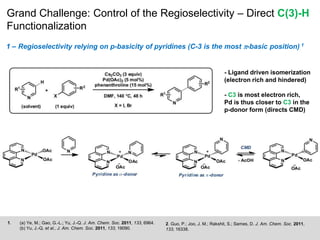
Grand Challenge: Control of the Regioselectivity – Direct C(3)-H
Functionalization
1. (a) Ye, M.; Gao, G.-L.; Yu, J.-Q. J. Am. Chem. Soc. 2011, 133, 6964.
(b) Yu, J.-Q. et al., J. Am. Chem. Soc. 2011, 133, 19090.
2. Guo, P.; Joo, J. M.; Rakshit, S.; Sames, D. J. Am. Chem. Soc. 2011,
133, 16338.
1 – Regioselectivity relying on p-basicity of pyridines (C-3 is the most p-basic position) 1
- Ligand driven isomerization
(electron rich and hindered)
- C3 is most electron rich,
Pd is thus closer to C3 in the
p-donor form (directs CMD)
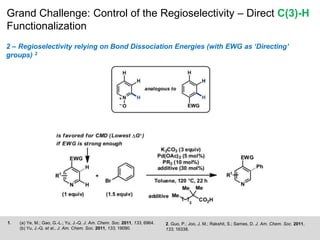
Grand Challenge: Control of the Regioselectivity – Direct C(3)-H
Functionalization
1. (a) Ye, M.; Gao, G.-L.; Yu, J.-Q. J. Am. Chem. Soc. 2011, 133, 6964.
(b) Yu, J.-Q. et al., J. Am. Chem. Soc. 2011, 133, 19090.
2. Guo, P.; Joo, J. M.; Rakshit, S.; Sames, D. J. Am. Chem. Soc. 2011,
133, 16338.
2 – Regioselectivity relying on Bond Dissociation Energies (with EWG as ‘Directing’
groups) 2
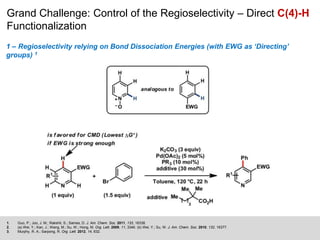
Grand Challenge: Control of the Regioselectivity – Direct C(4)-H
Functionalization
1 – Regioselectivity relying on Bond Dissociation Energies (with EWG as ‘Directing’
groups) 1
1. Guo, P.; Joo, J. M.; Rakshit, S.; Sames, D. J. Am. Chem. Soc. 2011, 133, 16338.
2. (a) Wei, Y.; Kan, J.; Wang, M.; Su, W.; Hong, M. Org. Lett. 2009, 11, 3346. (b) Wei, Y.; Su, W. J. Am. Chem. Soc. 2010, 132, 16377.
3. Murphy, R. A.; Sarpong, R. Org. Lett. 2012, 14, 632.
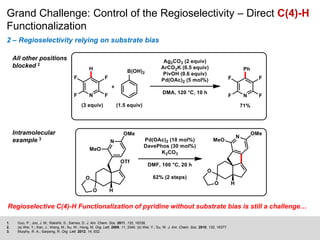
Grand Challenge: Control of the Regioselectivity – Direct C(4)-H
Functionalization
2 – Regioselectivity relying on substrate bias
1. Guo, P.; Joo, J. M.; Rakshit, S.; Sames, D. J. Am. Chem. Soc. 2011, 133, 16338.
2. (a) Wei, Y.; Kan, J.; Wang, M.; Su, W.; Hong, M. Org. Lett. 2009, 11, 3346. (b) Wei, Y.; Su, W. J. Am. Chem. Soc. 2010, 132, 16377.
3. Murphy, R. A.; Sarpong, R. Org. Lett. 2012, 14, 632.
All other positions
blocked 2
Intramolecular
example 3
Regioselective C(4)-H Functionalization of pyridine without substrate bias is still a challenge…
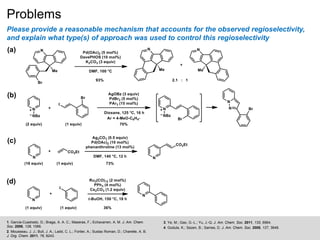
Problems
1. García-Cuadrado, D.; Braga, A. A. C.; Maseras, F.; Echavarren, A. M. J. Am. Chem.
Soc. 2006, 128, 1066.
2. Mousseau, J. J.; Bull, J. A.; Ladd, C. L.; Fortier, A.; Sustac Roman, D.; Charette, A. B.
J. Org. Chem. 2011, 76, 8243.
3. Ye, M.; Gao, G.-L.; Yu, J.-Q. J. Am. Chem. Soc. 2011, 133, 6964.
4. Godula, K.; Sezen, B.; Sames, D. J. Am. Chem. Soc. 2005, 127, 3648.
Please provide a reasonable mechanism that accounts for the observed regioselectivity,
and explain what type(s) of approach was used to control this regioselectivity
(a)
(c)
(b)
(d)
This work is licensed under a
Creative Commons Attribution-
ShareAlike 4.0 International
License.
Contributed by:
The Sarpong Lab
University of California, Berkeley, 2014

Pyridine CH functionalization

  • 1.
    Organic Pedagogical Electronic Network PyridineC–H Functionalization The Sarpong Lab University of California, Berkeley 2014
  • 2.
    Ubiquity and Importanceof Substituted Pyridine Derivatives Pharmaceutical Agents: Bioactive Natural Products:
  • 3.
    Approaches to FunctionalizePyridines Bull, J. A.; Mousseau, J. J.; Pelletier, G.; Charette, A. B. Chem. Rev. 2012, 112, 2642. 1 - Nucleophilic Addition to Activated Pyridines Nucleophilic substitution with halopyridines (SNAr) Organometallic addition / oxidation
  • 4.
    Approaches to FunctionalizePyridines Bull, J. A.; Mousseau, J. J.; Pelletier, G.; Charette, A. B. Chem. Rev. 2012, 112, 2642. 2 - Metallation of pyridines / Addition of electrophiles
  • 5.
    Approaches to FunctionalizePyridines Bull, J. A.; Mousseau, J. J.; Pelletier, G.; Charette, A. B. Chem. Rev. 2012, 112, 2642. 3 - Transition-Metal Mediated (or Catalyzed) Functionalization of Pyridines Cross-Coupling of Pseudonucleophilic Pyridines Direct C-H Functionalization
  • 6.
    Grand Challenge: Controlof the Regioselectivity – Direct C(2)-H Functionalization Using stoichiometric amounts of early transition metals 1 1 – Regioselectivity relying on proximity of the metal (Pyridine Nitrogen as Directing group) 1. (a) Durfee, L. D.; Rothwell, I. P. Chem. Rev. 1988, 88, 1059. (b) Sadimenko, A. P. Adv. Heterocycl. Chem. 2005, 88, 111. (c) Jordan, R. F.; Taylor, D. F. J. Am. Chem. Soc. 1989, 111, 778. 2. (a) Fagnou, K. et al J. Am. Chem. Soc. 2009, 131, 3291. (b) Sun, H.-Y.; Gorelsky, S. I.; Stuart, D. R.; Campeau, L.-C.; Fagnou, K. J. Org. Chem. 2010, 75, 8180. (c) Tan, Y.; Barrios-Landeros, F.; Hartwig, J. F. J. Am. Chem. Soc. 2012, 134, 3683. (d) Bull, J. A.; Mousseau, J. J.; Pelletier, G.; Charette, A. B. Chem. Rev. 2012, 112, 2642.
  • 7.
    Grand Challenge: Controlof the Regioselectivity – Direct C(2)-H Functionalization Pd-catalyzed Direct CH Arylation of Pyridine N-Oxides 2 2 – Regioselectivity relying on Bond Dissociation Energies 1. (a) Durfee, L. D.; Rothwell, I. P. Chem. Rev. 1988, 88, 1059. (b) Sadimenko, A. P. Adv. Heterocycl. Chem. 2005, 88, 111. (c) Jordan, R. F.; Taylor, D. F. J. Am. Chem. Soc. 1989, 111, 778. 2. (a) Fagnou, K. et al J. Am. Chem. Soc. 2009, 131, 3291. (b) Sun, H.-Y.; Gorelsky, S. I.; Stuart, D. R.; Campeau, L.-C.; Fagnou, K. J. Org. Chem. 2010, 75, 8180. (c) Tan, Y.; Barrios-Landeros, F.; Hartwig, J. F. J. Am. Chem. Soc. 2012, 134, 3683. (d) Bull, J. A.; Mousseau, J. J.; Pelletier, G.; Charette, A. B. Chem. Rev. 2012, 112, 2642.
  • 8.
    Grand Challenge: Controlof the Regioselectivity – Direct C(3)-H Functionalization 1. (a) Ye, M.; Gao, G.-L.; Yu, J.-Q. J. Am. Chem. Soc. 2011, 133, 6964. (b) Yu, J.-Q. et al., J. Am. Chem. Soc. 2011, 133, 19090. 2. Guo, P.; Joo, J. M.; Rakshit, S.; Sames, D. J. Am. Chem. Soc. 2011, 133, 16338. 1 – Regioselectivity relying on p-basicity of pyridines (C-3 is the most p-basic position) 1 - Ligand driven isomerization (electron rich and hindered) - C3 is most electron rich, Pd is thus closer to C3 in the p-donor form (directs CMD)
  • 9.
    Grand Challenge: Controlof the Regioselectivity – Direct C(3)-H Functionalization 1. (a) Ye, M.; Gao, G.-L.; Yu, J.-Q. J. Am. Chem. Soc. 2011, 133, 6964. (b) Yu, J.-Q. et al., J. Am. Chem. Soc. 2011, 133, 19090. 2. Guo, P.; Joo, J. M.; Rakshit, S.; Sames, D. J. Am. Chem. Soc. 2011, 133, 16338. 2 – Regioselectivity relying on Bond Dissociation Energies (with EWG as ‘Directing’ groups) 2
  • 10.
    Grand Challenge: Controlof the Regioselectivity – Direct C(4)-H Functionalization 1 – Regioselectivity relying on Bond Dissociation Energies (with EWG as ‘Directing’ groups) 1 1. Guo, P.; Joo, J. M.; Rakshit, S.; Sames, D. J. Am. Chem. Soc. 2011, 133, 16338. 2. (a) Wei, Y.; Kan, J.; Wang, M.; Su, W.; Hong, M. Org. Lett. 2009, 11, 3346. (b) Wei, Y.; Su, W. J. Am. Chem. Soc. 2010, 132, 16377. 3. Murphy, R. A.; Sarpong, R. Org. Lett. 2012, 14, 632.
  • 11.
    Grand Challenge: Controlof the Regioselectivity – Direct C(4)-H Functionalization 2 – Regioselectivity relying on substrate bias 1. Guo, P.; Joo, J. M.; Rakshit, S.; Sames, D. J. Am. Chem. Soc. 2011, 133, 16338. 2. (a) Wei, Y.; Kan, J.; Wang, M.; Su, W.; Hong, M. Org. Lett. 2009, 11, 3346. (b) Wei, Y.; Su, W. J. Am. Chem. Soc. 2010, 132, 16377. 3. Murphy, R. A.; Sarpong, R. Org. Lett. 2012, 14, 632. All other positions blocked 2 Intramolecular example 3 Regioselective C(4)-H Functionalization of pyridine without substrate bias is still a challenge…
  • 12.
    Problems 1. García-Cuadrado, D.;Braga, A. A. C.; Maseras, F.; Echavarren, A. M. J. Am. Chem. Soc. 2006, 128, 1066. 2. Mousseau, J. J.; Bull, J. A.; Ladd, C. L.; Fortier, A.; Sustac Roman, D.; Charette, A. B. J. Org. Chem. 2011, 76, 8243. 3. Ye, M.; Gao, G.-L.; Yu, J.-Q. J. Am. Chem. Soc. 2011, 133, 6964. 4. Godula, K.; Sezen, B.; Sames, D. J. Am. Chem. Soc. 2005, 127, 3648. Please provide a reasonable mechanism that accounts for the observed regioselectivity, and explain what type(s) of approach was used to control this regioselectivity (a) (c) (b) (d)
  • 13.
    This work islicensed under a Creative Commons Attribution- ShareAlike 4.0 International License. Contributed by: The Sarpong Lab University of California, Berkeley, 2014