PRODRUG DESIGN
SUBMITTED BY,
Manimegalai.G
M.Pharm-I year
Advanced Medicinal Chemistry
5/17/2023
Department of Pharmaceutical Chemistry 1
INTRODUCTION
• A Prodrug is pharmacologically inactive compound that is converted into
active drug by a metabolic biotransformation .
• Prodrug enhanced the usefulness of various therapeutic agents by altering
the physicochemical properties, pharmacokinetics and biopharmaceutical
properties.
• It might alter the tissue distribution , efficacy and toxicity of parent drug.
5/17/2023
Department of Pharmaceutical Chemistry 2
5/17/2023
Department of Pharmaceutical Chemistry 3
REASONS FOR PRODRUG APPROACH
• Improved aqueous solubility
• Improved absorption and distribution
• Site specificity
• Improved stability of drugs
• For prolonged release
• To reduce toxicity
• In poor patient acceptability
5/17/2023
Department of Pharmaceutical Chemistry
4
BASIC CONCEPT
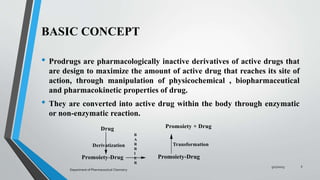
• Prodrugs are pharmacologically inactive derivatives of active drugs that
are design to maximize the amount of active drug that reaches its site of
action, through manipulation of physicochemical , biopharmaceutical
and pharmacokinetic properties of drug.
• They are converted into active drug within the body through enzymatic
or non-enzymatic reaction.
Promoiety-Drug
5/17/2023
Department of Pharmaceutical Chemistry
5
CARRIER LINKED PRODRUGS
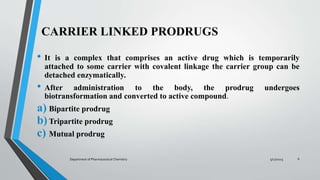
• It is a complex that comprises an active drug which is temporarily
attached to some carrier with covalent linkage the carrier group can be
detached enzymatically.
• After administration to the body, the prodrug undergoes
biotransformation and converted to active compound.
a) Bipartite prodrug
b)Tripartite prodrug
c) Mutual prodrug
5/17/2023
Department of Pharmaceutical Chemistry 6
BIPARTITE PRODRUG
• It is a prodrug composed of one carrier attached to the drug.( Drug+
Carrier)
• These are greatly modified lipophilicity due to the attached carrier . The
active released by hydrolytic cleavage either chemically or enzymatically.
For eg., Tolmetin – glycine prodrug (NSAIDs)
5/17/2023
Department of Pharmaceutical Chemistry
7
TRIPARTITE PRODRUG
• In a tripartite prodrug, the carrier is not connected directly to the drug,
but rather to a linker which is attached to the drug.
• This allows for different kinds of functional to be incorporated for varying
stabilities and it also displaces the drug farther from the hydrolysis site,
which decrease the steric interference by the carrier.
• The drug – linker connection however, must be designed so that it cleaves
spontaneously after the carrier has been detached.
5/17/2023
Department of Pharmaceutical Chemistry
8
5/17/2023
Department of Pharmaceutical Chemistry 9
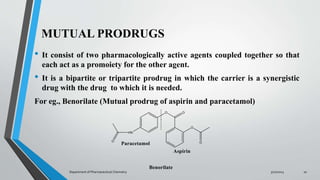
MUTUAL PRODRUGS
• It consist of two pharmacologically active agents coupled together so that
each act as a promoiety for the other agent.
• It is a bipartite or tripartite prodrug in which the carrier is a synergistic
drug with the drug to which it is needed.
For eg., Benorilate (Mutual prodrug of aspirin and paracetamol)
5/17/2023
Department of Pharmaceutical Chemistry 10
BIOPRECURSORS PRODRUG
• Bioprecursors results from the molecular modifications of the compound.
• There is no need of promoiety in bioprecursors. Carrier linked podrugs
rely largely hydrolysis reaction for their effectiveness, whereas
Bioprecursors prodrugs mostly utilize their oxidative or reductive
activation reaction.
a) Reductive Bioactivation
b)Oxidative activation
c) Oxidative deamination
d)N-oxidation
e) Azo reductive activation
f) Sulfoxide reduction
5/17/2023
Department of Pharmaceutical Chemistry 11
REDUCTIVE BIOACTIVATION
• Omeprazole , effectively inhibits gastric secretion by inhibiting the gastric
H+ K+ ATPase. This enzyme is responsible for gastric acid secretion and
located in the secretory membranes of parietal cells.
• Invivo Omeprazole is transformed into the active inhibitor, a cyclic
sulfonamide, which forms disulfide bridge with thiol group of the enzyme
and thus inactivates enzyme
5/17/2023
Department of Pharmaceutical Chemistry 12
5/17/2023
Department of Pharmaceutical Chemistry 13
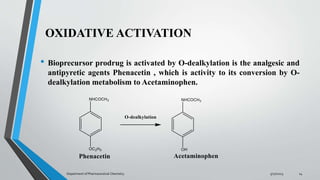
OXIDATIVE ACTIVATION
• Bioprecursor prodrug is activated by O-dealkylation is the analgesic and
antipyretic agents Phenacetin , which is activity to its conversion by O-
dealkylation metabolism to Acetaminophen.
5/17/2023
Department of Pharmaceutical Chemistry 14
OXIDATIVE DEAMINATION
• Cyclophosphamide is an alkylating agent it needs oxidative deamination
for active metabolite.
5/17/2023
Department of Pharmaceutical Chemistry 15
N- OXIDATION
• Pralidoxime is an antidote for poisoning by organophosphorus
compound which is believed to be activated by N- oxidation.
5/17/2023
Department of Pharmaceutical Chemistry 16
AZO REDUCTIVE ACTIVATION
• Sulfasalazine used in the treatment of inflammatory bowel disease is
reductively cleaved by anaerobic bacteria in the lower bowel to 5- amino
salicylic acid and sulfapyridine.
5/17/2023
Department of Pharmaceutical Chemistry
17
SULFOXIDE REDUCTION
• The antiarthritis drug sulindac is an indene isostere of the drug
Indomethacin. Invivo it undergoes sulfoxide reduction to form an active
metabolite sulindac sulfide.
5/17/2023
Department of Pharmaceutical Chemistry 18
PRODRUGS OF FUNCTIONAL GROUP
CARBOXYLIC ACID AND ALCOHOL
• Prodrugs of carboxylic acid & alcohol functionalities can be prepared
by conversion to esters. The esters can be easily hydrolysed by
esterase enzymes present in plasma and other tissues to give active
drug.
5/17/2023
Department of Pharmaceutical Chemistry
19
AMINES
• Due to the high stability and lack of amidase enzyme necessary for
hydrolysis, the conversion of amines to amide as a prodrug is not been
used for most of the drugs.
5/17/2023
Department of Pharmaceutical Chemistry 20
AZO LINKAGE
• Prodrugs of amines are occasionally prepared by incorporating them into
an azo linkage. By the action of azo reductase the amino compounds are
released.
For eg.,
5/17/2023
Department of Pharmaceutical Chemistry 21
CARBONYL GROUP
For eg., Hexamine releases Formaldehyde in the Urine(acidic pH) which act
as an antibacterial agent.
5/17/2023
Department of Pharmaceutical Chemistry 22
PRODRUGS TO IMPROVE PATIENT
ACCEPTABILITY
• Painful injections and unpleasant taste or odour are the most common
reasons for the lack of patient acceptance of a drug.
For eg., Ethyl Mercaptan is a foul smelling liquid used in the treatment of
leprosy. This is converted to phthalate ester, a diethyl dithioisophthalate that
has higher boiling point and is odourless.
5/17/2023
Department of Pharmaceutical Chemistry
23
PRODRUG FOR IMPROVED ABSORPTION AND
DISTRIBUTION
• The skin is designed to maintain the body fluids and prevent absorption
of xenobiotics into the general circulation. Consequently , drugs applied
to the skin are poorly absorbed.
• Even steroids have low dermal permeability if they contain OH groups
that can interact with the skin or binding site in the keratin.
• Corticosteroids for the topical treatment of inflammatory , allergic and
pruritis skin conditions can be made more suitable for topical absorption
by esterification.
5/17/2023
Department of Pharmaceutical Chemistry 24
• Fluocinonide is a prodrug of Flucinolone acetonide used for inflammtory
and pruritic manifestation . Once absorbed through the skin an esterase
release the drug.
Fluocinolone acetonide R =H (active)
Fluocinonide R= COCH3 (prodrug)
5/17/2023
Department of Pharmaceutical Chemistry 25
PRODRUG FOR SITE SPECIFICITY
• Blood Brain Barrier a unique lipid like protective barrier that prevents
hydrophilic compounds from entering the brain unless they are actively
transported.
• An increasing the brain concentration of the inhibitory neurotransmitter
GABA results in anticonvulsant activity.
• However, GABA is too polar to cross the BBB so it is not an effective
anticonvulsant drug.
5/17/2023
Department of Pharmaceutical Chemistry 26
• Progabide is an effective lipophilic analog of GABA that crosses the BBB,
releases GABA inside the brain and exhibit anticonvulsant activity.
GABA (unable to cross BBB)
Progabide (prodrug)
5/17/2023
Department of Pharmaceutical Chemistry 27
PRODRUG FOR PROLONG ACTIVITY
• The prodrug by its improved characteristics get closer to the receptor site
for a longer period of time and conversion to the parent drug takes place
at the site of action.
• It reduces the number and frequency of dose
• It eliminates night time administration of drugs
• Minimize patient non compliance.
5/17/2023
Department of Pharmaceutical Chemistry 28
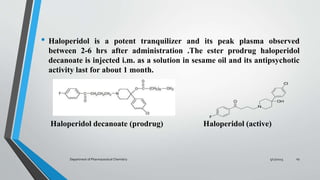
• Haloperidol is a potent tranquilizer and its peak plasma observed
between 2-6 hrs after administration .The ester prodrug haloperidol
decanoate is injected i.m. as a solution in sesame oil and its antipsychotic
activity last for about 1 month.
Haloperidol decanoate (prodrug) Haloperidol (active)
5/17/2023
Department of Pharmaceutical Chemistry 29
DRUG SOLUBILITY
• Hydrophilic or water soluble drugs are needed when parenteral or
ophthalmic formulation .
• Drug with hydroxyl functional group can be converted to their
hydrophilic form through the use of half ester such as hemi- glutarate or
hemi phthalate , the other half of this acid carries sodium, potassium or
amine salts and render this moiety more soluble.
5/17/2023
Department of Pharmaceutical Chemistry 30
methyl prednisolone methyl presdnisolone
succinate ester
5/17/2023
Department of Pharmaceutical Chemistry 31
RATIONALE OF PRODRUG DESIGN
• The prodrug design includes an infixed position that can be altered to improve
in membrane permeability, solubility and ADME properties.
• Different prodrugs used for cancer therapies and other related therapies
include,
• Antibody directed enzyme prodrug therapy
• Gene directed enzyme prodrug therapy
• Polymer directed enzyme prodrug therapy
• Virus directed enzyme prodrug therapy
• Lectin directed enzyme prodrug therapy
• Clostridiol directed enzyme prodrug therapy
5/17/2023
Department of Pharmaceutical Chemistry 32
• ANTIBODY DIRECTED ENZYME PRODRUG THERAPY
In the targeted therapy , the antibody enzyme conjugate will help in
selective binding of enzyme to the tumor cell and then the prodrug
converts into the active drug by the targeted enzyme , thus only affecting
the tumor and leaving back the normal cells.
• GENE DIRECTED ENZYME PRODRUG THERAPY
It is a suicide gene therapy in which the enzyme required for prodrug
conversion is produced within the target cell , using a gene delivered to it
by gene therapy
• VIRUS DIRECTED ENZYME PRODRUG THERAPY
It is an emerging strategy against cancer to the use of virus . It can be
potentially used to enhance the therapeutic potential of oncolytic virus.
5/17/2023
Department of Pharmaceutical Chemistry 33
• POLYMER DIRECTED ENZYME ACTIVATED PRODRUG
THERAPY
It is a novel two step antitumor approach using a combination of a
polymeric prodrug and polymeric enzyme conjugated to generate cytotoxic
drug selectivey at the tumor site.
• LECTIN DIRECTED ENZYME ACTIVATED PRODRUG
THERAPY
It is designed to exploit endogenous carbohydrate - lectin binding by
combining it with biocatalysis through the construction of novel
glycosylated enzymes and prodrugs.
• CLOSTRIDIA - DIRECTED ENZYME PRODRUG
THERAPY
The use of clostridia to convert prodrugs into active drug agents. It
expoits the tumor using anaerobic bacteria resident in the tumor to convert
the prodrug to the active form
5/17/2023
Department of Pharmaceutical Chemistry 34

PRODRUG DESIGN.pptx

  • 1.
    PRODRUG DESIGN SUBMITTED BY, Manimegalai.G M.Pharm-Iyear Advanced Medicinal Chemistry 5/17/2023 Department of Pharmaceutical Chemistry 1
  • 2.
    INTRODUCTION • A Prodrugis pharmacologically inactive compound that is converted into active drug by a metabolic biotransformation . • Prodrug enhanced the usefulness of various therapeutic agents by altering the physicochemical properties, pharmacokinetics and biopharmaceutical properties. • It might alter the tissue distribution , efficacy and toxicity of parent drug. 5/17/2023 Department of Pharmaceutical Chemistry 2
  • 3.
  • 4.
    REASONS FOR PRODRUGAPPROACH • Improved aqueous solubility • Improved absorption and distribution • Site specificity • Improved stability of drugs • For prolonged release • To reduce toxicity • In poor patient acceptability 5/17/2023 Department of Pharmaceutical Chemistry 4
  • 5.
    BASIC CONCEPT • Prodrugsare pharmacologically inactive derivatives of active drugs that are design to maximize the amount of active drug that reaches its site of action, through manipulation of physicochemical , biopharmaceutical and pharmacokinetic properties of drug. • They are converted into active drug within the body through enzymatic or non-enzymatic reaction. Promoiety-Drug 5/17/2023 Department of Pharmaceutical Chemistry 5
  • 6.
    CARRIER LINKED PRODRUGS •It is a complex that comprises an active drug which is temporarily attached to some carrier with covalent linkage the carrier group can be detached enzymatically. • After administration to the body, the prodrug undergoes biotransformation and converted to active compound. a) Bipartite prodrug b)Tripartite prodrug c) Mutual prodrug 5/17/2023 Department of Pharmaceutical Chemistry 6
  • 7.
    BIPARTITE PRODRUG • Itis a prodrug composed of one carrier attached to the drug.( Drug+ Carrier) • These are greatly modified lipophilicity due to the attached carrier . The active released by hydrolytic cleavage either chemically or enzymatically. For eg., Tolmetin – glycine prodrug (NSAIDs) 5/17/2023 Department of Pharmaceutical Chemistry 7
  • 8.
    TRIPARTITE PRODRUG • Ina tripartite prodrug, the carrier is not connected directly to the drug, but rather to a linker which is attached to the drug. • This allows for different kinds of functional to be incorporated for varying stabilities and it also displaces the drug farther from the hydrolysis site, which decrease the steric interference by the carrier. • The drug – linker connection however, must be designed so that it cleaves spontaneously after the carrier has been detached. 5/17/2023 Department of Pharmaceutical Chemistry 8
  • 9.
  • 10.
    MUTUAL PRODRUGS • Itconsist of two pharmacologically active agents coupled together so that each act as a promoiety for the other agent. • It is a bipartite or tripartite prodrug in which the carrier is a synergistic drug with the drug to which it is needed. For eg., Benorilate (Mutual prodrug of aspirin and paracetamol) 5/17/2023 Department of Pharmaceutical Chemistry 10
  • 11.
    BIOPRECURSORS PRODRUG • Bioprecursorsresults from the molecular modifications of the compound. • There is no need of promoiety in bioprecursors. Carrier linked podrugs rely largely hydrolysis reaction for their effectiveness, whereas Bioprecursors prodrugs mostly utilize their oxidative or reductive activation reaction. a) Reductive Bioactivation b)Oxidative activation c) Oxidative deamination d)N-oxidation e) Azo reductive activation f) Sulfoxide reduction 5/17/2023 Department of Pharmaceutical Chemistry 11
  • 12.
    REDUCTIVE BIOACTIVATION • Omeprazole, effectively inhibits gastric secretion by inhibiting the gastric H+ K+ ATPase. This enzyme is responsible for gastric acid secretion and located in the secretory membranes of parietal cells. • Invivo Omeprazole is transformed into the active inhibitor, a cyclic sulfonamide, which forms disulfide bridge with thiol group of the enzyme and thus inactivates enzyme 5/17/2023 Department of Pharmaceutical Chemistry 12
  • 13.
  • 14.
    OXIDATIVE ACTIVATION • Bioprecursorprodrug is activated by O-dealkylation is the analgesic and antipyretic agents Phenacetin , which is activity to its conversion by O- dealkylation metabolism to Acetaminophen. 5/17/2023 Department of Pharmaceutical Chemistry 14
  • 15.
    OXIDATIVE DEAMINATION • Cyclophosphamideis an alkylating agent it needs oxidative deamination for active metabolite. 5/17/2023 Department of Pharmaceutical Chemistry 15
  • 16.
    N- OXIDATION • Pralidoximeis an antidote for poisoning by organophosphorus compound which is believed to be activated by N- oxidation. 5/17/2023 Department of Pharmaceutical Chemistry 16
  • 17.
    AZO REDUCTIVE ACTIVATION •Sulfasalazine used in the treatment of inflammatory bowel disease is reductively cleaved by anaerobic bacteria in the lower bowel to 5- amino salicylic acid and sulfapyridine. 5/17/2023 Department of Pharmaceutical Chemistry 17
  • 18.
    SULFOXIDE REDUCTION • Theantiarthritis drug sulindac is an indene isostere of the drug Indomethacin. Invivo it undergoes sulfoxide reduction to form an active metabolite sulindac sulfide. 5/17/2023 Department of Pharmaceutical Chemistry 18
  • 19.
    PRODRUGS OF FUNCTIONALGROUP CARBOXYLIC ACID AND ALCOHOL • Prodrugs of carboxylic acid & alcohol functionalities can be prepared by conversion to esters. The esters can be easily hydrolysed by esterase enzymes present in plasma and other tissues to give active drug. 5/17/2023 Department of Pharmaceutical Chemistry 19
  • 20.
    AMINES • Due tothe high stability and lack of amidase enzyme necessary for hydrolysis, the conversion of amines to amide as a prodrug is not been used for most of the drugs. 5/17/2023 Department of Pharmaceutical Chemistry 20
  • 21.
    AZO LINKAGE • Prodrugsof amines are occasionally prepared by incorporating them into an azo linkage. By the action of azo reductase the amino compounds are released. For eg., 5/17/2023 Department of Pharmaceutical Chemistry 21
  • 22.
    CARBONYL GROUP For eg.,Hexamine releases Formaldehyde in the Urine(acidic pH) which act as an antibacterial agent. 5/17/2023 Department of Pharmaceutical Chemistry 22
  • 23.
    PRODRUGS TO IMPROVEPATIENT ACCEPTABILITY • Painful injections and unpleasant taste or odour are the most common reasons for the lack of patient acceptance of a drug. For eg., Ethyl Mercaptan is a foul smelling liquid used in the treatment of leprosy. This is converted to phthalate ester, a diethyl dithioisophthalate that has higher boiling point and is odourless. 5/17/2023 Department of Pharmaceutical Chemistry 23
  • 24.
    PRODRUG FOR IMPROVEDABSORPTION AND DISTRIBUTION • The skin is designed to maintain the body fluids and prevent absorption of xenobiotics into the general circulation. Consequently , drugs applied to the skin are poorly absorbed. • Even steroids have low dermal permeability if they contain OH groups that can interact with the skin or binding site in the keratin. • Corticosteroids for the topical treatment of inflammatory , allergic and pruritis skin conditions can be made more suitable for topical absorption by esterification. 5/17/2023 Department of Pharmaceutical Chemistry 24
  • 25.
    • Fluocinonide isa prodrug of Flucinolone acetonide used for inflammtory and pruritic manifestation . Once absorbed through the skin an esterase release the drug. Fluocinolone acetonide R =H (active) Fluocinonide R= COCH3 (prodrug) 5/17/2023 Department of Pharmaceutical Chemistry 25
  • 26.
    PRODRUG FOR SITESPECIFICITY • Blood Brain Barrier a unique lipid like protective barrier that prevents hydrophilic compounds from entering the brain unless they are actively transported. • An increasing the brain concentration of the inhibitory neurotransmitter GABA results in anticonvulsant activity. • However, GABA is too polar to cross the BBB so it is not an effective anticonvulsant drug. 5/17/2023 Department of Pharmaceutical Chemistry 26
  • 27.
    • Progabide isan effective lipophilic analog of GABA that crosses the BBB, releases GABA inside the brain and exhibit anticonvulsant activity. GABA (unable to cross BBB) Progabide (prodrug) 5/17/2023 Department of Pharmaceutical Chemistry 27
  • 28.
    PRODRUG FOR PROLONGACTIVITY • The prodrug by its improved characteristics get closer to the receptor site for a longer period of time and conversion to the parent drug takes place at the site of action. • It reduces the number and frequency of dose • It eliminates night time administration of drugs • Minimize patient non compliance. 5/17/2023 Department of Pharmaceutical Chemistry 28
  • 29.
    • Haloperidol isa potent tranquilizer and its peak plasma observed between 2-6 hrs after administration .The ester prodrug haloperidol decanoate is injected i.m. as a solution in sesame oil and its antipsychotic activity last for about 1 month. Haloperidol decanoate (prodrug) Haloperidol (active) 5/17/2023 Department of Pharmaceutical Chemistry 29
  • 30.
    DRUG SOLUBILITY • Hydrophilicor water soluble drugs are needed when parenteral or ophthalmic formulation . • Drug with hydroxyl functional group can be converted to their hydrophilic form through the use of half ester such as hemi- glutarate or hemi phthalate , the other half of this acid carries sodium, potassium or amine salts and render this moiety more soluble. 5/17/2023 Department of Pharmaceutical Chemistry 30
  • 31.
    methyl prednisolone methylpresdnisolone succinate ester 5/17/2023 Department of Pharmaceutical Chemistry 31
  • 32.
    RATIONALE OF PRODRUGDESIGN • The prodrug design includes an infixed position that can be altered to improve in membrane permeability, solubility and ADME properties. • Different prodrugs used for cancer therapies and other related therapies include, • Antibody directed enzyme prodrug therapy • Gene directed enzyme prodrug therapy • Polymer directed enzyme prodrug therapy • Virus directed enzyme prodrug therapy • Lectin directed enzyme prodrug therapy • Clostridiol directed enzyme prodrug therapy 5/17/2023 Department of Pharmaceutical Chemistry 32
  • 33.
    • ANTIBODY DIRECTEDENZYME PRODRUG THERAPY In the targeted therapy , the antibody enzyme conjugate will help in selective binding of enzyme to the tumor cell and then the prodrug converts into the active drug by the targeted enzyme , thus only affecting the tumor and leaving back the normal cells. • GENE DIRECTED ENZYME PRODRUG THERAPY It is a suicide gene therapy in which the enzyme required for prodrug conversion is produced within the target cell , using a gene delivered to it by gene therapy • VIRUS DIRECTED ENZYME PRODRUG THERAPY It is an emerging strategy against cancer to the use of virus . It can be potentially used to enhance the therapeutic potential of oncolytic virus. 5/17/2023 Department of Pharmaceutical Chemistry 33
  • 34.
    • POLYMER DIRECTEDENZYME ACTIVATED PRODRUG THERAPY It is a novel two step antitumor approach using a combination of a polymeric prodrug and polymeric enzyme conjugated to generate cytotoxic drug selectivey at the tumor site. • LECTIN DIRECTED ENZYME ACTIVATED PRODRUG THERAPY It is designed to exploit endogenous carbohydrate - lectin binding by combining it with biocatalysis through the construction of novel glycosylated enzymes and prodrugs. • CLOSTRIDIA - DIRECTED ENZYME PRODRUG THERAPY The use of clostridia to convert prodrugs into active drug agents. It expoits the tumor using anaerobic bacteria resident in the tumor to convert the prodrug to the active form 5/17/2023 Department of Pharmaceutical Chemistry 34