Transition Element
IV B GROUP
• Masita Saragih (06101010011)
• Narti Agustinah (06101010023)
• Paramita Dewi (06101010025)
• Murtiarni Putri (06101010026)
• Nora P Simamora (06101010035)
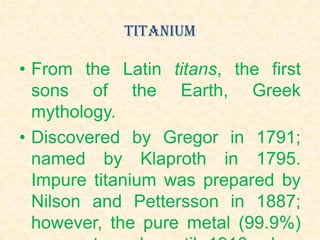
titanium
• From the Latin titans, the first
sons of the Earth, Greek
mythology.
• Discovered by Gregor in 1791;
named by Klaproth in 1795.
Impure titanium was prepared by
Nilson and Pettersson in 1887;
however, the pure metal (99.9%)
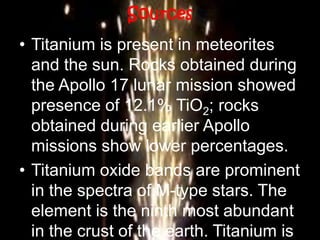
Sources
• Titanium is present in meteorites
and the sun. Rocks obtained during
the Apollo 17 lunar mission showed
presence of 12.1% TiO2; rocks
obtained during earlier Apollo
missions show lower percentages.
• Titanium oxide bands are prominent
in the spectra of M-type stars. The
element is the ninth most abundant
in the crust of the earth. Titanium is
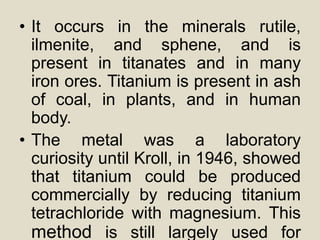
• It occurs in the minerals rutile,
ilmenite, and sphene, and is
present in titanates and in many
iron ores. Titanium is present in ash
of coal, in plants, and in human
body.
• The metal was a laboratory
curiosity until Kroll, in 1946, showed
that titanium could be produced
commercially by reducing titanium
tetrachloride with magnesium. This
method is still largely used for
Atomic number 22
Atomic symbol Ti
Atomic weight 47.88
Electron configuration [Ar]4s23d2
Atomic radius 187 pm
Elektronegativity 1.54
Density 4.54 g/cm3
Melting point 1668 C
Boiling Point 3287 C
Oxidation States 4,3,2
Ionization potential 4.82 V
Crystal stucture Hexagonal
Reaction Of Titanium
• Reaction with water
Ti(s) + 2H2O(g) → TiO2(s) + 2H2(g)
• Reaction with air
Ti(s) + O2(g) → TiO2(s)
2Ti(s) + N2(g) →TiN(s)
• Reaction with Halogen
Ti(s) + 2F2(s) → TiF4(s)
Ti(s) + 2Cl2(g) → TiCl4(s)
Ti(s) + 2Br2(l) → TiBr4(s)
Ti(s) + 2I2(s) → TiI4(s)
• Reaction with acid
Titanium does not react with mineral
acid in normal temperature but react
with hot hidrofluorik acid become
complex anion (TiF6)3-
2Ti(s) + 2HF (aq) → 2(TiF6)3-(aq) + 3
H2(g) + 6 H+(aq)
• Reactio with base
Titanium does not react with alkali in
normal temperature, but in hot
Uses
• Manufacture of aircraft and warship
• Titanium has potential use in desalination
plants for converting sea water into fresh
water
• Used to provide cathodic protection from
corrosion by salt water
• Titanium dioxide is extensively used for both
house paint and artist's paint
ZIRCONIUM
• From the Persian zargun, gold like. Zircon, the
primary gemstone of zirconium, is also known
as jargon, hyacinth, jacinth, or ligure
• The metal is found by M.H.Kalaproth in 1788
from of mineral zircon
• Zyrconium metal is grayish white,
crystalin,soft,malleabel and can be stretched
when in pure condition and resistant whith air
and fire.
Sources
• Zirconium is produced from the
mineral zircon (ZrSiO4).
• It is found in abundance in S-type
stars, and has been identified in
the sun and meteorites.
• Analysis of lunar rock samples
obtained during the various Apollo
missions to the moon show a
Atomic number 40
Atomic symbol Zr
Atomic weight 91.22
Electron configuration [Kr]5s24d2
Atomic radius 186 pm
Elektronegativitas 1.33
Kerapatan 6.506 g/cm3
Melting point 1855 C
Boiling Point 4409 C
Oxidation States 4
Ionization potential 6.84 V
Crystal stucture Hexagonal
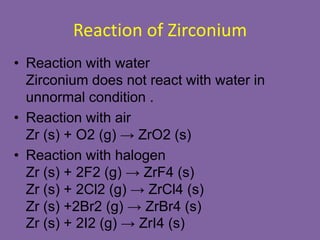
Reaction of Zirconium
• Reaction with water
Zirconium does not react with water in
unnormal condition .
• Reaction with air
Zr (s) + O2 (g) → ZrO2 (s)
• Reaction with halogen
Zr (s) + 2F2 (g) → ZrF4 (s)
Zr (s) + 2Cl2 (g) → ZrCl4 (s)
Zr (s) +2Br2 (g) → ZrBr4 (s)
Zr (s) + 2I2 (g) → ZrI4 (s)
Uses
• Zirconium is used as a getter in vacuum tubes
• used extensively by the chemical industry
where corrosive agents are employed
• as an alloying agent in steel, in surgical
appliances, photoflash bulbs, explosive
primers, rayon spinnerets, lamp filaments
• With niobium, zirconium is superconductive at
low temperatures and is used to make
superconductive magnets
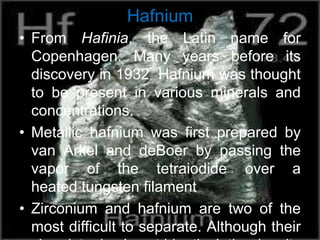
Hafnium
• From Hafinia, the Latin name for
Copenhagen. Many years before its
discovery in 1932 Hafnium was thought
to be present in various minerals and
concentrations.
• Metallic hafnium was first prepared by
van Arkel and deBoer by passing the
vapor of the tetraiodide over a
heated tungsten filament
• Zirconium and hafnium are two of the
most difficult to separate. Although their
Atomic number 72
Atomic symbol Hf
Atomic weight 178.49
Electron configuration [Xe]6s24f145d2
Atomic radius 212 pm
Elektronegativitas 1.30
Density 13,31 g/cm3
Melting point 2233 C
Boiling Point 4602 C
Oxidation States 4
Ionization potential 6.65
Crystal stucture Hexagonal
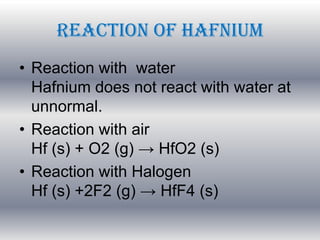
Reaction Of Hafnium
• Reaction with water
Hafnium does not react with water at
unnormal.
• Reaction with air
Hf (s) + O2 (g) → HfO2 (s)
• Reaction with Halogen
Hf (s) +2F2 (g) → HfF4 (s)
Uses
• Hafnium is used for reactor
control rods
• Hafnium is used in gas-filled and
incandescent lamps, and is an
efficient getter for
scavenging oxygen and nitrogen
• used as a gas filled in plasma
cutting

Anor

  • 1.
    Transition Element IV BGROUP • Masita Saragih (06101010011) • Narti Agustinah (06101010023) • Paramita Dewi (06101010025) • Murtiarni Putri (06101010026) • Nora P Simamora (06101010035)
  • 2.
    titanium • From theLatin titans, the first sons of the Earth, Greek mythology. • Discovered by Gregor in 1791; named by Klaproth in 1795. Impure titanium was prepared by Nilson and Pettersson in 1887; however, the pure metal (99.9%)
  • 3.
    Sources • Titanium ispresent in meteorites and the sun. Rocks obtained during the Apollo 17 lunar mission showed presence of 12.1% TiO2; rocks obtained during earlier Apollo missions show lower percentages. • Titanium oxide bands are prominent in the spectra of M-type stars. The element is the ninth most abundant in the crust of the earth. Titanium is
  • 4.
    • It occursin the minerals rutile, ilmenite, and sphene, and is present in titanates and in many iron ores. Titanium is present in ash of coal, in plants, and in human body. • The metal was a laboratory curiosity until Kroll, in 1946, showed that titanium could be produced commercially by reducing titanium tetrachloride with magnesium. This method is still largely used for
  • 5.
    Atomic number 22 Atomicsymbol Ti Atomic weight 47.88 Electron configuration [Ar]4s23d2 Atomic radius 187 pm Elektronegativity 1.54 Density 4.54 g/cm3 Melting point 1668 C Boiling Point 3287 C Oxidation States 4,3,2 Ionization potential 4.82 V Crystal stucture Hexagonal
  • 6.
    Reaction Of Titanium •Reaction with water Ti(s) + 2H2O(g) → TiO2(s) + 2H2(g) • Reaction with air Ti(s) + O2(g) → TiO2(s) 2Ti(s) + N2(g) →TiN(s) • Reaction with Halogen Ti(s) + 2F2(s) → TiF4(s) Ti(s) + 2Cl2(g) → TiCl4(s) Ti(s) + 2Br2(l) → TiBr4(s) Ti(s) + 2I2(s) → TiI4(s)
  • 7.
    • Reaction withacid Titanium does not react with mineral acid in normal temperature but react with hot hidrofluorik acid become complex anion (TiF6)3- 2Ti(s) + 2HF (aq) → 2(TiF6)3-(aq) + 3 H2(g) + 6 H+(aq) • Reactio with base Titanium does not react with alkali in normal temperature, but in hot
  • 8.
    Uses • Manufacture ofaircraft and warship • Titanium has potential use in desalination plants for converting sea water into fresh water • Used to provide cathodic protection from corrosion by salt water • Titanium dioxide is extensively used for both house paint and artist's paint
  • 9.
    ZIRCONIUM • From thePersian zargun, gold like. Zircon, the primary gemstone of zirconium, is also known as jargon, hyacinth, jacinth, or ligure • The metal is found by M.H.Kalaproth in 1788 from of mineral zircon • Zyrconium metal is grayish white, crystalin,soft,malleabel and can be stretched when in pure condition and resistant whith air and fire.
  • 10.
    Sources • Zirconium isproduced from the mineral zircon (ZrSiO4). • It is found in abundance in S-type stars, and has been identified in the sun and meteorites. • Analysis of lunar rock samples obtained during the various Apollo missions to the moon show a
  • 11.
    Atomic number 40 Atomicsymbol Zr Atomic weight 91.22 Electron configuration [Kr]5s24d2 Atomic radius 186 pm Elektronegativitas 1.33 Kerapatan 6.506 g/cm3 Melting point 1855 C Boiling Point 4409 C Oxidation States 4 Ionization potential 6.84 V Crystal stucture Hexagonal
  • 12.
    Reaction of Zirconium •Reaction with water Zirconium does not react with water in unnormal condition . • Reaction with air Zr (s) + O2 (g) → ZrO2 (s) • Reaction with halogen Zr (s) + 2F2 (g) → ZrF4 (s) Zr (s) + 2Cl2 (g) → ZrCl4 (s) Zr (s) +2Br2 (g) → ZrBr4 (s) Zr (s) + 2I2 (g) → ZrI4 (s)
  • 13.
    Uses • Zirconium isused as a getter in vacuum tubes • used extensively by the chemical industry where corrosive agents are employed • as an alloying agent in steel, in surgical appliances, photoflash bulbs, explosive primers, rayon spinnerets, lamp filaments • With niobium, zirconium is superconductive at low temperatures and is used to make superconductive magnets
  • 14.
    Hafnium • From Hafinia,the Latin name for Copenhagen. Many years before its discovery in 1932 Hafnium was thought to be present in various minerals and concentrations. • Metallic hafnium was first prepared by van Arkel and deBoer by passing the vapor of the tetraiodide over a heated tungsten filament • Zirconium and hafnium are two of the most difficult to separate. Although their
  • 15.
    Atomic number 72 Atomicsymbol Hf Atomic weight 178.49 Electron configuration [Xe]6s24f145d2 Atomic radius 212 pm Elektronegativitas 1.30 Density 13,31 g/cm3 Melting point 2233 C Boiling Point 4602 C Oxidation States 4 Ionization potential 6.65 Crystal stucture Hexagonal
  • 16.
    Reaction Of Hafnium •Reaction with water Hafnium does not react with water at unnormal. • Reaction with air Hf (s) + O2 (g) → HfO2 (s) • Reaction with Halogen Hf (s) +2F2 (g) → HfF4 (s)
  • 17.
    Uses • Hafnium isused for reactor control rods • Hafnium is used in gas-filled and incandescent lamps, and is an efficient getter for scavenging oxygen and nitrogen • used as a gas filled in plasma cutting