SUBMITTED BY:. SYED RASIB NAQVI
ROLL #:. 26
TOPIC:. STUDY OF ZIRCON
Zircon:.
 Is a mineral belonging to the group of Silicates, Nesosilicates. Its chemical name is
zirconium silicate and its corresponding chemical formula is ZrSiO4.
Environment:.
 Magmatic, metamorphic, pegmatitic, and alluvial rocks. Zircons are commonly slightly
radioactive due to trace amounts of uranium and make prime, geochron age indicators.
Properties of zircon:.
Cleavage: Indistinct
Color: Brown, Reddish brown, Colorless, Gray, Green.
Density: 4.6 - 4.7, Average = 4.65
Fracture: Uneven - Flat surfaces (not cleavage) fractured in an uneven pattern.
Luster: Adamantine
Streak: white
Hardness: 7.5 – Garnet
System: Tetragonal
Tenacity: Brittle
Transparency Transparent to opaque
Specific Gravity 4.6 - 4.8
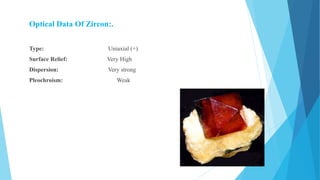
Optical Data Of Zircon:.
Type: Uniaxial (+)
Surface Relief: Very High
Dispersion: Very strong
Pleochroism: Weak
Varieties of zircon:.
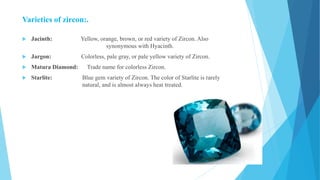
 Jacinth: Yellow, orange, brown, or red variety of Zircon. Also
synonymous with Hyacinth.
 Jargon: Colorless, pale gray, or pale yellow variety of Zircon.
 Matura Diamond: Trade name for colorless Zircon.
 Starlite: Blue gem variety of Zircon. The color of Starlite is rarely
natural, and is almost always heat treated.
Occurrence:.
 Zircon is a common accessory to trace mineral constituent of most granite and felsic
igneous rocks.
 Zircon is rare within mafic rocks and very rare within ultramafic rocks
 Due to its hardness, durability and chemical inertness, zircon persists in sedimentary
deposits and is a common constituent of most sands.
Zircon Sources:.
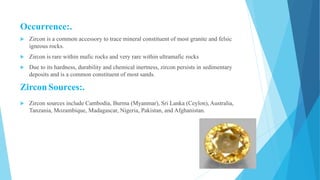
 Zircon sources include Cambodia, Burma (Myanmar), Sri Lanka (Ceylon), Australia,
Tanzania, Mozambique, Madagascar, Nigeria, Pakistan, and Afghanistan.
Uses
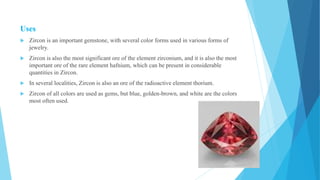
 Zircon is an important gemstone, with several color forms used in various forms of
jewelry.
 Zircon is also the most significant ore of the element zirconium, and it is also the most
important ore of the rare element hafnium, which can be present in considerable
quantities in Zircon.
 In several localities, Zircon is also an ore of the radioactive element thorium.
 Zircon of all colors are used as gems, but blue, golden-brown, and white are the colors
most often used.
Similar Gemstones:.
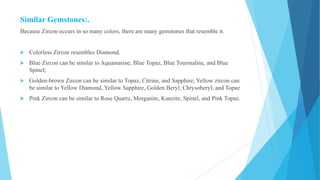
Because Zircon occurs in so many colors, there are many gemstones that resemble it.
 Colorless Zircon resembles Diamond.
 Blue Zircon can be similar to Aquamarine, Blue Topaz, Blue Tourmaline, and Blue
Spinel;
 Golden-brown Zircon can be similar to Topaz, Citrine, and Sapphire; Yellow zircon can
be similar to Yellow Diamond, Yellow Sapphire, Golden Beryl, Chrysoberyl, and Topaz
 Pink Zircon can be similar to Rose Quartz, Morganite, Kunzite, Spinel, and Pink Topaz.
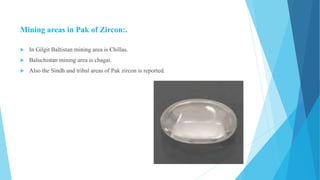
Mining areas in Pak of Zircon:.
 In Gilgit Baltistan mining area is Chillas.
 Baluchistan mining area is chagai.
 Also the Sindh and tribal areas of Pak zircon is reported.
Thank You

Zircon

  • 1.
    SUBMITTED BY:. SYEDRASIB NAQVI ROLL #:. 26 TOPIC:. STUDY OF ZIRCON
  • 2.
    Zircon:.  Is amineral belonging to the group of Silicates, Nesosilicates. Its chemical name is zirconium silicate and its corresponding chemical formula is ZrSiO4. Environment:.  Magmatic, metamorphic, pegmatitic, and alluvial rocks. Zircons are commonly slightly radioactive due to trace amounts of uranium and make prime, geochron age indicators.
  • 3.
    Properties of zircon:. Cleavage:Indistinct Color: Brown, Reddish brown, Colorless, Gray, Green. Density: 4.6 - 4.7, Average = 4.65 Fracture: Uneven - Flat surfaces (not cleavage) fractured in an uneven pattern. Luster: Adamantine Streak: white Hardness: 7.5 – Garnet System: Tetragonal Tenacity: Brittle Transparency Transparent to opaque Specific Gravity 4.6 - 4.8
  • 4.
    Optical Data OfZircon:. Type: Uniaxial (+) Surface Relief: Very High Dispersion: Very strong Pleochroism: Weak
  • 5.
    Varieties of zircon:. Jacinth: Yellow, orange, brown, or red variety of Zircon. Also synonymous with Hyacinth.  Jargon: Colorless, pale gray, or pale yellow variety of Zircon.  Matura Diamond: Trade name for colorless Zircon.  Starlite: Blue gem variety of Zircon. The color of Starlite is rarely natural, and is almost always heat treated.
  • 6.
    Occurrence:.  Zircon isa common accessory to trace mineral constituent of most granite and felsic igneous rocks.  Zircon is rare within mafic rocks and very rare within ultramafic rocks  Due to its hardness, durability and chemical inertness, zircon persists in sedimentary deposits and is a common constituent of most sands. Zircon Sources:.  Zircon sources include Cambodia, Burma (Myanmar), Sri Lanka (Ceylon), Australia, Tanzania, Mozambique, Madagascar, Nigeria, Pakistan, and Afghanistan.
  • 7.
    Uses  Zircon isan important gemstone, with several color forms used in various forms of jewelry.  Zircon is also the most significant ore of the element zirconium, and it is also the most important ore of the rare element hafnium, which can be present in considerable quantities in Zircon.  In several localities, Zircon is also an ore of the radioactive element thorium.  Zircon of all colors are used as gems, but blue, golden-brown, and white are the colors most often used.
  • 8.
    Similar Gemstones:. Because Zirconoccurs in so many colors, there are many gemstones that resemble it.  Colorless Zircon resembles Diamond.  Blue Zircon can be similar to Aquamarine, Blue Topaz, Blue Tourmaline, and Blue Spinel;  Golden-brown Zircon can be similar to Topaz, Citrine, and Sapphire; Yellow zircon can be similar to Yellow Diamond, Yellow Sapphire, Golden Beryl, Chrysoberyl, and Topaz  Pink Zircon can be similar to Rose Quartz, Morganite, Kunzite, Spinel, and Pink Topaz.
  • 9.
    Mining areas inPak of Zircon:.  In Gilgit Baltistan mining area is Chillas.  Baluchistan mining area is chagai.  Also the Sindh and tribal areas of Pak zircon is reported.
  • 10.