Processing Gold Ores
By
Rodger Allen Gold Mine
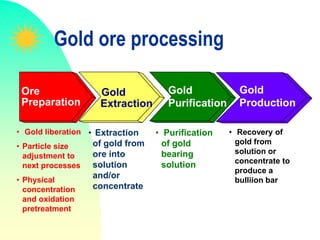
Gold ore processing
Ore
Preparation
• Gold liberation
• Particle size
adjustment to
next processes
• Physical
concentration
and oxidation
pretreatment
Gold
Extraction
• Extraction
of gold from
ore into
solution
and/or
concentrate
Gold
Purification
• Purification
of gold
bearing
solution
Gold
Production
• Recovery of
gold from
solution or
concentrate to
produce a
bulliion bar
Process development
for gold ores
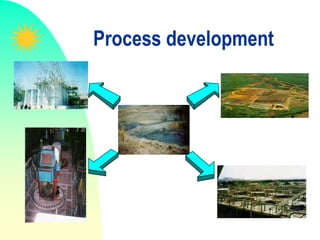
Process development
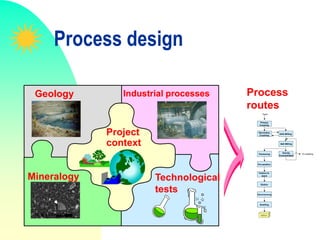
Process design
Mineralogy
Geology
Technological
tests
Process
routes
Primary
Crushing
Secondary
Crushing
SAG Milling
Ball Milling
Thickening
Gravity
Concentration
Pre-aeration
Carbon-in-
leach
Elution
Electrowinning
Smelting
Feed
GOLD
To smelting
Industrial processes
?
Project
context
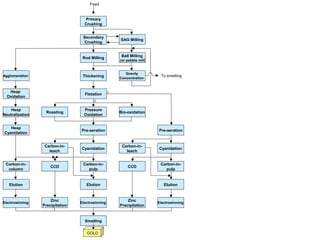
Primary
Crushing
Secondary
Crushing
SAG Milling
Rod Milling Ball Milling
(or pebble mill)
Thickening
Gravity
Concentration
Agglomeration
Flotation
Heap
Oxidation
Pressure
Oxidation
Bio-oxidationRoasting
Heap
Neutralization
Pre-aeration Pre-aeration
Heap
Cyanidation
Cyanidation Cyanidation
Carbon-in-
leach
Carbon-in-
leach
Carbon-in-
pulp
Carbon-in-
pulp
CCDCCD
Carbon-in-
column
Elution ElutionElution
Electrowinning Electrowinning
Zinc
Precipitation
Zinc
Precipitation
Electrowinning
Smelting
Feed
GOLD
To smelting
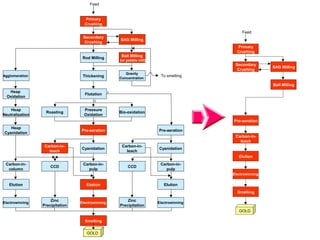
t
c
Primary
Crushing
Secondary
Crushing
SAG Milling
Ball Milling
Pre-aeration
Carbon-in-
leach
Elution
Electrowinning
Smelting
Feed
GOLD
Primary
Crushing
Secondary
Crushing
SAG Milling
Rod Milling Ball Milling
(or pebble mill)
Thickening
Gravity
Concentration
Agglomeration
Flotation
Heap
Oxidation
Pressure
Oxidation
Bio-oxidationRoasting
Heap
Neutralization
Pre-aeration Pre-aeration
Heap
Cyanidation
Cyanidation Cyanidation
Carbon-in-
leach
Carbon-in-
leach
Carbon-in-
pulp
Carbon-in-
pulp
CCDCCD
Carbon-in-
column
Elution ElutionElution
Electrowinning Electrowinning
Zinc
Precipitation
Zinc
Precipitation
Electrowinning
Smelting
Feed
To smelting
t
c
GOLD
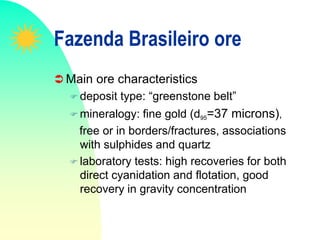
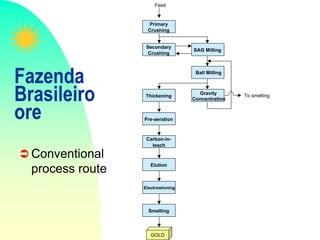
Fazenda Brasileiro ore
 Main ore characteristics
 deposit type: “greenstone belt”
 mineralogy: fine gold (d95=37 microns),
free or in borders/fractures, associations
with sulphides and quartz
 laboratory tests: high recoveries for both
direct cyanidation and flotation, good
recovery in gravity concentration
Primary
Crushing
Secondary
Crushing
SAG Milling
Ball Milling
Thickening
Gravity
Concentration
Pre-aeration
Carbon-in-
leach
Elution
Electrowinning
Smelting
Feed
GOLD
To smelting
Fazenda
Brasileiro
ore
 Conventional
process route
Refractory sulphide ore
 Main ore characteristics
 deposit type: “greenstone belt”
 mineralogy: very fine gold(d95=3 microns),
encapsulated and in borders/fractures,
association with sulphides
 laboratory tests: low recoveries in direct
cyanidation and gravity concentration tests,
high recoveries in flotation tests, high
recoveries by cyanidation after bio-oxidation
or pressure oxidation
Primary
Crushing
Secondary
Crushing
SAG Milling
Ball Milling
Flotation
Bio-oxidation
Cyanidation
Carbon-in-
pulp
Elution
Electrowinning
Smelting
Feed
GOLD
Tailings
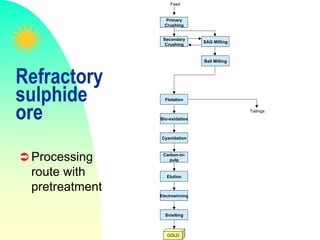
Refractory
sulphide
ore
 Processing
route with
pretreatment
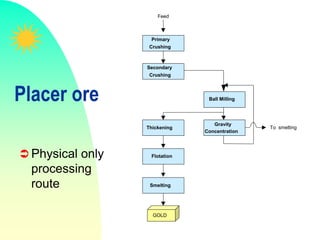
Placer ore
 Main ore characteristics
 deposit type: “placer”
 mineralogy: medium size gold(d95=100 microns),
some physically liberated,
some associated with sulphides
Placer ore
 Physical only
processing
route
Primary
Crushing
Secondary
Crushing
Ball Milling
Thickening
Gravity
Concentration
Flotation
Feed
To smelting
Smelting
GOLD
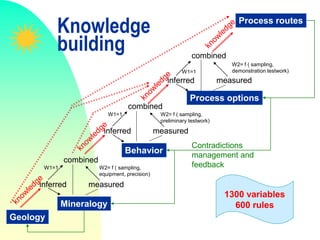
Geology
Mineralogy
inferred measured
combined
W1=1 W2= f ( sampling,
equipment, precision)
Behavior
inferred measured
combined
W1=1 W2= f ( sampling,
preliminary testwork)
Process options
inferred measured
combined
W1=1
W2= f ( sampling,
demonstration testwork)
Process routes
Knowledge
building
Contradictions
management and
feedback
1300 variables
600 rules
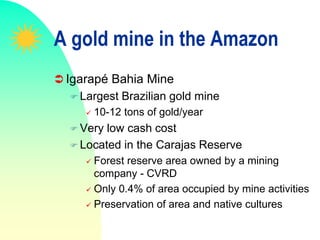
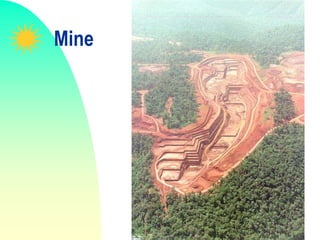
A gold mine in the Amazon
 Igarapé Bahia Mine
 Largest Brazilian gold mine
 10-12 tons of gold/year
 Very low cash cost
 Located in the Carajas Reserve
 Forest reserve area owned by a mining
company - CVRD
 Only 0.4% of area occupied by mine activities
 Preservation of area and native cultures
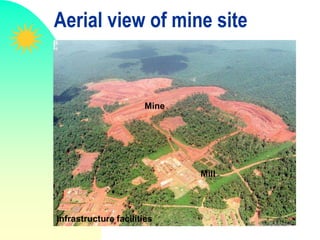
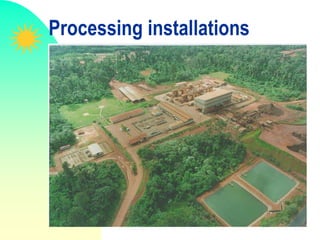
Aerial view of mine site
Mine
Mill
Infrastructure facilities
Mine
Processing installations
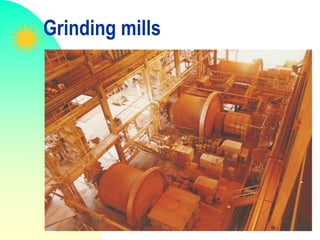
Grinding mills
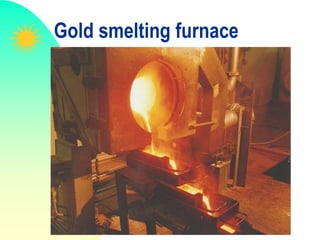
Gold smelting furnace
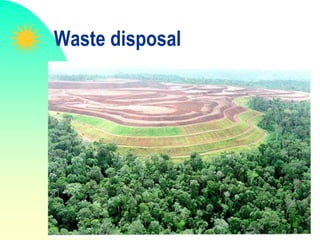
Waste disposal
Summary
 Gold is an important resource to economy
 Gold ores are found in different types
 Processing is highly dependent on
mineralogical characteristics
 Process design is a challenging activity
 Intelligent systems can be used to design
and operate gold plants
 Advanced use of information technology
in mineral industry is a key issue in the
21st century

processing Gold ore | Rodger Allen Gold Mine

Editor's Notes

  • #2 Good Morning, ladies and gentlemen. I'm here to present the paper "Process design for gold ores: a diagnostic approach" The authors are: myself; Professor Arthur Chaves, from University of São Paulo, Brazil, and Professor John Meech, from University of British Columbia, Canada
  • #16 This slide illustrates how the system "builds knowledge", to accomplish the task intended. The system is designed like a step ladder. Its inferencing goes, step by step, verificating, in each step, the compatibility about the inferred and measured variables. Or, in other words, knowledge and data. Each combined variable is therefore the weighted combination of measured and inferred sub-variables, that, in theory, have to be compatible, or have an approximate meaning. Usually, the weight of measured attributes are higher than the inferred. The system goes therefore inferencing and combining values until the suggestion and automatic drawing of feasible process routes are possible. Sometimes, when the system finds an incompatibility, like if mineralogy suggests gold is cyanidable and testwork finds it is not. The system then feedbacks the information, asking the user to verify the data in each level. If still the contradiction persists, it goes to the lower level, in a verification of causes and consequences. Ultimately, if the ore behavior is particular, the user has the ability of changing weights, telling the system which information it has to trust more. To have one idea of the size of the step ladder, it can be said that the process design module itself has around 600 rules and manipulates among 1300 variables and sub-variables.
  • #17 After the metallurgical evaluation is finished, the next step is the economic evaluation. . it uses generated flowsheets as input . estimate costs for each unit operation, using actual costs and adjustment factors and applying inflation indexes . calculate revenues based on gold recoveries and prices, and finally, . calculates the economic parameters . of course, the system assigns a degree of certainty to the economic parameters and indicates the main risk factors