ZIRCONIUM
 By: Annika Anderson
General Information
                           40-Zirconium
Atomic Number:                   40
Atomic weight:                   91.22 amu
Classification:                  Transition Metal
State:                           solid
Melting point:                   1850 oC, 2123 K
Boiling point:                   4400 oC, 4673 K
Shells:                          2,8,18,10,2
Electron configuration:          [Kr] 4d2 5s2
Density (at 20oC):               6.52 g/cm3
Atomic volume:                   14.0 cm3/mol
Structure:                       Hexagonal
Hardness:                        5.0 mohs
FACT #1: Zirconium in Jewelry
FACT #1: Zirconium in the Nuclear Industries
            When you think about zirconium, the first thing that comes to mind is definitely not nuclear power plants, but zirconium
is in fact essential t0 nuclear research and development. Zirconium is valued greatly by engineers for its properties. Zirconium is
transparent to neutrons, making it the ideal metal for nuclear research. Nuclear power plants often use Zirconium, Zirconium
compounds, and Zirconium alloys to build and construct nuclear power plant parts. Nuclear power plants became a popular energy
source after an energy shortage struck up crisis in the scientific community. In 1973, the Symposium on Nuclear Applications, took
place in Portland, Oregon. At the Symposium on Nuclear Application, scientists presented the collected works on the problems with
the current nuclear power plants and processes. The papers also included suggested ideas of how to improve the issues at hand. The
Symposium for Nuclear Applications allowed scientists to evaluate issues at hand as a collective group and provided huge
improvements for the nuclear power industry.
            One of the proposed changes was to use Zirconium and Zirconium alloys in Nuclear Primary Steam Systems. It was
proposed that they use Zirconium because it allows for the best of both metallurgical and mechanical properties to be utilized. Some
of these properties include fuel cladding and light. Scientists favored Zirconium for the Primary Steam Systems because Zirconium
could withstand extreme heat and was corrosion resistant. Zirconium could withstand neurons because of its transparency and
strength. One of the only issues that arise when using Zirconium instead of other metals such as steel is that Zirconium is much
more expensive. However, Zirconium lasts longer than the other less expensive metals. Another form of nuclear power discussed in
the papers proposed at the Symposium on Nuclear Applications was for developing a Closed-End Burst Test for zircaloy. Zircaloy is
and alloy of Zirconium. Engineers wanted to develop a Closed-End Burst Test procedure to test the zircaloy and its abilities in
reference to fuel cladding. After experimentation, engineers and researchers realized that the Closed-End Burst Test could be used to
measure the mechanical properties of the zircaloy tubes. They hoped that by performing the test that they could find zircaloy tubes
that had low amounts of energy so that it could be controlled more easily. At the Symposium on Nuclear Applications, another idea
proposed was that they improve the metallography of Zirconium alloys. By doing so, scientists would be able to observe
impurities, grain boundaries, and much more. The contrast in etchings and colors from the metallography would also indicate
size, amount, shape, and quality of the alloys. The ability to observe and view all of the characteristics and properties of the different
zirconium alloys allows scientists to use the best candidates to be used in the nuclear power plants, thus allowing for the best results
and most power possible produced. The Symposium on Nuclear Applications gave engineers and scientists the opportunity to assess
the energy crisis and improve upon the source available. Zirconium’s durability, heat tolerance, and neuron transparency made it the
perfect metal to use in nuclear power plants. Zirconium and Zirconium alloys have been proven more effective in nuclear plants than
metals such as steel, iron, and copper. Zirconium does not react often which also made it useful to engineers and scientists at the
Symposium on Nuclear Applications.
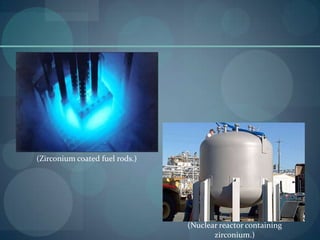
(Zirconium coated fuel rods.)


                                (Nuclear reactor containing
                                       zirconium.)
Zirconium
Zirconium
Zirconium
Zirconium
Zirconium
Zirconium
Zirconium

Zirconium

  • 1.
  • 2.
    General Information 40-Zirconium Atomic Number: 40 Atomic weight: 91.22 amu Classification: Transition Metal State: solid Melting point: 1850 oC, 2123 K Boiling point: 4400 oC, 4673 K Shells: 2,8,18,10,2 Electron configuration: [Kr] 4d2 5s2 Density (at 20oC): 6.52 g/cm3 Atomic volume: 14.0 cm3/mol Structure: Hexagonal Hardness: 5.0 mohs
  • 3.
  • 5.
    FACT #1: Zirconiumin the Nuclear Industries When you think about zirconium, the first thing that comes to mind is definitely not nuclear power plants, but zirconium is in fact essential t0 nuclear research and development. Zirconium is valued greatly by engineers for its properties. Zirconium is transparent to neutrons, making it the ideal metal for nuclear research. Nuclear power plants often use Zirconium, Zirconium compounds, and Zirconium alloys to build and construct nuclear power plant parts. Nuclear power plants became a popular energy source after an energy shortage struck up crisis in the scientific community. In 1973, the Symposium on Nuclear Applications, took place in Portland, Oregon. At the Symposium on Nuclear Application, scientists presented the collected works on the problems with the current nuclear power plants and processes. The papers also included suggested ideas of how to improve the issues at hand. The Symposium for Nuclear Applications allowed scientists to evaluate issues at hand as a collective group and provided huge improvements for the nuclear power industry. One of the proposed changes was to use Zirconium and Zirconium alloys in Nuclear Primary Steam Systems. It was proposed that they use Zirconium because it allows for the best of both metallurgical and mechanical properties to be utilized. Some of these properties include fuel cladding and light. Scientists favored Zirconium for the Primary Steam Systems because Zirconium could withstand extreme heat and was corrosion resistant. Zirconium could withstand neurons because of its transparency and strength. One of the only issues that arise when using Zirconium instead of other metals such as steel is that Zirconium is much more expensive. However, Zirconium lasts longer than the other less expensive metals. Another form of nuclear power discussed in the papers proposed at the Symposium on Nuclear Applications was for developing a Closed-End Burst Test for zircaloy. Zircaloy is and alloy of Zirconium. Engineers wanted to develop a Closed-End Burst Test procedure to test the zircaloy and its abilities in reference to fuel cladding. After experimentation, engineers and researchers realized that the Closed-End Burst Test could be used to measure the mechanical properties of the zircaloy tubes. They hoped that by performing the test that they could find zircaloy tubes that had low amounts of energy so that it could be controlled more easily. At the Symposium on Nuclear Applications, another idea proposed was that they improve the metallography of Zirconium alloys. By doing so, scientists would be able to observe impurities, grain boundaries, and much more. The contrast in etchings and colors from the metallography would also indicate size, amount, shape, and quality of the alloys. The ability to observe and view all of the characteristics and properties of the different zirconium alloys allows scientists to use the best candidates to be used in the nuclear power plants, thus allowing for the best results and most power possible produced. The Symposium on Nuclear Applications gave engineers and scientists the opportunity to assess the energy crisis and improve upon the source available. Zirconium’s durability, heat tolerance, and neuron transparency made it the perfect metal to use in nuclear power plants. Zirconium and Zirconium alloys have been proven more effective in nuclear plants than metals such as steel, iron, and copper. Zirconium does not react often which also made it useful to engineers and scientists at the Symposium on Nuclear Applications.
  • 6.
    (Zirconium coated fuelrods.) (Nuclear reactor containing zirconium.)