P. MOHAN BHARATHY
BRASS
 Brass is a metal alloy made of
copper and zinc.
 Brass has a muted yellow colour, somewhat
similar to gold.
 By varying the proportions of copper
and zinc, the properties of the brass
can be changed, allowing hard and soft
brasses.
 It’s melting point is 940OC
 Brass has higher malleability
than bronze or zinc
 The major constituent of brass is Cu (50-90%) and
Zn (20-40%).
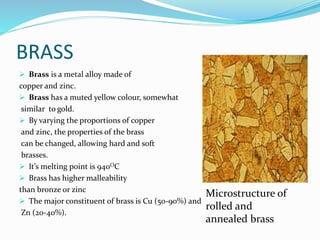
Microstructure of
rolled and
annealed brass
Properties:
 Higher malleability than zinc or copper.
 Low melting point (900 c)
 corrosion resistant
 Good conductor
 Not as hard as steel.
 It is yellow in colour.
 It’s weight is 380-450/kg
 Re-cyclable
• Yield Strength 250 to 500 MPa
Copper zinc alllloys (brasses)
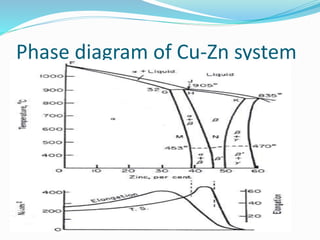
 Copper and zinc form solid solution up to ~39%
zinc at 456c, giving a wide rage of properties.
 Sn, Al, Si, Mg, Ni, and Pb are added elements,
called ‘alloy brasses’.
 Commercially used brasses can be divided into two
important groups:
1) α brasses (hypo-peritectic)- with α structure
containing upto ~35% Zn.
 2) α+β brasses (hyperperitectic)- with α+β two
phase structure, based on 60:40 ratio of Cu and Zn
Phase diagram of Cu-Zn system
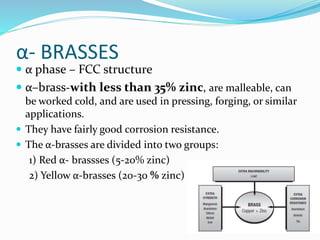
α- BRASSES
 α phase – FCC structure
 α–brass-with less than 35% zinc, are malleable, can
be worked cold, and are used in pressing, forging, or similar
applications.
 They have fairly good corrosion resistance.
 The α-brasses are divided into two groups:
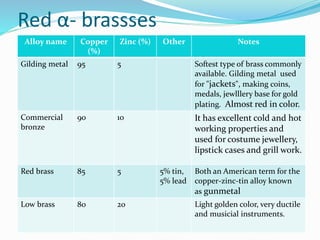
1) Red α- brassses (5-20% zinc)
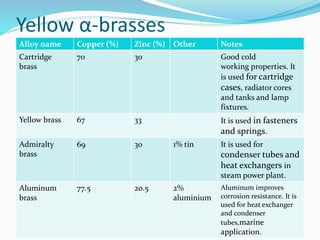
2) Yellow α-brasses (20-30 % zinc)
Red α- brassses
Alloy name Copper
(%)
Zinc (%) Other Notes
Gilding metal 95 5 Softest type of brass commonly
available. Gilding metal used
for "jackets", making coins,
medals, jewlllery base for gold
plating. Almost red in color.
Commercial
bronze
90 10 It has excellent cold and hot
working properties and
used for costume jewellery,
lipstick cases and grill work.
Red brass 85 5 5% tin,
5% lead
Both an American term for the
copper-zinc-tin alloy known
as gunmetal
Low brass 80 20 Light golden color, very ductile
and musicial instruments.
Yellow α-brasses
Alloy name Copper (%) Zinc (%) Other Notes
Cartridge
brass
70 30 Good cold
working properties. It
is used for cartridge
cases, radiator cores
and tanks and lamp
fixtures.
Yellow brass 67 33 It is used in fasteners
and springs.
Admiralty
brass
69 30 1% tin It is used for
condenser tubes and
heat exchangers in
steam power plant.
Aluminum
brass
77.5 20.5 2%
aluminium
Aluminum improves
corrosion resistance. It is
used for heat exchanger
and condenser
tubes,marine
application.
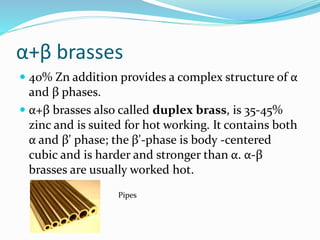
α+β brasses
 40% Zn addition provides a complex structure of α
and β phases.
 α+β brasses also called duplex brass, is 35-45%
zinc and is suited for hot working. It contains both
α and β' phase; the β'-phase is body -centered
cubic and is harder and stronger than α. α-β
brasses are usually worked hot.
Pipes
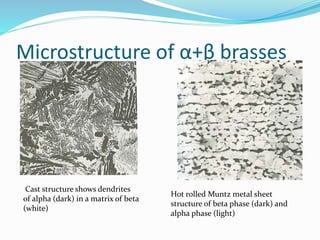
Microstructure of α+β brasses
Cast structure shows dendrites
of alpha (dark) in a matrix of beta
(white)
Hot rolled Muntz metal sheet
structure of beta phase (dark) and
alpha phase (light)
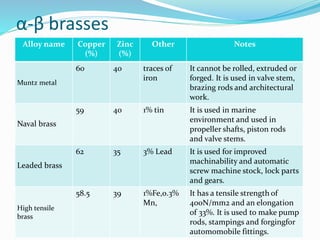
α-β brasses
Alloy name Copper
(%)
Zinc
(%)
Other Notes
Muntz metal
60 40 traces of
iron
It cannot be rolled, extruded or
forged. It is used in valve stem,
brazing rods and architectural
work.
Naval brass
59 40 1% tin It is used in marine
environment and used in
propeller shafts, piston rods
and valve stems.
Leaded brass
62 35 3% Lead It is used for improved
machinability and automatic
screw machine stock, lock parts
and gears.
High tensile
brass
58.5 39 1%Fe,0.3%
Mn,
It has a tensile strength of
400N/mm2 and an elongation
of 33%. It is used to make pump
rods, stampings and forgingfor
automomobile fittings.
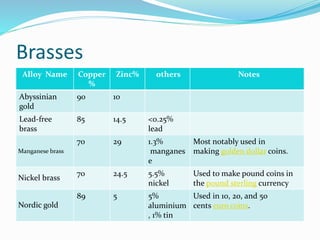
Brasses
Alloy Name Copper
%
Zinc% others Notes
Abyssinian
gold
90 10
Lead-free
brass
85 14.5 <0.25%
lead
Manganese brass
70 29 1.3%
manganes
e
Most notably used in
making golden dollar coins.
Nickel brass
70 24.5 5.5%
nickel
Used to make pound coins in
the pound sterling currency
Nordic gold
89 5 5%
aluminium
, 1% tin
Used in 10, 20, and 50
cents euro coins.
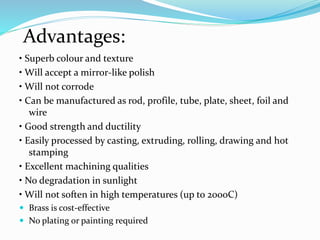
• Superb colour and texture
• Will accept a mirror-like polish
• Will not corrode
• Can be manufactured as rod, profile, tube, plate, sheet, foil and
wire
• Good strength and ductility
• Easily processed by casting, extruding, rolling, drawing and hot
stamping
• Excellent machining qualities
• No degradation in sunlight
• Will not soften in high temperatures (up to 200oC)
 Brass is cost-effective
 No plating or painting required
Advantages:
DISADVANTAGES
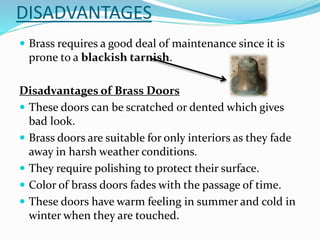
 Brass requires a good deal of maintenance since it is
prone to a blackish tarnish.
Disadvantages of Brass Doors
 These doors can be scratched or dented which gives
bad look.
 Brass doors are suitable for only interiors as they fade
away in harsh weather conditions.
 They require polishing to protect their surface.
 Color of brass doors fades with the passage of time.
 These doors have warm feeling in summer and cold in
winter when they are touched.
Applications of Brass:
 Because of its gold like appearance it is used in decoration
purposes and for making coins.
 Due to its acoustic properties, it is used in musical instruments
such as horns and bells.
 Due to its softness than other metals it is also used in zippers.
 And it is also used for fittings and tools around explosive gases.
 It is easy to shape, and resistant to corrosion.
 Polished brass was used as mirror in antiquity.
 In every industry, hot sampling are used for example pipe
fittings, domestic taps, radiator valves, gas appliances, windows
and door furniture are manufactured by this process.
 It is used in electrical applications.
THANKYOU!

Non-Ferrous Alloys - Brass

  • 1.
  • 2.
    BRASS  Brass isa metal alloy made of copper and zinc.  Brass has a muted yellow colour, somewhat similar to gold.  By varying the proportions of copper and zinc, the properties of the brass can be changed, allowing hard and soft brasses.  It’s melting point is 940OC  Brass has higher malleability than bronze or zinc  The major constituent of brass is Cu (50-90%) and Zn (20-40%). Microstructure of rolled and annealed brass
  • 3.
    Properties:  Higher malleabilitythan zinc or copper.  Low melting point (900 c)  corrosion resistant  Good conductor  Not as hard as steel.  It is yellow in colour.  It’s weight is 380-450/kg  Re-cyclable • Yield Strength 250 to 500 MPa
  • 4.
    Copper zinc alllloys(brasses)  Copper and zinc form solid solution up to ~39% zinc at 456c, giving a wide rage of properties.  Sn, Al, Si, Mg, Ni, and Pb are added elements, called ‘alloy brasses’.  Commercially used brasses can be divided into two important groups: 1) α brasses (hypo-peritectic)- with α structure containing upto ~35% Zn.  2) α+β brasses (hyperperitectic)- with α+β two phase structure, based on 60:40 ratio of Cu and Zn
  • 5.
    Phase diagram ofCu-Zn system
  • 6.
    α- BRASSES  αphase – FCC structure  α–brass-with less than 35% zinc, are malleable, can be worked cold, and are used in pressing, forging, or similar applications.  They have fairly good corrosion resistance.  The α-brasses are divided into two groups: 1) Red α- brassses (5-20% zinc) 2) Yellow α-brasses (20-30 % zinc)
  • 7.
    Red α- brassses Alloyname Copper (%) Zinc (%) Other Notes Gilding metal 95 5 Softest type of brass commonly available. Gilding metal used for "jackets", making coins, medals, jewlllery base for gold plating. Almost red in color. Commercial bronze 90 10 It has excellent cold and hot working properties and used for costume jewellery, lipstick cases and grill work. Red brass 85 5 5% tin, 5% lead Both an American term for the copper-zinc-tin alloy known as gunmetal Low brass 80 20 Light golden color, very ductile and musicial instruments.
  • 8.
    Yellow α-brasses Alloy nameCopper (%) Zinc (%) Other Notes Cartridge brass 70 30 Good cold working properties. It is used for cartridge cases, radiator cores and tanks and lamp fixtures. Yellow brass 67 33 It is used in fasteners and springs. Admiralty brass 69 30 1% tin It is used for condenser tubes and heat exchangers in steam power plant. Aluminum brass 77.5 20.5 2% aluminium Aluminum improves corrosion resistance. It is used for heat exchanger and condenser tubes,marine application.
  • 9.
    α+β brasses  40%Zn addition provides a complex structure of α and β phases.  α+β brasses also called duplex brass, is 35-45% zinc and is suited for hot working. It contains both α and β' phase; the β'-phase is body -centered cubic and is harder and stronger than α. α-β brasses are usually worked hot. Pipes
  • 10.
    Microstructure of α+βbrasses Cast structure shows dendrites of alpha (dark) in a matrix of beta (white) Hot rolled Muntz metal sheet structure of beta phase (dark) and alpha phase (light)
  • 11.
    α-β brasses Alloy nameCopper (%) Zinc (%) Other Notes Muntz metal 60 40 traces of iron It cannot be rolled, extruded or forged. It is used in valve stem, brazing rods and architectural work. Naval brass 59 40 1% tin It is used in marine environment and used in propeller shafts, piston rods and valve stems. Leaded brass 62 35 3% Lead It is used for improved machinability and automatic screw machine stock, lock parts and gears. High tensile brass 58.5 39 1%Fe,0.3% Mn, It has a tensile strength of 400N/mm2 and an elongation of 33%. It is used to make pump rods, stampings and forgingfor automomobile fittings.
  • 12.
    Brasses Alloy Name Copper % Zinc%others Notes Abyssinian gold 90 10 Lead-free brass 85 14.5 <0.25% lead Manganese brass 70 29 1.3% manganes e Most notably used in making golden dollar coins. Nickel brass 70 24.5 5.5% nickel Used to make pound coins in the pound sterling currency Nordic gold 89 5 5% aluminium , 1% tin Used in 10, 20, and 50 cents euro coins.
  • 13.
    • Superb colourand texture • Will accept a mirror-like polish • Will not corrode • Can be manufactured as rod, profile, tube, plate, sheet, foil and wire • Good strength and ductility • Easily processed by casting, extruding, rolling, drawing and hot stamping • Excellent machining qualities • No degradation in sunlight • Will not soften in high temperatures (up to 200oC)  Brass is cost-effective  No plating or painting required Advantages:
  • 14.
    DISADVANTAGES  Brass requiresa good deal of maintenance since it is prone to a blackish tarnish. Disadvantages of Brass Doors  These doors can be scratched or dented which gives bad look.  Brass doors are suitable for only interiors as they fade away in harsh weather conditions.  They require polishing to protect their surface.  Color of brass doors fades with the passage of time.  These doors have warm feeling in summer and cold in winter when they are touched.
  • 15.
    Applications of Brass: Because of its gold like appearance it is used in decoration purposes and for making coins.  Due to its acoustic properties, it is used in musical instruments such as horns and bells.  Due to its softness than other metals it is also used in zippers.  And it is also used for fittings and tools around explosive gases.  It is easy to shape, and resistant to corrosion.  Polished brass was used as mirror in antiquity.  In every industry, hot sampling are used for example pipe fittings, domestic taps, radiator valves, gas appliances, windows and door furniture are manufactured by this process.  It is used in electrical applications.
  • 16.