Stainless Steels
Presented by
Welding department
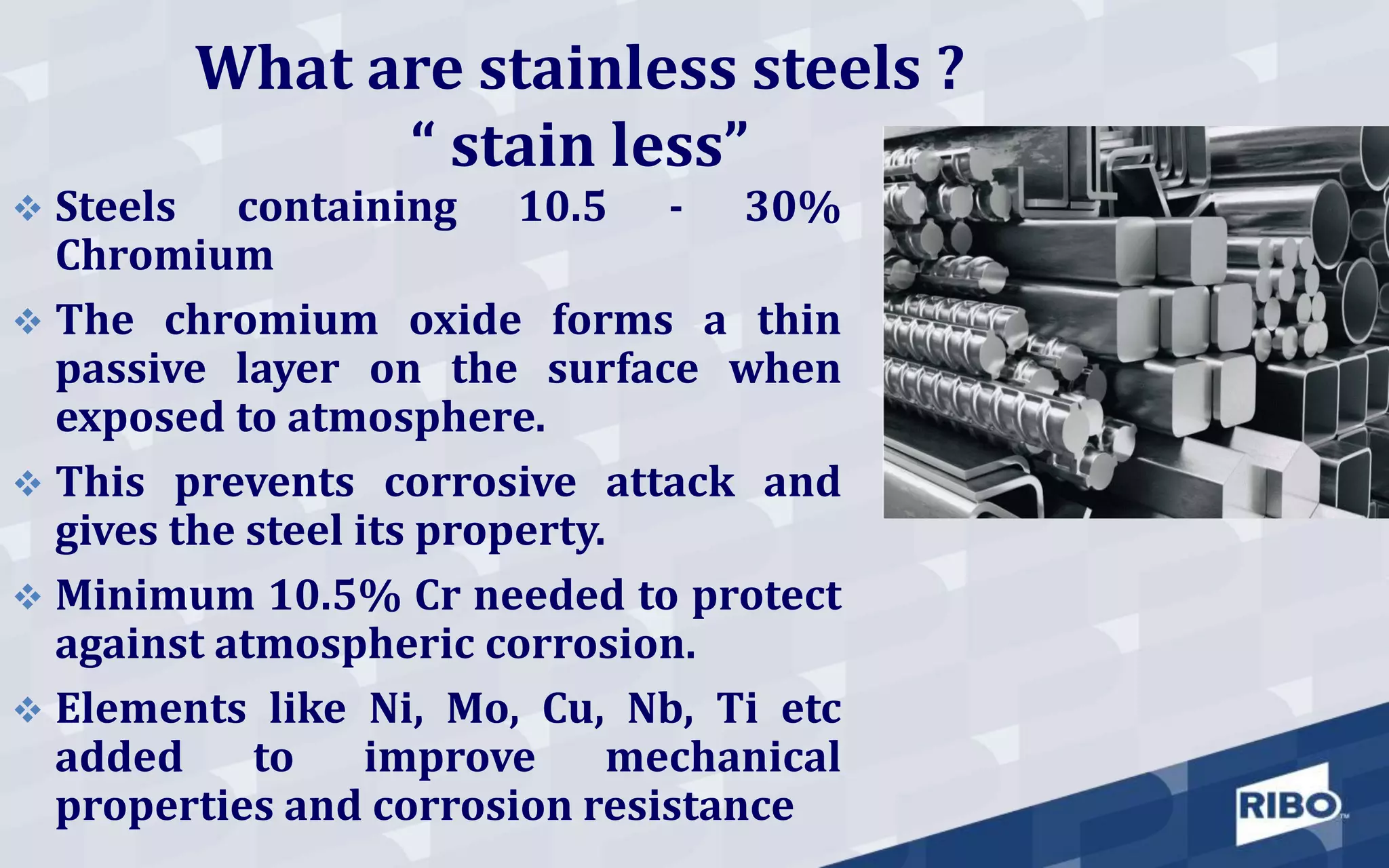
What are stainless steels ?
“ stain less”
 Steels containing 10.5 - 30%
Chromium
 The chromium oxide forms a thin
passive layer on the surface when
exposed to atmosphere.
 This prevents corrosive attack and
gives the steel its property.
 Minimum 10.5% Cr needed to protect
against atmospheric corrosion.
 Elements like Ni, Mo, Cu, Nb, Ti etc
added to improve mechanical
properties and corrosion resistance
Natural Passivation
Carbon steel VS Stainless steel
 Corrosion resistant
 Very durable
 Temperature resistant
 Easy formability and
fabrication
 Low-maintenance (long lasting)
 Attractive appearance
 Environmentally friendly
(recyclable)
General properties of Stainless Steel
Types of stainless steels
• Martensitic
• Ferritic
• Austenitic
• Duplex
(Austenite +Ferrite)
• Precipitation hardening
FERRITE FORMER
 Chromium
 Titanium
 Niobium/Columbium
 Silicon
 Molybdenum
AUSTENITE FORMER
 Nickel
 Nitrogen
 Copper
 Carbon
 Manganese
Effect of Alloying Elements and their Purpose
Chromium (Cr)
 Oxidation & Corrosion Resistance
 Formation of ferrite
Nickel (Ni)
 Increases resistance to mineral acids
 Produces tightly adhering high temperature oxides
 Increases Toughness properties
Effect of Alloying Elements and their Purpose
Molybdenum (Mo)
 Increases resistance to chlorides.
 Resistance to pitting corrosion
Copper (Cu)
 Provides resistance to sulfuric acid.
Manganese (Mn)
 Increases the solubility of nitrogen
Effect of Alloying Elements and their Purpose
Sulfur (S)
Improves resistance to chlorides.
 Improves weldability (Penetration) of certain
austenitic SS.
 Improves the machinability of certain austenitic SS.
Titanium (Ti)
 Stabilizes carbides to prevent formation of Cr carbide.
 Precipitation hardener
Effect of Alloying Elements and their Purpose
Niobium (Nb) & Columbium (Cb)
 Carbide stabilizer.
 Precipitation hardener
Aluminum (Al)
 Deoxidizer – Precipitation hardener
Carbon (C)
 Carbide former and Strengthener
Welding of stainless steels
All standard welding processes is SMAW, GMAW,
FCAW, GTAW, PAW and SAW maybe used depending
on the application.
Generally corresponding grades of filler metal
composition are used to match corrosion and / or
heat resistance properties along with strength.
Weldability problems are different for different
types of stainless steels eg martensitic, Ferritic,
austenitic, duplex and precipitation hardening.
Weldability considerations are similar for wrought
and cast alloys
Martensitic stainless steels
ASME: P.No-6
Martensitic SS – 4xx
Martensitic SS
High Carbon
Low Chromium
 Cr – 11.5-17.0 %
 Ni – 1.25-2.50 %
 Mo – 0.50-2.0%
 C – 0.05-0.20%
Martensitic stainless steels
 AISI 403, 410, 416, 420, 431 & 440
A/B/C grades
 Can be hardened by heat treatment
 Martensitic structure - higher carbon
grades used in tempered condition.
 Used for cutlery, surgical instruments,
steam, gas & hydel turbine blades, ball
bearings and races.
Welding of Martensitic Steels
 Higher carbon grades used in the quenched and
tempered condition
 Problem of Hydrogen induced cracking in HAZ.
 Pre-heat and post-weld heat treatment required if
welded with matching composition martensitic SS
electrodes.
 Austenitic SS electrodes generally used which
avoids cracking problems without pre and post
heating
Application of Martensitic SS
Ferritic stainless steels
ASME: P.No-7
Ferritic SS
Low Carbon
High Chromium
Ferritic SS – 4xx
 Cr – 11.5-30.0 %
 Ni – 0.50-2.50 %
 Mo – 0.75-4.2%
 C – 0.07-0.12%
 AISI 405, 409, 430, 446 grades
 Ferritic structure - higher ductility and resistance
to SCC & pitting corrosion.
 Used as thin sheet for corrosion, oxidation & heat
resisting applications and decorative purposes eg.
Automobile exhausts, Solar water heater, catalytic
converters and automobile trim.
Ferritic stainless steels
Welding of Ferritic steels
 Softer and more ductile than martensite steels
 Cannot be hardened by heat treatment
 Ferrite phase does not transform to martensite but
susceptible to 475 deg embrittlement and sigma phase
formation in higher chromium grades.
 Problem of grain growth during welding leading to
brittle structure in HAZ.
Generally welded with austenitic SS electrodes
Applications of Ferritic SS
Automobile exhausts
Solar water heater
Duplex stainless steels
ASME: P.No-10H
60% austenite
+
40% ferrite structure
 Cr – 19.5-30.0 %
 Ni – 1.0-8.0 %
 Mo – 0.10-5.0%
 C – 0.025-0.040%
 Mn – 1.0-6.0%
Duplex stainless steels
 AISI 2205, 2304, 2507
 Almost twice the strength of austenitic steels
 Excellent pitting + SCC resistance
 Used for plant and piping in oil and gas production,
corrosive applications to resist chloride ion media. Higher
strength structurals
Weldability of Duplex steels
Duplex stainless steels have fairly good weldability.
All standard welding processes can be used.
Not quite as easily welded as the austenitic grades but low
thermal expansion in duplex grades reduces distortion and
residual stresses after welding.
All grades
 Solidify as ferrite, austenite formation during cooling
 Austenite/Ferrite ratio dependent on 2 primary variables
Alloying effects – Cr & Ni equivalents
Heat input/cooling rate
Welding metallurgy of Duplex steels
 Faster cooling rate produces higher Ferrite which leads to
reduced low temperature impact strength and corrosion
resistance
 Slow cooling through 1050 – 550 C produces carbides,
nitrides, sigma etc which affect corrosion resistance and cause
embrittlement
Fast cooling Correct cooling Slow cooling
Too high Ferrite Between 30 -40 %
ferrite
Nitrides, Carbides
& intermetallics
Welding of Duplex Stainless Steels
–Overmatch nickel in filler metal
–Control heat input and cooling rates carefully
–Use N2 in shielding gas
–Ensure low impurities in base and filler
Application of Duplex SS
Precipitation Hardening stainless
steels
Cr 12 –18%
C 0.05 – 0.15%
Ni 3.0 – 27.0% +
Mo, Cu, Al, V, Cb, Ti
 Can be hardened by heat treatment
 This sub-group provides a combination
of austenitic and martensitic properties.
 Hardening is achieved by adding one or
more elements such as aluminium,
molybdenum, niobium, titanium, and
copper.
 It is capable of developing high tensile
strength through heat treatment
 Available as forgings, castings, bar and
plate and used for compressor blades,
pumps, gears for metering chemicals etc
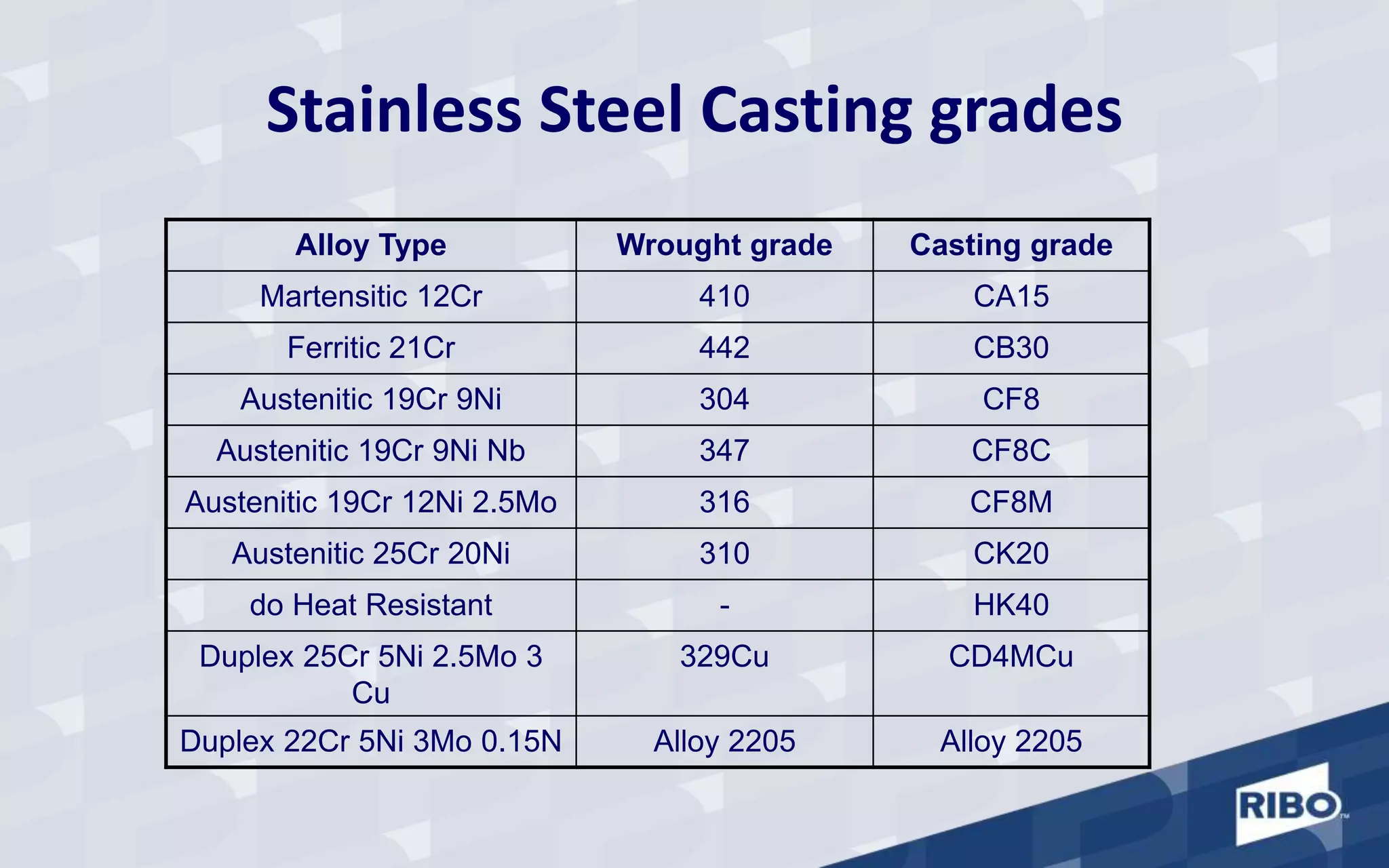
Stainless Steel Casting grades
Alloy Type Wrought grade Casting grade
Martensitic 12Cr 410 CA15
Ferritic 21Cr 442 CB30
Austenitic 19Cr 9Ni 304 CF8
Austenitic 19Cr 9Ni Nb 347 CF8C
Austenitic 19Cr 12Ni 2.5Mo 316 CF8M
Austenitic 25Cr 20Ni 310 CK20
do Heat Resistant - HK40
Duplex 25Cr 5Ni 2.5Mo 3
Cu
329Cu CD4MCu
Duplex 22Cr 5Ni 3Mo 0.15N Alloy 2205 Alloy 2205
Wrought Grade
C – Corrosion service
H – High – temperature service
Example:
CA15
C - Corrosion service
A - Refer Fig
15 – 0.15%Carbon (max)
Austenitic stainless steels
ASME: P.No-8
 Cr – 18.0-29.0 %
 Ni – 8.0-22.0 %
 Mo – 0.75-6.0%
 C – 0.03-0.24%
 AISI 304, 310, 316, 321 & 347 grades
 Austenitic structure gives good weldability with
excellent ductility and toughness down to
cryogenic temperatures.
 Nickel improves general corrosion resistance in
high temperature
 Widely used for Boiler components, chemical,
petrochemical, fertilizer plant and food
processing. Also used for nuclear and cryogenic
plant
Austenitic stainless steels
•Has 50% higher coefficient of linear expansion, than carbon
steels
•Has poor thermal conductivity, 30% less than carbon steels
•Results in much higher distortion after welding
•Steps to prevent distortion
- closer tacking
- greater use of jigs and fixtures
- use of balanced and skip welding
techniques
- limit heat input by use of low currents and
stringer beads
Physical properties of austenitic stainless
steels
Welding of Austenitic steels
Generally good weldability as there is no martensitic
transformation but following problems encountered:
 Sensitization leading to inter-granular corrosion –IGC
 Hot cracking
 Stress corrosion cracking –SCC
 Sigma phase formation leading to embrittlement
 Higher distortion during welding
Sensitization and inter-granular
corrosion
 Sensitization refers to the
precipitation of carbides at grain
boundaries in a stainless steel or
alloy, causing the alloy to be
susceptible to intergranular
corrosion.
 austenitic stainless steel may become
sensitised if they are heat treated or
used at temperature in range 450-
900c. the heat affected zones of welds
may also be sensitised in some
circumstance
Sensitization and inter-granular
corrosion
Steels to prevent IGC
 Steels with elements having higher affinity for carbon
eg. Ti , Nb/Cb – stabilised steels. Form carbides in
preference to Cr.
321 grade – Ti stabilised
347 grade - Nb stabilised
 Steels with low carbon 304L & 316L grades( 0.03% C
max)
Hot cracking in austenitic welds
 Hot cracking or solidification cracking is
caused due to low melting eutectics (S, P, Nb,
Ti, N) formed at the grain boundary.
 Due to presence of 5 – 10 % ferrite phase in
weld deposit as the weld solidifies, in
combination with shrinkage stresses, leads to
cracks in fully austenitic welds
 Promoted by S, P, Nb, Ti, N etc.
 Prevented by adjusting weld metal
composition to give 5 – 10 % ferrite phase in
the deposit.
 Also prevented by reducing heat input and
controlling design stress.
THE BASICS OF COLD WORKING AND ANNEALING
 Cold working makes alloys stronger and
harder while reducing the material’s ductility.
 annealing reduces strength and hardness
while restoring ductility.
r – nominal outside radius of pipe or tube
R – nominal bending radius to centerline of
pipe or tube
Before welding of stainless steel
 Preserve the materials in clean (carbon-free) environment
 Provide wood support / insulation material support
 Avoid contact with carbon steel, Low alloy steel (to avoid formation of
Iron oxide)
 Removing the oils, Dust, contaminant
 Edge preparation - Cobalt based tool
 Grinding/ polishing – Aluminum oxide wheels
 Cleaning – acetone
 use fixture
Before welding of stainless steel
During welding of stainless steel
 Argon purging (root & hot) - water soluble dam – to avoid oxidation (pitting)
in root pass
 Ensure shielding gas flow
 Avoid arc strike
 Inter pass temperature – 150 deg.
 Inter pass cleaning – SS wire brush
 Avoid Sudden stoppage of arcing
After welding of stainless steel
 Cleaning – Removal of heat tint
 preserve the weldment in clean environment
Types of weld Cleaning
 Mechanical Weld Cleaning
 Chemical Weld Cleaning
 Electrochemical Weld Cleaning
Mechanical Weld Cleaning
 Mechanical weld cleaning is a common and low cost method used for cleaning
stainless steel
 involves grinding machines and abrasives to clean the top layer of metal surfaces
where rust and other slag particles can form
Chemical Weld Cleaning
 chemical pickling paste for cleaning after a welding job. The paste is
applied to the affected areas using a brush or spray and left on the surface
for some time to interact with the metal
 chemical pickling paste contains a variety of toxic acids, including
hydrofluoric, nitric, and sulfur acids. These chemicals are quite dangerous
for the human body and they can cause serious, long-term damage to the
skin and internal organs if they are consumed or breathed in.
Electrochemical Weld Cleaning
 Electrochemical weld cleaning, also known as electropolishing, is
considered the most effective method of cleaning stainless steel
 It is faster, safer and preferred by welders, compared to the other two
methods. It doesn’t pose any major health risks for the welder.
Thank You

Stainless steel

  • 1.
  • 2.
    What are stainlesssteels ? “ stain less”  Steels containing 10.5 - 30% Chromium  The chromium oxide forms a thin passive layer on the surface when exposed to atmosphere.  This prevents corrosive attack and gives the steel its property.  Minimum 10.5% Cr needed to protect against atmospheric corrosion.  Elements like Ni, Mo, Cu, Nb, Ti etc added to improve mechanical properties and corrosion resistance
  • 4.
  • 5.
    Carbon steel VSStainless steel
  • 6.
     Corrosion resistant Very durable  Temperature resistant  Easy formability and fabrication  Low-maintenance (long lasting)  Attractive appearance  Environmentally friendly (recyclable) General properties of Stainless Steel
  • 7.
    Types of stainlesssteels • Martensitic • Ferritic • Austenitic • Duplex (Austenite +Ferrite) • Precipitation hardening
  • 9.
    FERRITE FORMER  Chromium Titanium  Niobium/Columbium  Silicon  Molybdenum
  • 10.
    AUSTENITE FORMER  Nickel Nitrogen  Copper  Carbon  Manganese
  • 11.
    Effect of AlloyingElements and their Purpose Chromium (Cr)  Oxidation & Corrosion Resistance  Formation of ferrite Nickel (Ni)  Increases resistance to mineral acids  Produces tightly adhering high temperature oxides  Increases Toughness properties
  • 12.
    Effect of AlloyingElements and their Purpose Molybdenum (Mo)  Increases resistance to chlorides.  Resistance to pitting corrosion Copper (Cu)  Provides resistance to sulfuric acid. Manganese (Mn)  Increases the solubility of nitrogen
  • 13.
    Effect of AlloyingElements and their Purpose Sulfur (S) Improves resistance to chlorides.  Improves weldability (Penetration) of certain austenitic SS.  Improves the machinability of certain austenitic SS. Titanium (Ti)  Stabilizes carbides to prevent formation of Cr carbide.  Precipitation hardener
  • 14.
    Effect of AlloyingElements and their Purpose Niobium (Nb) & Columbium (Cb)  Carbide stabilizer.  Precipitation hardener Aluminum (Al)  Deoxidizer – Precipitation hardener Carbon (C)  Carbide former and Strengthener
  • 15.
    Welding of stainlesssteels All standard welding processes is SMAW, GMAW, FCAW, GTAW, PAW and SAW maybe used depending on the application. Generally corresponding grades of filler metal composition are used to match corrosion and / or heat resistance properties along with strength. Weldability problems are different for different types of stainless steels eg martensitic, Ferritic, austenitic, duplex and precipitation hardening. Weldability considerations are similar for wrought and cast alloys
  • 16.
    Martensitic stainless steels ASME:P.No-6 Martensitic SS – 4xx Martensitic SS High Carbon Low Chromium  Cr – 11.5-17.0 %  Ni – 1.25-2.50 %  Mo – 0.50-2.0%  C – 0.05-0.20%
  • 17.
    Martensitic stainless steels AISI 403, 410, 416, 420, 431 & 440 A/B/C grades  Can be hardened by heat treatment  Martensitic structure - higher carbon grades used in tempered condition.  Used for cutlery, surgical instruments, steam, gas & hydel turbine blades, ball bearings and races.
  • 18.
    Welding of MartensiticSteels  Higher carbon grades used in the quenched and tempered condition  Problem of Hydrogen induced cracking in HAZ.  Pre-heat and post-weld heat treatment required if welded with matching composition martensitic SS electrodes.  Austenitic SS electrodes generally used which avoids cracking problems without pre and post heating
  • 19.
  • 20.
    Ferritic stainless steels ASME:P.No-7 Ferritic SS Low Carbon High Chromium Ferritic SS – 4xx  Cr – 11.5-30.0 %  Ni – 0.50-2.50 %  Mo – 0.75-4.2%  C – 0.07-0.12%
  • 21.
     AISI 405,409, 430, 446 grades  Ferritic structure - higher ductility and resistance to SCC & pitting corrosion.  Used as thin sheet for corrosion, oxidation & heat resisting applications and decorative purposes eg. Automobile exhausts, Solar water heater, catalytic converters and automobile trim. Ferritic stainless steels
  • 22.
    Welding of Ferriticsteels  Softer and more ductile than martensite steels  Cannot be hardened by heat treatment  Ferrite phase does not transform to martensite but susceptible to 475 deg embrittlement and sigma phase formation in higher chromium grades.  Problem of grain growth during welding leading to brittle structure in HAZ. Generally welded with austenitic SS electrodes
  • 23.
    Applications of FerriticSS Automobile exhausts Solar water heater
  • 24.
    Duplex stainless steels ASME:P.No-10H 60% austenite + 40% ferrite structure  Cr – 19.5-30.0 %  Ni – 1.0-8.0 %  Mo – 0.10-5.0%  C – 0.025-0.040%  Mn – 1.0-6.0%
  • 25.
    Duplex stainless steels AISI 2205, 2304, 2507  Almost twice the strength of austenitic steels  Excellent pitting + SCC resistance  Used for plant and piping in oil and gas production, corrosive applications to resist chloride ion media. Higher strength structurals
  • 26.
    Weldability of Duplexsteels Duplex stainless steels have fairly good weldability. All standard welding processes can be used. Not quite as easily welded as the austenitic grades but low thermal expansion in duplex grades reduces distortion and residual stresses after welding. All grades  Solidify as ferrite, austenite formation during cooling  Austenite/Ferrite ratio dependent on 2 primary variables Alloying effects – Cr & Ni equivalents Heat input/cooling rate
  • 27.
    Welding metallurgy ofDuplex steels  Faster cooling rate produces higher Ferrite which leads to reduced low temperature impact strength and corrosion resistance  Slow cooling through 1050 – 550 C produces carbides, nitrides, sigma etc which affect corrosion resistance and cause embrittlement Fast cooling Correct cooling Slow cooling Too high Ferrite Between 30 -40 % ferrite Nitrides, Carbides & intermetallics
  • 28.
    Welding of DuplexStainless Steels –Overmatch nickel in filler metal –Control heat input and cooling rates carefully –Use N2 in shielding gas –Ensure low impurities in base and filler
  • 29.
  • 30.
    Precipitation Hardening stainless steels Cr12 –18% C 0.05 – 0.15% Ni 3.0 – 27.0% + Mo, Cu, Al, V, Cb, Ti  Can be hardened by heat treatment  This sub-group provides a combination of austenitic and martensitic properties.  Hardening is achieved by adding one or more elements such as aluminium, molybdenum, niobium, titanium, and copper.  It is capable of developing high tensile strength through heat treatment  Available as forgings, castings, bar and plate and used for compressor blades, pumps, gears for metering chemicals etc
  • 31.
    Stainless Steel Castinggrades Alloy Type Wrought grade Casting grade Martensitic 12Cr 410 CA15 Ferritic 21Cr 442 CB30 Austenitic 19Cr 9Ni 304 CF8 Austenitic 19Cr 9Ni Nb 347 CF8C Austenitic 19Cr 12Ni 2.5Mo 316 CF8M Austenitic 25Cr 20Ni 310 CK20 do Heat Resistant - HK40 Duplex 25Cr 5Ni 2.5Mo 3 Cu 329Cu CD4MCu Duplex 22Cr 5Ni 3Mo 0.15N Alloy 2205 Alloy 2205
  • 32.
    Wrought Grade C –Corrosion service H – High – temperature service Example: CA15 C - Corrosion service A - Refer Fig 15 – 0.15%Carbon (max)
  • 33.
    Austenitic stainless steels ASME:P.No-8  Cr – 18.0-29.0 %  Ni – 8.0-22.0 %  Mo – 0.75-6.0%  C – 0.03-0.24%
  • 34.
     AISI 304,310, 316, 321 & 347 grades  Austenitic structure gives good weldability with excellent ductility and toughness down to cryogenic temperatures.  Nickel improves general corrosion resistance in high temperature  Widely used for Boiler components, chemical, petrochemical, fertilizer plant and food processing. Also used for nuclear and cryogenic plant Austenitic stainless steels
  • 35.
    •Has 50% highercoefficient of linear expansion, than carbon steels •Has poor thermal conductivity, 30% less than carbon steels •Results in much higher distortion after welding •Steps to prevent distortion - closer tacking - greater use of jigs and fixtures - use of balanced and skip welding techniques - limit heat input by use of low currents and stringer beads Physical properties of austenitic stainless steels
  • 36.
    Welding of Austeniticsteels Generally good weldability as there is no martensitic transformation but following problems encountered:  Sensitization leading to inter-granular corrosion –IGC  Hot cracking  Stress corrosion cracking –SCC  Sigma phase formation leading to embrittlement  Higher distortion during welding
  • 37.
    Sensitization and inter-granular corrosion Sensitization refers to the precipitation of carbides at grain boundaries in a stainless steel or alloy, causing the alloy to be susceptible to intergranular corrosion.  austenitic stainless steel may become sensitised if they are heat treated or used at temperature in range 450- 900c. the heat affected zones of welds may also be sensitised in some circumstance
  • 38.
  • 39.
    Steels to preventIGC  Steels with elements having higher affinity for carbon eg. Ti , Nb/Cb – stabilised steels. Form carbides in preference to Cr. 321 grade – Ti stabilised 347 grade - Nb stabilised  Steels with low carbon 304L & 316L grades( 0.03% C max)
  • 40.
    Hot cracking inaustenitic welds  Hot cracking or solidification cracking is caused due to low melting eutectics (S, P, Nb, Ti, N) formed at the grain boundary.  Due to presence of 5 – 10 % ferrite phase in weld deposit as the weld solidifies, in combination with shrinkage stresses, leads to cracks in fully austenitic welds  Promoted by S, P, Nb, Ti, N etc.  Prevented by adjusting weld metal composition to give 5 – 10 % ferrite phase in the deposit.  Also prevented by reducing heat input and controlling design stress.
  • 41.
    THE BASICS OFCOLD WORKING AND ANNEALING  Cold working makes alloys stronger and harder while reducing the material’s ductility.  annealing reduces strength and hardness while restoring ductility. r – nominal outside radius of pipe or tube R – nominal bending radius to centerline of pipe or tube
  • 44.
    Before welding ofstainless steel  Preserve the materials in clean (carbon-free) environment  Provide wood support / insulation material support  Avoid contact with carbon steel, Low alloy steel (to avoid formation of Iron oxide)  Removing the oils, Dust, contaminant  Edge preparation - Cobalt based tool  Grinding/ polishing – Aluminum oxide wheels  Cleaning – acetone  use fixture
  • 45.
    Before welding ofstainless steel
  • 46.
    During welding ofstainless steel  Argon purging (root & hot) - water soluble dam – to avoid oxidation (pitting) in root pass  Ensure shielding gas flow  Avoid arc strike  Inter pass temperature – 150 deg.  Inter pass cleaning – SS wire brush  Avoid Sudden stoppage of arcing
  • 48.
    After welding ofstainless steel  Cleaning – Removal of heat tint  preserve the weldment in clean environment
  • 49.
    Types of weldCleaning  Mechanical Weld Cleaning  Chemical Weld Cleaning  Electrochemical Weld Cleaning
  • 50.
    Mechanical Weld Cleaning Mechanical weld cleaning is a common and low cost method used for cleaning stainless steel  involves grinding machines and abrasives to clean the top layer of metal surfaces where rust and other slag particles can form
  • 51.
    Chemical Weld Cleaning chemical pickling paste for cleaning after a welding job. The paste is applied to the affected areas using a brush or spray and left on the surface for some time to interact with the metal  chemical pickling paste contains a variety of toxic acids, including hydrofluoric, nitric, and sulfur acids. These chemicals are quite dangerous for the human body and they can cause serious, long-term damage to the skin and internal organs if they are consumed or breathed in.
  • 52.
    Electrochemical Weld Cleaning Electrochemical weld cleaning, also known as electropolishing, is considered the most effective method of cleaning stainless steel  It is faster, safer and preferred by welders, compared to the other two methods. It doesn’t pose any major health risks for the welder.
  • 54.