APA Style
Guidelines for Tables
K.THIYAGU,
Assistant Professor,
Department of Education,
Central University of
Kerala, Kasaragod
(Research Article / Dissertation / Thesis)
The primary purpose of
any table
is to facilitate readers’
understanding of the work.
Tables
Tables
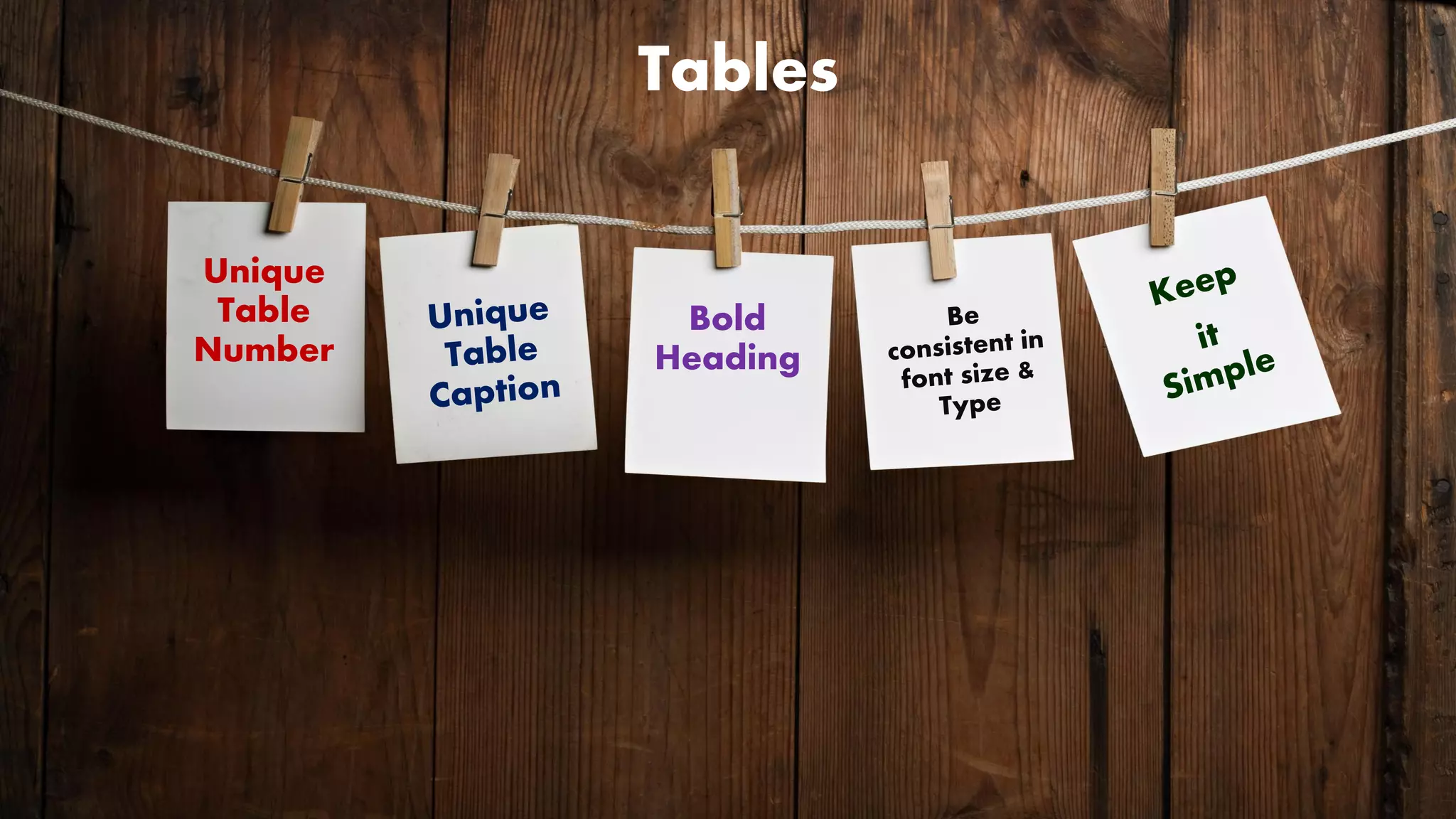
Unique
Table
Number
Bold
Heading
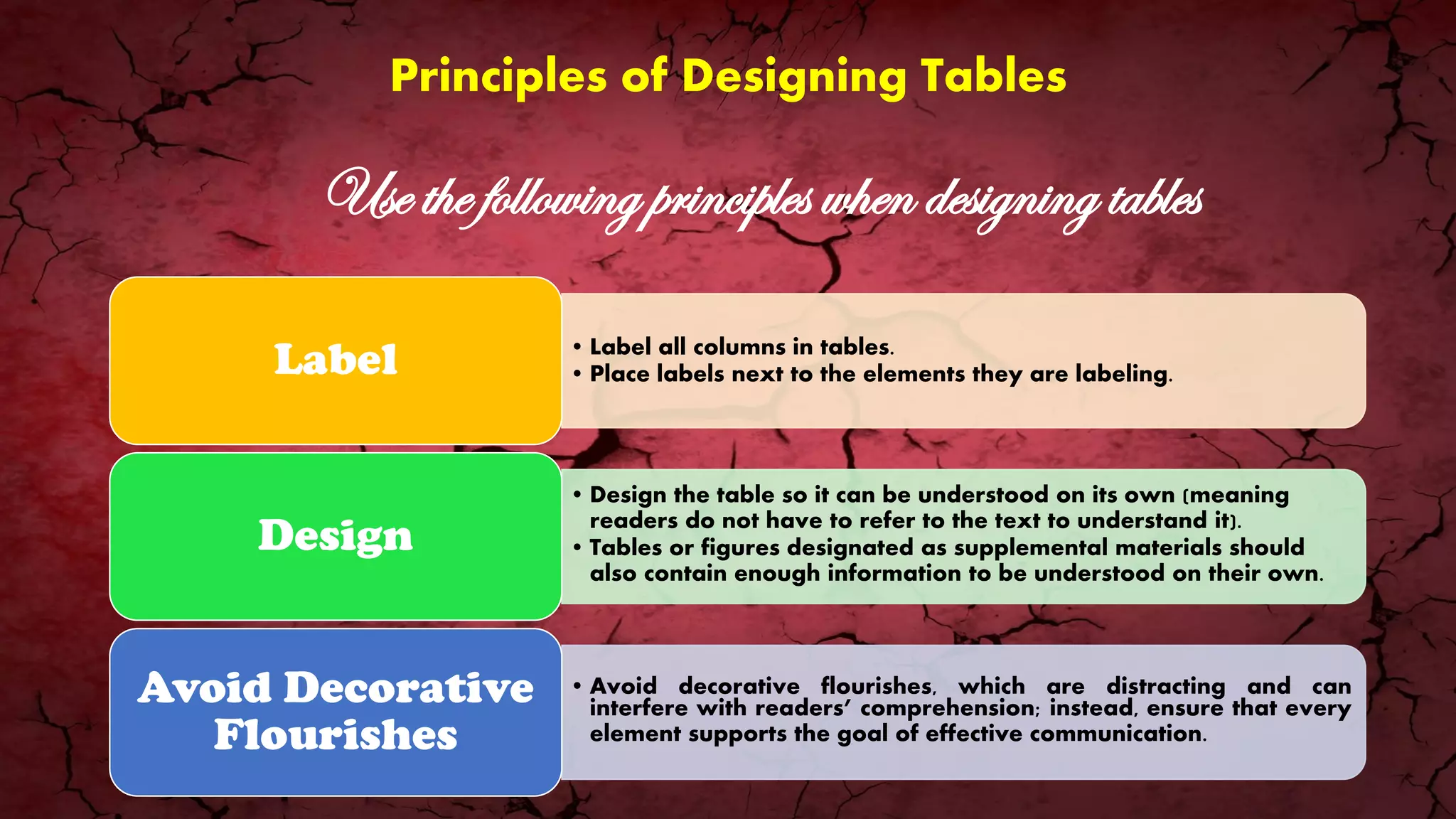
Principles of Designing Tables
• Label all columns in tables.
• Place labels next to the elements they are labeling.Label
• Design the table so it can be understood on its own (meaning
readers do not have to refer to the text to understand it).
• Tables or figures designated as supplemental materials should
also contain enough information to be understood on their own.
Design
• Avoid decorative flourishes, which are distracting and can
interfere with readers’ comprehension; instead, ensure that every
element supports the goal of effective communication.
Avoid Decorative
Flourishes
Use the following principles when designing tables
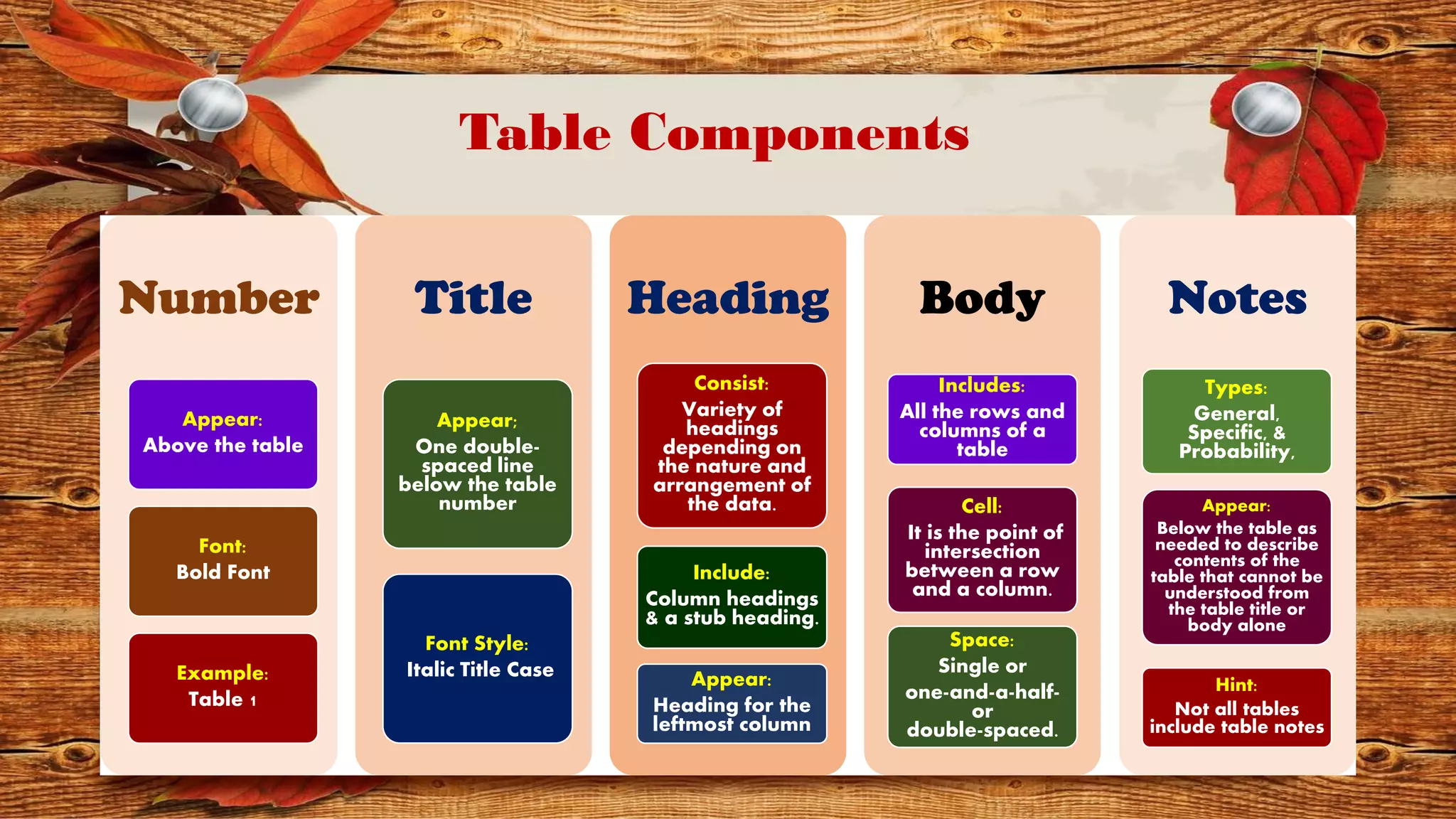
Table Components
Number
Appear:
Above the table
Font:
Bold Font
Example:
Table 1
Title
Appear;
One double-
spaced line
below the table
number
Font Style:
Italic Title Case
Heading
Consist:
Variety of
headings
depending on
the nature and
arrangement of
the data.
Include:
Column headings
& a stub heading.
Appear:
Heading for the
leftmost column
Body
Includes:
All the rows and
columns of a
table
Cell:
It is the point of
intersection
between a row
and a column.
Space:
Single or
one-and-a-half-
or
double-spaced.
Notes
Types:
General,
Specific, &
Probability,
Appear:
Below the table as
needed to describe
contents of the
table that cannot be
understood from
the table title or
body alone
Hint:
Not all tables
include table notes
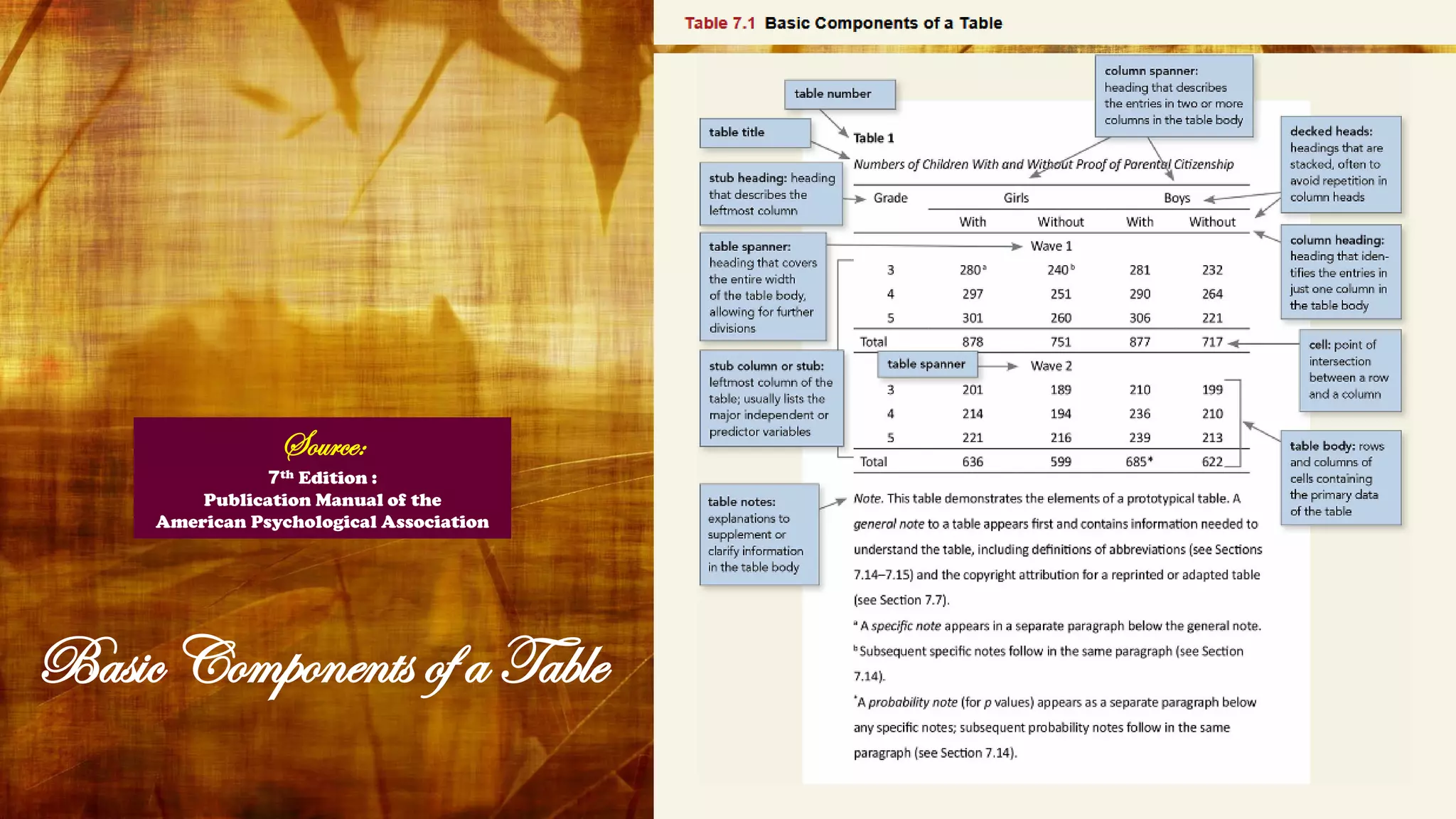
Basic Components of a Table
Source:
7th Edition :
Publication Manual of the
American Psychological Association
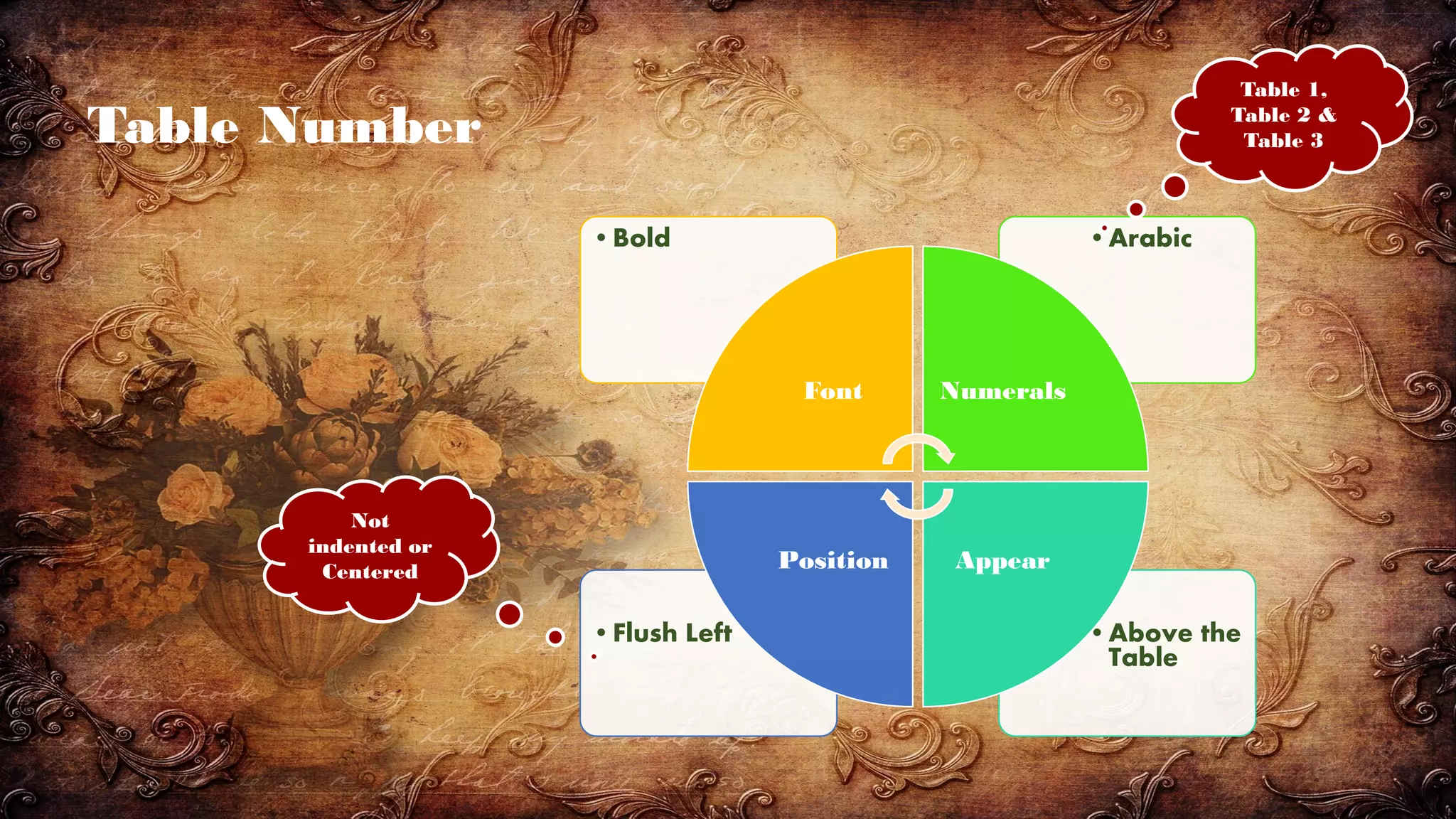
Table Number
•Above the
Table
•Flush Left
•Arabic•Bold
Font Numerals
AppearPosition
Table 1,
Table 2 &
Table 3
Not
indented or
Centered
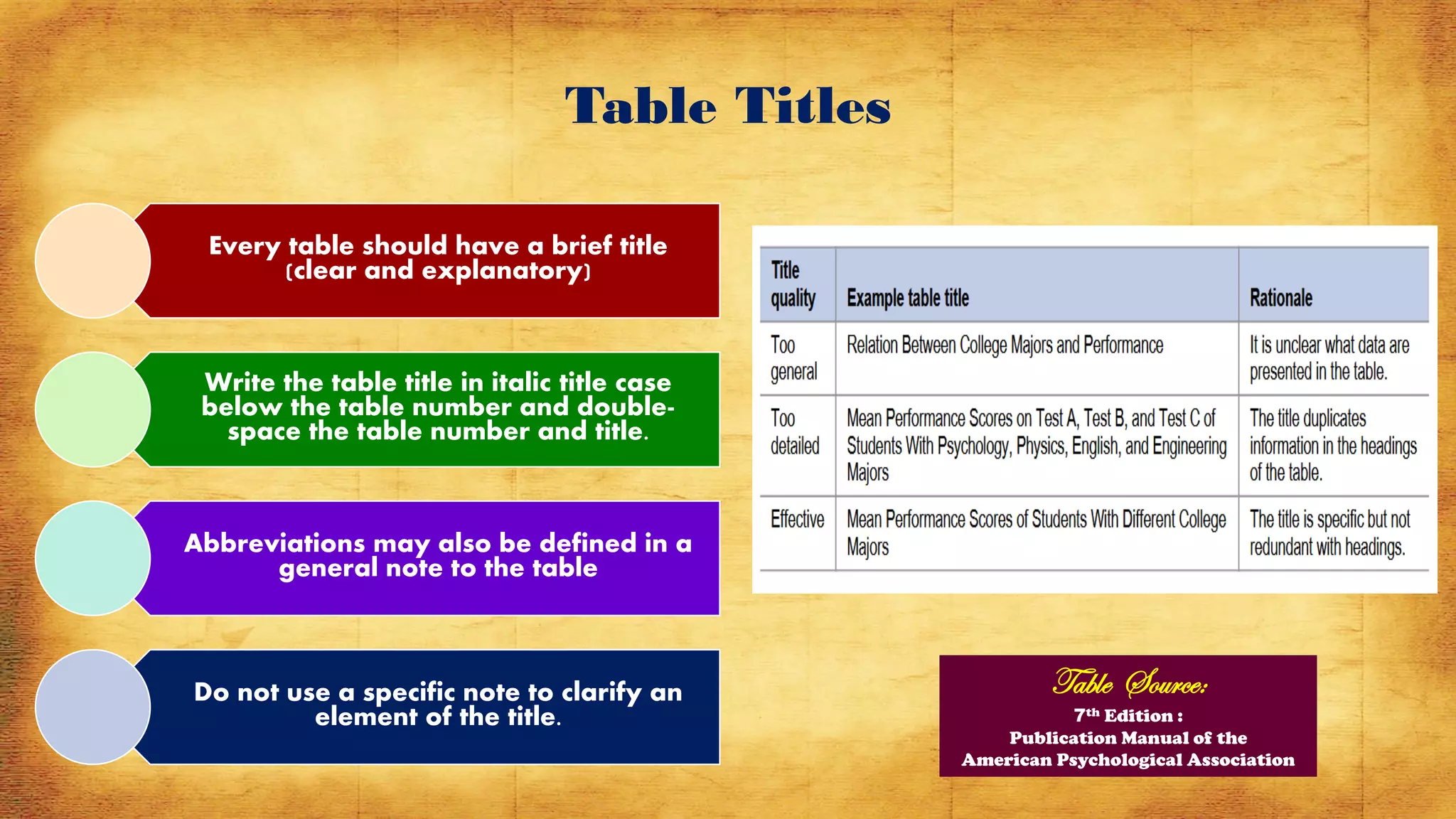
Table Titles
Every table should have a brief title
(clear and explanatory)
Write the table title in italic title case
below the table number and double-
space the table number and title.
Abbreviations may also be defined in a
general note to the table
Do not use a specific note to clarify an
element of the title.
Table Source:
7th Edition :
Publication Manual of the
American Psychological Association
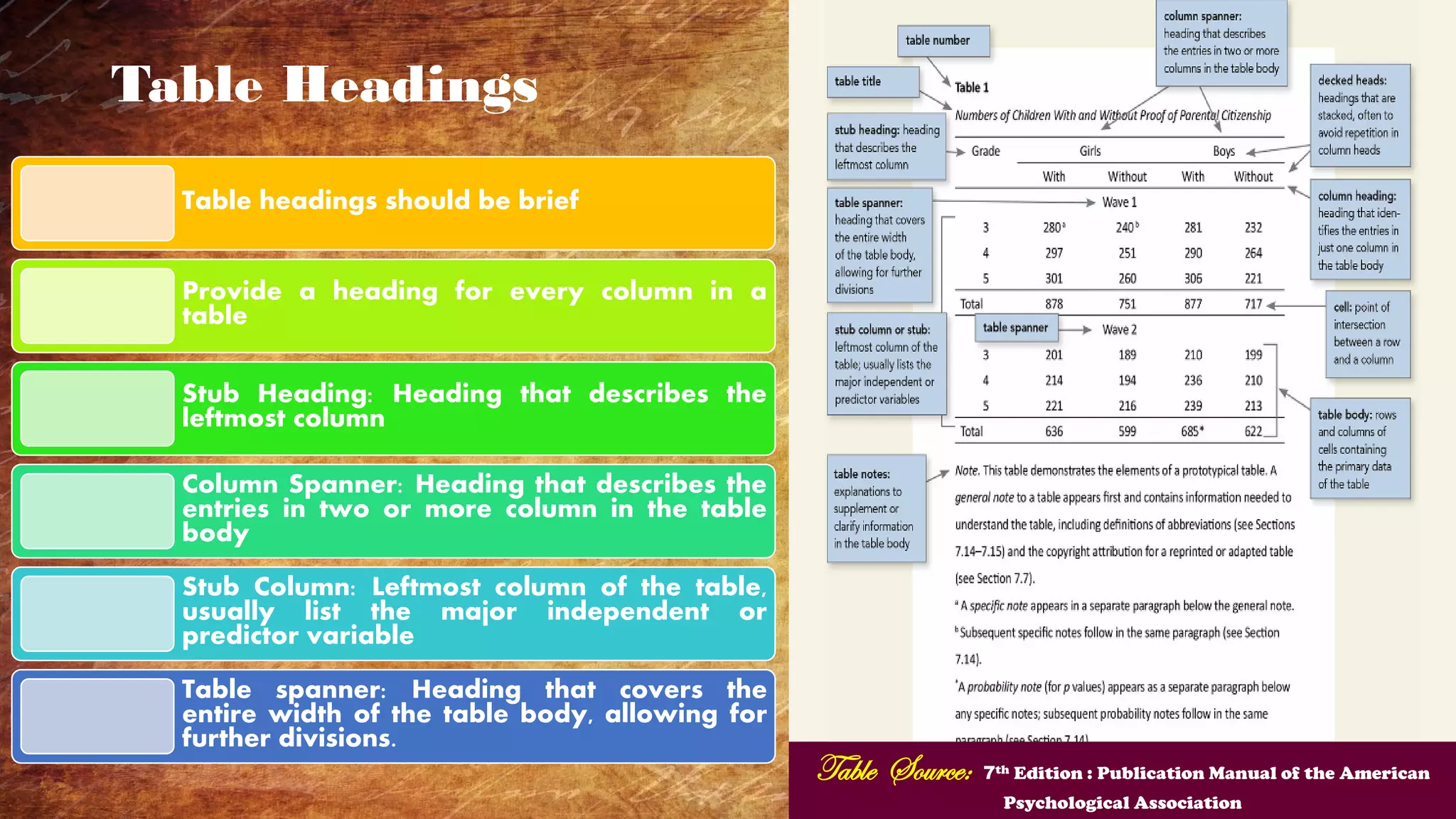
Table Headings
Table headings should be brief
Provide a heading for every column in a
table
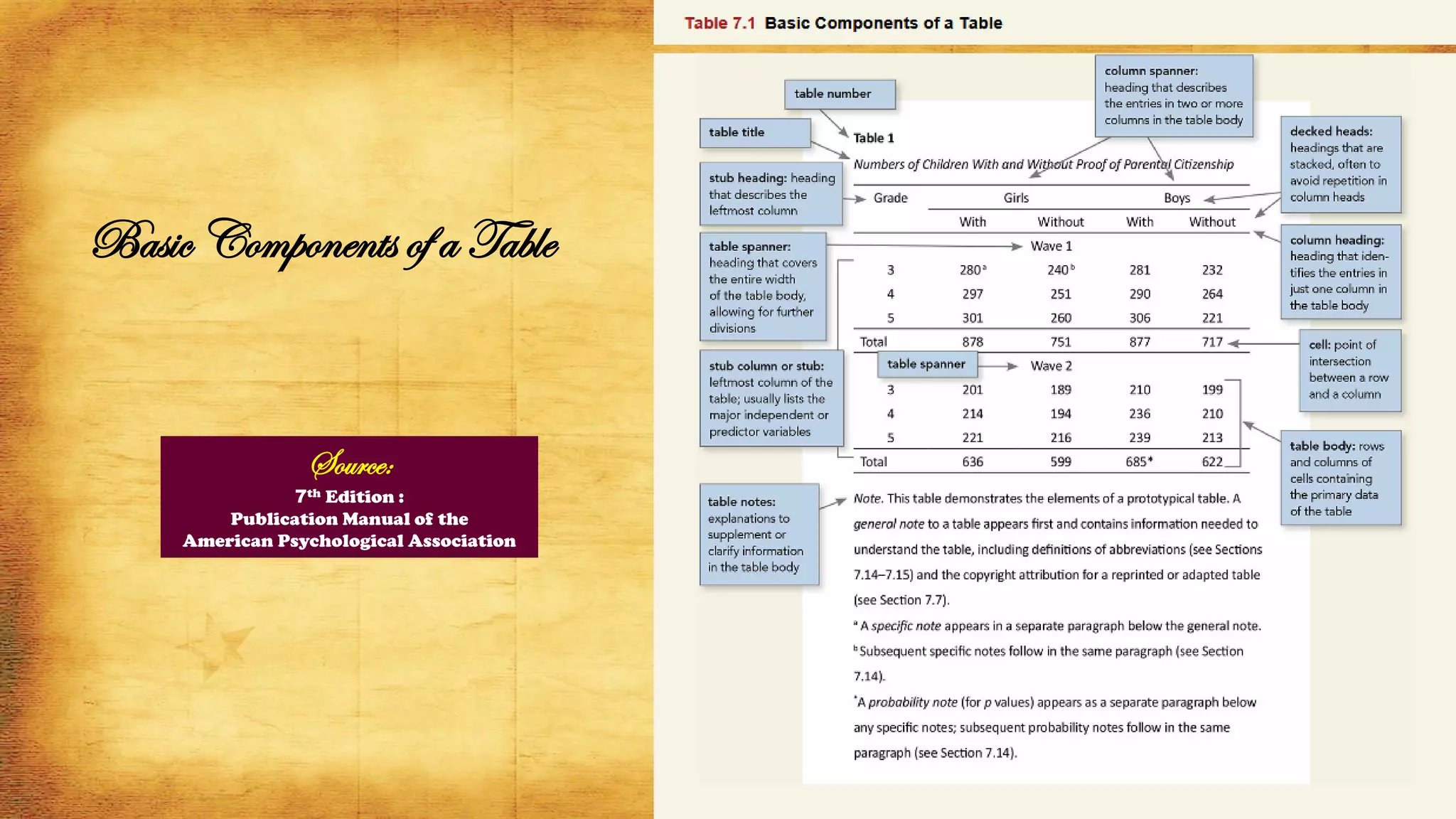
Stub Heading: Heading that describes the
leftmost column
Column Spanner: Heading that describes the
entries in two or more column in the table
body
Stub Column: Leftmost column of the table,
usually list the major independent or
predictor variable
Table spanner: Heading that covers the
entire width of the table body, allowing for
further divisions.
Table Source: 7th Edition : Publication Manual of the American
Psychological Association
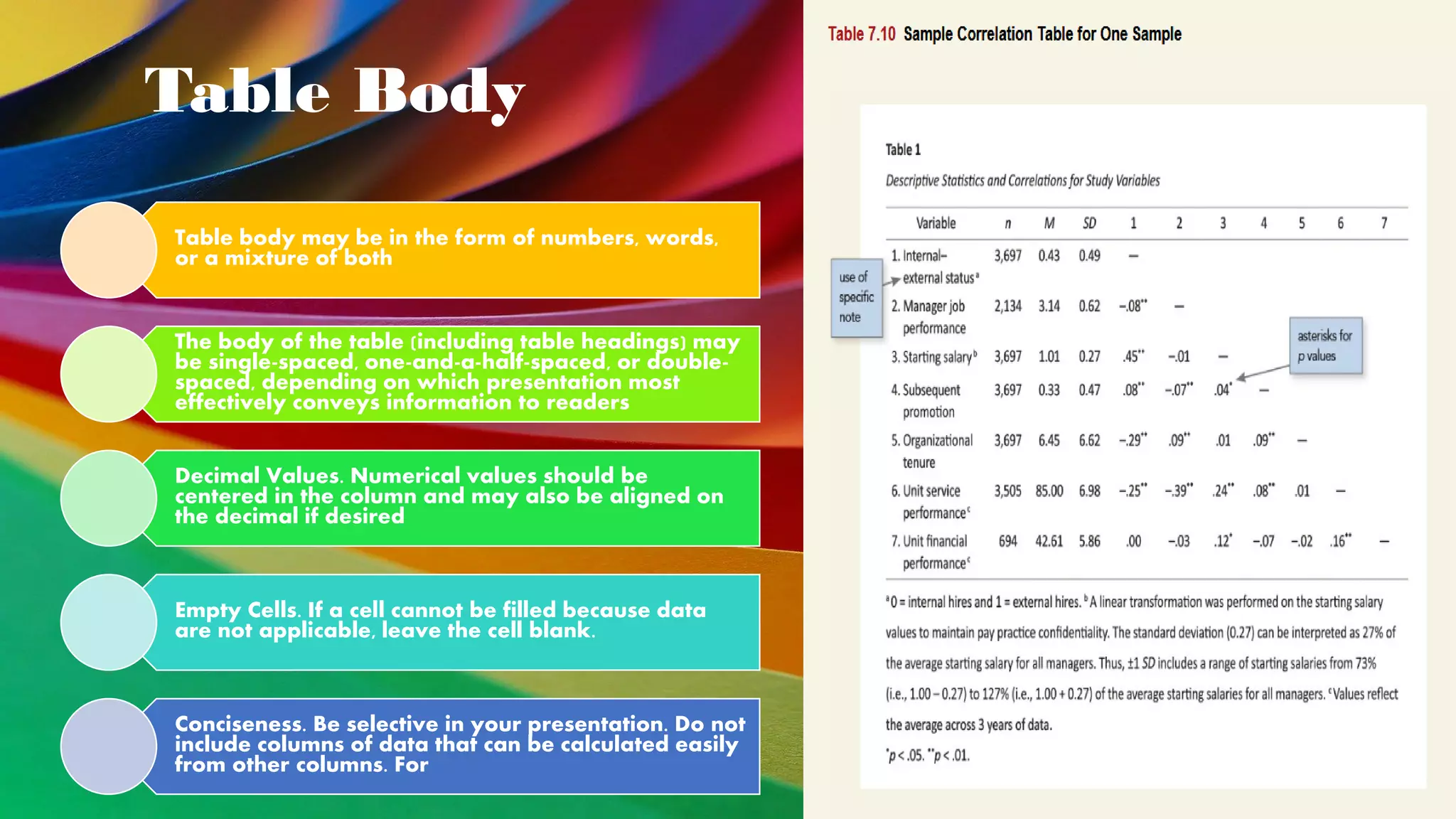
Table Body
Table body may be in the form of numbers, words,
or a mixture of both
The body of the table (including table headings) may
be single-spaced, one-and-a-half-spaced, or double-
spaced, depending on which presentation most
effectively conveys information to readers
Decimal Values. Numerical values should be
centered in the column and may also be aligned on
the decimal if desired
Empty Cells. If a cell cannot be filled because data
are not applicable, leave the cell blank.
Conciseness. Be selective in your presentation. Do not
include columns of data that can be calculated easily
from other columns. For
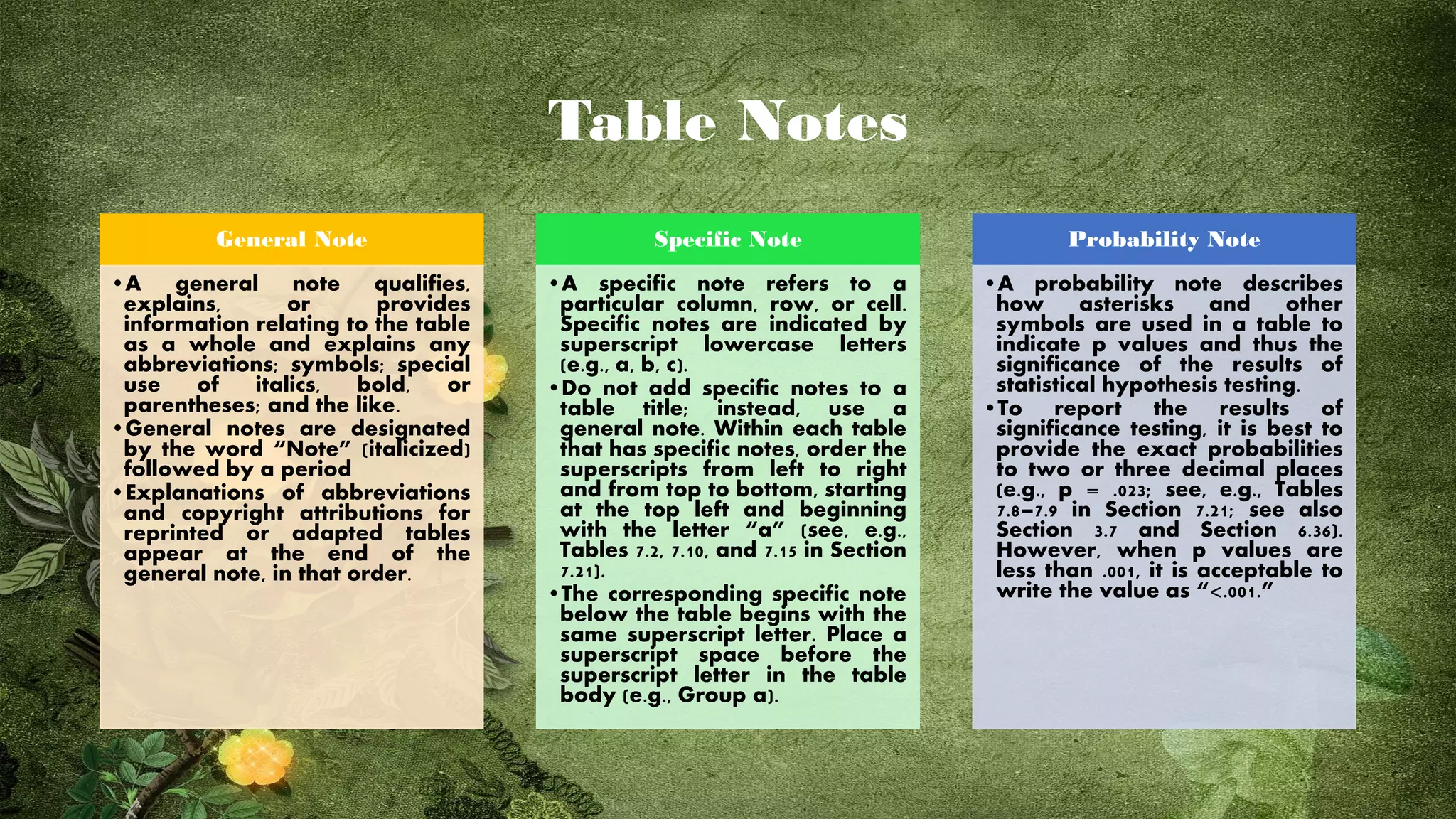
Table Notes
General Note
•A general note qualifies,
explains, or provides
information relating to the table
as a whole and explains any
abbreviations; symbols; special
use of italics, bold, or
parentheses; and the like.
•General notes are designated
by the word “Note” (italicized)
followed by a period
•Explanations of abbreviations
and copyright attributions for
reprinted or adapted tables
appear at the end of the
general note, in that order.
Specific Note
•A specific note refers to a
particular column, row, or cell.
Specific notes are indicated by
superscript lowercase letters
(e.g., a, b, c).
•Do not add specific notes to a
table title; instead, use a
general note. Within each table
that has specific notes, order the
superscripts from left to right
and from top to bottom, starting
at the top left and beginning
with the letter “a” (see, e.g.,
Tables 7.2, 7.10, and 7.15 in Section
7.21).
•The corresponding specific note
below the table begins with the
same superscript letter. Place a
superscript space before the
superscript letter in the table
body (e.g., Group a).
Probability Note
•A probability note describes
how asterisks and other
symbols are used in a table to
indicate p values and thus the
significance of the results of
statistical hypothesis testing.
•To report the results of
significance testing, it is best to
provide the exact probabilities
to two or three decimal places
(e.g., p = .023; see, e.g., Tables
7.8–7.9 in Section 7.21; see also
Section 3.7 and Section 6.36).
However, when p values are
less than .001, it is acceptable to
write the value as “<.001.”
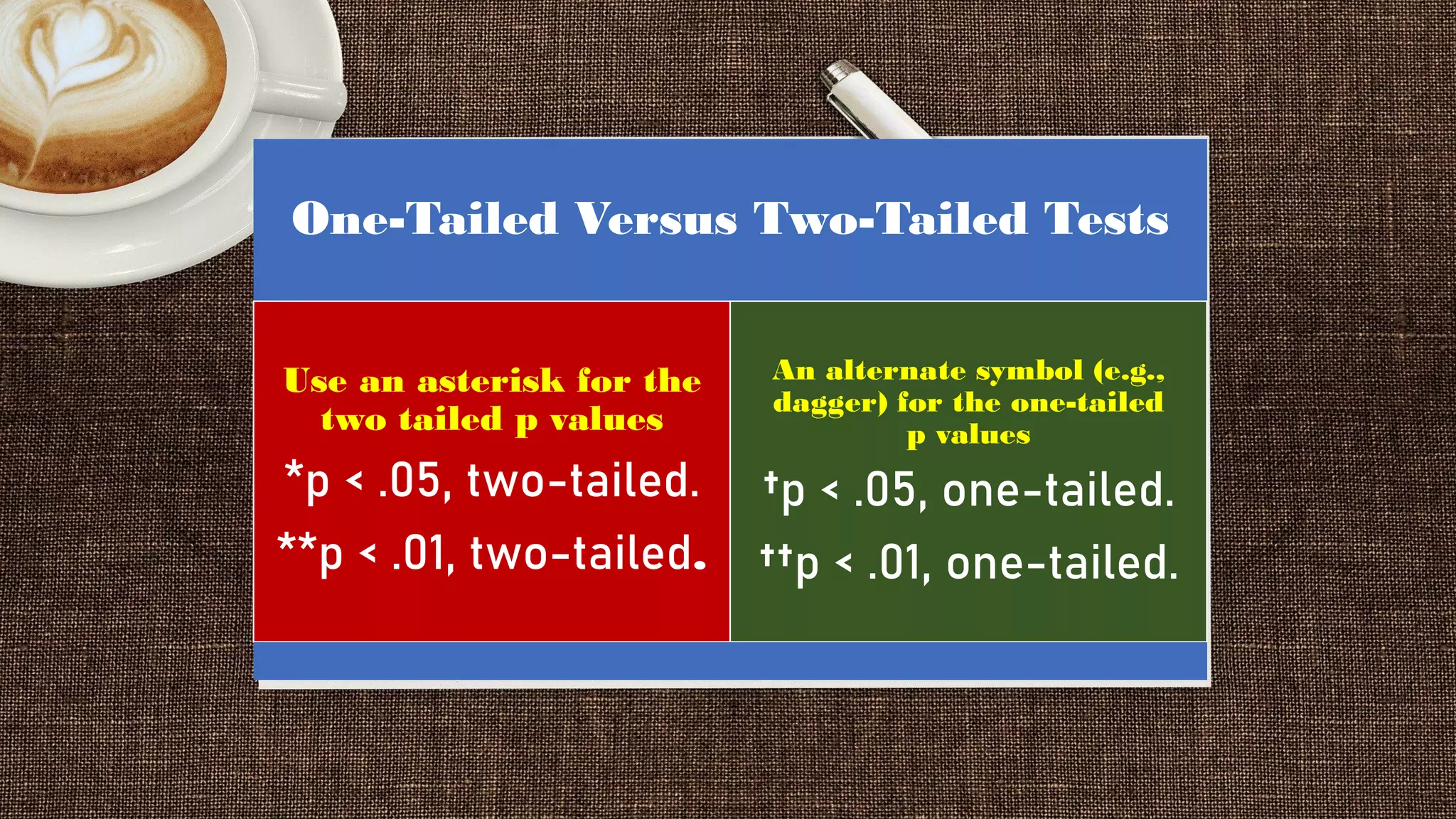
One-Tailed Versus Two-Tailed Tests
Use an asterisk for the
two tailed p values
*p < .05, two-tailed.
**p < .01, two-tailed.
An alternate symbol (e.g.,
dagger) for the one-tailed
p values
†p < .05, one-tailed.
††p < .01, one-tailed.
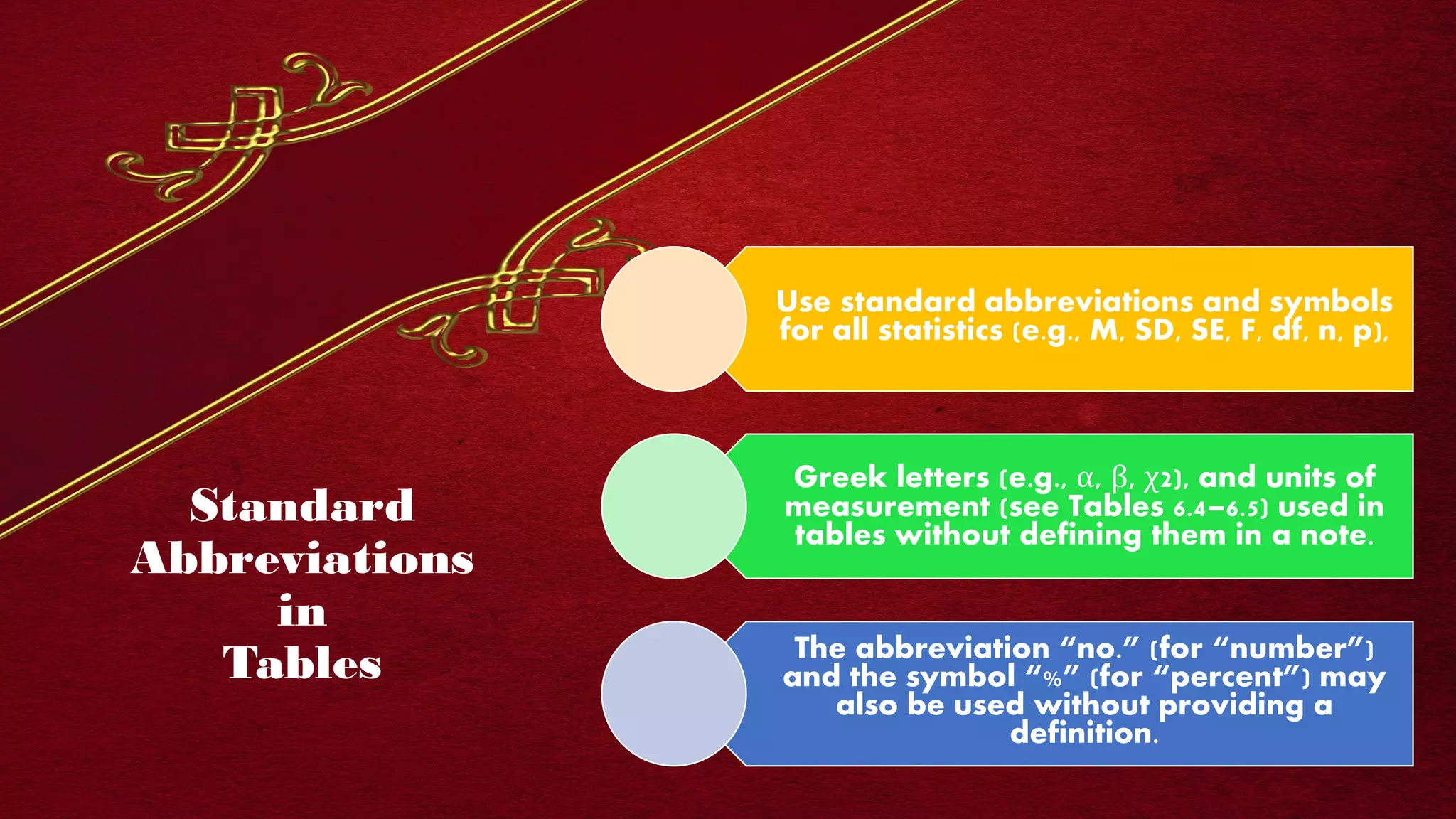
Standard
Abbreviations
in
Tables
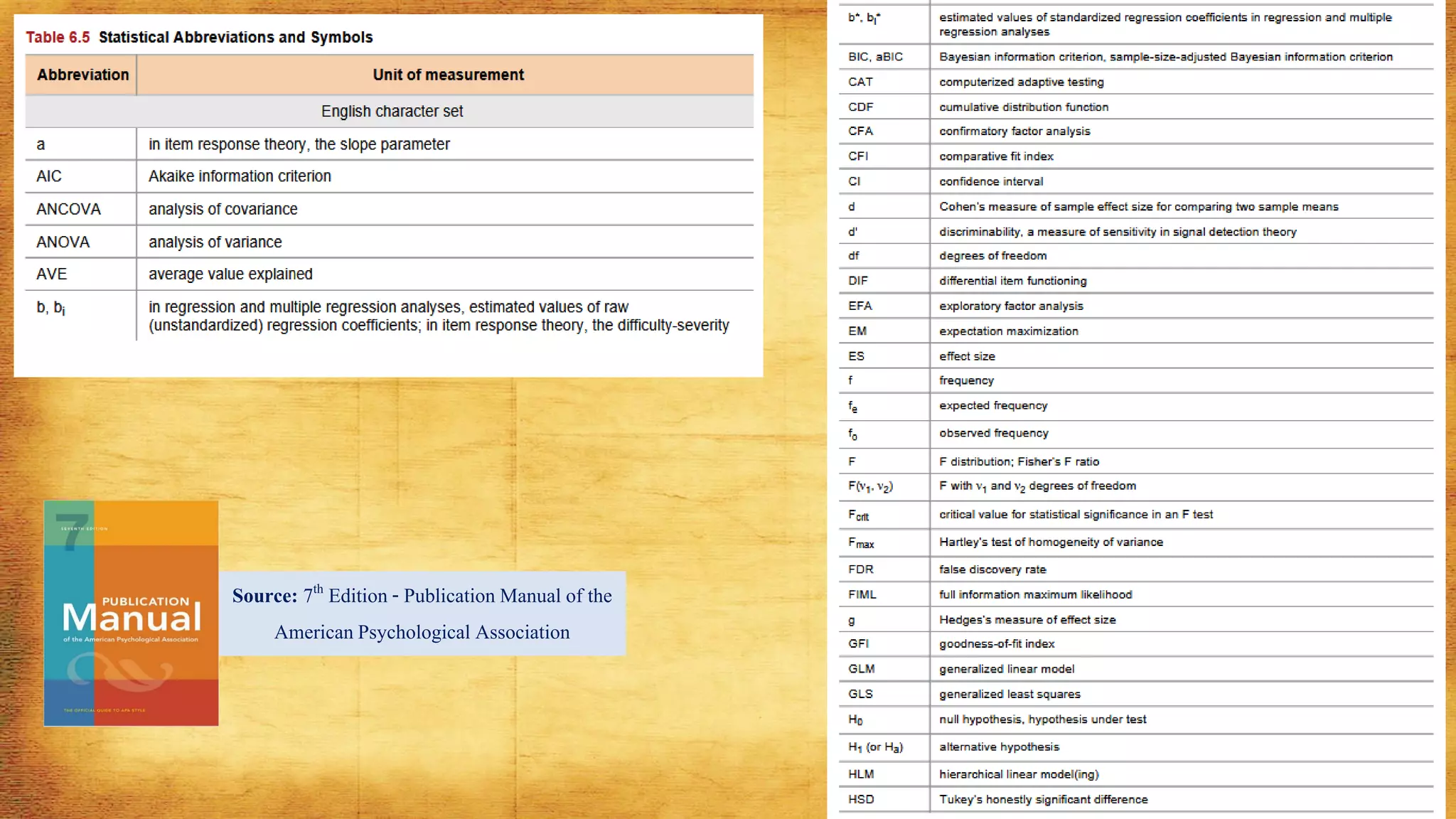
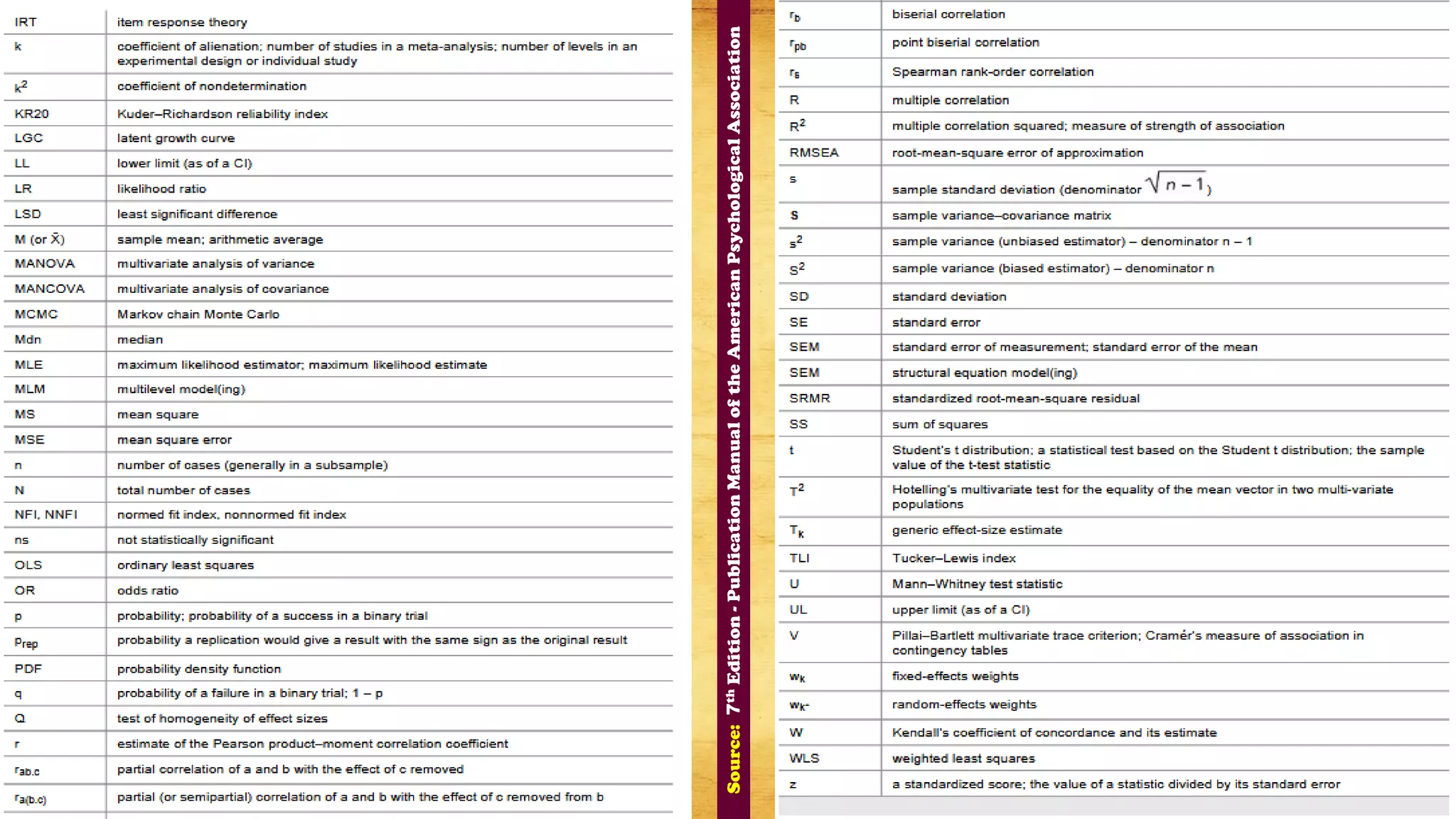
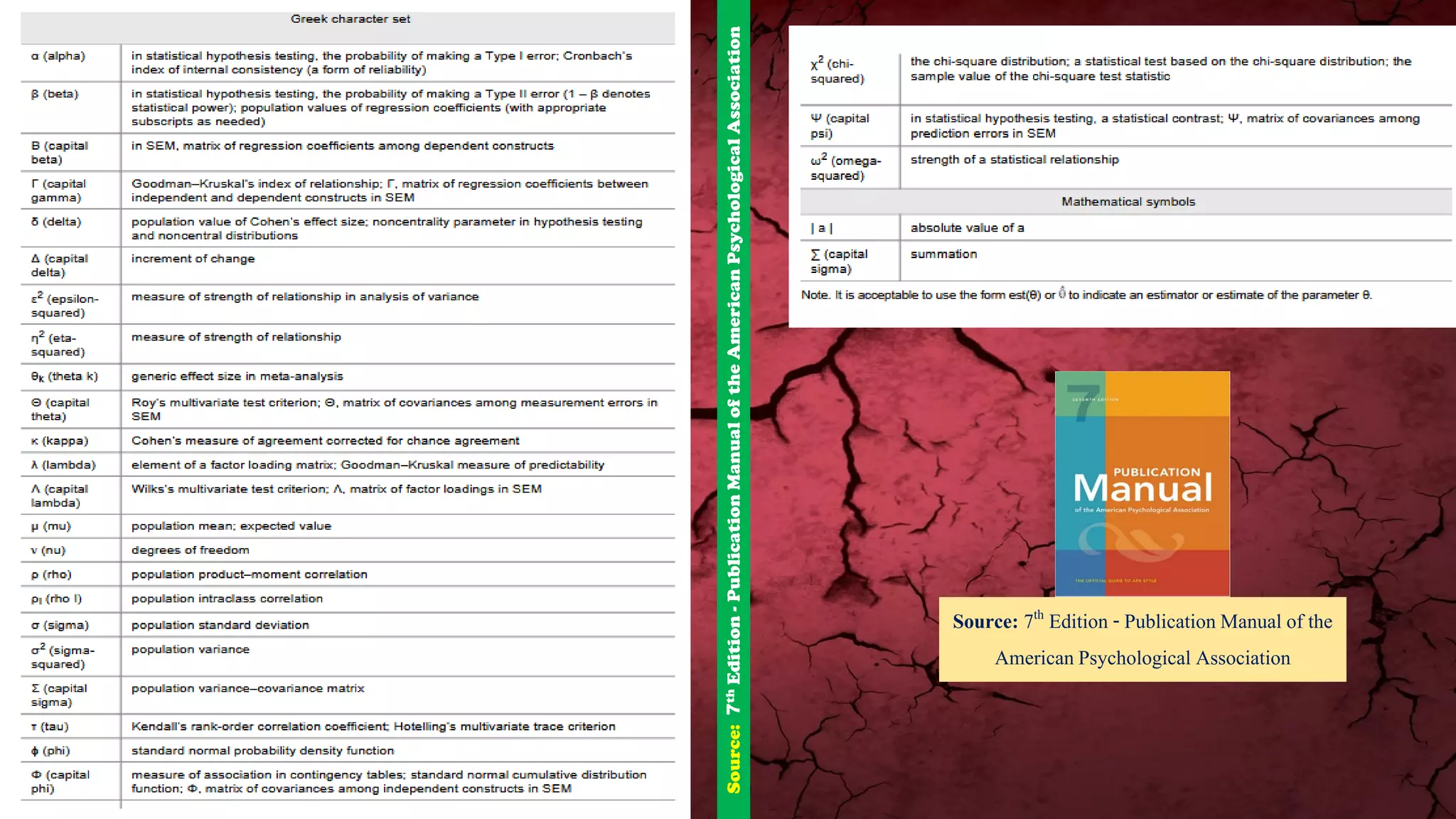
Use standard abbreviations and symbols
for all statistics (e.g., M, SD, SE, F, df, n, p),
Greek letters (e.g., α, β, χ2), and units of
measurement (see Tables 6.4–6.5) used in
tables without defining them in a note.
The abbreviation “no.” (for “number”)
and the symbol “%” (for “percent”) may
also be used without providing a
definition.
Source: 7th Edition- Publication Manual of the
AmericanPsychological Association
Source:7thEdition-PublicationManualoftheAmericanPsychologicalAssociation
Source: 7th Edition - PublicationManual of the
AmericanPsychological Association
Source:7thEdition-PublicationManualoftheAmericanPsychologicalAssociation
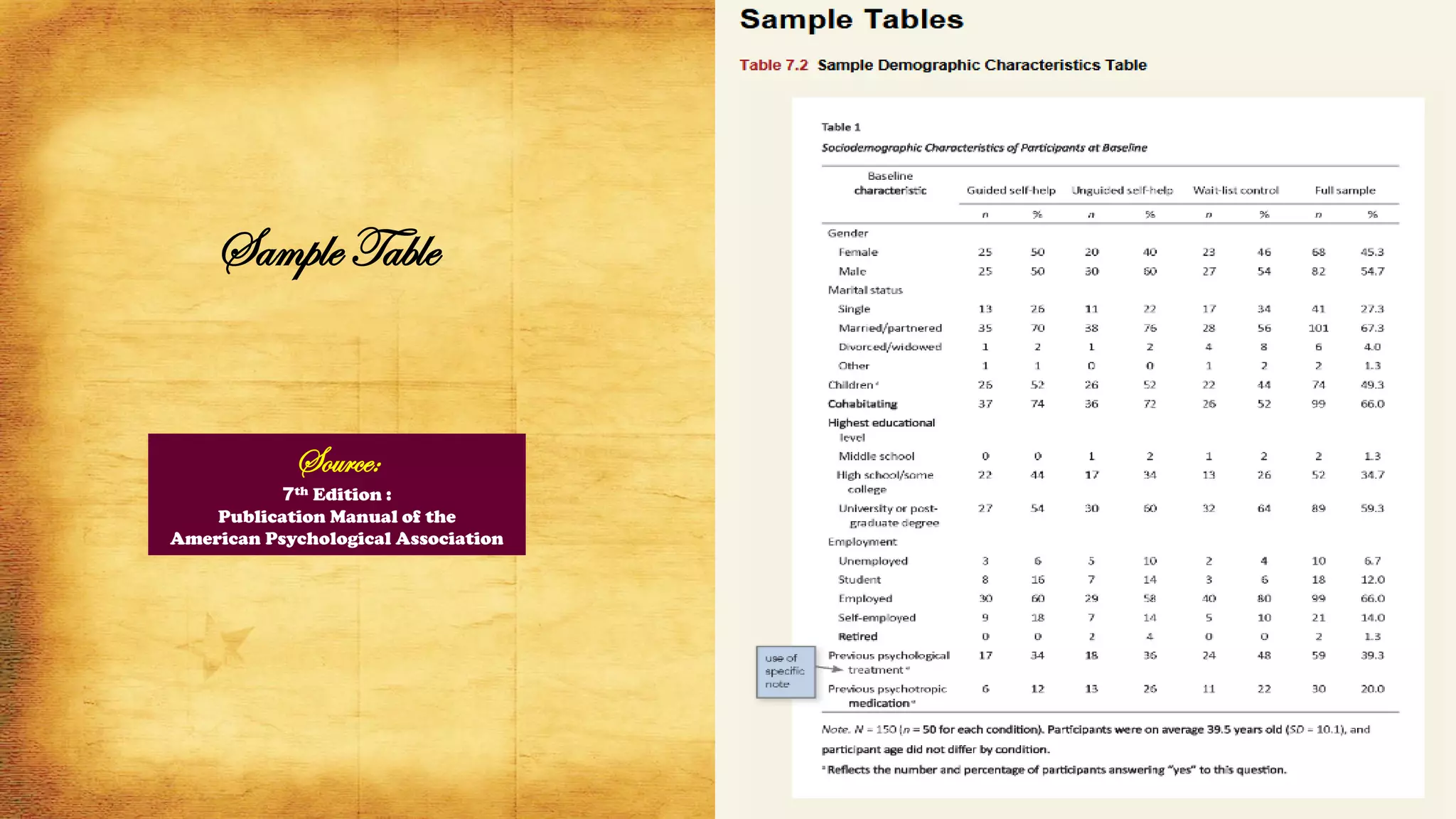
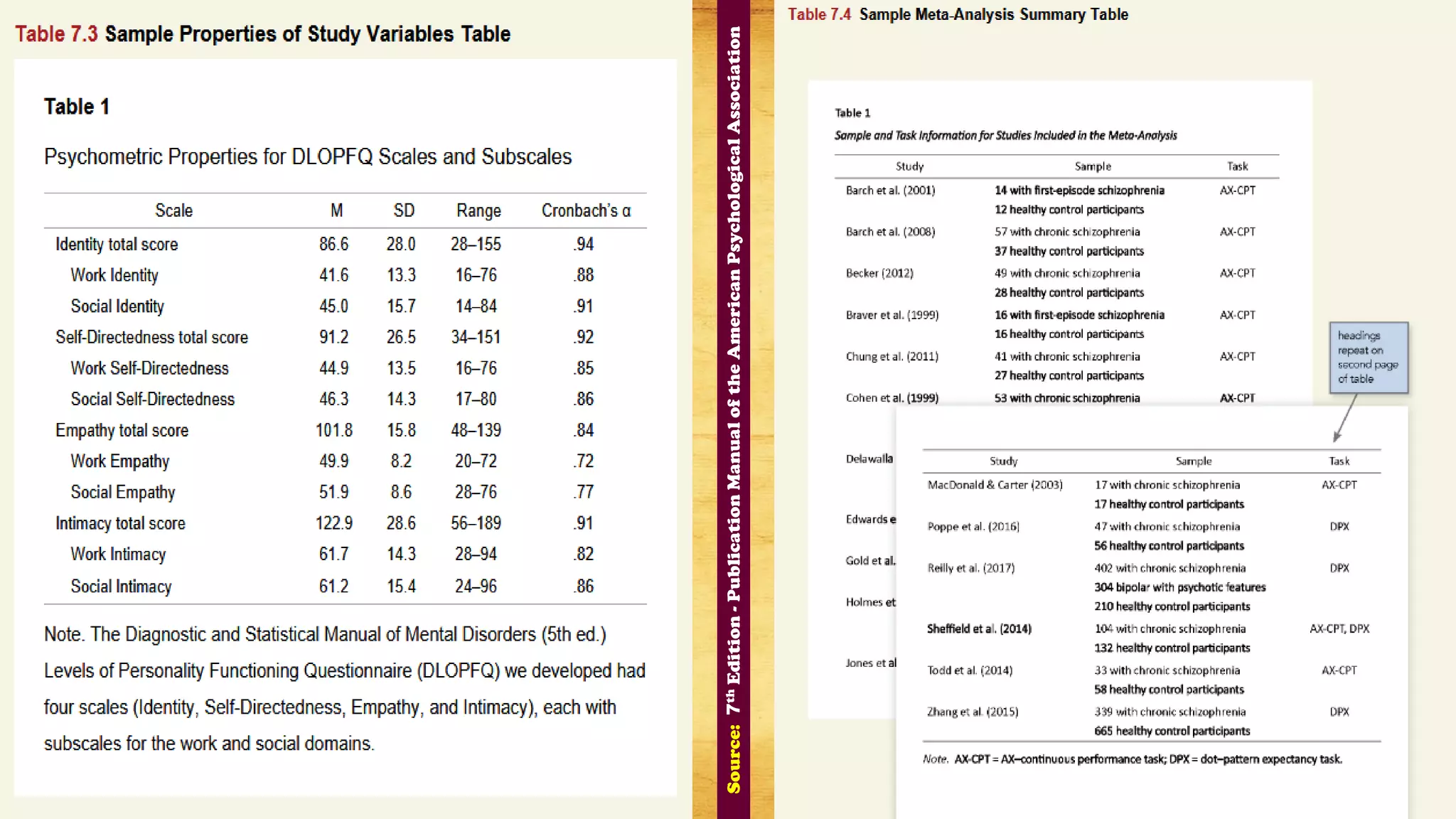
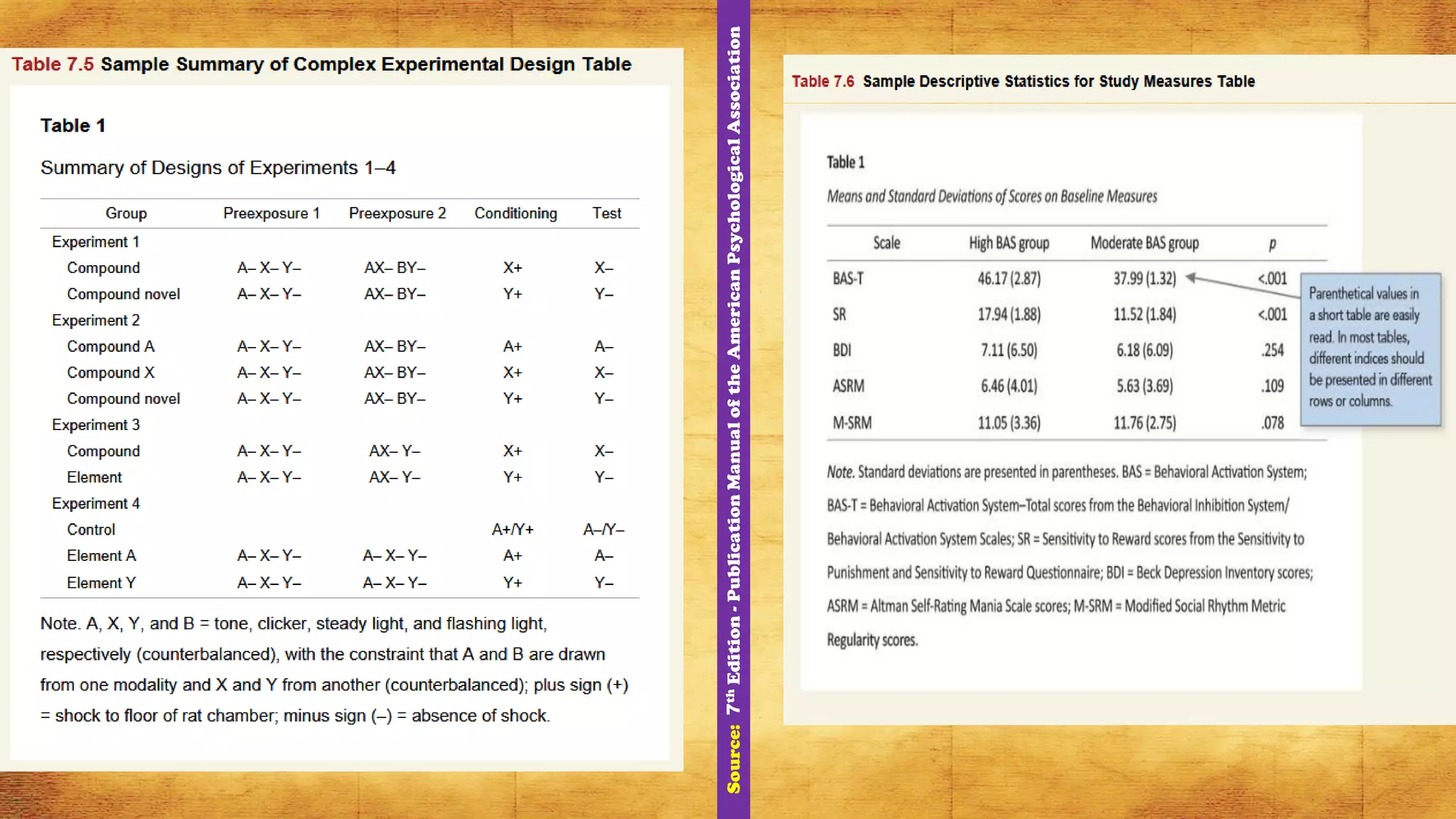
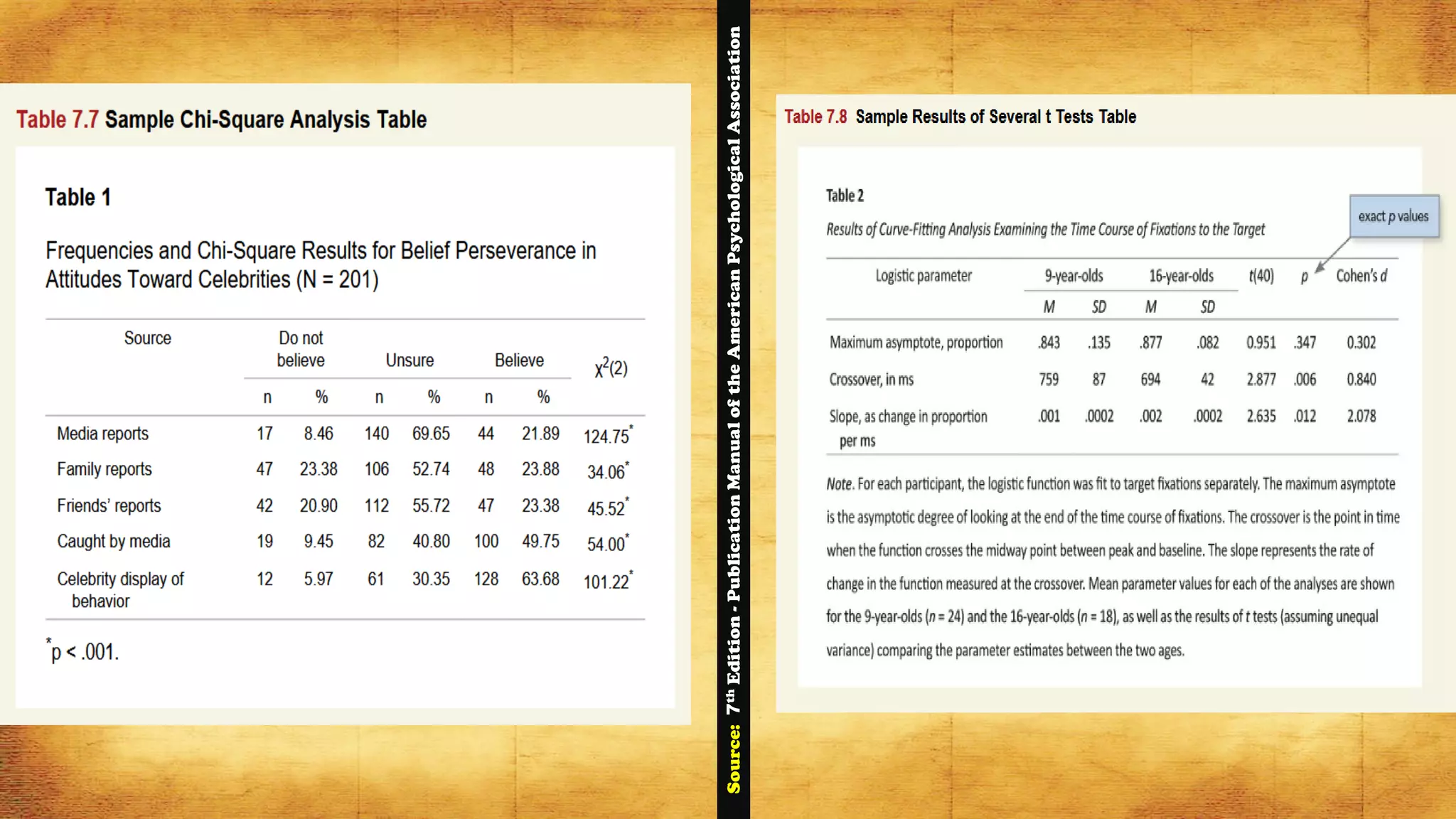
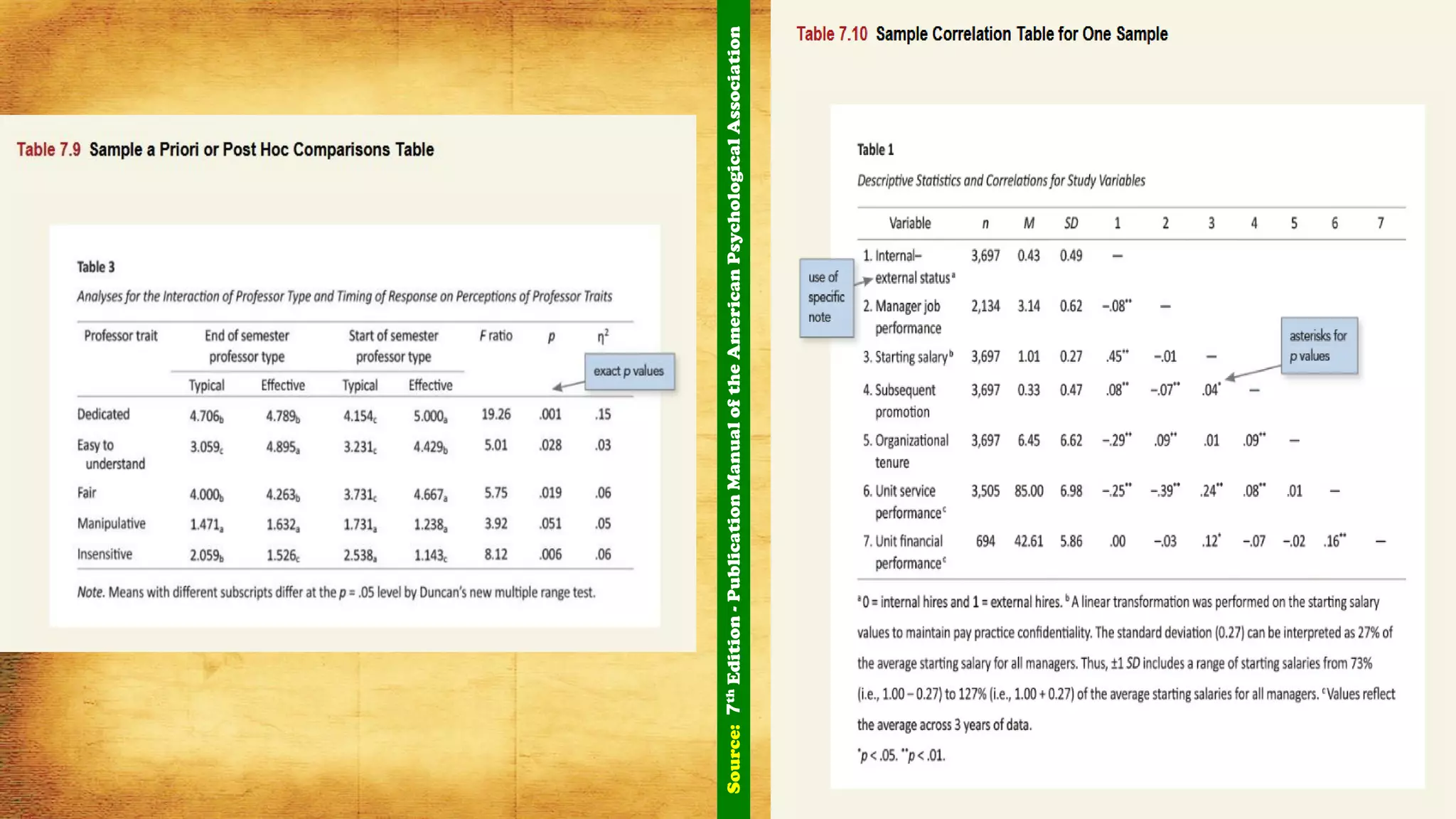
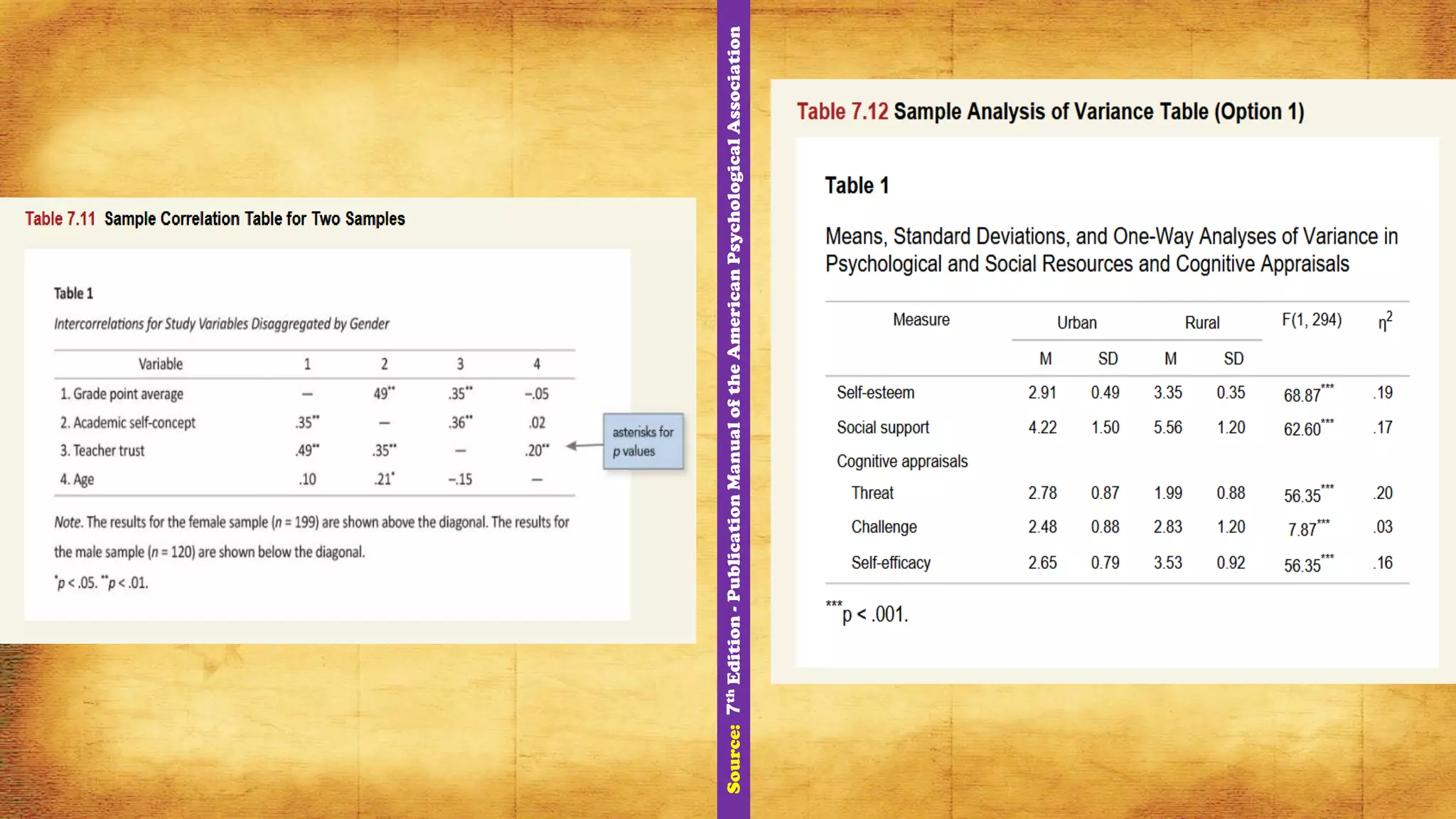
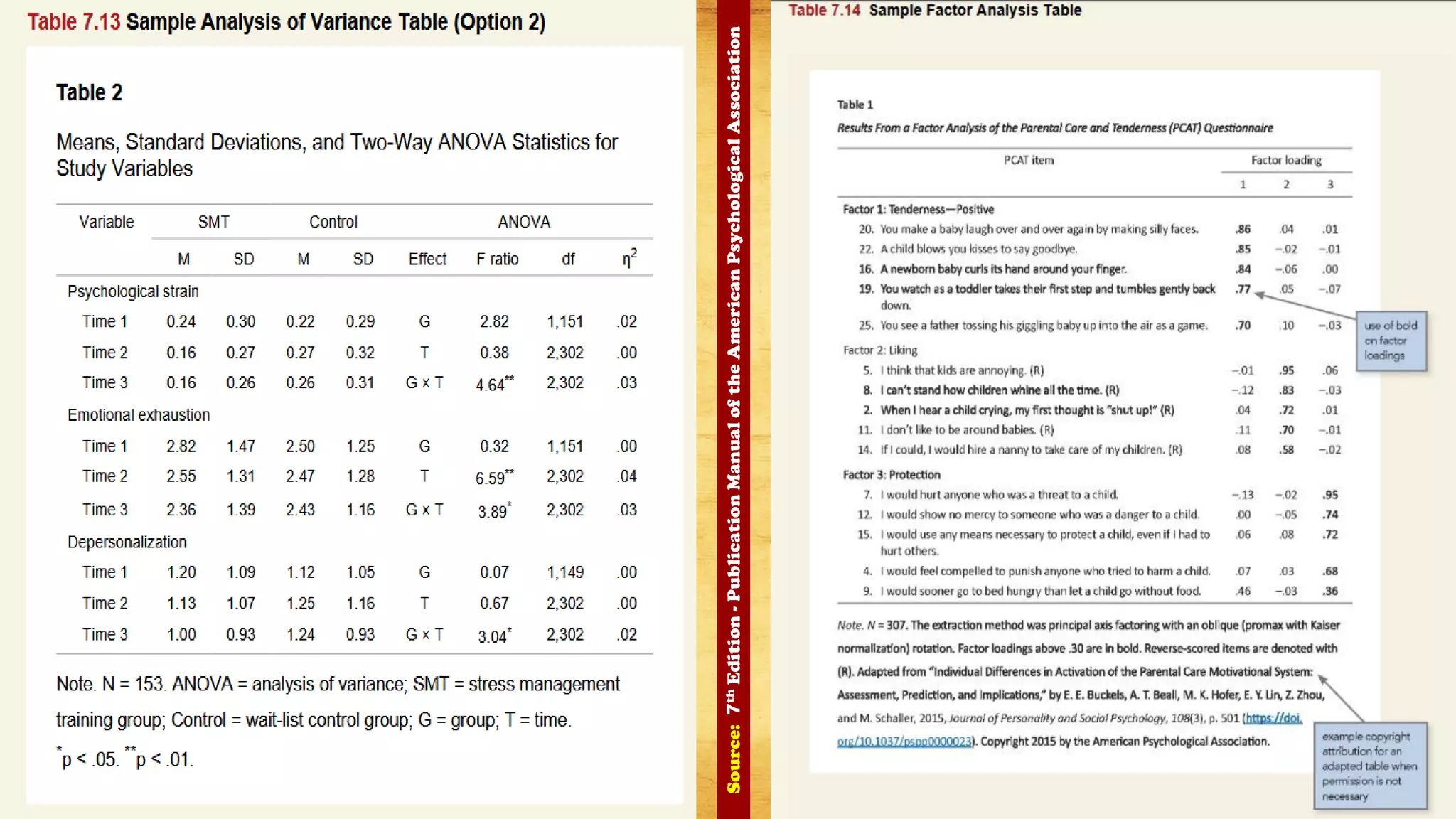
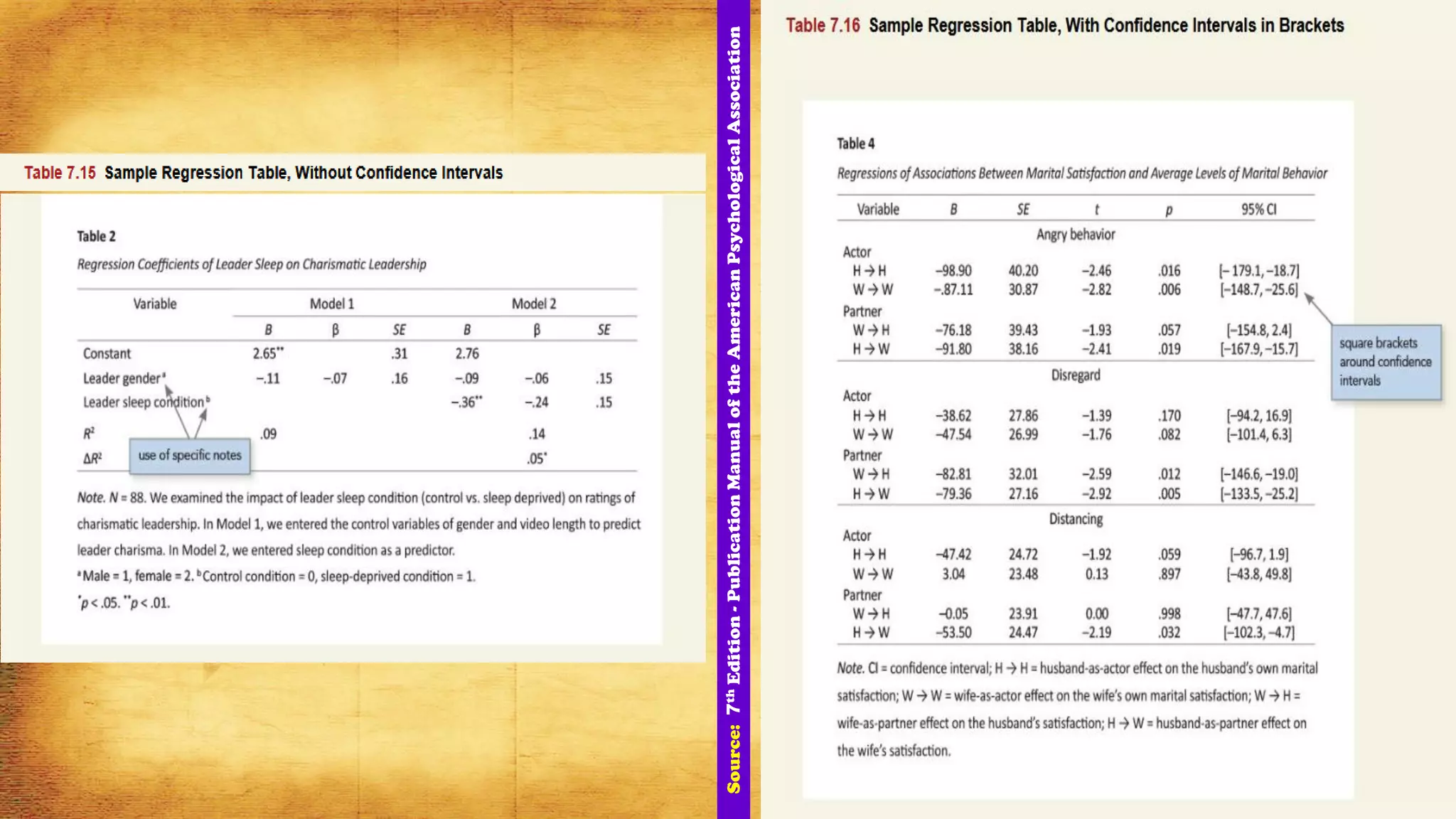
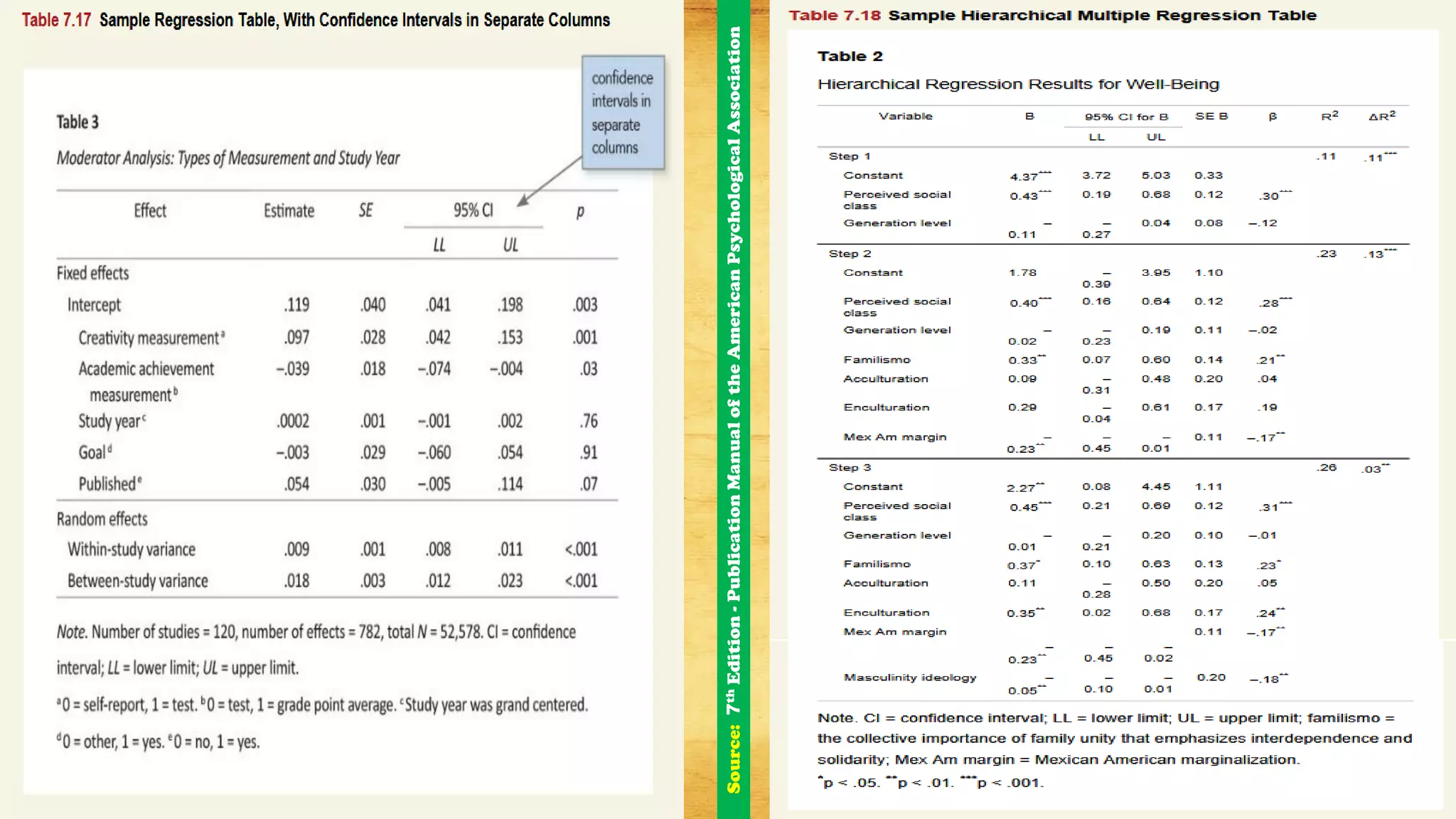
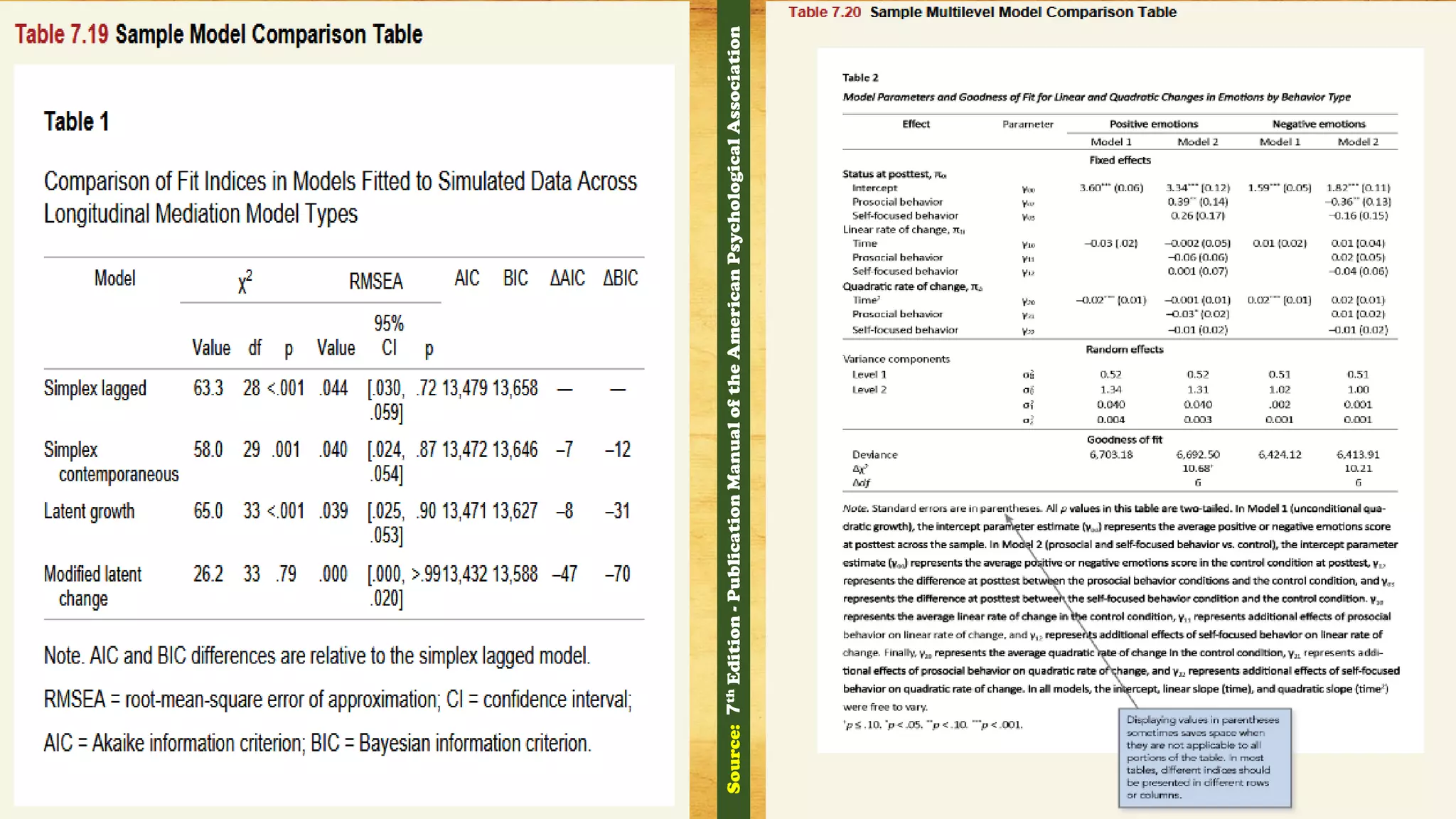
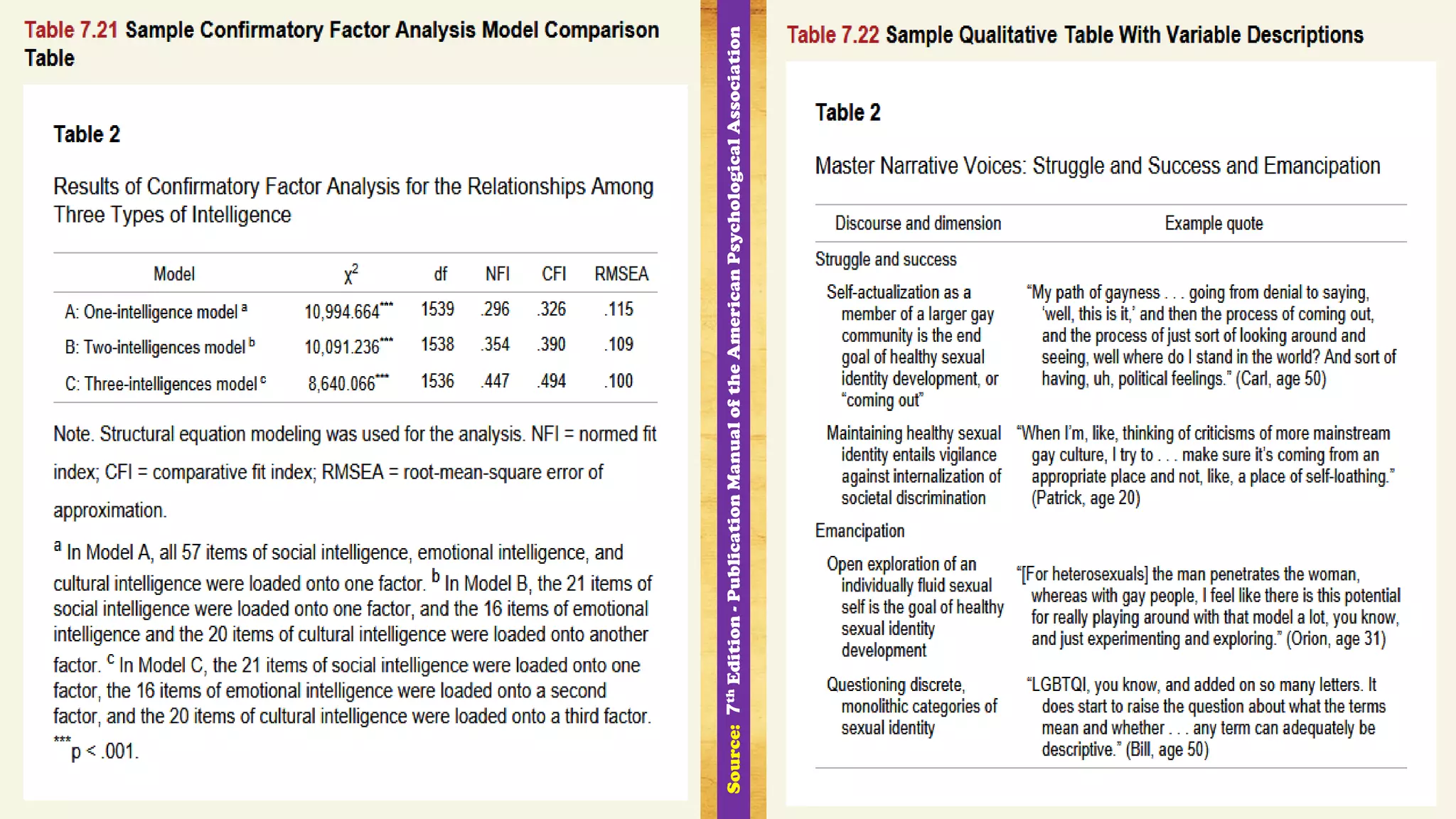
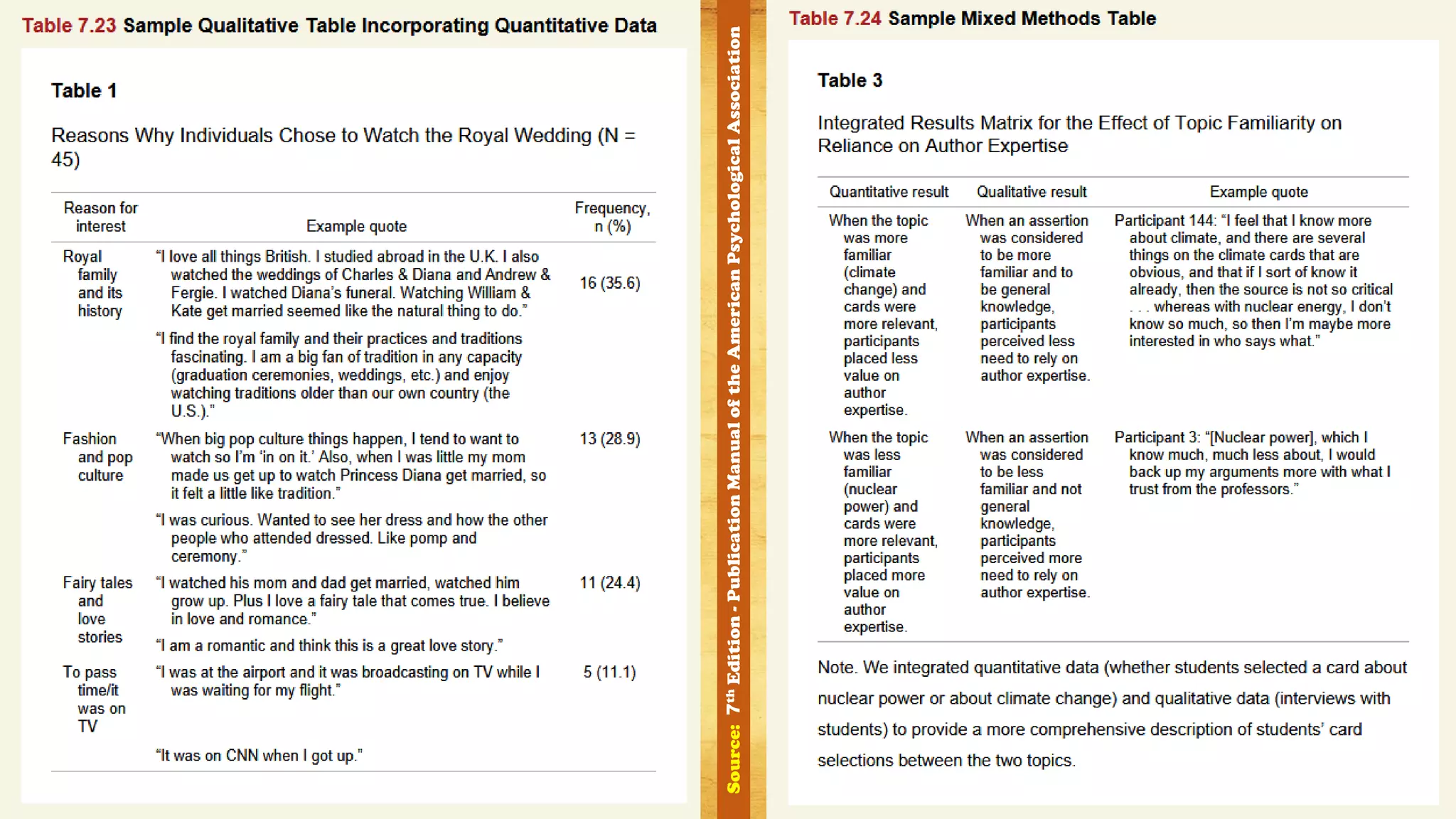
Sample Tables
Basic Components of a Table
Source:
7th Edition :
Publication Manual of the
American Psychological Association
Sample Table
Source:
7th Edition :
Publication Manual of the
American Psychological Association
Source:7thEdition-PublicationManualoftheAmericanPsychologicalAssociation
Thank You

Guidelines of Tables - APA Style - 7th Edition

  • 1.
    APA Style Guidelines forTables K.THIYAGU, Assistant Professor, Department of Education, Central University of Kerala, Kasaragod (Research Article / Dissertation / Thesis)
  • 2.
    The primary purposeof any table is to facilitate readers’ understanding of the work. Tables
  • 3.
  • 4.
    Principles of DesigningTables • Label all columns in tables. • Place labels next to the elements they are labeling.Label • Design the table so it can be understood on its own (meaning readers do not have to refer to the text to understand it). • Tables or figures designated as supplemental materials should also contain enough information to be understood on their own. Design • Avoid decorative flourishes, which are distracting and can interfere with readers’ comprehension; instead, ensure that every element supports the goal of effective communication. Avoid Decorative Flourishes Use the following principles when designing tables
  • 5.
    Table Components Number Appear: Above thetable Font: Bold Font Example: Table 1 Title Appear; One double- spaced line below the table number Font Style: Italic Title Case Heading Consist: Variety of headings depending on the nature and arrangement of the data. Include: Column headings & a stub heading. Appear: Heading for the leftmost column Body Includes: All the rows and columns of a table Cell: It is the point of intersection between a row and a column. Space: Single or one-and-a-half- or double-spaced. Notes Types: General, Specific, & Probability, Appear: Below the table as needed to describe contents of the table that cannot be understood from the table title or body alone Hint: Not all tables include table notes
  • 6.
    Basic Components ofa Table Source: 7th Edition : Publication Manual of the American Psychological Association
  • 7.
    Table Number •Above the Table •FlushLeft •Arabic•Bold Font Numerals AppearPosition Table 1, Table 2 & Table 3 Not indented or Centered
  • 8.
    Table Titles Every tableshould have a brief title (clear and explanatory) Write the table title in italic title case below the table number and double- space the table number and title. Abbreviations may also be defined in a general note to the table Do not use a specific note to clarify an element of the title. Table Source: 7th Edition : Publication Manual of the American Psychological Association
  • 9.
    Table Headings Table headingsshould be brief Provide a heading for every column in a table Stub Heading: Heading that describes the leftmost column Column Spanner: Heading that describes the entries in two or more column in the table body Stub Column: Leftmost column of the table, usually list the major independent or predictor variable Table spanner: Heading that covers the entire width of the table body, allowing for further divisions. Table Source: 7th Edition : Publication Manual of the American Psychological Association
  • 10.
    Table Body Table bodymay be in the form of numbers, words, or a mixture of both The body of the table (including table headings) may be single-spaced, one-and-a-half-spaced, or double- spaced, depending on which presentation most effectively conveys information to readers Decimal Values. Numerical values should be centered in the column and may also be aligned on the decimal if desired Empty Cells. If a cell cannot be filled because data are not applicable, leave the cell blank. Conciseness. Be selective in your presentation. Do not include columns of data that can be calculated easily from other columns. For
  • 11.
    Table Notes General Note •Ageneral note qualifies, explains, or provides information relating to the table as a whole and explains any abbreviations; symbols; special use of italics, bold, or parentheses; and the like. •General notes are designated by the word “Note” (italicized) followed by a period •Explanations of abbreviations and copyright attributions for reprinted or adapted tables appear at the end of the general note, in that order. Specific Note •A specific note refers to a particular column, row, or cell. Specific notes are indicated by superscript lowercase letters (e.g., a, b, c). •Do not add specific notes to a table title; instead, use a general note. Within each table that has specific notes, order the superscripts from left to right and from top to bottom, starting at the top left and beginning with the letter “a” (see, e.g., Tables 7.2, 7.10, and 7.15 in Section 7.21). •The corresponding specific note below the table begins with the same superscript letter. Place a superscript space before the superscript letter in the table body (e.g., Group a). Probability Note •A probability note describes how asterisks and other symbols are used in a table to indicate p values and thus the significance of the results of statistical hypothesis testing. •To report the results of significance testing, it is best to provide the exact probabilities to two or three decimal places (e.g., p = .023; see, e.g., Tables 7.8–7.9 in Section 7.21; see also Section 3.7 and Section 6.36). However, when p values are less than .001, it is acceptable to write the value as “<.001.”
  • 12.
    One-Tailed Versus Two-TailedTests Use an asterisk for the two tailed p values *p < .05, two-tailed. **p < .01, two-tailed. An alternate symbol (e.g., dagger) for the one-tailed p values †p < .05, one-tailed. ††p < .01, one-tailed.
  • 13.
    Standard Abbreviations in Tables Use standard abbreviationsand symbols for all statistics (e.g., M, SD, SE, F, df, n, p), Greek letters (e.g., α, β, χ2), and units of measurement (see Tables 6.4–6.5) used in tables without defining them in a note. The abbreviation “no.” (for “number”) and the symbol “%” (for “percent”) may also be used without providing a definition.
  • 14.
    Source: 7th Edition-Publication Manual of the AmericanPsychological Association
  • 15.
  • 16.
    Source: 7th Edition- PublicationManual of the AmericanPsychological Association Source:7thEdition-PublicationManualoftheAmericanPsychologicalAssociation
  • 17.
  • 18.
    Basic Components ofa Table Source: 7th Edition : Publication Manual of the American Psychological Association
  • 19.
    Sample Table Source: 7th Edition: Publication Manual of the American Psychological Association
  • 20.
  • 21.
  • 22.
  • 23.
  • 24.
  • 25.
  • 26.
  • 27.
  • 28.
  • 29.
  • 30.
  • 31.